
Mapping the Landscape of Degree Apprenticeship: Expanding a Promising Model for Mobility
Abstract
This report surveys the landscape of degree apprenticeship, an emerging model of career preparation that integrates Registered Apprenticeship with an associate, bachelor’s, or master’s degree. We identify the occupations that are the focus of degree apprenticeships, the degrees they award, and the state and characteristics of the higher education institutions that offer them. We highlight five aspirational quality principles for the effective implementation of degree apprenticeships and describe exemplary programs that are putting the principles into action. We conclude by assessing opportunities for degree apprenticeship to grow and discuss barriers to replication of the model and how they might be overcome.
Acknowledgments
We would like to thank the Strada Education Foundation for its generous support of this research. We appreciate the guidance and support of our colleagues, Taylor White and Iris Palmer. Sabrina Detlef’s editorial comments made our work clearer and stronger, and we thank the New America Education Policy program communications team of Katherine Portnoy, Mandy Dean, Natalya Brill, and Taylor Murray for their production and dissemination support. The findings and conclusions contained within this report are those of the authors and do not necessarily reflect positions or policies of the foundation.
We would also like to thank the 12 members of the advisory committee who developed the quality principles for degree apprenticeship programs:
- Nicole Kendall Arrighi, Assistant Dean, Educator Preparation, Education Practice and Leadership, Tennessee State University
- Anthony Caison, Former Vice President of Workforce Continuing Education, Wake Technical Community College
- Andrew Cortés, Founder, President, and CEO, Building Futures | Apprenticeship Rhode Island
- Eric Dunker, Chief Engagement and Advancement Officer, Reach University
- Juanita Glanton, Medical Assistant Apprentice, Arapahoe Community College
- Steve Jurch, Associate Vice President, Center for Policy and Practice, Association of Community College Trustees
- Casey Kilpatrick, Director of Learning Services, Colorado Education Association
- Deborah Kobes, Senior Fellow, Apprenticeships and Labor Markets, Urban Institute
- Tyler Sturdivant, Associate Dean of Nursing, Coastal Alabama Community College
- Jason Trotter, Head of Talent Acquisition & Apprenticeship Program, Aon
- Darice Trout, Senior Director of Workforce Solutions and Job Placement, William Rainey Harper College
- Katrina Vigil, State Apprenticeship Director, New Mexico Department of Workforce Solutions
Finally, we thank people at the following institutions of higher education and individuals who shared their experience and expertise with us during the development of this report:
Institutions: Alabama A&M University, Alamance Community College, Calhoun Community College, Central Community College, City Colleges of Chicago, Colorado Mountain College, Guilford Technical Community College, Harper College, Heartland Community College, Illinois Central College, Randolph Community College, Rend Lake College, Surry Community College, Thomas Edison State University, University of Colorado Denver, and Wallace State Community College Hanceville.
Individuals: Bettina Akukwe, Shonda Anderson, Morgan Arnold, David Baker, Laurie Bargebuhr, Kelly Bay, Reese Beeson, Zach Bell, Gina Briscoe, Gretchen Broadway, Mike Chiapetta, Erin Crisp, Tony Davis, Sergio De La Rosa, Michelle DeVore, Jack Elsey, Axel Enriquez, Maggie Ervin, Francheska Feliciano, Steve Flinn, Ann G. Flynt, Crystal Folger-Hawks, Jason Frasco, Yesenia Gonzalez, Catrina Gray, Norm Griffin, Wendee Guth, Cindy Gutierrez, Jeff Harmon, Chris Harrington, Julia Hector, Teresa Hess, Brandon Hill, Lynn S. Hogan, Christina Holmes, Kenneth Kirkland, Jennifer Kral, Ashley Kranz, John Ladd, Josh Laney, Linda Lawrey, Donna Lewelling, Juan Lomeli, Taylor Maag, Kaley Martin, Landon Martin, Kaitlyn Michael-Ryan, Danielle Miles, Stacey Miller, Jordan Morang, Monica Moreno-Martinez, Kelli Morris, Paula Nachtrieb, Adrianna Nickell, Amanda Nordstrom, Shelly Ocanas, Kianna Pittman, Liz Qualman, Sheila Quirk-Bailey, Curt Rendall, Luis Romero, Nicole Rudman, Connie Rutledge, Besa Sadiku, Kristie Sauls, Meredith Smith, Annie Sylvester, Zak Waddell, Joel Waggoner, Lydia Walton, Sara Williams, Corey Young, and Gina Zuberbier.
Downloads
I. Introduction
Juan Lomeli was working as a dental assistant in his hometown, but he wanted more. He liked being part of creating a healthy community in Ft. Morgan—a town of about 12,000 in rural northeastern Colorado—but he was struggling to find his next step. He thought back to a moment as a soccer coach in nearby Greeley that had stayed with him. One of his young players was struggling in school but felt comfortable being himself and found success playing on Lomeli’s team. The player’s father pulled Lomeli aside and said, “You know, you’d make a great teacher.”
Lomeli decided he wanted to follow that call but wasn’t sure how to make it work. He looked into enrolling at the local community college, but the classes he’d need took place on campus during the day, which would have been impossible with his work schedule. So, he texted his high school math teacher, Adrianna Nickell, who is now the principal of Pioneer Elementary School in Ft. Morgan, to ask for advice.
What Nickell shared changed the course of Lomeli’s life. She directed him to an innovative, new program at Colorado Mountain College, a community college with campuses in the foothills of the Rockies that offers many of its associate and bachelor’s degree programs online. Lomeli could earn his bachelor’s degree in education while being paid to learn to teach on the job under the guidance of a mentor at Pioneer. Lomeli was on board right away. “I’m a graduate from Ft. Morgan High School. I went to elementary school in Ft. Morgan, so this is a really good way for me to give back to the community,” he says.
Lomeli is one of a growing number of Americans earning a degree while gaining relevant, paid work experience through an emerging model: degree apprenticeship. Degree apprenticeships provide a more affordable path through higher education, and the degree is enhanced by the extensive mentored, paid practical learning essential to Registered Apprenticeship.
Now in the second year of his apprenticeship, Lomeli is even more committed to the teaching profession. “I tell my kids this all the time,” he said, that “it’s the hardest job I’ve ever had, but it’s been the most rewarding thing I’ve ever done in my life. The students have changed my life. I see myself being a teacher for the rest of my career.” Lomeli also sees degree apprenticeship as a crucial tool for the teaching profession: “The answer to the teacher shortage is making more apprenticeships available for those people where a four-year university may not be an option. Apprenticeship provides a way for future teachers to get that experience that a lot of jobs require.” He added, “By the time I graduate, I’ll already have been in the classroom for four years. A lot of the people in my classes are older and wanting to go back to school, and this has been a great, great opportunity for us.”
Opportunities like these could not be emerging at a better time. Americans are increasingly skeptical about the value of a postsecondary degree, but they’ve never needed them more. A slim majority (52 percent) of the adults polled for New America’s Varying Degrees 2025 survey identified a postsecondary degree as “the minimum level of education that you believe your immediate or close family members need to complete to ensure financial security.”1 However, earning a postsecondary degree remains the surest path to economic security and family-supporting wages. In 2024, families with households with two adults needed to make more than $100,000 to support two children2—yet the only jobs paying that much typically require at least an associate degree.3
Higher education is very expensive. In 2024, the average out-of-pocket cost of attending a public, two-year college was $15,810; a public, four-year institution cost $20,780.4 For students who attend private institutions of higher education, the out-of-pocket costs are much higher. Students and their parents borrowed an estimated $99 billion in federal and other loans in 2024 to pay for college.5
Finding that first family-sustaining wage job right out of school has become a toss-up.6 Many students don’t have a clear pathway from their degree into a job in their field, and many new graduates struggle to put their degree to work right away. If they settle for a job that requires less than the education they have, they could find themselves locked out of the college-level job market for a decade.7 While participating in work-based learning during school improves those odds,8 those opportunities are scarce and fiercely competitive.9
At its most basic, a degree apprenticeship is an industry-vetted and approved apprenticeship program that includes the following four elements:
- Paid work experience: Apprentices earn progressive wages.
- On-the-job learning: Programs provide structured on-the-job training, including instruction from an employee mentor.
- Supplemental education: Apprentices receive classroom education, based on the skill needs of employers.
- Credentials: Apprentices earn a portable, industry-recognized journeyworker credential plus an associate, bachelor’s, or master’s degree.
In the degree apprenticeship model, learners engage in paid, mentored, work-based learning emblematic of apprenticeship. They complete coursework that complements their on-the-job learning—known as related technical instruction—at an institution of higher education. In degree apprenticeship models, that related instruction culminates in a degree. Graduates of degree apprenticeships hold the same higher education credential as peers who took a traditional path to a degree, but they have also earned wages and benefited from structured opportunities to apply their classroom learning on the job.
“…anytime that you can have a program that marries paid work and higher education, you better do it.”
Degree apprenticeship addresses a compelling need in higher education. As Kelli Morris, director of Career Services and Cooperative Learning at Calhoun Community College in Decatur, Alabama, put it, “Over 60 percent of our students are part time. And they’re part time because school is optional and work is not. So anytime that you can have a program that marries paid work and higher education, you better do it.”
Despite their promise, these models remain rare in the United States, but interest in their earn-and-learn potential is growing. However, data and analysis on these programs is still scattered, making it difficult to identify trends, name and address common challenges, and craft policy to support the development and sustainability of the most promising programs.
To begin to address these gaps, New America launched a research project to identify and analyze degree apprenticeship opportunities in the United States. We conducted the first survey of where degree apprenticeships are offered, their types, and the characteristics of the institutions that offer them. We worked with an advisory committee of degree apprenticeship experts to develop a set of aspirational quality principles for these programs. We sought out leaders among institutions of higher education offering degree apprenticeship programs so that we could highlight exemplar programs and best practices and identify common barriers to developing and sustaining degree apprenticeships. This report brings together all of these findings—mapping the current landscape, outlining quality principles, profiling leading programs, and synthesizing the lessons and challenges that emerged across the field.
Citations
- Sophie Nguyen, Olivia Sawyer, and Olivia Cheche, Varying Degrees 2025: Americans Find Common Ground in Higher Education (New America, July 2025), Figure 10, source.
- According to the Economic Policy Institute’s Family Budget Calculator (data from January 2025 using 2024 dollars), the median state wage that two working adults each needed to earn in 2024 to support a family with two children was $53,352. See source.
- U.S. Bureau of Labor Statistics, “Occupations that Need More Education for Entry Are Projected to Grow Faster Than Average,” Table 5.2, August 28, 2025, source.
- Jennifer Ma, Matea Pender, and Meghan Oster, Trends in College Pricing and Student Aid (College Board, 2024), 17–18, Figures CP-8 and CP-9, source.
- Ma, Pender, and Oster, Trends in College Pricing, 38, Figure SA-6, source.
- Gad Levanon, Matt Sigelman, Mariano Mamertino, Mels de Zeeuw, and Gwynn Guilford, No Country for Young Grads: The Structural Forces That Are Reshaping Entry-Level Employment (Burning Glass Institute, July 2025), 13, source.
- Andrew Hanson, Carlo Salerno, Matt Sigelman, Mels de Zeeuw, and Stephen Moret, Talent Disrupted: College Graduates, Underemployment, and the Way Forward (Burning Glass Institute, February 2024), 6, source.
- Hanson et al., Talent Disrupted, 24.
- Handshake, Internships Index 2025 (Handshake, 2025), 6, source.
II. Landscape Scan
In summer 2025, we conducted a comprehensive search for degree apprenticeships in the United States.1 We found nearly 350 institutions of higher education (346) in 49 states and the District of Columbia that offered close to 600 (579) degree apprenticeship opportunities in which a Registered Apprenticeship was integrated with an associate, bachelor’s, or master’s degree, providing career preparation for 91 different occupations.
We learned 11 key things about the state of degree apprenticeships, organized into three categories below: occupational findings, higher education findings, and geographic findings.
Occupation Findings
Degree Apprenticeships Are Concentrated in a Small Number of Occupational Groups
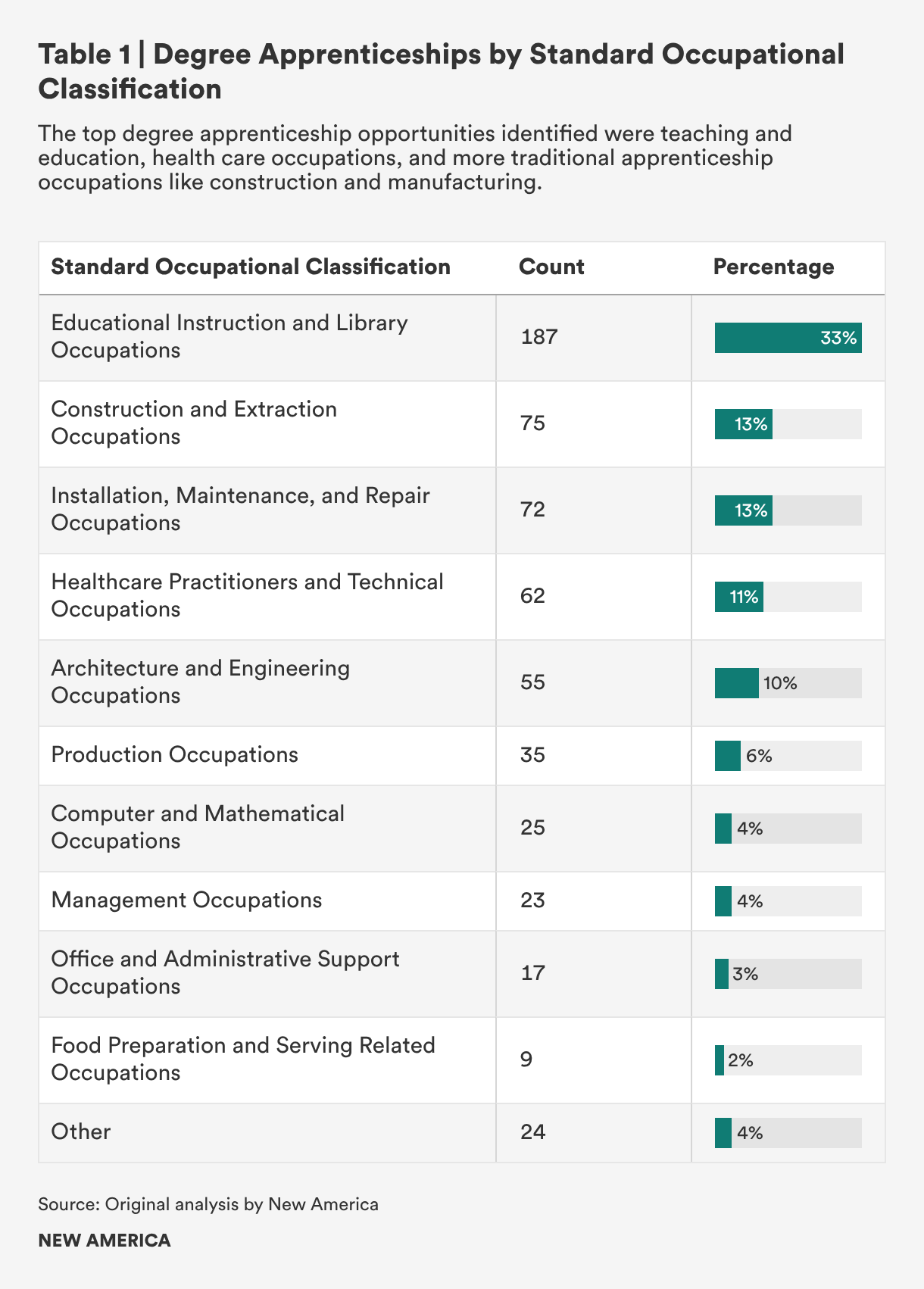
The degree apprenticeship opportunities we identified were heavily concentrated in only a handful of occupational categories. Using the U.S. Department of Labor’s (DOL’s) 23 Standard Occupational Classification (SOC) major categories, we found degree apprenticeship opportunities in 18 of the 23 categories. But more than three-quarters of the degree apprenticeship opportunities were in just five occupational groups (see Table 1), and nearly one-third of them were in just one category: Educational Instruction and Library Occupations. This category includes occupations like K–12 teacher and preschool teacher. Rounding out the top five were health care occupations and more traditional apprenticeship occupations like construction and manufacturing.
This finding matches anecdotal trends and evidence. During the Biden administration, both the secretary of education and the secretary of labor strongly promoted the development of teacher apprenticeships as a strategy to address nationwide teacher shortages and to diversify the educator workforce.2 DOL also widely publicized the availability of competitive grant funding for these programs and awarded numerous grants to support teacher apprenticeship programs in 2023 and 2024.3 Similarly, the federal government invested significant resources in health care apprenticeship via funding opportunities like “Apprenticeships: Closing the Skills Gaps in 2019.”4 There are shortages of professionals in many allied health occupations5 and this may have prompted employers and institutions of higher education to seek out more innovative strategies for attracting and preparing students for these jobs. The prominence of more traditional apprenticeship occupations like the skilled trades among degree apprenticeship opportunities may reflect the recent growth of community colleges as related instruction providers and sponsors for Registered Apprenticeships.6
K–12 Teacher and Registered Nurse Are the Top Two Occupations for Which Degree Apprenticeships Offer Career Preparation
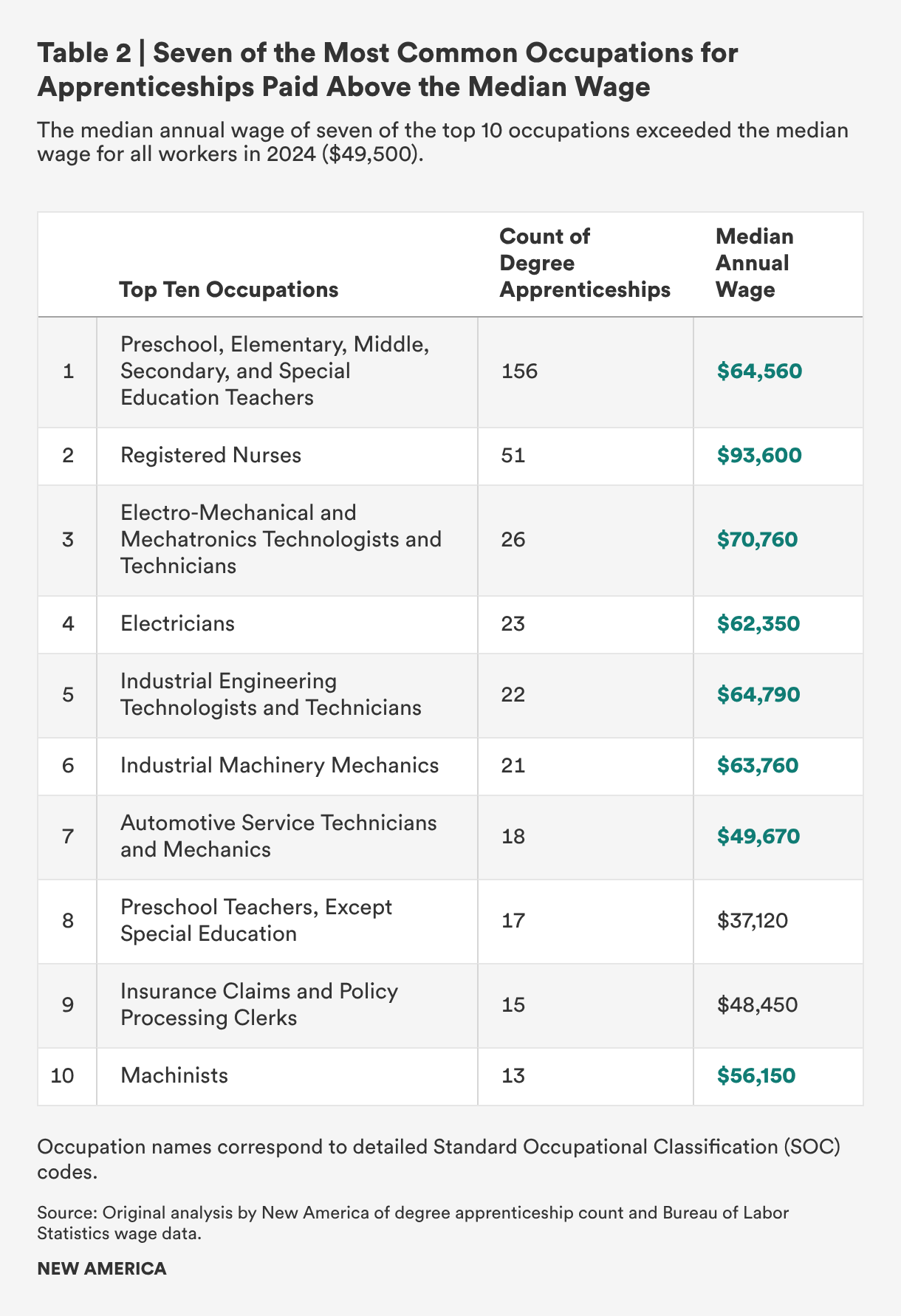
The degree apprenticeship opportunities we identified provided career preparation for 91 different occupations, from computer user support specialist to petroleum pump system operator. The 10 occupations with the largest number of degree apprenticeship opportunities are shown in Table 2. Programs for teachers and registered nurses top the list. Apprenticeships for both occupations also originated in the last four years,7 indicating how quickly institutions of higher education can start up programs when there is a strong demand.
Most of the Occupations Targeted by Degree Apprenticeship Pay Above the Median Wage and Are Projected to Grow
For the most part, degree apprenticeships are opening doors to well-paying jobs. As indicated in Table 2, the median annual wage of seven of the top 10 occupations exceeded the median wage for all workers in 2024 ($49,500). Of the occupations for which we identified degree apprenticeship opportunities, 86 percent paid more than the 2024 median annual wage. Software developer was the highest paying occupation ($133,080), while K–12 teaching assistant paid the least ($35,240).8
The employment outlook for the occupations for which we identified degree apprenticeship opportunities is mixed. The average projected rate of growth of job openings between 2024 and 2034 for the 91 occupations is .44 percent, significantly below the 3.1 percent average projected rate of growth for all occupations. However, 50 of the 91 occupations, or 55 percent, have above-average projected rates of growth. The number of jobs for 16 of the 91 occupations, or 18 percent, is projected to decline between 2024 and 2034.9
Many of these occupations in fields like health care and education pay close to, or even slightly below, the median annual wage, but are critical roles for our society. Degree apprenticeship programs lower the cost to enter professions and allow job advancement for those already employed in lower-paying or lower-skilled positions. Lowered barriers to entry may make degree apprenticeships more attractive to learners, even if they do not lead to the highest-paying jobs.
About Half of the Occupations for Which Degree Apprenticeships Offer Career Preparation Do Not Typically Require a Degree for Entry
According to the Bureau of Labor Statistics (BLS), earning a degree is not a typical requirement for entry for about half (48 percent) of the occupations for which we identified degree apprenticeship opportunities. So if a postsecondary degree is not a typical requirement for an occupation, why are apprenticeship sponsors combining them with Registered Apprenticeship programs to create degree apprenticeships? And why are students enrolling in them?
We heard several different explanations in our interviews. Students in an industrial maintenance mechanic degree apprenticeship in Alabama told us the associate degree was important to them because they believed it would give them more job security and provide greater opportunities for advancement. Other managers sponsoring degree apprenticeships for occupations that do not typically require a degree described the programs as long-term talent development strategies intended to create a bench of well-prepared employees who could later step into other, higher-ranking roles in the organization or even into leadership positions. A North Carolina employer whose apprentices were recent high school graduates said the degree was important to young people and their families. The degree also made the apprenticeship more appealing and competitive with what other area employers were offering.
The insurance industry provides a good example of why an employer may consider offering a degree apprenticeship for a position that does not typically require a degree. Insurance claims and policy processing clerk, one of the entry-level occupations for which we identified degree apprenticeship opportunities, typically does not require a degree.10 However, the academic and technical foundation provided by a degree may be helpful in advancing to higher-paying occupations in insurance for which the completion of licensure and certification courses and exams are desirable or required or, in the case of insurance underwriter, for which earning a degree is typically required. Ensuring claims and policy processing clerks earn a degree through their apprenticeship opens paths to upward mobility in the industry that might otherwise be closed off to them, allowing the apprentice—and the employers—to potentially reap longer-term career development rewards. The opportunity for upward mobility may be especially important in fields where entry-level jobs may be at risk due to the growth of artificial intelligence.
Occupations in the skilled trades do not typically require a degree, but they are the focus of about 13 percent of the degree apprenticeship opportunities we identified. For example, since 1994, Ivy Tech Community College has awarded AAS degrees to more than 25,000 apprentices in the construction trades through its partnership with the Indiana Building Trades Joint Apprenticeship Training Committees (JATCs).11 Individuals in JATC apprenticeships are co-enrolled in an Ivy Tech AAS degree program and take general education courses and some electives, usually online. The JATCs provide the technical-related instruction, for which Ivy Tech awards academic credit.12 Indiana pays the college tuition, using fines and interest on delinquent payments collected from employers by the state unemployment insurance system.13 In 2023–2024, Ivy Tech awarded 972 associate degrees in the construction trades.14
It is important to note that our research identified degree apprenticeship opportunities offered by institutions of higher education, but quantifying the extent to which employers are pursuing these options was beyond the scope of the project. For those occupations for which a degree is not a legal requirement for entry, some college officials noted that they also offered, and employers sometimes chose, a postsecondary certificate rather than a degree connected to the apprenticeship. How employers choose the postsecondary credentials they pair with a Registered Apprenticeship is a complex issue about which more research is needed.
There Are Promising Opportunities for Growth in Some Occupational Categories for Which We Identified Few or No Degree Apprenticeships
Several occupations requiring a degree for entry with strong projected growth and above-median pay still have few to no degree apprenticeships, despite being designated as apprenticeable occupations.15 Occupational therapy assistant and physical therapy assistant both require an associate degree16 and extensive supervised clinical experience17 that could be delivered through a Registered Apprenticeship, yet we located no degree apprenticeships for either occupation. We identified only two degree apprenticeship opportunities for biological technician and none for chemical technician and forensic science technician, but all three typically require a degree18 and have been identified by the U.S. Department of Labor’s Office of Apprenticeship (OA) as an apprenticeable occupation.19 Although we identified only one degree apprenticeship for police officer, there is great interest in using the apprenticeship model in law enforcement.20 While not all police training culminates in a degree, in 2024, 73 percent of detectives and criminal investigators and 58 percent of police and sheriff’s patrol officers had a degree.21 Embalmer is another apprenticeable occupation that typically requires a degree22 and practical work experience23 for which we found only one degree apprenticeship. Expanding degree apprenticeship programs in these occupations could expand affordable pathways into well-paying jobs in new fields.
Higher Education Findings
Most Degree Apprenticeship Opportunities Are Associate Degrees, Chiefly Associate of Applied Science Degrees
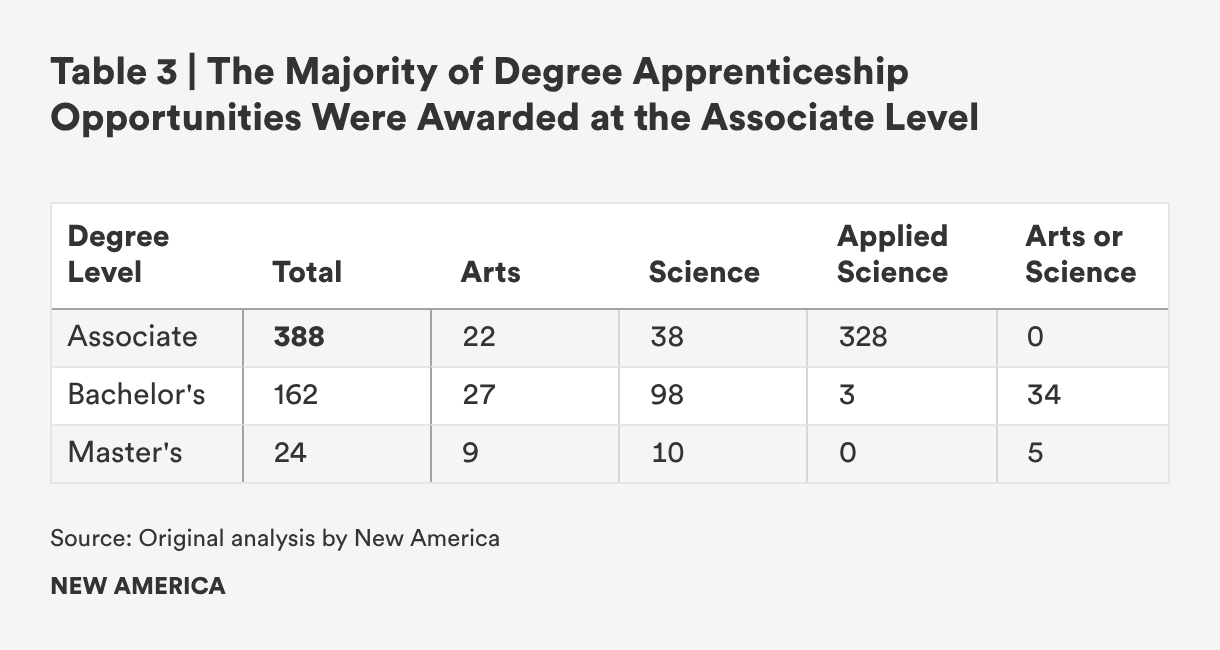
With the exception of teaching degree apprenticeship programs, most degree apprenticeship opportunities are concentrated at the associate degree level. As Table 3 shows, two-thirds of the degree apprenticeship opportunities we identified awarded degrees at the associate degree level, 29 percent awarded bachelor’s degrees, and 4 percent awarded master’s degrees. The associate degree opportunities were predominantly associate of applied science degrees (AAS).
Although results vary by field, AAS degrees can have strong value in the labor market, offering, on average, higher earnings than a high school credential.24 However, AAS degrees have historically been designed as terminal degrees intended to prepare students for immediate entry into the workforce and not as a foundation for transfer to a bachelor’s degree program.25 This limits the upward mobility of individuals with AAS degrees by making it more difficult and costly to attain a bachelor’s degree, except for applied bachelor’s degrees that are aligned with AAS degrees.26 Research in North Carolina has found that students with AAS degrees who transfer into University of North Carolina institutions lose, on average, over two semesters’ worth of course credits in making the transfer. They are less likely to earn a bachelor’s degree than students who transfer with AA or AS degrees, in part because of those lost credits.27
Unsurprisingly, the programs that offered bachelor’s degrees are overwhelmingly in occupations where a bachelor’s degree is required for entry. The bachelor’s degree apprenticeship opportunities are predominantly (92 percent) in education or a related field. Of the remainder, 4 percent are in nursing, and 4 percent are in other fields, such as construction management and cybersecurity. All but two of the master’s degree apprenticeship opportunities are in education.
Degree Apprenticeship Programs Are Rare and Primarily Offered at Large and Urban Schools
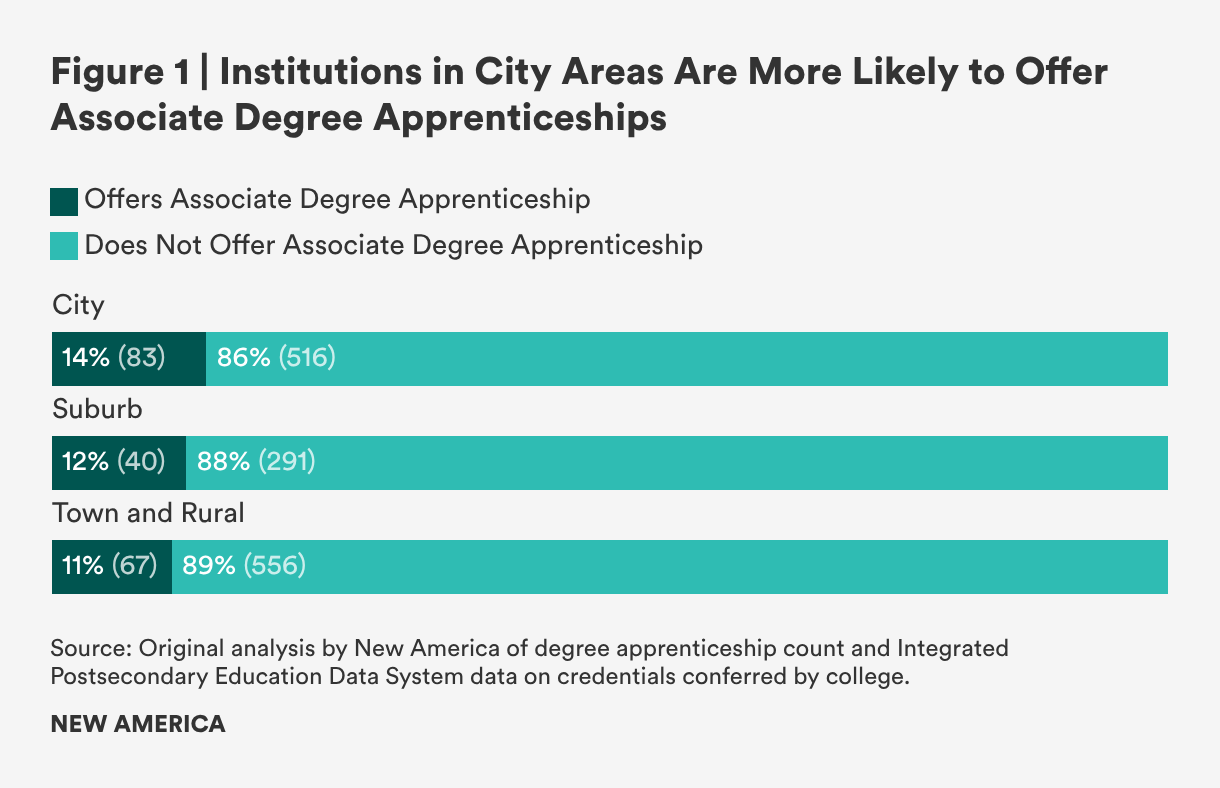
While degree apprenticeship programs have seen growth in recent years, these opportunities remain relatively rare at institutions of higher education. Among the public and private nonprofit institutions of higher education that awarded associate degrees in occupational areas28 in 2022–2023, about 12 percent offered at least one associate degree apprenticeship opportunity. Larger institutions of higher education are overrepresented in this group.29 Figure 1 also highlights that a higher percentage of colleges in urban areas that award occupational associate degrees offer degree apprenticeships than in suburban or rural locales. These institutions may have more resources and staff capacity for the employer outreach and curriculum and program development required to launch degree apprenticeships than schools with fewer students.
Though it is not yet clear why, degree apprenticeship remains a tool used almost exclusively by public colleges and universities. While about one-quarter of the institutions of higher education that awarded occupational associate degrees in 2022–2023 were private nonprofit entities, nearly all of the institutions of higher education that offer associate degree apprenticeship opportunities are public entities (99 percent). Among the colleges and universities that offered bachelor’s degree apprenticeships in teaching, however, 29 percent were private nonprofit institutions of higher education.
Few Public Undergraduate Colleges Offer Both Associate Degree Apprenticeships and Bachelor’s Degree Programs
We explored the intersection of degree apprenticeship opportunities with another emerging but more mature program innovation at public undergraduate colleges: the community college bachelor’s degree. These bachelor’s degrees are almost without exception technical, workforce-oriented degrees, often designed to provide a pathway to a bachelor’s degree after applied associate degree programs previously considered terminal degrees.30 Like degree apprenticeship, states and colleges have been using community college bachelor’s degrees to provide a more affordable, accessible way to upward economic mobility.
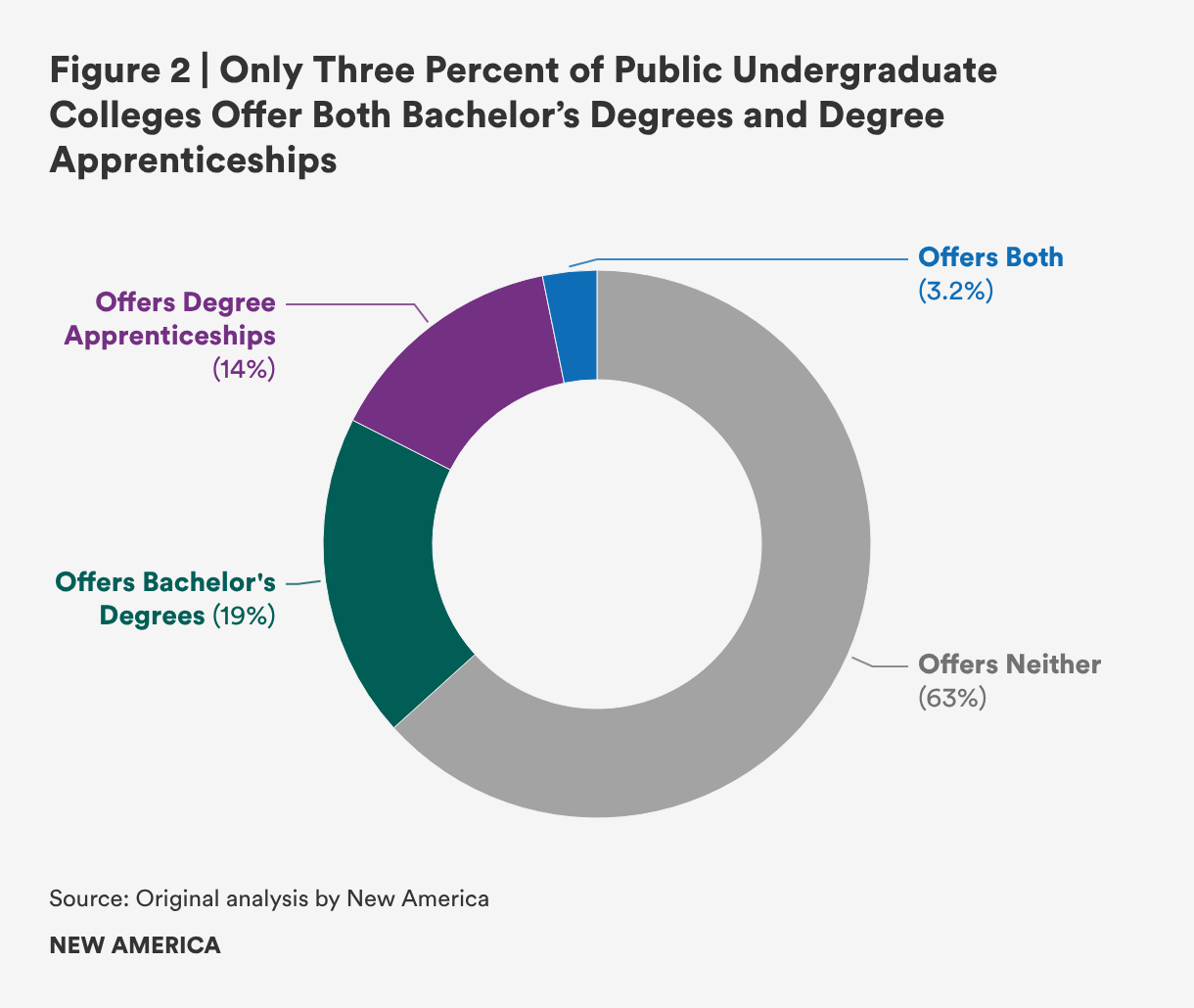
However, as shown in Figure 2, we observed that there is little overlap between public undergraduate colleges (i.e., those with no graduate programs) offering both a bachelor’s degree and an associate degree apprenticeship program.31 Only 3 percent of these colleges offer both bachelor’s degrees and degree apprenticeships. Another 33 percent offer either a bachelor’s program or an associate degree apprenticeship, but not both. More analysis is needed to understand why these two emerging postsecondary workforce development strategies so seldom overlap.
The implications of keeping these separate are important for policymakers and institutional leaders to consider. At colleges with bachelor’s programs but no associate degree apprenticeships, institutions could be missing out on students who first need an accessible, affordable path to an associate degree—like an apprenticeship—before they can begin to think about a bachelor’s degree. For colleges with an associate degree apprenticeship but no bachelor’s degree, the institution may be missing an opportunity to provide learners with applied associate degrees the opportunity to earn a bachelor’s degree at some point down the road without the credit loss they typically experience when transferring.32
Geographic Location Findings
Town and Rural Institutions Are Overrepresented Among Schools Offering Teacher Apprenticeships
We also examined the extent to which colleges and universities with educator preparation programs offered an apprenticeship degree opportunity for aspiring teachers. Among the institutions of higher education that awarded bachelor’s degrees in education in 2022–2023, 10 percent have a bachelor’s degree apprenticeship program in teaching. In contrast to our finding that institutions in town and rural areas were underrepresented among colleges that offer associate degree apprenticeship opportunities, we found that institutions in town and rural areas were overrepresented among the colleges and universities that offer bachelor’s degree apprenticeship programs in education. The great difficulties that rural schools experience filling teacher vacancies33 and their commitment to Grow Your Own programs may be factors in the disproportionate representation of teacher degree apprenticeship opportunities at institutions of higher education in towns and rural areas.
Nursing Degree Apprenticeships Are Uncommon Outside Alabama
In addition, we looked at the extent to which the apprenticeship degree model is being used by colleges and universities with nursing programs. Among the public and private nonprofit institutions of higher education that awarded associate degrees in nursing in 2022–2023, just 4 percent offer associate degree apprenticeships in nursing. Less than 1 percent of the public and private nonprofit institutions of higher education that awarded bachelor’s degrees in nursing in 2022–2023 offer bachelor’s degree apprenticeships in nursing. In Alabama, however, nursing degree apprenticeships are offered by 78 percent of the colleges that awarded associate degrees in nursing in 2022–2023 and 25 percent of the schools with bachelor’s degree programs in nursing. This comparatively high rate is the result of deliberate policy decisions, which we detail in the next section.
Many Degree Apprenticeship Opportunities Are Concentrated in Just Three States
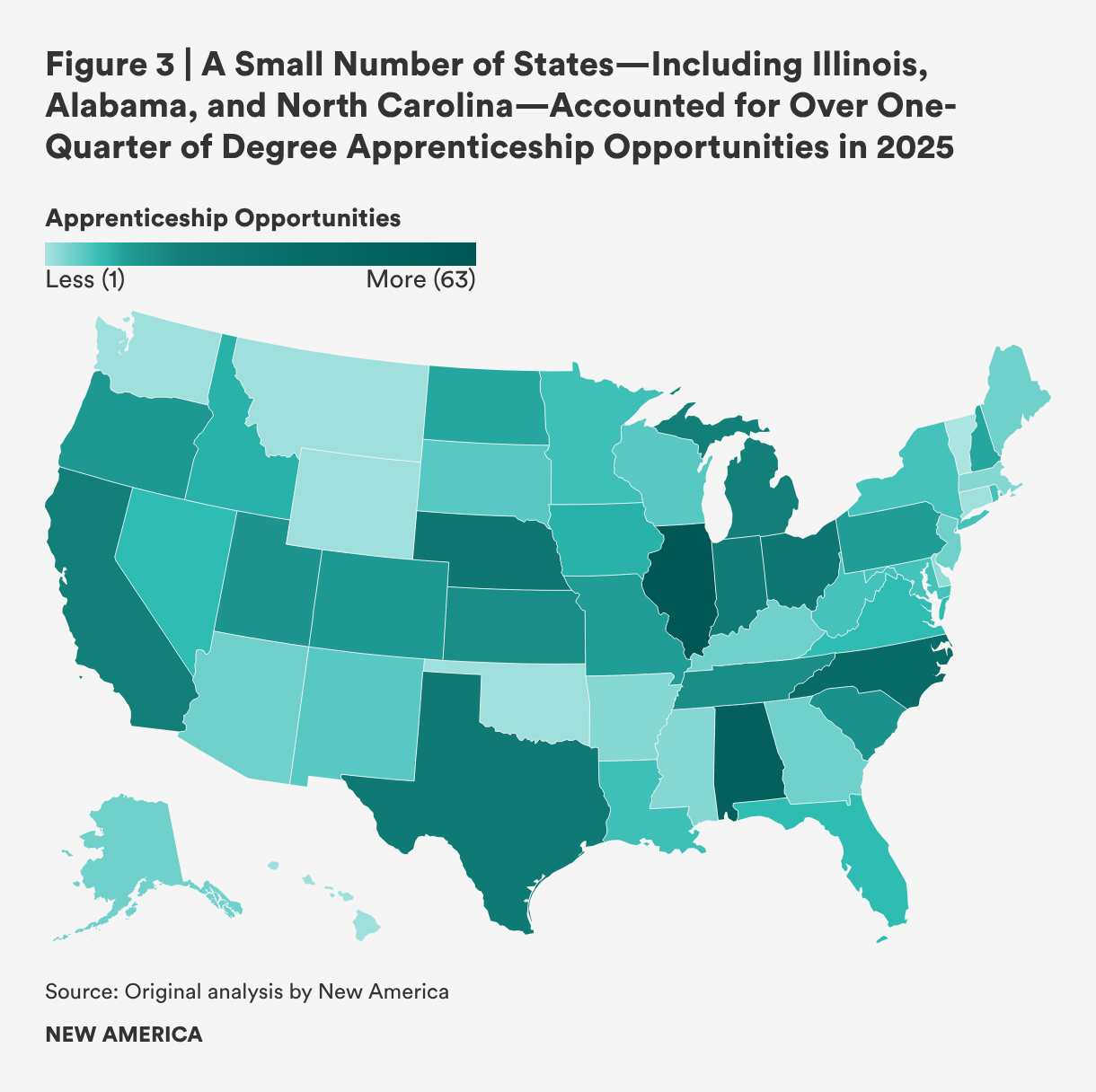
The extensive use of the apprenticeship degree model in Alabama is not limited to its nursing programs. We identified at least one degree apprenticeship opportunity in each of 49 states and the District of Columbia, but three states—Illinois, Alabama, and North Carolina—accounted for more than one-quarter of the opportunities. Several factors appear to have contributed to the growth of degree apprenticeship opportunities in these states, but chief among them is a supportive policy environment, the availability of public funding, and the influence of Europe-based companies that view apprenticeship as an important talent development strategy. Figure 3 shows the number of degree apprenticeship opportunities we located in each state.
In Alabama, increasing degree apprenticeship opportunities has been a state priority since the Alabama Office of Apprenticeship (AOA) was established as the state’s apprenticeship agency in 2019. Josh Laney, the first AOA director, said the state made expanding apprenticeship into occupations that require a degree a priority, “because we saw that many of the opportunities to expand apprenticeship outside the traditional skilled trades were occupations that required postsecondary education, such as nursing. Our focus was those occupations that just hadn’t been touched.” The registration of the first master’s degree apprenticeship at Alabama A&M University was an important early milestone, but the critical breakthrough was AOA’s collaboration with Alabama’s state nursing board, which led to the creation of associate degree nursing apprenticeships throughout the state.
In Illinois, Harper College first launched degree apprenticeship programs following conversations with manufacturers in its region. After receiving a Trade Adjustment Assistance Community College and Career Training grant in 2012 from the U.S. Department of Labor, Harper expanded its capacity to offer more advanced manufacturing programs and later received funds from two federal grants in 2015 to create additional apprenticeship opportunities across the state. Harper directly received a $2.5 million American Apprenticeship Initiative (AAI) grant from the U.S. Department of Labor, which it used to partner with Zurich North America to offer an associate degree apprenticeship in general insurance, as well as to support other apprenticeships in information technology and manufacturing.34 These efforts were further supported by the award of another $3.9 million AAI grant from the U.S. Department of Labor to a consortium led by the Illinois Manufacturers Association Education Foundation that included Harper and the German-American Chamber of Commerce of the Midwest.35 The work of this consortium also led to the establishment of the Industry Consortium for Advanced Technical Training, which promotes associate degree apprenticeship programs in manufacturing throughout the Midwest. Other Illinois colleges worked with former Harper administrators to launch their own programs outside of the Chicagoland region. For example, Heartland Community College in Normal contracted with Harper’s former dean of workforce and economic development for technical assistance in launching their own degree apprenticeships. Another Harper alumnus, Sheila Quirk-Bailey, created a robust apprenticeship program at Illinois Central College in Peoria after she became its president in 2016. In Chicago, the Aon Corporation launched its associate degree apprenticeship program with Harold Washington College in 2017.36
The presence of European-based corporations in North Carolina also seems to have been a factor in the development of degree apprenticeships in that state. In 1995, a group of American, Austrian, German, and Swiss advanced manufacturing companies based outside Charlotte established the Apprenticeship 2000 employer consortium to offer associate degree apprenticeships in mechatronics and other fields related to advanced manufacturing at Central Piedmont Community College. They marketed the opportunity to high school juniors and seniors as one of the country’s first registered youth apprenticeship programs. Apprenticeship 2000’s success prompted employers in other counties to form similar consortia, working with area community and technical colleges.37 The growth and diversification of degree apprenticeships in North Carolina was further fueled by the 2015 enactment of a tuition waiver for recent high school graduates who become apprentices. The state waives tuition costs for high school students in a pre-apprenticeship or Registered Apprenticeship who enroll in a Registered Apprenticeship within four months (120 days) of high school graduation and reimburses community and technical colleges for these costs.38 Chris Harrington, state director of ApprenticeshipNC, reported that 28 of the state’s 58 community and technical colleges took advantage of the waiver in 2024, costing the state about $1 million. Many of the degree apprenticeships we encountered in North Carolina in our research were predominantly composed of recent high school graduates.
Citations
- For details on our search methods, see the appendix.
- On August 31, 2022, Education Secretary Miguel Cardona and Labor Secretary Martin Walsh published a letter to state leaders encouraging them to support Registered Apprenticeships for teachers. See U.S. Department of Education, “Joint Letter with Secretary Martin Walsh of DOL regarding a Sustainable Teacher Workforce,” August 31, 2022, source.
- The Department of Labor summarized its investments in teacher apprenticeships during the Biden administration in a 2024 blog post. See Manny Lamarr, “Building the Next Generation of Teachers Through Apprenticeship” U.S. Department of Labor Blog, May 7, 2024, source.
- The U.S. Department of Labor awarded $99,281,216 in grants to 28 grantees for the H-1B Apprenticeships: Closing the Skills Gap grant program in February 2020. For more information, see the U.S. Department of Labor awarded U.S. Department of Labor, Employment and Training Administration, Overview of the H-1B Apprenticeship: Closing the Skills Gap Grant Program, February 11, 2020, source.
- For example, a 2022 survey by AMN Healthcare found that 85 percent of hospitals, medical groups, home health providers and other health care facilities are experiencing a shortage of allied health care professionals. See Survey of Allied Healthcare Professional New Graduate Hiring Patterns (AMN Healthcare Center for Research, 2022), 3, source.
- Robert Lerman, Tamar Jacoby, Deniz Nemli, and John Colborn, How Community Colleges Can Help Scale US Apprenticeships: Evidence from the Field (Apprenticeships for America, November 6, 2024), source.
- OA approved K–12 Teacher as an apprenticeable occupation on November 30, 2021. See OA Bulletin 2022–18, source. Registered Nurse was approved as apprenticeable on July 19, 2023; see OA Bulletin 2023-111, source.
- U.S. Bureau of Labor Statistics, “Table 1.2 Occupational Projections, 2024–2034, and Worker Characteristics, 2024 (Employment in Thousands),” source.
- Bureau of Labor Statistics, “Table 1.2 Occupational Projections, 2024–2034,” source projections and worker characteristics. Bureau of Labor Statistics, “Table 1.2 Occupational Projections, 2024–2034,” source.
- However, a significant share of the workers in this occupation (42 percent) did have a degree in 2022. See U.S. Bureau of Labor Statistics, “Table 5.3 Educational attainment for workers 25 years and older by detailed occupation, 2022–23 (Percent),” source.
- Built to Succeed (website), source.
- Ivy Tech Community College, “Apprenticeships,” source.
- Indiana Code 22-4-25, Chapter 25, Special Employment and Training Services Fund, source.
- Teresa Hess, Assistant Vice President for Apprenticeships and Work-Based Learning, Ivy Tech Community College, email message to authors, January 5, 2025.
- ApprenticeshipUSA (USDOL Office of Apprenticeship), “Explore Approved Occupations for Registered Apprenticeship,” source.
- Bureau of Labor Statistics, Occupational Outlook Handbook, “Occupational Therapy Assistants and Aides,” source and “Physical Therapist Assistants and Aides,” source.
- The accreditation standards for associate degree programs require occupational therapy assistant students to complete 16 weeks of full-time, supervised fieldwork and physical therapy students to complete 12 weeks of full-time, supervised clinical experience. Accreditation Council for Occupational Therapy Education, 2023 Standards and Interpretive Guide (ACOTE, August 2025 Version), Standard C.1.12, 39, source; and Commission on Accreditation in Physical Therapy Education, Accreditation Handbook, Standards and Required Elements for Accreditation of Physical Therapist Assistant Education Programs (CAPTE, 2024), Standard 6A, 34, source.
- Bureau of Labor Statistics, “Occupational Projections and Worker Characteristics, Table 1.2 Occupational Projections, 2024–2034, and Worker Characteristics, 2024,” source.
- ApprenticeshipUSA (website), “Explore Approved Occupations for Registered Apprenticeships,” source.
- See, for example, Benjamin Klosky and Robert Lerman, Police Apprenticeships for Youth Can Enhance Recruitment and the Quality of Officers While Lowering Costs (Urban Institute, March 2024), source.
- Bureau of Labor Statistics, “Educational Attainment for Workers 25 Years and Older by Detailed Occupation,” Table 5.3, source.
- Bureau of Labor Statistics, “Occupational Projections and Worker Characteristics,” Table 1.2, source.
- The Conference, Regulations in Funeral Service Licensing (The International Conference of Funeral Service Examining Boards, 2025), source.
- Research on the economic returns of postsecondary credentials consistently finds that, on average, individuals with an associate degree earn more than those with only a high school credential. See, for example, Véronique Irwin, Ke Wang, Julie Jung, et al., “Annual Earnings by Educational Attainment,” The Condition of Education 2024 (Institute of Education Sciences, May 2024), Figure 2, source. While this research does not typically disaggregate results for AAS degrees specifically, other studies comparing the returns to different types of associate degrees have found that, on average, individuals with AAS degrees earn as much or more than individuals with AS or AA degrees. See, for example, Mark Schneider, Education Pays in Colorado: Earnings 1, 5, and 10 Years after College (College Measures, 2015), 2, source.
- Mark Fincher, Chris Kelly, Miranda Harrison, Zachary Harrison, Danielle Hopson, and Selah Weems, “Articulation and Transfer for Career and Technical Students: Best Practices for Dealing with Real and Perceived Barriers to Baccalaureate Degree Attainment for Applied Science Students,” Community College Journal of Research and Practice 41 (8): 531–35, source.
- Washington State Board for Community and Technical Colleges, Applied Baccalaureate Degrees:Policy and Outcomes Evaluation, Research Report 15-2 (SBCTC, August 2015), source.
- Holley Nichols and Sarah Deal, Applied Associate of Science Degrees: Pathways for Workforce and Transfer (Belk Center for Community College Leadership and Research, June 2025), source.
- These are associate degrees awarded in the following Classification of Instructional Programs (CIP) two-digit code groups: (01) Agriculture, Agriculture Operations, and Related Sciences; (03) Natural Resources and Conservation; (04) Architecture and Related Services; (10) Communications Technologies/Technicians and Support Services; (11) Computer and Information Sciences and Support Services; (12) Personal and Culinary Services; (13) Education; (15) Engineering Technologies and Engineering-Related Fields; (19) Family and Consumer Sciences/Human Sciences; (22) Legal Professions and Studies; (31) Parks, Recreation, Leisure, and Fitness Studies; (41) Science Technologies/Technicians; (43) Homeland Security, Law Enforcement, Firefighting, and Related Protective Service; (44) Public Administration and Social Service Professions; (46) Construction Trades; (47) Mechanic and Repair Technologies/Technicians; (48) Precision Production; (49) Transportation and Materials Moving; (51) Health Professions and Related Programs; and (52) Business, Management, Marketing, and Related Support Services.
- Only 16 percent of the public and private nonprofit higher education institutions that awarded occupational associate degrees in 2022–23 had total enrollments of 10,000, but these larger institutions comprised 29 percent of the schools offering associate degree apprenticeship opportunities.
- Elizabeth Meza and Ivy Love, When Community Colleges Offer a Bachelor’s Degree: A Literature Review on Student Access and Outcomes (New America, March 2023), source.
- Not all institutions in this count and in Figure 5 are community colleges. We include all public colleges where the highest credential awarded is a bachelor’s degree. Therefore this count includes some institutions for which the bachelor’s degree is the predominantly awarded credential; these institutions fall outside counts of community college bachelor’s degrees in other publications. We include them here for the broadest look at colleges entirely committed to undergraduate education and offering technical associate degrees, as we consider these the most likely to consider both policy innovations discussed in this section.
- Elizabeth Meza and Ivy Love, When Community Colleges Offer a Bachelor’s Degree: A Literature Review on Student Access and Outcomes (New America, March 2023), source.
- Richard M. Ingersoll and Henry Tran, “The Rural Teacher Shortage,” Kappan, October 23, 2023, source.
- Darice Trout, Senior Director of Workforce Solutions and Job Placement, Harper College, email message to authors, January 13, 2025.
- “American Apprenticeship Grant Award Summaries,” Obama White House Archives, National Archives and Records Administration, September 10, 2015, page 5, source.
- Nichola Lowe, Haley Glover, and Ranita Jain, Case Study: Next Generation Apprenticeships at Aon (UpSkill America, February 2023), source.
- Bhavani Arabandi, Zach Boren, and Andrew Campbell, Building Sustainable Apprenticeships: The Case of Apprenticeship 2000 (Urban Institute, February 2021), source.
- Michael Prebil, Solid Foundations: Four State Policy Approaches for Supporting College-Connected Apprenticeships (New America, September 2019), source.
III. Quality Principles
Degree apprenticeship is an emerging, fast-growing, but still rare, model in education and workforce development. We can learn from the pioneers and experts in degree apprenticeship about what works, what doesn’t, and how to deliver a high-quality program that effectively serves both learners and employers. As programs continue to grow and emerge, quality principles can point the way to successful implementation.
To this end, New America convened an advisory committee of 12 leaders in the field with a wide range of expertise and experience. We asked them to develop a set of principles to help define what high-quality degree apprenticeship programs look like. They agreed upon five quality principles for degree apprenticeship programs. Grounded in research and experience, the principles are both practical and aspirational, setting a high bar for program design, outcomes, and continuous improvement. They offer guidance for those who seek to replicate degree apprenticeships, and provide a framework that policymakers can use to assess the extent to which policy may foster their growth and quality.
The quality principles put student-apprentices at the center, recognizing the great challenges they face in their dual roles as learners and workers. Completion rates for similar, overlapping learner populations suggest that degree apprenticeship programs may not be easy. Estimates of the average completion rate of an apprenticeship range from below 35 percent1 to 60 percent,2 while 34 percent of part-time college students earn a postsecondary certificate or degree within six years of enrolling.3 The quality principles aim to create the conditions for apprentices to succeed in both realms, while also meeting employer needs. A high-quality degree apprenticeship prioritizes the goals, needs, and experiences of degree apprentices while helping employers build a strong talent pipeline. This kind of program features five characteristics.
- Accessible: The program must offer comprehensive wraparound support to ensure both participation and sustained engagement. It should include services like recruiting, academic guidance, transportation assistance, and help with employer negotiations. The degree apprenticeship infrastructure should actively promote equity, access, and inclusion for all participants.
- Responsive: The program should be grounded in strong quality assurance systems that prioritize accountability towards occupational mastery through clear outcomes, robust program oversight, and mentor and faculty support. It should also be data-driven, aligned with identified labor needs, and regularly evaluated against defined metrics to ensure it meets high design, delivery, and learner success standards.
- Affordable and Sustainable: The program must be economically sustainable for colleges, employers, and apprentices. This means ensuring affordability in tuition (eliminating or reducing debt), competitive salaries and benefits, and cost structures that deliver value for participants and employers.
- Flexible: The program must be permeable and flexible, maximizing academic credit in required coursework for contextualized on-the-job learning while streamlining college and employer administrative processes. The registration process should be sequenced appropriately for the target occupation, so the apprentice benefits from continuity of employment. This approach enables apprentices and employers to efficiently navigate the path from training to a quality degree.
- Collaborative: The program should be developed and run with all stakeholder groups in order to build strong, trust-based relationships. It must integrate industry-driven skills and competencies, so that training directly reflects employer needs and secures buy-in and ongoing partnership between industry leaders and faculty.
Below, informed by our interviews and site visits, we discuss each principle in depth. We highlight programs that have successfully and effectively implemented these principles, and we explore barriers or challenges to adopting them.
1. Accessible
High-quality degree apprenticeships offer student-apprentices comprehensive wraparound supports that are in addition to those available to regular college students. The Aon Corporation’s degree apprenticeship at Harold Washington College in Chicago, Illinois, is one such example. The college pairs student-apprentices with a workforce success coach who helps them navigate their college experience and resolve any challenges that get in the way of completing their schoolwork. The coach also keeps Aon informed about apprentices’ academic progress.4 On the employer side, Aon contracts with the nonprofit One Million Degrees to provide career navigators who work with apprentices to address any life or workplace challenges that may interfere with their progress at work. Aon also offers a monthly professional development series for apprentices to build their employability and technical skills. These partners share student-apprentice progress and challenges across their organizations. The Aon apprenticeship coordinator collects a monthly status report from supervisors to identify areas where career coaching might be helpful. The coordinator meets monthly with the coaches from Harold Washington and One Million Degrees to share information and to collaborate with them to address problems apprentices may be experiencing.
A key strength of the Aon and Harold Washington College apprenticeship is its cohort model. Degree apprentices are usually enrolled in the same classes as their cohort members and have opportunities to connect with them formally and informally in the workplace. As we heard from program leaders and apprentices alike, the cohort structure is an important source of support, enabling degree apprentices to call on peers if they need help in class or at work. “Your own cohort is one of the main supports that you have while you’re in an apprenticeship,” said one student-apprentice.
At Harper College and Illinois Central Community College, apprenticeship coordinators are exclusively responsible for helping student-apprentices navigate life and academic challenges. Harper College’s Annie Sylvester compared her role to that of a “concierge,” explaining that she is there to “make sure that [student-apprentices] have somebody that’s there to help connect them with the resources that they need.” At Illinois Central College, Amanda Nordstrom said that she develops close bonds with the student-apprentices. “We will go with them if they feel uncomfortable going to a tutor or going to talk to a faculty member. I’ll be their support. They trust us,” she said. The Harper and ICC coordinators also keep employers informed about apprentices’ attendance and grades.
2. Responsive
As the labor market evolves, so do the skills and competencies required for career success. Degree apprenticeships must adapt accordingly. Collecting and analyzing quality data is crucial to ensuring programs effectively prepare student-apprentices for their chosen careers. Programs we encountered were ramping up their collection and use of data as their portfolios of degree apprenticeships grew.
Illinois Central College collects qualitative and quantitative data from employers and student-apprentices during and following the degree apprenticeship. Apprenticeship Manager Kelly Bay and her team regularly collect data about participants’ experience and performance in their classes and their progress against their work process schedules and attainment of competencies. They survey participants after they’ve earned their degree to assess their satisfaction with their courses and the program. Bay and her team connect with employers regularly to assess their satisfaction and identify issues that may need to be resolved. Since the college’s degree apprenticeships have grown, the team is currently developing a formal survey to collect data rather than relying on verbal feedback from employers.
Bay and others at ICC ensure that employers have a clear line of communication with the college, and their feedback is taken seriously. “They know that they can reach out to me anytime there’s an issue,” she said. Participant feedback gets prompt attention as well. She recalled an incident when she approached a dean about participants’ concerns about classroom communication. “The apprentices were amazed at how quickly we responded. They felt immediately supported,” she said. We identified similar commitments to using feedback to support effective instruction and mentorship in degree apprenticeships across the country.
Further north, City Colleges of Chicago are investing in improved data collection systems and processes for their apprenticeship programs. The Decision Support Department recently launched a study to fill in gaps in the system’s data on apprenticeship outcomes, including completions, earnings, the extent to which apprentices are converted to full-time employees, and progress on the job. City Colleges are working with a technical assistance provider to develop survey instruments for apprentices and employers and question prompts for focus groups. They are also hiring a full-time data coordinator in the Apprenticeships and Work-Based Learning unit and investigating strategies to integrate data on apprenticeship participation and outcomes in their student information system.
3. Affordable and Sustainable
For degree apprenticeship models to address the cost concerns of both learners and employers, they must be affordable for apprentices and sustainable for all partners. Deliberate design and policy decisions can make this possible.
The Alabama Office of Apprenticeship (AOA), for example, does not register an apprenticeship unless the related instruction is made available to apprentices at no cost. Employers are required to provide a “last dollar scholarship,” paying any costs associated with an apprenticeship that remain after federal student aid, education and training benefits under the GI Bill, scholarships, tax credits, or grants have been tapped. The 2020 memorandum announcing the policy said, “One of the most important and attractive benefits of apprenticeship when compared to other forms of post-secondary education is the opportunity to avoid student debt.”5
Josh Laney, who directed AOA at the time the policy was adopted and authored the memo quoted above, recalled that AOA received “essentially no pushback on that” policy change. That’s because AOA makes sure employers understand that they’ll get a return on the money they put towards apprentice training. “When we start out orienting the employers, we start with their return on investment,” he explained. “We’re not asking you to do this just out of the goodness of your heart or for the benefit of the community, or some kind of corporate altruism,” he said. “It’s got to make sense for you as a company, because somewhere in that building is a CFO who’s got to decide whether we’re going to continue to fund this thing or not.”
North Carolina’s youth apprentice tuition waiver, which became law in 2016, keeps degree apprenticeships affordable for both employers and student-apprentices. It waives community college tuition costs for students who begin a Registered Apprenticeship within four months of their high school graduation. Lydia Walton, Human Resources Manager for Energizer Holdings in Randolph County, North Carolina, described the tuition waiver as “a great way to get employers involved initially. It makes it an easier transition to get into the program, and especially for some of our smaller employers, they have an opportunity to tap into talent that they may not have been able to reach otherwise.”
School districts that hire apprentices have had to find creative, nimble solutions to ensure that their program is affordable for themselves and their apprentices. St. Vrain Valley Schools, the school district in Longmont, Colorado, has done exactly this, developing ways to keep both related instruction and apprentice wages low-cost and sustainable in the long term. An agreement with the University of Colorado Denver (CU Denver) has allowed the district to offer dual enrollment classes at “basement, bottom-dollar community college level rate, which is about a fifth of regular tuition,” according to Cindy Gutierrez, assistant dean of Teacher Education & Partnerships at CU Denver’s School of Education & Human Development. These classes, which count towards related instruction requirements, are available not only to high school students but also to paraprofessionals, which has allowed the district to expand the pool of apprentices.
4. Flexible
Flexible programs eliminate redundancies and reduce burdens for learners without sacrificing quality in the knowledge and skills gained. These programs are designed so that students neither have to miss work to attend classes nor have to spend time in the classroom to get credit for skills they have already mastered on the job. These flexible models of learning and work allow student-apprentices to more easily complete the many requirements of their program on time and with minimal additional burden.
Reach University, based in Oakland, California, sets the standard for awarding credit for on-the-job learning in degree apprenticeship programs designed for teaching, and starting in 2026, health care. As much as half of the academic credits in the work-embedded degree are earned through paid on-the-job learning as degree apprentices work with a mentor to apply the methods they learn in their synchronous seminars. Mentors document learning through portfolios and observations and faculty review for academic equivalence.6
In North Carolina, community colleges can award up to 16 semester credit hours for work-based learning in a Registered Apprenticeship offered in conjunction with an associate of applied science degree program.7 Kristie Sauls, formerly with the North Carolina Business Committee for Education, noted that this flexibility enables colleges to tailor the degree apprenticeship to the needs of the employer. She said, “If an employer really wants to craft a degree, they can because they can replace some of those electives with work-based learning.”
We observed embedded flexibility in other aspects of the degree apprenticeship experience as well. For example, Colorado Mountain College offers all the coursework for the degree remotely, allowing teacher apprentices in communities far from a CMC campus to participate, including the two apprentices we interviewed from rural Morgan County in northeastern Colorado. “The fact that I don’t have to drive forever-and-a-half to go to school is a huge plus,” said Sergio De La Rosa, one of the teacher apprentices.
In other instances, colleges find ways to reduce the administrative burden on employers. Often this involves taking on the logistical work of registering apprenticeships and liaising with the state apprenticeship agency or U.S. Department of Labor representatives. At Illinois Central College, for example, staff handle all the documentation necessary for registration, from developing competencies and related instruction curricula to making DOL-requested updates to the work process schedule. And ICC staff support employers through the paperwork they can’t avoid, like providing hands-on guidance for how to track apprentice progress against DOL competencies. “Our handling of all of the required documents for Registered Apprenticeships and working with DOL takes a huge burden off of employers,” said Paula Nachtrieb, the college’s executive director for Workforce Development.
5. Collaborative
Often, challenges arise when partners have conflicting interests or goals. For example, some employers do not see the value of the general education courses required to complete a degree program. A collaborative attitude has been key to finding a resolution to this issue. College partners have adapted or created general education courses relevant to the employer’s needs. Illinois Central College, for example, offers a math course designed for the skilled trades. College faculty also persuaded the college’s general education curriculum committee that some of its industrial electrical maintenance and instrumentation technology courses were rigorous enough to be considered science courses. Kelly Bay, the school’s apprenticeship manager, reported that employers were enthusiastic about including these courses in an apprenticeship once they understood that they were contextual.
Strong partnerships were often evident in the development and revision of curricula in many of the degree apprenticeships we encountered. College faculty and apprenticeship program staff collaborate with employers to develop courses and to make regular revisions to meet employers’ evolving needs. In some cases, this has involved creating entirely new courses, as Harper College’s business department did, developing insurance courses for a degree apprenticeship with Zurich North America and a finance course for a banking and finance degree apprenticeship.
At the degree apprenticeship programs we encountered, deep relationships between colleges, employers, and other key stakeholders, like community-based organizations or industry associations, allowed the partners to run the program collaboratively. North Carolina, for example, is home to several public-private partnerships that help its degree youth apprenticeships thrive.8 Based at the Community Foundation of Greater Greensboro, Guilford Apprenticeship Partners (GAP) is a decade-old collaboration among Guilford Technical Community College (GTCC), the Greensboro Chamber of Commerce, Business High Point Chamber of Commerce, Guilford County Schools, and more than 30 employers. GAP recruits and supports young people in pursuing degree apprenticeships at GTCC in accounting, supply chain logistics, advanced manufacturing, and six other career areas. It sponsors educational events to brief students and their parents about the opportunities, helps employers recruit and screen prospective apprentices, and provides technical assistance, training, and support to employers in their roles as Registered Apprenticeship sponsors. There are similar partnerships supporting degree apprenticeships for youth at Alamance Community College, Randolph Community College, and Surry Community College. These programs meet the definition and quality standards for youth apprenticeship that the Partnership to Advance Youth Apprenticeship (PAYA), a New America-led initiative to advance high-quality youth apprenticeship opportunities, has established.
Citations
- U.S. Department of Labor, Overview of U.S. Apprenticeship (DOL, 2021), 5, source.
- Robert Bruno and Frank Manzo IV, Living Wages in Registered Apprenticeship Programs: An Assessment by Industry, Demographics, State, and Labor Policy (Manhattan Strategy Group, January 20, 2025), 9, source.
- National Student Clearinghouse Research Center, “Yearly Progress and Completion,” December 4, 2025, Overview: Data Highlights, source.
- Students sign a waiver of the confidentiality requirements of the Family Educational Rights and Privacy Act at the time they matriculate to enable the college to share this information.
- Joshua J. Laney, Alabama Office of Apprenticeship, “Memorandum re: Costs of Training,” November 20, 2020, source.
- Reach University, 2025-2026 University Catalog (Reach University, 2025), 3, source.
- North Carolina Community Colleges, Curriculum Procedures Reference Manual, Section 20: Work-Based Learning (North Carolina Community Colleges, revised August 26, 2021), 20-2, source.
- The New America-led Partnership to Advance Youth Apprenticeship funds ApprenticeshipNC, North Carolina’s state apprenticeship agency, to help support the growth of the youth apprenticeship programs discussed in this section and similar youth-serving models.
IV. Key Considerations for Degree Apprenticeship Expansion
Once institutions decided they wanted to integrate apprenticeships and degree programs and began developing degree apprenticeship opportunities, it became a new way of doing business. With time, this promising strategy to meet labor market needs could expand significantly. Our research has yielded six key takeaways as degree apprenticeship garners more interest. These are listed below.
1. Degree Apprenticeship Programs Are Typically Small
The number of students enrolled in some degree apprenticeships is a fraction of the number of individuals enrolled as regular students in degree programs. The small size of some programs is consistent with employer demand for prospective apprentices in the community. In other cases, program size is constrained by limited resources.
At Calhoun Community College, for example, approximately 20 percent of the students enrolled in the associate degree nursing program are also in a Registered Apprenticeship. Calhoun leaders said they had limited capacity to enroll more students in nursing apprenticeships, in part because of the time and complexity of implementing nursing apprenticeships, but also because the supply of nurses willing and able to serve as mentors was limited. More resources for degree apprenticeship development and implementation could overcome some of those constraints.
In other cases, programs are purposefully small to match local labor market need. In Ft. Morgan Schools, a rural-serving district in Colorado, staff said the number of apprentices in the school is shaped by projected job vacancies. Adrianna Nickell, principal of Pioneer Elementary in Ft. Morgan, described thinking years ahead to potential retirements and new positions, where an apprentice could fill that opening. Currently, there are four teacher apprentices at Pioneer. While a small number, these apprenticeships proceed along a clear path into employment.
2. Public Funding Is Key to the Growth of Degree Apprenticeships
A Department of Labor grant to Harper College was instrumental in its development of the first degree apprenticeship programs in Illinois, and other colleges have used grants to build out their apprenticeship offerings to include degree programs. Grant funds, for example, can pay for employer outreach, faculty time to enhance degree programs to address employer requirements and to assess whether on-the-job learning is equivalent in rigor and content to a regular college course, or wraparound services. State funding for the tuition waiver for recent high school graduates in North Carolina and for the Talent Together teacher apprenticeship initiative in Michigan, for example, has fueled the growth of high-quality degree apprenticeships in those states.
Alabama had a tax credit at one time, but Josh Laney, former director of the Alabama Office of Apprenticeship, reported that it had been “wholly ineffective overall” because the tax burden in Alabama is so low. He also said that “the ‘delayed gratification’ aspect of the tax credit also made it less appealing. Their tax guy might notice the small credit at the end of the year but that doesn’t have the same impact as getting an actual check in the mail.” He thinks the state’s current cash incentive program is more effective. For up to three years, employers who register a new program or occupation may be reimbursed for 50 percent of the wages paid to up to 10 apprentices for up to 480 hours of on-the-job learning.1
In Michigan, state policy has played a key role in the emergence and growth of teacher apprenticeship. In 2023, the legislature allocated $66.4 million to Talent Together, the partnership of school districts using apprenticeship to get newly certified teachers into classrooms.2 The move was aimed at combating the state’s teacher shortage, which Jack Elsey of Michigan Educator Workforce Initiative described as one of the worst in the country. This funding supports Talent Together staff, last-dollar tuition scholarships at colleges, mentor teacher stipends, and apprentice salaries in the final year of the program.3 Schools across the state got on board. “We got a lot of uptake because we made it easy for districts to say yes financially,” Elsey said. In 2025, Talent Together received a second allocation of $12.5 million from the legislature.4 Elsey and his colleague Gina Zuberbier at Talent Together hope to see these bipartisan investments in teacher apprenticeship continue, but recognize that they are not guaranteed.
Policymakers can increase degree apprenticeship opportunities if they commit more funds to their replication. Public funds will be critical to establishing new models and helping them gain traction while they recruit employer buy-in/investment and seek strategies for sustainability.
3. Accreditation Guidelines and State Regulations Pose Barriers to Expanding Degree Apprenticeships
Historically, students preparing for many allied health careers have been required to complete hundreds of hours of clinical experience without compensation. Sometimes, unpaid clinical experience mandates are embedded in program accreditation guidelines for associate degree programs, as with respiratory therapy.5 In other cases, they are the result of misinformation. For example, people at several colleges expressed frustration that they could not convert surgical technology associate degree programs into degree apprenticeships because program accreditation rules prohibit payment for clinical experiences. However, the accreditor for surgical technology programs has stated in writing that clinical experiences can be paid under certain circumstances and affirmed that “Registered Apprenticeships can provide an alternate pathway for the profession of surgical technology when the curriculum is developed with the goal of patient safety.”6
Similarly, confusion about state licensure requirements can be a barrier to implementing degree apprenticeships in allied health. For example, based on information they received from the state, some community colleges in Illinois believe that clinical experiences in nursing programs must be unpaid in order to meet the requirements for state licensure as a registered nurse, though we were unable to find a statutory or regulatory basis for this view. Heartland Community College has structured its associate degree nursing apprenticeship program to comply with its understanding of state licensure requirements on paid clinical experience hours while also ensuring the program is financially viable for learners. The employer pays nurse apprentices a monthly stipend to help offset their living expenses so that they do not need to work another job to make ends meet. Apprentices also do paid work for a minimum of four hours per week for the employer in non-clinical roles, which does not count toward the apprenticeship’s on-the-job learning hours. Instead, apprentices complete all of their paid on-the-job learning hours after earning the associate degree in nursing and passing their licensure exam.
State licensure requirements or how they are interpreted also may be an obstacle to degree apprenticeships in allied health occupations. Alabama has demonstrated how creative, collaborative leadership can modify state licensure requirements for registered nurses to create opportunities for degree apprenticeships. The Alabama Office of Apprenticeship (AOA) pursued another strategy. In 2021, Meredith Smith, then assistant director of AOA and now its director, worked with the Alabama Board of Nursing, employers, and some higher education leaders to convince legislators to authorize the Board of Nursing to establish standards for student nurse apprenticeships and to issue student nurse apprentice permits to those enrolled in both a nursing education program and a Registered Apprenticeship. The clinical experience requirements for the nursing credential and licensure are fulfilled by the paid on-the-job learning that occurs during the apprenticeship within the scope of practice for each apprentice under their Alabama nurse apprentice permit.7 Complementary national leadership, technical assistance, and myth-busting are needed to address real or perceived barriers to degree apprenticeship in allied health program accreditation rules and state licensure requirements.
4. Colleges and Employers Need Clarity and Consistency About New Apprenticeable Occupations and the Registration Process
People at several colleges and leaders in creating degree apprenticeships expressed concern that guidance from the Office of Apprenticeship (OA) in the U.S. Department of Labor was sometimes inconsistent and idiosyncratic, shifting when the state apprenticeship training representative changed. Colleges that had sought to register new occupations reported that they had been rejected without a clear explanation. These concerns could be addressed by more clearly documenting OA procedures for the registration and designation of new apprenticeable occupations and widely disseminating this documentation.
Meanwhile, strong relationships between colleges, employers, and state apprenticeship leaders have facilitated the registration and program development process. Kelli Morris, director of Career Services and Cooperative Learning at Calhoun Community College, noted recent interest from a local employer who had reached out to the Alabama Office of Apprenticeship about the possibility of a degree apprenticeship program. She said, AOA staff alerted Morris about the employer’s interest and worked with her and a Calhoun faculty member to align the college’s offerings with the employer’s skilling needs. Early coordination among all stakeholders, led by AOA, has made the registration process clearer and simpler for Calhoun as its slate of degree apprenticeships continues to grow.
5. Few Degree Apprenticeship Programs Award Academic Credit for On-The-Job Learning
Where degree apprenticeships did not award credit for on-the-job learning, there was great interest among college and program leaders in identifying cost-effective and efficient strategies for doing so. States can accelerate their progress by establishing policies like the discretion that North Carolina gives its community colleges to award up to 16 credits for work-based learning in associate degree programs that are aligned with a Registered Apprenticeship. In Colorado, the law creating the state’s teacher degree apprenticeship program requires bachelor’s degree programs to “incorporate on-the-job training in meaningful and time-saving ways” by
- Offering 30 or more credits for successfully completing on-the-job training;
- Creating a residency model that integrates coursework and clinical experience that counts as 25 percent or more toward the degree;
- Embedding on-the-job learning into the homework or assignment requirements of 25 percent or more of the courses within the degree; or
- Operating a competency-based degree program.8
While these examples show the possibilities of maximizing credit for degree apprentices, they remain outliers in the degree apprenticeship space. Most college staff we spoke with reported that their programs were not yet able to offer credit for on-the-job training despite a desire to do so. City Colleges of Chicago, for example, plan to make offering credit for on-the-job learning a greater priority as they expand their apprenticeship programs. But getting there has been an uphill battle due to institutional accreditation requirements that mandate considerable time and effort from both employers and faculty. Connie Rutledge, executive director for Apprenticeship and Workforce Solutions at City Colleges of Chicago, explained that “it requires not only an employer who’s willing to give us all the curriculum for the on-the-job training [and] an outline of what they’re learning, but also a faculty member on our side to review all of that to make sure it’s actually in alignment with one of our courses.” She said that it was challenging to find time and resources for faculty to perform this role.
6. Degree Apprenticeships May Better Prepare Students for Some Careers than Standalone Degree Programs
Degree apprenticeship typically provides more hours of supervised, individualized occupational experience than standalone degree programs. For example, in traditional associate degree nursing programs, students complete at least 400 hours of clinical experience,9 which is usually unpaid. In Alabama’s model of nursing degree apprenticeship, student-apprentices spend at least 2,000 paid hours working individually with a registered nurse mentor. An administrator at a hospital in northern Alabama told us, “When you have nurses who have been trained one-on-one with a mentor, you have a safer environment. It doesn’t mean the traditional approach is wrong; it’s that this approach is better.”
Similarly, teacher degree apprentices receive at least 2,000 hours of paid on-the-job learning under the supervision of a mentor teacher, in contrast to traditional models of teacher preparation that use unpaid student teaching placements that last 14 to 16 weeks.10
The extensive practical learning that takes place with employers in a degree apprenticeship can also provide an effective way to prepare students for professional success in the community where they have trained. St. Vrain Valley Schools in Colorado, for example, has long had a robust education career and technical education pathway in which students can earn CU Denver college credit through dual enrollment classes. Many of these students would graduate high school, continue their teacher training in college, and end up as educators in different school districts. St. Vrain Valley faculty realized they were losing out on potential teachers. When “our program just ended at high school, we had this group of students that we were missing,” said Nicole Rudman, an education teacher who also leads the teacher apprenticeship program.11
St. Vrain Valley now has an apprenticeship program that many of these young people participate in upon leaving high school. After students graduate, they can get hired as paraprofessional educators at a St. Vrain Valley school and continue earning and learning through the apprenticeship, already having earned credit towards their education degree through dual enrollment coursework. “[They] still stay in our community, work in our community, be that support that’s still needed within their family, and do this [apprenticeship] at the same time,” Rudman said.
Citations
- Alabama Office of Apprenticeship, Apprenticeship Expansion Incentive Policies and Procedures (Alabama Office of Apprenticeship, revised February 15, 2024), source.
- Stephen DeLadurantaye, “Michigan Responds to Teacher Shortage with Talent Together Initiative,” WLUC-TV, June 30, 2023, source.
- In the Talent Together model, aspiring teachers enroll in an educator preparation program for which they receive a “last-dollar scholarship” that fully covers tuition after other aid is applied, and they work in a school-based role until their final year of coursework, when they enroll in a Registered Apprenticeship and work alongside a mentor teacher. Talent Together, “FAQs,” source.
- Paula McCambridge, “Talent Together: Addressing Teacher Shortages across Michigan,” Rural Innovation Exchange, February 20, 2025, source.
- The Commission on Accreditation for Respiratory Care, which accredits associate degree respiratory care programs, states: “Students must not receive any form of remuneration in exchange for patient care they provide during programmatic clinical coursework.” Commission on Accreditation for Respiratory Care, Accreditation Standards for Entry into Respiratory Care Professional Practice (CoARC, revised November 4, 2023), 43, source.
- Accreditation Review Council on Education in Surgical Technology and Surgical Assisting, Addressing the Surgical Technologist Workforce Shortage (ARC/STSA, February 8, 2023), 14, source.
- Alabama Board of Nursing, Alabama Administrative Code, Chapter 610-X-15, source. See also Alabama Board of Nursing, “Student Nurse Apprentice: FAQs,” source.
- Colorado Department of Education, “Teacher Degree Apprenticeship Programs,” source.
- Clinical hour requirements vary by state. See Ayana Dunn, “Associate Nursing Degree (ADN) Overview,” NurseJournal, October 23, 2025, source.
- Amaya Garcia, “How Teacher Apprenticeship Is Changing Teacher Preparation,” EdCentral (blog), New America, October 26, 2023, source.
- For more information on the P-TEACH program, refer to the St. Vrain Valley Schools website: source.
V. Conclusion
Degree apprenticeship isn’t a brand-new model. Some colleges have, without fanfare, offered degree apprenticeships for years or even decades. But until recently, when the model gained more attention in the United States and new programs began emerging at a rapid clip, it has remained relatively unstudied in this country.
This report provides a first-of-its-kind overview of the state of degree apprenticeships in the United States, where these opportunities exist, what they look like, and what design elements make these programs strong. We hope this paper establishes a baseline of knowledge about this promising model and that the landscape analysis, quality criteria, and findings we have identified here can help guide practitioners, policymakers, and fellow researchers in advancing and strengthening degree apprenticeships in the United States.
There are many, many questions we did not and could not explore in this single paper. We will dig into a few of those with three companion pieces coming later this year. We will publish two industry-specific briefs exploring health care and education degree apprenticeships in more depth, as well as a set of state and federal policy recommendations to help expand high-quality degree apprenticeships across the country. Our research will continue.
VI. Appendix
Methodology
To learn more about the availability and characteristics of degree apprenticeships in the United States, we conducted a comprehensive search during summer 2025 that used multiple sources to try to identify institutions of higher education that offered degree apprenticeship opportunities.
We limited our analysis to Registered Apprenticeships and programs in which the degree is an essential part of the apprenticeship. Apprenticeships for America devised a useful typology of degree apprenticeship programs1 that is helpful in clarifying the kinds of programs we sought for our landscape analysis and qualitative research:
- In an apprenticeship-integrated degree program, the apprenticeship and degree programs occur concurrently and conclude at the same time.
- In an apprenticeship-staggered degree program, students enroll in the degree program first and then enter the apprenticeship later. Sometimes both the degree and apprenticeship conclude at the same time, and sometimes the apprenticeship continues after the degree is earned.
- An apprenticeship-embedded degree program is competency-based, in which all or a portion of the college course competencies are integrated in the on-the-job learning.
We included all three of these types of degree apprenticeships in our search and analysis. We did not include a fourth type of degree apprenticeship in the typology, apprenticeship-linked degrees, in which related instruction is credit-based but only covers a portion of degree requirements and the learner has the option of completing the degree later, outside of the apprenticeship. While we see great value in apprenticeship-linked degree programs, we do not consider them to be degree apprenticeships.
To identify degree apprenticeship opportunities:
- We began with the U.S. Department of Labor’s Registered Apprenticeship Partners Information Database System (RAPIDS). Variables identifying the related technical instruction provider for Registered Apprenticeship programs were not available in the data we were able to access. Searching for programs for which a sponsor was an institution of higher education and the target occupation typically requires a degree proved less than fruitful because of missing data.
- We contacted the directors of state apprenticeship agencies (SAAs) and, for states where the U.S. Department of Labor’s Office of Apprenticeship oversees apprenticeships, the OA staff responsible for those states.
- We reviewed recent literature on degree apprenticeships, such as the Collaboration for Effective Educator Development, Accountability, and Reform (CEEDAR) Center’s Database of Registered Teacher Apprenticeship Programs Leading to Special Education Licensure,2 Education Trust’s “Registered Teacher Apprenticeship Programs: A 50-State Scan,”3 and An Untapped Opportunity: Registered Apprenticeship at Minority Serving Institutions by the Rutgers Graduate School of Education’s Center for MSIs.4 We included degree apprenticeships identified in these publications that we were able to confirm with a second source.
- Using the U.S. Department of Education’s Integrated Postsecondary Education Data System (IPEDS),5 we identified 1,555 public and private nonprofit institutions of higher education that awarded associate degrees in occupational fields6 in 2022–2023.7 We visited the website of each institution, searched its contents using the terms apprentice and apprenticeship, and reviewed the information identified by the search. We focused on program catalogs from the most recent year available, but we also reviewed news releases and announcements published in the last three years, and other information retrieved using the search terms.
- Using Google, we conducted a series of internet searches and reviewed the first 200 items retrieved using the name of each state and the District of Columbia along with the following sets of search terms: (1) apprentice, apprenticeship, and degree; (2) apprentice, apprenticeship, associate, and associate degree; (3) apprentice, apprenticeship, and bachelor’s; (3) apprentice, apprenticeship, and nurse; and (4) apprentice, apprenticeship, and teacher.
We excluded from our inventory opportunities that were not consistent with our definition of degree apprenticeship. For example, because they do not award a degree, we excluded teacher apprenticeships that are alternative, non-degree pathways that enable prospective teachers with a bachelor’s or master’s degree outside the field of education to meet certain state teacher certification or licensure requirements. We excluded all degree apprenticeship opportunities that we could not verify were Registered Apprenticeships using the Office of Apprenticeship’s Apprenticeship Partner Finder8 and lists of Registered Apprenticeships published by SAAs.
After identifying the 579 opportunities, we manually coded them by occupation with detailed Standard Occupational Classification (SOC) system codes using the SOC-CIP Crosswalk produced by the Bureau of Labor Statistics and the National Center for Education Statistics.9 We also retrieved data on the characteristics and locations of the institutions of higher education with degree apprenticeship opportunities from IPEDS.
Limitations
Our search strategies, while comprehensive, have clear limitations. Information on the websites of colleges and universities about degree apprenticeships is not always clear and straightforward, may be outdated, and may not fully document all of the degree apprenticeship opportunities on offer. Identifying all of the institutions of higher education offering degree apprenticeship opportunities for prospective teachers was particularly challenging in some states where these programs are selected by individual school districts from among the universe of all state-approved educator preparation programs. The field of degree apprenticeships is also rapidly evolving. Finally, our inventory only identifies opportunities for degree apprenticeships; we were not able to collect information on the extent to which student-apprentices are taking advantage of these opportunities.
But even with these limitations, our inventory provides a useful starting point for understanding the current extent of degree apprenticeships, the institutions offering them and their characteristics, and areas for further exploration through case studies and other research.
Citations
- Jooyoung Voeller and Chris Zirkle, Learning from the Field: Making Apprenticeship Degrees Work at Scale (Apprenticeships for America, 2025), iii–iv, source.
- SPARC Center (website), “Database of Registered Teacher Apprenticeship Programs Leading to Special Education Licensure,” from the Collaboration for Effective Educator Development, Accountability, and Reform (CEEDAR) Center, 2025, source.
- Nathan Kriha, Sarah Westphal, Jonathan Feinstein, and Erin Mote, “Registered Teacher Apprenticeship Programs: A 50-State Scan,” EdTrust, January 10, 2025, source.
- Marybeth Gasman, Alice Ginsberg, Leah P. Hollis, et al., An Untapped Opportunity: Registered Apprenticeship at Minority Serving Institutions (Rutgers Graduate School of Education Center for MSIs, August 2022), source.
- National Center for Education Statistics, Integrated Postsecondary Education Data System, source.
- These are associate degrees awarded in the following Classification of Instructional Programs (CIP) two-digit code groups: (01) Agriculture, Agriculture Operations, and Related Sciences; (03) Natural Resources and Conservation; (04) Architecture and Related Services; (10) Communications Technologies/Technicians and Support Services; (11) Computer and Information Sciences and Support Services; (12) Personal and Culinary Services; (13) Education; (15) Engineering Technologies and Engineering-Related Fields; (19) Family and Consumer Sciences/Human Sciences; (22) Legal Professions and Studies; (31) Parks, Recreation, Leisure, and Fitness Studies; (41) Science Technologies/Technicians; (43) Homeland Security, Law Enforcement, Firefighting, and Related Protective Service; (44) Public Administration and Social Service Professions; (46) Construction Trades; (47) Mechanic and Repair Technologies/Technicians; (48) Precision Production; (49) Transportation and Materials Moving; (51) Health Professions and Related Programs; and (52) Business, Management, Marketing, and Related Support Services.
- We used 2022–23 as the reference school year because this is the most recent year for which the National Center of Education Statistics has published institution-level data on degree awards by CIP code.
- The Apprenticeship Partner Finder is available at source.
- The crosswalk is available at source.
More About the Authors

Lancy Downs
Senior Policy Analyst, Center on Education & Labor

Braden Goetz
Senior Policy Advisor, Center on Education and Labor

Ivy Love
Senior Policy Analyst, Center on Education & Labor