Table of Contents
- Introduction
- National Naloxone Access Map
- National Prescription Drop-off Map
- Celebrating Lost Loved Ones Map
- Case Study: Northern Kentucky
- Case Study: Tri-County, Colorado
- Case Study: DuPage County, Illinois
- Case Study: Cook County, Illinois
- Case Study: Alameda County, California
- Case Study: Tempe, Arizona
- Case study: Northeastern University
- Getting Started With Local Opioid Work
Case study: Northeastern University
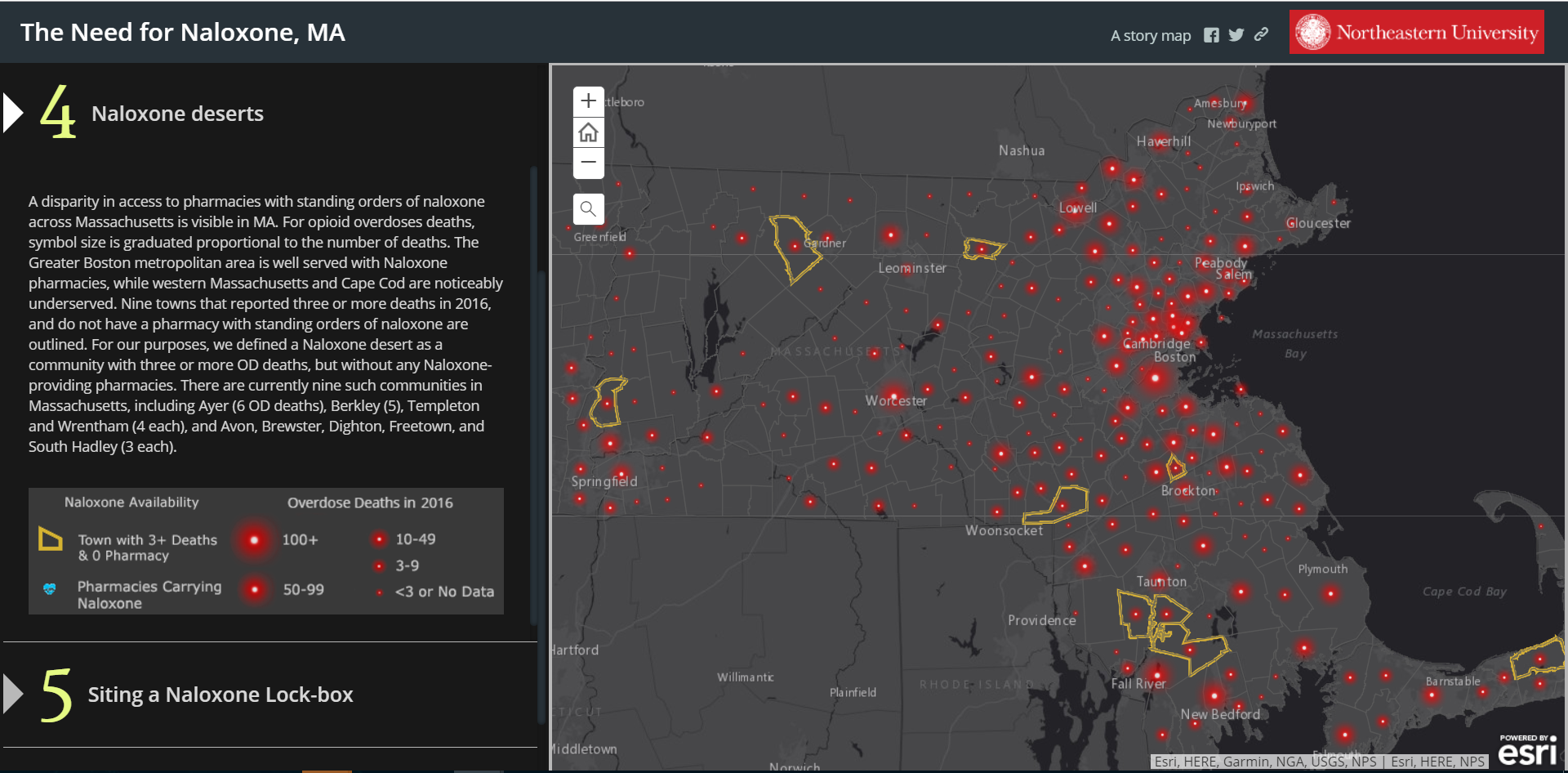
“Our first goal is to prioritize prevention, so we inventoried pharmacies with naloxone. In mapping these, we noticed a correlation between sites of overdose deaths and a lack of access to pharmacies—some towns were even classified as ‘naloxone deserts’.”
Dr. Cordula Robinson, Professor, Northeastern University
The Opioid Mapping Initiative comprises more than just local governments. A team of Northeastern University researchers and the school’s Global Resilience Institute are proactively addressing the opioid epidemic in Massachusetts.
The team started by compiling maps that examined death rates in Massachusetts. They were able to analyze year-over-year trends in opioid deaths and look more closely at opioid deaths per town. The team then created a story map to present this information publicly and highlight areas for better responses.
One of the clearest areas for change was found in nine “naloxone deserts,” or towns where three or more deaths have occurred, but there are no naloxone-providing pharmacies. Armed with clear information, Northeastern University and the Global Resilience Institute have started to hold larger community meetings, using data as a critical public education tool.
The team is now also bringing their focus closer to home, conducting in-depth analyses of fentanyl overdoses in Boston neighborhoods, working with community advisory boards, and partnering with local organizations like We Are Allies to distribute naloxone.
Since they began this work in 2017, several other universities have begun conducting similar studies. Higher education institutions often have the capacity to collect and analyze large amounts of data that local governments lack, making them a welcome addition to any area looking to implement data into their strategies to combat the opioid epidemic.