
Lisa Guernsey
Senior Director, Birth to 12th Grade Policy; Co-Founder and Director, Learning Sciences Exchange

 The Washington Post’s “Answer Sheet” just published a commentary I wrote about how to improve children’s grasp of math in the early years. It’s a call to parents to build math moments into the morning routine, just as book reading is part of the bedtime drill. To make something like this work, we’ll need preschool teachers and elementary school teachers to help parents recognize their own capacity for helping their kids, providing them with creative ideas that make math accessible and easy. I’ve included some of those ideas in the post below, but I’d love to find more. Please don’t hesitate to add your feedback and ideas to the comment section below or at the Answer Sheet site, where parents are chiming in.
Bedtime = book time. Parents know that equation by heart, or at least they’re supposed to. The drill goes like this: Just before the goodnight kiss, we snuggle up with our young kids, open a book, and read with them. Okay, so maybe at first we have to beg them to just settle down. And maybe the baby is more prone to eat the pages than look at them. But still, we try. We’re the ones responsible for these little human beings. It’s part of our job.
Mathematics, on the other hand, that’s not on the must-do list. Reading may be part of the raising-kids routine. Math — not so much.
But maybe it should be. Our children’s mediocre performance in mathematics has been a running theme. Reports stream forth on the need for educators to pay more attention to young children’s math skills. Last month, new data out of the U.S. Department of Education showed that fourth-grade students are in a math slump. After nearly two decades of watching fourth graders make steady progress, scores on the National Assessment of Educational Progress seemed to hit a wall. The average math score hasn’t budged since 2007.
Theories abound on why this might be. For one, we don’t recognize that young children can grasp more mathematics concepts than we give them credit for. A report from the National Academies of Sciences earlier this year pointed out that “although virtually all young children have the capability to learn and become competent in mathematics,” most of them don’t have good opportunities to do so. Teacher preparation programs are partly to blame too. Many teachers admit to being uncomfortable with math themselves – let alone prepared to make it fun and interesting for young kids.
So, yes, the educational system can do a lot more, but isn’t it time for numbers to get the nod in households too? Could mathematics for young children become embedded in family’s daily routines as deeply as bedtime books?
Here’s my proposal: Make way for morning math.
Now don’t take this the wrong way. This is not a call for yet more hyper-parenting. You won’t need preschool math tutors or 1+1 flash cards. Hang up the phone and put those away. A sure-fire way to make math miserable is to force a 4 year old to memorize what the number 10 looks like without giving him anything concrete to help him relate to those strange symbols and what they are supposed to represent.
Nor is this a proposal that only mathematical geniuses can pull off. This isn’t about doing differential equations at the dining room table. It doesn’t require pencils and paper, calculators or measuring sticks.
This is about helping to lay a foundation for children in their youngest years, when doing math is about finding fun, playful moments to introduce numbers, shapes, measuring, grouping and sorting.
Rummage through the sock drawer with your 4 year old, encouraging her to find a matching pair. Voila. You’ve covered one math concept already. Go to the freezer and pull out the frozen waffles for your 6-year-old. “You want one-and-a-half? How about three halfs instead?” Wink, wink, another concept down the hatch. Ask your 8-year-old to pour the juice so that the glasses are 75 percent full. Aha. A good opening for a chat about fractions.
Two years ago, in an influential article in the journal Developmental Psychology, researchers reported that mathematics skills trumped reading skills as one of the best predictors of success in the later school years. As policy makers and educators continue to search for the best ways to close the achievement gap, you can bet that math education for young children will be attracting more and more attention.
So let’s make math count in the home as well as at school. On the literacy front, we’ve had decades of reading research to remind us about the importance of that bedtime book-reading routine. Public service advertisements, kindergarten homework assignments and family literacy programs all urge parents to read a book with their kids.
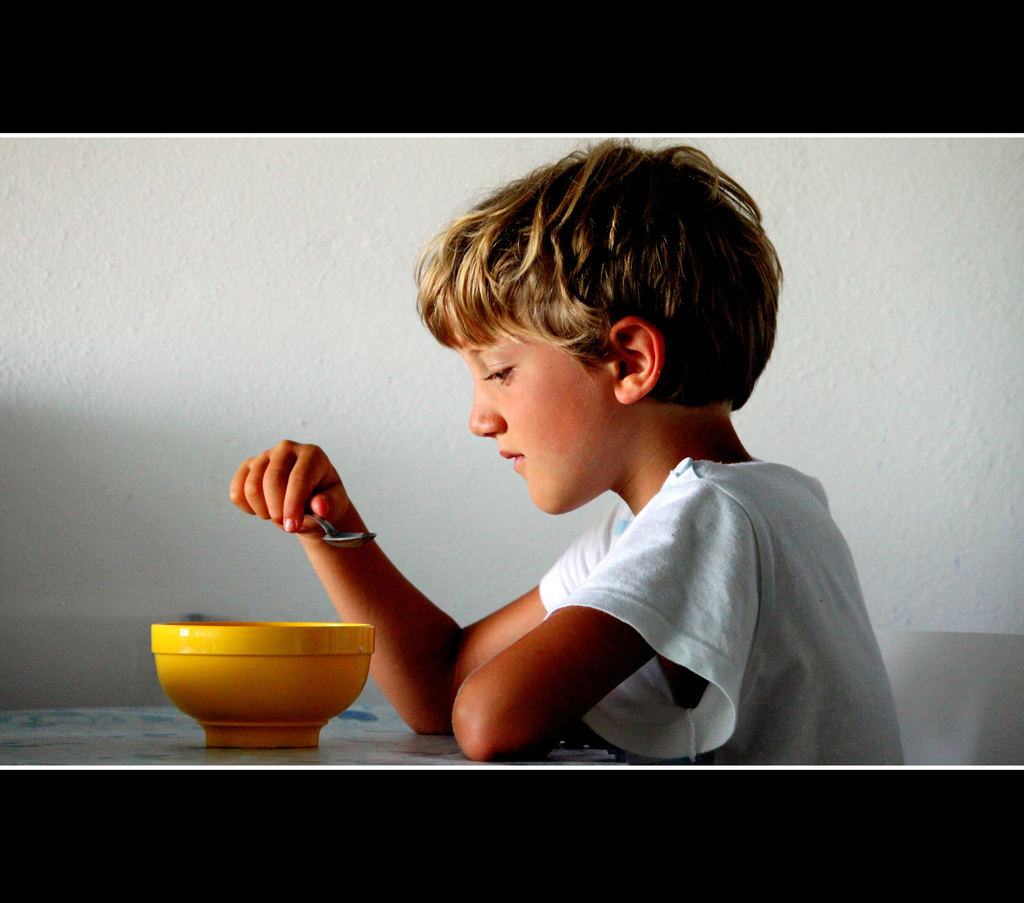
Imagine what might happen with a similar campaign that suggests ways for parents to do math in the morning with their children. Look for numbers on cereal boxes. Talk about the score of last night’s ball game. Point out patterns on their hats and mittens as you dress them for school.
At the very least, this morning math concept should be an idea worth pondering while we sip our morning coffee — after we’ve challenged our kids to estimate how many cups are still left in the pot.
Photo courtesy of flickr user Mario Bellavite under the Creative Commons license.
Senior Director, Birth to 12th Grade Policy; Co-Founder and Director, Learning Sciences Exchange