
Table of Contents
Local Governance Needs More Attention
When new early childhood programs are launched, decisions need to be made about how to run them and who will do it. There are many ways to structure early childhood programs within city, county, and state governments, and this structure is referred to as “governance.” Prenatal-to-3 Policy Impact Center defines early childhood governance as “the organization of government entities and the distribution of authority and accountability for administering programs and services that support young children and their families.” Early childhood governance is a lofty term with real impacts on the kinds of care families and children can get, because it helps define who participates in the system, where services are delivered, how connected they feel to local school systems, and more. Most families and many providers might not be fully engaged with the behind-the-scenes mechanics of governance, but they will be aware of the system performance and the way that the interacting pieces work together—or don’t.
“Early childhood governance is a lofty term with real impacts on the kinds of care families and children can get, because it helps define who participates in the system, where services are delivered, how connected they feel to local school systems, and more.”
State-level early childhood governance is well documented, with thorough state-by-state analysis of different models and interagency relationships from the Education Commission of the States. In recent years, more states have begun consolidating early childhood governance under one agency or entity, a trend that has been analyzed by New America, the Center for American Progress, and others.
However, this body of research offers limited insight into how states interact with local systems and what the implications are for local leaders who are designing and launching new early childhood programs. The National Institute for Early Education Research publishes a detailed annual report examining the inner workings of every state pre-K program, but there is no parallel resource for municipal pre-K programs. CityHealth has named high-quality pre-K as an indicator of overall health for a city and examines pre-K systems in the 75 largest cities, but their research does not address governance details. And Children’s Funding Project, which works with local governments as they raise new funds for children’s initiatives, has profiled the governance structures that some cities and counties have pursued—like New Orleans and Denver—but these are standalone case studies.
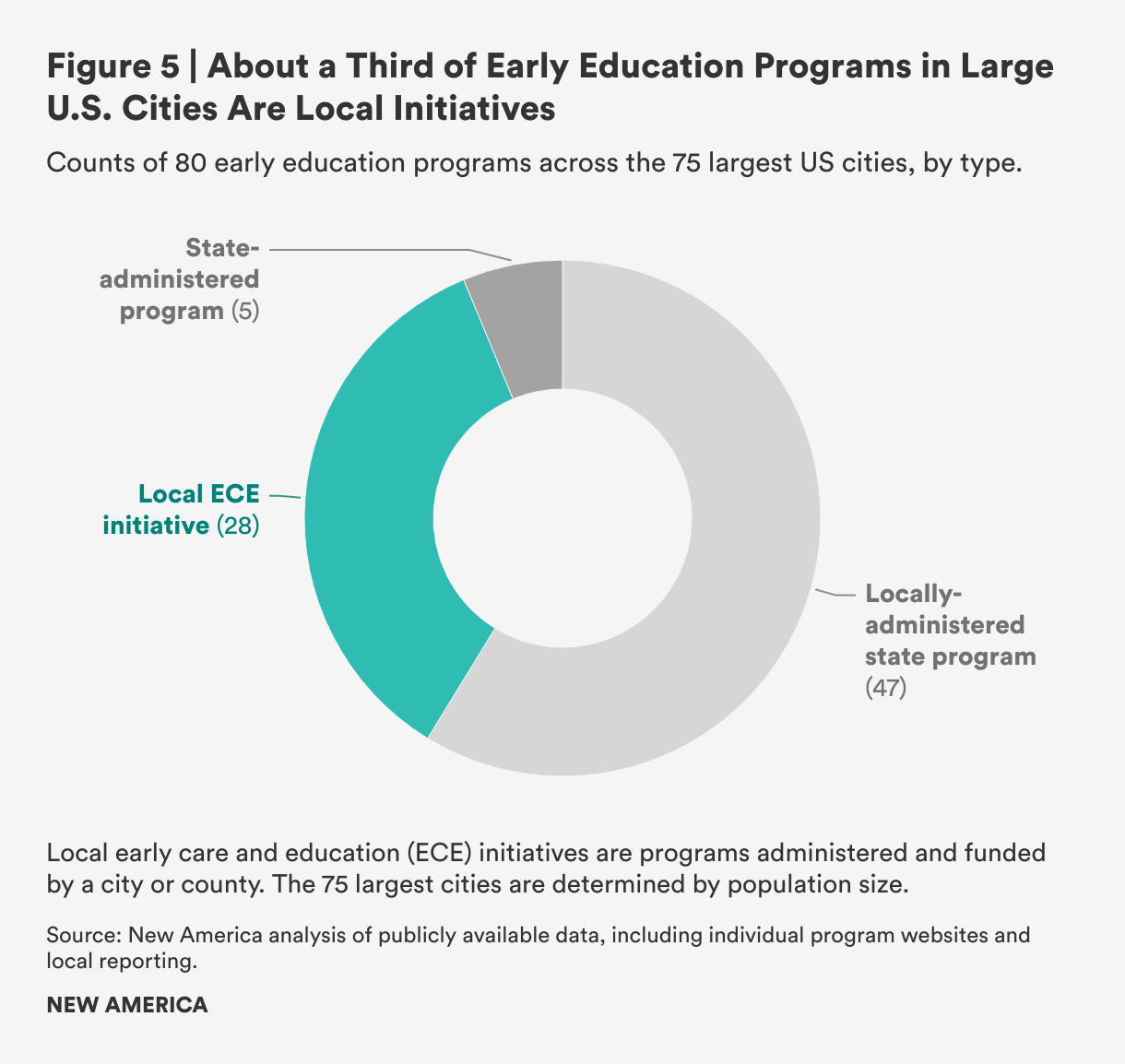
Analysis of public program data for 80 early education programs across the 75 largest cities revealed that while many of the programs were state-funded and administered or locally administered state programs (i.e., state preschool programs administered by the local school district), about one third (28 programs) were funded and administered locally, either at the city or county level (see Figure 5). This demonstrates the extent to which local early education programs are distinct from state-led or funded counterparts, and the need for more guidance on how such programs can be structured and stood up for local leaders.
The lack of overarching guidance at the local level leaves policymakers in the difficult position of designing systems without guidance documents or a compilation of best practices. This is not to suggest that there is one “best” governance structure—it is unlikely research would lead us to a clear answer, nor would that answer be helpful across contexts. Even when starting a system from scratch, few local leaders can just design the governance structure of their dreams. There are many constraining factors determining where a program will “sit” and who will run it. Within the ECE Implementation Working Group, there are members from mayor’s offices, county executive’s offices, county agencies, independent nonprofits, school districts, and local collective impact organizations. This is not some haphazard accident—it’s because in their respective city or county each of these groups plays a pivotal role in implementing publicly funded programs.
Still, experience from the group teaches us that when local leaders can learn from each other, it improves the efficacy of implementation, and documenting lessons from different approaches to local early childhood governance will help future champions and leaders design programs that are well suited to their operating environments.
“Documenting lessons from different approaches to local early childhood governance will help future champions and leaders design programs that are well suited to their operating environments.”
This report defines different local early childhood governance archetypes and describes where and how they are used. Understanding the strengths and drawbacks of different archetypes will support local leaders, across all governance structures, in decision-making and design. For municipalities just starting out, why pick one governance approach over another, to the extent there is a choice? What are some important design considerations to fight for? For municipalities already locked into a governance structure, what are some lessons on maximizing impact that apply to your particular approach?