
Table of Contents
A Framework for Different Local Models
For the purposes of this report, we focus on explicitly local early childhood initiatives (i.e., those with dedicated local revenue sources) and their governance structures. In this context, ‘governance’ refers to what entity or entities administer the overall program and bear fiscal responsibility for it. The governing body is sometimes, but not always, a direct operator of services. The models we looked at are mostly, though not exclusively, pre-K programs.
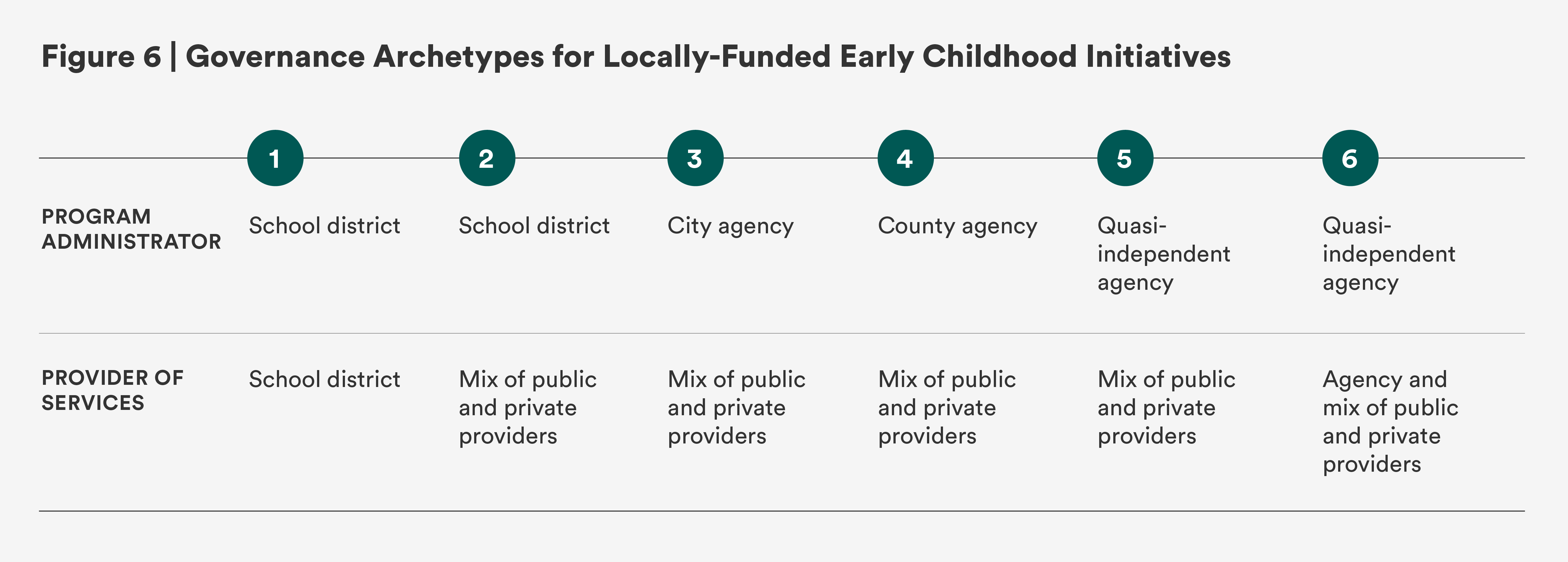
Across locally funded early childhood initiatives, there are at least six archetypes for governance (see Figure 6 above):
- The school district administers the program and directly operates all services. This approach is becoming less common as more systems move toward mixed delivery models where services are offered both through public schools as well as contracted, private partners like center-based programs, Head Start programs, family child care homes, and others. This archetype reflects how Boston’s preschool program was managed for many years, though they have recently begun incorporating some contracted partners. Similarly, Baltimore City Public Schools administered and operated all preschool services until recent state legislation pushed for mixed delivery. California’s statewide Transitional Kindergarten program—which is on a path to serve all four-year-olds in the state—is administered and operated by school districts almost exclusively.
- The school district administers the program, directly operating some services and contracting with a mix of providers for others. New York City’s Pre-K for All program is run by the city’s public school system, though more than half of the preschool slots are operated by contracted partners. In Chicago, the city’s Chicago Early Learning initiative, which includes services for children from birth through age five, is a partnership between the mayor’s office, the city’s Department of Family and Support Services, Chicago Public Schools, and privately operated Head Start programs. Fiscal and administrative controls for the city’s preschool program fall under the auspices of Chicago Public Schools, which operates most, but not all, of the city’s pre-K seats.
- A city agency administers the program and works with a mix of public and private providers. In Philadelphia, the Office of Children and Families sits within the mayor’s office and has oversight of the PHLpreK initiative. The city partners with over 300 preschool sites, including many public schools, and the School District of Philadelphia is a core partner. The San Francisco Department of Early Childhood—a standalone city agency—administers the city’s Early Learning for All initiative, which offers free or low-cost child care to most families in San Francisco. Over 500 child care centers and family child care providers participate in Early Learning for All programs, and services are also provided through the San Francisco Unified School District.
- A county agency administers the program and works with a mix of public and private providers. In Multnomah County, Oregon, the countywide Preschool for All initiative is implemented by the Preschool and Early Learning Division in Multnomah County’s Department of County Human Services. The county works directly with private child care centers and family child care providers, as well as Portland Public Schools and some smaller school districts.
- A quasi-independent agency administers the program and works with a mix of public and private providers. These organizations are operated as independent nonprofits and have their own boards of directors, though some board members may be appointed by the mayor or other public agencies. Public funds are directed to the nonprofit for distribution to preschool providers and to support administrative services. Denver and Cincinnati have similarly structured preschool initiatives—the Denver Preschool Program and Cincinnati Preschool Promise both administer funds and work with their local school district and with private child care providers to offer services, but neither organization directly provides preschool services.
- A quasi-independent agency administers the program, provides direct services, and works with a mix of public and private providers. Like in the model above, these organizations operate as independent nonprofits, but with some oversight from the city or county government. In San Antonio, Pre-K 4 SA is a standalone entity administering the city-funded preschool program; Pre-K 4 SA directly operates four centers, serving 4,000 children annually. Pre-K 4 SA also works with private providers and school districts throughout San Antonio to provide additional services and support.
Across local early care and education programs in the 75 largest cities, the most common governance model includes an independent or quasi-independent agency; almost 40 percent of the 28 local governance systems analyzed here are administered by an independent agency (see Figure 7).
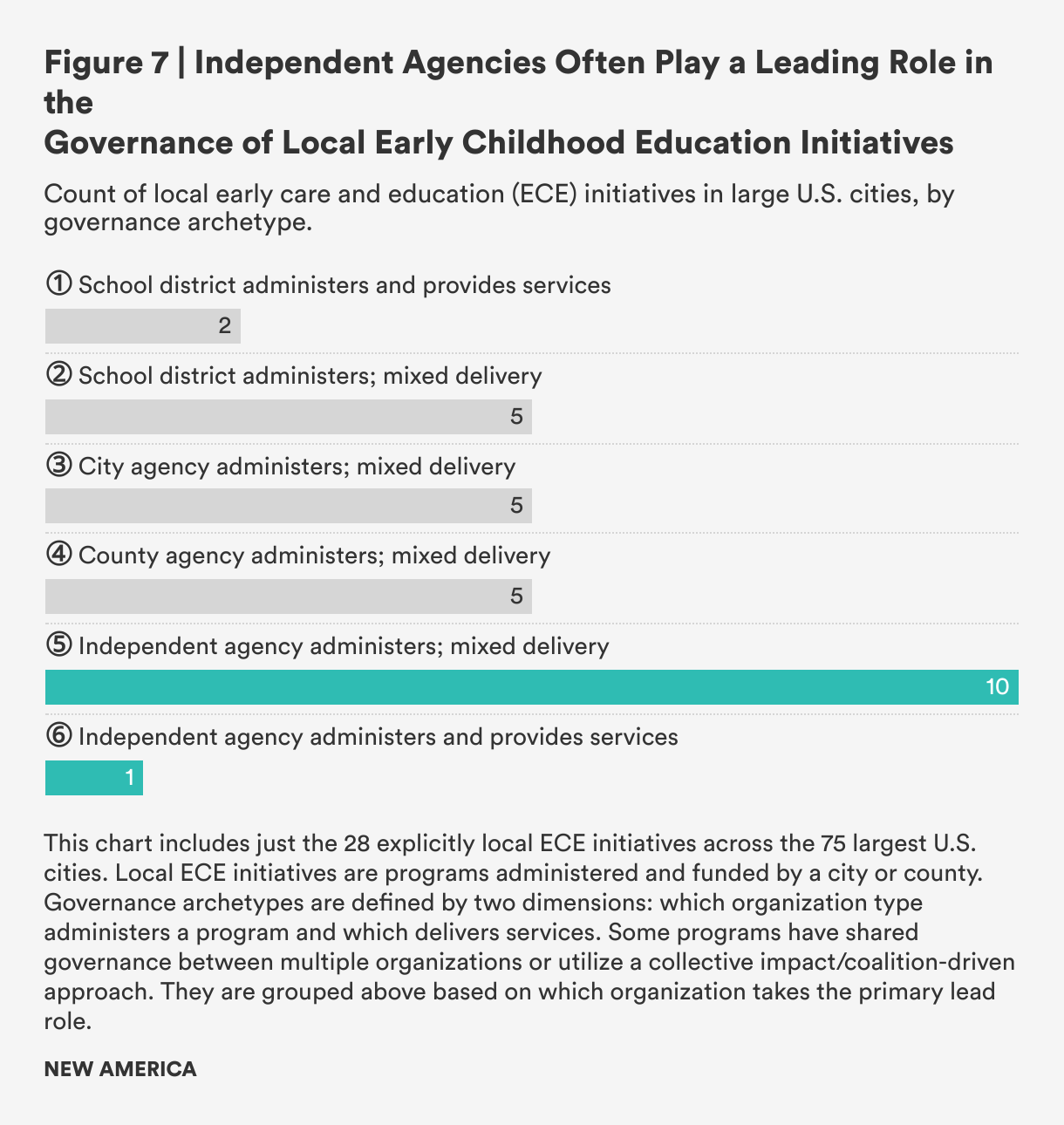
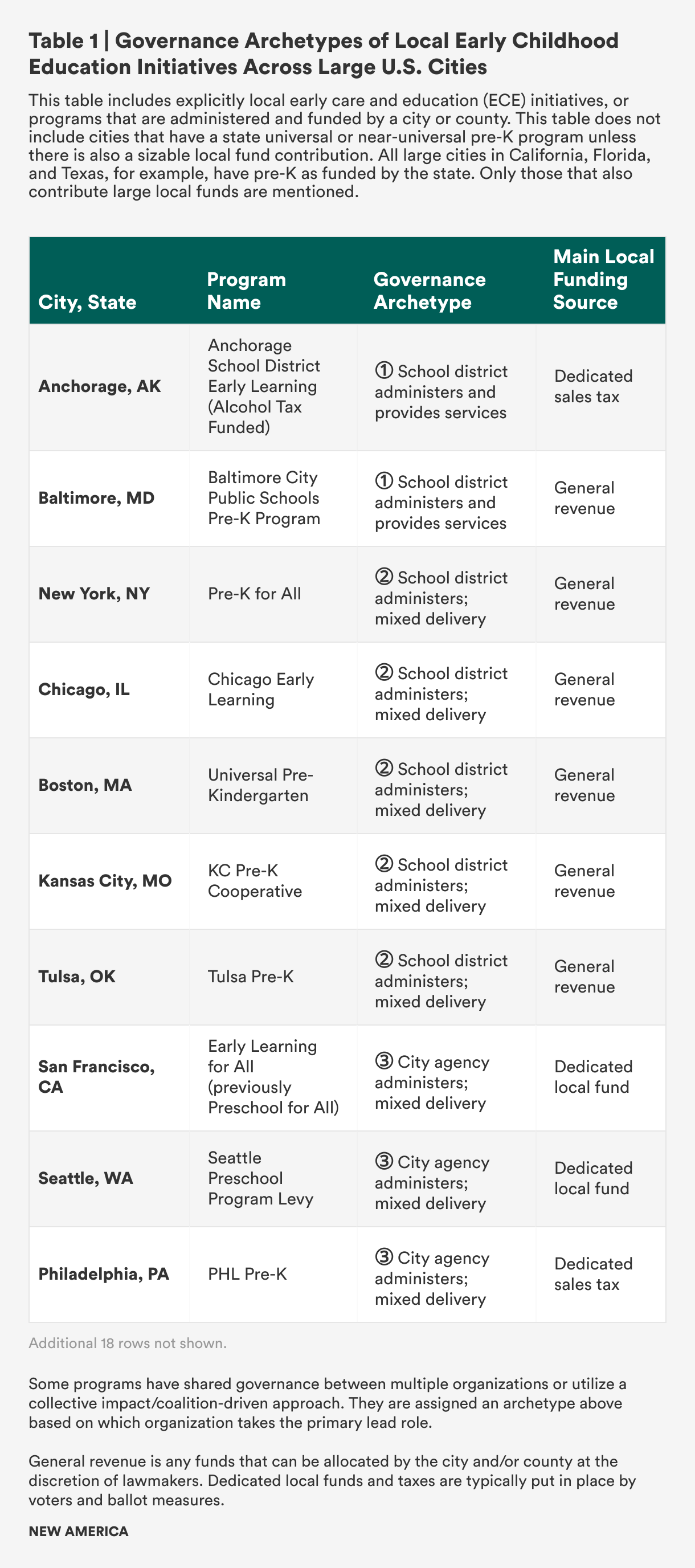
This is not a wholly comprehensive list of every possible local governance structure. Some places have a shared governance model, in which multiple organizations hold responsibilities for program oversight. For example, in New Orleans, the city’s early childhood program is jointly administered by a local nonprofit, Agenda for Children, and New Orleans Public Schools. Many large cities take a collective impact approach, in which multiple organizations hold different responsibilities and come together as a coalition. Washington, DC, is another outlier; the Office of the State Superintendent of Education oversees the city’s early childhood program. Still, this framework can help us understand some of the most common approaches and sort local programs accordingly (see Table 1).1
Citations
- Program archetypes were determined through the authors’ analysis of programs’ websites, local news reporting, and other reputable public sources. Not all programs fit neatly into one archetype. In cases with shared governance or collective impact approach, the archetypes are based on which organization takes the lead role. We welcome feedback on this analysis; please contact us at npl_work@newamerica.org with questions or if you believe a program has been misidentified.