
Table of Contents
- Summary of Findings
- Introduction
- What Americans Think about Why Men Do and Do Not Take Leave from Work to Care for Loved Ones
- Who Has Access to and Uses Family and Medical Leave from Work?
- Six in 10 Americans Anticipate Needing to Take Leave from Work in the Future
- Affording Leave: How Americans Get Pay When They Take Leave and How They Cover the Gaps
- Conclusion
- Methods
- Bibliography
Who Has Access to and Uses Family and Medical Leave from Work?
The complicated, confusing, and uneven leave landscape for workers
Across America, workers welcome new babies, care for ill spouses, partners, siblings, children, friends, and aging parents over the course of their working lives. Caring for all of these individuals often requires taking time away from work. But not every employed person in the United States has access to leave from work, be it paid or unpaid, short or long, and when they do have it, it can take many forms. Leave from work can take a variety of forms:
- Sick leave allows the worker to take short periods of time off to care for their own health, and under some workplace policies, and laws in some states and localities,1 the health of a loved one.
- Vacation time gives workers access to time away from work to travel, visit loved ones, rest, and rejuvenate—or take care of chores and caregiving demands.
- Some workers may have access to an aggregated pool of personal paid time off that can be used as the worker wishes, with no expectation that it is used for a particular purpose.
- Some workers have access to paid family and medical leave, where time away from work to care for a new child, a sick family member, or one’s own health condition is partly or fully paid. This leave may be an employer-provided benefit, or in some states is accessed through a public insurance program paid for through employee and/or employer contributions.
- And still other American workers have access to unpaid leave through the Family Medical Leave Act of 1993, that enables some full-time workers to take unpaid, job-protected leave. Qualified workers must be employed by businesses with 50 or more employees and have worked there for one year to take time off of work without pay.
Asking Americans about these different kinds of time off from work can get confusing. Other research has shown that American adults don’t often know what the various policies are in their workplaces around various types of leave until they need to use it.2 Some workers assume they have access to paid maternity or paternity leave, only to find they don’t. Some workers cobble together paid vacation and sick days and think that’s paid family leave. In other instances, especially around paid family and medical leave, it’s not clear to workers who is providing the benefit—a state or an employer—and how it should be counted.
Some employers offer temporary disability insurance to new mothers recovering from childbirth, but otherwise do not offer any pay for time off work to bond with a new child—thereby excluding adopted and foster children and any parent who did not give birth—and call that paid family leave. The available leave is further complicated by a range of options offered by several states with a variety of eligibility requirements and implementation dates.
One father said he didn’t know what his company’s policy was on paid family leave benefits until he needed them. He discovered he didn’t have any.
In our survey of 2,966 American adults, we found that more than half of those who are employed say they get paid vacation days (64 percent), paid sick days (59 percent), or paid time off to do as they choose (54 percent) through their employers. Fifty-two percent say they get unpaid family and medical leave. Overall, 43 percent of Americans in our survey say they have taken leave to care for a new child or an adult family member in need. More than half (52 percent) of parents of kids of any age say they have ever, at any point in their lives, taken paid or unpaid leave following the birth or adoption of a new child. Nearly three in 10 (28 percent) of the survey respondents said they had done so to take care of an adult family member. This includes leave of more than a day or two off work, regardless of whether that came from sick or vacation time or some other allotted time off work, paid or unpaid. Our survey question asked generally about leaves that lasted “more than a day or two” off work, but did not specifically ask about the duration of leaves.
For instance, one father in our online threaded focus group sessions said he didn’t know what his company’s policy was on paid family leave benefits until he needed them. It was then that he discovered he didn’t have any. “It’s not something I knew anything about, until you really get into educating yourself about the pregnancy, birth, and postpartum experience,” he said.
Why does New America data look so different from the BLS data?
Our data shows that 43 percent of workers in our sample say they have taken paid family and medical leave, while the standard Bureau of Labor Standards data shows 19 percent of the civilian workforce has access to paid family leave. More civilian workers, 40 percent, have access to personal medical leave through employer-provided Temporary Disability Insurance,3 which can be used to cover a birth mother’s recovery. Some of the discrepancy may be due to confusion. Previous research suggests that employees don’t always have a full picture of what their benefits really are until they need to use them. Additionally, we defined leave as more than one to two days off work, and informed participants this could include paid vacation, paid sick days, or other methods of taking time away. BLS data captures only programs explicitly classified as paid leave. Further, there may be methodological differences in data collection. New America’s data comes from a nationally representative panel survey of 2,966 American adults reporting on what they believe they have access to, while the BLS data comes from a survey of employers.
Using Leave: Care for infants and newly adopted children
Roughly one-third of parents have not taken any leave to care for a new child.
About half of parents of children of any age say they’ve taken leave at some point in their lives to care for a new child, but about one-third (31 percent) of parents said they have not taken any leave to care for a new child. This latter finding, because it includes workers with now-grown children, could reflect how women more often left—or were forced to leave—the workforce after giving birth in the past, how few men have had access to leave or felt empowered to use it, and/or how caregiving leaves are a relatively new phenomenon in America, with a legal guarantee to unpaid leave enacted in the last 25 years.
About three in 10 American adults are parents of a minor child.4 In our survey, among all parents of children of any age (from infancy to adults with their own families), just about half (52 percent) said they took some kind of leave at some point in their lives to care for a newborn or newly adopted child. By our definition, this leave would have been more than a day or two, and could have been unpaid, partly paid, or paid from any source—vacation days, sick days, disability benefits, or a state public or employer-provided Paid Family Medical Leave program.
One in 10 parents said they were not working when they would have needed to take leave.
About half of all parents said they took some kind of leave at some point in their lives to care for a newborn or newly adopted child.
Men take leave to care for family, but are less likely to do so than women.
Overall, mothers are more likely than fathers to report taking any kind of leave for a new child, with 55 percent of mothers taking some kind of leave, compared with 48 percent of fathers. Mothers are more likely than fathers to report that they were not working when they would have needed to take leave (15 percent of mothers versus 5 percent of fathers). Fathers are more likely to report not having access to leave when they needed or wanted it (8 percent of fathers versus 4 percent of mothers).
As families grow, fathers today are more likely to have taken leave to care for a new child. Current fathers of two or more young children (eight and younger) are more likely to report that they’ve taken leave to care for a child than fathers with just one young child. Fully 62 percent of fathers of two or more young children have taken leave to care for a child, compared with 50 percent of fathers with one young child.
In our focus group research, fathers and mothers talked about the times they were able to take leave to care for their new infants. The interviews highlighted the variability in leave that fathers especially were able to take when caring for new babies—from two days, to a week or two. In one rare instance, one father took one year of caregiving leave.
“I was able to take one week off following the births of both of our children. I had to use vacation time, and my boss did bother me a few times with some trivial phone calls. I wish I would have been able to take off longer with the first child.” –Asher J., 39 years old, entrepreneur, father of two, Indiana.
“I received a year of paternal leave from my job to help take care of my kids, but I have not taken any other such time off. I was still paid during that time, so I didn’t need to worry about finances very much. If I weren’t given parental leave, I probably wouldn’t have taken any time off, simply because my job is so fast-paced that I may actually get let off if I take too many breaks.” –David I., 26 years old, teacher, father of two, Pennsylvania.
Low-income workers struggle to take leave to care for a new child.
In our survey, the lowest-income parents, those earning less than $30,000 in household income each year, were the least likely to say they had ever taken any leave—paid or unpaid, longer than one or two days for the birth or adoption of a child. Two in five (40 percent) of the lowest wage earners took leave to care for a new child, compared with 56 percent of those earning more.
Hispanic parents are the least likely to say they have taken leave to care for a new baby.
White and Black parents are more likely than Hispanic parents to say they’ve taken time off work to care for a new baby—43 percent of Hispanic parents have taken more than a day or two off work, compared with 56 percent of Black parents and 53 percent of white parents. Most of the differences are from lower levels of leave taking among Hispanic mothers, which may reflect lower levels of labor market participation or higher participation in occupations where leave is not offered or job protected.
Using Leave: Care for family
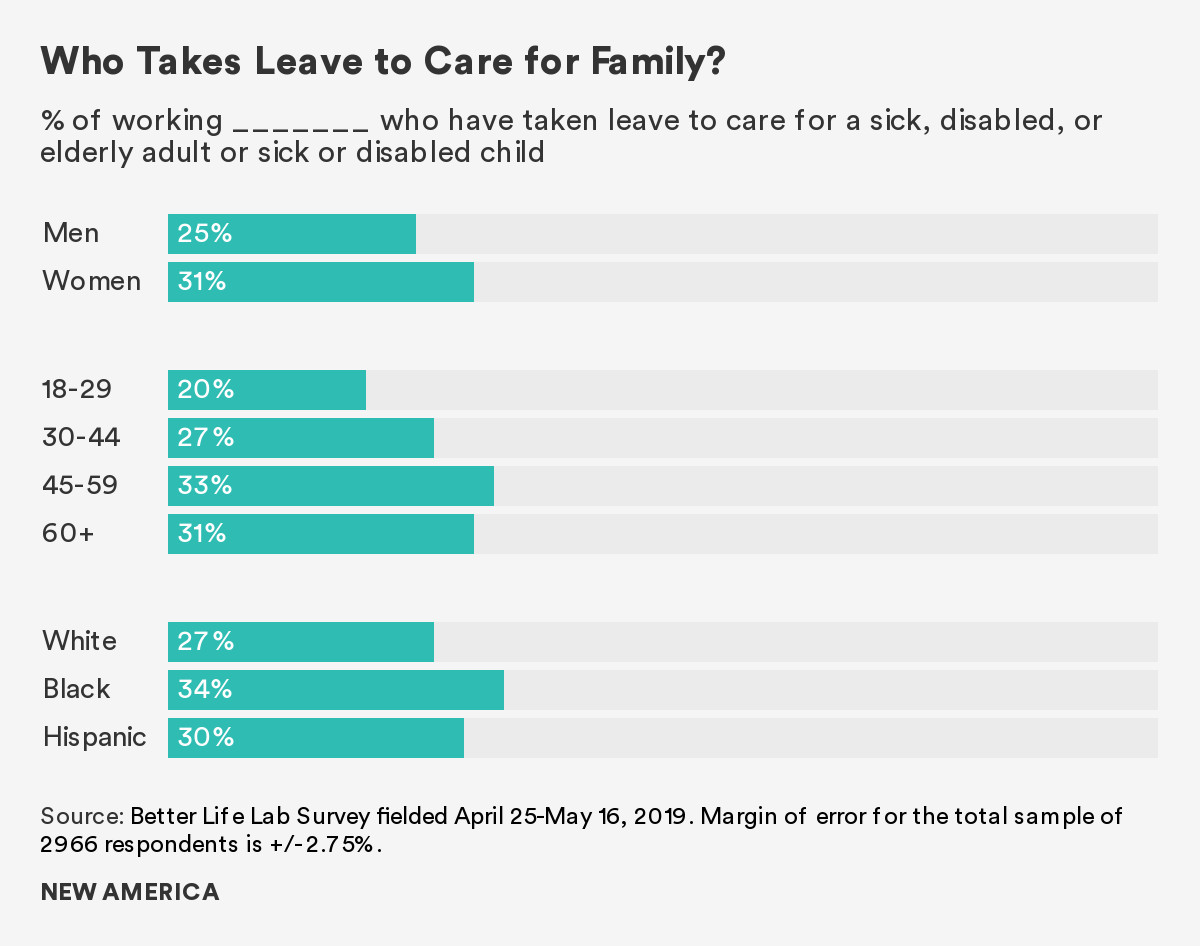
While policymakers often focus on care for new infants when thinking about adults taking leave from work, a substantial portion of leave from work is used for care for a disabled, ill, and/or aging adult or a sick or disabled child. Nearly 3 in 10 (28 percent) American adults say they have taken leave from work to care for a sick, disabled, or elderly family member.
Women and middle-age adults are more likely to take leave to care for family.
As with infant and new child bonding leave, women are more likely to take leave, with 31 percent of women taking leave to care for adults compared with about a quarter (25 percent) of working men.
Adults 45–59 years old are the most likely to report having taken leave—with a third of adults that age reporting that they’ve ever taken leave to care for a family member. Black adults are more likely than white adults to have taken leave to care for a family member.
Lowest-income workers lack access or were not working when they needed leave.
The lowest-income workers are the most likely of all income groups to say they have not taken leave to care for an elderly family member or sick adult or child. The data suggests that these workers are more likely to say they were not working when they needed the leave, and that they did not have access to it when they needed it.
Citations
- National Partnership for Women and Families, Fact Sheet, (Washington, DC: National Partnership for Women and Families, 2019), source
- Barbara Gault, Heidi Hartmann, Ariane Hegewisch, Jessica Milli, and Lindsey Reichlin, Paid Parental Leave in the United States, (Washington, DC: Institute for Women’s Policy Research, 2014), source
- Bureau of Labor Statistics, National Compensation Survey: Employee Benefits, (Washington, DC: U.S. Department of Labor, March 2019, source
- Gretchen Livingston, More than One-in-Ten U.S. Parents are Caring for an Adult, (Washington, DC: Pew Research Center, 2018), source