
Lifting the Barriers to Paid Family and Medical Leave for Men in the United States
Table of Contents
- Summary of Findings
- Introduction
- What Americans Think about Why Men Do and Do Not Take Leave from Work to Care for Loved Ones
- Who Has Access to and Uses Family and Medical Leave from Work?
- Six in 10 Americans Anticipate Needing to Take Leave from Work in the Future
- Affording Leave: How Americans Get Pay When They Take Leave and How They Cover the Gaps
- Conclusion
- Methods
- Bibliography
Abstract
Rather than thinking caregiving is something only women should do, Americans’ attitudes toward men giving care and taking caregiving leaves are evolving, most notably among men themselves. Based on a nationally representative survey conducted in partnership with NORC at the University of Chicago, and five online focus groups, this report points to key barriers men face that may prevent them from taking time off from work to engage in caregiving. These include financial concerns, inadequate workplace and manager support, and family and cultural barriers. These barriers are particularly challenging for low and median-wage earners who have the least access to paid leave. None of these barriers are adequately addressed in the current ad hoc system in America that relies on private companies to decide to voluntarily offer paid caregiving leave, or in public policy, where a piecemeal system benefits only those lucky enough to live in the handful of states that offer the paid leave benefit to residents and adequately enable them to use it.
Key statistics from the report:
- Nearly half of mothers and fathers didn’t even take two days off work, paid or unpaid, after the birth or adoption of a child
- Six in 10 adults say they anticipate needing to take time off in the future to care for a new child or adult family member
- Men and women equally anticipate needing to take leave, but men lag behind women in actually taking it. 48% of fathers versus 55% of mothers have taken time off to care for a newborn, and 28% of working men versus 31% of working women have taken time off to care for a family member.
- 87% of adults say a reason men don’t take leave from work for caregiving is that they can’t afford it
- Of men who were able to take leave from work, 65% reported receiving some pay. Only 53% of women who took leave reported receiving some pay
- Workers in low-income households are the least likely to have access to paid leave. Just 41% of workers in households earning less than $30,000 annually had leave that was partly or fully paid, compared with nearly three-quarters of workers earning $100,000 or more annually.
Acknowledgments
This study was conducted with support from the Robert Wood Johnson Foundation and Pivotal Ventures, an investment and incubation company created by Melinda Gates
Roselyn Miller and Jahdziah St. Julien, of the Better Life Lab team and former team members Elizabeth Weingarten, Alieza Durana and Leah Crowder made invaluable contributions to the design, data collection, analysis, writing, and editing of the report.
The authors of the report would like to extend a special thanks to NORC colleagues Dan Malato, Jennifer Titus, Jennifer Benz, and Tomas Okal for their thoughtful assistance and work on this project.
We are also incredibly grateful to the men, many of them busy caregivers themselves, who thoughtfully reviewed our focus-group questions: Amit A. Pandya, Eddie Munoz, John Buttell, and Evan Schweikert.
We would also like to thank our outside reviewers who gave input on the study design and/or this report: Juliana Horowitz, Gretchen Livingston, Susannah Fox, Jeffrey Hayes, Vicki Shabo, Richard J. Petts, and Jessica Mason. Special thanks to Alieza Durana for her copyediting of this report.
And finally, thanks to our stellar New America colleagues who helped get this report out into the world: Maria Elkin, Joanne Zalatoris, Angela Spidalette, Narmada Variaym, LuLin McArthur and Naomi Morduch Toubman.
Summary of Findings
The subject of men’s interest in and ability to take paid time off work for caregiving leave has become an important focus of national and global discussions of evolving masculinity norms and gender equality. Whether they become fathers or need to take care of family members and loved ones at other critical moments, men’s growing role as caregivers has not yet been matched by appropriate policy and social support.
For decades, the public discussion of paid leave has focused on new mothers’ rights to time off work for recovery after childbirth and time to bond with and nurture newborns. This has been of particular concern in the United States, virtually the only nation where mothers have no legal guarantee to paid leave. A number of countries found that long paid maternity-only leaves served only to reinforce traditional gender roles and the expectation that women should be primary caregivers, rather than foster gender equality. As a result, at the turn of the twenty-first century, several nations began to design new paid caregiving leave policies to encourage men to use it too. Research is finding that men who take paid parental leave become more involved in direct care and hands-on parenting, which can lead to closer attachment and better social, emotional, cognitive, and health outcomes for their children.1 Further, research on paid parental leave finds that men taking paid time off work to care reduces family stress, improves the quality and stability of relationships with their partners, and increases paternal health and life expectancy.2 Men taking paid leave to care and normalizing shared caregiving norms are also associated with narrowing gender wage and opportunity gaps.
As experts continue to grapple with the stalled progress toward gender equality in the United States, and as more states and Congress consider paid family and medical leave policy, it is critical to better understand what men want when it comes to taking time off work to give care, what enables them to take leave, and what prevents them from doing so. Further, it is important to learn whether and how men use leave, what they think about it, and what they anticipate needing in the future to care for themselves and their families.
In a study that included a nationally-representative survey and online focus group discussion boards, we found that men make up a significant portion of those who need to take time off work for care. We found that, while there are still tensions around masculine ideals around caregiving, economic factors, family attitudes and support, and workplace cultures and practices are key in driving both what motivates and what inhibits men from taking caregiving leaves.
In all, our study shows that, contrary to conventional wisdom, men not only have widespread experience taking caregiving leaves, though typically of short duration, but also significant anticipated need for paid leave for caregiving in the future. Because men in the United States typically tend to take no more than one week of leave following the birth of a child, and while the median length of leave for women is 11 weeks,3 our survey defined leave as “more than a day or two off work” in order to capture the broadest range of men’s experiences and anticipated need. Still, even with that expansive definition, it’s important to note that, while the survey found significant anticipated need for leaves to care for children or families, caregiving leaves are still relatively rare or difficult to access in America. While about half of mothers and fathers reported taking paid or unpaid leave for the birth or adoption of a child, nearly half didn’t even take two days off work. The numbers are even higher for paid or unpaid leave to care for family members, with about three-fourths of men and 69 percent of women reporting taking less than two days off work.
The study results also reveal that, rather than thinking caregiving is something only women do or should do, as traditional gender norms hold, Americans' attitudes toward men giving care and taking caregiving leaves are evolving, most notably among men themselves, and particularly among older men who’ve had more life experience. Yet, our findings point to key barriers men face that may prevent them from taking time off from work to engage in caregiving. These include financial concerns, inadequate workplace and manager support, and family and cultural barriers. These barriers are particularly challenging for low and median-wage earners who have the least access to paid leave. None of these barriers are adequately addressed in the current ad hoc system in America that relies on private companies to decide to voluntarily offer paid caregiving leave, or in public policy, where a piecemeal state system benefits only those lucky enough to live in the handful of states that offer the paid leave benefit to residents, and adequately enable them to use it.
We summarize our key findings below:
A solid majority of Americans believe that financial and workplace pressures shape men’s decisions around caregiving leave.
- Eighty-seven percent of Americans believe that economic factors are what chiefly influence men’s decision surrounding leave. A majority of American adults (70 percent) say that not being able to afford to take leave from work is a major reason that men don’t take leave, and another 17 percent say it’s a minor reason.
However, a majority say that support from both family and one’s employer are factors that enable men to make that choice.
- More than half (53 percent) of American adults think that support from family is a major reason why men take leave, with another 31 percent saying it’s a minor reason.
- Slightly less than one third (30 percent) of Americans said that managers supporting and encouraging their employees to take leave is a major reason why men are able to take leave from their jobs to give care. Another 35 percent said it’s a minor reason.
- One quarter (27 percent) of American adults think a lack of visible penalties for other male colleagues who’ve taken leave in their workplaces is a major reason why men take leave. Another third (34 percent) believe this is a minor reason.
Americans also overwhelmingly think men who do take leave do so because it’s the right thing to do, with more than 84 percent saying it’s a reason men take leave.
The survey also uncovered complicated and evolving views around the roles of men and notions of masculinity in America, and how masculine identity incorporates—or doesn’t incorporate—caregiving. It also found differences between men and women on the importance of these views.
- The survey asked men and women if the idea that caregiving isn’t “manly” is a factor in men not taking leave. Though a slight majority of people still hold more traditional views of gender roles, more men disagreed. Nearly half of men, 47 percent, rejected the notion that caregiving leaves aren’t manly. Forty-three percent of women say the same.
- Two in five (40 percent) American adults think a major reason that men don’t take leave is because they don’t need to, because their partners or other family members take the caregiving leave instead. And yet far fewer men think it’s a major reason why men don’t take leave (34 percent) than women (46 percent).
We also found that both men and women are finding ways to take time off for care now, though there are major disparities in the ability to do so.
- Despite the absence of a federal policy, or rather because of it, a significant number of American men and women find a way to take leave of “more than a day or two,” but often at a cost to themselves and their families.
- Confirming previous research, we also found that workers with more education and financial resources are more likely to have access to fully or partially paid leaves.4
- Although our survey did not address the duration of leave beyond more than two or three days, in our qualitative focus groups, several men reported that the paid leaves they were able to take were of a significantly shorter duration than they needed or wanted.
Both men and women anticipate needing to take time off work, particularly as they look to the future. Six in 10 adults say they anticipate needing to take time off in the future to care for a new child or adult family member. More than half of Americans anticipate needing leave in the future to care for ill, disabled, and elderly family members, and nearly a third anticipate needing leave to care for a new child.
- About three in 10 men anticipate needing leave to take care of a new child. Men and women are equally likely (30 percent) to say they will need this type of leave in the future.
- Half of the workforce (51 percent) anticipates needing time off at some point in the future to care for a sick, disabled, or elderly family member. There are no differences by gender, race, or ethnicity in anticipating leave.
Though many men report taking time off work to give care, they still lag behind women, but not by much.
- When it comes to paid or unpaid parental leave, 55 percent of mothers report taking some kind of leave following the birth or adoption of a new child, compared to 48 percent of fathers.
- Women are also slightly more likely to report taking leave to care for family members, with 31 percent of women taking leave from work to care for adults compared with a quarter (25 percent) of working men.
- Men are feeling the squeeze of the sandwich generation: 34 percent of men with children say they have taken leave to care for an ill, disabled, or elderly family member. Hispanic fathers are more likely than white fathers to say they have taken leave to care for an ill, disabled, or elderly family member (42 percent of Hispanic fathers versus 30 percent of white fathers).
Men are overall slightly less likely to have taken a caregiving leave from work than women. But when men do take leave, they’re more likely to be paid, and fully paid, than when women take it.
- Sixty-five percent of men who were able to take leave from work reported receiving some pay, compared with 53 percent of women who took leave, even though only women are eligible for partially paid disability insurance for the birth of a child, which some workers receive through their employer or a state public policy system.
- Men who received pay during leave were also much more likely than their women counterparts to say that leave was fully paid—52 percent of all men who took paid leave said their leave was fully paid, compared to just over a third (35 percent) of women.
- And while just 28 percent of men who took leave said that leave was unpaid, fully 40 percent of women who took leave reported receiving no pay while off of work.
Workers in low-income households are the least likely to have access to leave and to get paid when they take it.
- Workers in low-income households, who often have the least savings and who are the most likely to need every paycheck they earn to make ends meet, are the least likely to have access to paid leave. Among those workers able to take leave when they needed it, just 41 percent of workers in households earning less than $30,000 annually had leave that was partly or fully paid, compared with nearly three-quarters of the highest-earning workers—those earning $100,000 or more a year.
- Lower-income households are more than twice as likely to take unpaid leave for caregiving than higher-income households (52 percent to 24 percent).
As more states pass public paid family and medical leave policies, and as pressure mounts for a paid leave program at the federal level, this report highlights critical elements that policymakers must take into account when designing fair and effective policies that would cover all American workers and provide American families with the time, opportunity, and support they need to combine work and care responsibilities. These include job protection, adequate wage replacement, particularly for low-wage workers, evidence-based adequate duration of leave, protection from negative consequences at work, and universal access to caregivers of all genders.
Citations
- Brigid Schulte, Alieza Durana, Brian Stout, and Jonathan Moyer, Paid Family Leave: How Much Time Is Enough? (Washington, DC: New America, 2017), source
- Most paid parental leave research focuses on heterosexual relationships. Little research is available on same-sex couples or solo parents and caregiving leaves, or outcomes related to paid leaves for family care.
- Juliana Menasce Horowitz, Kim Parker, Nikki Graf, and Gretchen Livingston, Americans Widely Support Paid Family and Medical Leave, but Differ Over Specific Policies, (Washington, DC: Pew Research Center, 2017),source
- The Council of Economic Advisers, The Economics of Paid and Unpaid Leave, (Washington, DC: The Executive Office of the President of the United States, 2014), source
Introduction
Dave Sucharski didn’t think much about whether he had access to time off work for caregiving until he needed it. It was only when his wife was pregnant and about to deliver their first child in the summer of 2017 that Sucharski, who participated in our focus groups and agreed to be interviewed, realized the small Pennsylvania firm where he worked didn’t offer paid or unpaid paternity leave. Because of their small size, they also weren’t required by law to offer 12 weeks of unpaid Family and Medical Leave, or FMLA.
His wife had a difficult delivery, and their daughter wound up in the neonatal intensive care unit for several days. And although Sucharski was the one who wanted to start a family, and he was the one who dreamed of being an active caregiver and equal partner, he found himself back at work a week and a half later, having used up all his allotted paid vacation time. His wife, who also had a difficult recovery, was entitled to six weeks of partially paid disability and 12 weeks of unpaid leave through FMLA. She cashed out all her paid sick and vacation time to get a few weeks’ more pay, then took the remaining time unpaid. “It was pretty abysmal. She piecemealed what she could,” he said. “I carried—and still do carry—some guilt and resentment that I couldn’t be there to give her support and help.”
Sucharski said he wished things were different. He wished he’d had more time to provide care to his wife and daughter. He wished his traditional family had been more supportive. “I had no one in my inner circle of family or friends who could say, ‘Oh Dave, it’s so important for you to be there.’” He wished American business culture didn’t expect men to prioritize work over care. “I don’t feel (taking leave) is widely accepted in the business world. I felt pressure that my job is to be the breadwinner, not to be home with the ice packs and baby bottles.”
And he wished he’d thought about it all sooner. “I became more aware of the importance of the man’s role as supporter and caregiver in the first days and first weeks after my daughter was born,” he said. “That’s when the lightbulb started to hit—you’re not going to be able to be everything you should be.”
The United States is woefully behind its peers when it comes to allowing workers paid time off to care for themselves, new infants or adopted children, sick or disabled family members, aging parents, and other loved ones in need of care. Neither the patchwork of public policies nor the private sector voluntary practices meet twenty-first century working families’ needs.
The Paid Leave Public Policy Landscape
Since 1993, many U.S. workers have had access to unpaid, job-protected workplace leave through the Family and Medical Leave Act (FMLA). About 20 million American workers use FMLA to take unpaid time off from work every year.1 Contrary to popular belief that FMLA is used primarily by new mothers, more than half of those using the unpaid leave need it to address their own serious health condition. Fewer than one quarter of leave takers use it to care for a newborn child, and 18 percent use FMLA to care for a family member.
And it’s not just women who use FMLA. About 56 percent of those using FMLA are women. Forty-four percent are men.2 In using FMLA, many of these workers sacrifice all or most of their usual pay, unless they live in one of the few states that offers paid family leave or temporary disability, or they happen to work for an employer who voluntarily offers a paid leave benefit. Even these benefits may not fully reimburse workers for their full wage or salary. One-quarter of the companies required by law to provide FMLA fail to comply because they fail to offer the full 12 weeks of leave to men.3 And only workers who have been employed full time for over one year at companies with more than 50 employees are eligible.
In contrast, nearly every country besides the United States guarantees workers some publicly funded maternity leave, for an average of 18 weeks among countries in the Organization for Economic Cooperation and Development (OECD).4 The majority of OECD countries provide more than 50 percent of wage replacement to new mothers while on leave from their jobs, with many guaranteeing full wage replacement. Most non-OECD countries also outpace the United States when it comes to paid maternity leave offerings, including some of the poorest countries in the world. Haiti, for instance, offers about one month of paid maternity leave before the delivery and two months of leave after the birth of a child.
Nearly every country besides the United States guarantees workers some publicly funded maternity leave, for an average of 18 weeks among countries in the OECD.
Over the past 20 years, as gender norms have evolved, the international paid leave movement has turned its attention to leaves for men, especially new fathers.5 In 1994, the International Labor Organization reported that 40 countries provided some form of paid paternity leave by law. By 2013, the number had risen to 78, with more countries also offering paid parental leaves designed to promote gender and caregiving equity that can be shared between mothers and fathers.
Today, most high-income countries offer some kind of at least partially paid leave to fathers as well as mothers, typically paid through a public social insurance program. This often includes options for leave immediately following the birth or adoption of a child and a second leave option for the father to care for an infant after the mother has returned to work or at some other point in the child’s early years. Two-thirds of the 36 OECD countries have statutes offering some paid paternity leave of varying lengths. In three countries, Belgium, Italy, and Portugal, it is obligatory for fathers to take some or all of their paid paternity leave, which ranges from five days to two weeks. According to the World Policy Analysis Center, 14 middle-income countries and 28 high-income countries now offer 14 weeks or more of paid paternity leave.6 However, unless countries have implemented policy designed to encourage men to use the leave offered to them by law, uptake of leave remains imbalanced by gender.
In a few places, longer, fully funded parental leaves designed to encourage both mothers and fathers to actually use the policy has become the norm. In Sweden in 2017, for instance, men took 34 percent of the leaves. That proportion has been climbing since Sweden, along with other countries, began to offer families exclusive “daddy days.”7 These policies, first adopted by Iceland, are designed to specifically encourage men to take leave by creating an option for dedicated leave for fathers or non-birth parents that is non-transferrable to the mother, which they must “use or lose.”8 These policies to nudge men’s behavior were adopted after other measures, including more pay during the leave, job protection, and longer leaves, were not enough to empower men to actually use the policies on the books. Even relatively low-income countries like the Democratic Republic of Congo now offer paid paternity leave (three weeks).
While parental leave policies are more common, a few countries have also introduced other, gender-neutral leave programs meant to accommodate workers who must leave work temporarily to provide care to someone other than an infant, including disabled or ill adult family members. According to the World Policy Analysis Center, less than a quarter of OECD countries provide three months of paid leave to care for adult family members.9
The United States has not been untouched by this wave of policy developments. Beginning with California in 2002, eight states and the District of Columbia have enacted and implemented, or are in the process of implementing, paid family and medical leave programs through state-level legislation.10 All of these state policies make paid leave available to workers in the private sector (and some public sector workers) who need time away from their jobs to provide care to newborns, newly adopted and newly-placed foster children, disabled or ailing loved ones, and their own serious health issues. Some states built their paid family leave programs on top of pre-existing Temporary Disability Insurance (TDI) programs, which have enabled mothers to receive partial pay for six to eight weeks after the birth of a child since the passage of the Pregnancy Discrimination Act of 1978. TDI programs also enable employees to take time away from work due to a serious health issue. All of the state paid family and medical leave and temporary disability insurance programs are funded through payroll deductions from employers, employees, or both.11
Employer-Based Paid Leave Offerings
In the absence of a federal policy for paid leave, and in response to employee demand, a number of private employers in the United States have begun bolstering paid leave offerings for their employees. However, the benefit is typically offered by large employers—many of them multinationals already offering paid family leave benefits to employees overseas—and typically offered to high-wage professional workers much more frequently and with more generosity than to lower-wage and hourly workers.12 For example, over the past three years, the Bureau of Labor Statistics data shows a 5 percent increase in access to paid family leave among private-sector workers in the United States, from 13 percent in 201613 to 18 percent in 2019.14 However, that overall increase masks deep disparities. In that period, leave among the highest wage workers grew from 24 percent to 35 percent (an 11 percent increase), while leave for the lowest wage workers grew from 4 percent to 5 percent, a mere 1 percent increase.
When private companies do choose to offer paid leave as a benefit, it is often described as a “perk,” or fringe benefit to attract top talent. A select few companies have policies that compare favorably with international peers when it comes to duration and rate of wage replacement. Of the private employers who offer leave, a majority offer six to 12 weeks of leave, with some pay. Some companies have made longer leaves available to “primary” caregivers (usually women) and offered shorter leaves to “secondary” caregivers (usually men).15 But these plans have come under fire as unfair, and a number of men who need time off work to care for family are challenging them in court as discriminatory on the basis of sex.16
Even when employees have access to paid leave at work, research shows the presence of these policies does not always mean employees feel comfortable using them, or prevent them from worrying, sometimes rightly, about negative repercussions if they do use them.
Men are close to half of the growing number of Americans acting as caregivers to aging adults in their families.
The movement for more and better paid leave policies comes as men take on historically unprecedented roles as caregivers throughout the United States. Prior studies have found that though men spend significantly less time than women participating in unpaid work like caregiving in the home on average,17 men are taking on more active roles as fathers than men of previous generations. Men are also close to half of the growing number of Americans acting as caregivers to aging adults in their own families. With the United States’ rapidly aging population, it is anticipated that men will only continue to take on a larger role in caregiving, and to confront challenges in balancing paid work with family caregiving responsibilities.
In our discussion group with fathers in particular, there was more yearning for caregiving leave and longer leaves than, in many cases, the actual experience of it. “It is unfortunate we do not have this universal leave benefit. There are people who are going back to work within a few weeks of giving birth and this does not seem right to me. I would be excited if this were an option and I wish it was when I had our first child,” said Asher J.
The Men and Care Project
Throughout 2019, the Better Life Lab at New America conducted a multi-modal study of men and caregiving in the United States, with support from the Robert Wood Johnson Foundation and Pivotal Ventures, an investment and incubation company created by Melinda Gates. This research included a quantitative component: a nationally representative survey of 2,966 Americans, in partnership with NORC at the University of Chicago, including oversamples of adult men and fathers of children zero to eight years old.
The research also included a qualitative research component: five three-day, online threaded discussions about men and caregiving, each with a different group of participants: adult women from the general population, adult men from the general population, fathers of children ages zero to eight, men who provide unpaid care for an adult, and men who work as professional caregivers, either in the medical field or in early childhood education. Both components included modules specifically on paid leave. For more detail, please see the Methods section. This is the first in a series of reports on men and care. We detail the findings of our men and caregiving leave modules below.
Citations
- Women’s Initiative, Paid Family and Medical Leave: By the Numbers (Washington, DC: Center for American Progress, 2017), source
- Jacob Alex Klerman, Kelly Daley, and Alyssa Pozniak, Technical Report Commissioned by Department of Labor (Washington, DC: U.S. Department of Labor, 2012), www.dol.gov/whd/fmla/survey
- Kenneth Matos, Ellen Galinsky, and James T. Bond, National Study of Employers (Alexandria: Society for Human Resource Management Online, 2019), source
- “OECD Family Database,” OECD, last updated August 2019, source
- Many policies originally designed exclusively around birth mothers and later expanded to include fathers assume a heterosexual relationship around the birth of a new child. According to the World Policy Analysis Center, “11 OECD countries use inclusive language that allows individuals to care for “partners,” “cohabitants,” individuals residing in the same household,” or “loved ones.” This broader language is also inclusive of other family types, including unmarried couples of any sexual orientation.” They add that, “The ability of gay and lesbian couples to access paid leave to care for partners’ health needs relies predominantly on two factors: whether paid leave is restricted only to spouses and whether same-sex marriage is legal.” They also include recommendations for policies to meet the needs of single parents and find that six OECD countries currently provide additional leave time to single parents.
- “Is paid leave accessible to mothers and fathers? (Data)” WORLD Policy Analysis Center, last accessed November 18, 2019, source
- “Shared and paid parental leave fact sheet,” Nordic Information on Gender, last updated October 2018, source
- Kate Ryan, “Gay fathers receive less parental leave than other couples: study,” Reuters, September 5, 2019, source
- Amy Raub et al. Paid Leave for Family Illness: A Detailed Look at Approaches Across OECD Countries, (Los Angeles: WORLD Policy Analysis Center, 2018), source
- Vicki Shabo, Overview of Paid Family Leave Use and Coverage, (Washington, DC.: New America, 2019), source
- National Partnership for Women and Families, Paid Leave Works: Evidence from State Programs: Fact Sheet, (Washington, DC:National Partnership for Women and Families, 2019), source
- National Partnership for Women and Families, Leading on Leave: Companies With New or Expanded Paid Leave Policies, (Washington, DC.: National Partnership for Women and Families, 2019), source
- “Employee Benefits Survey” (Table 32. Leave benefits: Access, private industry workers, March 2016), Bureau of Labor Statistics, last accessed November 2019, source
- “Employee Benefits Survey” (Table 31. Leave benefits: Access, private industry workers, March 2019), Bureau of Labor Statistics, last accessed November 2019, source
- Trish Stroman, Wendy Woods, Gabrielle Fitzgerald, Shalini Unnikrishan, and Liz Bird, Why Paid Family Leave is Good Business, (Boston: The Boston Consulting Group, February 2017), source
- Matt Reynolds, “JP Morgan Chase to Pay $5M to Settle Dads’ Parental-Leave Case,” Courthouse News, May 30, 2019, source
- “Economic News Release “ (American Time Use Survey Summary 2018), Bureau of Labor Statistics, last accessed November 18, 2019, source
What Americans Think about Why Men Do and Do Not Take Leave from Work to Care for Loved Ones
We asked our sample of American adults what they believe motivates American men to take leave from work to care for children and family and what barriers keep them from doing so. In all, we found that economic factors, family attitudes and support, and workplace cultures and practices are key in driving both what motivates and what inhibits men from taking caregiving leaves. Americans overwhelmingly believe that men take caregiving leaves from work because it is morally the right thing to do.
American beliefs on these push-pull factors influencing men’s caregiving leave decisions and behavior fell into five main categories:
- Economic imperatives
- Workplace support and norms
- Family and community support and norms
- Moral imperatives and personal need
- Masculinity norms
Within each of these groupings, Americans had varying degrees of strength in their beliefs about how much each of these concepts helped or hindered men as they decided whether or not to take caregiving leave. The responses reveal a complicated and evolving portrait of attitudes toward men, masculine identity, work, and care.
The survey uncovered different beliefs and perceptions based on gender, age, income level, and race or ethnicity. For instance, while sharing similar views about the factors that motivate men to take leave, men and women diverge in their beliefs about what barriers keep men from taking leave, with more women believing that men do not wish to or think they don’t need to take on caregiving.
Americans overwhelmingly believe that men take caregiving leaves from work because it is morally the right thing to do.
Younger adults are more likely than older adults to believe that norms of masculinity push men away from taking leave, while having positive role models can influence men to take leave. Black and Hispanic Americans are more likely than white Americans to say that public figures taking caregiving leave is a major influence on men’s decisions and actions.
Economic Imperatives: Americans believe economic reasons exert the most pressure on men as they weigh whether or not they can take leave and for how long.
Seven in 10 Americans believe difficulty affording leave from work keeps men from taking it.
Overall, economic reasons top the list of reasons why men in the U.S. workforce don’t take leave when loved ones need care. The most common major reason why Americans think men don’t take leave to care is that they can’t afford to do so.
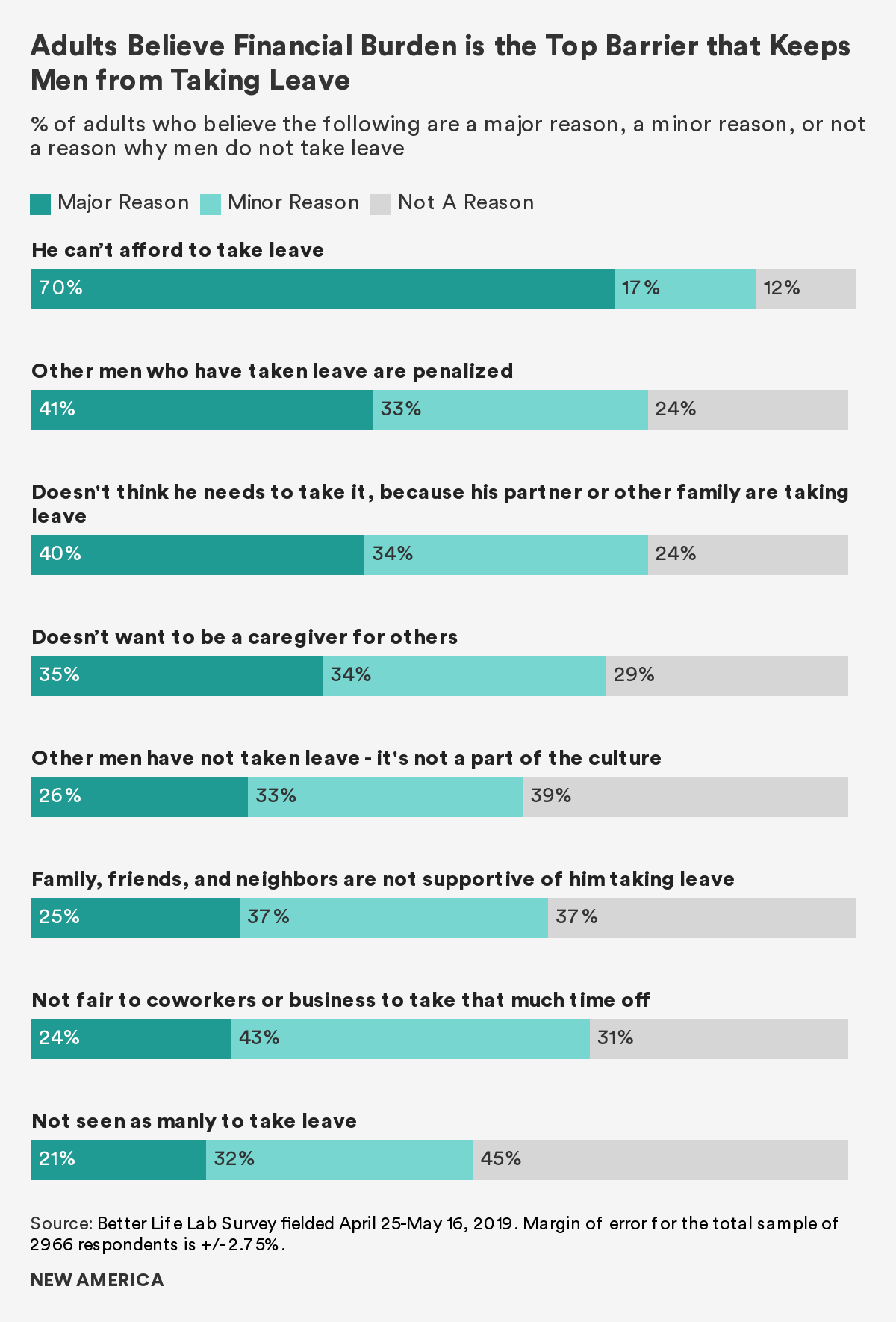
Many believe this economic factor is a powerful influence on men’s behavior—a solid majority of American adults (70 percent) say that not being able to afford to take leave from work is a major reason that men don’t take leave and another 17 percent say it’s a minor reason. Just 12 percent of Americans say ability to afford leave isn’t a reason why men take leave.
One of the fathers in our focus groups detailed his challenges trying to take leave to care for his infant while living paycheck to paycheck:
“I was only able to take three days off and [they] were unpaid. I wish men [would] also get maternity leave to spend time the first week or two at home with your newborn. At that time, I was living paycheck to paycheck barely making it, I had no choice but to get back to work. I wanted to stay home but I couldn’t afford it.” –Louis R., 37 years old, self-employed, financial coach, father of three, Florida
79 percent of adults say a partner’s need to keep working is a reason why men take leave.
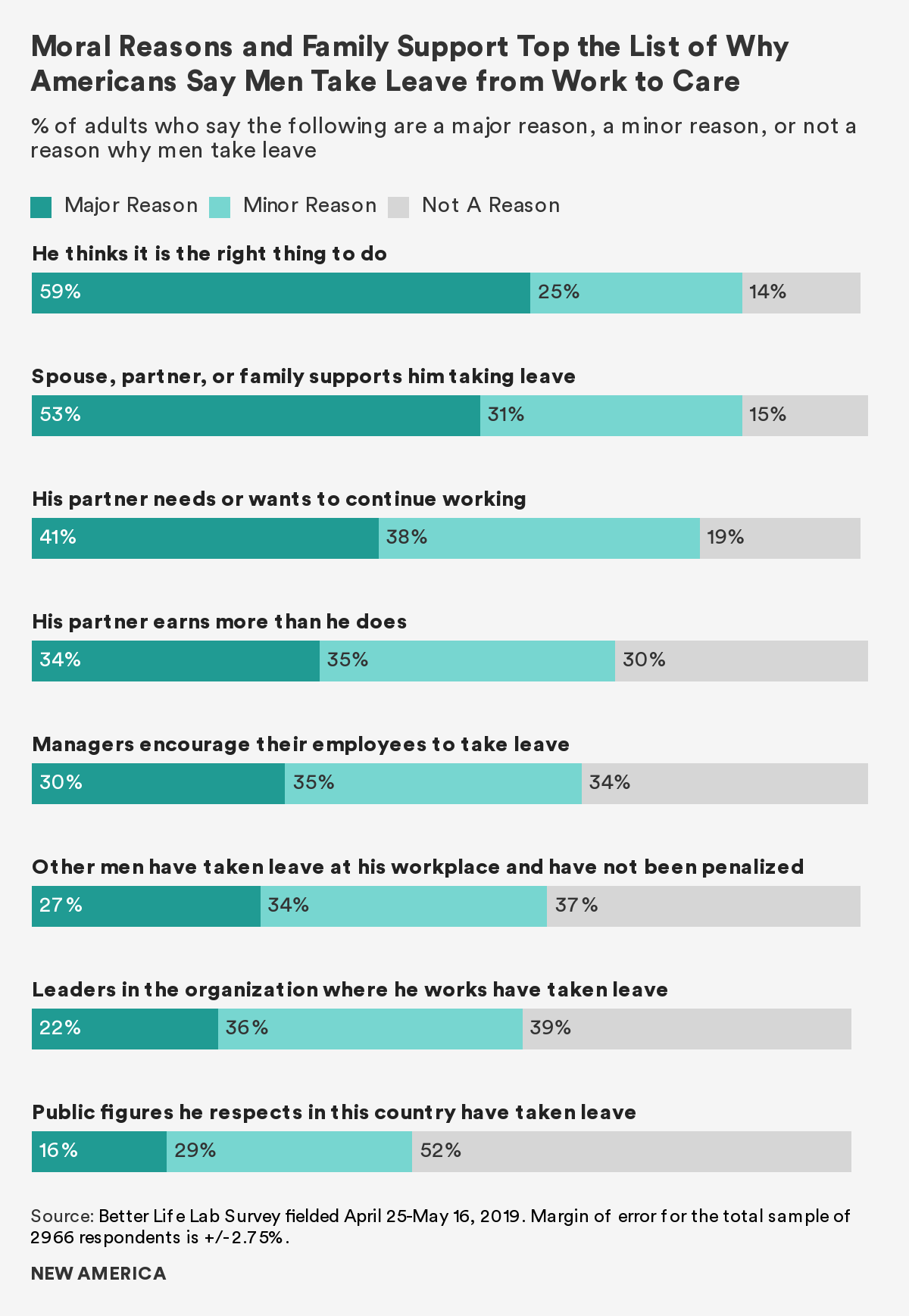
Often familial and economic imperatives for taking or not taking leave overlap. Americans think that a partner or spouse’s need and desire to keep working is an important factor in whether or not men take leave, with nearly eight in 10 Americans positing that a partner’s work needs could motivate a man to take leave from work. Two in five (41 percent) American adults say a man’s partner’s need or desire to continue working is a major reason why men take leave, another two in five (38 percent) say this is a minor reason, and 19 percent say this is not a reason.
His spouse or partner’s earnings may smooth the path for men to take leave.
On the flip side, 68 percent of Americans believe a man may be more likely to take leave from work to care if his partner or spouse earns more than he does. Americans are relatively evenly divided over how much of an impact they believe a spouse or partner’s earning has. About a third (34 percent) of Americans say that a man’s spouse or partner earning more than he does is a major reason why some men take leave to care for others. A similar 35 percent say this is a minor reason and another 30 percent say this is not a reason why men take leave from work to care.
41 percent of American adults say a man’s partner’s need or desire to continue working is a major reason why men take leave.
When asked their thoughts about a public paid family and medical leave policy, with public funds to help more families have access to and afford caregiving leave, one family caregiver, Cody F., responded: “I have a benefit like that. It is my own funds. But I support a public benefit like that. I think that would be totally fine. I would be supportive. It would not matter to me which gender. I would use it.” Another family caregiver, Justin T, said “Everyone would be able to focus on what’s most important. Taking care of those in need. This would really show America cares.”
Workplace Support and Norms: Workplaces, especially managers, and the norms they model and directly espouse, influence men’s leave taking behaviors.
The workplace is a critical site of influence around men and leave-taking. The workplace is where the benefit—if it exists—is managed and where its use is applauded or frowned upon, and where many of the perceived or real feared consequences of taking leave can play out. Americans believe that the impact of managers, and organizational leaders, and what they say or do is a powerful agent in shaping the behavior of men in the workplace.
In our qualitative discussions, many women felt it was easier for women to take caregiving leaves than men. “I think women may use it more because men would feel odd about using it due to stereotypes. Company culture may prevent people from using it. Even if the benefit is there, some managers frown upon the missed time,” said Margaret C., a 43-year-old caregiver to her mother.
30 percent of Americans said that managers encouraging their employees to take leave was a major reason why men take leave.
Support from managers and modeling by organizational leaders help motivate men to take leave.
Many Americans point to support from within the workplace as a reason why men take leave from work to care for others. Nearly two-thirds (65 percent) of Americans say that a manager’s encouragement is a reason men take leave from work to care for family and loved ones. A bit under a third (30 percent) of Americans said that managers encouraging their employees to take leave was a major reason why men take leave from their jobs for care.
Americans also believe the impact of public role models to be a real, if minor, reason why men take leave. However, adults are a bit more convinced of the impact of organizational leaders in modeling taking leave from work to care. Nearly six in 10 (59 percent) of Americans think that a reason why men take leave to care for loved ones is because leaders in the organization where he works have taken leave.
Professional penalties exert more pressure on men to forgo leave than lack of visible penalties serve as an encouragement.
Given the dependence of so many Americans on their paychecks, concerns about potential job loss or career damage are real concerns for all Americans needing to take leave. Many Americans point to cultural or professional penalties exacted on men who take leave as a deterrent to additional men taking time off of work to care, though they believe penalties for leave-taking are more powerful deterrents than lack of (visible) penalties are an incentive.
The penalties that men suffer—personal, professional, and economic—clearly deter other men from taking leave to care for loved ones when the need arises. Three-quarters (74 percent) of adults point to the penalties other men have suffered as a deterrent for men taking leave. Two in five (41 percent) adults say that a major reason men do not take leave when someone in their life needs care is that other men who have taken leave have been penalized for it. Another third (33 percent) say this is a minor reason and a quarter (24 percent) say this is not a reason.
The penalties that men suffer—personal, professional, and economic—clearly deter other men from taking leave to care for loved ones when the need arises.
And when a workplace does not penalize employees for taking leave, workers notice. Six in 10 (61 percent) Americans think that when other men take leave in a workplace and are not penalized as a result, it encourages men to take leave. One quarter (27 percent) of American adults think a lack of visible penalties to men who have taken leave in their workplace are a major reason why men take leave. A third (34 percent) believe this is a minor reason and 37 percent say this is not a reason.
Concern for coworkers and employers are barriers to men taking leave.
Another more minor economic and professional reason that Americans give to explain why men don’t take leave is that it isn’t fair to their coworkers or business to take that much time off. Americans are conscious of and concerned about the impact of leave on employers and coworkers, but are most likely to characterize it as a minor reason why men do not take leave. One quarter (24 percent) of adults say this is a major reason, and 43 percent point to it as a minor reason, with just three in 10 (31 percent) saying it’s not a reason why men do not take time off from work to care.
In the focus group conversations with a group of adult men from the general population, views on the availability of leave were mixed. Roughly half of the men said that taking time off would not be a major burden, or that their workplace would be understanding. About a third of men said that taking time off would be difficult to do.
Some Americans believe men don't take leave because it isn’t fair to their coworkers or business to take that much time off.
Many of the men in our focus groups said they would be understanding of coworkers of any gender who needed to take caregiving leave. Yet, similar to our survey findings, their views were slightly different when it came to thinking about their own caregiving leave. Many expressed concerns about burdening their coworkers and employers as they decided whether they could take leave and for how long. “I would worry, personally, about how my time away would affect the workload of my team,” said Nathan B., a 37-year-old consultant in Washington, D.C.
“I would have loved to have used it for the birth of our daughter. My family has a history of cancer and I absolutely would love to be able to have that time to take care of family members if and when it presented and not have to worry about my job or financial security. At the same time, I do feel that there may be some pressure from coworkers or society NOT to take these types of benefits. I wouldn’t want employees/employers thinking I don't care about my job or team members but again my job is not my most important role in life. Taking care of my family is the most important thing I do and am.” –Dave S., business executive, father of one, Pennsylvania.
A number of men in our focus group expressed real (and founded) concerns about the potential impact of their leave on their work and careers and the way those concerns kept them from taking leave or taking it for as long as they needed and wanted. Some even reported having to quit their positions in order to take the leave they wanted.
“I did take time to care for my son right when he was born. I felt that it was a really important process and I wanted to help my wife at the time and also get to know my new son… I did have to quit the job I was at to do so because they wouldn’t give me the time off.” –Blake K., 32 years old, executive director, single father of one, Colorado.
Other men describe the mix of professional expectations, concerns about being seen as a dedicated employee, and the risk of job loss as a part of their calculus around their leave-taking decisions.
“I would use it if available and I needed it. My only worry is with my long-term job, even if the policy allowed for it, would it be used against me during a down-size/layoffs?” said James B, a 48-year-old father of one who works as an analyst for a vehicle manufacturer in Michigan. “I would only be reluctant to use it if my company pressured me not to use it or if I would be giving up a significant career opportunity by being gone. However, my family comes first, and I would take care of them regardless of the ramifications.”
But some men said that they had confidence that their workplace would be accommodating or found that it was when they needed to take leave.
“My job would be accommodating if I needed it to be. The PTO and work from home policies are excellent.” –Darren S., 41 years old, manager for a human resources company, Georgia.
“My son was hospitalized from Sunday until Wednesday. I took that time off because I felt a paternal responsibility to be there with him the entire time. Financially, there were no issues. My work was understanding.” –Leonard G., 42 years old, project manager and part-time adjunct faculty; father of one, Texas.
Family Support and Norms: Family support, family needs, and supportive or unsupportive community norms influence whether men take leave from work to care.
Almost as critical as economic issues and the ability to afford leave is family and community support. Americans believe a supportive family and a community with role models of other men taking leave can potentially show a path for taking leave to men, and that the inverse—a family who is not supportive and norms that attack the masculinity of men taking leave—can hinder men from taking leave.
Spousal, partner, or family support is seen as critical in explaining why men take leave from work to care for others. Overall, 84 percent of Americans think support from a spouse, partner, or family is a reason why men take leave. More than half (53 percent) of American adults think that support from family is a major reason why men take leave, and another 31 percent said it was a minor reason why men take leave. “My family would support me, but I don’t think my job would be so understanding,” said Dante G., a 32-year-old father of two, in our focus group discussions.
Americans point to a lack of support and few models of other men taking leave as a minor reason why men do not take leave.
Conversely, a lack of support can be a barrier to men taking leave. Most Americans characterize lack of family support as a minor reason why men wouldn’t take leave. That comes in contrast to the strength of their belief in the power of positive family support that serves as an incentive for men to take leave. More than a third of adults say this is a minor reason or not a reason (both 37 percent) why men don’t take leave to care for others. Just a quarter (25 percent) of Americans say lack of family support for taking leave is a major reason why men don’t take leave.
Visible role models are seen as a minor reason why men take leave.
One school of thought suggests that if men had more visible role models demonstrating positive leave-taking that more men would be inspired and incentivized to take leave. While a little less than half of American adults think this is either a major or minor reason that men take leave, it was the reason with which the smallest share of respondents agreed. Just about half (45 percent) of American adults think that a (major or minor) reason that a man takes leave is because public figures a man respects have taken it, with a slight majority believing role modeling is not a reason why men take leave. More workplace-specific role-modeling of managers and/or coworkers is deemed more influential in shaping men’s behavior by Americans, as will be discussed more in our workplace section below.
Just about half of American adults think that a reason that a man takes leave is because public figures a man respects have taken it.
Lack of visible role models are seen as a minor reason for why men do not take leave for caregiving.
Americans also point to the absence of visible role models as a deterrent to men taking leave. About six in 10 adults say the lack of other men taking leave and it not being a part of the culture inhibits men from taking leave themselves. About a quarter (26 percent) of Americans say that other men not taking leave is a major reason why men don’t take leave when a care need arises. A third (33 percent) say is a minor reason, and about 2 in 5 (39 percent) say it’s not a reason.
Moral Imperatives and Personal Need: Moral imperatives, sense of responsibility, and need or desire to care shape whether men take leave.
84 percent of American adults say men take leave because it’s the right thing to do.
Beyond economic and family considerations, moral reasons and a personal sense of a need or desire to provide care are also seen as important reasons why men do and do not take leave. At the top of Americans’ list of reasons that motivate men to take leave to care for loved ones is that it is the right thing to do, with 84 percent of American adults saying this is a reason why men take leave to care. And Americans feel relatively strongly about it—nearly 6 in 10 (59 percent) of people say a moral imperative is a major reason men take leave.
In our focus group discussions, several men and women said they felt it was important for men not only to work, but also to have access to leave in order to care for their families. “I think family comes first. PERIOD! I think a job is a job, but nothing is more important than taking care of family whether it is a new baby or an elderly relative,” said James B, a 48-year-old father of one.
John Z., a 32-year-old father of two who participated in a discussion of fathers of young children, said, “Taking care of family is simply a high priority. It wouldn’t matter if this was a man or a woman. I think if I found out that someone had a sick family member that needed care, but that this person was neglecting them even though they had leave, that I would think less of that person.”
Dante G., a 32-year-old father of two, said the focus group discussion “made me realize that caregiving is very important and that society doesn’t put much value on it. They don’t seem to care. Also, companies really don’t care at all. The 12-week idea sounds like a great solution, which I doubt corporations will agree to.”
Masculinity Norms: Just about half of American adults say taking leave not being seen as “manly” keeps men from taking it.
Historically, from the time of the industrial revolution, notions of masculinity and caregiving haven’t been closely linked, with men expected to take on a more distant breadwinner role to fulfill their family responsibilities, rather than participate in hands-on direct care. As concepts of working and caregiving (and who performs each) change, American attitudes about the impact of norms around masculinity on the decision to take leave to care are beginning to shift. Our survey suggests Americans are divided about just how much they think these norms have changed. Slightly more than half of adults surveyed said that leave not being seen as manly was a reason that men did not take leave, though many of them said it was a minor reason (32 percent) rather than a major one (21 percent). Another 45 percent of adults say it is not a reason why men do not take leave. Men taking leave not being seen as manly was the reason with which the fewest respondents explained why men don’t take leave.
A father in one of our focus groups described some of the workplace and masculinity pressures he faced in taking and figuring out how to pay for unpaid leave.
“I took paternity leave from my job recently. Four months. I felt sort of frowned upon about it. As a man. Taking full paternity as a sales rep seemed weak. Also, financially I had saved up for it and made some money in the stock market, luckily.” –Peter H., 42 years old, father of two, lives with 79-year-old mother, New York.
Other men saw it differently. Andrew B., who regularly gives care to a family member said, “I see the world has changed to support men and women in taking time off.” And Malachi R., a 32-year-old caregiver to his father, said, “I believe it may be equal, at least at my workplace.”
Yet in the focus group of fathers of young children, while many felt that both men and women would benefit from paid caregiving leaves, many felt that it’s more acceptable for women to actually use them. “I think it would be close, but women would use it more—mostly because they see other women in the world and in history who served in this caregiver role. Some men are also embarrassed to take on this stereotyped caregiver role and may even get teased by friends and colleagues that it isn’t masculine. I would not care,” said Kyle C., a 36-year-old manager and father of two in Massachusetts.
Men taking leave not being seen as manly was the reason with which the fewest respondents explained why men don’t take leave
About three-quarters of American adults think that a reason men do not take leave is because they believe someone else in their family will cover the care.
Lack of a sense of need to take leave or a lack of desire to take leave was another common reason offered for why men don’t take leave. Three-quarters (75 percent) of American adults think a reason that men don’t take leave is because they don’t think they need to, because their partner or other family members are taking the leave. Two in five (40 percent) says this is a major reason, another 34 percent say this is a minor reason, and a quarter (24 percent) say this is not a reason why men don’t take leave when there is a need for care.
Seven in 10 Americans think men don’t take leave because they do not want to be caregivers.
Another key reason Americans identify for why men do not want to take time off from work is the belief that men do not want to be caregivers. Overall, 70 percent of adults think a reason why men do not take leave is because they do not want to be caregivers. A third (35 percent) say this is a major reason and another 34 percent say this lack of desire to be a caregiver is a minor reason why men do not take leave. One in three (29 percent) of American adults think this is not a reason.
70 percent of adults think a reason why men do not take leave is because they do not want to be caregivers.
Women and men don’t see eye-to-eye on what they believe bars men from taking leave.
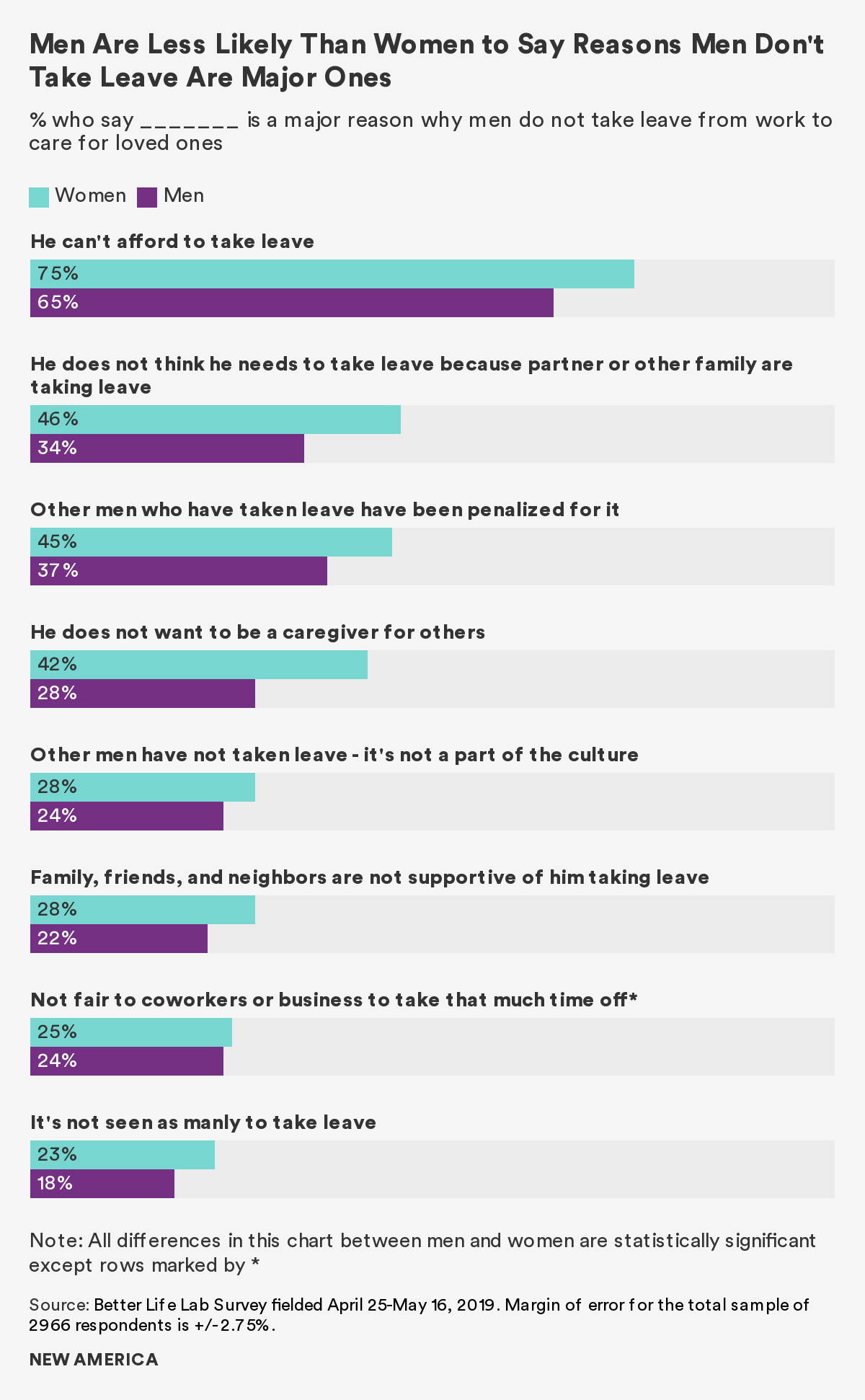
While women and men are generally in agreement about what helps motivate American men to take leave to care for loved ones, they do not share the same strength of beliefs about the barriers that keep men from leave. For all but one question, women are more likely than men to say that each of the possible reasons listed in our survey were major reasons men don’t take leave. Women were especially more likely to say that men not wanting to be caregivers shapes men’s caregiving decisions (42 percent of women versus 28 percent of men). Women are also more likely than men to think men believe they do not need to take leave because their partner or other family members will take leave instead—46 percent of women say this is a major reason compared with 34 percent of men. Men are more likely to believe that visible penalties against other men act as a more powerful deterrent than men not thinking they need to take leave because others in their family will manage care. Where do men and women agree about barriers to men taking leave? Both say concerns about fairness to coworkers and the business are an equal mix of major and minor reasons.
The women in our qualitative discussion groups said they saw men struggling with meeting society’s expectations that they be breadwinners devoted to work and providing for their families, with their needs or desires to take leave from work to be more actively involved in caregiving.
“I think women would use [paid leave] most. Men are expected to provide for the family.” –Linda C., 56 years old, local municipality worker, Connecticut.
Russell A., a 33-year-old father of four who participated in the fathers of young children discussion, like many other men in the group, said that women took priority, and needed longer leaves, particularly after the birth of a child. “I think it’s important for mothers to stay with their child for as long as possible and these days it seems that women often go back to work after just a couple of weeks after giving birth, which I think really sucks for their health (physical and emotional) and for the bond between mothers and their kids. But I also see men using much time provided by this benefit as well.”
Yet most of the women and many men in our focus groups supported the idea of gender neutral, or gender equal caregiving leaves. Their reasoning was often driven by a sense of fairness for men and their life experiences.
“I think it is unfair that men don’t get that time to bond as well as help their wives with a newborn. My husband was very helpful and was able to take a couple of weeks, but we both could have used more time together. I think everyone should take the max time allowed, if they are financially able. It is a fleeting moment in time, when you think about working 50 years, who gives a #$%^ about a couple of months.” –Lauren F., 37 years old, sales, mother of three, Arkansas.
“I would hope it would be used equally. Unfortunately, there is still a view by some that it is a woman’s responsibility to handle these matters. The barrier would be made by uneducated people with old-fashioned ideals. People who think men should work and women should take care of their families.” –Thomas H., 47 years old, sales, father of two, Minnesota.
Lower-income Americans have a different perspective on what does and does not motivate men to take leave.
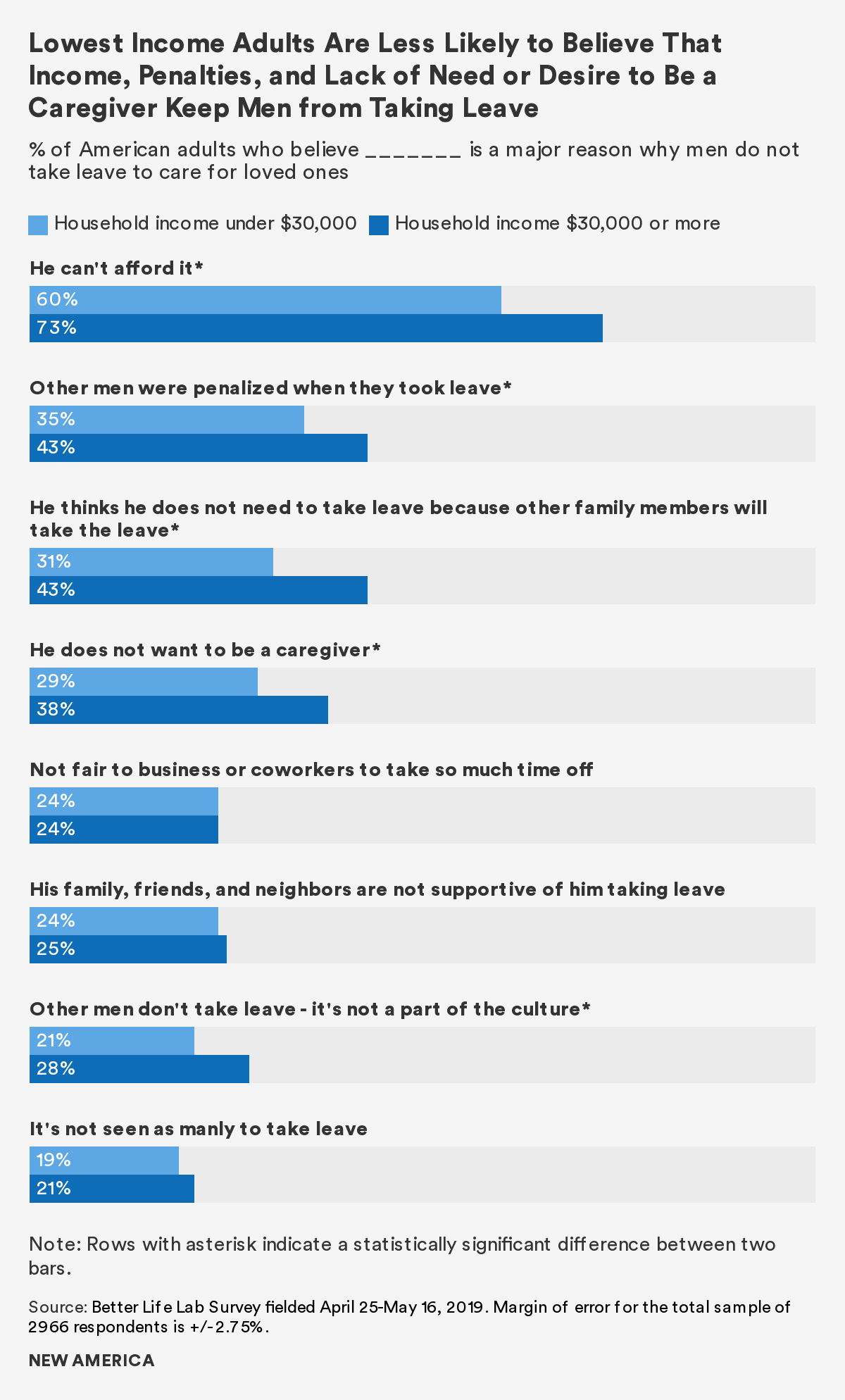
As we will detail later in the report, the lowest-income Americans face unique challenges in accessing leave from work, especially getting paid when they take that leave and being able to afford it when they don’t. Despite, or perhaps because of, their coping with these economic struggles, Americans in households earning less than $30,000 are less likely to see most issues as enticements to men or as barriers to men taking leave from work to care for loved ones.
Perhaps because they have already been forced to find ways to manage the financial and job-related headaches that accompany the need to provide care with few resources and little to no policy or workplace support, lower-income Americans are, surprisingly, less likely than higher-income individuals to say not being able to afford to take leave is a reason why men don’t take it. Nearly three-quarters (73 percent) of those earning more than $30,000 or more annually think ability to afford to take leave is a major reason why men don’t take leave, while just 60 percent of those earning less than $30,000 say the same.
The respondents from low-income households also do not agree with respondents from higher- income households that penalties, lack of desire to care, or thinking other family members will cover leave are major reasons why men do not take leave to care.
In our focus group discussions, one father of young children said that low-income families would benefit the most from a public or company-paid caregiving leave policy. “This policy would allow them extra time to remedy the situation instead of having to rely on the help of others,” said Stefan B. However, Martin L., a 42-year-old father of two, worried that those lower-wage workers would be fearful about taking caregiving leave. “I could see how unskilled labor may be a little frightful of using it, for fear of losing their jobs. There are plenty of labor laws that are ignored or bent.”
Authors' Note
Throughout the report, we use the terminology for racial categories used in the NORC survey panel. We do this to maintain clarity for readers and because other terminology for these classifications can change how respondents would self-identify, thus changing the accuracy of our findings. For instance, someone who identifies as Black in the NORC panel may not identify as African American. We have opted to remain consistent with the classifications in the NORC survey panel to ensure maximum accuracy between participants’ self-identification and our findings.
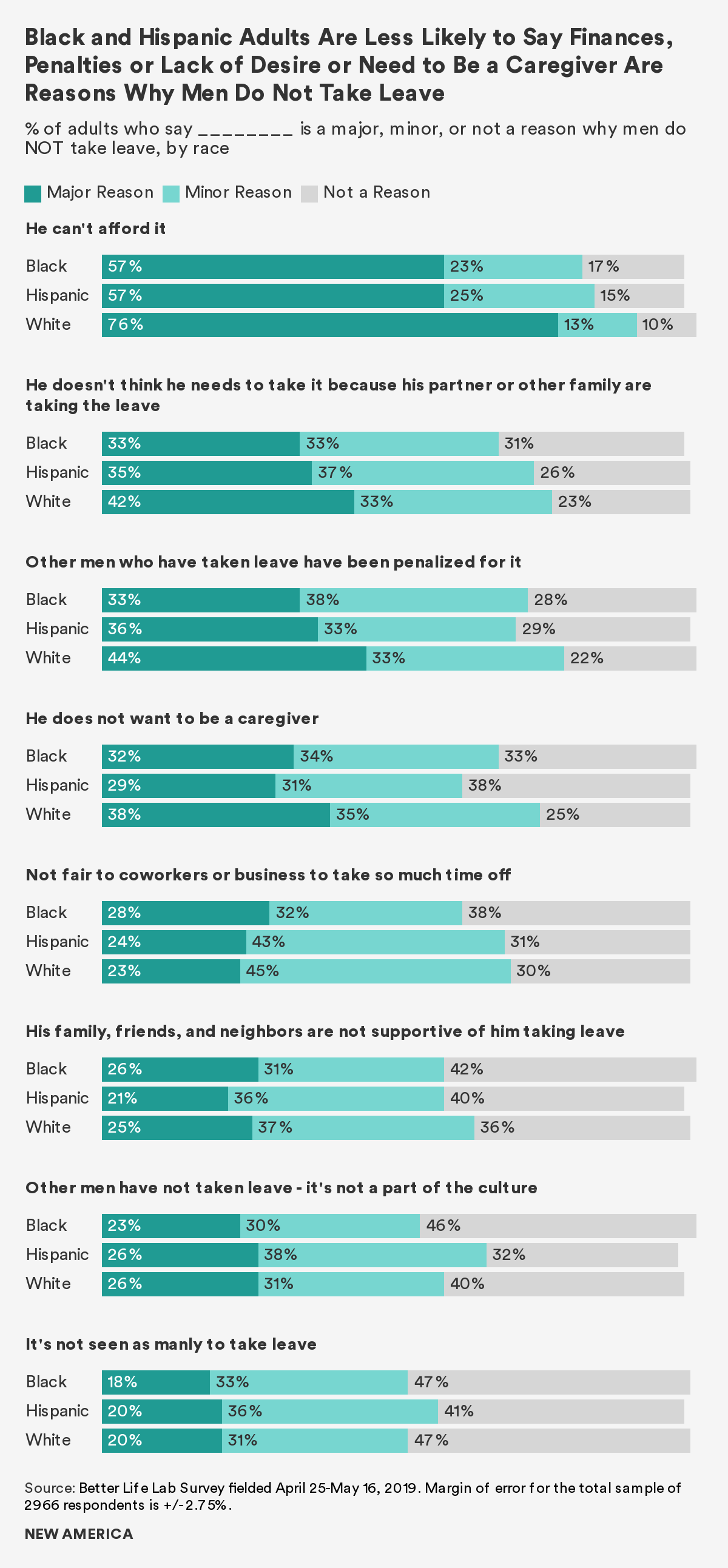
Black Americans and Hispanic Americans differ from white Americans in what they believe motivates men to take leave and bars them from taking it.
Overall, white Americans are more likely than Black or Hispanic Americans to say most of the reasons that potentially encourage men to take leave are major reasons, while Black and Hispanic adults are more skeptical of the impact of these issues and are more likely to say these are minor reasons if they are reasons at all.
Black Americans are more likely to see the power of role models.
Black (20 percent) and Hispanic (21 percent) Americans are more likely than white (15 percent) Americans to believe in the power of public figures modeling leave for men, and to say that it is a major reason why men might take leave.
Somewhat contradictorily, Black adults and white adults are more likely than Hispanic adults to say a lack of a culture of leave taking among other men is not a reason why men don’t take leave: Black adults (46 percent), white adults (40 percent), versus Hispanic adults (32 percent). This may indicate a distinction in beliefs among Hispanics in particular about the power of high-profile role models vs. the power of everyday peers on men's behavior.
Fairness to coworkers is more of a concern to Hispanic and white Americans.
White and Hispanic adults are more likely than Black adults to report that this is a minor reason why men do not take time off from work—with 45 percent of white adults and 43 percent of Hispanic adults saying it isn’t fair to businesses and coworkers to take that much time off, while 32 percent of Black adults say it’s a minor reason. Black adults are more likely than white adults to say it is not a reason (38 percent of Black adults versus 30 percent of white adults).
Younger adults are more concerned about norms of masculinity and the impact of role models than older adults.
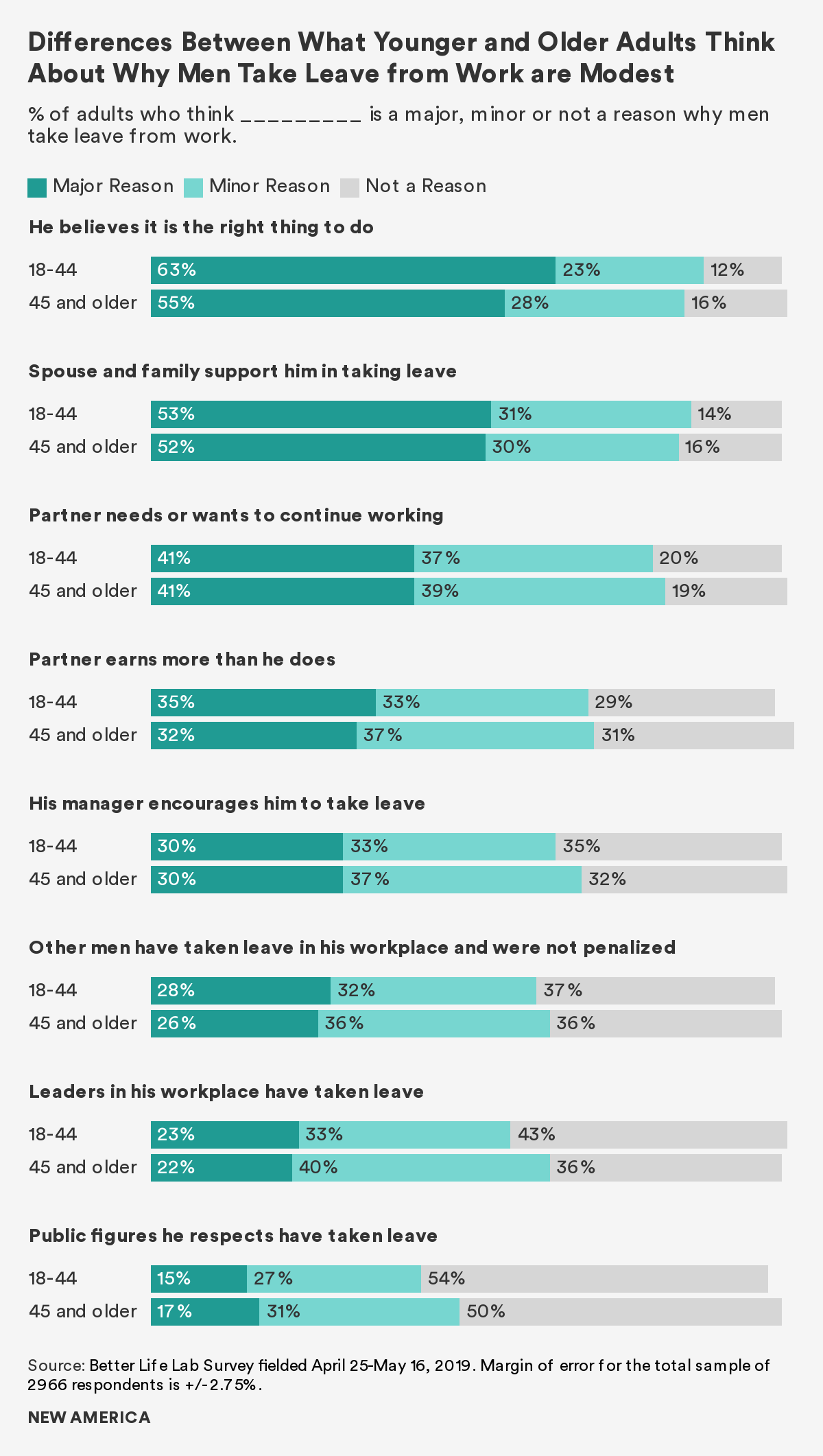
While younger and older adults mostly agree on what constitutes a major reason why men take leave, younger adults are more likely to say that most reasons are minor reasons, while older adults are more likely to say those same reasons do not influence men’s decisions around taking leave.
There are a few key differences in what younger and older Americans think serve as barriers to men taking leave.
Whether or not leave-taking is seen as manly and how that influences men’s leave-taking behavior reveals some differences between younger and older adults. Younger adults under 45 are more likely to see this as a major reason why men do not take leave (25 percent of adults under 45 compared with 18 percent of adults 45 and older). The youngest men are a bit more likely than older men to see this as a minor reason, while men 45 and older were more likely to say the manliness of leave is not a reason why men don’t take leave.
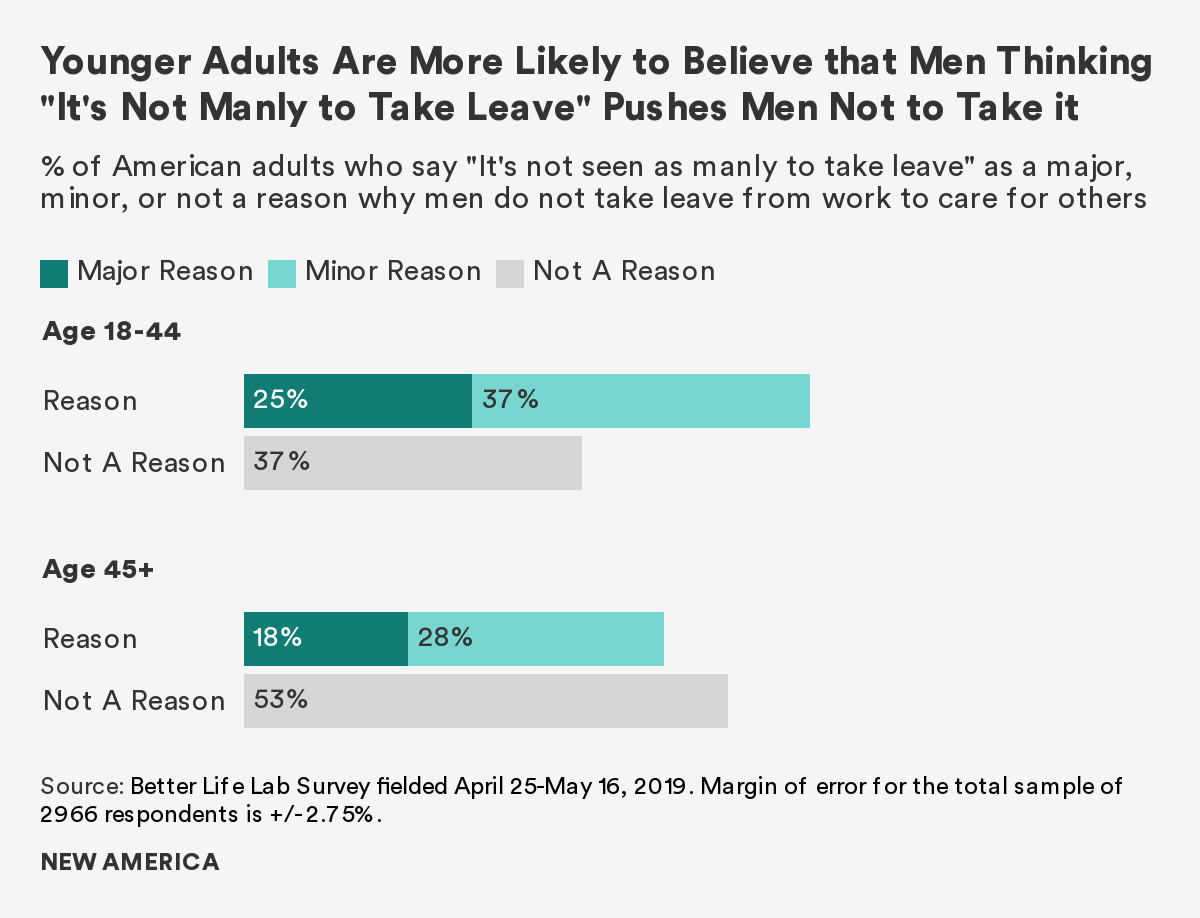
This finding is interesting and perplexing. On the one hand, it may signal a greater prevalence of more traditional gender ideals rather than egalitarian views among the younger adult cohort, something that a 2017 longitudinal analysis of high school seniors’ attitudes found.1 However, the finding does not necessarily mean that younger Americans themselves believe taking leave is not manly. It may signal that these young men are simply more likely to see these ideals as prevalent in society as a whole and as powerful in affecting behavior. The finding may also reflect young Americans’ life stage and lesser experience with thinking about or planning for caregiving, parenting, and other behaviors which have been shown to impact gender ideology.
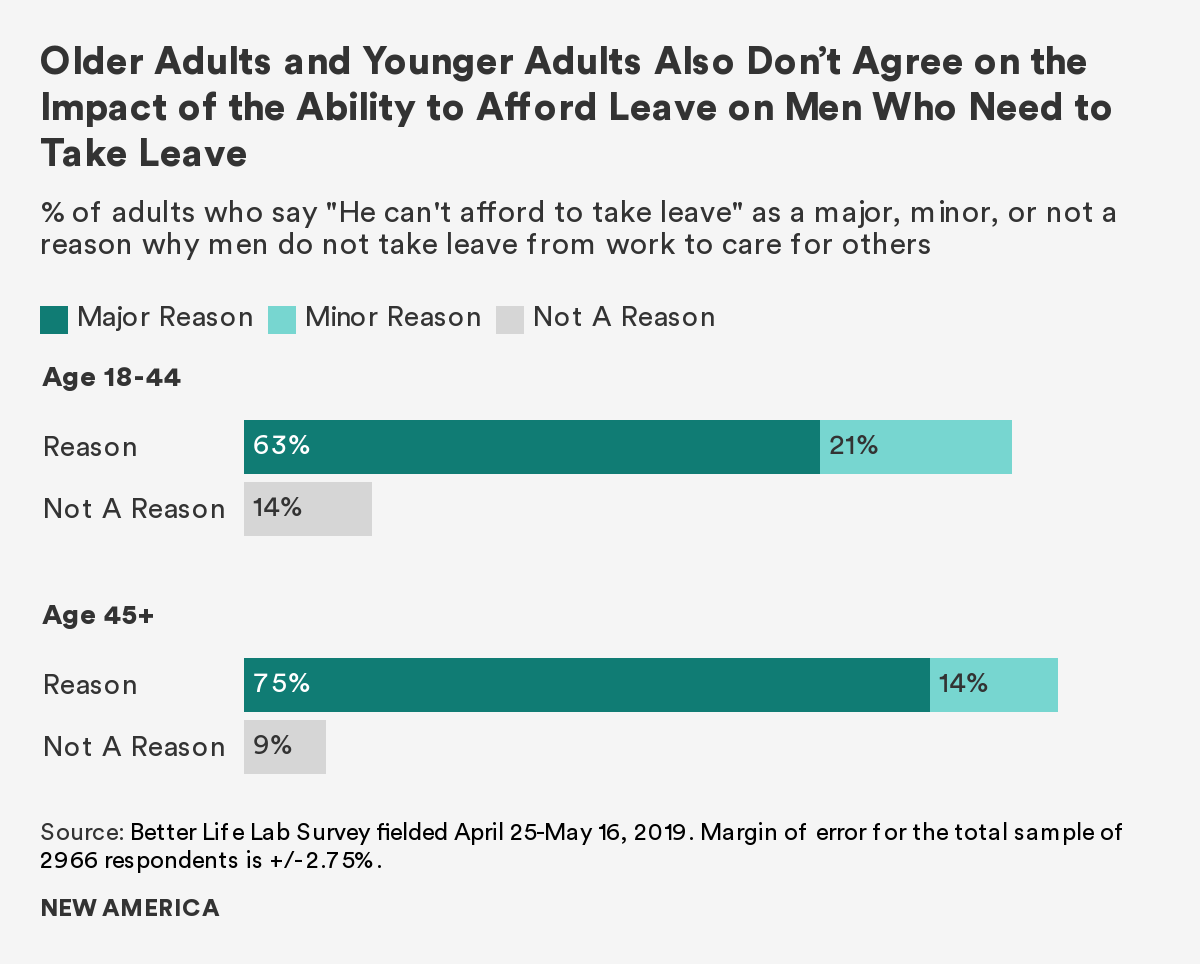
Older adults and younger adults also don’t agree on the impact of the ability to afford leave on men who need to take it—though more than half of both groups agree it is a major reason. Three quarters of adults 45 and older think an inability to afford to take leave is a major barrier to men’s use of leave from work, while 63 percent of adults 44 and younger believe it is a major reason.
Younger adults are more likely than older adults to say that role models are a minor reason why men take leave. Older adults are more likely to say that having role models isn’t a reason why men take leave from work.
Adults under 45 are more likely than older adults to say that other men not taking leave is a minor reason why men do not take leave themselves (37 percent of adults under 45 versus 29 percent of adults 45 and older). Older adults are most likely to say that lack of models is not a reason why men do not take leave. Similarly, younger adults (18–44) are more likely than those 45 and older to say that role modeling by workplace leaders is a minor reason why men take leave (40 percent of those 18–44 versus 33 percent of those 45 and older), while older adults are most likely to say it’s not a reason.
Citations
- David Cotter and Joanna Pepin, Trending Towards Traditionalism? Changes in Youths’ Gender Ideology, (Austin: Council of Contemporary Families, 2017), source
Who Has Access to and Uses Family and Medical Leave from Work?
The complicated, confusing, and uneven leave landscape for workers
Across America, workers welcome new babies, care for ill spouses, partners, siblings, children, friends, and aging parents over the course of their working lives. Caring for all of these individuals often requires taking time away from work. But not every employed person in the United States has access to leave from work, be it paid or unpaid, short or long, and when they do have it, it can take many forms. Leave from work can take a variety of forms:
- Sick leave allows the worker to take short periods of time off to care for their own health, and under some workplace policies, and laws in some states and localities,1 the health of a loved one.
- Vacation time gives workers access to time away from work to travel, visit loved ones, rest, and rejuvenate—or take care of chores and caregiving demands.
- Some workers may have access to an aggregated pool of personal paid time off that can be used as the worker wishes, with no expectation that it is used for a particular purpose.
- Some workers have access to paid family and medical leave, where time away from work to care for a new child, a sick family member, or one’s own health condition is partly or fully paid. This leave may be an employer-provided benefit, or in some states is accessed through a public insurance program paid for through employee and/or employer contributions.
- And still other American workers have access to unpaid leave through the Family Medical Leave Act of 1993, that enables some full-time workers to take unpaid, job-protected leave. Qualified workers must be employed by businesses with 50 or more employees and have worked there for one year to take time off of work without pay.
Asking Americans about these different kinds of time off from work can get confusing. Other research has shown that American adults don’t often know what the various policies are in their workplaces around various types of leave until they need to use it.2 Some workers assume they have access to paid maternity or paternity leave, only to find they don’t. Some workers cobble together paid vacation and sick days and think that’s paid family leave. In other instances, especially around paid family and medical leave, it’s not clear to workers who is providing the benefit—a state or an employer—and how it should be counted.
Some employers offer temporary disability insurance to new mothers recovering from childbirth, but otherwise do not offer any pay for time off work to bond with a new child—thereby excluding adopted and foster children and any parent who did not give birth—and call that paid family leave. The available leave is further complicated by a range of options offered by several states with a variety of eligibility requirements and implementation dates.
One father said he didn’t know what his company’s policy was on paid family leave benefits until he needed them. He discovered he didn’t have any.
In our survey of 2,966 American adults, we found that more than half of those who are employed say they get paid vacation days (64 percent), paid sick days (59 percent), or paid time off to do as they choose (54 percent) through their employers. Fifty-two percent say they get unpaid family and medical leave. Overall, 43 percent of Americans in our survey say they have taken leave to care for a new child or an adult family member in need. More than half (52 percent) of parents of kids of any age say they have ever, at any point in their lives, taken paid or unpaid leave following the birth or adoption of a new child. Nearly three in 10 (28 percent) of the survey respondents said they had done so to take care of an adult family member. This includes leave of more than a day or two off work, regardless of whether that came from sick or vacation time or some other allotted time off work, paid or unpaid. Our survey question asked generally about leaves that lasted “more than a day or two” off work, but did not specifically ask about the duration of leaves.
For instance, one father in our online threaded focus group sessions said he didn’t know what his company’s policy was on paid family leave benefits until he needed them. It was then that he discovered he didn’t have any. “It’s not something I knew anything about, until you really get into educating yourself about the pregnancy, birth, and postpartum experience,” he said.
Why does New America data look so different from the BLS data?
Our data shows that 43 percent of workers in our sample say they have taken paid family and medical leave, while the standard Bureau of Labor Standards data shows 19 percent of the civilian workforce has access to paid family leave. More civilian workers, 40 percent, have access to personal medical leave through employer-provided Temporary Disability Insurance,3 which can be used to cover a birth mother’s recovery. Some of the discrepancy may be due to confusion. Previous research suggests that employees don’t always have a full picture of what their benefits really are until they need to use them. Additionally, we defined leave as more than one to two days off work, and informed participants this could include paid vacation, paid sick days, or other methods of taking time away. BLS data captures only programs explicitly classified as paid leave. Further, there may be methodological differences in data collection. New America’s data comes from a nationally representative panel survey of 2,966 American adults reporting on what they believe they have access to, while the BLS data comes from a survey of employers.
Using Leave: Care for infants and newly adopted children
Roughly one-third of parents have not taken any leave to care for a new child.
About half of parents of children of any age say they’ve taken leave at some point in their lives to care for a new child, but about one-third (31 percent) of parents said they have not taken any leave to care for a new child. This latter finding, because it includes workers with now-grown children, could reflect how women more often left—or were forced to leave—the workforce after giving birth in the past, how few men have had access to leave or felt empowered to use it, and/or how caregiving leaves are a relatively new phenomenon in America, with a legal guarantee to unpaid leave enacted in the last 25 years.
About three in 10 American adults are parents of a minor child.4 In our survey, among all parents of children of any age (from infancy to adults with their own families), just about half (52 percent) said they took some kind of leave at some point in their lives to care for a newborn or newly adopted child. By our definition, this leave would have been more than a day or two, and could have been unpaid, partly paid, or paid from any source—vacation days, sick days, disability benefits, or a state public or employer-provided Paid Family Medical Leave program.
One in 10 parents said they were not working when they would have needed to take leave.
About half of all parents said they took some kind of leave at some point in their lives to care for a newborn or newly adopted child.
Men take leave to care for family, but are less likely to do so than women.
Overall, mothers are more likely than fathers to report taking any kind of leave for a new child, with 55 percent of mothers taking some kind of leave, compared with 48 percent of fathers. Mothers are more likely than fathers to report that they were not working when they would have needed to take leave (15 percent of mothers versus 5 percent of fathers). Fathers are more likely to report not having access to leave when they needed or wanted it (8 percent of fathers versus 4 percent of mothers).
As families grow, fathers today are more likely to have taken leave to care for a new child. Current fathers of two or more young children (eight and younger) are more likely to report that they’ve taken leave to care for a child than fathers with just one young child. Fully 62 percent of fathers of two or more young children have taken leave to care for a child, compared with 50 percent of fathers with one young child.
In our focus group research, fathers and mothers talked about the times they were able to take leave to care for their new infants. The interviews highlighted the variability in leave that fathers especially were able to take when caring for new babies—from two days, to a week or two. In one rare instance, one father took one year of caregiving leave.
“I was able to take one week off following the births of both of our children. I had to use vacation time, and my boss did bother me a few times with some trivial phone calls. I wish I would have been able to take off longer with the first child.” –Asher J., 39 years old, entrepreneur, father of two, Indiana.
“I received a year of paternal leave from my job to help take care of my kids, but I have not taken any other such time off. I was still paid during that time, so I didn’t need to worry about finances very much. If I weren’t given parental leave, I probably wouldn’t have taken any time off, simply because my job is so fast-paced that I may actually get let off if I take too many breaks.” –David I., 26 years old, teacher, father of two, Pennsylvania.
Low-income workers struggle to take leave to care for a new child.
In our survey, the lowest-income parents, those earning less than $30,000 in household income each year, were the least likely to say they had ever taken any leave—paid or unpaid, longer than one or two days for the birth or adoption of a child. Two in five (40 percent) of the lowest wage earners took leave to care for a new child, compared with 56 percent of those earning more.
Hispanic parents are the least likely to say they have taken leave to care for a new baby.
White and Black parents are more likely than Hispanic parents to say they’ve taken time off work to care for a new baby—43 percent of Hispanic parents have taken more than a day or two off work, compared with 56 percent of Black parents and 53 percent of white parents. Most of the differences are from lower levels of leave taking among Hispanic mothers, which may reflect lower levels of labor market participation or higher participation in occupations where leave is not offered or job protected.
Using Leave: Care for family
While policymakers often focus on care for new infants when thinking about adults taking leave from work, a substantial portion of leave from work is used for care for a disabled, ill, and/or aging adult or a sick or disabled child. Nearly 3 in 10 (28 percent) American adults say they have taken leave from work to care for a sick, disabled, or elderly family member.
Women and middle-age adults are more likely to take leave to care for family.
As with infant and new child bonding leave, women are more likely to take leave, with 31 percent of women taking leave to care for adults compared with about a quarter (25 percent) of working men.
Adults 45–59 years old are the most likely to report having taken leave—with a third of adults that age reporting that they’ve ever taken leave to care for a family member. Black adults are more likely than white adults to have taken leave to care for a family member.
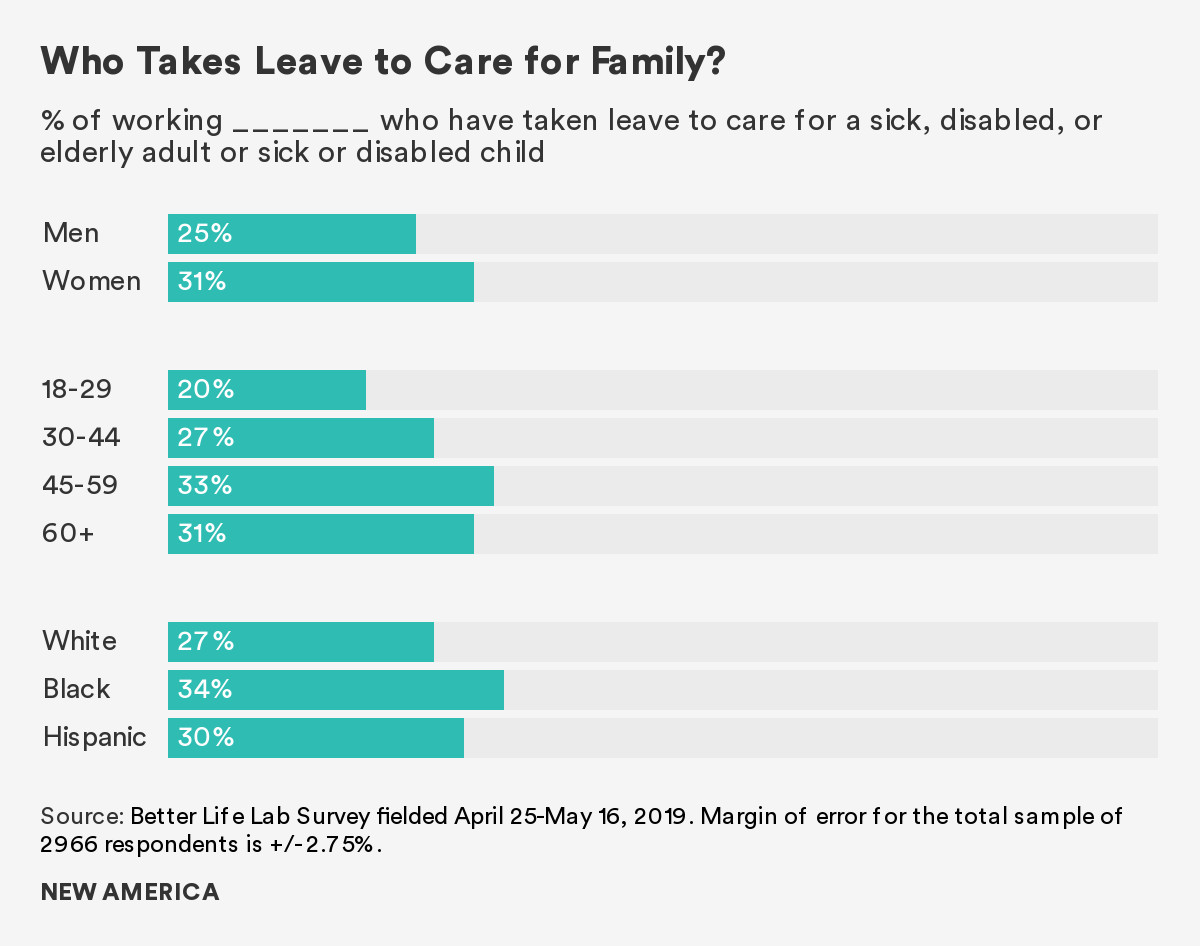
Lowest-income workers lack access or were not working when they needed leave.
The lowest-income workers are the most likely of all income groups to say they have not taken leave to care for an elderly family member or sick adult or child. The data suggests that these workers are more likely to say they were not working when they needed the leave, and that they did not have access to it when they needed it.
Citations
- National Partnership for Women and Families, Fact Sheet, (Washington, DC: National Partnership for Women and Families, 2019), source
- Barbara Gault, Heidi Hartmann, Ariane Hegewisch, Jessica Milli, and Lindsey Reichlin, Paid Parental Leave in the United States, (Washington, DC: Institute for Women’s Policy Research, 2014), source
- Bureau of Labor Statistics, National Compensation Survey: Employee Benefits, (Washington, DC: U.S. Department of Labor, March 2019, source
- Gretchen Livingston, More than One-in-Ten U.S. Parents are Caring for an Adult, (Washington, DC: Pew Research Center, 2018), source
Six in 10 Americans Anticipate Needing to Take Leave from Work in the Future
In addition to asking respondents whether they had taken more than a few days off of work to care for a new child or a loved one, the survey also asked whether respondents anticipated needing leave to care for a child or adult in the future. Just over half—51 percent—of working Americans say they anticipate needing to take leave at some point in the future to care for an ill, disabled, or aging adult family member. Three in 10 (30 percent) anticipate needing leave to take care of a new child. Overall, 60 percent of working adults say they anticipate needing at least one of these types of leave in the future.
According to our survey, men anticipate needing leave at statistically similar rates as women, and the need for access to paid leave across gender will only grow in the coming years, with many respondents anticipating needing leave for either child or elder care, and some anticipating needing leaves for both.
60 percent of working adults say they anticipate needing at least one of these types of leave [to care for a child or adult] in the future.
Parental Leave
About a third (30 percent) of American workers say they will need to take leave to care for a new child in the future. Younger workers, Black and Hispanic workers, and workers earning less than $30,000 per year in household income are more likely than their counterparts to believe they’ll need to take leave to care for a new child in the future.
Men and women are equally likely (30 percent) to say they will likely need this type of leave in the future. However, men are more likely than women to say they are not too likely to need to take leave to care for a child (24 percent of men versus 16 percent of women), while women are more likely to say they are not at all likely to need this leave (53 percent versus 45 percent of men). In other words, women appear more confident about saying they definitely will not need leave for a child than men do.
Parents of young children ages zero to eight are also more likely than those who aren’t the parents of young children to say they believe they will need to take leave to care for a new child in the future—36 percent versus 15 percent, likely because they are more inclined to be considering or planning for more children than non-parents or parents without young children.
Family Leave
Half of the survey respondents who are currently in the workforce (51 percent) anticipate needing time off in the future to care for a sick, disabled, or elderly family member. Those in mid-life (30–59) are the most likely to say they are very or somewhat likely to need to take time off of work to care in the future. Fewer of those 60 and older say the same, most likely because many of them are, or anticipate being, retired in the near future, or perhaps because the older adults they would have cared for in the future have already passed away. College-educated workers are also a bit more likely than those without a college degree to say they believe they will need time off to care for a family member in the future (55 percent of college degree-holders versus 49 percent of non-college degree-holders).
There are no differences by gender, race or ethnicity in anticipating leave. There are very modest differences between the highest-income workers and middle-income workers.
Unsurprisingly, those who are or have ever been caregivers are more likely than those without those responsibilities to say they anticipate needing to take leave in the future (59 percent versus 46 percent of non-caregivers).
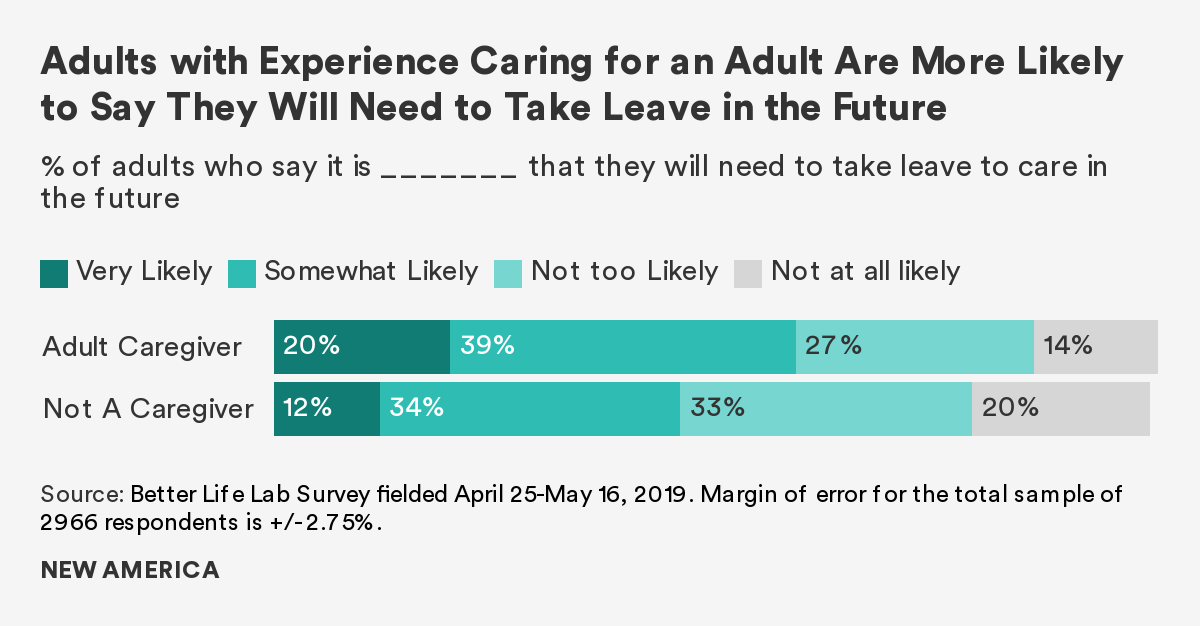
Taking Multiple Leaves in the “Sandwich” Generation
Among our respondents, some have used or anticipate using leave for both a new child and for an ill, disabled, or elderly family member. Fourteen percent of survey respondents say they have ever taken leave of any kind, paid or unpaid, to care for both a new child and a sick family member. The number of multiple-use leave takers will likely grow. More than half (53 percent) of parents who have taken leave for the birth of a child anticipate needing to take leave to care for a family member in the future.
Other researchers have identified people juggling caregiving for both younger and older relatives at the same time as the “sandwich generation.” The sandwich generation is typically described as older Millennials and Generation X, those ages 30 to 60, who might have living elderly parents needing help while at the same time caring for children under age 18 in the home. The online focus groups surfaced several participants who were, by this definition, sandwiched. Take 39-year-old father-of-three Justin T., who participated in our online threaded discussion focusing on unpaid caregivers. Justin spends his days working as an online student adviser and his evenings caring for his aging father who struggles with mobility issues, among other challenges, all while juggling fatherhood and marriage.
Fourteen percent of survey respondents say they have ever taken leave of any kind, paid or unpaid, to care for both a new child and a sick family member.
The Better Life Lab survey cannot determine whether participants who reported taking leaves for multiple purposes took them in close proximity to one another and represented simultaneous caregiving burdens. But that so many respondents anticipate needing multiple leaves in their lifetimes indicates a large portion of American workers will, at some point in their lives, take part in both elder care and child care. Unsurprisingly, 30 to 44-year-olds were the age group most likely to anticipate needing leave for both taking care of a new child and taking care of an ill, disabled, or elderly family member. Adults 45–59 years old were the age group most likely to have used leave for both purposes at some point in the past.
Justin T., like other respondents from the research with multiple and multi-generational caregiving responsibilities, anticipated needing leave from work to care for his father. “I think I’ll need more than a few days off soon, and I think my family will be supportive,” he said.
Men and women express equal anticipated future need for time off work to care.
There are no significant differences between men and women when it comes to anticipating the need to take leave for both child care and elder care at some point, or having used leave for child care and having used leave for elder care.
One third (34 percent) of men with children, for instance, say they have taken leave to care for an ill, disabled, or elderly family member. Hispanic fathers are more likely than white fathers to say they have taken leave to care for an ill, disabled, or elderly family member (42 percent of Hispanic fathers versus 30 percent of white fathers).
Parents who have cared for children with more than typical needs1 are more likely than those who have not provided such care to report that they are “very likely” to need to take leave to care for a family member in the future (21 percent compared to 13 percent of those without these care responsibilities).
As the U.S. public collectively thinks about and innovates around new employer-offered, state-based, and federal paid family leave policies, understanding the full anticipated demand for different caregiving situations highlights both the important need these policies address and who they need to target. In other words, the changing demographics of the United States and increasing caregiving demands across the life cycle make clear that leave policies targeted only to mothers or parental caregiving will fall short. Further, policies designed to enable parents to take leave by drawing a benefit from Social Security in exchange for a later cut to retirement misses a large section of workers with adult family care responsibilities. It also fails to address the ways that caregiving, and the need to take unpaid leaves, already causes workers to cut back work hours, drop out of the workforce, or suffer penalties at work at a cost to retirement savings. While some Americans may never need to use leave, those with close family connections and active involvement in caregiving may need to use it multiple times over their lives for different people and in a variety of different caregiving situations. A federal paid leave policy centered around caregivers would account for multiple leave users and ensure that these involved caregivers are not penalized at work or in their financial security for shouldering this multifaceted caregiving responsibility.
Citations
- In our study, we identified a group of caregivers of sick or disabled children by asking the following question “Have you, personally, ever provided care to your child or any of your children (when they were under the age of 18) because of a medical, behavioral, or other condition or disability? This kind of care is more than the normal care required for a child of that age. This could include care for an ongoing medical condition, a serious short-term condition, emotional or behavioral problems, or developmental problems.
Affording Leave: How Americans Get Pay When They Take Leave and How They Cover the Gaps
Taking leave from work can be challenging enough, but it often comes with economic strain. In our sample, even among people who are able to take leave from work without fear of job loss, a substantial portion must take this leave without full or often any pay.
58 percent of workers who took leave were able to get some pay; 35 percent said it was unpaid.
Just under six in 10 (58 percent) of those in the workforce who took leave were able to get at least some pay for the time they took off. These numbers reflect only those workers who were able to take leave from work; those who do not have access to paid leave often cannot afford to take time away from their jobs, and many other workers do not have job protection and risk losing their job if they take even unpaid leave.
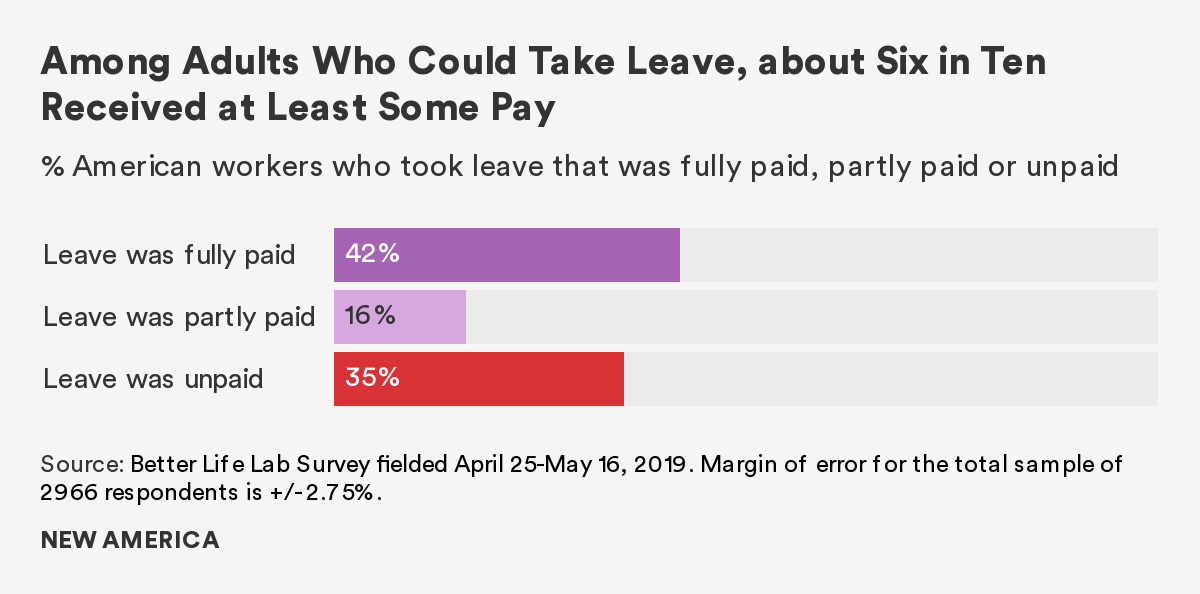
Among adults who have taken leave, 42 percent say their most recent leave to care for either a child or adult was fully paid, and 16 percent say it was partly paid. 35 percent say it was entirely unpaid.
Differences in access to leave often break across socioeconomic lines, with those with higher incomes and more education having greater access to paid leave, while those with lower incomes scrape by without pay. Those with a college degree were more likely to be fully paid for their leave (48 percent with a college degree versus 39 percent non-college), and Americans with a household income under $60,000 were more likely to be unpaid during their leave (44 percent versus 26 percent). The current system, which burdens those households most in need of every dollar of their income, and who have fewer resources to pay others to manage their family care needs, exacerbates inequality. Low-income families with access only to unpaid leave are often forced into a wrenching choice—care for loved ones or keep the family financially afloat.
Below we highlight what families in this situation do when they need to care for family and try to make ends meet.
When they take leave, men, especially fathers, are more likely to be paid than women and mothers.
Men are less likely than women to take leave to care for a child or family member. Yet the men who took leave were more likely to say their leave was paid. More than six in 10 men (65 percent) who were able to take leave reported receiving some pay, compared with 53 percent of women who took leave. Among those men who were paid for leave, they were also much more likely than their female counterparts to say that leave was fully paid—52 percent of all men who took leave said their leave was fully paid, compared to just over a third (35 percent) of women. While just 28 percent of men who took leave said that leave was unpaid, 40 percent of women who took leave reported receiving no pay while off of work.
This finding is even starker when focused on fathers. Fathers who have taken leave from work to care for a child or an adult are substantially more likely to have had that leave paid, and fully paid, than mothers who took any kind of leave. Seven in 10 (71 percent) of fathers who took leave for any reason said it was paid to some degree, with 57 percent saying it was fully paid. In comparison, half (52 percent) of mothers who took leave said it was paid, and only a third (33 percent) reported that their leave was fully paid. Just 24 percent of fathers who took leave said they took unpaid leave, while 40 percent of mothers taking leave took it unpaid. Fathers are more likely to receive pay during their leave despite the fact that only mothers are able to use temporary disability insurance around childbirth, at least in some parts of the United States.
Among those men who were paid for leave, they were also much more likely than their female counterparts to say that leave was fully paid.
This finding may be the result of the different durations of leave that new parents take—research has found that the vast majority of fathers tend to take less than two weeks of leave, whereas women who can afford to do so take 10 to 12 weeks. The vacation or sick time a worker may have available can more easily cover the duration of leave that men typically take but is much more likely to run out when a mother or father takes a longer leave. This difference may help to explain the findings here and the BLS surveys.
The finding is also indicative of the pressure many men feel to provide for their families and how it shapes their identities—and structure their household finances—around being economic breadwinners. In order to ensure men can fully participate in the first months of a child’s life or take time away from work to care for loved ones, effective paid leave policies will need to include adequate wage replacement and job protection strategies, or men are unlikely to take it at all.
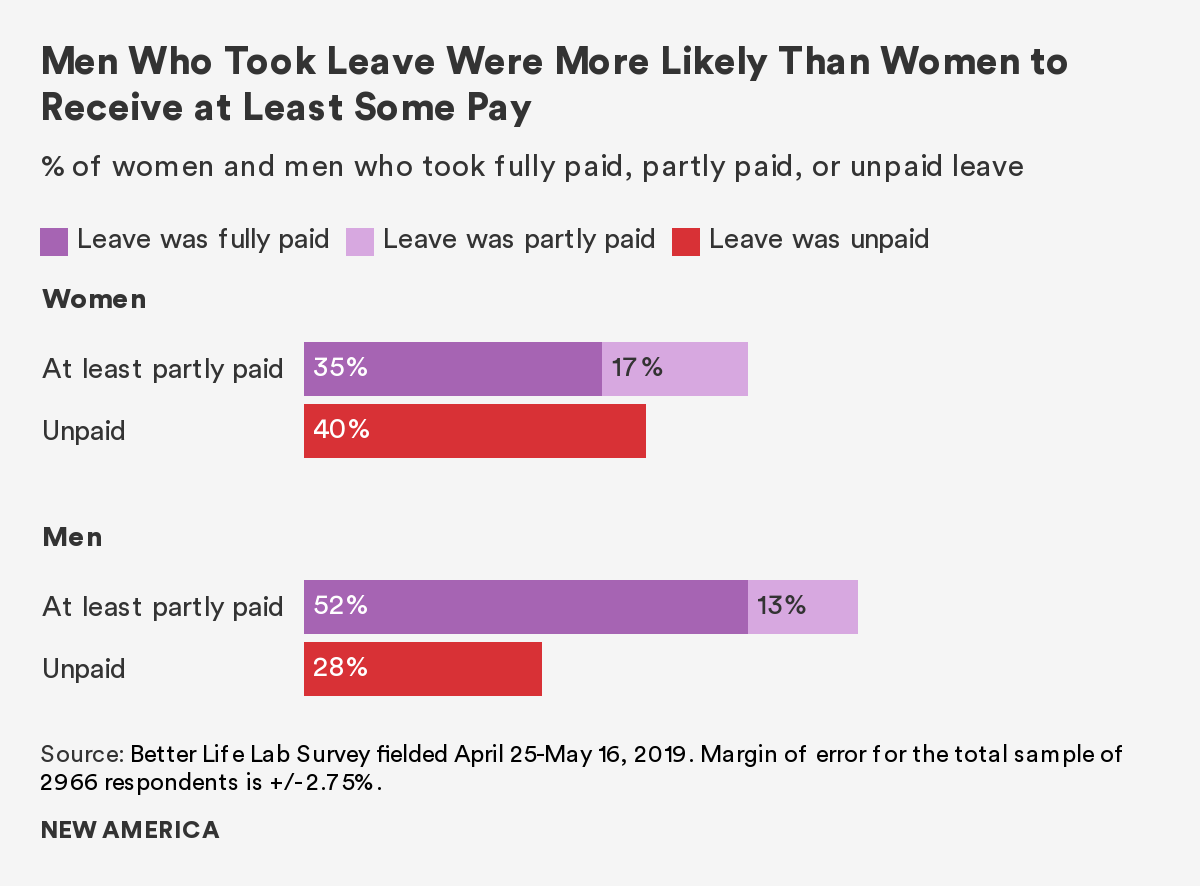
Our focus group research sheds light on these findings. For instance, 33-year-old father of four Russell A. was able to take a week off work following the birth of his youngest child, but noted that if he had not received pay during his time off, even a week would not have been possible for him financially. “The longest that I’ve taken was one week immediately following the birth of our one-year-old. I managed that okay, I just had to catch up on a bunch of work. But [at] the same time, I couldn’t take more time off because that would cause issues like an unbearable amount of catch up work as well as financial stress in general.”
Low-income workers are the least likely to get paid leave from work for care.
Low-income workers, who often have the least savings and who are the most likely to need every paycheck they earn to make ends meet, are the least likely to have access to paid leave. Among those workers able to take leave when they needed it, just 41 percent of workers in households earning less than $30,000 annually had leave that was partly or fully paid, compared with nearly three-quarters of the highest-earning workers—those earning $100,000 or more a year. Fully two-thirds (66 percent) of college degree holders who took leave got at least some pay for that time off of work, while 53 percent of those without a college degree who took leave got paid.
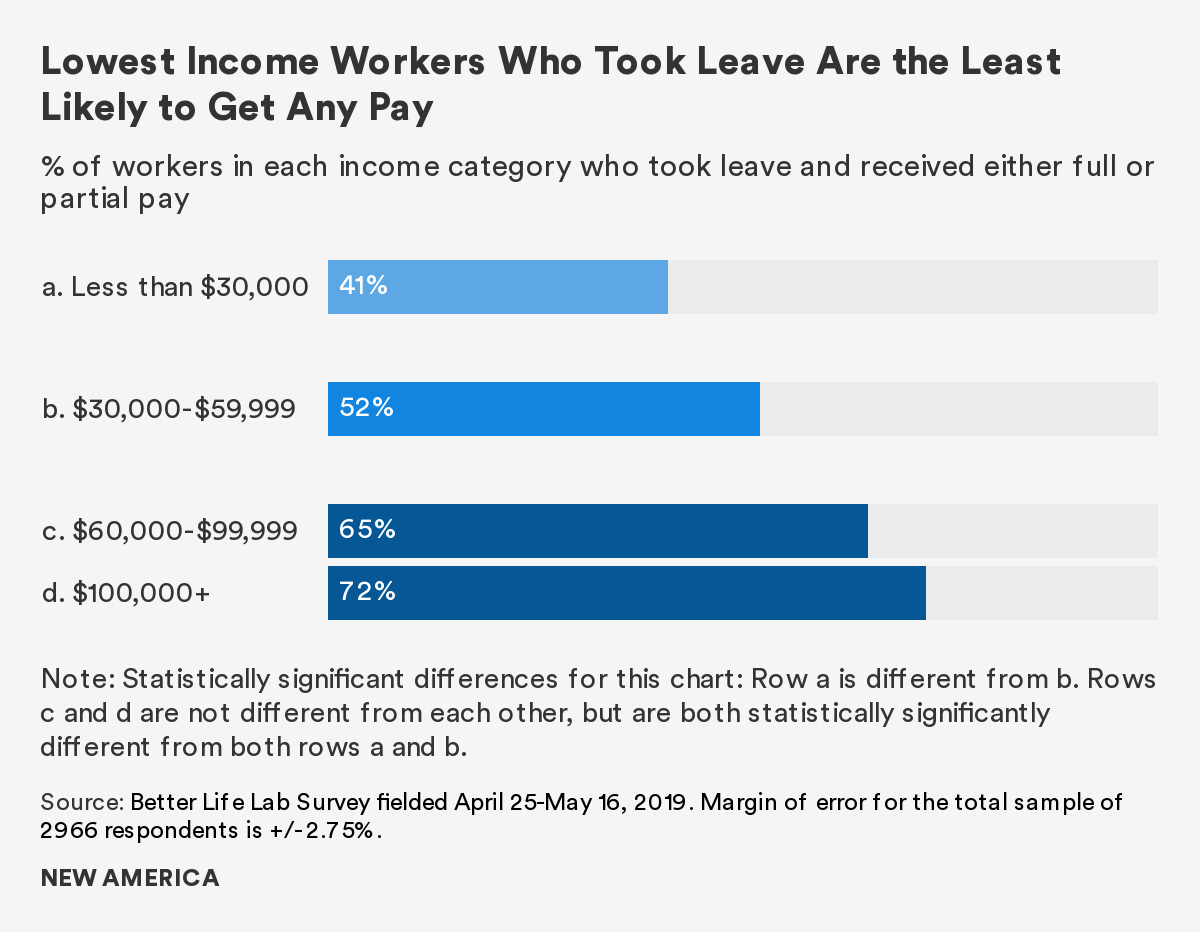
As we’ve seen consistently in the research, workers with college degrees and in higher earning households are more likely to get time off work that is at least partly, if not fully paid. These workers already have better access to all types of benefits like paid sick days, and paid vacations as well as employer-provided family and medical leave, all of which can be used to help pay for time off to care for others.
Covering the Cost of Leave
American families struggle to manage income shortfalls and hardship from unpaid and partly paid family and medical leave.
Millions of American families, even those ostensibly in the middle class, struggle to cover the costs of their lives. Many live paycheck to paycheck, and four in 10 American adults would have trouble finding $400 to cover an emergency expense.1 In our survey, American families who needed and were able to take leave—paid or unpaid—used a variety of strategies to make ends meet during the time they were off of work.
To cover the costs of this care, more than a third of Americans who were not fully paid for their leave had to use savings set aside for other uses or limit spending on basic needs. Just one in five said they were able to cover the costs of caregiving leave without making any sacrifices, trade-offs, or other changes to the family budget.
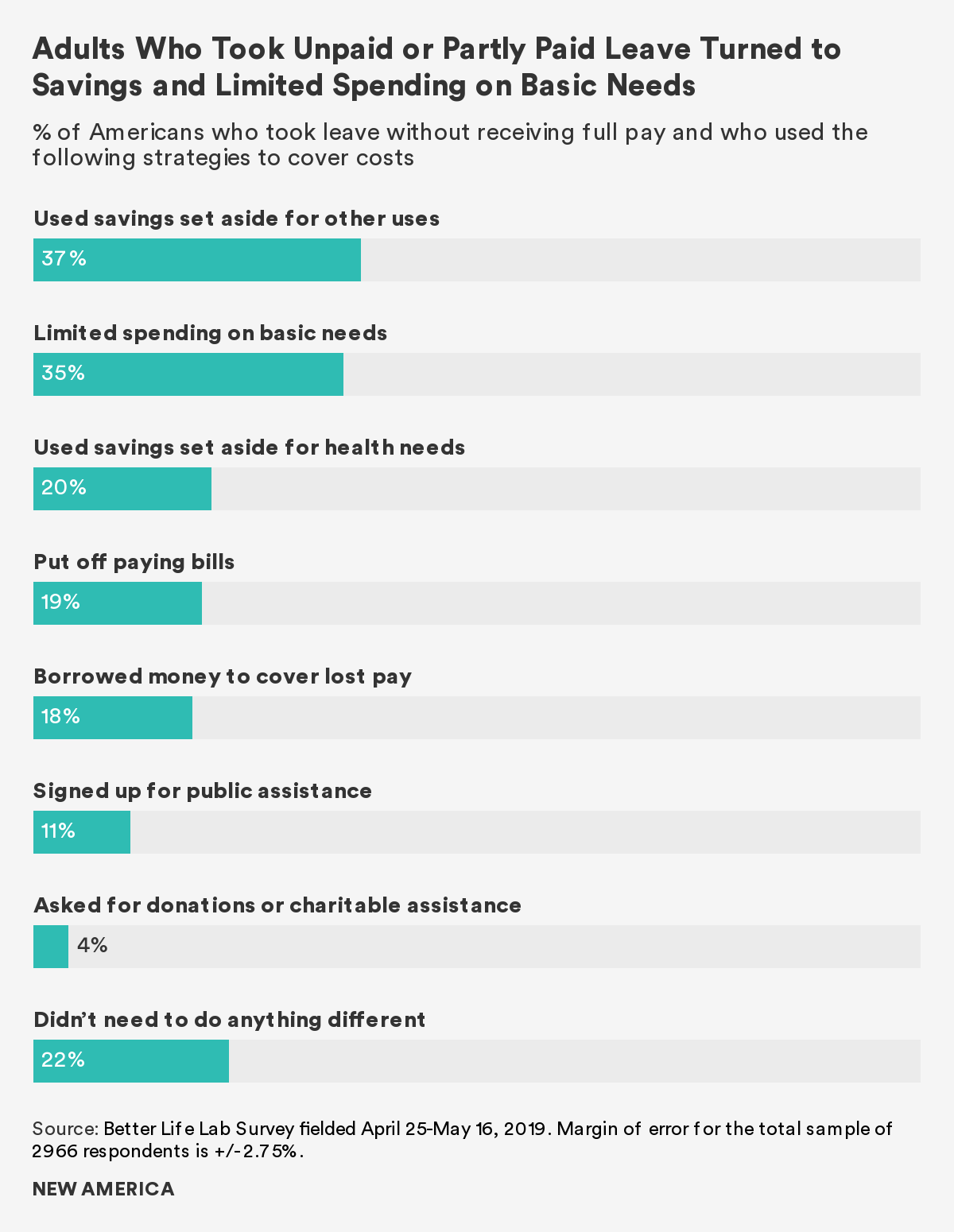
Workers who take unpaid leave have different coping strategies for managing the challenge of leave than their counterparts who are partly paid. While both groups deploy savings—either deliberately set aside for health issues or for other purposes—the unpaid workers are less likely to use savings, and much less likely to have or use health-related savings for their unpaid leaves. Workers who take leave without pay are much more likely to have to cut back on basic needs, borrow money to cover lost pay, and put off paying bills until they can get back to work.
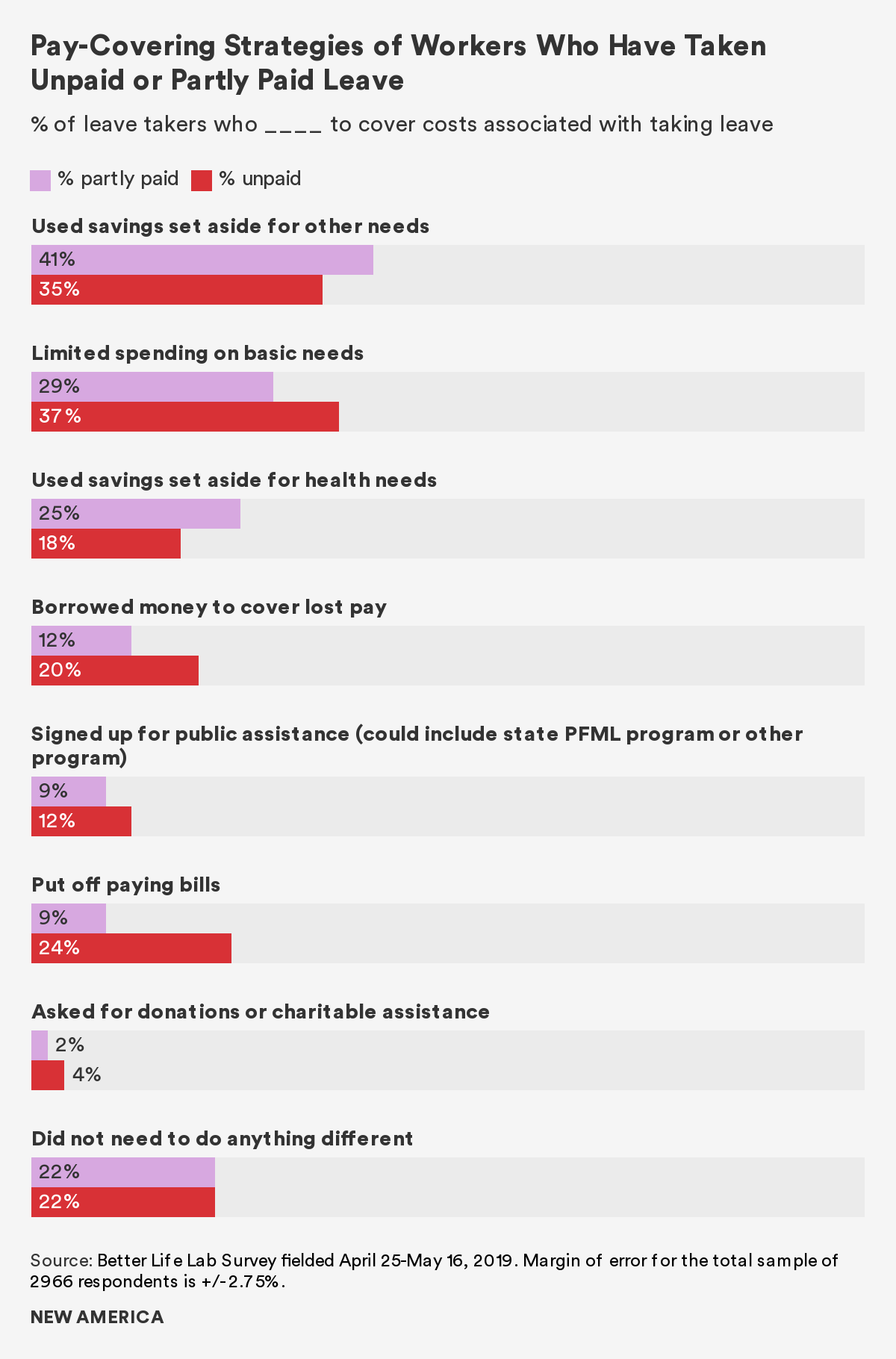
The lowest-income earners who took partly paid or unpaid leave—those who were able to take any leave at all—are more likely to deploy most of the strategies asked about in our study. They rely on limiting spending on basic needs (44 percent), borrowing money (33 percent), putting off paying bills (25 percent), signing up for public assistance (20 percent), and asking for donations or charitable assistance (8 percent). They are just as likely as higher earners who took partly or unpaid leave to rely on savings, even as they are less likely to have much, if any, money saved. Only 14 percent of the lowest-income households did not need to do anything different to manage leave, compared to 25 percent of those in households earning $30,000 or more and taking partly or unpaid leave.
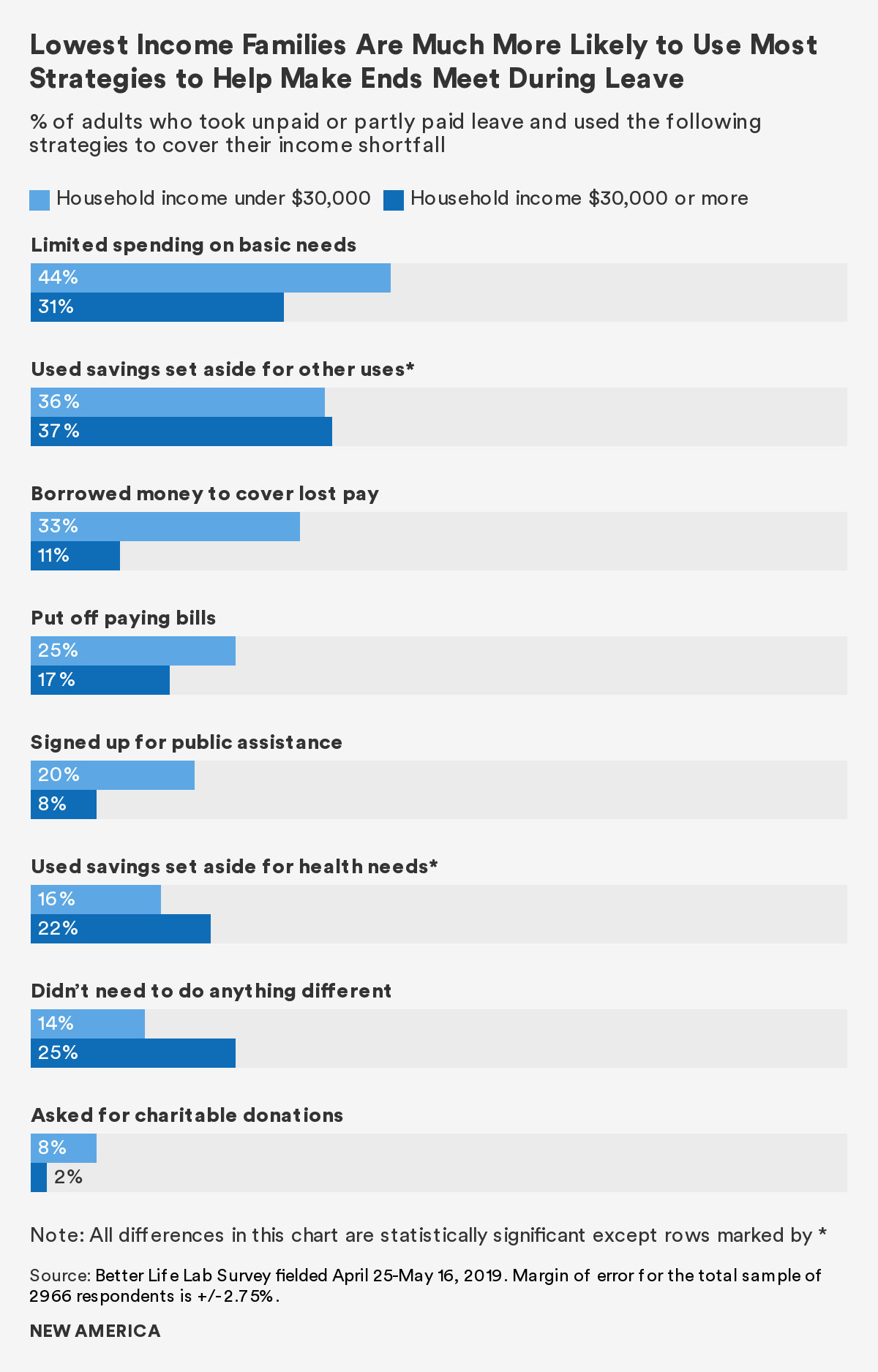
Younger adults are more likely to need to use savings, borrow, limit spending, or access public assistance to cover the cost of taking partly or unpaid leave.
Regardless of whether or not they had fully, partly, or unpaid leave, individuals under 45 were significantly more likely to need to use savings, borrow money, limit spending, or sign up for public assistance to cover the cost of taking time off work than workers 45 and older—a reflection of the fact that these workers are less likely to have access to paid leave of any kind through an employer, generally earn less than older adults, may have high student debt burden, and have not had as long a time horizon to build up savings.
Workers who take leave without pay are much more likely to have to cut back on basic needs, borrow money, and put off paying bills until they can get back to work.
To manage the loss of pay during leave, women more often limit spending on basics.
There are few differences between men and women in how they say they manage lost pay. The exception: Women are more likely to report limiting spending on basic needs (29 percent of women versus 17 percent of men).
Parents taking leave for a birth differ from those taking leave for a sick child.
Parents of young children ages zero to eight and caregivers for children with greater than typical needs are more likely than others to borrow money to cover lost pay and to sign up for public assistance to help manage the gaps in pay caused by taking time to care. Parents of young children are also more likely to say they’ve used savings set aside for health needs to manage the costs of time off work—though caregivers for children with more than typical needs do not use this strategy more than others. Parents anticipating the birth of a child have a number of months to potentially plan and try to set aside money to cover the costs associated with leave and new children joining a household in general. Parents caring for a sick or injured child are often faced with an immediate, unplanned need for leave and attendant costs associated with the care of a sick, injured, or special-needs child, making saving in advance difficult if not impossible.
Half of employed survey respondents with access to paid family and medical leave through an employer say they didn’t need to do anything different to manage their finances when they took leave, but just roughly 3 in 10 of those without paid leave said the same.
Leave takers without access to paid family and medical leave are more likely to report that they limited spending on basic needs during their time away from work to care than those with access to paid leave. Three in 10 (30 percent) of those without paid leave said they limited spending on basic needs to cover the costs of leave, while just 18 percent of those with a paid leave benefit said the same.
Leave takers without paid family and medical leave access are also more likely than those with the benefit to say they raided their savings set aside for other reasons to make ends meet during leave—with 31 percent of those with leave reporting using other savings, compared with 21 percent of those with access to paid family leave.
Parents caring for a sick or injured child are often faced with an immediate, unplanned need for leave and attendant costs…making saving in advance difficult if not impossible.
Many parents cobble together ad hoc plans to find time and money for leave.
Parents in our focus groups spoke about the ways they were able to creatively cobble together paid leave through sick or vacation time if they were lucky enough to have it, or split days and hours at work to toggle between caregiving and work. For those with paid leave or who found a way to pay for leave without hardship, the relief and gratitude for having the time to care without substantial financial stress was notable.
“I only took a week and a half for each kid’s birth. I used vacation and sick time. That was all I was able to take. There were no financial issues. My boss has been understanding and flexible and I have been able to play a big part in raising my kids.” –Kyle C., 36 years old, manager at logistics company, father of two, Massachusetts.
“… my daughter was born seven weeks early, and was in the NICU for a month. After she was born, my wife remained in the hospital with complications for about a week. I took time off immediately after her birth, and then off and on half-days to spend time with her and my wife to make sure my son’s life wasn't disrupted too much. Luckily, the university I work at, and my boss, are flexible and understanding with our time. We have a pretty generous Family Care Leave, Personal Leave, and Annual Leave allowances. While taking as much time as I did drained my Annual Leave balance, I was ok not having a ton of remaining time left.” –Stefan B., 44 years old, academic adviser, father of two, Michigan.
Few men, however, shared stories like some of the more fortunate women in our study did, of having access to and being fully supported in taking paid family leave:
“I took maternity leave for all three children. I took 12 weeks each time. I was paid my full salary on leave and I am grateful for that.” –Lauren F., 37 years old, sales, mother of three, Arkansas.
Citations
- Consumer and Community Research Section, Report on the Economic Wellbeing of U.S. Households in 2018, (Washington, DC: Federal Reserve Board, 2019), source
Conclusion
Our study suggests that given the economic pressures, time strains, and shifting realities many families face around work and care responsibilities, men are already taking at least some leave and anticipating taking leave in significant numbers. In our quantitative and qualitative surveys, we found only minor differences by gender in actually taking leave over the life course, and no significant differences in anticipating needing leave. Our findings suggest that enabling more men to take leave or empowering men to take leaves longer than a few days is likely more dependent on practical and logistical considerations like the availability of paid leave policies, their acceptance in workplace cultures, and support from family, than it is on focusing solely on shifting masculine norms around care. Men’s evolving role as caregivers is most widely accepted among older men with more experience of the realities of modern life and exposure to the juggle most families face combining work and caregiving responsibilities.
Although a majority of Americans, men and women alike, believe men don’t take leave because they think men don’t think of caregiving as their responsibility, that viewpoint was by far the exception in our focus groups. Most men took as much leave as they felt they could afford or felt they could justify at work without facing negative repercussions.
Only one respondent in our focus groups said he didn’t take leave because he “didn’t need to” when his children were born, because his mother and mother-in-law were around to help his wife. In most cases, men reported needing or wanting to take leave, but were concerned about how to access it, how to pay for it, that they’d fall behind at work, or that they’d face negative repercussions.
Most men took as much leave as they felt they could afford or felt they could justify at work without facing negative repercussions.
Men overwhelmingly told us that they were grateful to have been able to take time off from work. They also expressed anger and even guilt when they were unable to do so or were forced to take less time off than they would have liked for financial or other work-related reasons.
A majority of Americans believe economic pressures are a key driver behind why men don’t take leave, and the data bear that out, with men in higher-income groups much more likely to have access to and take paid caregiving leave than men in lower-income groups.
Men are less likely to take leave than women, but when they do, it’s more likely to be paid than unpaid. Women who have taken leave are less likely than men to have reported receiving some pay during the course of their leave, and are much more likely to take leave even if it’s unpaid. This finding suggests a gender difference in leave-taking versus paid work when men and women are forced to choose between the two, with women taking leave while men continue with their paid work.
Our findings as a whole illustrate the competing pressures men in the United States face. On the one hand, breadwinning, adhering to “ideal worker” norms, and “being manly,” are all expectations that appear to persist for men and fathers. Yet on the other hand, men want to take leave, anticipate needing leave, and appear engaged in caregiving across the life cycle.
The lesson to policymakers seeking to craft policies designed to support working families and encourage more equal caregiving leave uptake across the life course are clear. If policymakers hope to see gender and economic equity outcomes from enacting paid leave policies, policies must be designed to encourage men to take leave following the birth or adoption of a child, or to care for a family member. To accomplish this, any paid leave policy must include financial remuneration men will consider adequate to compensate for their time off from work.
Workplaces, too, have an important role to play in whether men feel they can choose to take time to provide care for their families. Our findings suggest that men’s behavior surrounding leave is not just the result of access through a policy, but is also influenced by the support they receive for using leave from their managers and coworkers. Workplaces must create supportive environments that accommodate and normalize workers’ caregiving responsibilities, regardless of gender, and recognize that caregiving needs extend far beyond parenthood: workers anticipate needing time to care not only for children, but also for themselves and other family members and loved ones, particularly as parents age.
American values around men and caregiving have evolved tremendously in recent decades. American men today are participating in caregiving in significant ways, with benefits to themselves, their families, and U.S. society more broadly. But simply asking men to step up to care without the policy and workplace support that can make that participation possible will have limited impact. It’s time for our policy structures and work culture to catch up with them.
Methods
This research was underpinned by two separate data collections: an online survey and a series of five online discussions. Detailed methods for each data collection are outlined below.
Focus Group Methods
In order to understand the experiences and beliefs of a broad swath of American adult men and women from across the United States regarding men and caregiving, we conducted five three-day long online discussions using the 20|20 Research’s facilitation platform QualBoard. 20|20 recruited and screened focus group participants for each of the online discussions. The groups were conducted over four weeks in May 2019 and included a total of 68 participants. Participants were compensated for their time. The five groups were each with separate populations, with each group drawing the following populations from across the United States:
- A general population group of men 18 and older,
- A general population group of women 18 and older,
- A group of fathers of children ages zero to eight,
- A group of men who are currently caring for another adult, and
- A group of men who work in caregiving professions such as nursing or early childhood education. Physicians were excluded.
Better Life Lab at New America supplied 20|20 with six open-ended discussion prompt modules, with a first module of questions released early in the morning and a second in the early afternoon of each day of the three days that each board was active. All of the modules from the previous days remained available for respondents to engage with on the following days. The boards were live for five days, to allow participants extra time to finish answering questions. Participants could respond to moderators, moderators could ask participants follow-up questions to learn more about their experiences, and participants could ask questions of each other or comment on one another’s thoughts. Participants were asked about their experiences with leave, how they would feel about their employer offering a paid leave benefit, how they feel about coworkers using the benefit, and how they would feel about the government offering a universal paid leave policy. Researchers at the Better Life Lab used a grounded theory methodology to develop a coding scheme for the focus group transcripts and analyzed the data using these codes to identify common themes.
All moderators for the focus groups were women and interacted with participants using their actual first names and portraits as their avatars, which may have limited the disclosures some men made about their feelings around caregiving and paid leave. Other than those participants who explicitly gave us permission to report on their stories as journalists after the focus groups concluded, all focus group participant names have been changed to pseudonyms chosen by the authors of this report. The promise of anonymity in all public records may have encouraged participants to be open and honest.
Both the quantitative and qualitative components of the study included modules specifically on paid family and medical leave, including questions about whether Americans have taken leave, how they paid for it, whether they anticipate needing leave in the future, and why they think men do or do not take leave.
The transcripts of these focus group discussions were coded using a grounded theory methodology. Coders began by reading the full transcripts of all five discussion boards. Coders then read through the transcripts a second time, noting themes. Themes were generated based on clear differences amongst participants on the questions, and common attitudes, beliefs, and behaviors, as well as participants’ stated desires, motivations, and barriers. The coders then compared their notes and established a common list of codes that was all-inclusive of the noted findings, collapsing overlapping categories together without losing differences or details, and including working definitions of each code and how it should be applied. Using the established list of approximately 60 codes across the categories of Behavior, Beliefs, and Attitudes, coders went back through the five transcripts coding utterances with relevant codes. Coders ran two tests for coding accuracy—comparing their application of codes on the answers to two distinct discussion questions in two groups’ transcripts. Coders agreed on the application of codes in over 90 percent of cases. The key trends and themes these codes revealed are detailed throughout the report, with select quotations from participants that best exemplify these findings.
Survey Methodology
The study included a nationally representative online and phone survey of 2,966 adults residing in the United States. The survey was fielded between April 25 and May 16, 2019, with an average interview length of 14 minutes and an overall margin of error of +/- 2.75%. The survey was conducted in English and Spanish by NORC at the University of Chicago on its AmeriSpeak platform for New America. Funded and operated by NORC at the University of Chicago, AmeriSpeak® is a probability-based panel designed to be representative of the U.S. household population. Randomly selected U.S. households are sampled with a known, non-zero probability of selection from the NORC National Sample Frame, and then contacted by U.S. mail, email, telephone, and field interviewers (face to face).
The survey includes an oversample of the men 18 and older, as well as two additional non-probability oversamples of fathers of children zero to eight and men who currently work in caregiving professions. NORC partnered with Dynata for the father of zero to eight year-olds and professional male caregiver samples. The oversamples of men and fathers are included in this analysis. The professional caregiver oversample is separate, cannot be weighted back to the general population sample, and is not included in this analysis, nor is in include in the n=2966. This research was done to support a better understanding of the perceived caregiving responsibilities of men and women with a focus on the parenting and caregiving roles of men.
Panelists were offered the cash equivalent of $3. Toward the end of the field period, the incentive was increased to the cash equivalent of $7. New America and NORC collaborated on the writing of the survey instrument.
Sampling
A general population of U.S. adults age 18 years and older was selected from NORC’s AmeriSpeak Panel for this study. Additionally, male respondents from the Dynata panel were screened for parental status (fathers of zero to eight year-olds) and professional occupation (professional male caregivers).
The sample for a specific study is selected from the AmeriSpeak Panel using sampling strata based on age, race, Hispanic ethnicity, education, and gender (48 sampling strata in total). The size of the selected sample per sampling stratum is determined by the population distribution for each stratum. In addition, sample selection takes into account expected differential survey completion rates by demographic groups so that the set of panel members with a completed interview for a study is a representative sample of the target population. If the panel household has more than one active adult panel member, only one adult in the household is eligible for selection (random within-household sampling). Panelists selected for an AmeriSpeak study earlier in the business week are not eligible for sample selection until the following business week.
A small sample of English-speaking AmeriSpeak web-mode panelists were invited on April 12 for a pretest. In total, NORC collected 40 pretest interviews. The initial data from the pretest was reviewed by NORC and was delivered to New America.
Changes to CATI (i.e., question text or response options customized for phone interviews) question text were made before fielding the main survey to collect the 3,200 interviews.
In total, NORC collected 3,297 interviews, 3,040 by web mode and 257 by phone mode.
Data Processing
NORC prepared a fully labeled data file of respondent survey data and demographic data for New America. NORC applied cleaning rules to the survey data for quality control by implementing the following rules:
- Removed respondents who completed the survey in 2 minutes or less (10 cases)
- Removed suspicious grid item respondents (13 cases)
- Removed over-collection of doctors to match the contract requirement of the male professional caregiver sample composition of less than 10 percent doctors (99 cases randomly selected).
Statistical Weighting
NORC produced two weights for this survey data:
- Weight1: Post-stratification weights of General Population, aged 18+ (n=2,966)
- Weight2: Post-stratification weights of Fathers (n=1,158)
The third population group for this survey—men who work in caregiving professions (n=331)—did not receive weights. This sample should be analyzed unweighted.
Statistical weights for the study eligible respondents were calculated using panel base sampling weights to start.
Panel base sampling weights for all sampled housing units are computed as the inverse of probability of selection from the NORC National Frame (the sampling frame that is used to sample housing units for AmeriSpeak) or address-based sample. The sample design and recruitment protocol for the AmeriSpeak Panel involves subsampling of initial non-respondent housing units. These subsampled non-respondent housing units are selected for an in-person follow-up. The subsample of housing units that are selected for the nonresponse follow-up (NRFU) have their panel base sampling weights inflated by the inverse of the subsampling rate. The base sampling weights are further adjusted to account for unknown eligibility and nonresponse among eligible housing units. The household-level nonresponse adjusted weights are then post-stratified to external counts for the number of households obtained from the Current Population Survey. Then, these household-level post-stratified weights are assigned to each eligible adult in every recruited household. Furthermore, a person-level nonresponse adjustment accounts for nonresponding adults within a recruited household.
Finally, panel weights are raked to external population totals associated with age, sex, education, race/Hispanic ethnicity, housing tenure, telephone status, and Census Division. The external population totals are obtained from the Current Population Survey. The weights adjusted to the external population totals are the final panel weights.
Study-specific base sampling weights are derived using a combination of the final panel weight and the probability of selection associated with the sampled panel member. Since not all sampled panel members respond to the survey interview, an adjustment is needed to account and adjust for survey non-respondents. This adjustment decreases potential nonresponse bias associated with sampled panel members who did not complete the survey interview for the study.
Thus, the nonresponse adjusted survey weights for the study are adjusted via a raking ratio method to general population totals associated with the following socio-demographic characteristics: age (four levels), Hispanic ethnicity, and education, each controlled by gender and father status as well as age (seven levels), race/Hispanic ethnicity, and Census Division, each controlled by gender. The same nonresponse adjusted survey weights for the study are adjusted via raking ratio method to father totals associated with age (four levels), Hispanic ethnicity, and education.
For the weights of fathers with children age zero to eight, calibration techniques were used to adjust the opt-in father sample from Dynata. The final opt-in respondents are assigned a base weight of one, then are adjusted via raking ratio method to population totals associated with age (four levels), Hispanic ethnicity, and education. The combined AmeriSpeak and Dynata opt-in panel sample weight is obtained by determining an optimal composition factor for combining the final raked AmeriSpeak and opt-in panel sample; the optimal composition factor for the combined weights is computed based on a criterion of minimizing the mean squared error associated with key survey estimates. The purpose of calibration is to adjust the weights for the nonprobability sample so as to bring weighted distributions of the nonprobability sample in line with the population distribution for characteristics correlated with the survey variables. Such calibration adjustments help to reduce potential bias, yielding more accurate population estimates. Finally, the combined weights for fathers with children age zero to eight together with all other fathers produce the final father’s weight. The weights, adjusted to the external population totals, are the final study weights.
Raking and re-raking is done during the weighting process such that the weighted demographic distribution of the survey completes resemble the demographic distribution in the target population. The assumption is that the key survey items are related to the demographics. Therefore, by aligning the survey respondent demographics with the target population, the key survey items should also be in closer alignment with the target population.
Bibliography
Brigid Schulte, Alieza Durana, Brian Stout, and Jonathan Moyer, Paid Family Leave: How Much Time Is Enough? (Washington, DC: New America, 2017), https://www.newamerica.org/better-life-lab/reports/paid-family-leave-how-much-time-enough/.
Juliana Menasce Horowitz, Kim Parker, Nikki Graf, and Gretchen Livingston, Americans Widely Support Paid Family and Medical Leave, but Differ over Specific Policies, (Washington, DC: Pew Research Center, 2017), https://www.pewsocialtrends.org/2017/03/23/americans-widely-support-paid-family-and-medical-leave-but-differ-over-specific-policies/.
Women’s Initiative, Paid Family and Medical Leave: By the Numbers, (Washington, DC: Center for American Progress, 2017), https://www.americanprogress.org/issues/women/reports/2017/09/27/439527/paid-family-medical-leave-numbers/.
Jacob Alex Klerman, Kelly Daley, and Alyssa Pozniak, Technical Report Commissioned by Department of Labor (Washington, D.C., U.S. Department of Labor: 2012), www.dol.gov/whd/fmla/survey.
Kenneth Matos, Ellen Galinsky, and James T. Bond, National Study of Employers, (Alexandria: Society for Human Resource Management Online, 2019), https://www.shrm.org/resourcesandtools/hr-topics/benefits/pages/jpmorgan-chase-settles-paternity-suit-over-primary-caregiver-leave.aspx.
“OECD Family Database,” OECD, last updated August 2019, https://www.oecd.org/els/soc/PF2_1_Parental_leave_systems.pdf.
“Is paid leave accessible to mothers and fathers? (Data)” WORLD Policy Analysis Center, last accessed November 18, 2019, https://www.worldpolicycenter.org/policies/is-paid-leave-available-to-mothers-and-fathers-of-infants/is-paid-leave-available-for-fathers-of-infants.
Amy Raub et al. Paid Leave for Family Illness: A Detailed Look at Approaches Across OECD Countries, (Los Angeles: WORLD Policy Analysis Center, 2018), https://www.worldpolicycenter.org/sites/default/files/WORLD%20Report%20-%20Family%20Medical%20Leave%20OECD%20Country%20Approaches_0.pdf.
Vicki Shabo, Overview of Paid Family Leave Use and Coverage, (Washington, DC:New America,2019),https://newamericadotorg.s3.amazonaws.com/documents/Overview_of_FMLA_and_Paid_Leave_Use_and_Coverage.pdf.
National Partnership for Women and Families, Paid Leave Works: Evidence from State Programs: Fact Sheet (Washington, DC: National Partnership for Women and Families:2019), http://www.nationalpartnership.org/our-work/resources/economic-justice/paid-leave/paid-leave-works-in-california-new-jersey-and-rhode-island.pdf.
National Partnership for Women and Families, Leading on Leave: Companies With New or Expanded Paid Leave Policies, (Washington, DC: National Partnership for Women and Families 2019), http://www.nationalpartnership.org/our-work/resources/economic-justice/paid-leave/new-and-expanded-employer-paid-family-leave-policies.pdf.
“Employee Benefits Survey” (Table 32. Leave benefits: Access, private industry workers, March 2016), Bureau of Labor Statistics, last accessed November 2019, https://www.bls.gov/ncs/ebs/benefits/2016/ownership/private/table32a.htm.
“Employee Benefits Survey” (Table 31. Leave benefits: Access, private industry workers, March 2019), Bureau of Labor Statistics, last accessed November 2019, https://www.bls.gov/ncs/ebs/benefits/2019/ownership/private/table31a.pdf.
Matt Reynolds, “JP Morgan Chase to Pay $5M to Settle Dads’ Parental-Leave Case,” Courthouse News, May 30, 2019, https://www.courthousenews.com/jpmorgan-chase-to-pay-5m-to-settle-dads-parental-leave-case/.
“Economic News Release” (American Time Use Survey Summary 2018), Bureau of Labor Statistics, last accessed November 18, 2019, https://www.bls.gov/news.release/atus.nr0.htm.
David Cotter and Joanna Pepin, Trending Towards Traditionalism? Changes in Youths’ Gender Ideology, (Austin: Council of Contemporary Families, 2017), https://contemporaryfamilies.org/2-pepin-cotter-traditionalism/.
Daniel Carlson and Jamie L. Lynch, “Housework: Cause and Consequence of Gender Ideology?” Social Science Research 42(6) (November 2013): 1505-1518.
National Partnership for Women and Families, Fact Sheet, (Washington, DC: National Partnership for Women and Families: 2019), http://www.nationalpartnership.org/our-work/resources/economic-justice/paid-sick-days/current-paid-sick-days-laws.pdf.
Barbara Gault, Heidi Hartmann, Ariane Hegewisch, Jessica Milli, and Lindsey Reichlin, Paid Parental Leave in the United States, (Washington, DC: Institute for Women’s Policy Research, 2014) https://www.dol.gov/wb/resources/paid_parental_leave_in_the_united_states.pdf
Bureau of Labor Statistics, National Compensation Survey: Employee Benefits, (Washington, DC: U.S. Department of Labor, March 2019, https://www.bls.gov/ncs/ebs/benefits/2019/employee-benefits-in-the-united-states-march-2019.pdf.
Gretchen Livingston, More than One-in-Ten U.S. Parents are Caring for an Adult, (Washington, DC: Pew Research Center, 2018), https://www.pewresearch.org/fact-tank/2018/11/29/more-than-one-in-ten-u-s-parents-are-also-caring-for-an-adult/.
Consumer and Community Research Section, Report on the Economic Wellbeing of U.S. Households in 2018, (Washington, DC: Federal Reserve Board, 2019), https://www.federalreserve.gov/publications/files/2018-report-economic-well-being-us-households-201905.pdf.
More About the Authors

Haley Swenson
Senior Writer and Researcher, Better Life Lab

Brigid Schulte
Director, Better Life Lab