
Connecting Adults to College with Credit for Prior Learning
Table of Contents
- Introduction
- Jumpstarting the Economy: The Trade Adjustment Assistance Community College and Career Training Program
- Credit Where It's Due: Prior Learning Assessment
- Methodology
- Harmonizing Policy: PLA Grant Activities
- Challenges with PLA Implementation
- Lessons from PLA Implementation
- Recommendations
- Conclusion
- Appendix
Abstract
In this report we walk through a systematic review of how PLA was implemented under the ideal circumstances provided by the TAACCCT grant program. We found that there was positive policy development, but student use of PLA opportunities remained low. In some isolated places, we found policy and practice changes that were connected to an increase in students’ use of PLA. From this analysis, we distilled lessons on implementation and suggest how to scale up the use of PLA in higher education.
Acknowledgments
We would like to thank Lumina Foundation for their generous support of this work. Particularly, we would like to thank Frank Essien, Wendy Sedlak, and Holly Zanville for their helpful feedback and encouragement throughout the project. We would also like to thank all the people who spoke to us about our research and the staff from the US Department of Labor, particularly Robin Fernkas, Eugenie Agia, Cheryl Martin, and Evan Burke. Thanks to our research partners at Bragg & Associates. Thank you to all of our New America colleagues including Sabrina Detlef, Maria Elkin, Riker Pasterkiewicz, and Julie Brosnan.
Downloads
Introduction
Jordan Schoener needed a jump-start on his education. He had joined the military straight out of high school and, after completing his service eight years later, went to work at an iron casting foundry in his hometown of Mankato, Minnesota.1 He enjoyed machining, and as he approached his 30s, he decided to upgrade his skills by pursuing an associate’s degree in it from the nearby South Central College, a community and technical college.
Attending the program while continuing to work full time could have slowed Schoener down. But luckily for him, South Central was part of a grant program run by the U.S. Department of Labor (DOL), which allowed the school to create a system that awarded him 12 credits for machining skills he had obtained through his previous experience in the military and at work.2 Receiving those credits gave him the head start he needed to earn his degree in two years. He is now pursuing his bachelor degree in manufacturing engineering at Minnesota State University, Mankato.
Schoener’s experience shows the promise of prior learning assessment (PLA), the process of evaluating and awarding college credit for the equivalent college-level learning acquired outside of a postsecondary institution, such as at a job, during military service, corporate training, or through volunteer work. Colleges and policymakers have been working to build these opportunities for 80 years.3 Now, interest in prior learning assessment is growing as we face a future where people need to get their skills and abilities recognized and built into credentials. These credentials in turn give them an edge in the face of automation and recession.
Unfortunately, Schoener’s story is all too rare. Despite years of investment in policies and programs to support PLA, it has not been scaled up in the way that other student success strategies—such as remedial education reform or guided pathways—have. For instance, a recent survey by the Southern Association of Colleges and Schools Commission on Colleges of its member institutions found that very few track the use of PLA and, among those that do, less than 5 percent of students take advantage of the opportunity.4
Even after years of focus, PLA has failed to take root. The Labor Department’s Trade Adjustment Assistance Community College and Career Training (TAACCCT) program provides an opportunity for studying why that might be. Over each of its four rounds, the DOL emphasized investing in better systems for awarding credit for prior learning. By directing money and focus on PLA and adult students, TAACCCT created the ideal circumstances for colleges to implement PLA.
We conducted a systematic review of how PLA was implemented under the ideal circumstances provided by the TAACCCT grant program. We found that there was plenty of positive policy development, but student use of PLA opportunities remained low. In some isolated places, we found policy and practice changes that were actually connected to an increase in students’ use of PLA. From this analysis, we distilled lessons on implementation and suggest how to scale up the use of PLA in higher education.
There was plenty of positive policy development, but student use of PLA opportunities was low.
Citations
- See Credit for Prior Learning—Jordan [Video file] Retrieved from source Central College. [southcentralcollege] (March 1, 2018,). And Jordan Schoener, Profile [Linkedin Page]. source andSouth Central College. For the Schoeners, SCC Is All in The Family. Career Focus. Fall/Winter 2017, Volume 1 – Issue 2, source.
- See Stacy Tomhave, MnAMP Credit for Prior Learning Guide 1.1 (Faribault, MN: South Central College, March 7, 2017), source.
- See Nan L. Travers, Prior Learning Assessment Handbook: Northeast Resiliency Consortium (Paterson, NJ: Northeast Resiliency Consortium, January, 2015), source.
- See Nuria M. Cuevas, Alexei G. Matveev, & Kyle L. McCarrell (May 2019) Credentialing: A Study of Non-Credit-to-Credit Conversion Activities, Presentation at AIR Forum, Denver, CO.
Jumpstarting the Economy: The Trade Adjustment Assistance Community College and Career Training Program
Congress created the $2 billion TAACCCT program in 2010 at the height of the deepest recession in more than a generation. The program was the largest targeted investment in community colleges that the federal government has made and was meant to increase the schools’ capacity for providing training for in-demand jobs. With unemployment approaching 10 percent, the idea was to build the country’s national capacity to get people retrained and back into employment. With each round of grants, the Departments of Labor and Education identified promising practices that applicants could implement as part of their grant, and prior learning assessment was encouraged in all four grant solicitations. Colleges created new or improved workforce focused programs integrating their choice of PLA, online and technology enabled learning, career pathways, and stacked and latticed credentials. After four rounds of funding, the Department of Labor had made 256 TAACCCT grants, reaching every state in the country, with each grant lasting four years. After the first round, the DOL required an external evaluation for each grant.
Prior Learning Assessment was a priority of the TAACCCT grants because—in theory—it helps people accelerate to a credential. The DOL required colleges to explain how they would measure credit for prior learning in every solicitation of grant applications it released as part of the TAACCCT grant. Through our review of more than 50 top-rated evaluations, we found that nearly half of the grants mentioned significant efforts on PLA, while only 11 did not include a prior learning component at all.
Credit Where It's Due: Prior Learning Assessment
Prior learning assessment, also known as credit for prior learning (CPL), is the process of evaluating and awarding college credit for college-level learning acquired outside of a postsecondary institution. PLA credits can be awarded using different methods. According to a survey conducted in 2014 by the American Association of Collegiate Registrars and Admissions Officers of its member institutions, four most common methods used to assess prior learning include: (1) standardized exams, like the College-Level Evaluation Program;1 (2) evaluation of corporate, military, or other non-credit training, like the American Council on Education credit recommendations;2 (3) challenge exams; and (4) portfolio based assessment.3 Depending on the college’s policy, students can apply their approved credits for prior learning to skip a prerequisite class, advance to a higher-level class, or even satisfy some of the program’s requirements, helping them complete the program faster.
PLA is not a new idea. It has been around since the 1930s,4 and recently gained traction as an innovation to boost adult learners’ persistence and completion rates.5 Most literature on PLA showcases policy and practices at the college or state level. These studies tend to provide detailed information on PLA’s policy development and practices.6 They have not, however, highlighted the challenges that can hinder the update of these practices.
A few studies have examined the impact of PLA on student outcomes such as persistence and completion, and how long it took these students to get their degrees.7 While a number of studies have found a correlation between obtaining PLA credits and persistence and completion, none have been able to isolate PLA as the determining factor. For example, one of the largest studies was conducted in 2010 by the Council for Adult and Experiential Learning (CAEL), a non-profit that is a pioneer of PLA. CAEL’s 2010 study examined student outcomes at nearly 50 institutions that offered PLA.8 It found that students with PLA credits were more likely to persist and to finish their programs faster than students with no PLA credits. These findings held up regardless of institutional type, academic capability or financial aid, race, age, and gender. But the study did not include a matched comparison group; it simply compared outcomes for students with PLA credits to the general student population. Since students who take the time to learn about and complete a PLA process might also be better resourced or more motivated than students who do not, it is possible they would have been more likely to complete their programs with or without PLA. As a result, researchers cannot say for certain that PLA credits have positive impacts on student outcomes.
| Type of PLA | Description |
|---|---|
| Evaluation of corporate, military, or other non-credit training | Evaluation can be done by the college itself or by the American Council on Education (ACE). ACE [publishes](https://www.acenet.edu/Programs-Services/Pages/Credit-Transcripts/CREDIT-Evaluations.aspx) credit recommendations for formal instructional programs offered by non-collegiate entities. |
| Standardized exams | These can include: [Advanced Placement](https://apstudents.collegeboard.org/) or [International Baccalaureate](http://www.ibo.org/) exams given to high school students to demonstrate college-level learning. [College-Level Examination Program](https://clep.collegeboard.org/register?gclid=Cj0KCQjwwb3rBRDrARIsALR3XeZVo1ncZLZ08KWM5fy_wZ7RRoaauL-gW96b8MRiG8lytXuCOpf4yKoaAtXHEALw_wcB&s_kwcid=AL!4330!3!285287761647!e!!g!!%2Bclep%20%2Bexams&ef_id=Cj0KCQjwwb3rBRDrARIsALR3XeZVo1ncZLZ08KWM5fy_wZ7RRoaauL-gW96b8MRiG8lytXuCOpf4yKoaAtXHEALw_wcB:G:s&s_kwcid=AL!4330!3!285287761647!e!!g!!+clep%20+exams) or CLEP Exams, which allow students to test out of introductory classes in subjects like business, languages, or history at colleges that recognize them. [UExcel Exams](https://www.excelsior.edu/exams/uexcel/), offered by Excelsior College, which allow students to test out of classes in business, liberal arts, science, technology at participating colleges. [DSST Exams](https://www.getcollegecredit.com/about/), which offer students college credit in subjects like social sciences, math, applied technology, business, physical sciences, and humanities. |
| Challenge exams | These are custom, mostly faculty-created, tests meant to verify that students have already mastered course content. Challenge exams may be current course final exams or may be developed specifically for this purpose. |
| Portfolio-based assessment | Typically, this is a written presentation that shows that student knowledge is equivalent to what would be taught in a specific course. The portfolio can address a course description and learning outcomes through narrative and a collection of evidence that helps demonstrate subject mastery. |
Citations
- See College Board, CLEP (website), source.
- See American Council on Education (ACE) (website), “Credit Recommendations,”source.
- See Credit for Prior Learning Practices: Results of the AACRAO December 2014 60 Second Survey (Washington, DC: American Association of Collegiate Registrars and Admissions Officers, January 2015), source.
- See Nan L. Travers, “What Is Next after 40 Years? Part 1: Prior Learning Assessment: 1970–2011,” Journal of Continuing Higher Education 60, no.1 (2012): 43–47.
- See Developing Credit for Prior Learning Policies to Support Postsecondary Attainment for Every Learner (Silver Spring, MD: Advance CTE. April 2019), source.
- See Theresa Hoffmann and Kevin A. Michel, “Recognizing Prior Learning Assessment Best Practices for Evaluators: An Experiential Learning Approach,” Journal of Continuing Higher Education 58, no. 2 (2010): 113–120; Nan L. Travers, “What Is Next after 40 Years? Part 2: Prior Learning Assessment: 2012 and After,” Journal of Continuing Higher Education 60, no. 2 (2012): 117–121; and Ireri Valenzuela, Donald MacIntyre, Becky Klein-Collins, and John Clerx, Prior Learning Assessment and Competency-Based Education: An Overview of Programs, Policies, and Practices (March 2016), source.
- See Walter Stephen Pearson. 2000. “Enhancing adult student persistence: The relationship between prior learning assessment and persistence toward the baccalaureate degree,” Phd diss. Iowa State University; Jean Marie Chappell. 2012. “A Study of Prior Learning Assessment in Degree Completion,” Ed.D diss. Graduate College of Marshall University; Milan S. Hayward & Mitchell R. Williams, “Adult Learner Graduation Rates at Four U.S. Community Colleges by Prior Learning Assessment Status and Method,” Community College Journal of Research and Practice, no. 39:1 (2015) 44–54; Dianna Z. Rust & William L. Ikard, “Prior Learning Assessment Portfolio Completion: Improved Outcomes at a Public Institution,” The Journal of Continuing Higher Education no. 64:2 (2016) 94–100; Antonio L. Jackson. 2016. “Credit for Prior Learning: The Efficacy of Awarding Credit for Non-college Learning on Community College Completion,” Phd diss. Proquest LLC; Reena Lichtenfeld. 2018. “Prior Learning Assessment at a Small, Private Midwestern Institution,” Ed.D diss.Walden University.
- See Council for Adult and Experiential Learning (CAEL). “Fueling the Race to Postsecondary Success: A 48-Institution Study of Prior Learning Assessment and Adult Students outcomes.” source.
Methodology
This brief is part of a larger project that attempts to understand the implementation and impact of the TAACCCT investment through a systematic review of third-party grant evaluation reports. The project involves a team of six researchers from Bragg & Associates and New America who have collected and reviewed 220 available evaluation reports available from 256 TAACCCT projects. It has three phases: scanning and scoring, systematic review, and semi-structured interviews with evaluators and grantee institutions.
In the first phase, our team collected 220 evaluation reports available from the four rounds of TAACCCT. Each report was reviewed at least twice and graded by two different team members on three elements: theory of change, implementation analysis, and impact analysis. Fifty-six reports with the top quartile total scores and implementation scores were chosen for the second phase.1
For this brief, we reviewed those 56 reports again, this time looking for efforts related to improving or expanding PLA practices. We later added one additional report suggested by experts as having substantial PLA policy implementation, bringing the number of reports to 57. We then selected nine reports for further investigation, conducting interviews with their evaluators and grant staff.
Citations
- See appendix for list of projects we reviewed in the second phase.
Harmonizing Policy: PLA Grant Activities
Institutions and consortia created—or at least planned—their own individual or regional PLA guidelines and policies, modified existing standards, trained staff and faculty in the assessment process, and marketed the benefits and process to students and employers. The TAACCCT grants funded an array of activities in relation to PLA, but we found that most projects that included PLA tended to focus on improving and clarifying policy around what counted for credit and how that credit was assessed at both the college and state level. These policies governed key aspects of PLA, including what types of experience counted for credit, how much credit students should be awarded, and what the credit counted towards in the degree program.
At many of these institutions or consortia, PLA policy existed long before TAACCCT. But the structures were largely independent and varied across colleges in the same system. For example, in Colorado, colleges have been offering PLA credits for 40 years, but each college has followed different guidelines and procedures for assessment.1 According to the evaluation report, colleges not only differed in their methods of offering PLA—some used standardized exams such as CLEP, some allowed portfolio evaluation, and some did not (see box Type of PLA in section 3 for more on different methods of offering PLA)—but they also differed in criteria for offering the credits. Some offered credits if the CLEP score was four or above, and others only offered credit for scores of five and above.2
During the period in which TAACCCT grants were awarded and implemented (2010–2016), states such as Missouri, Colorado, and New Jersey tried to solve this hodgepodge of policies by providing statewide PLA policy or standards. For instance, the MoHealth WINs project—an effort in Missouri where all 13 community colleges developed healthcare training programs—created statewide standards for implementing PLA.3 The Northeast Resiliency Consortium (NRC), a consortium of seven community colleges from Connecticut, Massachusetts, New Jersey, and New York, developed PLA standards that were later adopted by the New Jersey Health Professions Pathways Consortium. According to the consortium’s final evaluation, “all colleges modified institutional PLA policies, and in a few instances formally approved new PLA policies and processes, particularly for students taking continuing education courses.”
Challenges with PLA Implementation
We found that while many grantees developed policies for awarding credit for prior learning, they struggled with putting the programs in place. In MoHealth WINs, the final evaluation found that one of the strategies that stood out “as having not reached full implementation in most colleges” was PLA.1 The Pathway to Success in a Technical Career project—a grant to a single community college in Wyoming for improving energy programs—found “the process for developing a CPL portfolio is overwhelming for students and the review process is cumbersome for faculty so it is not typically utilized.”2 The Iowa Advanced Manufacturing grant, a consortium of 15 community colleges, cited PLA implementation as one of the weaknesses of the project.3
Not enough time has passed to determine whether the policies that grantees established ultimately affected students’ use of credit for prior learning. It is notable, however, how few students ended up using these alternative pathways by the time the evaluators wrote their final reports. We also heard that this low uptake continued well after the grant period had closed. For instance, at the end of the grant period for the NRC, only 7 percent of students earned credits through an assessment or a portfolio and only 12 percent earned credits through a third party evaluation.4 In the Oregon Credentials, Acceleration, and Support for Employment (CASE) project, five community colleges planned to put PLA policies in place and during the term of the grant the state passed policy supporting PLA implementation. However, only 24 participants were granted credit for prior learning.5
The Advanced Manufacturing Education (AME) Alliance—a consortium of three community colleges in Minnesota building manufacturing programs—also had trouble getting students to take advantage of the program. Students perceived the PLA “process as arduous and indicated that they would rather take the course to refresh their knowledge and be on the same level as their cohort,” the alliance’s final evaluation states.
Citations
- See Debera Bragg, MoHealthWINs Implementation: Third-Party Evaluation of Implementation of Programs of Study and Strategies. (June 2015) source
- See Leah Woodke, Larry Graf, & Daniel Driessen, Pathway to Success Project Evaluation Final Report. (July 2017) source.
- See Arlene de la Mora, Mari Kemis, Elisabeth Callen, Soko Starobin. Iowa Advanced Manufacturing (I-AM) Final External Evaluation Report. (September 2016) source
- See Derek V. Price, Leah Childress, Wendy Sedlak & Robert Roach. Northeast Resiliency Consortium: Final Evaluation Report. (October 2017) source
- See Bob Watrus, Heather Fercho. Oregon Credentials, Acceleration and Support for Employment (CASE) Evaluation Report: Results, Key Issues and Implications for Policy, Practice and Systems. (September 2015) source.
Lessons from PLA Implementation
Why did colleges have so much trouble putting the programs into place and getting students to take advantage of them? There are a number of possible explanations. Judging from the evaluations, the three most common hurdles were: lack of guidance connecting students to PLA opportunities, mismatch between how PLA was administered and program design, and continued wariness about accepting learning outside of the classroom.
Connecting Students to PLA
Many of the grantees put all of their energy into developing PLA policies rather than connecting students to these programs. As a result, students at many of the participating institutions did not know the PLA option was available or how to make use of it.
Take Colorado Helps Advanced Manufacturing Program (CHAMP), for instance, a project run out of the community college system that included seven community colleges, one four-year university, and one technical college. The state community college system used its TAACCCT grant to develop a PLA manual and a unified procedure.1 This was hard work at the system office, and each individual community college also engaged in putting these policies in place. Work is still being done, but only 3 percent of students at these colleges earned PLA credit during the grant period.2
According to the state’s evaluation, “the majority of students were not familiar with PLA, including those coming from the military.”3 Those students who were aware that these options were available seemed confused and believed their skills did not translate into credits. As one student said, “I looked into it…but none of mine correlated…which is weird because I was in the Army for welder/machinist so none of those carried over.”4 Whether or not this student was eligible to receive credits for skills he obtained in the military is unclear, but students need enough high-quality guidance so there is not this type of confusion.
One of the biggest problems that Colorado ran into was that community college advisors “did not fully understand how to advise on it,” the evaluation says.5 And many of the administrators were not able to make advising on PLA a priority. “Discussing options with students and fully understanding their prior learning experience(s) required a significant amount of time and discussion,” according to the evaluation. Devoting that much time was “something general advisors do not always have time to do, especially during high-priority registration periods.”6
While providing quality advising may demand a lot of time and effort, the most successful projects focused on finding ways to make students aware that they could get credit for prior learning and walked them through how to do so. The evaluations clearly show that it is not enough to alert students about the option in brochures and on websites. Connecting students to the information they need requires personalized advising to guide them towards the forms of PLA that fit their experience and their desired program of study. Some projects achieved this by strengthening their advising and others went a step further by embedding the PLA for credit option into their academic programs.
Automating How PLA is Granted
Certain types of PLAs were easier to carry out than others. The more aligned the type of PLA was to the goal of the program, the better it worked. For instance, the Oregon CASE project, which included all 17 of Oregon’s community colleges as well as the statewide workforce and higher education agencies, focused on integrating portfolio assessment into short-term programs, which was not a good fit. Students create a portfolio by assembling a written narrative and a collection of evidence that support their knowledge and background. As the evaluation states, “portfolios that take a couple of quarters to develop may not be well suited for unemployed workers interested in getting trained and back into the labor market as soon as possible.”7 By the time a portfolio is completed, the entire program might be over. In contrast, grants like the AME Alliance and the Minnesota Advanced Manufacturing Program (MnAMP), a consortium of 12 community and technical colleges and two university centers of excellence, integrated credit for industry-recognized credentials into their programs and experienced more success.
As the AME and MnAMP examples outlined below show, the more automatic the process was for granting credit for prior learning, the more likely students were to make use of it. In Colorado, Casey Sacks, who led two TAACCCT grants, including one in Colorado, told us that if the TAACCCT project had already evaluated something those credits could be granted automatically and “the things that were actually happening were the things that were automatic.” Standardized exams like CLEP, AP, and IB and credit for industry-recognized credentials were some of the simplest to fit into this automatic structure. Colleges were able to decide on a standard score that made students eligible for credit and agree on the general education classes they counted for.
Integrating Automation and Advising for PLA Success
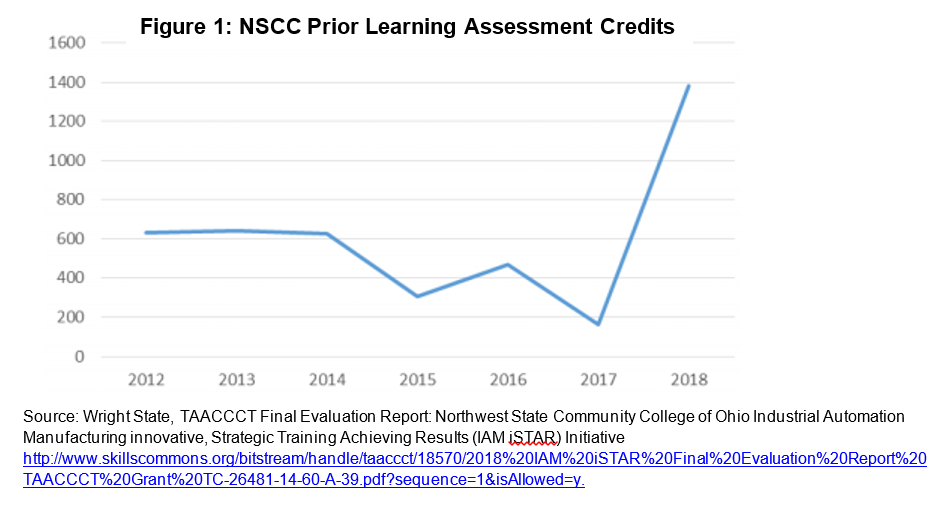
The Northwest State Community College of Ohio Industrial Automation Manufacturing innovative Strategic Training Achieving Results (IAM iSTAR) Initiative, a single community college project, was especially successful because it both strengthened PLA advising and made it as automatic as possible.
The college alerted students to the option of PLA credit when they first met with their academic advisers. The advisers then referred likely students to a coach, who was hired to guide students through the process of obtaining PLA credits. Military veterans were particularly encouraged to work with the coach to evaluate their experience. The coach worked with each student to determine the level of their college-equivalent learning and helped them prove it to faculty. For example, a military veteran who worked in computer-based anti-terrorism for four years was able to get credit for a cybersecurity course. This strategy of having an administrator dedicated to helping students obtain credits through PLA appears to have worked, as credits awarded this way more than doubled (see Figure 1) during the grant period.
The school also built automatic PLA into its degree and certificate programs for incumbent workers. According to the initiative’s final evaluation, the college “institutionalized a competency-based PLA policy for the industrial technology division.” For example, students who have worked on the manufacturing floor at local employers for a designated amount of time are granted credit for the industrial safety course. Instead of going through a formal portfolio review process, students receive the credits as long as the company’s human resource department certifies that they have worked there for a certain amount of time.
Another school that did both was Jordan Schoener’s college, South Central, which built an online credit for prior learning tracking and assessment tool that helps students list learning and experience that might count for college credit.8 That information is then sent to the dedicated PLA and transfer adviser, who connects the student with the right faculty member to assess their learning. This tool will soon be scaled up systemwide.
The college also built automatic credit for industry-recognized credentials into programs in advanced manufacturing and healthcare. The faculty looked at the competencies included in these industry-recognized credentials and aligned them with their programs. Now, after students earn industry-recognized credentials, they automatically get credit for classes, just like Schoener did. The faculty, at South Central College and across its TAACCCT consortium, also created credit equivalencies for military experience that now appear in the statewide Veterans Education Transfer System (VETS) designed to communicate the credit veterans can get for their learning and training.9 When veterans enter their information into the VETS, it shows the number of credits they will receive at any given Minnesota state college, and a career pathway the credits align with. This effort seems to have paid off. While the number of CPL credits granted per year is still small, it has doubled since these innovations were put in place.
Changing College Culture
Higher education has long had a culture that students get credit for material covered only in the context of a classroom course. The community colleges with the most effective PLA projects, such as Blue Ridge Community and Technical College in West Virginia, South Central College and Pine Technical and Community College in Minnesota, and Northwest State Community College in Ohio, have strong leaders and faculty members who were more flexible in their view of learning. They also recognized the recruiting value of effective PLA policy, which created a financial incentive to continue investing in their schools’ PLA process.
Leadership
We found that the strength of the leadership at participating community colleges made a tremendous difference in how PLA was implemented. Over and over, people we interviewed talked about how, even within the same consortium, schools with strong leaders committed to alternative approaches to education made more progress than others within the same group. At South Central College, where Jordan Schoener attended, the TAACCCT grant coincided with the president of the college being put in charge of a statewide credit for prior learning initiative. “PLA was among the reforms in the TAACCCT grant that required the highest level of leadership in order to achieve the goals,” said Michelle Van Noy, the evaluator for the New Jersey Health Professions Pathways to Regional Excellence Project, a consortium of 12 community colleges. She added, “Implementation depended on the level of leadership buy-in the different colleges were able to bring to bear.” This leadership took time and effort to build, leading implementation to lag if it did not already exist at the college.
Faculty
The faculty culture at many colleges can also pose a challenge to implementation. For instance, Colorado’s statewide PLA redesign of its CHAMP project had difficulty changing faculty attitudes.10 Some professors were concerned that providing credits for prior learning would lead to lost class enrollment. Others were concerned that moving in this direction would cheapen the education they were providing and turn the school into a “diploma mill.” Still others were on board with providing credit for prior learning through standardized exams, like CLEP, but were reluctant to take on the additional burden of reviewing portfolios. While the evaluations revealed that some colleges were able to shift these attitudes over time, addressing them required substantial and sustained efforts. These types of challenges with faculty were common across the interviews we conducted.
Financial Incentives
Colleges were also wary of giving students credit for classes without requiring them to sit through class or pay tuition. This is because they view the lost tuition and accompanying state funding as a financial hit. These misaligned financial incentives created an environment that made cultural change even more difficult to achieve. Heather McKay, an evaluator on the Colorado CHAMPS grant, told us, “there needs to be an awareness around PLA and FTE [full time equivalent enrollment], because people are afraid PLA is taking FTE away.” Colleges want to charge students and get state per-student reimbursement for all of the credits they award. Programs within colleges are under pressure to fill their classes. These misaligned incentives were a barrier to getting cultural buy-in at many colleges.
Citations
- See Colorado Community College System. Prior Learning Assessment Credit Manual source and Colorado Community College System. System Procedure Prior Learning Assessment Credit. source
- See Heather McKay, Renee Edwards, Suzanne Michael, and Li Kuang, Colorado Helps Advanced Manufacturing Program: Final Report (Piscataway, NJ: Rutgers Education and Employment Research Center, September 2017), source.
- Ibid
- Ibid
- Ibid
- Ibid
- See Bob Watrus, Heather Fercho. Oregon Credentials, Acceleration and Support for Employment (CASE) Evaluation Report: Results, Key Issues and Implications for Policy, Practice and Systems. (September 2015) source
- See Central College, Credit for Prior Learning Wizard, source
- See Minnesota State. Veterans Education Transfer System. source
- See Heather McKay, Renee Edwards, Suzanne Michael, and Li Kuang, Colorado Helps Advanced Manufacturing Program: Final Report (Piscataway, NJ: Rutgers Education and Employment Research Center, September 2017), source.
Recommendations
Based on our interviews and review of the projects’ final evaluations, we offer the following recommendations to help colleges create more effective PLA programs:
Build advising capacity and credential paths with automatic opportunities for PLA
The single most important thing that colleges can do to strengthen their prior learning for credit programs is to create strong advising programs that help students take advantage of PLA opportunities. According to Marylin Smith, the state coordinator of the grant at Colorado, the advisers should not just know about PLA but also “know what questions to ask” and “how to follow up with the students about those questions.” Creating that high-quality infrastructure to connect directly to students allows the college to plug in any complex reform while actively ensuring student success.
Furthermore, to eliminate the complexity around PLA, colleges should also consider providing automatic credits for certain workforce training or particular structured work experience. Doing so would not only increase the take-up of PLA but also ensure that the credit counts towards a degree program. One or both of these reforms should be in place before colleges spend the political capital on creating additional policy changes to support PLA. No other policy will matter if students are not aware that they can get credit for learning that occurs outside the classroom.
We recommend that:
- Colleges integrate information about PLA into recruitment.
- Colleges integrate conversations about PLA into the first student advising session.
- Colleges hire specialized advisers to work with students who are found to have possible college-level learning and work to get that learning evaluated and connected to their program of study.
- Colleges build automatic PLA opportunities into programs of study where possible.
- States provide resources to support enhanced advising, particularly to support students through the PLA process.
- Colleges build this advising capacity before they start their work to improve PLA policy.
Collect and analyze data on PLA
While some of the evaluations gave a good accounting, through administrative data, of the types of PLA schools offered and the number and demographics of the students who made use of it, most relied on surveys and interviews of students and administrators. Many colleges and states simply do not collect standardized data on PLA.
We recommend that:
- Colleges regularly collect data on the use of PLA with agreed-upon definitions among institutions.
- States and systems include PLA in longitudinal data systems and regularly report on the number and types of students using it.
Focus on context-appropriate PLA
Colleges should prioritize policy around the type of PLA that makes the most sense given their population and programs. For instance, if the college serves a large veteran population, figuring out how to give program credit for the Joint Services Transcript, which provides documentation of military education and training, should be a priority. If the college is creating a program for incumbent workers, working with an employer to grant program credit for certain types of training and experience might make the most sense.
We recommend that:
- Colleges consider how to make PLA as automatic as possible for students; this process will differ by the type of PLA and the program of study.
- Colleges align the type of PLA they are implementing with the program of study it is meant to apply to and the student population it will benefit.
Work to change the college culture
Colleges need strong leadership to make the case for PLA and get buy-in from faculty and advisers. As Heather McKay, the evaluator for the Colorado Helps Advanced Manufacturing Program grant, said, “The groundwork has been laid, the foundation is there, but that culture still needs to be created.”
We recommend that:
- Those implementing PLA achieve strong buy-in first, by bringing leadership to key conferences and learning opportunities like those provided by CAEL, sharing student stories, and by demonstrating the recruitment benefits.
- Colleges involve key faculty and advisers in planning and program development.
- Colleges provide training for faculty and staff not involved in planning.
Change the financial incentives for PLA
States and colleges need to change the perception of financial incentives: By focusing on how PLA can improve recruitment for the entire college rather than the forgone tuition and FTE revenue, some school leaders managed to communicate how PLA can actually be financially beneficial. But colleges need to be aware that departments and faculty may not appreciate improved recruiting when the incentive that means the most to them is being able to fill their classes.
We recommend that:
- States consider providing a small—partial FTE or performance funding—incentive for credit awarded through PLA.
- Colleges focus on how PLA can improve recruitment and enrollment college wide rather than the forgone tuition revenue.
- Colleges consider making students who are awarded PLA credits but who do not sit in class count in department budget allocations.
Create consistent PLA policy across the college, system, and state
Creating consistent policy, like the number of credits awarded for different types of PLA, is important both within colleges and across systems. State policy is a powerful tool that can help focus colleges on PLA policy, but creating state policy on PLA needs to be timely and relevant, sequenced after building the capacity to implement PLA and connect it to students at colleges.
We recommend that:
- States and systems convene colleges to create consistent PLA policy around the transfer of credit, fees charged to students, methods of earning, and other relevant factors. More information on what those state policies can look like can be found in the publication State Policy Approaches to Support Prior Learning Assessment. 1
- Colleges work with their states and systems to clarify their PLA policies.
Citations
- See Sherman, A., Klein-Collins, R. State Policy Approaches to Support Prior Learning Assessment. source
Conclusion
As Jordan Schoener’s experience shows, prior learning assessment has the potential to be a powerful tool to help adults achieve their educational goals in a timely manner. But the only way this can happen is if each student who stands to benefit from PLA is aware of the opportunity and knows how to use it. Through advising and program design, colleges can make that happen. These connections need to be built before states and colleges spend time and effort creating the perfect PLA policy. But as we face increased automation and the threat of recession, PLA could help workers connect with and accelerate through our system of higher education, which will help prepare them, and the economy, for the future of work.
Appendix
List of TAACCCT Projects by Round
| Grant Title | Round | State | Industry Sector |
|---|---|---|---|
| Missouri Healthcare Workforce Innovation Networks (MoHealthWINs) | 1 | MO | Healthcare |
| Oregon CASE (Credentials, Acceleration, and Support for Employment) | 1 | OR | unclear |
| Health Professions Pathways (H2P) Consortium | 1 | IL | Healthcare |
| National Information, Security & Geospatial Technologies Consortium (NISGTC) | 1 | IL | IT |
| Virginia RETHINKS Health Sciences Education | 1 | VA | Healthcare |
| Central California Community Colleges Committed to Change (C6) Consortium | 1 | CA | Healthcare, manufacturing |
| Missouri Manufacturing Workforce Innovation Networks (MoManufacturingWINs) | 2 | MO | Manufacturing |
| Illinois Network for Advanced Manufacturing | 2 | IL | Advanced manufacturing |
| Consortium for Healthcare Education Online (CHEO) | 2 | multi | Healthcare |
| Multi-State Advanced Manufacturing Consortium (M-SAMC) | 2 | multi | Automotive training |
| Iowa-Advanced Manufacturing (I-AM) | 2 | IO | Advanced manufacturing |
| Prince George's Community College (INsTEP) | 2 | MD | IT |
| Southwest Missouri Public Safety and Emergency Medical Initiative | 2 | MO | Criminal justice, fire science, emergency medical services |
| AFTEN—Alabama/Florida Technical Employment Network | 2 | AL | Welding |
| Arizona Sun Corridor—Get Into Energy | 2 | AZ | Energy |
| Pathways to Engineering Technology Careers | 2 | IA | Engineering technology |
| Credentials to Careers Consortium | 2 | MI | Healthcare, biotech |
| Advanced Manufacturing Education (AME) | 2 | WV | Advanced manufacturing |
| Applied Manufacturing Technology | 2 | WV | Advanced manufacturing |
| ShaleNET Initiative | 2 | PA | Shale oil and gas |
| Coconino County Community College (CCC) and Northern Arizona University (NAU) | 2 | VA | unclear |
| Advanced Manufacturing, Mechatronics, and Quality Consortium (AMMQC) | 3 | multi | Advanced manufacturing |
| Midlands Technical College, Better Occupational Outcomes with Simulation Training | 3 | SC | Healthcare |
| Northeast Resiliency Consortium | 3 | IN | Healthcare, IT, hospitality, environment |
| Mission Critical Operations | 3 | NC | IT, operations technology |
| West Virginia Bridging the Gap | 3 | WV | Advanced manufacturing, construction, energy, IT |
| Southwest Arkansas Community College Consortium | 3 | AR | IT, advanced manufacturing, engineering, industrial technology |
| Pathways to Success in a Technical Career: Leveraging TAACCCT | 3 | WY | Industrial technology, machine tool technology, wielding |
| Greater Cincinnati Manufacturing Careers Accelerator | 3 | OH | Welding, CNC, manufacturing management |
| Linn-Berton Community College: LB iLearn Campus | 3 | OR | Business administration |
| Mesa Community College-Arizona Advanced Manufacturing Institute | 3 | AZ | Aerospace, manufacturing |
| Orthotics, Prosthetics, and Pedorthics (HOPE) Careers Consortium | 3 | CO | Healthcare |
| Missouri State University-West Plains | 3 | MO | Healthcare, agriculture |
| Southeastern Economic and Education Leadership Consortium (SEELC) | 3 | multi | Advanced manufacturing |
| Southwest Solutions | 3 | TN | Manufacturing |
| Mississippi River Transportation, Distribution, Logistics | 3 | MS | Transportation, distribution, logistics |
| Butler Community College | 3 | KS | IT |
| Project IMPACT Innovative Multi-Industry Partnership and Career Training Project-Gateway Community & Technical College | 3 | KY | Manufacturing, construction, transportation, warehousing |
| North Dakota Advanced Manufacturing | 3 | ND | Advanced manufacturing |
| Colorado Helps Advanced Manufacturing Program | 3 | CO | Advanced manufacturing |
| Miracosta College Technical Career Institute (TCI) | 3 | CA | Electronics engineering, robotics/automation |
| Assisting Workforce by Advancing Knowledge for Employment(AWAKE) | 3 | IN | Mechanics, mechatronics |
| Rural Information Technology Alliance (RITA) | 3 | MN | IT |
| University of District of Columbia-Community College | 3 | VA | Construction, hospitality |
| Utah Adult CBE | 4 | UT | Administrative support, computer support, clinical lab work, electronics, web design, welding |
| Minnesota Advanced Manufacturing Project (MnAMP) | 4 | MN | Advanced manufacturing |
| Advancing Career and Training (ACT) for Healthcare | 4 | WI | Healthcare |
| Ohio Tech Net | 4 | OH | Advanced manufacturing |
| Washington Integrated Sector Employment (WISE) | 4 | WA | Energy technology, management, aerospace, advanced manufacturing, construction, machining |
| Training for Regional Energy in North Dakota (TREND) | 4 | ND | Oil, gas, transportation, welding |
| New Mexico Skill UP Network: Pathways Acceleration in Technology and Healthcare (SUN PATH) | 4 | NM | Healthcare |
| Missouri STEM Workforce Innovation Networks (MoSTEMWINs) | 4 | MO | IT, health science, life sciences, manufacturing, transportation |
| New Jersey Health Professions Pathways | 4 | NJ | Healthcare |
| Idaho Center of Excellence Healthcare Partnership | 4 | ID | Healthcare |
| Building Illinois' Bioeconomy | 4 | AL | Bioeconomy |
| Northwest State Community College of Ohio Industrial Automation Manufacturing Innovative Strategic Training Achieving Results (IAM iSTAR) Initiative | 4 | OH | Industrial automation manufacturing |
| Training for Manufactured Construction Consortium | 4 | FL | Manufacturing |
List of Interviewees
| Name | Title | Organization | TAACCCT Project |
|---|---|---|---|
| Wilson Finch | senior director of higher education consulting | Council for Adult and Experiential Learning | |
| Michelle Van Noy | associate director of Education & Employment Research Center | Rutgers | New Jersey Health Professions Pathways |
| Heather McKay | director of the Education & Employment Research Center | Rutgers | Colorado Helps Advanced Manufacturing Program |
| Bob Watrus | third party evaluator | Oregon CASE | |
| John Cosgrove | third party evaluator | Cosgrove & Associates | MoHealthWINs |
| Maggie Cosgrove | third party evaluator | Cosgrove & Associates | MoHealthWINs |
| Deb Bragg | third party evaluator | Bragg and Associates | Health Professions Pathways (H2P) |
| Rebekah Kent | dean of career and technical programs | Central Lakes College | Advanced Manufacturing Education (AME) |
| Casey Sacks | deputy assistant secretary for community colleges | U.S. Department of Education, Office of Career, Technical, and Adult Education | |
| Christian Lagarde | founder and CEO | Lagarde Consulting Group | |
| Marilyn Smith | state coordinator, Developmental Education | Colorado Community College System | Colorado Helps Advanced Manufacturing Program |
| Donna Lewelling | deputy director of Community Colleges and Workforce Development | Oregon Higher Education Coordinating Commission | Oregon CASE |
| Brad Geer | PLA coordinator | North West State Community College | IAM iSTAR |
| Marsha Danielson | vice president of economic development | South Central College | Minnesota Advanced Manufacturing Project (MnAMP) |
More About the Authors

Iris Palmer
Director, Community Colleges

Sophie Nguyen
Senior Policy Manager, Higher Education