
Table of Contents
- About the LEO Policy Working Group
- Foreword
- Executive Summary
- A Brief Introduction to Low Earth Orbit (LEO) Satellites
- Chapter I. Fueling Connectivity from Space: Spectrum Sharing and Coexistence
- Chapter II. The Final Economic Frontier: Satellite Competition in Low Earth Orbit
- Chapter III. Connectivity from New Horizons: How LEO Satellites Help Bridge the Digital Divide
Chapter II. The Final Economic Frontier: Satellite Competition in Low Earth Orbit
Introduction
For decades, Low Earth Orbit (LEO) resembled a corporate graveyard more than a functioning market. Technologists attracted to the advantageous conditions of locating communications infrastructure just beyond the Karman line1 were met with a harsh economic reality.2 High costs, significant infrastructure needs, high failure rates, and short useful lives were a lethal combination for competitive viability. The few systems that made the transition from business concept to functioning constellation quickly ran up against the operational challenge of maintaining a truly global service when the orbiting asset base is continuously depreciating worldwide. The result has been a checkered history of insolvencies and restructurings. Iridium, Globalstar, Orbcomm, SkyBridge, and Teledesic—once envisioned as alternatives to early mobile telephony or global broadband—all went bust at some point; some never returned.3
But the market, as well as its underlying economics, has evolved. New cost efficiencies in launch and payload production, together with advances in spot beam technology and frequency reusability that have dramatically increased satellite throughput, have made large constellations containing hundreds or thousands of satellites economically feasible.4 These developments, in turn, have allowed LEO satellites to rapidly become a viable alternative to terrestrial connectivity in many rural and underserved areas, providing both global coverage and high-speed, low-latency connectivity to meet consumer demand for quality service. These production efficiencies and innovations could not have come at a more opportune moment. Skyrocketing bandwidth demands from both consumers and enterprises, along with latency sensitive applications—ranging from video conferencing to real-time gaming—mean that this expanded output is meeting growing consumer demand. As a result, a growing array of new business models and market niches are emerging, from direct communication with off-the-shelf consumer devices to enterprise backhaul connectivity.
While outer space has shifted from the exclusive province of a select number of nation states to a commercial arena, the two are not mutually exclusive.5 Satellite systems have immense geopolitical implications, and their missions often coincide with broader national interests. A large share of the world’s operational and planned capability is located outside the United States, supported by governments that view satellite constellations as instruments of industrial and geopolitical strategy. In contrast to terrestrial broadband or other communications sectors where private demand has primarily set the pace, LEO competition has been significantly shaped from the outset by state sponsorship, subsidies, and strategic mandates. At the same time, even private commercial systems controlled by foreign interests may pose a threat to these same political economy considerations, given long-standing concerns of foreign infrastructure and its tension with national security.6
These realities underscore that geopolitics is not peripheral to LEO competition but central to it. The playing field is skewed by political considerations, both in the form of national champions explicitly cultivated to project soft power and through subsidies that insulate state-backed firms from commercial risk. In this environment, consumer welfare is not defined solely by prices, output, or service quality, but also by who controls the infrastructure and what strategic objectives they serve. This means LEO cannot be understood as a textbook competitive market; it is instead a hybrid arena where strategic statecraft and economics continually overlap.
Political influence also distorts the market away from free-market competition. For example, a nationalist agenda may craft a view of consumer welfare that goes beyond archetypal measures of price and output to consider who is providing a service. Is it a domestic provider or foreign competitor? Is a competitor completely commercial or are they intertwined with another nation’s public infrastructure? And is that nation-state an ally or an adversary? Each question has an array of ramifications and inroads for intervention that impact existing and future competition.
Embedded within this geopolitical theater is a now viable commercial domain. The key question is what we should expect from LEO providers in terms of market competition.7 This chapter explores this question and its many contours, recognizing that a framework for competition is emerging in real time. While only a few hundred commercial satellites occupied LEO orbits a decade ago, more than 11,700 satellites are currently deployed and operational today, providing both fixed and mobile satellite service connectivity to users across the globe,8 with several times that planned and pending.
It is important to recognize, however, that while the number of LEOs and the size of constellations are important factors in the ability to offer competing services, they are not the only factors.9 Distribution of constellations is also critically important. A provider may have a large number of satellites covering one orbital band but few or none in others. Determining (or worse, predicting) what constitutes a competitive market, especially as the market matures, presents significant challenges.10
None of this is surprising. This segment of the satellite industry is nascent, which means we should expect a lot of entrepreneurial activity and entry by firms vying “for the market.”11 But as the market for satellite broadband and services evolves, so too will the nature of competition.12 Eventually, growth in the supply of LEO satellites will slow for both economic and technological reasons, and priorities shift from rapid deployment to delivering economical and sustainable services.13 Yet unlike traditional product markets, it is far from certain that LEO competition will converge on a stable structure. Because constellations function as infrastructure capable of supporting diverse verticals—from consumer broadband to enterprise backhaul to defense—the pace of maturation may differ across service segments. Production economics will reward those operators who can sustain low-cost deployment at scale, but service differentiation, interconnection with terrestrial networks, and political sponsorship will also shape outcomes. As a result, dynamic competition may continue to reshape markets in ways that resist the familiar trajectory toward stability and concentration.
The current competition environment in LEO can be structured along four principal dimensions or “pillars.” First, we assess the current market structure and broader industrial policy considerations, including the strategic interaction between both existing and imminent satellite operators in LEO. Second, market power and barriers to entry play a prominent role in the feasibility of competitive entry into the market, and each must be considered in detail. Third, we assess the relevant competition dimensions beyond the current race for the market, including the role of competitive differentiation and an emphasis on service quality. Last, by incorporating each of these assessments, we present the key fracture points or potential avenues for anticompetitive behavior within the LEO satellite market, providing agencies and enforcers with clear examples of where competition may falter.
Importantly, we do not attempt to make definite predictions on what competition should look like in either case. Rather, our objectives are two-fold. First, we seek to provide competitive guideposts so that regulators, policymakers, and the occasional enforcer know where to look. This includes specifying which competitive dimensions may be leveraged and where to focus (or avoid) scrutiny. Second, we present a potential toolkit that may be put into practice. Specifically, we identify what pragmatic and implementable policy interventions may look like, both in the short and long term.
Market Composition and State of Play
Analyzing the structure of the market, market composition, and the relevant players provides a first cut from which broader competitive conditions—entry barriers, differentiation, and conduct—can be assessed. We then turn to the state of play, including the strategic advantages of existing firms and the shifting definitions of various service markets facilitated by modern satellite systems.
A. Market Structure and Concentration
Within the United States, a select number of LEO constellations are currently operational or imminent. The broader market for consumer broadband services by LEO providers can be separated into two categories: fixed satellite service (FSS) and mobile satellite service (MSS). Through regulatory actions at the International Telecommunication Union (ITU) and the Federal Communications Commission (FCC), decades-old spectrum use designations continue to distinguish FSS and MSS operations by LEO providers. We apply these distinctions below, while noting that this historical framing is not completely representative of operating realities.
While FSS was traditionally characterized for broadband satellite services, and MSS for narrowband service for mobile uses, the services being deployed today do not neatly fit into these categories. In terms of practicalities, an FSS operator cannot begin offering mobile services without navigating a separate set of licensing requirements and technical conditions (and vice versa). At the same time, the traditional regulatory distinction between FSS and MSS does not neatly capture how competition is unfolding in practice. Virtually every FSS operator also offers connectivity to platforms in motion, such as internet service for aircraft and cruise ships,14 that were once the exclusive domain of MSS. From a market perspective, the more relevant distinction is technological: whether a constellation requires directional antennas—typically higher-frequency systems capable of delivering broadband speeds at or above the FCC’s benchmark of 100 Mbps downlink and 20 Mbps uplink—or whether it can operate with omnidirectional, handset-capable antennas that rely on the narrower bands of lower-frequency spectrum associated with legacy MSS allocations. This functional divide, rather than the regulatory categories alone, more accurately captures the competitive dynamics in emerging service markets.
1. FSS Operations
Most of the growth and entrepreneurial activity currently underway in space can be attributed to LEO satellite systems whose core business case is to offer FSS broadband connectivity to retail consumers. A significant portion of all active space objects serve this function, and the number is steadily increasing. The service also remains the most sought after satellite operation in filings to regulatory agencies, both domestically and in international fora. See Table 4 for a list of the currently active and imminent systems.15
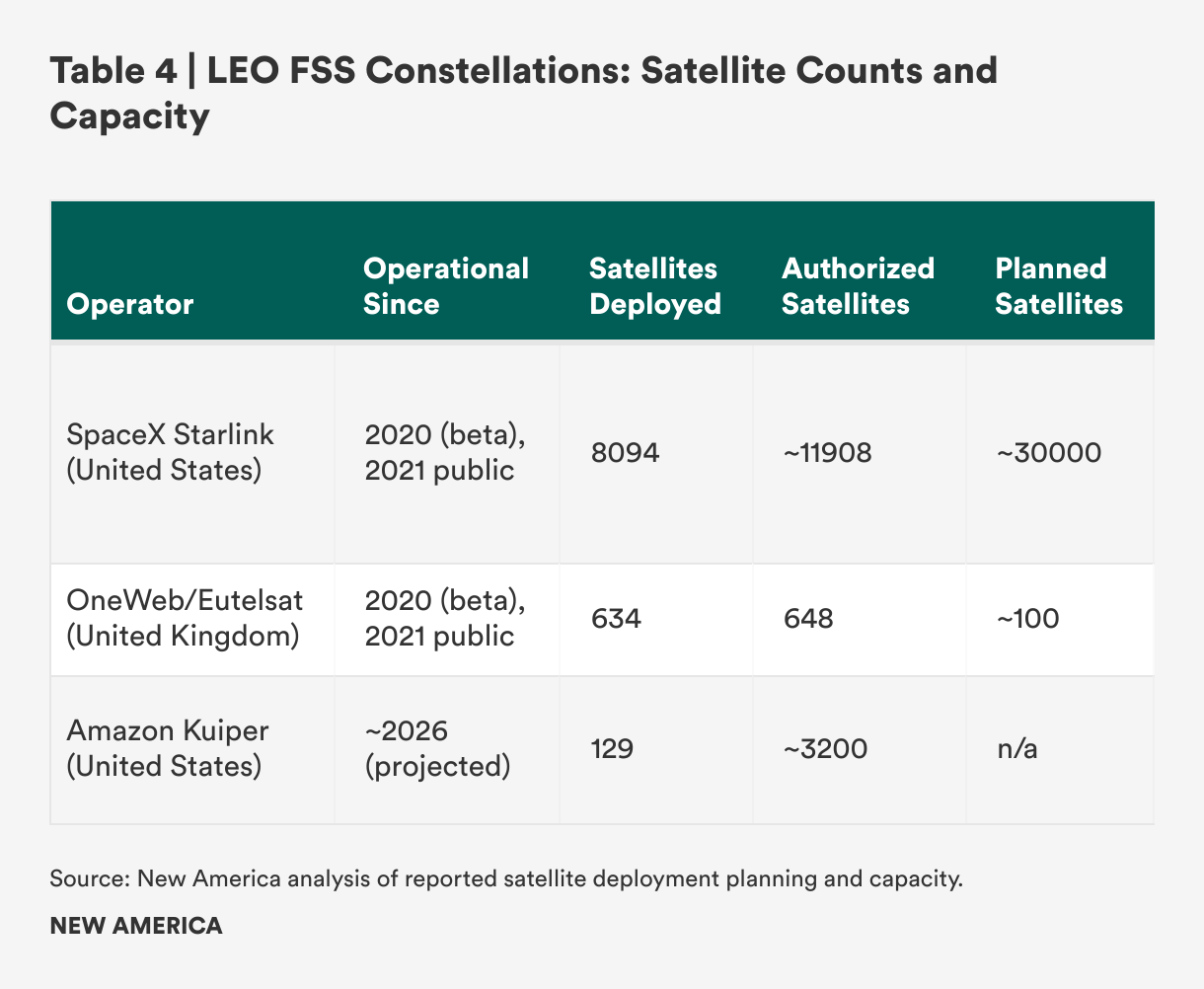
An unprecedented number of LEO constellations have been proposed in recent years. Across four separate regulatory proceedings, over 20 entities have sought a license to provide FSS operations to the U.S. market alone.16 More than half of these planned systems have either been authorized or remain pending before the FCC. More broadly, filings before the ITU now reference more than one million proposed non-geostationary satellites.17 While the eventual realization of these proposed systems could reduce market concentration, such an outcome remains uncertain in the foreseeable future.
Indeed, the more imminent concern is whether any of these systems will materialize within the procedural deadlines imposed by the FCC. An unfortunate consequence of the existing licensing regime for FSS systems is that it incentivizes operators to submit early—often premature—filings to preserve license parity with competitors. In the best case, as systems materialize, these early plans quickly become outdated and require repeated filings to modify these initial plans with updated system designs and configurations.18 In the worst case, operators commit to plans and then attempt to adjust their business model to the filing, only to realize it is operationally infeasible or economically impractical, leading to numerous application filings that never materialize into operational systems.19
2. MSS Operations
LEO constellations providing global coverage for mobile devices first emerged in the late 1990s. At the time, providing mobile connectivity from space proved to be economically impractical in many cases, particularly for LEO constellations that require a dense deployment of satellites. Nearly every LEO satellite operator licensed to provide MSS to retail consumers in the United States would eventually declare insolvency, and only two of the original licensees remain operational today.20 See Table 5 for a list of the currently active and imminent systems.21
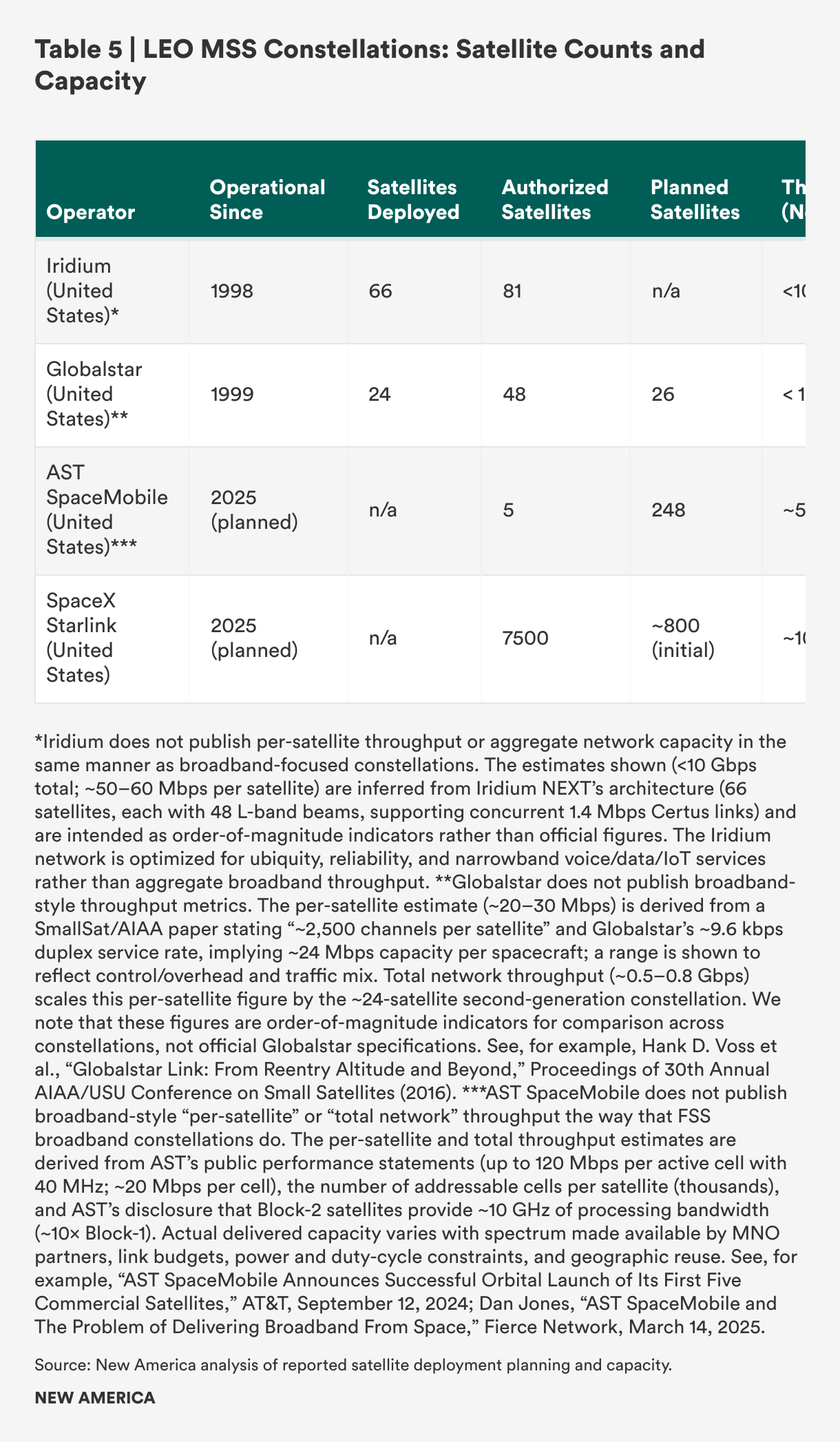
Other established operators, such as SpaceX, have recently sought to broaden their service footprint to include MSS operations. Notably, the company recently purchased EchoStar’s domestic MSS spectrum in the 2 GHz band, as well as its global MSS spectrum licenses.22 The company has indicated that these frequencies will be included on the antenna payload of its next-generation satellites and offer what it calls direct-to-cell services. Additionally, the company continues to seek a petition for rulemaking proposing shared access to the 1.6/2.4 GHz bands exclusively occupied by Globalstar.
At the same time, a new class of direct-to-device (D2D) projects—such as Lynk’s deployed satellites and other initiatives for supplemental space coverage23—has emerged alongside traditional MSS. These systems provide connectivity directly to ordinary mobile handsets without the need for specialized terminals, often by partnering with terrestrial mobile operators. While they rely on different technical and regulatory pathways than legacy MSS, they nonetheless can serve as a substitutable product for end-users. As such, they represent an alternative entry point into the MSS market, though one with its own set of frictions and uncertainties.
The SpaceX filings and accompanying proceedings are representative of a broader issue. Despite being originally allocated for some degree of joint use, each of the domestic MSS bands are exclusively occupied and used by incumbents.24 Indeed, the company’s entry into MSS frequencies required directly contracting with an existing licensee, a paradigm typically characteristic of exclusively held terrestrial spectrum licenses, not shared satellite frequencies. The key policy questions going forward are whether sharing, as originally intended, is technically feasible and what number of systems is realistic.
B. Resource Management and Strategic Incentives
Every satellite system is dependent on two physical resources for its operation: orbits and radio spectrum. Both resources are finite, congestible, and—given the inherently global nature of satellite systems—shared; thus, they require international coordination of their access and use. Within both the international registration system managed by the ITU and various regulatory regimes imposed by specific countries to operate in their market, entities that secure licenses or deploy spacecraft first are given priority, with interference protections imposed on later entrants. But a system of first-in-time, first-in-right effectively disincentivizes conservation or efficient sharing. Additionally, license priority becomes the linchpin for strategic interactions between parties and presents a clear means of competitive advantage. If left unchecked, this license priority may be leveraged by incumbents as a means of rent seeking or even market foreclosure.
The most well-documented examples are in international markets where coordinating with established systems is a prerequisite to market access. For example, access to the Canadian market is dependent on new systems coordinating with already established systems, leading several new operators to be delayed in accessing the market and providing added competition.25 The same can be said for market access regimes in Brazil,26 Japan,27 and India,28 where the newcomers must reconcile to some degree with incumbent satellite operators, often backed by the governments themselves. The flaws are obvious: If an incumbent holds the power to control its rivals’ existence in the market, it will leverage that power to stifle market access and limit competition in any way possible.
To the FCC’s credit, its newly adopted framework for spectrum sharing among non-geostationary orbit (NGSO) operators pursues a solution that avoids incumbent obstructionism. For example, the FCC’s recently adopted inter-round interference thresholds impose an upper limit on the ability of incumbents to restrict or constrain new market entry, since a later-round system can avoid coordination entirely if it complies with the defined inter-system interference thresholds.29 At the same time, the framework fails to provide security of expectations to existing systems. For example, aggregate interference limits cannot be defined because there is no telling how many lower-priority systems may contribute to interference, or how many processing rounds may occur within a given satellite band. It leads to the inevitable question: What happens to the spectrum sharing framework when a third processing round emerges in the Ka-band? A fourth? It seems foolish to presume that the framework’s sunsetting of priority system protections will take hold before these realities emerge.
The obvious alternative strategy is exclusion. But defining a set number of LEO satellite systems to serve American consumers seems equally, if not more, fraught. Indeed, it would be contrary to the basic tenets of competition and responsible regulation to guess ex ante how many operators a market can support. Setting a predetermined number of competing systems forecloses the possibility of new innovations that may compel market entry and evolving competition.
While unintentional, this exclusion strategy has unwittingly manifested itself in MSS bands. In the 1990s and early 2000s, each of the 2 GHz, Big LEO, and L-band allocations were initially defined to support a specified number of coexisting satellite systems based on perceived technological capabilities at the time. Eventually, several of these systems failed to materialize into operational services, thus leading to quasi-exclusive satellite spectrum allocations for the remaining systems. Technically, spectrum sharing in these lower bands remains formidable for consumer services, particularly because omnidirectional handset links are hard to coordinate without unacceptable interference. That said, it would be overstating matters to suggest sharing is impossible: These bands were originally structured to accommodate multiple providers through partitioning, and future technologies could revisit that possibility. The reality is that the MSS ecosystem has failed to materialize into the systems that regulators initially envisioned, much less the number of systems that consumer demand can support today.
In practice, priority has given MSS incumbents an even more pronounced competitive advantage, enabling them to preclude new entry absent contractual arrangements. Despite this rigidity, commercial agreements have already reallocated spectrum rights toward higher-value uses, both within MSS bands and alternative frequency allocations.30 This includes Globalstar’s arrangement with Apple,31 AST’s partnerships with AT&T32 and Ligado,33 SpaceX’s agreement with T-Mobile,34 and Skylo’s ties with Viasat35 and TerreStar.36 While the legacy licensing regime created quasi-exclusive positions, market transactions are reshaping how the spectrum is actually deployed.
The allocation of new satellite bands will relax some of this tension between priority-in-use management regimes and competitive access along both service domains. Specifically, by expanding the set of resource options that new entrants can choose from, incumbency presents less of a gatekeeping function that disadvantages new entrants. New competitive FSS bands that are opening for commercial use include the upper portion of the Ku-band, portions of the V-band, and a broad set of W-band frequencies.37 Potential opportunities may still exist in higher frequencies, such as terahertz bands, as well. For MSS connectivity, the focus has been on trying to repurpose or maximize use of existing allocations, such as the 1.5 and 2 GHz bands. Another band of relevance is the upper C-band. But in each case, the central challenge is that consumer mobile services require globally contiguous spectrum to operate efficiently, which sharply narrows the set of viable frequencies. An added challenge, particularly for those frequencies with the propagation characteristics necessary for MSS connectivity, is that the most desirable bands are also the very same that terrestrial mobile operators seek and are often willing to pay more for. These additional allocations are discussed in greater detail in Chapter I.
C. Converging Market Definitions
As LEO systems mature, it is becoming increasingly evident that their constellations should be characterized as infrastructure platforms that can support multiple service offerings simultaneously rather than being precisely tailored to a single market niche. A single constellation may provide both fixed and mobile service to various consumer populations, both retail and enterprise uses. Moreover, the infrastructure may serve a broader function than mere last-mile provider, creating a complementary avenue for backhaul service between a local network and the broader core network, whether that be a backbone provider, content delivery network (CDN), or other infrastructure within the internet architecture.
Consequently, the delineation between different service markets becomes more blurred. For example, the distinction between fixed and mobile satellite service is becoming less and less apparent. The regulatory embrace of earth stations in motion (ESIM) for FSS connectivity (for example, to an RV) presented an initial point of overlap between the two service definitions. This convergence has since been bolstered by the rapidly developing interest of terrestrial mobile carriers (IMT) in partnering with LEO satellite operators to offer supplementary service coverage, using mobile carrier spectrum, for mobile subscribers outside the coverage area of the mobile network.38
From a competition standpoint, this convergence leads to what antitrust regulators refer to as “cluster markets.”39 In typical assessments of competition, the relevant market for assessing competitive conditions is typically characterized by demand substitution—how easily a consumer can switch from a given product to a substitute if prices increase or output is lessened. A less pronounced, but equally relevant feature is supply substitution—how easily a firm can switch to a different product or service in response to changing market conditions. Cluster markets suggest that certain service verticals or “markets” may be aggregated and assessed together, even though they are not technically substitutes for each other, because the conditions of competition are reasonably similar. The approach is widely embraced in public infrastructure contexts, such as hospitals. The core idea of the application is that the availability of multiple services simultaneously and on the same platform is more attractive to consumers because consumers may make use of different services at different times, and therefore the services complement one another.40 Satellite constellations are well-suited to such an approach.
A byproduct of this convergence is that non-price competition often looks different than in other market contexts. Notably, the typical strategy by firms—which entails differentiating their products to fit a particular service niche and then dominating their narrow subset of the market—is unlikely to take hold. Because there are production advantages to serving multiple market segments through the same underlying infrastructure, the appeal of typical product differentiation is less pronounced. But product variety differences are not the only way to differentiate one’s product or service. Rather, the strategic method for satellite operators to stand out among their rivals is through providing a superior quality product.
Market Power and Entry Barriers
Market power is often associated with market concentration and barriers to competitive entry. Insofar as the current market structure is less than the competitive ideal, this section explores the potential barriers that may preclude new competitors from emerging.
A. Capital, Labor, and Infrastructure
Arguably the most pervasive and formidable barrier to competitive entry is natural rather than artificial. The stark reality for potential entrants into the LEO market is that they must tolerate a significant amount of initial capital risk to construct, launch, and effectively deploy communications infrastructure in a harsh space environment. Historically, satellite operators often struggled to acquire the requisite capital to adequately finance their ventures. But today there is little reason that high investment costs alone would be a deterrent. Investment appetites for the space economy have dramatically shifted, with significant amounts of private capital flowing into space ventures, particularly smaller LEO constellations targeting consumer services with omnidirectional antennas. By contrast, the largest constellations have been backed by multi-billionaires (such as SpaceX’s Starlink), large corporations (Amazon’s Kuiper), or governments, as with OneWeb (United Kingdom and France) and China’s state-supported systems. This divide underscores that while private capital is more available than in the past, the feasibility of financing still depends heavily on the scale and scope of the constellation being pursued.
Capital markets are efficient in providing liquidity to viable investment opportunities. So long as satellite ventures remain promising, high investment costs alone should not be seen as a barrier to competitive entry. The real concern is the likelihood of failure and, should failure occur, how much of that capital is at risk—sunk costs. The history of LEO constellations in particular is marked by repeated insolvencies, suggesting that the risk and the extensiveness of potential losses are quite high, even if new efficiencies are lowering the amount of investment capital required to reach efficient scale. An additional factor is lead time.41 As the interval between deciding to enter a market and the earliest possible time for deploying a viable (and profitable) service lengthens, entry becomes riskier. Hundreds, if not thousands, of LEO satellites are necessary to provide adequate coverage and operating capacity to support high-speed connectivity for a diffused consumer base or enterprise traffic. Reaching a deployment of this scale takes years. This time horizon places new entrants at risk, particularly if incumbent firms can strategically respond during this period to deprive new entrants of their expected market. But this does not hold true for every satellite offering. For example, narrowband MSS constellations such as Iridium and Globalstar have historically achieved global coverage with fewer than 100 satellites, and emerging D2D constellations like AST or Starlink’s planned overlay will likely fall between these two extremes (see Table 2).
Infrastructure constraints present a bottleneck of their own. While there has long been a robust base of spacecraft manufacturers—Airbus, Boeing, Thales, Lockheed, and others—their production models were historically optimized for bespoke, large satellites rather than high-volume production lines of many similar small spacecraft.42 This has pushed newer entrants, including both satellite broadband operators and remote-sensing companies like Planet, to move toward in-house manufacturing or alternative suppliers better suited to standardized mass production. Part and parcel with these infrastructure limitations are the costs of specialized labor, particularly technically skilled workforces for research and development, product design, and system management.43
But even if these obstacles can be overcome, a lack of adequate launch infrastructure domestically and abroad has constrained satellite operators in reaching LEO. For example, a commercial operator seeking to launch on SpaceX’s Falcon 9 program may face significant wait times—often well over a year for dedicated missions, and many months even for Transporter rideshares—reflecting the strain on available launch capacity.44 Competing offerings, such United Launch Alliance, continue to face reliability concerns and extensive delays that have often led to even longer timetables. Other launch providers include Europe’s Ariane and Amazon’s Blue Origin. To increase the cadence of launches, SpaceX is building additional launch pads at Cape Canaveral, along with complementary launch facilities across the country.
B. Vertical Integration and Productive Efficiencies
Economies of scale are an entry barrier in the LEO satellite market, causing potential firms to consider not only the costs of production but the costs of reaching sufficient scale to achieve competitive viability.45 Given the rapid success of SpaceX and its current dominance in LEO broadband, vertical integration appears to be the presumptive recipe for competitive success in a market that is cost-intensive, nascent, and heavily reliant on innovation.46 The challenge is that few entities currently possess the resources or time horizon to make that choice, and therefore are reliant on outside contracting by practical necessity. Moreover, in practice, the build-buy calculus is fluid: In-house manufacturing tends to make sense for very large constellations such as Starlink or Kuiper, while smaller operators like OneWeb or Lightspeed have relied more heavily on established manufacturers. At the same time, remote-sensing ventures such as Planet and Spire illustrate that firms may migrate toward in-house production as they scale, suggesting that manufacturing strategy often evolves alongside constellation size and maturity. As a result, integrated firms may possess efficiency advantages that impose a barrier for rivals to compete.
Several complementary explanations exist for why vertical integration may be advantageous. The first is basic production economics. LEO constellations require massive production volumes in terms of satellites in orbit, ground station infrastructure, and (ideally) user terminals. Lower operating altitudes lead to smaller coverage areas and infrastructure that is moving relative to the Earth’s orbit, thus requiring more ground infrastructure for handovers and to ensure connectivity. Additionally, more in-orbit infrastructure is necessary to ensure global connectivity and to replenish existing infrastructure whose operating life is measured in years rather than decades.
For firms that have the initial capital to integrate this cost-intensive production in-house, economies of scale emerge. If these costs can be recovered over an expanding quantity of goods produced, then the cost per unit of production decreases, creating a competitive advantage relative to rivals who are dependent on outside contracting. As a result, basic productive efficiencies may be the most pronounced barrier to competitive entry. If a new entrant wishes to viably compete with existing, integrated providers on cost, the only avenue may be through vertically integrating itself. But such a strategy requires extensive capital, infrastructure, and expertise to be viable.
Another clear advantage of integration is a firm’s composition, specifically the synergies from shared labor and knowledge capital across the entire supply chain. These efficiencies can generally be characterized by increases in productive output due to labor productivity and innovation capital. These efficiencies may also promote business agility, allowing integrated firms to pivot toward new designs or react to changing conditions unilaterally. By contrast, contracting is often set well in advance and any shift is subject to extensive delays or frictions. One only needs to look at the number of satellite modifications that SpaceX has sought and implemented, and then compare these numbers to its competitors, to see these differences at work.
C. Resource Inputs
As noted above, both the orbits and the spectrum that operators require to function are finite and congestible. While no explicit constraints may exist to accessing the market, plenty of operational restrictions may. Within LEO, certain orbits are more heavily sought after than others based on what altitudes and inclinations achieve the right mix of coverage and performance while maintaining sufficient infrastructure longevity. Large constellations are already beginning to compete for certain orbital shells, as evidenced by the overlapping filings of Amazon’s Project Kuiper and portions of a Chinese state-owned constellation. As these orbits become more densely populated, new entrants may be relegated to suboptimal orbital configurations.
The same is true for spectrum access, particularly when the requirements of providing a viable service are considered. The maximum error-free data rate of any communications network is dependent on the bandwidth of the channel that it operates over and the amount of channel noise it incurs.47 Achieving certain performance requirements, as necessary to satisfy service level agreements (SLAs) with businesses or match consumer data rates by competitors, becomes more difficult for later entrants.
D. Regulation and State Intervention
Much of the regulatory framework governing satellite services was designed in an earlier era and has not kept pace with technological change. While these legacy rules once served important purposes, they now risk functioning as barriers to entry. For example, as noted above, the rigid separation of MSS allocations—originally intended to support multiple coexisting systems—has in practice hardened into quasi-exclusive entitlements that limit new entry. Regardless of the technical justifications that may have existed at the time, the persistence of these rules illustrates how outdated regulation can entrench incumbents and distort competitive outcomes. Licensing processes and broader regulation of satellite services by individual countries present competitive bottlenecks. At times, this means acquiescing to operating conditions that are largely shaped by competing systems from a given market. Within the United States, for example, applications for market access are generally treated on equal footing with domestic licensing applications, which means they generally must comply with the same thresholds and conditions to serve American consumers.48 The timelines and costs associated with licensing (see also Chapter I), along with compliance with the requisite sharing rules,49 each impose some constraints on market access. At other times, the constraints are more explicit and inequitable. As noted above, numerous countries have imposed their own protectionist criteria that advantage domestic providers.
The influence of national interests on the competitive process extends beyond traditional regulation. Numerous government-embedded systems are currently deploying or have plans to enter the market soon. Notable systems include the multiple Chinese state-backed constellations (Guowang and Qianfan) and the planned European constellation (Infrastructure for Resilience, Interconnectivity and Security by Satellite, or IRIS2). Governments have also taken direct equity stakes in ostensibly commercial projects, such as the U.K. and French investments in OneWeb.50 In each case, these systems likely face less regulatory constraint, at least in their home market, because the entity supporting the constellation is also the entity that oversees regulation. More broadly, the trendline is toward government sponsorship—whether through ownership, financing, or regulatory preference—of most emerging constellation projects, with the main alternatives being systems underwritten by billionaires or very large corporations. By contrast, an American commercial system that must navigate extensive licensing processes and compliance obligations before becoming operational is at a structural disadvantage relative to state-backed projects that can deploy at will.
In practice, this means the LEO market is not a fully functioning competitive market in the traditional sense. Firms do not operate on comparable terms, and broader frictions—licensing processes, national security filters, and state-driven subsidies—shape outcomes as much as entrepreneurial execution. Market entry and survival often depend not only on technical or financial capabilities but also on alignment with government priorities, distorting market forces. For example, government financing or subsidization of certain commercial constellations presents an indirect barrier that may distort potential competition. Certain systems may be able to carve into the market through state-supported predatory pricing methods or incur added expenses because these losses are then passed on to the state.51 As a result, competing systems that are inherently international may be able to bear certain costs or market frictions in a way that privately financed systems cannot.
Competition Dimensions
The satellite industry is currently undergoing a second revolution in LEO: Innovation and new cost efficiencies in launch and operation have enabled LEO services to disrupt and displace traditional satellite services while leading to broader economic growth and technological progress.52 The most straightforward way to conceptualize the emergence of the LEO market and what we can expect of competition is within the theorized framework for industry life cycles, whose evolution we walk through below.
A. Growth
The LEO satellite market is firmly within a growth-oriented, access-driven phase of competitive development. While there are signs of maturation, such as completed satellite deployments and initial service rollouts, most competition today still revolves around establishing basic operability. The market remains incomplete, and its parameters are being shaped by the still emerging competitive activities of firms: who can reach orbit, build out infrastructure, and offer a working product.
In this phase the value proposition centers on whether a firm can deliver a service and turn its plans into a product. Starlink, with its head start and vertical integration, has emerged as the de facto pacesetter, establishing a network of nearly 8,000 operational satellites. Other entrants, such as Amazon’s Kuiper, remain firmly within the very early phases of infrastructure buildout. While existing firms, such as OneWeb, illustrate how business plans may shift as firms find viable commercial potential, additional categories of LEO projects—including D2D ventures like AST SpaceMobile and Lynk, as well as Internet of Things–focused constellations such as Kepler—are likewise navigating this access-first stage.
At the same time, LEO providers have not merely entered existing markets but created new ones, such as RV connectivity and precision agriculture while also challenging GEO incumbents in established segments like in-flight connectivity. Airlines are already migrating from GEO to LEO systems, as illustrated by Alaska Airlines’ decision in August 2025 to switch its entire fleet to Starlink service.53 Even in the access-driven phase, LEO competition is expanding the boundaries of what satellite services are and where they are used.
It is likely that no provider can yet afford to restrict its scope of potential services because the market remains strongly in flux. Rather, the priority is to demonstrate operability at scale, secure access to critical resources (for example, spectrum, orbits), and anchor partnerships before others do. This access-first dynamic will surely persist, even as established firms become more settled and their constellations more solidified. For these established systems, the market will transition from one defined by exclusivity—who can deliver a service—to one defined by comparison—who delivers a better service. Indeed, this dynamic is already playing out between established operators like SpaceX, OneWeb, SES/O3b, and others. Nevertheless, the looming threat of highly motivated and deep-pocketed entrants, such as Amazon’s Kuiper and the emerging Chinese constellations, will recalibrate competitive conditions in LEO.
It is also important to situate LEO competition in the broader communications landscape. For many use cases, particularly fixed broadband to residences and businesses, LEO systems compete intermodally with terrestrial providers such as cable, fiber, and fixed wireless. Even with satellite service occupying a modest market share, it has the potential to discipline terrestrial pricing, spur network upgrades, and influence competitive behavior. In national security and enterprise contexts, LEO may similarly be best understood as one option among several rather than as a standalone market.
Importantly, not all competitive dynamics reflect pure market viability. Some systems continue to operate despite limited profitability because they are backed by national governments with strategic interests at stake. OneWeb’s restructuring under U.K. and French investment, as well as Canadian support for domestic satellite projects, illustrates how political sponsorship can keep systems in play as the industry matures. This political cushioning alters the normal economics of industry shakeouts, sustaining players for reasons that go beyond commercial performance. The same is true of varying rates of growth depending on different regulatory conditions. For example, U.S. regulators’ more heavy-handed approach through compliance obligations and licensing can slow deployments for its domestic systems, including current market leader SpaceX. By contrast, China’s state-backed Guowang and Qianfan constellations face fewer domestic constraints, raising the prospect that aggressive regulation of U.S. operators could create opportunities for foreign rivals to catch up or even leapfrog in global markets.
B. Mature Competition
Assuming the LEO market does progress beyond its current composition of a single dominant player with a competitive fringe, once multiple constellations offer comparable levels of coverage and basic functionality, competition will begin to manifest along more familiar economic lines: pricing strategies, vertical targeting, and service tailoring.
Price competition will emerge for standardized offerings, particularly in more commoditized product segments where consumers see services as largely interchangeable. At the same time, a dichotomy may emerge between the constellations that consist of several hundred satellites and those that consist of tens of thousands of satellites. For the former, these systems may begin to target certain service verticals and tailor their service. Maritime logistics, aviation, defense, and direct-to-consumer broadband all have different tolerances for latency, reliability, and price. Rather than casting a wide net, firms will specialize or tier their offerings to capture distinct segments. By contrast, the comparatively larger constellations may have the scale and scope to exercise their excess service capacity to both reach tailored service verticals or specialized consumer segments while maintaining standardized product offerings.
The shift from market presence to performance introduces distinct methods of product differentiation as a means of competitive advantage. We present these methods along two principal dimensions: product variety and product quality.
Product variety captures horizontal differentiation—firms serving distinct customer segments or use cases, which allows firms to reduce head-to-head competition by occupying different points in the market and catering to distinct consumer preferences through different product characteristics.54 In the LEO context, this could take various forms, including specializing in defense communications, remote education, cargo fleet management, or emergency response. Firms can escape the trap of commoditization and pricing pressure by embedding themselves in use cases with distinct switching costs or regulatory requirements. The ongoing fragmentation of enterprise connectivity needs—especially after the COVID-19 pandemic—offers fertile ground for such strategic specialization and capturing market niches.
Product quality denotes vertical differentiation—differences in performance across otherwise similar services.55 Here, LEO firms will compete on latency, bandwidth, coverage stability, terminal compatibility, and network reliability. These quality dimensions are not merely engineering metrics; they become marketable traits that allow firms to justify premium pricing or attract institutional clients. Importantly, as constellations scale, quality differentiation will intensify. Larger networks enable better latency, coverage overlap, and bandwidth density, but they also create operational complexity. Firms that can coordinate across these variables—leveraging inter-satellite links, dynamic routing, and edge caching—will deliver superior performance. Competitive advantage at scale, then, will hinge not just on having more satellites, but on orchestrating them more effectively.
Successful LEO systems will align their constellation scale, system design, and vertical specialization into coherent business models. The ultimate question then becomes how many of these moderately differentiated systems the market can support.
C. Shakeout and Consolidation
It remains to be seen how many proposed LEO constellations will materialize into operational systems, and what number of systems market demand can feasibly support. A common paradigm is that market opportunities lead to more firms than what the market can naturally support, with competition eventually leading to a market “shakeout.” LEO systems that entered with hopes of establishing general-purpose systems will face commercial realities and move toward narrower niches. Some will exit. Others will merge.
These dynamics are playing out in real time within the legacy GEO market where LEO systems are quickly encroaching on previously established product markets. Several GEO systems have responded to competitive pressure by shedding divisions, consolidating, or pivoting to higher-margin applications like aero-connectivity and government services. Additionally, the GEO market is rapidly consolidating, spurred by the mergers of Viasat and Inmarsat in 2023.56 Along with traditional consolidation within the GEO market, other providers are seeking to enter the LEO market through a pivot to hybrid constellations, as illustrated by Eutelsat’s acquisition of OneWeb57 and the LEO capabilities possessed by the consolidated Intelsat/SES.58
LEO is likely to follow the same trajectory. As constellations fill out and mature and the capital burn rates normalize, not all firms will be able to justify continued expansion across all customer classes. Mergers, exits, and reorientations are likely. Those who endure will do so by differentiating along one or more domains to maintain their place within the market.
Potential Anticompetitive Concerns
The current LEO satellite market presents a complex landscape for antitrust enforcement. In general, any assessment of competition or antitrust enforcement relies on a snapshot of market structure and past conduct. Indeed, that is why antitrust law overwhelmingly focuses on mature markets. Coincidentally, this framing presents a problem for nascent industries where the market is in flux, such as LEO satellite services.59 On the one hand, well-intentioned but nonetheless premature antitrust enforcement can lead to false positives by treating the industry’s capital intensity and vertical integration as anticompetitive or misconstruing industry-specific competitive behavior for exclusionary conduct.60 On the other hand, extensive delay in raising inquiries when competition is truly stifled can lead to monopoly entrenchment that is difficult to reverse.61 Even in those instances where market-based competition is stifled, broader geopolitical factors may be in play that sacrifice free competition for broader objectives.
With these complications in mind, this section presents several scenarios that both reflect the economic features of the satellite industry and highlight what conduct should place enforcers and policymakers on alert. Our list is not meant to be exhaustive; rather, we seek to recognize the clear-cut instances of anticompetitive conduct based on the market conditions and features at play today. To that end, the most immediate concerns stem from unilateral conduct by vertically integrated operators seeking to stifle competitive growth, particularly those controlling critical inputs or access to service complements. As the market matures and consumer demand for certain service verticals begins to stabilize, merger activity is likely to emerge as the most significant competitive issue.
A. Vertical Integration and Exclusionary Practices
Vertical integration represents both the primary competitive advantage and the principal anticompetitive risk in the LEO market. Vertical integration becomes problematic only when firms with sufficient market power leverage control over essential inputs to impair their rivals’ ability to compete, either by refusing access or granting access only on discriminatory terms.62 This distinction proves crucial in evaluating LEO market structure, where integration often reflects operational necessities rather than strategic positioning to harm competitors.
SpaceX exemplifies both the benefits and potential risks of vertical integration. The company manages its own satellite manufacturing through its Starlink division, its own launch services through Falcon 9, and it increasingly dominates the downstream broadband market. On the one hand, economic theory suggests this integration can raise concerns of exclusionary practices or exercises of bargaining advantages to entrench its market position. At its most extreme, SpaceX could deviate from its current practice as de facto launch provider to deny launch access to competing satellite operators. A more nuanced strategy would involve securing its position as a dominant satellite broadband provider by charging its competitors supracompetitive launch prices, and therefore raising their input costs to such a degree that competition is severely diminished. Each is taken below.
1. Foreclosure and Unilateral Refusals to Deal
A long-standing principle of antitrust law is that firms are free to choose who they will (and will not) do business with.63 The default is that firms can lawfully refuse to transact with their rivals, so long as the choice is unilateral.64 The explicit exception to this latitude is when a dominant firm imposes its restrictions in an attempt to “monopolize” the market.65
To find that a vertically integrated firm is engaged in monopolization, a necessary first step is demonstrating that a monopoly does in fact exist and that it controls an essential technology or input. If market shares persist, then SpaceX satisfies the first of these elements. SpaceX occupies a substantial share of the overall LEO broadband market, with less pronounced market share in certain industry service verticals. Moreover, launch is a necessary service input for any satellite constellation. On that front, SpaceX accounted for approximately 80 percent of global commercial launch capacity in 2024,66 and is on pace to dominate existing launch servicing for the near future. Competing launch providers, such as United Launch Alliance and Arianespace, offer limited capacity at higher costs and with longer lead times.67 Amazon’s Project Kuiper, for instance, has faced deployment delays partly attributed to limited launch availability outside of SpaceX’s services. This bottleneck creates the structural conditions where foreclosure could theoretically occur. Nevertheless, it is important to note that launch alternatives do exist for LEO providers, even if they are not as lucrative.
But courts have determined that foreclosure theories require demonstrating both the ability and the incentive to exclude rivals in ways that ultimately harm consumers.68 This latter requirement proves to be more complex. Vertical foreclosure requires demonstrating that denying access to competitors would be profitable for the integrated firm.69 In SpaceX’s case, launch services generate substantial revenue independent of any competitive effects on satellite broadband. It is estimated the company earned approximately $4.2 billion in launch revenue in 2024 from non-Starlink launches, which amounts to about one-third of its total launch revenue.70 This indicates a significant business interest in maintaining broad customer access. As a result, foreclosing competitors could sacrifice some portion of SpaceX’s revenue stream without clear offsetting benefits. Moreover, SpaceX faces genuine capacity constraints and must allocate launch slots among competing demands, including its own Starlink deployments, NASA missions, and commercial customers.
But even in the event that launch access is eventually rendered unavailable for SpaceX’s LEO broadband competitors, these entities must still satisfy the high bar of showing that the market is, in fact, foreclosed by their lack of launch access. The essential facilities doctrine, while historically narrow in U.S. antitrust law, exhibits the prevailing standard for addressing vertical foreclosure concerns. The doctrine requires that aggrieved parties demonstrate that the controlled facility is truly indispensable and that access cannot reasonably be obtained elsewhere.71 SpaceX’s launch capacity, while dominant, does not clearly meet this standard given alternative launch providers, both domestically and abroad—even if those alternatives involve higher costs or longer delays. OneWeb’s successful constellation deployment, despite early launch setbacks, illustrates the availability of work-around strategies. The delays that coincide with these alternatives may be perceived as anticompetitive; however, that inquiry falls into the discussion below.
It is also worth noting that concerns about leveraging vertical integration are not unique to satellite markets, and history shows they are frequently overstated. For example, Amazon’s position in cloud computing through Amazon Web Services (AWS) is sometimes cited as a case where a dominant provider in one infrastructure layer could discriminate against rivals in another.72 Yet evidence of actual foreclosure has been limited or nonexistent, while the efficiencies of integration—lower costs, reliable service, and rapid innovation—have largely accrued to consumers. The relevant concern is whether conduct demonstrably harms competition rather than assuming that structural dominance necessarily translates into exclusionary behavior.
2. Raising Rivals’ Costs
More subtle forms of discrimination, such as preferential scheduling or pricing, present greater theoretical risks that raise rivals’ costs without complete foreclosure. The challenge is distinguishing anticompetitive strategy from legitimate business prioritization. Raising rivals’ costs involves imposing conditions that disadvantage competitors, either by increasing their input costs, extending their development timelines, or imposing regulatory compliance burdens.73 In the LEO context, these strategies might manifest through differential pricing in launch services, preferential treatment in manufacturing agreements, or leveraging regulatory processes to advantage incumbents.
Launch pricing presents the most obvious example.74 However, detecting such discrimination proves challenging given the bespoke nature of launch contracts and the legitimate cost differences that arise from mission complexity, payload characteristics, and scheduling requirements. Manufacturing bottlenecks present another avenue for raising rivals’ costs.75 Traditional satellite manufacturers such as Airbus and Thales have struggled to adapt their production processes for high-volume LEO constellations. This has pushed newer entrants toward in-house manufacturing or alternative suppliers, potentially creating dependencies that incumbent firms could exploit. However, the emergence of new manufacturing capacity, including Amazon’s production facilities for Project Kuiper and investments by companies such as Relativity Space, suggests that market responses may be addressing these bottlenecks.
Regulatory processes offer additional opportunities for strategic cost-raising. Complex licensing requirements and coordination procedures can be manipulated to advantage incumbents familiar with regulatory processes. The requirement for new satellite systems to coordinate with existing operators creates obvious opportunities for incumbents to impose delays or extract concessions from new entrants. For example, Canada’s coordination requirements, which rivals claim effectively give Telesat veto power over competing systems, illustrate how regulatory frameworks can function as barriers to entry. In the United States, the FCC’s new spectrum sharing framework (described in Chapter I) limits such opportunities by establishing interference thresholds that later-round applicants can meet without requiring coordination with incumbents. However, this framework remains untested at scale, and its effectiveness will depend on enforcement consistency and technical implementation, particularly in international markets where coordination requirements are more extensive. In Europe, the proposed EU Space Act seems designed to do the opposite. The proposal selectively targets U.S. large-constellation operators, imposing compliance burdens that are not proportionate to any demonstrated safety or sustainability benefits.76 The regulation’s structure and procedural mechanisms—most notably its size-based “giga-constellation” threshold, dual-track registration process, and extraterritorial inspection provisions—would create discriminatory market-access barriers, clearly raising the cost to rivals of EU-based firms.
B. Product Tying and Bundling
Tying and bundling are distinct antitrust concepts that describe how products are sold together, often by firms with significant market power. The key distinction is that tying requires consumers to buy one product as a condition of buying another, whereas bundling provides consumers with the options of buying the products separately or together. Thus, tying is generally seen as more coercive and potentially harmful under antitrust law because it restricts consumer choice and can exclude competitors from the market for the tied product,77 while bundling can sometimes be justified on efficiency or consumer benefit grounds.
That said, tying arrangements often produce consumer benefits through cost savings, improved compatibility, and reduced transaction costs, such as the “tied” purchase of a smartphone with the smartphone’s operating system. This insight proves particularly relevant where integrated service offerings may reflect legitimate efficiency considerations rather than exclusionary strategies. For example, an integrated constellation that “ties” user terminals together with satellite broadband service may provide consumers with a lower-cost, more reliable, and easier-to-use solution than if those components were sold separately. While certain consumers may prefer to disaggregate their purchases, the reality is that some combination of products may economize on transaction costs and be superior for overall consumer welfare, particularly in the long run. As with vertical integration more broadly, regulators should be careful not to mistake efficiency-enhancing bundling for exclusionary conduct.
Similar nuance is required for product bundling and its associated theories of competitive harm. For example, it has been speculated that Amazon will bundle Project Kuiper service with Prime memberships, AWS cloud services, or preferential treatment in its retail marketplace. Such arrangements might foreclose competing satellite providers by leveraging dominance in a different market to offer consumers integrated packages that rivals cannot match. However, evaluating whether such bundling harms competition requires analyzing whether such bundling harms consumers, not merely competitors.
Bundling becomes anticompetitive only when it allows firms to extend monopoly power from one market to another in ways that ultimately reduce consumer choice or increase prices above competitive levels.78 In the Amazon example, cross-subsidization from profitable business units might allow below-cost pricing for satellite services, potentially driving out competitors who cannot match such offers. However, consumers would benefit from lower prices in the short term, and the long-term competitive effects remain speculative given the early stage of market development.
Ultimately, evaluating the competitive effects of tying and bundling requires examining market concentration, barriers to entry, and consumer switching costs. In satellite markets, where multiple constellations are still deploying and service differentiation remains limited, bundling arrangements may accelerate consumer adoption and market development rather than foreclose competition. The key analytical question involves distinguishing between bundling that serves legitimate business purposes and arrangements designed primarily to exclude rivals.
C. Merger Activity and Consolidation
Merger activity presents the most significant long-term competitive concern in LEO markets, where high capital requirements and economies of scale create natural pressures toward consolidation. The satellite industry already exhibits consolidation trends, particularly in the traditional GEO market, where operators face competitive pressure from LEO entrants. The 2023 merger between Viasat and Inmarsat created the world’s largest GEO satellite operator and illustrated how established firms with legacy technologies are responding to the onslaught of LEO constellation deployments and nascent competitors.79 Similarly, the recent combination of SES and Intelsat has further consolidated the GEO market while also creating a hybrid operator with both GEO and MEO capabilities.
Economic analysis suggests that merger policy in satellite markets should focus on preserving sufficient competition to discipline pricing and service quality while recognizing that some consolidation may be necessary for operators to achieve viable scale. Effective merger review requires distinguishing between combinations that enhance efficiency and those that merely reduce competitive pressure, a task that proves particularly challenging in rapidly evolving markets where competitive dynamics remain uncertain. The challenge for antitrust authorities involves developing analytical frameworks that account for the unique characteristics of satellite markets: high fixed costs, global scope, technology-driven competition, and significant geopolitical dimensions. Traditional merger analysis tools may require adaptation to address these features while avoiding both false positives that prevent beneficial consolidation and false negatives that permit anticompetitive combinations.
Horizontal mergers between LEO operators would raise more direct competitive concerns, particularly if they eliminated head-to-head competition in key service segments. However, evaluating such transactions requires considering the unique economics of satellite constellations, where fixed costs dominate and minimum viable scale is measured in hundreds or thousands of satellites. Generally, transactions in capital-intensive industries often produce genuine efficiencies that benefit consumers through lower prices or improved service quality.80
Vertical mergers present different analytical challenges, particularly where they involve integration between satellite operators and terrestrial infrastructure providers. Such combinations might foreclose competitors’ access to essential ground infrastructure or create incentives for discrimination in interconnection arrangements. However, vertical merger analysis must also consider whether integration produces cost savings or service improvements that outweigh any competitive harm.
International considerations further complicate merger analysis in satellite markets. Many transactions involve operators from different countries or regions, raising questions about national security, industrial policy, and competitive balance in global markets. The Committee on Foreign Investment in the United States has increasingly scrutinized satellite-related transactions, reflecting concerns about foreign control over critical communications infrastructure.81
D. Implications for Competition Policy
The LEO satellite market presents enforcement agencies with a complex analytical challenge where traditional antitrust frameworks must be adapted to address novel competitive dynamics. The industry’s capital intensity, technological complexity, and geopolitical dimensions create risks of both under-enforcement and over-enforcement, making careful economic analysis essential for effective policy development.
Evidence-based enforcement should focus on conduct that demonstrably harms consumer welfare rather than structural features that might theoretically create competitive concerns. In vertical integration cases, this requires showing actual foreclosure or discrimination rather than merely identifying dominant positions in complementary markets. In merger cases, this requires analyzing whether consolidation eliminates meaningful competition rather than simply reducing the number of competitors.
The rapid pace of technological change in satellite markets suggests that enforcement intervention should be calibrated to avoid deterring beneficial innovation or investment. Overly aggressive enforcement of vertical integration, for instance, might discourage the efficiency-enhancing combinations that have driven cost reductions and service improvements in LEO markets. Similarly, excessive scrutiny of merger activity might prevent operators from achieving scale economies necessary for sustainable competition.
Citations
- See Eric Bentz, “The Karman Line: Where Space Begins,” Astronomy, July 24, 2024, source.
- See, for example, Sydney Finkelstein and Shade H. Sanford, “Learning From Corporate Mistakes: The Rise and Fall of Iridium,” Organizational Dynamics 29 (2000): 138.
- See Tim Fernholz, “Satellite Internet Is a Space Business Widow-Maker—So Why Does Elon Musk Want In?,” Quartz, July 21, 2022, source; see also J. Armand Musey, “Satellite Bankruptcies Circa 2000 vs. 2020: We’ve Come a Long Way!,” SpaceNews, April 15, 2021, source.
- See Richard Swinford and Bertrand Grau, High Throughput Satellites: Delivering Future Capacity Needs, white paper, (Arthur D. Little, 2015), source.
- See Gerald L. Adams III and Christopher S. Yoo, “The Emerging Commercial Space Age: Legal and Policy Implications,” Journal of Law & Innovation 6 (2023): 1.
- See “FCC Announces Additional $3.08 Billion for Rip-and-Replace Program,” JSI, April 17, 2025, source.
- See Matthew Weinzierl, “Space, the Final Economic Frontier,” Journal of Economic Perspectives 32 (2018): 173.
- See, for example, “Our Common Agenda Policy Brief 7: For All Humanity: The Future of Outer Space Governance,” United Nations, May 2023, at 4, source.
- Eutelsat, for example, offers service using a relatively small number of satellites by combining GEOs and LEOs. See Jason Rainbow, “Dawn of the Multi-Orbit Era,” SpaceNews, March 11, 2024, source.
- Whether the LEO broadband service or some service vertical constitutes a “relevant market” for antitrust purposes will be a fact-specific inquiry that will depend on both demand and supply substitution factors. Our intent is not to make such determinations here; rather, it is to recognize the general competitive conditions for a range of services that are facilitated by LEO constellations and their associated policy implications.
- See, for example, Harold Demsetz, “Why Regulate Utilities?,” Journal of Law and Economics 11 (1968): 55; William J. Baumol, “Contestable Markets: An Uprising in the Theory of Industry Structure,” American Economic Review 72 (1982): 1; Israel M. Kirzner, Competition, Economic Planning, and the Knowledge Problem (Liberty Fund, 2018).
- See Steven Klepper, “Industry Life Cycles,” Industrial and Corporate Change 6 (1997): 145.
- See Wesley M. Cohen and Steven Klepper, “The Anatomy of Industry R&D Intensity Distributions,” American Economic Review 82 (1992): 773; Richard R. Nelson, “Research on Productivity Growth and Productivity Differences: Dead Ends and New Departures,” Journal of Economic Literature 19 (1981): 1029, 1049–51.
- See, for example, Hazem Moakkit, “Expanding the Use of Geostationary FSS Space Stations with Mobility,” ITU News Magazine, October 11, 2023, source (noting that the different service types are converging on common solutions).
- Kuiper’s per-satellite throughput estimate is extrapolated from its authorization size and projected total network throughput.
- Specifically, the Federal Communications Commission initiated processing rounds for Ku- and Ka-band spectrum in 2016 and in 2020; it also held processing rounds for V-band spectrum in 2017 and 2021. Each of these rounds triggered numerous satellite applications, frequently by the same entities, to establish priority within the LEO satellite market for satellite spectrum.
- Falle et al., “One Million (Paper) Satellites,” source.
- For example, both SpaceX and Amazon Kuiper have sought (often multiple) system modifications following their initial licenses through the processing-round framework. See, for example, Federal Communications Commission, re Space Exploration Holdings, FCC Docket No. SAT-MOD-20200417-00037 (rel. Apr. 27, 2021); Federal Communications Commission, re Kuiper Systems, LLC, FCC Docket No. SAT-MOD-20211207-00186 (rel. Feb. 8, 2023).
- For example, operators like Boeing and Viasat have withdrawn prior satellite applications. Other systems, like Karousel and Telesat, have surrendered their authorization. In other instances, the Federal Communications Commission has terminated or recognized the expiration of licenses, as in the case of Theia and LeoSat.
- In re Globalstar Licensee LLC and Iridium Constellation LLC, Order of Modifications, FCC Docket No. 08-248, at paras. 3-5 (rel. Oct. 15, 2008).
- Much of this data is extrapolated from a variety of publicly available statements. We acknowledge that Inmarsat also provides an MSS offering, but its system is limited to GEO and HEO satellite constellations. The company has announced its “Orchestra” strategy, which envisions expanding into an approximately 150-satellite LEO constellation for high-demand broadband areas, but those plans remain in the planning stage and are not yet deployed or authorized.
- “EchoStar Announces Spectrum Sale and Commercial Agreement With SpaceX,” EchoStar, September 8, 2025, source.
- “Satellite Direct-to-Device Services,” International Telecommunication Union and Digital Regulation Platform, April 28, 2025, source.
- Specifically, the 1.6/2.4 GHz bands are partitioned and exclusively occupied by Globalstar and Iridium. See Space Exploration Holdings LLC, Revision of the Commission’s 1.6/2.4 GHz “Big LEO” NGSO MSS Sharing Plan, Petition for Rulemaking, RM-11975 (filed Feb. 21, 2024). Prior to the commercial transaction, the 2 GHz band was exclusively allocated to EchoStar, with a modification authorizing ancillary terrestrial service. See Federal Communications Commission, Service Rules for Advanced Wireless Services in the 2000-2020 MHz and 2180-2200 MHz bands, Report and Order and Order of Proposed Modification, WT Docket No. 12-70, at paras. 6-15 (rel. Dec. 17, 2012). The 1.5 GHz band is held by Ligado, which is currently leasing the band to AST & Science, LLC. See Announcement of Settlement Term-Sheet by AST-Mobile, Securities and Exchange Commission, Ex. 99.1 (filed Jan. 6, 2025), source.
- See Procedure for the Submission of Applications to Approve the Use of Foreign-Licensed Satellites in Canada, Innovation, Science and Economic Development Canada Client Procedures Circular No. CPC-2-6-04, at § 6 (May 2025), source.
- See “Restrictions on Telecommunication Sector,” European Commission, Barrier ID No. 11366, November 5, 2024 (detailing Brazil’s market access requirement as part of Brazil public law no. 13, 879).
- See Haruko Takeshita, “Satellite Regulatory Framework in Japan,” presentation, ITU International Satellite Symposium 2015, September 30– October 1, 2015, Danang City, Vietnam, source (describing Japan’s market-access restrictions and coordination requirements).
- See, for example, Ankit Tiwari, “The Unexpected Alliance,” Council for Strategic and Defense Research, April 2, 2025, source (describing the in-market partnerships Starlink struck in order to ease regulatory acceptance of its market entry).
- See 47 C.F.R. § 25.261.
- See Ronald Coase, “The Federal Communications Commission,” Journal of Law & Economics 2 (1959): 1, 30–35.
- Jason Rainbow, “Globalstar Soars on Apple’s $1.7 Billion Satellite Investment,” SpaceNews, November 1, 2024, source.
- “AT&T and AST SpaceMobile Announce Definitive Commercial Agreement,” AT&T, May 15, 2024, source.
- “Viasat Announces Comprehensive Agreement with Ligado Networks,” ViaSat, June 13, 2025, source.
- Nelson Aguilar, “T-Mobile’s Starlink Phone Service is Launching July 23, But Everyone Can Sign Up For the Free Beta Right Now,” CNET, July 1, 2025, source.
- “Via Satellite: ViaSat and Skylo to Launch Direct-to-Device Service,” Skylo, November 16, 2023, source.
- “TELUS, TerreStar and Skylo Demonstrate Canada’s First Two-Way Communication Between Smartphones and Satellites,” Skylo, November 1, 2023, source.
- See Federal Communications Commission, Satellite Spectrum Abundance, Further Notice of Proposed Rulemaking and Notice of Proposed Rulemaking, SB Docket No. 25-180, at paras. 14-46 (rel. May 27, 2025), source.
- See, for example, Federal Communications Commission, Single Network Future: Supplemental Coverage From Space, Report and Order and Further Notice of Proposed Rulemaking, GN Docket No. 22-271 (rel. Feb. 22, 2024), source.
- See Herbert Hovenkamp, Federal Antitrust Policy, The Law of Competition and Its Practice, 6th ed. (West Academic Publishing, 2020), 129–32.
- See Hovenkamp, Federal Antitrust Policy, 129–32.
- Notably, lead times for constellation deployment have improved in recent years, aided by vertical integration and declining launch and manufacturing costs. These reductions have been a critical factor in making some LEO projects commercially viable where earlier efforts struggled.
- See, for example, Mark Holmes, “Satellite Manufacturers Look to Benefit From the Multi-Orbit Future,” Via Satellite, July 24, 2023, source (noting that standardizing drives profits for these manufacturers).
- See Kathy Pretz, “The LEO Satellite Industry Needs More Engineers,” IEEE Spectrum, January 7, 2024, source.
- See Will Robinson-Smith, “SpaceX Launches Falcon 9 Rocket on Transporter-14 Smallsat Rideshare Mission,” Spaceflight Now, June 22, 2025, source.
- A further dimension of scale is the time lag between initial deployment and the point at which a constellation can begin generating meaningful revenue. Because hundreds of satellites may need to be launched before global or near-global coverage is possible, operators face years of high up-front fixed costs before service revenues can offset investment.
- See Garrett Reim, “Why Is the U.S. Space Industry So Obsessed with Vertical Integration?,” Aviation Week Network, July 5, 2024, source. See generally Ronald H. Coase, “The Nature of the Firm,” Economica 4 (1937): 386; Oliver E. Williamson, “Transaction-Cost Economics: The Governance of Contractual Relations,” Journal of Law & Economics 22 (1979): 233.
- See Claude E. Shannon, “Communication in the Presence of Noise,” Proceedings of the Institute of Radio Engineers 37 (1949): 10, 16–18 (proving the effect of background noise on signal strength).
- See generally Federal Communications Commission, Amendment of the Commission’s Regulatory Policies to Allow Non-U.S.-Licensed Satellites to Provide Domestic and International Service in the United States, Report and Order, 12 FCC Rcd 24094 (1997); see also Federal Communications Commission, Expediting Initial Processing of Satellite and Earth Station Applications, Report and Order and Further Notice of Proposed Rulemaking, IB Docket No. 22-411 (rel. Sept. 22, 2023), source.
- See 47 C.F.R. §§ 25.137, 25.146, 25.261, 25.289.
- “OneWeb Merger with Eutelsat,” Government of the United Kingdom, July 26, 2022, source; Jason Rainbow, “French Government to Lead Eutelsat’s $1.56 Billion Capital Boost,” SpaceNews, June 19, 2025, source.
- See, for example, David E.M. Sappington and J. Gregory Sidak, “Competition Law for State-Owned Enterprises,” Antitrust Law Journal 71 (2003): 479, 499 (“When an SEO [state-owned enterprise] values an expanded scale of operation in addition to profit, it will be less concerned than its private, profit-maximizing counterpart with the extra costs associated with increased output. Consequently, even though an SOE may value the profit that its anticompetitive activities can generate less highly than does a private profit-maximizing firm, the SOE may still find it optimal to pursue aggressively anticompetitive activities that expand its own output and revenue. To illustrate, the SOE might set the price it charges for a product below its marginal cost of production, particularly if the product is one for which demand increases substantially as price declines. If prohibitions on below-cost pricing are in effect, an SOE may have a strong incentive to understate its marginal cost of production or to over-invest in fixed operating costs so as to reduce variable operating costs. A public enterprise may also often have stronger incentives than a private, profit-maximizing firm to raise its rivals’ cost and to undertake activities designed to exclude competitors from the market because these activities can expand the scale and scope of the SOE’s operations.”).
- See Joseph Schumpeter, Capitalism, Socialism, and Democracy (Harper & Brothers, 1942); see also Lee W. McKnight et al., Creative Destruction: Business Survival Strategies in the Global Internet Economy (MIT Press, 2002).
- See “Alaska Airlines Selects Starlink, the Fastest Wi-Fi in the Sky, to Launch New Era of Connectivity,” Alaska Airlines, August 20, 2025, source.
- See, for example, B. Curtis Eaton and Richard G. Lipsey, “Product Differentiation,” Handbook of Industrial Organization (North Holland, 1989), at 725.
- See, for example, Jean J. Gabszewicz, “Product Differentiation,” in Strategic Interaction and Markets (Oxford University Press, 1999), at 46.
- “ViaSat Completes Acquisition of Inmarsat,” ViaSat, May 31, 2023, source.
- “Eutelsat and OneWeb Combination Heralds New Era in Space Connectivity as World’s First GEO-LEO Operator,” Eutelsat OneWeb, September 28, 2023, source.
- “SES Completes Acquisition of Intelsat, Creating Global Multi-Orbit Connectivity Powerhouse,” SES, July 17, 2025, source.
- See Stephen Dnes and Fred de Fossard, The Digital Markets, Competition and Consumers Bills: How to Protect Prosperity and Innovation in the Digital Economy (Legatum Institute, December 2023), source (noting that evidence of foreclosure in nascent markets “may prove elusive” and that market power may not be demonstrable because “no competition exists.”)
- For the classic explanation of an error cost framework to antitrust analysis, see Frank Easterbrook, “The Limits of Antitrust,” Texas Law Review 63 (1984): 1. The Supreme Court has incorporated the economic logic of this “error cost” framework into its antitrust jurisprudence. See Ohio v. Am. Express Co., 138 S. Ct. 2274, 2287 (2018) (“Any other analysis would lead to ‘mistaken inferences’ of the kind that could ‘chill the very conduct the antitrust laws are designed to protect.’”) (quoting Brooke Grp. Ltd. v. Brown & Williamson Tobacco Corp., 509 U.S. 209, 226 (1993)).
- The Federal Communications Commission, as an expert regulator, can act as a necessary guide to assess competitive conditions, both by regularly reporting on the industry to assess the market and as a regulator capable of applying a timely “nudge” when it deems appropriate.
- Herbert Hovenkamp, “Robert Bork and Vertical Integration: Leverage, Foreclosure, and Efficiency,” Antitrust Law Journal 79 (2014): 983.
- See United States v. Trans-Mo. Freight Ass’n, 166 U.S. 290, 320 (1897) (noting that a firm “can sell to whom he pleases”); United States v. Colgate & Co., 250 U.S. 300, 307 (1919) (acknowledging “the long recognized right of [a firm]…to exercise his own independent discretion as to parties with whom he will deal”).
- Cf. Verizon Commc’ns Inc. v. Law Offs. of Curtis V. Trinko, LLP, 540 U.S. 398, 410 n.3 (2004) (noting that concerted refusals present “greater anticompetitive concerns”).
- 15 U.S.C. § 2.
- See Magdalena Petrova, “How the U.S. Space Industry Became Dependent on SpaceX,” CNBC, August 24, 2025, source.
- See Julia Seibert, “ULA vs SpaceX—A Detailed Comparison,” Space Insider, May 9, 2025, source.
- For example, the court in United States v. AT&T Inc., No. 18-5214 (D.C. Cir. 2019) decided that a successful challenge to a vertical merger demands concrete, credible, and compelling evidence that the transaction will likely cause a substantial harm to competition in the actual marketplace.
- See Verizon Commc’ns Inc. v. Law Offices of Curtis V. Trinko, 540 U.S. 398, 409 (“The unilateral termination of a voluntary (and thus presumably profitable) course of dealing suggested a willingness to forsake short-term profits to achieve an anticompetitive end.”); Aspen Skiing Co. v. Aspen Highland Skiing Corp., 472 U.S. 585, 610–11 (“Thus the evidence supports an inference that Ski Co. was not motivated by efficiency concerns and that it was willing to sacrifice short-run benefits and consumer goodwill in exchange for a perceived long-run impact on its smaller rival.”).
- Jack Kuhr, “Estimating SpaceX’s 2024 Revenue,” Payload, January 29, 2025, source.
- United States v. Terminal Railroad Ass’n, 224 U.S. 383 (1912).
- See, for example, Lina M. Khan, “Amazon’s Antitrust Paradox,” Yale Law Journal 126 (2017): 710, 802 (“Given that Amazon controls key infrastructure for e-commerce, imposing a duty to allow access to its infrastructure on a nondiscriminatory basis make sense. And in light of the company’s current trajectory, we can imagine at least three aspects of its business could eventually raise “essential facilities”-like concerns: (1) its fulfillment services in physical delivery; (2) its Marketplace platform; and (3) Amazon Web Services.”).
- Steven C. Salop and David T. Scheffman, “Raising Rivals’ Costs,” American Economic Review 73 (1983): 267.
- Cf. Pac. Bell Tel. Co. v. linkLine Commc’ns, Inc., 555 U.S. 438 (2009).
- Meaning this would be an “essential facilities” argument.
- See Kristian Stout and Eric Fruits, “Comments of the International Center for Law & Economics, RE: Department of Commerce and Department of State’s Consultation on the EU Space Act,” International Center for Law & Economics, August 13, 2025, source.
- See, for example, Jefferson Parish Hospital Dist. v. Hyde, 466 U.S. 2, 12 (1984) (“Our cases have concluded that the essential characteristic of an invalid tying arrangement lies in the seller's exploitation of its control over the tying product to force the buyer into the purchase of a tied product that the buyer either did not want at all, or might have preferred to purchase elsewhere on different terms.”).
- See, for example, U.S. v. Microsoft Corp., 253 F. 3d 34, 85 (Dist. D.C. 2000) (“There are four elements to a per se tying violation: (1) the tying and tied goods are two separate products; (2) the defendant has market power in the tying product market; (3) the defendant affords consumers no choice but to purchase the tied product from it; and (4) the tying arrangement forecloses a substantial volume of commerce.”).
- See Schumpeter, Capitalism, Socialism, and Democracy.
- See Eric Fruits et al., “Static and Dynamic Effects of Mergers: A Review of the Empirical Evidence in the Wireless Telecommunications Industry,” OECD Directorate for Financial and Enterprise Affairs Competition Committee, Global Forum on Competition, December 6, 2019, source.
- Nimit Dhir, Curt Blake and Peter Bratton, “The Blake Brief: Navigating Foreign Investments for U.S. Space Companies,” SatMagazine, October 2024, source (“In addition to review by the FCC itself, the FCC also refers cases of significant foreign ownership to the collection of executive branch agencies colloquially called ‘Team Telecom’ so that they may perform any necessary national security review…The same divisions of those three agencies responsible for participation in the CFIUS process also maintain special teams devoted to reviewing these FCC referrals, known collectively as ‘Team Telecom.’”).