
Low Earth Orbit Satellites: Policies to Promote Spectrum Sharing, Foster Competition, and Close Digital Divides
Table of Contents
- About the LEO Policy Working Group
- Foreword
- Executive Summary
- A Brief Introduction to Low Earth Orbit (LEO) Satellites
- Chapter I. Fueling Connectivity from Space: Spectrum Sharing and Coexistence
- Chapter II. The Final Economic Frontier: Satellite Competition in Low Earth Orbit
- Chapter III. Connectivity from New Horizons: How LEO Satellites Help Bridge the Digital Divide
Abstract
Recent advances in technology have dramatically expanded the potential for Low Earth Orbit (LEO) satellites to meet global connectivity needs. Satellites in orbit have grown tenfold over the past decade. LEO systems can now deliver faster speeds and lower latency than previous generations, enabling services ranging from broadband internet and remote backhaul to sensing networks and enterprise IoT.
This report by the LEO Policy Working Group highlights three salient LEO issues for policymakers to address. First, effective spectrum sharing and coexistence reforms can hugely expand LEO capacity, performance, and innovation. The report endorses a new U.S.-led framework for satellite spectrum sharing, higher power, and a dramatic increase in allocations for both fixed and mobile satellite use. Second, the report finds that competition is real and intensifying but also skewed by state sponsorship and regulatory asymmetries. Policymakers must remain alert to how vertical integration, tying, and merger activity shape the market over time. Third, LEO systems are advancing the goal of universal connectivity, but traditional government subsidy programs need to be adjusted to better incorporate them. Policymakers must consider LEO service’s strengths, challenges, and use cases to effectively include LEO systems in ongoing and future broadband subsidy programs.
Editorial note: While this report lists five primary authors for publication purposes, the findings and recommendations presented here emerged from the LEO Policy Working Group. The authors gratefully acknowledge the full contributions of all working group members in shaping this report.
Members of the LEO Policy Working Group
- Michael Calabrese (co-chair), Director of Wireless Future at New America
- Kristian Stout (co-chair), Director of Innovation Policy, International Center for Law & Economics (ICLE)
- Jeffrey Carlisle, Managing Member, Lerman Senter PLLC, Former Chief of the FCC’s Wireline Competition Bureau
- Patricia Cooper, Founder, Constellation Advisory LLC, Former President, Satellite Industry Association
- Harold Feld, Senior Vice President, Public Knowledge
- Paul Garnett, Chief Executive Officer, Vernonburg Group, Former Assistant Vice President, Regulatory Affairs, at CTIA-The Wireless Association
- Mark Jamison, Gerald Gunter Professor, University of Florida, and Director, Public Utility Research Center (PURC) and Digital Markets Initiative
- Joe Kane, Director, Broadband and Spectrum Policy, Information Technology and Innovation Foundation
- J. Armand Musey, President and Founder, Summit Ridge Group, LLC
- Michael O’Rielly, Strategic Advisor and Advocate, MPORielly Consulting LLC, Former FCC Commissioner
- Jon Peha, Professor, Electrical Engineering and Public Policy, Carnegie Mellon University, Former Chief Technologist at the Federal Communications Commission and Assistant Director, White House Office of Science & Technology Policy
- Ruth Pritchard-Kelly, Principal, RPK Advisors, Former Senior Advisor for Regulatory and Space Policy, OneWeb
- David Reed, Scholar in Residence, University of Colorado Boulder, Former Telecommunications Policy Analyst at the Office of Plans and Policy, FCC
- Nicol Turner Lee, Director, Center for Technology Innovation and Senior Fellow of Governance Studies, Brookings Institution
Acknowledgments
This report was made possible by the dedicated individuals who provided their insight, experience, and expertise through their participation in the LEO Policy Working Group and subgroups that met regularly to focus in depth on competition, spectrum, and the digital divide. Bringing together experts from multiple disciplines to analyze the emerging LEO satellites is no easy task. Although this report reflects our best attempt to reach consensus on these complex topics, not everyone endorsed every recommendation. Moreover, the views expressed in the report reflect the personal views of those listed; organizational affiliations are noted for informational purposes only.
In addition to the working group members, the International Center for Law & Economics and New America would like to thank the following individuals for their invaluable contributions as part of the team that served as rapporteurs, researchers, drafters, and editors throughout this entire process:
- Gerald L. Adams III, George Sharswood Fellow, University of Pennsylvania Carey Law School
- Jessica Dine, Policy Analyst, Wireless Future and Open Technology Institute at New America
- Sarah Forland, Policy Analyst, Open Technology Institute at New America
- Eric Fruits, Senior Scholar of Innovation Policy, International Center for Law & Economics
- Celvi Ann Lisy, PhD Candidate in AeroAstro, MIT, and Fellow, Wireless Future at New America
- Ben Sperry, Senior Scholar of Innovation Policy, International Center for Law & Economics
Editorial disclosure: The views expressed in this report are solely those of the authors and do not reflect the views of New America, its staff, fellows, funders, or board of directors.
Downloads
About the LEO Policy Working Group
In 2023, New America’s Wireless Future program and the International Center for Law & Economics (ICLE) co-chaired a series of roundtable discussions on Low Earth Orbit (LEO) satellites with the Bipartisan Policy Center. Out of that work, Wireless Future and ICLE created the LEO Satellite Forum. Over the past year, Wireless Future and ICLE brought together stakeholders with industry, public policy, academic, and regulatory expertise to explore the challenges facing the development and deployment of LEO satellites for universal connectivity. In numerous meetings since January 2025, this LEO Policy Working Group has focused on (1) promoting a sustainable competition environment; (2) improving LEO satellite coexistence and performance through updated licensing and spectrum sharing frameworks; and (3) integrating LEO satellites into digital equity and broadband access initiatives. Our goal is to promote a better understanding of these challenges so that policymakers can facilitate LEO satellite innovation and solutions to current connectivity gaps. Working group members are listed below.
Michael Calabrese (co-chair)
Director of Wireless Future, New America
Kristian Stout (co-chair)
Director of Innovation Policy, International Center for Law & Economics
Jeffrey J. Carlisle
Managing Member, Lerman Senter PLLC
Former Chief of the FCC’s Wireline Competition Bureau
Patricia Cooper
President & Founder, Constellation Advisory LLC
Former VP, SpaceX and President, Satellite Industry Association
Harold Feld
Senior Vice President, Public Knowledge
Paul Garnett
Chief Executive Officer, Vernonburg Group
Former Assistant Vice President, Regulatory Affairs, CTIA–The Wireless Association
Mark Jamison
Gerald Gunter Professor, University of Florida, and Director, Public Utility Research Center and Digital Markets Initiative
Joe Kane
Director, Broadband and Spectrum Policy, Information Technology & Innovation Foundation
J. Armand Musey
President and Founder, Summit Ridge Group, LLC
Michael O’Rielly
Strategic Advisor and Advocate, MPORielly Consulting LLC
Former FCC Commissioner
Jon Peha
Professor, Electrical Engineering and Public Policy, Carnegie Mellon University
Former Chief Technologist, FCC, and Assistant Director, White House Office of Science and Technology Policy
Ruth Pritchard-Kelly
Principal, RPK Advisors, LLC
Former Senior Advisor for Regulatory and Space Policy, OneWeb
David Reed
Scholar in Residence, University of Colorado Boulder
Former telecommunications policy analyst in Office of Plans and Policy, FCC
Nicol Turner Lee
Director, Center for Technology Innovation and Senior Fellow of Governance Studies, Brookings Institution
Editorial note: Affiliations are for informational purposes only. The views expressed in this report reflect the views of the members in their individual capacity and not those of any organization.
Foreword
Michael Calabrese and Kristian Stout, Working Group Co-Chairs
We are pleased to share this report on the challenges and opportunities facing the satellite industry and government regulators at a moment of rapid growth and technological transformation. Over the past decade, advances in technology have dramatically expanded the potential for Low Earth Orbit (LEO) satellites to meet global connectivity needs. These systems now deliver far higher speeds and lower latency than previous satellite generations, enabling services that range from broadband internet service and remote backhaul, to sensing networks and enterprise IoT.
This progress has been extraordinary: In 2014, roughly 1,000 satellites were active in orbit; by 2024, that number had grown tenfold to 10,000. Filings with the International Telecommunication Union suggest this trend will accelerate, with plans for hundreds of thousands of additional satellites in the coming years. The scale of this growth makes it imperative for policymakers to grapple with the opportunities and challenges LEO systems present as part of the broader communications ecosystem.
This report reflects the efforts of many contributors who brought diverse expertise to bear on these issues. In the chapters that follow, we highlight three central themes that U.S. policymakers will need to address: fostering a sustainable competitive environment, enabling effective spectrum sharing and coexistence, and ensuring that LEO systems advance the goal of digital inclusion. Our aim is not only to frame the problems but also to provide practical recommendations that can inform policy decisions in this fast-moving field.
We are grateful to the colleagues and experts who contributed to this project, and to the readers who will carry these ideas forward into the policymaking process.
Executive Summary
Space in Low Earth Orbit (LEO) is becoming increasingly crowded with communication satellites, and policy developments have failed to keep up. This report, prepared by the LEO Policy Working Group, seeks to provide policymakers with a forward-looking assessment of the evolving landscape of LEO satellite policy. It highlights three central themes that U.S. policymakers will need to address: (1) enabling effective spectrum sharing and coexistence; (2) fostering a sustainable competitive environment in a rapidly evolving industry; and (3) optimizing LEO connectivity’s role in closing the digital divide.
LEO Spectrum Sharing and Coexistence
While a proliferation of large constellations and advances in technology will increase network capacity dramatically, LEO satellite growth and performance is hamstrung by limited access to spectrum, constrained power levels, and outdated regulations that impose more restrictive and burdensome licensing and coordination requirements than are needed. To realize the full potential of LEO systems for ubiquitous connectivity, innovation, and competition, along with closing digital divides, regulators must ensure sufficient access to spectrum and modernize coordination and coexistence mechanisms.
The regulatory processes that govern satellite licensing and access to spectrum (and recommendations for their improvement) can be broken into three categories: the licensing system that allows operators access to satellite spectrum bands, the framework for good-faith spectrum sharing and coexistence among a growing number of systems, and the satellite spectrum access pipeline.
First, we find the current satellite-licensing system to be overly slow, bespoke, and burdensome. It could be improved by a shift to clear, uniform ex ante rules and conditions, with targeted ex post enforcement as needed. Second, the report endorses a new U.S.-led framework for satellite spectrum sharing, allowing higher power and more extensive spectrum access for LEOs in shared bands. Finally, a robust spectrum pipeline is needed to create far greater spectrum availability for both fixed satellite service (FSS) and mobile satellite service (MSS), which can be achieved through modern interference protection frameworks, coordinated sharing, and allocating more bands for satellite use.
Satellite Competition in LEO
Cost reductions in LEO launch and satellite production, coupled with advances in throughput and latency, have enabled the deployment of large constellations capable of serving consumer broadband, enterprise backhaul, and emerging applications such as direct-to-device connectivity. Yet this transformation is not the product of a purely competitive market. From the outset, LEO has been shaped by geopolitics: state-backed constellations in China and Europe, government equity in OneWeb, and heavy subsidies that tilt the field. The industry must therefore be understood as a hybrid arena where statecraft and economics interact.
The report examines how competition is unfolding, and where it may be lacking, across four principal dimensions: market structure, barriers to entry, competitive differentiation, and potential anticompetitive conduct. We find that competition is real and intensifying, but also skewed by political sponsorship and regulatory asymmetries. Market consolidation becomes likely as systems move from rapid deployment to the provision of sustainable services, with only a handful of global-scale operators likely to survive. Looking forward, policymakers should remain alert to how vertical integration, tying, and merger activity shape outcomes while recognizing that many forms of integration and consolidation can be efficiency-enhancing and pro-consumer.
Bridging the Digital Divide with LEO Satellite
The world of communications services has changed. Home broadband, traditionally the purview of fixed terrestrial broadband, can now be offered through a wireless connection—including, with recent advances, through LEO satellite service that can beam 100/20 Mbps service directly to a building or home. These advances have arrived as federal policy aims to close lingering deployment gaps to extend broadband internet service to all remaining unserved and underserved households. LEO satellite has an important role to play in closing the digital divide, and policymakers should be aware of its unique strengths, weaknesses, and particular use cases in order to effectively include LEO systems in ongoing and future federal subsidy programs.
The report examines considerations for including LEO satellite service in broadband subsidy programs. We find that LEO service is appropriate in otherwise hard-to-reach locations due to its minimal ground infrastructure and ability to deliver broadband in a variety of geographies, although capacity constraints and potential high prices mean it is not a ubiquitous solution. The report further explores how LEO satellite service’s unique business structure, deployment model, and policy context create challenges when incorporating it into existing subsidy programs. We close on recommendations for policymakers to create a policy and regulatory environment that addresses barriers and allows LEO satellite service to reach consumers effectively.
A Brief Introduction to Low Earth Orbit (LEO) Satellites
What Are LEO Satellites?
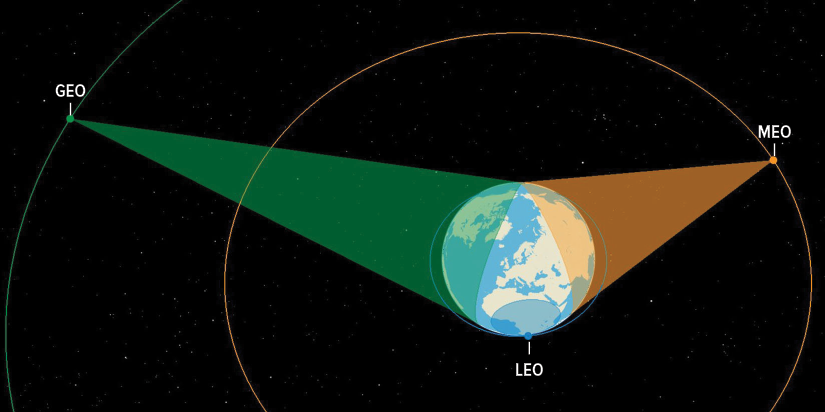
Satellite technologies are divided into three categories based on the orbital range they occupy: Geostationary Earth Orbit (GEO), Medium Earth Orbit (MEO), and Low Earth Orbit (LEO).1 LEO satellites operate in the closest range to Earth, orbiting between 300 and 2,000 kilometers above the planet’s surface (see Figure 1). At this altitude, latency (or lag time) is reduced, thus enabling LEO satellites to provide near-real-time communications with less signal power for transmission.2 This allows LEO satellites to be smaller in size than those in MEO or GEO, reducing the cost to develop and deploy them.
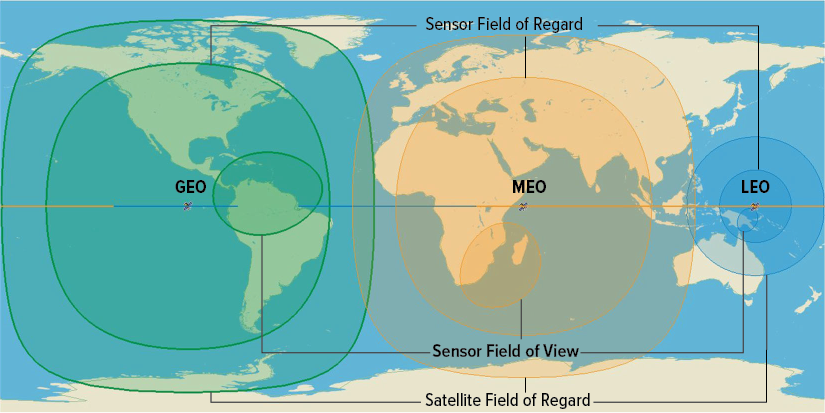
While LEOs can provide enhanced satellite-communication services due to their proximity to Earth’s surface, they do come with tradeoffs. LEOs have smaller coverage areas than MEOs and GEOs (see Figure 2), and they must be constantly in motion to offset the pull of gravity and remain on their orbital path. Due to their proximity, movement, and small size, a “constellation” of hundreds or thousands of LEOs is typically needed to provide consistent service to an area. Additionally, LEO satellites, which complete an orbit approximately every 90 minutes, are fuel-intensive to operate and prone to atmospheric drag, which degrades satellites over time. As a result, the lifespan of a typical LEO ranges from seven to 10 years.
Screenshot from “Large Constellations of Low-Altitude Satellites: A Primer,” May 2023, Congressional Budget Office, cbo.gov/publication/59175.
How Do LEO Satellites Work?
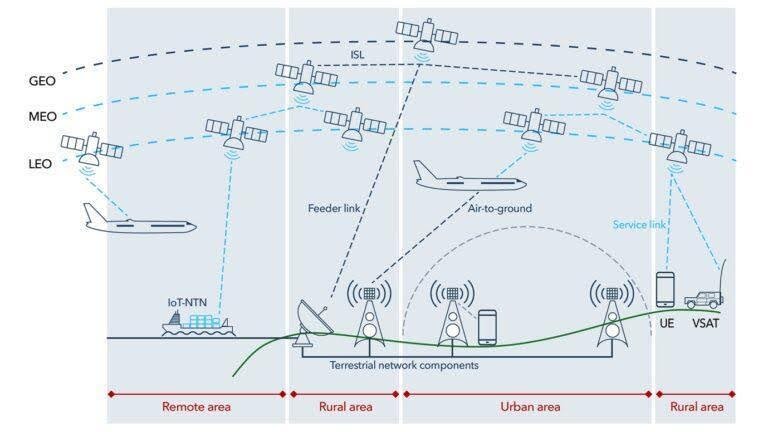
LEO satellite systems consist of three main components: the satellite constellation, user terminals, and ground stations.3 To establish a connection, terminals and ground stations must have clear lines of sight to satellites. Since LEO satellites are in constant movement, a constellation of hundreds or thousands of LEO satellites is typically needed to provide consistent service to an area, with user terminals and ground stations continually switching among different satellites within the constellation to maintain a user’s connection. While LEO satellites generally need to be within range of a ground station to send or receive data, some satellites also use inter-satellite links to share data among themselves until the data reaches a satellite within range of a ground station. Advancements in inter-satellite links, such as laser-based technologies, help LEO satellites provide reliable connectivity, even in areas far from a ground station.4
Satellites use spectrum—radio frequencies that transmit wireless signals—to send (downlink) and receive (uplink) information from user terminals and ground stations.5 Since available spectrum is limited and in most cases shared among operators, it is regulated nationally and internationally to promote global harmonization and to avoid interference or signal disruptions.6
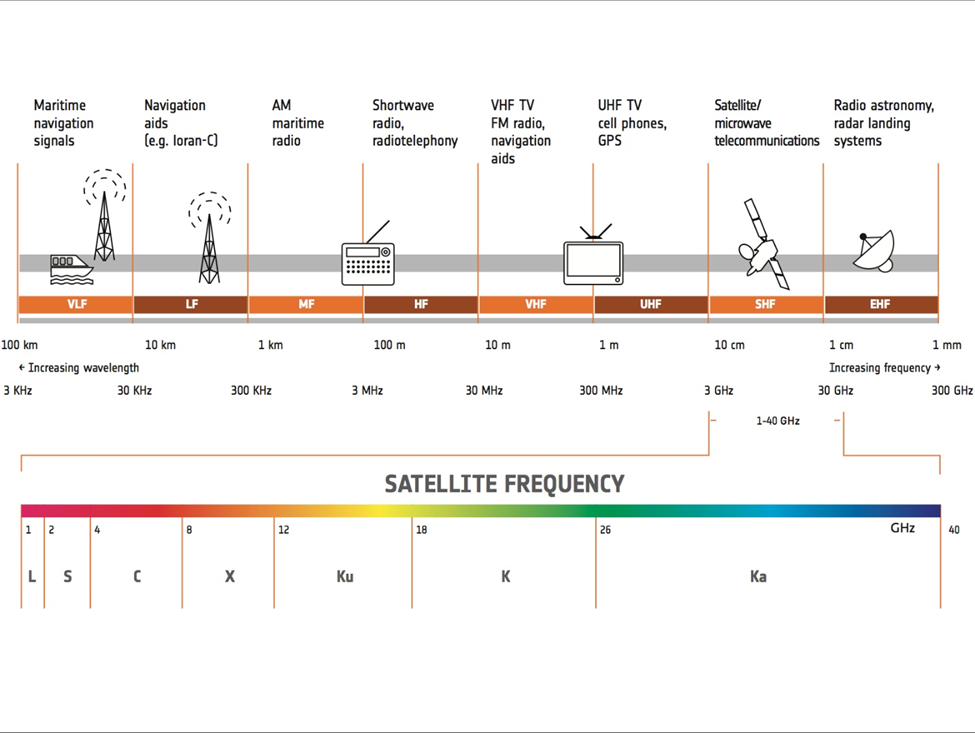
The International Telecommunication Union (ITU), an organization within the United Nations, allocates specific frequency bands for satellite communications with a variety of propagation characteristics and coordinates the registration of satellite-frequency assignments and (for the geosynchronous GEOs) their associated orbital positions.7 Currently, the most commonly used bands for connectivity-oriented LEO satellites are the Ku- (12–18 GHz) and Ka- (26.5–40 GHz) bands.8
Satellite operators obtain licenses for spectrum use from their national regulators, who are responsible for ensuring registered satellite operators follow international guidelines, as well as any specific national regulations. Filing a registered satellite operator with the ITU is a multistep process designed to identify and mitigate any potential conflicts between a planned system’s orbital characteristics, frequency bands, and intended service areas within an existing system.9 As such, once certain spectrum bands are in use, new entrants must design their systems around existing operators.
Screenshot from “Large Constellations of Low-Altitude Satellites: A Primer,” May 2023, Congressional Budget Office, cbo.gov/publication/59175.
The Promise of LEO Satellites: Ubiquitous Connection and Versatility
Due to their global coverage and proximity to Earth, LEO satellites can offer a wide range of services as both an alternative and complement to existing connectivity services. LEO systems can provide broadband connectivity to residential, community, and enterprise customers, along with other services such as:
- Vehicles and platforms in motion: In June 2022, the Federal Communications Commission (FCC) approved SpaceX’s Starlink and Kepler Communications for earth stations in motion (moving or transportable ground terminals), allowing the use of LEO satellites to provide connectivity for vehicles in motion—including cars, trucks, ships, and planes.10
- Areas experiencing natural disasters and conflict: LEO satellite connections are being used in combination with GEO satellites to respond to natural disasters and connect areas experiencing conflict, such as Ukraine and Gaza, where existing infrastructure is damaged.
- Enterprise Internet of Things (IoT): LEO satellites can offer enterprise connectivity services, such as providing backhaul to increase network coverage, enhance cloud storage, and provide support for edge computing. LEOs can also provide connectivity for widespread IoT devices and machine-to-machine communications, from asset tracking and remote monitoring to delivery drones and robotics.
- Direct-to-device mobile service: The FCC’s 2024 decision to authorize “supplemental coverage from space” allows LEO (and GEO) satellites to transmit directly to devices (D2D) on select mobile-carrier spectrum bands without the need for a ground station.11 Starlink and T-Mobile have been authorized to provide this service, initially limited to texting. Similarly, LEO operators can use Mobile Satellite Service spectrum bands to transmit directly to mobile devices without an arrangement with a terrestrial mobile carrier, such as Apple’s partnership with Globalstar, to transmit directly to iPhones and enable texting in even remote locations.12
Screenshot from “Regulation of NGSO Satellite Constellations,” International Telecommunication Union and Digital Regulation Platform from European Space Agency data, March 3, 2024, digitalregulation.org/regulation-of-ngso-satellite-constellations.
From GEO to LEO Satellites: A New Space Race
Global satellite communications first began in the 1960s with GEO and MEO satellites. In 1962, AT&T, with help from NASA, launched Telstar 1—a medium orbit satellite that enabled transatlantic television transmission from the United States to the United Kingdom and France.13 In 1964, Syncom 3, developed by Hughes Aircraft Co., became the first satellite in geostationary orbit, and transmitted live coverage of the 1964 Tokyo Olympics to one-third of the globe.14 From these initial launches until the 1990s, GEO and MEO satellites dominated the satellite-communications industry, delivering telephone and broadcast radio and television services across the globe.
In 1998, both Iridium and Globalstar launched LEO satellite mobile-communications services.15 High costs, limited market share, and long timelines to bring networks online, however, often meant the LEO networks of the 1990s failed to gain competitive viability relative to other terrestrial-service providers.16 In 2003, Eutelsat would launch e-BIRD, the first geostationary satellite designed to deliver broadband.17
Despite previous false starts, advances in satellite and launch technologies over the past decade have lowered the cost to bring LEO constellations online and to improve performance, thereby renewing the promise for future LEO-based communications and ushering in a new space race. By 2024 there were an estimated 10,000 active satellites in orbit, up tenfold from 1,000 satellites in 2014.18
With operators around the world filing with the ITU to bring hundreds of thousands of new satellites online in the coming years, Goldman Sachs Research forecasts as many as 70,000 LEO satellites to be launched within the next five years.19 To deter early filers from “warehousing” spectrum or reserving it for future use, satellite operators must deploy systems within seven years of the ITU receiving its request or their claim expires. For LEO satellites, operators are required to deploy 10 percent of a planned constellation within two years, 50 percent within five years, and total deployment within seven years to maintain their spectrum authorization.
The LEO satellite field is occupied by only a small number of companies, with SpaceX’s Starlink dominating satellites in orbit. One estimate found that Starlink operated roughly 60 percent of 10,000 functioning satellites as of 2024. As of July 2025, Starlink reports having more than 7,800 satellites in orbit.20 Starlink originally planned to launch 12,000 satellites for its constellation, but later expanded the project to 42,000 satellites.21 Other companies—including Eutelsat’s OneWeb (operating 630 satellites), Telesat (operating 198 satellites), Amazon’s Project Kuiper (launched 129 of its planned 3,000 satellite constellation as of September 2025), and Iridium Communications (operating 80 satellites)—are working to carve out market share for LEO-based connectivity for residential, enterprise, and government consumers.22
At the same time, many countries are exploring opportunities to advance and invest in the commercial LEO sector. Canada, China, and the EU are developing and heavily investing in national LEO satellite systems. The Canadian government provided Telesat Lightspeed a C$2.14 billion loan to develop and operate a LEO network to advance national connectivity and defense.23 In December 2024, the European Commission announced a contract to build a multi-orbital constellation of 290 satellites for its Infrastructure for Resilience, Interconnectivity and Security by Satellite (IRIS²) project.24 In China, two megaconstellation projects—Guowang and Qianfan—have plans to launch 13,000 and 14,000 LEO satellites respectively.25 As the field of LEO satellite connectivity matures, the orbital range is expected to become increasingly crowded, limiting orbital and spectrum availability while increasing space traffic and debris.
While LEO-based solutions are on the rise, some are already pushing for a new era of the final frontier: multi-orbit satellite connectivity. By integrating satellite service from multiple orbits, advocates hope to dynamically route service and capacity needs between GEOs, MEOs, and LEOs to provide reliable, flexible, and quality service for consumers.26 Developing multi-orbit service configurations depends, however, on first establishing a robust LEO satellite ecosystem.
Incorporating LEO Systems into the Existing Infrastructure
As LEO systems continue to come online, the existing connectivity infrastructure is struggling to accommodate and integrate this new technology. With LEO satellite growth expected to rise exponentially in the coming years, it is critical to assess and address barriers to LEO system inclusion to fully capture the potential to better connect everyone, everywhere.
This report outlines three major challenges currently facing LEO satellite inclusion and offers recommendations specific to the U.S. context:
- Chapter I explains how the proliferation of LEO systems is straining spectrum availability and existing regulatory structures that were not designed to accommodate the nascent field’s emergence or the speed of its growth. The chapter offers proposals to reform the current system to more efficiently accommodate a growing number of LEO systems and their expected rapid development.
- Chapter II examines the current LEO competition environment across four principal dimensions: market structure, barriers to entry, competitive differentiation, and potential anticompetitive conduct. While competition within the sector is intensifying, it is often skewed, and the chapter suggests ways for policymakers to monitor the development of the field to ensure robust and sustainable competition.
- Chapter III looks at the role of LEO satellites in bridging the digital divide and helping to provide broadband access across the United States, with an emphasis on their strengths and limitations. The chapter provides policymakers with key considerations and recommendations for how to utilize and integrate LEO systems into current universal service programs.
Citations
- Satellites in MEO or LEO are also referred to as non-geostationary satellite orbit (NGSO), meaning they move in relation to the Earth rather than remaining stationary. “Large Constellations of Low-Altitude Satellites: A Primer,” Congressional Budget Office, May 2023, source; Lisa Sodders, “LEO, MEO or GEO? Diversifying Orbits Is Not a One-Size-Fits-All Mission (Part 1 of 3),” Space Systems Command, July 18, 2023, source; Lisa Sodders, “LEO, MEO or GEO? Diversifying Orbits Is Not a One-Size-Fits-All Mission (Part 2 of 3),” Space Systems Command, July 20, 2023, source; Lisa Sodders, “LEO, MEO or GEO? Diversifying Orbits Is Not a One-Size-Fits-All Mission (Part 3 of 3),” Space Systems Command, July 21, 2023, source.
- “What is Network Latency,” Amazon, source.
- Perspectives on LEO Satellites: Using Low Earth Orbit Satellites for Internet Access (Internet Society, 2022), source.
- “Using Laser Transceivers for LEO Satellite Links,” Tech Briefs, January 1, 2023, source.
- “What is Spectrum? A Brief Explainer,” CTIA, June 5, 2018, source.
- Spectrum Management Training Program, “Interference,” International Telecommunications Union Academy, 2020, source.
- “Regulation of NGSO Satellite Constellations,” Digital Regulation Platform, March 28, 2024, source.
- “Ku, K, Ka Bands in LEO Satellites,” Reliasat, January 25, 2024, source.
- “Regulation of Satellite Systems,” International Telecommunications Union, February 2022, source; “International Satellite Coordination,” Federal Communications Commission, April 17, 2024, source.
- Federal Communications Commission, SpaceX Services, Inc. Application for Blanket Authorization of Next-Generation Ku-Band Earth Stations in Motion, IBFS File No. SES-LIC-20210803-01360 Call Sign E210309, SpaceX Services, Inc. Application for Blanket Authorization of HighPerformance Ku-Band Earth Stations in Motion, IBFS File No. SES-LIC-20210803-01361 Call Sign E210310, and Kepler Communications Inc. Application for Blanket Authorization of Ku-Band Earth Stations on Vessels, IBFS File No. SES-LIC-20210809-01568 Call Sign E210416, Order and Authorization, (rel. June 30, 2022), source.
- Federal Communications Commission, Single Network Future: Supplemental Coverage from Space, Report and Order and Further Notice of Proposed Rulemaking, GN Docket No. 23-65 (rel. March 15, 2024), source.
- Michael Sheetz, “Apple Commits $1.5 Billion to Globalstar for Expanded iPhone Satellite Services,” CNBC, November 1, 2024, source.
- David J. Whalen, “Communications Making the Global Village Possible,” National Air and Space Administration, November 30, 2010, source; “Bell-Labs Telstar,” Bell System Memorial, source; “Telstar,” Smithsonian National Air and Space Museum, source.
- “A Brief History of Satellite Communications,” Ground Control, source.
- “T-Minus Ten Years to First Launch,” Iridium Museum, source; “Globalstar Telcom Network Launched,” Wired, February 16, 1998, source.
- J. Armand Musey, “Satellite Bankruptcies Circa 2020: We’ve Come a Long Way!” SpaceNews, April 15, 2021, source.
- “e-Bird, The First Satellite Designed for Internet Broadband Lofted into Orbit for Eutelsat,” SpaceNews, September 28, 2003, source.
- “Space Connect: The Rise of LEO Satellite Constellations,” International Telecommunications Union, February 11, 2025, source.
- Ryan Duffy, “Astra, Hughes Net, Inmarsat, Telesat, and Others File Constellation Applications,” Payload, November 5, 2021, source; “The Global Satellite Market Forecast to Become Seven Times Bigger,” Goldman Sachs, March 5, 2025, source.
- “Starlink Network Update,” Starlink, July 2025, source; some estimates, however, put this figure closer to over 8,000 active satellites. Tereza Pultarova, “Starlink Satellites: Facts, Tracking, and Impact on Astronomy,” Space.com, August 1, 2025, source.
- Sissi Cao, “SpaceX Expands Starlink Project to 42,000 Satellites, ‘Drowns’ ITU in Filing Paper,” Observer, October 21, 2019, source.
- “Our Network,” Eutelsat OneWeb, source; “LEO Network,” Telesat, source; “Project Kuiper,” Amazon, source; “Kuiper Mission Updates,” Amazon, accessed on September 16, 2025, source; “Iridium Adds to Constellation Resilience with Launch of Spare Satellites,” Iridium, May 20, 2023, source.
- “High-Speed Internet Across the Country with Canada’s Largest Space Program,” Prime Minister of Canada, September 13, 2024, source.
- “Commission Takes Next Step to Deploy to Deploy the IRIS² Secure Satellite System,” European Commission, December 16, 2024, source.
- Stephen Clark, “China Orbits First Guowang Internet Satellites, with Thousands More to Come,” Ars Technica, December 16, 2024, source.
- “Multi-Orbit Connectivity Advancing Innovation in Satellite Communications,” Payload, April 15, 2024, source; Jason Rainbow, “Dawn of the Multi-Orbit Era,” SpaceNews, March 11, 2024, source.
Chapter I. Fueling Connectivity from Space: Spectrum Sharing and Coexistence
Introduction
Filings with the International Telecommunication Union (ITU) indicate plans for hundreds of thousands of new Low Earth Orbit (LEO) satellites globally. While most of these constellations may never secure funding or be deployed, if even a fraction come to fruition, it would represent an unprecedented expansion of satellite activity.1 According to ITU Radiocommunication Bureau Director Mario Maniewicz, “Over the past decade, such requests have grown 5.5 times, showcasing not only the immense promise of the rapidly growing space economy, but also highlighting the complexity and challenges we face.”2 This growth will require more spectrum capacity and greater coordination among systems, and not only to accommodate the explosion in data capacity. Network performance metrics like latency and signal quality are also improving dramatically, making satellite services increasingly viable for near-real-time, high-capacity applications.
As of mid-2025, there were more than 11,700 active satellites in orbit—a number that has grown dramatically in recent years.3 This surge has been dominated by LEO communication satellites. Even larger LEO constellations are being proposed, enabled by advances in spacecraft manufacturing and cheaper access to launch. SpaceX alone has nearly 8,000 satellites in LEO and a pending Federal Communications Commission (FCC) authorization to begin launching a Gen 3 constellation with up to 30,000 satellites in 2026—each with 10 times the downlink capacity and more than 20 times the uplink capacity of current satellites.4
The surge in on-orbit systems has been matched by equally dramatic growth in network capacity. Global satellite capacity increased eightfold from 2020 to 2023, reaching 27 Tbps, and is forecast to increase another tenfold by 2028, to 240 Tbps.5 Virtually all of this growth reflects an explosion in demand for LEO satellite connectivity, marking a clear transition from an ecosystem dominated by a small number of large geostationary orbit (GSO) satellites to rapidly growing constellations of LEO satellites. According to consulting firm Novaspace, total capacity for non-geostationary orbit (NGSO) satellite networks was seven times greater than total GSO capacity in 2023, a disparity projected to grow to 26 times by 2028, with NGSOs representing 97 percent of the projected net increase in satellite capacity over that period.6
This rapid proliferation of LEO systems, and the scale at which they are being deployed, has begun to strain both spectrum availability and existing regulatory structures. The FCC’s current framework for spectrum allocation and licensing was not designed for this emerging dense and dynamic LEO environment. Relevant FCC regulations were largely promulgated more than 20 years ago, when the largest constellations envisioned were in the hundreds, and most were not deployed. While the circumstances have changed, many of these regulations have remained the same.
A key challenge in today’s satellite regulatory landscape is accommodating the rapid proliferation of LEO systems, particularly in the shared fixed satellite service (FSS) bands that serve as the primary spectrum resource for both incumbent GSO systems and most NGSO constellations. FSS downlink operations primarily use the 10.7–12.7 GHz and 17.8–20.2 GHz bands, while uplinks typically use the 27.5–30.0 GHz and 14.0–14.5 GHz bands. These bands are shared internationally and were not originally planned with large-scale NGSO constellations in mind, further compounding the technical and policy challenges of coexistence and coordination.
Screenshot from “Regulation of NGSO Satellite Constellations,” International Telecommunication Union and Digital Regulation Platform, from European Space Agency data, March 3, 2024, digitalregulation.org/regulation-of-ngso-satellite-constellations.
This chapter will cover the current allocation, licensing, and coordination mechanisms for FSS and mobile satellite service (MSS) satellite systems. It discusses potential reforms that could better streamline authorizations, boost LEO satellite capacity and performance, and facilitate more efficient spectrum sharing and coexistence among incumbents and market entrants alike.
Licensing and Market Access
The current FCC satellite-licensing system is rightly criticized for being slow, bespoke, and overly burdensome for satellite operators, forcing delays that hinder the development of the rapidly growing satellite sector. Highly customized application requirements, duplicate processes between the FCC and ITU filings, and the combination of technical, spectrum, and orbital debris reviews lead to a long process and restrictive, sometimes inconsistent licensing conditions. Reforms that seek to better standardize and streamline authorizations through clear, uniform ex ante rules and conditions, while shifting to target ex post enforcement as needed, could help address these challenges.
A. Authorizations and Modifications: Bespoke, Burdensome, and Delayed
1. Application Requirements and Procedural Burdens
Currently, the FCC has three types of licenses for nongovernmental satellites: amateur, experimental, and “Part 25.” All three license applications require operators to submit information regarding their radio frequency and orbital parameters, orbital debris mitigation plan, and a draft of their ITU filing materials. Apart from prototype satellites or bands not allocated for satellites, all FCC-licensed LEO constellations for MSS or FSS—as well as foreign-licensed LEO constellations seeking U.S. market access—are licensed under Part 25 of the commission’s rules.
NGSO systems—particularly those operating in the FSS—do not receive exclusive spectrum assignments. Instead, they are expected to coordinate and share frequency bands on a nonexclusive basis. Indeed, virtually all satellite spectrum is shared, although first-in-time authorizations generally get priority for protection from interference. FSS system licenses are considered for application in a processing-round procedure in groups based on their filing date. The filing of an acceptable lead application for a specific frequency band triggers the opening of a processing round and deadline for filing competing applications.
The Part 25 satellite licensing process used for constellations is complex, costly, and lengthy, with the process taking anywhere from one to nearly four years.7 Operators that file with the FCC under Part 25 rules must submit an extensive application that often runs more than 100 pages and includes requirements to provide a detailed narrative, technical annex, Schedule S, orbital debris mitigation plan, and ITU filing-related materials.8 Each application is reviewed individually and often subject to system-specific conditions. This differs from the licensing process for terrestrial services, where the FCC has adopted more consistent rules that provide a clear framework for applicants.
The unique “processing round” approach applied to NGSO systems has compounded these challenges. Unlike other FCC licensing frameworks, the satellite licensing system limits the period when applicants can apply, and recent FSS/MSS processing rounds have overlapped in ways that lack clear rules or precedent. Applicants may face significant delays if they are forced to wait for a new round to open after a lead applicant files, or risk missing a narrow filing window if they are not prepared. These dynamics, while intended to ensure fairness and spectrum sharing among competitors, are frequently cited as a primary source of delay for NGSO licensing.
ITU filings are submitted to the ITU’s Radiocommunication Bureau early in a satellite system’s development process and contain technical and operational information. Due to the public nature of FCC filings, applicants tend to submit filings to the FCC later in the satellite development process and include a more comprehensive set of materials for domestic authorization and, where applicable, for coordination with U.S. government users. Like the ITU, the FCC process assumes good-faith coordination among operators, with oversight by the licensing or registration administration.
One of the primary procedural challenges is the duplicative nature of the FCC and ITU procedures, which have significant overlap. For example, both applications include coordination requirements, such as identifying potential interference and documenting efforts to mitigate potential interference to other services (including GSO systems, terrestrial systems, and other NGSO systems), including calculations of equivalent power flux density (EPFD), a metric that the United States is moving away from (discussed further below).
2. Timeline for Approval
When the FCC accepts a lead application for a specific frequency band, it opens a processing round and sets a deadline for competing applications. Each application is placed on public notice and the commission notifies applicants if there are questions, errors, or omissions in the application that need to be resolved. This must be done within 60 days of submission to the FCC’s International Communications Filing System (ICFS), except when extensions are granted. The exception is, however, more common than the rule.
After applications are placed on public notice, the filings are open to public review and comment. FCC staff undertake a technical, legal, and managerial review, which generally extends far longer than the comment period. While applications are eventually either granted or denied, the timeline is unpredictable and may take many months or even years.
3. Buildout and Enforcement
The FCC and ITU both impose deployment milestones for satellite systems, but their frameworks differ in scope and intent. FCC rules require NGSO operators to deploy 50 percent of their authorized constellation within six years of being granted an FCC license, and to complete 100 percent within nine years of receiving a license. If these milestones are not met, the FCC adjusts the authorization to match what has been deployed, and the remaining satellite authorizations are forfeited.
Milestone requirements are one of the few consistent obligations in the satellite context, but they operate as blunt tools to weed out purely speculative filings. To date, FCC-licensed LEO systems have largely met these requirements. Given the growing number and scale of proposed constellations, however, milestone compliance is an emerging area of concern. This is particularly true given the relative shortage of launch capacity, which can be a major obstacle to timely deployment. For example, Amazon’s Project Kuiper must deploy at least 1,618 satellites by July 30, 2026, to meet its six-year milestone, but it had launched only 129 satellites as of September 2025.9 Table 1 shows the pending milestone obligations and deployments associated with several FCC-licensed NGSO systems as of mid-2025.
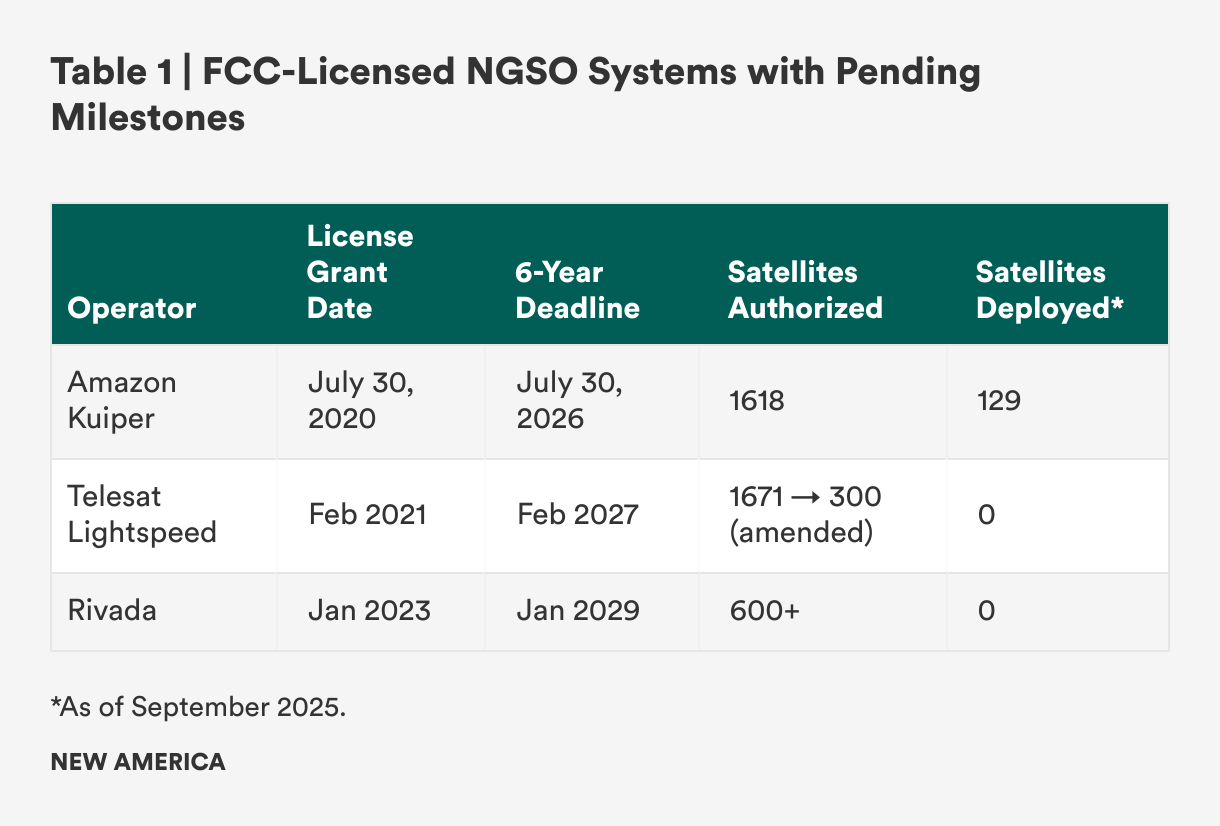
A key concern is whether these milestone requirements strike the right balance between facilitating market entry and deterring frivolous or infeasible applications. Some argue that these deployment deadlines are too lengthy and should be shortened, given the rapidly evolving ecosystem in LEO. Another consideration is whether enforcement of the buildout milestones is sufficient to offset the incentive for prospective satellite operators to apply and then later drop out if sufficient financing is not secured. The primary issue is how the FCC should distinguish systems that are legitimately trying to meet buildout requirements versus purely speculative or frivolous applications. The Commission has not yet tested how milestone waivers are to be handled, with Amazon’s Project Kuiper serving as one of the first cases to raise this issue. The ITU already has some precedent for handling waiver requests, which could serve as a reference point for the FCC.10
Introducing a higher up-front financial bond (for example, an escalating bond of $5 million or more post authorization) could serve as a stronger incentive to meet deployment milestones. Such a bond could be structured to release funds as verified buildout milestones are met. Conversely, failure to meet deadlines could result in partial forfeiture. This system would add accountability while giving applicants the opportunity to recover costs through performance. One of the potential downsides is that higher application fees or bond requirements may crowd out less well-funded startups and early innovators.
B. Proposals for Reform
1. Standardize Licensing Presumption
One overarching reform would be adoption of the presumption that NGSO applications that comply with existing FCC rules, especially those related to technical and sustainability standards, are in the public interest. This would reduce the need for case-by-case bespoke reviews and conditions. This would promote a more streamlined and consistent process, similar to how terrestrial wireless services are licensed. Instead of tailoring conditions to each operator, standardized operational rules—including for space sustainability—could provide clarity and predictability. Applicants seeking deviations from the rules would be required to seek waivers, creating a more rule-bound and transparent system.
2. Implement a Shot Clock for Application Review
A “shot clock” for application review would provide operators with more certainty about licensing timelines. It should be noted, however, that implementation of such a clock could be challenging, given the complexity of NGSO applications and the FCC’s current resource constraints. A rigid shot clock risks more tolling or dismissals without prejudice for incomplete showings.
Flexibility mechanisms could be included, such as pausing the clock in unusual review cases or if applicants fail to provide necessary information. U.S. government regulators like the Federal Trade Commission and Department of Justice employ similar flexibility in merger reviews if they need more time or if merging companies fail to provide required or needed information. Alternatively, some systems could seek a waiver of shot-clock rules to allow more time-sensitive applications to be addressed first. Systems that may be far away from their buildout requirements would allow higher-priority systems to be reviewed first.
3. Create Incremental Deployment Milestones
Deployment requirements could also be restructured into more graduated, measurable steps. For example, after final approval, satellite operators could be required to launch 5 percent of their constellation by Year 1, 10 percent by Year 2, and 20 percent by Year 3. These staged checkpoints could be tied to both financial incentives (for example, bond releases or refunds) and enforcement penalties for missed deadlines. Extensions would only be granted for deployment requirements in extenuating circumstances.
4. Raise Application Fees
Higher cost-based application fees could enable the FCC to hire additional staff and improve processing efficiency. In parallel, performance bonds structured to release funds as verified buildout milestones are met could reinforce deployment incentives. For example, an applicant might post a $5 million bond, with $3 million released upon launch of the first satellite and the remainder tied to subsequent milestones; missed deadlines would result in partial forfeiture. This dual-track approach would maintain compliance with the FCC’s statutory fee authority while still embedding strong, enforceable incentives for timely buildout.
C. Earth Stations: Light Licensing and Automated Database Coordination
LEO systems rely on ground-based earth stations (ES), also called ES gateways, to relay uplink traffic to their spacecraft, connect with the terrestrial internet, backhaul data, and perform essential tracking, telemetry, and control (TT&C) functions. ES gateways for these systems are typically dispersed globally, and larger constellations may require dozens of individual sites with hundreds of antennas worldwide. While inter-satellite links can reduce the number needed, ES gateways remain an essential component of NGSO network architecture.
One reform currently under consideration by the FCC is to streamline ES licensing by authorizing an automated database operated by one or more Commission-certified third parties to coordinate across all authorized Ka- and mmW-bands. As LEO constellations scale, gateway siting and authorization have become a key bottleneck. This is especially true in urban and suburban areas where access to fiber and low-latency ground infrastructure is essential, but where traditional Part 25 approvals are slow and often constrained by rigid geographic restrictions that govern certain mmW bands. It can also take a year and substantial cost to obtain a site-based license through the FCC’s traditional process. These delays can hinder timely constellation deployment and complicate coordination with terrestrial users in shared bands.
A simplified database-coordination system for third parties could rapidly aid in spectrum coordination and register new Earth stations in mmW bands above 28 GHz. It could also leverage the FCC’s existing 70/80/90 GHz lightweight coordination database, which for many years has successfully coordinated terrestrial fixed links (and, now, high-altitude platform links) operating in the 71–76, 81–86, and 92–95 GHz bands. This existing model allows for rapid, relatively easy registration and interference checking through third-party coordination without a full Part 25 review. This model is well-suited for sharing between satellite and terrestrial users, such as in the lower 37 GHz band, where the FCC has already requested comment on moving to a “lightly licensed” and automated coordination of terrestrial fixed and mobile network siting.
Integrating satellite ES into this database-coordination system could streamline the process, enabling faster, scalable NGSO-gateway deployments; reduce the burden of application development and processing on satellite operators and FCC staff; and help facilitate coexistence between terrestrial and satellite systems in the mmW bands. Finally, this method would allow for dynamic sharing and spatial reuse based on actual beam locations and terrain constraints. In mmW frequencies, a terrestrial fixed or mobile deployment at street level will rarely experience harmful interference from an ES gateway on a rooftop, or on the ground even a block away, and vice versa.
One remaining issue is whether the rules should also be modernized in bands designated for upper microwave flexible use service (UMFUS), such as 28 and 37–39 GHz, which also are allocated for mobile terrestrial use on a primary basis. These bands have very restrictive rules on ES location and operation, which typically limit siting to remote locations far from population areas or even highways. The FCC should revisit these legacy restrictions in mmW bands, especially the geographic exclusion zones and limited siting options, which prevent deployment in high-demand areas. Automated database coordination would enable an increased number of operators in channels without creating harmful interference and would open up more flexible interference-safe siting options.
Market Mechanisms and Spectrum Efficiency
A. Secondary Market Transactions
NGSO satellite licensing also lacks a functioning secondary market for licenses. This raises the question of whether such markets should be enabled and, if so, under what rules. There is often little to no demand for unrealized licenses for LEO systems because the licenses are specific to the operator’s system in terms of orbital configurations, spectrum, and orbital debris. Moreover, licenses cannot be altered or modified without losing their priority status, which would arguably be the primary motivation for a potential purchaser to seek to acquire a license rather than apply themselves.
Barring a new entrant who wants to provide a substantially identical system as the one proposed in the original application (or some subset of the same), there is likely no potential buyer for the license held by a willing seller. Further, the value of shared satellite licenses (FSS) generally depreciates as demand increases, since more systems deploying more satellites leads to more intensive spectrum sharing and more parties that must be accommodated through coordination agreements. MSS licenses are an exception, as they currently authorize only a single operator within each fairly narrow band; the September 2025 sale of 2 GHz MSS spectrum by EchoStar to SpaceX demonstrates the potential value of that exception.11
A key question is whether spectrum rights and coordination priorities should be transferable through secondary transactions. Allowing transfers could improve efficiency and flexibility, but it also raises concerns about encouraging speculative filings—where operators apply not to deploy but to resell. This issue overlaps with warehousing behaviors, in which licenses are held without any intent to build. If a secondary market were created, appropriate safeguards would be needed to prevent abuse and to ensure the market supports deployment and the sustainable use of spectrum rather than delaying it.
One potential reform is to explicitly allow secondary-market transactions related to relaxing or changing the default metrics that protect systems with prioritization from harmful interference. For example, even if the FCC adopts default coordination metrics that include a good-faith coordination requirement and defaults based on actual harmful interference—as it did for NGSO/NGSO coordination in 2024 and is currently considering for GSO/NGSO coordination (discussed below)—a secondary market for interference protection could further promote spectrum efficiency.
In practice, ITU administrations have approved the transfer of satellite licenses for both GEO orbital slots and NGSO systems, which contain associated coordination rights and priorities.12 While these do not constitute “sales” of coordination priority, the ability to transfer licenses allows operators to transfer interference-protection status to other parties. Processing rounds are intended to give operators greater certainty that their capital investments will be protected from harmful interference while still allowing future entrants (subject to coordination).
To the extent that an operator with prioritization agrees that the default interference thresholds (for example, the 3 percent degraded throughput metric that the FCC applies to sharing among NGSOs) can be further relaxed or even discarded, a negotiated transaction should generally promote more intensive and efficient use of shared satellite bands. Inasmuch as operators may be making payments as part of private coordination agreements, or granting other considerations, explicitly allowing transactions that relax priority coordination rights could encourage these transactions, as would an FCC requirement to disclose them.
B. Auctions
Spectrum allocated globally for satellite use is inherently shared under ITU rules and, with very few exceptions, continues to be coordinated for shared use in every nation. There are, however, important differences between the wide higher-frequency bands that characterize allocations for the FSS and the relatively few and narrow low-frequency bands allocated for the MSS. While NGSOs use both, these differences are crucial in considering the nature of the spectrum rights that are assigned and coordinated.
Neither the ITU nor the FCC currently uses an auction system for either FSS or MSS spectrum. The ITU lacks the authority to hold a global auction and requires operators to obtain a license from their national regulator, as well as an authorization for market access in any other nation where they operate. This does give participating member nations some flexibility in terms of how allocations and assignments are conducted. For example, Brazil previously conducted domestic FSS spectrum auctions but amended its regulations in 2020 to replace these auctions with administrative licensing.
In the United States, the FCC uses auctions for terrestrial exclusive-use licenses but does not currently use auctions to assign satellite spectrum. The ORBIT Act, enacted by Congress in 2000, generally prohibits globally allocated satellite spectrum from being auctioned.13 The law is premised on the idea that exclusive-use auctions would undermine the ITU’s global harmonization of frequency allocation and shared use. Whether that is necessary or the best policy in all bands, however, remains an open question among some economists and policy experts.
Supporters of auctions argue that the ORBIT Act’s prohibition is interpreted too broadly and that it could allow the FCC to conduct domestic auctions that do not impact global satellite allocations or those of other nations. For example, two decades ago, the FCC auctioned spectrum for purely domestic direct broadcast satellite (DBS) services in auctions 8, 9, and 52. However, the agency has not auctioned spectrum for satellite use since 2004, although it did auction FSS spectrum in the upper 3 GHz C-band for terrestrial use in 2021.
The working group discussed a few scenarios in which auctions could potentially be constructive. One option would be to use auctions to allocate priority in coordination for protection from interference for NGSO FSS systems operating in shared satellite spectrum. As congestion and traffic in LEO continues, satellite spectrum will become more congested as well. Auctions could be a mechanism to determine who receives coordination priority rather than rely solely on the current first-come, first-served processing round framework.
Similarly, the FCC could auction or assign aggregate “interference allowances,” which would effectively assign shares of a maximum allowable interference footprint for each NGSO system. This could give operators more certainty about their interference rights and obligations, at least in aggregate. It could additionally promote more efficient coordination if operators are allowed to trade interference allowances as part of their obligation to avoid harmful interference. It would also create an incentive for more spectrum-efficient satellite and system design by effectively putting a price on the externality of generating interference.
This approach is not without significant challenges. Interference is inherently dynamic—varying by geography, time, and constellation design—and defining static or aggregate interference quotas may oversimplify these complexities. Moreover, global satellite operations require coordination through the ITU, and any attempt to implement a U.S.-only interference allowance system may complicate international harmonization efforts or potentially hobble U.S.-licensed systems seeking to compete globally.
There could also be concerns about the impact on competition if one or even a few operators could effectively acquire all or most of the available spectrum capacity. In the context of terrestrial mobile licensing, the FCC has long had a “spectrum screen,” and the agency’s review of spectrum license transfers considers the impact on the concentration of spectrum ownership. Still, as NGSO operations scale up, exploring whether interference can be quantified, allocated, and traded may be worth studying as a means to increase the efficient use of limited spectrum capacity.
A third scenario where auctions might play a productive role would be in the narrower and scarcer MSS spectrum bands at lower frequencies. In the United States, these are currently occupied by single operators, but they are increasingly in demand for direct-to-device (D2D) services. In a January 2025 paper on MSS, Armand Musey and Tim Farrar stated: “Although co-frequency spectrum sharing (i.e., two operators sharing the same frequency) has been successfully implemented in FSS bands and certain terrestrial frequencies, the MSS spectrum bands and existing services within these bands have very different characteristics than FSS.”14 Unlike NGSO FSS systems, which often point highly directional antennas at ground-station locations, MSS systems typically serve mobile users with omnidirectional or low-gain antennas, and with limited interference-mitigation capabilities. This makes coordination more difficult and increases the risk of interference among MSS operators.
For example, in early 2024, SpaceX filed two currently pending petitions for rulemaking that requested the FCC consider whether the 2 GHz and 1.6/2.4 GHz MSS bands can be coordinated for shared use beyond their current assignment to single operators (for example, Globalstar, EchoStar, Iridium).15 This proposal has sparked debate that is unlikely to end with SpaceX’s September 2025 purchase of EchoStar’s 2 GHz licenses. Whether existing or newly allocated MSS bands can be assigned by coordinated sharing, or for a single or limited number of operators by auction, will be influenced in large part by disputed technical claims about whether multiple MSS operators can coexist on a co-frequency basis, or whether exclusive assignments are needed to avoid harmful interference. This is discussed further below.
Satellite Spectrum Sharing and Coexistence
A. Fixed Satellite Service (FSS): A New Framework for More Intensive Spectrum Sharing
NGSO FSS operators are required to share spectrum and coordinate operations with both incumbent GSO systems, which have assigned orbital slots, and other NGSO operators. This presents unique challenges in bands where demand is high and there is risk of interference, which can be short-term (the risk of in-line events between two satellites) or long-term (the risk of aggregate interference from multiple satellites). In 2023, the FCC adopted a new framework to govern sharing and coexistence among NGSO systems. It currently applies only to NGSO operations over U.S. skies, as it departs from the ITU’s decades-old approach to interference protection by instead relying on default interference thresholds that better reflect the risk of actual harmful interference.16 A similar framework is under consideration for NGSO/GSO sharing.
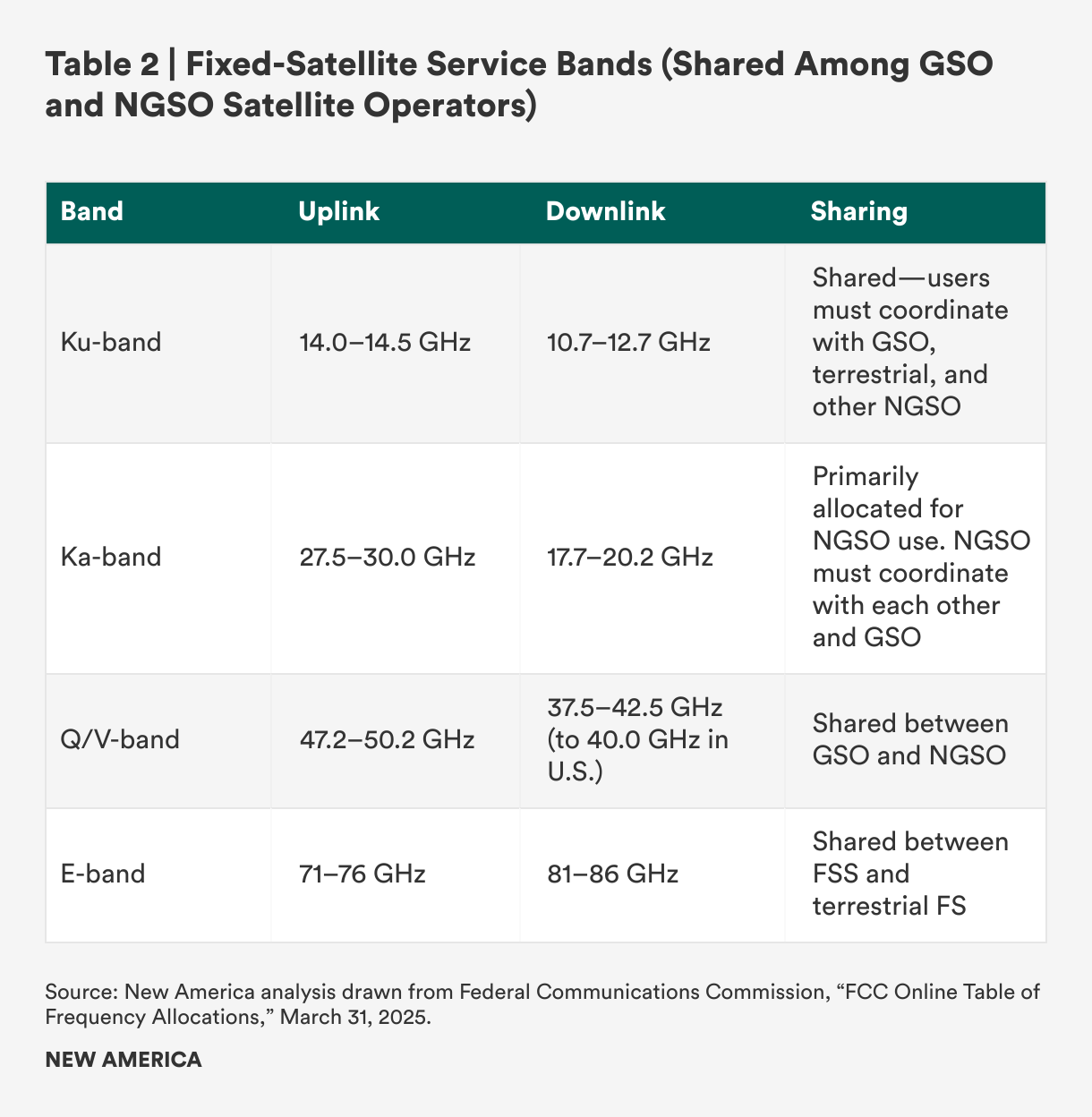
Under its current regulations, the ITU has two regulatory procedures to record spectrum assignments that allow satellite operators to obtain protection from interference: advance publication information (API) and coordination request (CR). The FCC does not distinguish between these, marking a divergence in domestic regulations from the ITU’s procedures.17
1. NGSO/NGSO Coordination and Coexistence
Through a pair of orders in 2023 and 2024, the FCC adopted a revised framework to govern coordination and coexistence among NGSO systems.18 The new rules require good-faith coordination to avoid interference, including by systems authorized in an earlier processing round, which receive prioritization for interference protection over systems licensed in later rounds. NGSO systems approved in the same processing round that fail to reach a coordination agreement are subject to a default spectrum-splitting procedure as the remedy for an in-line event that makes harmful interference likely. This typically serves as an incentive for voluntary coordination among systems approved in the same processing round, since neither party would welcome an arbitrary division of the band.
For operators approved in different processing rounds, a failure to coordinate gives the system approved in an earlier round priority protection for up to 10 years, after which the protection sunsets. Earlier-round systems are protected from later-round systems by interference-protection thresholds based on actual harmful interference: The short-term limit protects against a loss of link availability that exceeds 0.4 percent and the long-term interference threshold protects against aggregate interference, defined as exceeding the 3 percent time-weighted average throughput degradation.
The FCC’s coordination framework for NGSO FSS operators, which relies on a default interference-protection threshold based on actual harmful interference, represents a major change from what both leading LEO operators and the FCC itself characterized as the outdated and overly conservative EPFD threshold, which remains the ITU standard globally.19 For example, using a default threshold of 3 percent degraded throughput makes spectrum more available, particularly for later entrants, and could greatly increase the potential capacity of NGSO FSS bands.
2. NGSO/GSO Coordination and Coexistence
While spectrum sharing among U.S. NGSO FSS systems is now conducted under a modernized coordination framework, LEO satellites remain bound internationally by the ITU’s low-power EPFD limits designed decades ago to prioritize GSO operations. These legacy ITU rules limit aggregate NGSO equivalent isotropically radiated power (EIRP) toward the GSO arc, regardless of whether a GSO link is at risk of harmful interference at a given time or location. The result is reduced power levels, constrained beam patterns, and narrower orbital flexibility—all of which significantly suppress NGSO system capacity.
While updating the rules for NGSO/GSO sharing is under study at the ITU (with any change at least two to six years away), the FCC launched a notice of proposed rulemaking (NPRM) in April 2025 to modernize its framework for spectrum sharing among NGSO and GSO operators. At the time, the Commission stated that the ITU’s “EPFD limits based on 90s-era system designs significantly limits the services offered by NGSO broadband satellite constellations today.”20 More specifically, the FCC notes that EPFD rules constrain NGSO operations in multiple critical respects: limiting radiated power levels; establishing wide avoidance angles around the GSO satellite arc; restricting the number of satellites allowed to serve a particular location; and limiting ES antenna-elevation angles.
The FCC proposes to replace static EPFD masks in certain Ku- and Ka-band ranges with a sharing model based on metrics that approximate actual harmful interference. In place of fixed power-density limits and large avoidance angles, the FCC’s default protections would measure the actual impact on GSO service. For example, the short-term limit could be based on an absolute increase in link unavailability between 0.1 percent (proposed by SpaceX) and 0.4 percent (the metric for NGSO/NGSO sharing). The long-term limit, at least for GSO satellites using adaptive coding and modulation (ACM)-enabled GSO links, could be a 3 percent average degraded-throughput threshold (if the FCC adopts the same threshold it did for the NGSO/NGSO sharing framework); for non-ACM GSO links, an I/N threshold would be set over a defined percentage of time. A small minimum avoidance angle (for example, 4 degrees) would serve only as a backstop where validated GSO reference links are unavailable. Operators could meet these protections using in situ mitigation—such as dynamic beam shaping, time–frequency scheduling, and geographic avoidance—rather than designing entire systems around a one-size-fits-all EPFD mask. This approach contrasts sharply with the ITU’s legacy framework, which relies on low power, large avoidance angles, and static exclusion zones.
If the FCC adopts default interference limits premised on actual harmful interference, it will enable substantially higher power limits for LEO satellites and more beams per satellite over a given geographic area, enabling enormous increases in data capacity and performance. Kuiper included a study in its initial comments demonstrating that adopting these “new limits for NGSO-to-GSO interference…could increase the number of satellites available to serve a location by roughly 27 percent and increase the capacity available to an area by 700 percent, while, at most, a GSO operator might experience a 0.000001756 percent increase in unavailability and a less than 3 percent reduction in throughput.”21 This would allow NGSO operators to take full advantage of the capabilities of modern NGSO systems, which are increasingly software-defined and adaptive.
The FCC’s NPRM also requests comments on whether to apply a sunset period to GSO interference protections, analogous to the 10-year priority protection limit the agency applies to NGSO systems approved in earlier processing rounds. Applying such a limit to GSOs poses challenges, as these satellites are larger, more expensive, and designed for operational lifetimes of 15 years or more. They are also part of systems that are less able to adapt rapidly to new coordination regimes. Even if a sunset provision were to be phased in, it would be challenging to determine a reasonable duration due to the long and variable lifespan of GSO satellites.
A more practical alternative may be to enact sunsets for GSO ground infrastructure, such as ES gateways and user terminals. These facilities are far easier to upgrade on a predictable cycle, and targeted sunsetting of protections for outdated equipment could help clear persistent bottlenecks without undermining the economics of long-lived spacecraft. While there are limits to how feasible this would be if the satellites were not updated, the FCC and ITU should study how such an approach could be implemented to accelerate adoption of modern, more resilient GSO ground systems.
Overall, the Working Group recommends adoption of a good-faith coordination framework anchored in degraded-throughput and other service-quality metrics—rather than static EPFD masks—as default protections when coordination fails. By tying interference limits to actual harmful-interference proxies, the FCC can unlock substantial spectrum capacity for LEO systems, raise permissible NGSO transmit power, and improve both coverage and service quality while still ensuring that GSO networks receive robust and predictable protection.
3. Advances in Spectrum Sharing Technologies
One potential approach to improve coordination among NGSO systems—and possibly with GSO systems as well—is the development of database-enabled spectrum coordination mechanisms. A database-enabled coordination tool could be used to better manage spectrum for FSS systems by preventing interference, automating coordination, and allowing for more dynamic spectrum sharing. This database could contain key operating parameters for NGSO systems (such as orbital parameters, power, and frequencies used) and be used to track spectrum usage in LEO. Operators would benefit from a database that facilitates orbital planning and spectrum coordination, including the anticipation and avoidance of interference and other in-line events, including with space debris. Database coordination could potentially incorporate data on GSO operations as well, allowing NGSOs to adjust in congested areas.
The operational data sharing (ODS) system recently announced and tested by the U.S. National Radio Astronomy Observatory in partnership with SpaceX offers a potential preview of this concept.22 The ODS system enables near-real-time sharing of telescope operational data through a secure database between observatories and participating satellite operators. Satellites can then dynamically adjust their transmissions to minimize interference. One key technique tested by SpaceX allows “satellites equipped with phased array antennas to redirect their beams away from telescopes when they are within a certain proximity, and also temporarily disable transmissions if they pass directly through a telescope’s line of sight.”23
The European Space Agency has recommended further study of dynamic-satellite database coordination, and several major operators have expressed cautious interest.24 At the same time, questions remain about the feasibility, efficiency, and fairness of such systems—particularly concerns that it could place disproportionate burdens on NGSO operators. The emergence of far more capable spectrum analysis tools that leverage advanced computing and artificial intelligence could help address some of these challenges by enabling faster and more accurate interference assessments. Any future coordination mechanism must carefully balance these tradeoffs and be subject to rigorous cost-benefit evaluation.
A broader and related question is what role advances in spectrum sharing technology should play in the FCC’s coordination framework, and whether the commission should encourage or require their use with sunset provisions. For example, to what degree should the FCC prioritize systems using steerable antennas or other technologies that make coordination and coexistence more efficient? In this context, regulators could consider whether and how to sunset certain GSO interference protections over time, particularly for GSO earth stations and user terminals, which are generally more practical to upgrade than the satellites themselves. While such an approach would face challenges—notably, the long operational lifespans of incumbent GSO satellites—it could help encourage greater adoption of technologies that facilitate coexistence. Ultimately, the FCC should consider whether a more technology-forward sharing regime is feasible or necessary for long-term spectrum sustainability in heavily used FSS bands.
B. The Mobile Satellite Service Access and Sharing Challenge
Spectrum allocated for MSS comes with an entirely different set of capabilities, challenges, and constraints. The lower-frequency spectrum currently used to bring MSS connectivity to mobile devices and platforms in motion—including vehicles, ships, and aircraft—is in increasing demand to fill connectivity gaps where traditional mobile or landline service is not possible or cost-effective. D2D service, which enables communication between satellites and handheld consumer devices (for example, smartphones) or with enterprise IoT networks (for example, sensors, asset tracking), is a particularly useful form of communication that has grown in both popularity and relevance as satellite communication improves and as private enterprise networks proliferate.25
But while the demand and use cases for D2D are growing, efforts to expand services are complicated by the fact that there are only a few relatively narrow bands of licensed MSS spectrum available, all of it currently assigned to single operators. The three primary MSS bands are much lower in frequency than FSS spectrum and thus better able to connect to consumer handsets. These include the L-band GEO spectrum (1525–1559 MHz downlink and 1626.5–1660.5 MHz uplink), the 2 GHz S-band (2.0–2.02 GHz and 2.18–2.2 GHz), and the “Big LEO” band (1610–1626.5 MHz paired with 2483.5–2500 MHz).26
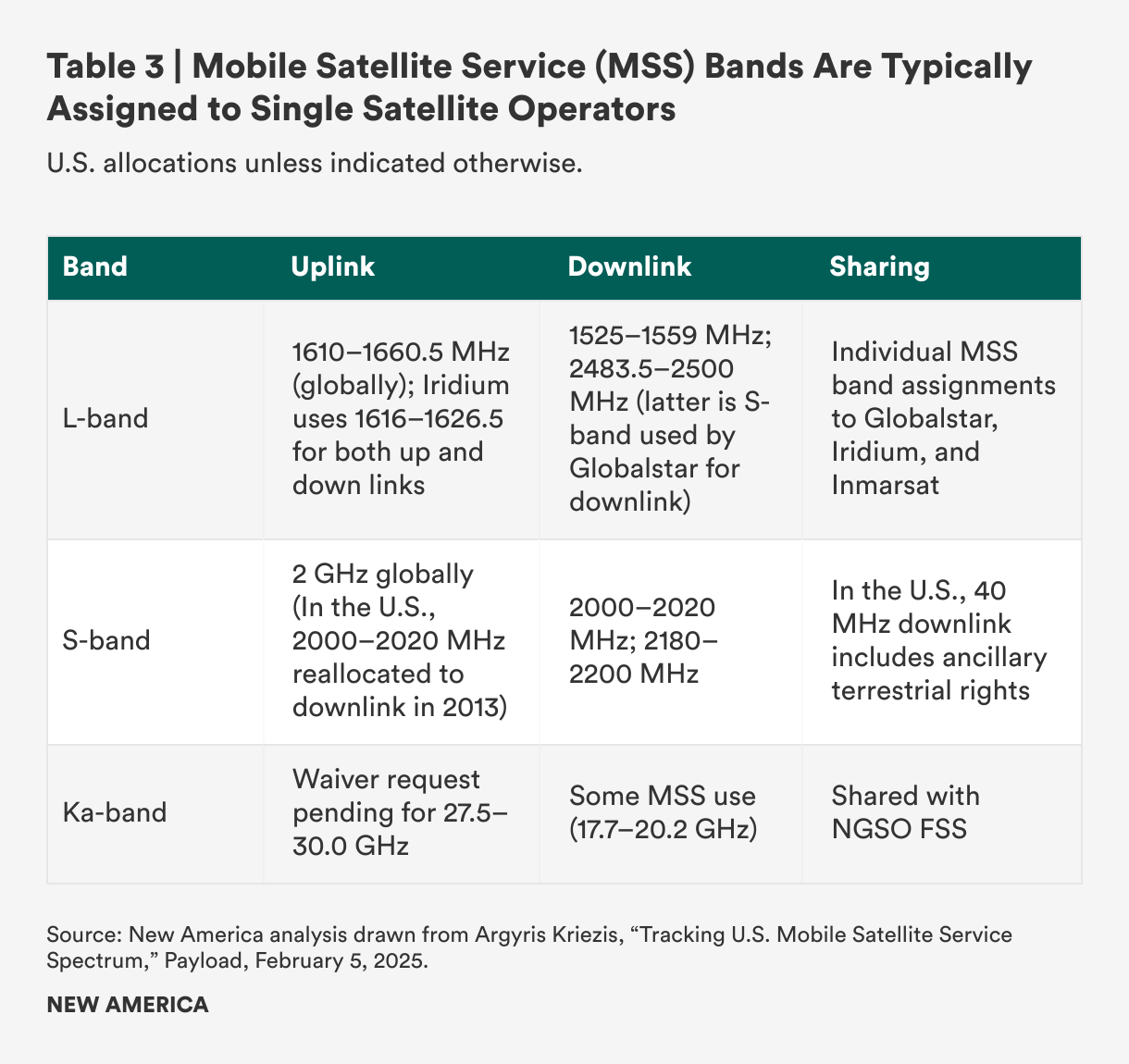
In addition, LEO satellite operators recently have forged partnerships with leading terrestrial mobile carriers in the United States and in Europe to use terrestrial mobile (IMT) spectrum to provide very basic LEO satellite connectivity—initially texting, and possibly phone calls and web browsing in the future—to mobile phone customers in rural, remote, and other areas without cellular coverage or where the signal is too weak. In 2023, the FCC authorized this additional option for D2D service as supplemental coverage from space (SCS).27 In 2025, T-Mobile’s partnership with Starlink became the first to offer D2D to cellular customers in the United States. A major constraint, however, is that SCS service is contingent on an agreement with the mobile carrier that licenses that frequency band on an exclusive basis. SCS is a secondary use case and heavily dependent on partnerships between satellite and mobile providers.
In contrast, Globalstar uses its own allocation of MSS spectrum in the “Big LEO” band, in partnership with Apple, to allow owners of new-model iPhones to text from any location, regardless of which operator they use for their mobile service. Whereas SCS is a complement to the mobile carrier’s service, enough MSS spectrum could allow LEO operators to innovate new services and even compete directly with mobile carriers.
As noted in the discussion of auctions above, a key challenge is how to make more MSS spectrum available. The low mid-band spectrum useful for D2D connectivity is in extremely short supply and, in the United States, Congress recently required that another very large increment of mid-band spectrum be identified and auctioned for exclusive terrestrial use.28 Alternatively, SpaceX and others have argued that existing MSS bands could be shared, making room for new users. However, the technical feasibility of sharing MSS bands remains unproven. Unlike FSS spectrum, which offers very wide bands more easily shared by coordinating antenna direction among users, D2D devices require omnidirectional antennas that are less able to direct the power they radiate toward one specific satellite and away from others. Because of these challenges, co-frequency sharing has historically been looked at as unlikely or impossible.
A Brief History of Mobile Satellite Service (MSS) Spectrum
Both the Big LEO and 2 GHz bands were initially allocated for shared use. Big LEO’s original band plan allowed for up to four NGSO MSS operators using code-division multiple access (CDMA) in 1610–1621.35 MHz, and for one NGSO MSS operator using time-division multiple access (TDMA) in 1621.35–1626.5 MHz, for uplink and bidirectional transmission respectively.29 It also assigned 2483.5–2500 MHz for the equivalent downlink use. Though multiple applicants were intended to use the band, only two ended up deploying: Globalstar, using CDMA, and Iridium Constellation LLC (Iridium), using TDMA. Further revisions to the band plan have further minimized the amount of spectrum shared between the operators, which now have most of their operations in bands they exclusively occupy.
Until the recent emergence of demand for LEO direct-to-smartphone connectivity, there was little interest in expanding or sharing low-band MSS spectrum. Eight operators were initially licensed to provide MSS in the 2 GHz band, but most either failed to complete buildout requirements or eventually surrendered their licenses.30 The two that remained in the band went bankrupt and were acquired by DISH, now EchoStar, which has only very recently announced the sale of its AWS-4 and H-block licenses to SpaceX.31 In 2012, the FCC authorized an ancillary terrestrial component (ATC) for this 2 GHz spectrum (AWS-4) that allowed EchoStar to offer both terrestrial and satellite service using the same 2 GHz MSS spectrum.32 This has had the practical effect of closing the band to additional MSS users based on the assumption that only a single operator could coordinate use of the band for both downlink satellite and terrestrial mobile use without causing harmful interference to one service or the other. As noted above, in September 2025 EchoStar agreed to sell its 2 GHz MSS spectrum to SpaceX.
Although the MSS bands have evolved in ways that currently appear incompatible with spectrum sharing, their relatively light usage has made them the target of hopeful direct-to-device (D2D) providers seeking more MSS spectrum. After SpaceX filed petitions for rulemaking in 2024 asking the FCC to authorize shared use,33 the Commission invited public comment on the issue and may still decide to open a rulemaking to determine if sharing these relatively narrow MSS bands is technically feasible.34 Since SpaceX filed its petitions, the debate over the potential for coexistence in the bands has only intensified. Proponents argue that shared use better aligns with the original intent of the band plans, while incumbents argue there is insufficient technical evidence in the record on how band entrants could adequately protect existing services from harmful interference.
At the same time, D2D providers have recently begun striking business partnerships with existing MSS licensees—most notably, Apple’s partnership with Globalstar35 and AST SpaceMobile’s leasing agreement with Ligado Networks.36 The demand for MSS spectrum does, however, exceed the amount available and seems likely to grow as the number and importance of potential D2D use cases increase.
The FCC should work to allocate or open more MSS spectrum for use through two primary avenues. First, the commission should allocate additional MSS spectrum that supports new D2D use cases. One immediate opportunity is the upper C-band (3980–4200 MHz), where the FCC is currently exploring the consolidation of incumbent FSS earth stations, as well as what additional services could be accommodated in the upper portion of the band that remains in use for FSS. One option is to authorize MSS operations to share the band with GSO FSS downlinks to earth stations, which are primarily used for relaying video and data content in near real time (for example, live TV programming).37 The FCC’s consolidation of the upper C-band has been mandated by Congress and represents a timely opportunity to add MSS services to prime spectrum that is only lightly used. An added advantage is that, since this spectrum is allocated globally for FSS, it could become a global MSS band as well. While the FCC would need to determine if coexistence is technically feasible, the agency should use its upcoming C-band rulemaking as an opportunity to invite proposals and studies.
Longer term, the Commission should seek to identify other bands that may be suitable for MSS use. One pathway is through the bands that the National Telecommunications and Information Administration (NTIA) is charged with studying under the One Big Beautiful Bill Act.38 As part of its 2025 budget reconciliation package, Congress instructed NTIA to conduct spectrum analysis of several large federal bands, with the goal of identifying bands for reallocation to commercial use. Some of the lower-frequency bands under review—including 2.7–2.9 GHz and 4.4–4.9 GHz—likely possess the physical characteristics needed to support an MSS allocation. Portions of those bands that are too narrow or non-harmonized to support a valuable auction for full-power terrestrial mobile service should, instead, be considered for MSS.
One downside of a new U.S. allocation for MSS is its effect on global harmonization. For example, EchoStar’s (and now SpaceX’s) 2 GHz MSS spectrum is available for D2D services across Europe and most of the world. But a U.S.-only allocation in a band currently allocated primarily for terrestrial or federal agency use might not be economically viable, depending on the value of the service provided and which other nations followed suit.
Second, the FCC should open a broad proceeding to better understand whether, and under what circumstances, it might be feasible for two or more LEO satellite providers to coordinate and share MSS spectrum. While debates to that effect are currently raging over some MSS bands, there is insufficient technical evidence in the records related to these proceedings to say whether, or with what strategies, coexistence is possible. Collecting a technical record on the subject would both help the Commission reach a conclusion on the current debates and inform future band plans.
The timing for this proceeding is ripe as NTIA explores new bands for additional uses. Indeed, even if sharing is too difficult for already-allocated bands occupied by operators who have proceeded under the assumption that they would not need to coordinate shared use, sharing could be possible in newly allocated bands if those bands could be licensed under specific conditions intended to coordinate multiple users. For example, some federal satellite users may be able to share with commercial MSS under the right conditions. A proceeding that gathers evidence on which rule structures and limitations are necessary to enable sharing will both help open up MSS spectrum to additional users and facilitate maximum use of the bands.
C. Recommendations to Expand the LEO Satellite Spectrum Access Pipeline
1. Expanding Contiguous FSS Downlink Allocations
The Working Group expressed general support for the FCC’s pending “Satellite Spectrum Abundance” proposals to allocate substantially more spectrum in the upper 12 GHz and lower 42 GHz bands for NGSO FSS operations. The agency’s NPRM outlined a number of substantial new allocations for both NGSO satellite downlinks, as well as for very high-capacity uplinks for FSS earth-station gateways in the 51.4–52.4 GHz and W-band frequencies above 94 GHz.39
As part of this rulemaking, the FCC has requested comment on a proposal to add an additional 500 megahertz to the downlink Ku-band—the 10.7–12.7 GHz band currently shared by GSO and NGSO FSS operators, including Starlink and OneWeb—that would extend this contiguous allocation to 13.25 GHz. This would facilitate a substantial increase in overall LEO satellite downlink throughput, latency, and quality of service, particularly if combined with the modernization of NGSO/GSO spectrum sharing and power limitations discussed above.
2. Allocating Additional MSS Bands or Shared Access in Low Mid-Band Spectrum
Another promising area is the potential expansion of MSS access to low mid-band spectrum. In February 2025, the FCC created a notice of inquiry on how to free additional mid-band spectrum for new services in the upper C-band, which is currently used for FSS earth stations between 3980 and 4200 MHz.40 Congress subsequently required the Commission to reallocate and auction at least 100 megahertz in this band for terrestrial mobile use.
It is likely, however, that a substantial portion of the band will remain in use for FSS, and as a buffer to protect airline altimeter systems operating in the band above from interference. The FCC should use this opportunity to consider whether MSS systems could share and coexist with incumbent FSS earth stations in any portion of the band that remains allocated to FSS, as SpaceX41 and New America’s Open Technology Institute42 suggested in comments responding to the FCC’s notice of inquiry.
The FCC should also evaluate band segments that are less attractive or feasible for terrestrial mobile use to determine their feasibility for MSS use. Some bands that should be investigated in particular are those that are too narrow or non-harmonized to be of great value for auction to terrestrial carriers. For example, Congress has required the FCC and Department of Commerce to consider the 2.7–2.9 GHz band for potential reallocation. Full repurposing of this band to MSS is likely unfeasible, as it overlaps with critical radar systems, but sharing in the band should be studied.
Finally, the FCC should consider initiating a rulemaking process to gather input on whether existing MSS bands could be more efficiently shared among multiple operators, given the growing demand for MSS capacity and advancement of satellite technology.
Citations
- Andrew Falle et al., “One Million (Paper) Satellites,” Science 382 (October 2023): 150–2, source.
- “Space Connect,” International Telecommunications Union, source.
- Harry Baker, “How Many Satellites Could Fit in Earth Orbit? And How Many Do We Really Need?” Live Science, May 30, 2025, source.
- “Network Update,” Starlink, source.
- “Novaspace Reports Major Shifts in Satellite Communications Industry,” BroadcastPro Middle East, September 16, 2024, source.
- “Non-Geostationary Orbit Constellations Redefining the High Throughput Satellites Market Landscape,” Novaspace, April 25, 2024, source.
- See Argyris Kriezis and Whitney Lohmeyer, U.S. Market Access Authorization Timeline Analysis for Megaconstellation Networks (Olin Satellite + Spectrum Technology & Policy Group, April 2022).
- “Part 25 Space Station License and Market Access Checklist,” Federal Communications Commission, updated October 27, 2023, source.
- Amazon, “Kuiper Mission Updates,” accessed on September 25, 2025, source.
- “ITU Radio Regulations Board Approves Waiver for Rivada LEO Constellation and the Company Signs an MoU with IEC Telecom,” SatNews, July 11, 2023, source.
- “EchoStar Announces Spectrum Sale and Commercial Agreement with SpaceX,” EchoStar, September 8, 2025, source. The pending 2 GHz license transfer also includes ancillary terrestrial rights. At the time of this report, SpaceX stated it would do a direct-to-cell service but had not announced any plans for a terrestrial component.
- “Spectrum Management: Key Applications and Regulatory Considerations Driving the Future Use of Spectrum,” Digital Regulation Platform, April 25, 2025, source.
- See ORBIT ACT, Pub. L. No. 106-180, 106th Congress (Mar. 17, 2000), (“Notwithstanding any other provision of law, the Commission shall not have the authority to assign by competitive bidding orbital locations or spectrum used for the provision of international or global satellite communications services. The President shall oppose in the International Telecommunication Union and in other bilateral and multilateral for any assignment by competitive bidding of orbital locations or spectrum used for the provision of such services.”). The Federal Communications Commission (FCC) has determined that the act does not cover allocations for purely domestic services. For example, the FCC required auctions for co-primary rights to deliver one-way direct broadcast satellite service both before and after passage of the ORBIT Act. See Federal Communications Commission, Auction of Direct Broadcast Satellite Licenses, Order, AUC-03-52 (rel. Jan. 15, 2004).
- J. Armand Musey and Tim Farrar, Spectrum for Emerging Direct-to-Device Satellite Operators, at 15 (Summit Ridge Group, January 2025), source.
- Space Exploration Holdings LLC, Revision of the Big LEO Spectrum Sharing Plan to Encourage Productive MSS Use of 1.6/2.4 GHz Frequencies, Petition for Rulemaking, RM-11975 (filed Feb. 21, 2024); Space Exploration Holdings LLC, Revision of the Commission’s Sharing Plan to Encourage Productive Satellite Use of the 2 GHz Frequencies, Petition for Rulemaking, RM-11976 (Feb. 22, 2024).
- Federal Communications Commission, Revising Spectrum Sharing Rules for NonGeostationary Orbit, Fixed-Satellite Service Systems, Second Report and Order and Order on Reconsideration, IB Docket No. 21-456 (rel. Nov. 15, 2024), source.
- At the International Telecommunication Union, an API filing is early notification and includes basic orbital parameters and frequency information. It does not, however, require formal coordination. Many GSO FSS assignments are API-only and not coordinated with NGSO systems. CR filings are required when radio regulations mandate coordination or agreement with other administrations. See “Regulation of NGSO Satellite Constellations,” Digital Regulation Platform, source.
- Federal Communications Commission, Revising Spectrum Sharing Rules for Non-Geostationary Orbit, Fixed-Satellite Service Systems, Report and Order and Further Notice of Proposed Rulemaking, IB Docket No. 21-456, (rel. April 21, 2023); source; Federal Communications Commission, Revising Spectrum Sharing for NGSO, FSS Systems, Docket No. 21-456, (2024).
- See Jack Kuhr, “LEO and GEO Satellite Operators Battle It Out on EPFD Rules: Payload Research,” Payload, June 12, 2024, source.
- Federal Communications Commission, Modernizing Spectrum Sharing for Satellite Broadband, Notice of Proposed Rulemaking, SB Docket No. 25-157, at para. 11 (rel. April 29, 2025), source.
- Federal Communications Commission, Comments of Kuiper Systems LLC, Modernizing Spectrum Sharing for Satellite Broadband, SB Docket No. 25-157, at i and Appendix (July 28, 2025). Id. at 11-12 and Appendix, Table 14.
- Bang D. Nhan et al., “ODS: A Self-Reporting System for Radio Telescopes to Coexist with Adaptive Satellite Constellations,” arXiv (2025), source.
- “Satellite Internet Meets Space Science: A Groundbreaking Solution for Spectrum Sharing,” National Radio Astronomy Observatory/National Science Foundation, August 12, 2025, source.
- See Michael Calabrese, Solving the Spectrum Crunch: Dynamic Spectrum Management Systems (Dynamic Spectrum Alliance, October 2023), 45–46, source.
- See Musey and Farrar, Spectrum for Emerging Direct-to-Device Satellite Operators, source.
- Musey and Farrar, Spectrum for Emerging Direct-to-Device Satellite Operators, source.
- FCC, Supplemental Coverage from Space, GN Docket No. 23-65 (2024).
- See One Big Beautiful Bill Act, H.R.1, 119th Cong. (2025), source.
- Federal Communications Commission, Amendment of the Commission’s Rules to Establish Rules and Policies Pertaining to a Mobile Satellite Service in the 1619–1626.5/2483.5–2500 MHz Frequency Band, Memorandum Opinion and Order, CC Docket No. 92-166 (rel. Feb. 15, 1996), source.
- Federal Communications Commission, Space Exploration Holdings, LLC, Application for Modification of Authorization for the SpaceX Gen2 NGSO Satellite System to Add a Mobile-Satellite Service System, Order, ICFS File No.: SAT-MOD-20230207-00022 (rel. March 26, 2024).
- Monica Alleven, “SpaceX Scoops Up EchoStar Spectrum for $17B,” Fierce Network, September 8, 2025, source.
- Federal Communications Commission, Space Exploration Holdings, LLC, Application for Modification of Authorization for the SpaceX Gen2 NGSO Satellite System to Add a Mobile-Satellite Service System, Order, ICFS File No.: SAT-MOD-20230207-00022 (rel. March 26, 2024).
- SpaceX, Revision of the Big LEO Spectrum Sharing Plan, Petition for Rulemaking (2024); SpaceX, Revision of the Commission’s Sharing Plan to Encourage Productive Use of 2 GHz, Petition for Rulemaking (2024).
- See Federal Communications Commission, Request for Comment on Petition for Rulemaking by Space Exploration Holdings, LLC, Regarding Revision of the Commission’s 2 GHz MSS Sharing Plan, Public Notice, RM-11976, (rel. March 26, 2024), source; see also Federal Communications Commission, Request for Comment on Petition for Rulemaking by Space Exploration Holdings, LLC, Regarding Revision of the Commission’s 1.6/2.4 GHz “Big LEO” NGSO MSS Sharing Plan, Public Notice, RM-11975, (rel. March 26, 2024), source.
- Argyris Kriezis, “Tracking U.S. Mobile Satellite Service Spectrum,” Payload, February 5, 2025, source.
- “AST SpaceMobile Announces Agreement for Long-Term Access to up to 45 MHz of Premium Lower Mid-Band Spectrum in the United States for Direct-to-Device Satellite Applications,” AST SpaceMobile, January 6, 2025, source.
- Federal Communications Commission, Comments of New America’s Open Technology Institute and Public Knowledge, Upper C-band (3.98 to 4.2 GHz), GN Docket No. 25-29 (April 29, 2025), source.
- One Big Beautiful Bill Act, H.R.1, 119th Cong.
- Federal Communications Commission, Satellite Spectrum Abundance, Further Notice of Proposed Rulemaking and Notice of Proposed Rulemaking, SB Docket No. 25-180 (rel. May 27, 2025), source.
- Federal Communications Commission, Upper C-band (3.98 to 4.2 GHz), Notice of Inquiry, GN Docket No. 25-29 (rel. Feb. 28, 2025), source.
- Letter from Jameson Dempsey, Director, Satellite Policy, Space Exploration Technologies Corp., to Marlene H. Dortch, Secretary, Upper C-band (3.98 to 4.2 GHz), Federal Communications Commission, GN Docket No. 25-59 (Feb. 20, 2025).
- Federal Communications Commission, Comments of Open Technology Institute and Public Knowledge, Upper C-Band, source.
Chapter II. The Final Economic Frontier: Satellite Competition in Low Earth Orbit
Introduction
For decades, Low Earth Orbit (LEO) resembled a corporate graveyard more than a functioning market. Technologists attracted to the advantageous conditions of locating communications infrastructure just beyond the Karman line1 were met with a harsh economic reality.2 High costs, significant infrastructure needs, high failure rates, and short useful lives were a lethal combination for competitive viability. The few systems that made the transition from business concept to functioning constellation quickly ran up against the operational challenge of maintaining a truly global service when the orbiting asset base is continuously depreciating worldwide. The result has been a checkered history of insolvencies and restructurings. Iridium, Globalstar, Orbcomm, SkyBridge, and Teledesic—once envisioned as alternatives to early mobile telephony or global broadband—all went bust at some point; some never returned.3
But the market, as well as its underlying economics, has evolved. New cost efficiencies in launch and payload production, together with advances in spot beam technology and frequency reusability that have dramatically increased satellite throughput, have made large constellations containing hundreds or thousands of satellites economically feasible.4 These developments, in turn, have allowed LEO satellites to rapidly become a viable alternative to terrestrial connectivity in many rural and underserved areas, providing both global coverage and high-speed, low-latency connectivity to meet consumer demand for quality service. These production efficiencies and innovations could not have come at a more opportune moment. Skyrocketing bandwidth demands from both consumers and enterprises, along with latency sensitive applications—ranging from video conferencing to real-time gaming—mean that this expanded output is meeting growing consumer demand. As a result, a growing array of new business models and market niches are emerging, from direct communication with off-the-shelf consumer devices to enterprise backhaul connectivity.
While outer space has shifted from the exclusive province of a select number of nation states to a commercial arena, the two are not mutually exclusive.5 Satellite systems have immense geopolitical implications, and their missions often coincide with broader national interests. A large share of the world’s operational and planned capability is located outside the United States, supported by governments that view satellite constellations as instruments of industrial and geopolitical strategy. In contrast to terrestrial broadband or other communications sectors where private demand has primarily set the pace, LEO competition has been significantly shaped from the outset by state sponsorship, subsidies, and strategic mandates. At the same time, even private commercial systems controlled by foreign interests may pose a threat to these same political economy considerations, given long-standing concerns of foreign infrastructure and its tension with national security.6
These realities underscore that geopolitics is not peripheral to LEO competition but central to it. The playing field is skewed by political considerations, both in the form of national champions explicitly cultivated to project soft power and through subsidies that insulate state-backed firms from commercial risk. In this environment, consumer welfare is not defined solely by prices, output, or service quality, but also by who controls the infrastructure and what strategic objectives they serve. This means LEO cannot be understood as a textbook competitive market; it is instead a hybrid arena where strategic statecraft and economics continually overlap.
Political influence also distorts the market away from free-market competition. For example, a nationalist agenda may craft a view of consumer welfare that goes beyond archetypal measures of price and output to consider who is providing a service. Is it a domestic provider or foreign competitor? Is a competitor completely commercial or are they intertwined with another nation’s public infrastructure? And is that nation-state an ally or an adversary? Each question has an array of ramifications and inroads for intervention that impact existing and future competition.
Embedded within this geopolitical theater is a now viable commercial domain. The key question is what we should expect from LEO providers in terms of market competition.7 This chapter explores this question and its many contours, recognizing that a framework for competition is emerging in real time. While only a few hundred commercial satellites occupied LEO orbits a decade ago, more than 11,700 satellites are currently deployed and operational today, providing both fixed and mobile satellite service connectivity to users across the globe,8 with several times that planned and pending.
It is important to recognize, however, that while the number of LEOs and the size of constellations are important factors in the ability to offer competing services, they are not the only factors.9 Distribution of constellations is also critically important. A provider may have a large number of satellites covering one orbital band but few or none in others. Determining (or worse, predicting) what constitutes a competitive market, especially as the market matures, presents significant challenges.10
None of this is surprising. This segment of the satellite industry is nascent, which means we should expect a lot of entrepreneurial activity and entry by firms vying “for the market.”11 But as the market for satellite broadband and services evolves, so too will the nature of competition.12 Eventually, growth in the supply of LEO satellites will slow for both economic and technological reasons, and priorities shift from rapid deployment to delivering economical and sustainable services.13 Yet unlike traditional product markets, it is far from certain that LEO competition will converge on a stable structure. Because constellations function as infrastructure capable of supporting diverse verticals—from consumer broadband to enterprise backhaul to defense—the pace of maturation may differ across service segments. Production economics will reward those operators who can sustain low-cost deployment at scale, but service differentiation, interconnection with terrestrial networks, and political sponsorship will also shape outcomes. As a result, dynamic competition may continue to reshape markets in ways that resist the familiar trajectory toward stability and concentration.
The current competition environment in LEO can be structured along four principal dimensions or “pillars.” First, we assess the current market structure and broader industrial policy considerations, including the strategic interaction between both existing and imminent satellite operators in LEO. Second, market power and barriers to entry play a prominent role in the feasibility of competitive entry into the market, and each must be considered in detail. Third, we assess the relevant competition dimensions beyond the current race for the market, including the role of competitive differentiation and an emphasis on service quality. Last, by incorporating each of these assessments, we present the key fracture points or potential avenues for anticompetitive behavior within the LEO satellite market, providing agencies and enforcers with clear examples of where competition may falter.
Importantly, we do not attempt to make definite predictions on what competition should look like in either case. Rather, our objectives are two-fold. First, we seek to provide competitive guideposts so that regulators, policymakers, and the occasional enforcer know where to look. This includes specifying which competitive dimensions may be leveraged and where to focus (or avoid) scrutiny. Second, we present a potential toolkit that may be put into practice. Specifically, we identify what pragmatic and implementable policy interventions may look like, both in the short and long term.
Market Composition and State of Play
Analyzing the structure of the market, market composition, and the relevant players provides a first cut from which broader competitive conditions—entry barriers, differentiation, and conduct—can be assessed. We then turn to the state of play, including the strategic advantages of existing firms and the shifting definitions of various service markets facilitated by modern satellite systems.
A. Market Structure and Concentration
Within the United States, a select number of LEO constellations are currently operational or imminent. The broader market for consumer broadband services by LEO providers can be separated into two categories: fixed satellite service (FSS) and mobile satellite service (MSS). Through regulatory actions at the International Telecommunication Union (ITU) and the Federal Communications Commission (FCC), decades-old spectrum use designations continue to distinguish FSS and MSS operations by LEO providers. We apply these distinctions below, while noting that this historical framing is not completely representative of operating realities.
While FSS was traditionally characterized for broadband satellite services, and MSS for narrowband service for mobile uses, the services being deployed today do not neatly fit into these categories. In terms of practicalities, an FSS operator cannot begin offering mobile services without navigating a separate set of licensing requirements and technical conditions (and vice versa). At the same time, the traditional regulatory distinction between FSS and MSS does not neatly capture how competition is unfolding in practice. Virtually every FSS operator also offers connectivity to platforms in motion, such as internet service for aircraft and cruise ships,14 that were once the exclusive domain of MSS. From a market perspective, the more relevant distinction is technological: whether a constellation requires directional antennas—typically higher-frequency systems capable of delivering broadband speeds at or above the FCC’s benchmark of 100 Mbps downlink and 20 Mbps uplink—or whether it can operate with omnidirectional, handset-capable antennas that rely on the narrower bands of lower-frequency spectrum associated with legacy MSS allocations. This functional divide, rather than the regulatory categories alone, more accurately captures the competitive dynamics in emerging service markets.
1. FSS Operations
Most of the growth and entrepreneurial activity currently underway in space can be attributed to LEO satellite systems whose core business case is to offer FSS broadband connectivity to retail consumers. A significant portion of all active space objects serve this function, and the number is steadily increasing. The service also remains the most sought after satellite operation in filings to regulatory agencies, both domestically and in international fora. See Table 4 for a list of the currently active and imminent systems.15
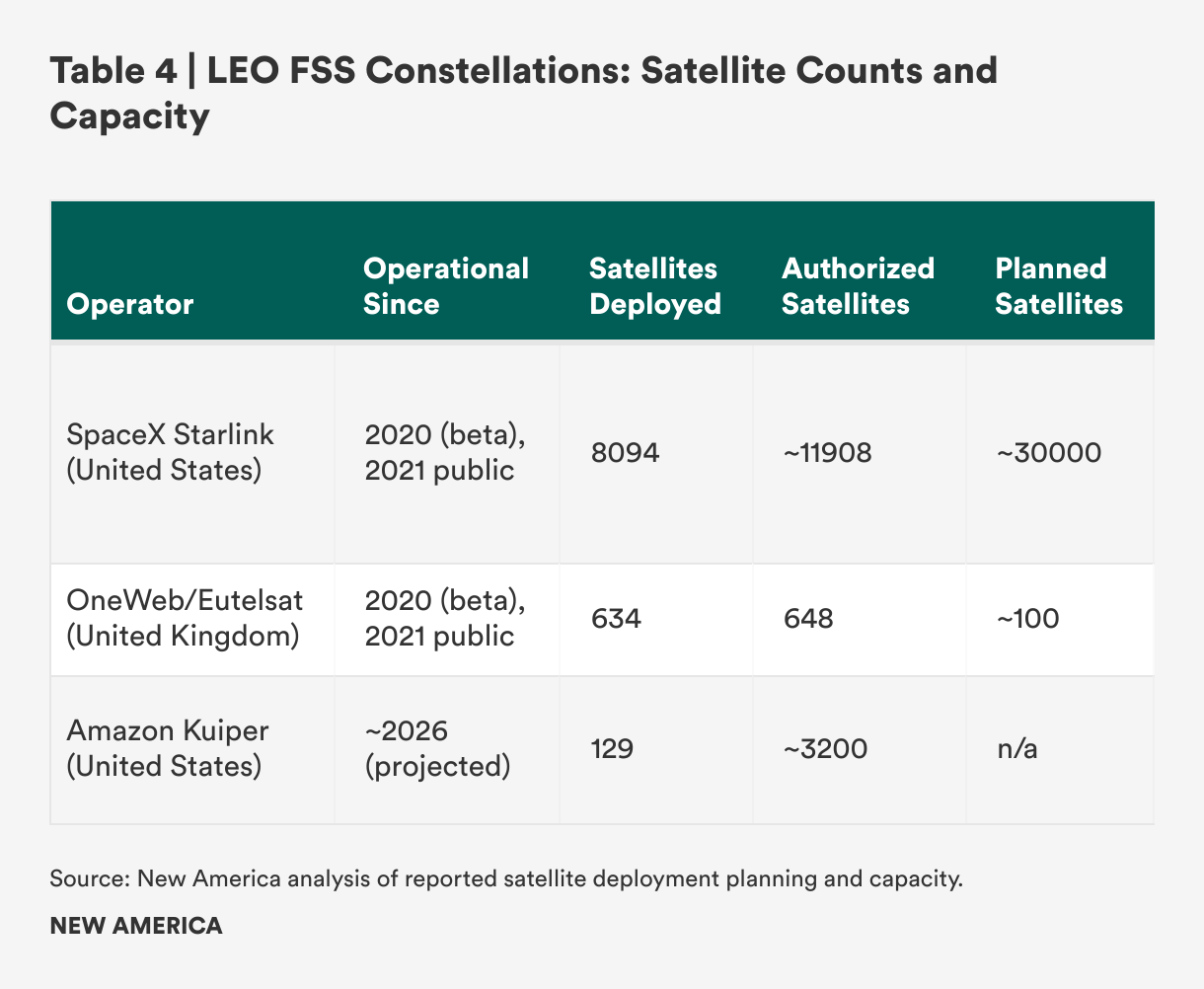
An unprecedented number of LEO constellations have been proposed in recent years. Across four separate regulatory proceedings, over 20 entities have sought a license to provide FSS operations to the U.S. market alone.16 More than half of these planned systems have either been authorized or remain pending before the FCC. More broadly, filings before the ITU now reference more than one million proposed non-geostationary satellites.17 While the eventual realization of these proposed systems could reduce market concentration, such an outcome remains uncertain in the foreseeable future.
Indeed, the more imminent concern is whether any of these systems will materialize within the procedural deadlines imposed by the FCC. An unfortunate consequence of the existing licensing regime for FSS systems is that it incentivizes operators to submit early—often premature—filings to preserve license parity with competitors. In the best case, as systems materialize, these early plans quickly become outdated and require repeated filings to modify these initial plans with updated system designs and configurations.18 In the worst case, operators commit to plans and then attempt to adjust their business model to the filing, only to realize it is operationally infeasible or economically impractical, leading to numerous application filings that never materialize into operational systems.19
2. MSS Operations
LEO constellations providing global coverage for mobile devices first emerged in the late 1990s. At the time, providing mobile connectivity from space proved to be economically impractical in many cases, particularly for LEO constellations that require a dense deployment of satellites. Nearly every LEO satellite operator licensed to provide MSS to retail consumers in the United States would eventually declare insolvency, and only two of the original licensees remain operational today.20 See Table 5 for a list of the currently active and imminent systems.21
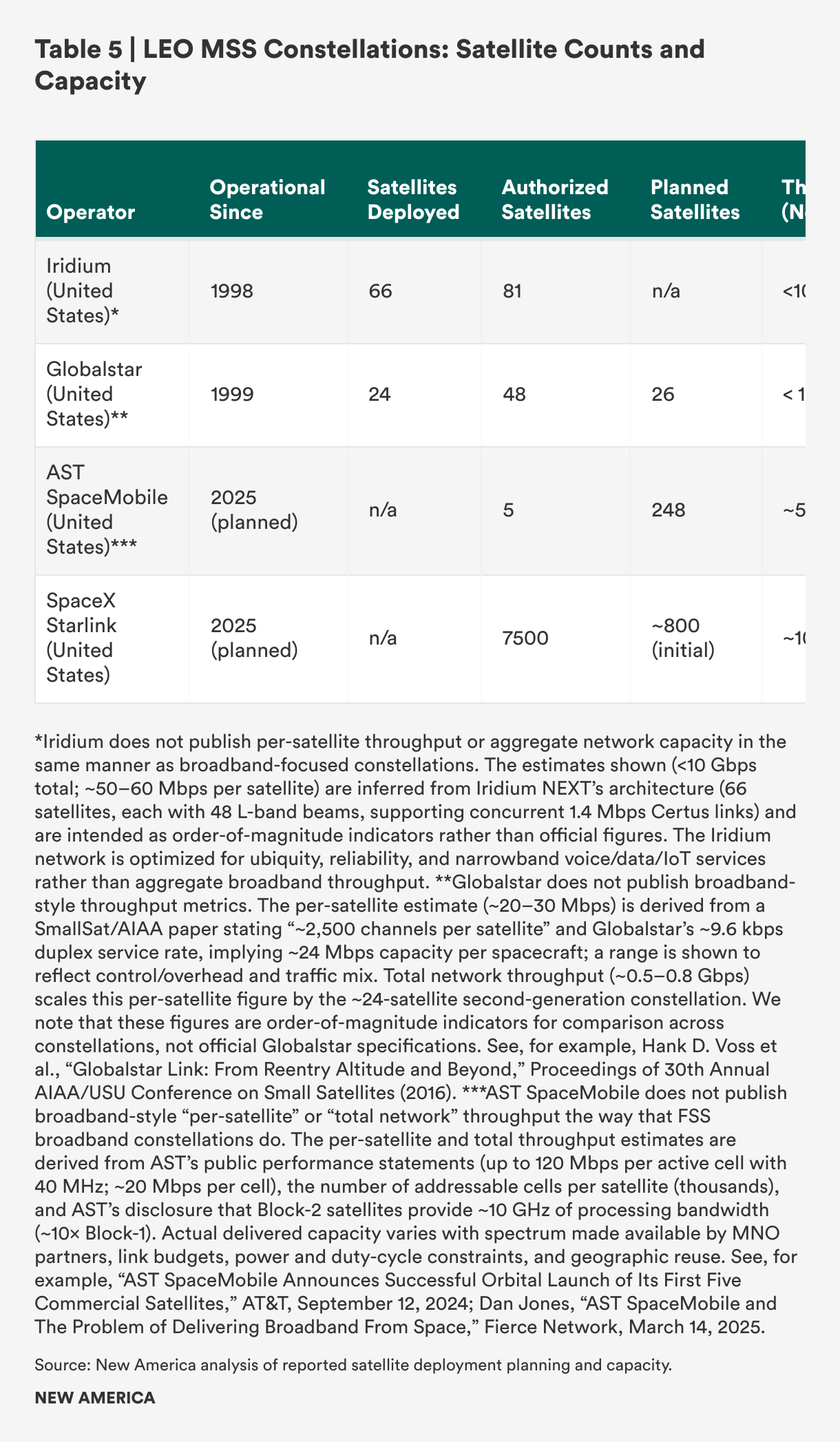
Other established operators, such as SpaceX, have recently sought to broaden their service footprint to include MSS operations. Notably, the company recently purchased EchoStar’s domestic MSS spectrum in the 2 GHz band, as well as its global MSS spectrum licenses.22 The company has indicated that these frequencies will be included on the antenna payload of its next-generation satellites and offer what it calls direct-to-cell services. Additionally, the company continues to seek a petition for rulemaking proposing shared access to the 1.6/2.4 GHz bands exclusively occupied by Globalstar.
At the same time, a new class of direct-to-device (D2D) projects—such as Lynk’s deployed satellites and other initiatives for supplemental space coverage23—has emerged alongside traditional MSS. These systems provide connectivity directly to ordinary mobile handsets without the need for specialized terminals, often by partnering with terrestrial mobile operators. While they rely on different technical and regulatory pathways than legacy MSS, they nonetheless can serve as a substitutable product for end-users. As such, they represent an alternative entry point into the MSS market, though one with its own set of frictions and uncertainties.
The SpaceX filings and accompanying proceedings are representative of a broader issue. Despite being originally allocated for some degree of joint use, each of the domestic MSS bands are exclusively occupied and used by incumbents.24 Indeed, the company’s entry into MSS frequencies required directly contracting with an existing licensee, a paradigm typically characteristic of exclusively held terrestrial spectrum licenses, not shared satellite frequencies. The key policy questions going forward are whether sharing, as originally intended, is technically feasible and what number of systems is realistic.
B. Resource Management and Strategic Incentives
Every satellite system is dependent on two physical resources for its operation: orbits and radio spectrum. Both resources are finite, congestible, and—given the inherently global nature of satellite systems—shared; thus, they require international coordination of their access and use. Within both the international registration system managed by the ITU and various regulatory regimes imposed by specific countries to operate in their market, entities that secure licenses or deploy spacecraft first are given priority, with interference protections imposed on later entrants. But a system of first-in-time, first-in-right effectively disincentivizes conservation or efficient sharing. Additionally, license priority becomes the linchpin for strategic interactions between parties and presents a clear means of competitive advantage. If left unchecked, this license priority may be leveraged by incumbents as a means of rent seeking or even market foreclosure.
The most well-documented examples are in international markets where coordinating with established systems is a prerequisite to market access. For example, access to the Canadian market is dependent on new systems coordinating with already established systems, leading several new operators to be delayed in accessing the market and providing added competition.25 The same can be said for market access regimes in Brazil,26 Japan,27 and India,28 where the newcomers must reconcile to some degree with incumbent satellite operators, often backed by the governments themselves. The flaws are obvious: If an incumbent holds the power to control its rivals’ existence in the market, it will leverage that power to stifle market access and limit competition in any way possible.
To the FCC’s credit, its newly adopted framework for spectrum sharing among non-geostationary orbit (NGSO) operators pursues a solution that avoids incumbent obstructionism. For example, the FCC’s recently adopted inter-round interference thresholds impose an upper limit on the ability of incumbents to restrict or constrain new market entry, since a later-round system can avoid coordination entirely if it complies with the defined inter-system interference thresholds.29 At the same time, the framework fails to provide security of expectations to existing systems. For example, aggregate interference limits cannot be defined because there is no telling how many lower-priority systems may contribute to interference, or how many processing rounds may occur within a given satellite band. It leads to the inevitable question: What happens to the spectrum sharing framework when a third processing round emerges in the Ka-band? A fourth? It seems foolish to presume that the framework’s sunsetting of priority system protections will take hold before these realities emerge.
The obvious alternative strategy is exclusion. But defining a set number of LEO satellite systems to serve American consumers seems equally, if not more, fraught. Indeed, it would be contrary to the basic tenets of competition and responsible regulation to guess ex ante how many operators a market can support. Setting a predetermined number of competing systems forecloses the possibility of new innovations that may compel market entry and evolving competition.
While unintentional, this exclusion strategy has unwittingly manifested itself in MSS bands. In the 1990s and early 2000s, each of the 2 GHz, Big LEO, and L-band allocations were initially defined to support a specified number of coexisting satellite systems based on perceived technological capabilities at the time. Eventually, several of these systems failed to materialize into operational services, thus leading to quasi-exclusive satellite spectrum allocations for the remaining systems. Technically, spectrum sharing in these lower bands remains formidable for consumer services, particularly because omnidirectional handset links are hard to coordinate without unacceptable interference. That said, it would be overstating matters to suggest sharing is impossible: These bands were originally structured to accommodate multiple providers through partitioning, and future technologies could revisit that possibility. The reality is that the MSS ecosystem has failed to materialize into the systems that regulators initially envisioned, much less the number of systems that consumer demand can support today.
In practice, priority has given MSS incumbents an even more pronounced competitive advantage, enabling them to preclude new entry absent contractual arrangements. Despite this rigidity, commercial agreements have already reallocated spectrum rights toward higher-value uses, both within MSS bands and alternative frequency allocations.30 This includes Globalstar’s arrangement with Apple,31 AST’s partnerships with AT&T32 and Ligado,33 SpaceX’s agreement with T-Mobile,34 and Skylo’s ties with Viasat35 and TerreStar.36 While the legacy licensing regime created quasi-exclusive positions, market transactions are reshaping how the spectrum is actually deployed.
The allocation of new satellite bands will relax some of this tension between priority-in-use management regimes and competitive access along both service domains. Specifically, by expanding the set of resource options that new entrants can choose from, incumbency presents less of a gatekeeping function that disadvantages new entrants. New competitive FSS bands that are opening for commercial use include the upper portion of the Ku-band, portions of the V-band, and a broad set of W-band frequencies.37 Potential opportunities may still exist in higher frequencies, such as terahertz bands, as well. For MSS connectivity, the focus has been on trying to repurpose or maximize use of existing allocations, such as the 1.5 and 2 GHz bands. Another band of relevance is the upper C-band. But in each case, the central challenge is that consumer mobile services require globally contiguous spectrum to operate efficiently, which sharply narrows the set of viable frequencies. An added challenge, particularly for those frequencies with the propagation characteristics necessary for MSS connectivity, is that the most desirable bands are also the very same that terrestrial mobile operators seek and are often willing to pay more for. These additional allocations are discussed in greater detail in Chapter I.
C. Converging Market Definitions
As LEO systems mature, it is becoming increasingly evident that their constellations should be characterized as infrastructure platforms that can support multiple service offerings simultaneously rather than being precisely tailored to a single market niche. A single constellation may provide both fixed and mobile service to various consumer populations, both retail and enterprise uses. Moreover, the infrastructure may serve a broader function than mere last-mile provider, creating a complementary avenue for backhaul service between a local network and the broader core network, whether that be a backbone provider, content delivery network (CDN), or other infrastructure within the internet architecture.
Consequently, the delineation between different service markets becomes more blurred. For example, the distinction between fixed and mobile satellite service is becoming less and less apparent. The regulatory embrace of earth stations in motion (ESIM) for FSS connectivity (for example, to an RV) presented an initial point of overlap between the two service definitions. This convergence has since been bolstered by the rapidly developing interest of terrestrial mobile carriers (IMT) in partnering with LEO satellite operators to offer supplementary service coverage, using mobile carrier spectrum, for mobile subscribers outside the coverage area of the mobile network.38
From a competition standpoint, this convergence leads to what antitrust regulators refer to as “cluster markets.”39 In typical assessments of competition, the relevant market for assessing competitive conditions is typically characterized by demand substitution—how easily a consumer can switch from a given product to a substitute if prices increase or output is lessened. A less pronounced, but equally relevant feature is supply substitution—how easily a firm can switch to a different product or service in response to changing market conditions. Cluster markets suggest that certain service verticals or “markets” may be aggregated and assessed together, even though they are not technically substitutes for each other, because the conditions of competition are reasonably similar. The approach is widely embraced in public infrastructure contexts, such as hospitals. The core idea of the application is that the availability of multiple services simultaneously and on the same platform is more attractive to consumers because consumers may make use of different services at different times, and therefore the services complement one another.40 Satellite constellations are well-suited to such an approach.
A byproduct of this convergence is that non-price competition often looks different than in other market contexts. Notably, the typical strategy by firms—which entails differentiating their products to fit a particular service niche and then dominating their narrow subset of the market—is unlikely to take hold. Because there are production advantages to serving multiple market segments through the same underlying infrastructure, the appeal of typical product differentiation is less pronounced. But product variety differences are not the only way to differentiate one’s product or service. Rather, the strategic method for satellite operators to stand out among their rivals is through providing a superior quality product.
Market Power and Entry Barriers
Market power is often associated with market concentration and barriers to competitive entry. Insofar as the current market structure is less than the competitive ideal, this section explores the potential barriers that may preclude new competitors from emerging.
A. Capital, Labor, and Infrastructure
Arguably the most pervasive and formidable barrier to competitive entry is natural rather than artificial. The stark reality for potential entrants into the LEO market is that they must tolerate a significant amount of initial capital risk to construct, launch, and effectively deploy communications infrastructure in a harsh space environment. Historically, satellite operators often struggled to acquire the requisite capital to adequately finance their ventures. But today there is little reason that high investment costs alone would be a deterrent. Investment appetites for the space economy have dramatically shifted, with significant amounts of private capital flowing into space ventures, particularly smaller LEO constellations targeting consumer services with omnidirectional antennas. By contrast, the largest constellations have been backed by multi-billionaires (such as SpaceX’s Starlink), large corporations (Amazon’s Kuiper), or governments, as with OneWeb (United Kingdom and France) and China’s state-supported systems. This divide underscores that while private capital is more available than in the past, the feasibility of financing still depends heavily on the scale and scope of the constellation being pursued.
Capital markets are efficient in providing liquidity to viable investment opportunities. So long as satellite ventures remain promising, high investment costs alone should not be seen as a barrier to competitive entry. The real concern is the likelihood of failure and, should failure occur, how much of that capital is at risk—sunk costs. The history of LEO constellations in particular is marked by repeated insolvencies, suggesting that the risk and the extensiveness of potential losses are quite high, even if new efficiencies are lowering the amount of investment capital required to reach efficient scale. An additional factor is lead time.41 As the interval between deciding to enter a market and the earliest possible time for deploying a viable (and profitable) service lengthens, entry becomes riskier. Hundreds, if not thousands, of LEO satellites are necessary to provide adequate coverage and operating capacity to support high-speed connectivity for a diffused consumer base or enterprise traffic. Reaching a deployment of this scale takes years. This time horizon places new entrants at risk, particularly if incumbent firms can strategically respond during this period to deprive new entrants of their expected market. But this does not hold true for every satellite offering. For example, narrowband MSS constellations such as Iridium and Globalstar have historically achieved global coverage with fewer than 100 satellites, and emerging D2D constellations like AST or Starlink’s planned overlay will likely fall between these two extremes (see Table 2).
Infrastructure constraints present a bottleneck of their own. While there has long been a robust base of spacecraft manufacturers—Airbus, Boeing, Thales, Lockheed, and others—their production models were historically optimized for bespoke, large satellites rather than high-volume production lines of many similar small spacecraft.42 This has pushed newer entrants, including both satellite broadband operators and remote-sensing companies like Planet, to move toward in-house manufacturing or alternative suppliers better suited to standardized mass production. Part and parcel with these infrastructure limitations are the costs of specialized labor, particularly technically skilled workforces for research and development, product design, and system management.43
But even if these obstacles can be overcome, a lack of adequate launch infrastructure domestically and abroad has constrained satellite operators in reaching LEO. For example, a commercial operator seeking to launch on SpaceX’s Falcon 9 program may face significant wait times—often well over a year for dedicated missions, and many months even for Transporter rideshares—reflecting the strain on available launch capacity.44 Competing offerings, such United Launch Alliance, continue to face reliability concerns and extensive delays that have often led to even longer timetables. Other launch providers include Europe’s Ariane and Amazon’s Blue Origin. To increase the cadence of launches, SpaceX is building additional launch pads at Cape Canaveral, along with complementary launch facilities across the country.
B. Vertical Integration and Productive Efficiencies
Economies of scale are an entry barrier in the LEO satellite market, causing potential firms to consider not only the costs of production but the costs of reaching sufficient scale to achieve competitive viability.45 Given the rapid success of SpaceX and its current dominance in LEO broadband, vertical integration appears to be the presumptive recipe for competitive success in a market that is cost-intensive, nascent, and heavily reliant on innovation.46 The challenge is that few entities currently possess the resources or time horizon to make that choice, and therefore are reliant on outside contracting by practical necessity. Moreover, in practice, the build-buy calculus is fluid: In-house manufacturing tends to make sense for very large constellations such as Starlink or Kuiper, while smaller operators like OneWeb or Lightspeed have relied more heavily on established manufacturers. At the same time, remote-sensing ventures such as Planet and Spire illustrate that firms may migrate toward in-house production as they scale, suggesting that manufacturing strategy often evolves alongside constellation size and maturity. As a result, integrated firms may possess efficiency advantages that impose a barrier for rivals to compete.
Several complementary explanations exist for why vertical integration may be advantageous. The first is basic production economics. LEO constellations require massive production volumes in terms of satellites in orbit, ground station infrastructure, and (ideally) user terminals. Lower operating altitudes lead to smaller coverage areas and infrastructure that is moving relative to the Earth’s orbit, thus requiring more ground infrastructure for handovers and to ensure connectivity. Additionally, more in-orbit infrastructure is necessary to ensure global connectivity and to replenish existing infrastructure whose operating life is measured in years rather than decades.
For firms that have the initial capital to integrate this cost-intensive production in-house, economies of scale emerge. If these costs can be recovered over an expanding quantity of goods produced, then the cost per unit of production decreases, creating a competitive advantage relative to rivals who are dependent on outside contracting. As a result, basic productive efficiencies may be the most pronounced barrier to competitive entry. If a new entrant wishes to viably compete with existing, integrated providers on cost, the only avenue may be through vertically integrating itself. But such a strategy requires extensive capital, infrastructure, and expertise to be viable.
Another clear advantage of integration is a firm’s composition, specifically the synergies from shared labor and knowledge capital across the entire supply chain. These efficiencies can generally be characterized by increases in productive output due to labor productivity and innovation capital. These efficiencies may also promote business agility, allowing integrated firms to pivot toward new designs or react to changing conditions unilaterally. By contrast, contracting is often set well in advance and any shift is subject to extensive delays or frictions. One only needs to look at the number of satellite modifications that SpaceX has sought and implemented, and then compare these numbers to its competitors, to see these differences at work.
C. Resource Inputs
As noted above, both the orbits and the spectrum that operators require to function are finite and congestible. While no explicit constraints may exist to accessing the market, plenty of operational restrictions may. Within LEO, certain orbits are more heavily sought after than others based on what altitudes and inclinations achieve the right mix of coverage and performance while maintaining sufficient infrastructure longevity. Large constellations are already beginning to compete for certain orbital shells, as evidenced by the overlapping filings of Amazon’s Project Kuiper and portions of a Chinese state-owned constellation. As these orbits become more densely populated, new entrants may be relegated to suboptimal orbital configurations.
The same is true for spectrum access, particularly when the requirements of providing a viable service are considered. The maximum error-free data rate of any communications network is dependent on the bandwidth of the channel that it operates over and the amount of channel noise it incurs.47 Achieving certain performance requirements, as necessary to satisfy service level agreements (SLAs) with businesses or match consumer data rates by competitors, becomes more difficult for later entrants.
D. Regulation and State Intervention
Much of the regulatory framework governing satellite services was designed in an earlier era and has not kept pace with technological change. While these legacy rules once served important purposes, they now risk functioning as barriers to entry. For example, as noted above, the rigid separation of MSS allocations—originally intended to support multiple coexisting systems—has in practice hardened into quasi-exclusive entitlements that limit new entry. Regardless of the technical justifications that may have existed at the time, the persistence of these rules illustrates how outdated regulation can entrench incumbents and distort competitive outcomes. Licensing processes and broader regulation of satellite services by individual countries present competitive bottlenecks. At times, this means acquiescing to operating conditions that are largely shaped by competing systems from a given market. Within the United States, for example, applications for market access are generally treated on equal footing with domestic licensing applications, which means they generally must comply with the same thresholds and conditions to serve American consumers.48 The timelines and costs associated with licensing (see also Chapter I), along with compliance with the requisite sharing rules,49 each impose some constraints on market access. At other times, the constraints are more explicit and inequitable. As noted above, numerous countries have imposed their own protectionist criteria that advantage domestic providers.
The influence of national interests on the competitive process extends beyond traditional regulation. Numerous government-embedded systems are currently deploying or have plans to enter the market soon. Notable systems include the multiple Chinese state-backed constellations (Guowang and Qianfan) and the planned European constellation (Infrastructure for Resilience, Interconnectivity and Security by Satellite, or IRIS2). Governments have also taken direct equity stakes in ostensibly commercial projects, such as the U.K. and French investments in OneWeb.50 In each case, these systems likely face less regulatory constraint, at least in their home market, because the entity supporting the constellation is also the entity that oversees regulation. More broadly, the trendline is toward government sponsorship—whether through ownership, financing, or regulatory preference—of most emerging constellation projects, with the main alternatives being systems underwritten by billionaires or very large corporations. By contrast, an American commercial system that must navigate extensive licensing processes and compliance obligations before becoming operational is at a structural disadvantage relative to state-backed projects that can deploy at will.
In practice, this means the LEO market is not a fully functioning competitive market in the traditional sense. Firms do not operate on comparable terms, and broader frictions—licensing processes, national security filters, and state-driven subsidies—shape outcomes as much as entrepreneurial execution. Market entry and survival often depend not only on technical or financial capabilities but also on alignment with government priorities, distorting market forces. For example, government financing or subsidization of certain commercial constellations presents an indirect barrier that may distort potential competition. Certain systems may be able to carve into the market through state-supported predatory pricing methods or incur added expenses because these losses are then passed on to the state.51 As a result, competing systems that are inherently international may be able to bear certain costs or market frictions in a way that privately financed systems cannot.
Competition Dimensions
The satellite industry is currently undergoing a second revolution in LEO: Innovation and new cost efficiencies in launch and operation have enabled LEO services to disrupt and displace traditional satellite services while leading to broader economic growth and technological progress.52 The most straightforward way to conceptualize the emergence of the LEO market and what we can expect of competition is within the theorized framework for industry life cycles, whose evolution we walk through below.
A. Growth
The LEO satellite market is firmly within a growth-oriented, access-driven phase of competitive development. While there are signs of maturation, such as completed satellite deployments and initial service rollouts, most competition today still revolves around establishing basic operability. The market remains incomplete, and its parameters are being shaped by the still emerging competitive activities of firms: who can reach orbit, build out infrastructure, and offer a working product.
In this phase the value proposition centers on whether a firm can deliver a service and turn its plans into a product. Starlink, with its head start and vertical integration, has emerged as the de facto pacesetter, establishing a network of nearly 8,000 operational satellites. Other entrants, such as Amazon’s Kuiper, remain firmly within the very early phases of infrastructure buildout. While existing firms, such as OneWeb, illustrate how business plans may shift as firms find viable commercial potential, additional categories of LEO projects—including D2D ventures like AST SpaceMobile and Lynk, as well as Internet of Things–focused constellations such as Kepler—are likewise navigating this access-first stage.
At the same time, LEO providers have not merely entered existing markets but created new ones, such as RV connectivity and precision agriculture while also challenging GEO incumbents in established segments like in-flight connectivity. Airlines are already migrating from GEO to LEO systems, as illustrated by Alaska Airlines’ decision in August 2025 to switch its entire fleet to Starlink service.53 Even in the access-driven phase, LEO competition is expanding the boundaries of what satellite services are and where they are used.
It is likely that no provider can yet afford to restrict its scope of potential services because the market remains strongly in flux. Rather, the priority is to demonstrate operability at scale, secure access to critical resources (for example, spectrum, orbits), and anchor partnerships before others do. This access-first dynamic will surely persist, even as established firms become more settled and their constellations more solidified. For these established systems, the market will transition from one defined by exclusivity—who can deliver a service—to one defined by comparison—who delivers a better service. Indeed, this dynamic is already playing out between established operators like SpaceX, OneWeb, SES/O3b, and others. Nevertheless, the looming threat of highly motivated and deep-pocketed entrants, such as Amazon’s Kuiper and the emerging Chinese constellations, will recalibrate competitive conditions in LEO.
It is also important to situate LEO competition in the broader communications landscape. For many use cases, particularly fixed broadband to residences and businesses, LEO systems compete intermodally with terrestrial providers such as cable, fiber, and fixed wireless. Even with satellite service occupying a modest market share, it has the potential to discipline terrestrial pricing, spur network upgrades, and influence competitive behavior. In national security and enterprise contexts, LEO may similarly be best understood as one option among several rather than as a standalone market.
Importantly, not all competitive dynamics reflect pure market viability. Some systems continue to operate despite limited profitability because they are backed by national governments with strategic interests at stake. OneWeb’s restructuring under U.K. and French investment, as well as Canadian support for domestic satellite projects, illustrates how political sponsorship can keep systems in play as the industry matures. This political cushioning alters the normal economics of industry shakeouts, sustaining players for reasons that go beyond commercial performance. The same is true of varying rates of growth depending on different regulatory conditions. For example, U.S. regulators’ more heavy-handed approach through compliance obligations and licensing can slow deployments for its domestic systems, including current market leader SpaceX. By contrast, China’s state-backed Guowang and Qianfan constellations face fewer domestic constraints, raising the prospect that aggressive regulation of U.S. operators could create opportunities for foreign rivals to catch up or even leapfrog in global markets.
B. Mature Competition
Assuming the LEO market does progress beyond its current composition of a single dominant player with a competitive fringe, once multiple constellations offer comparable levels of coverage and basic functionality, competition will begin to manifest along more familiar economic lines: pricing strategies, vertical targeting, and service tailoring.
Price competition will emerge for standardized offerings, particularly in more commoditized product segments where consumers see services as largely interchangeable. At the same time, a dichotomy may emerge between the constellations that consist of several hundred satellites and those that consist of tens of thousands of satellites. For the former, these systems may begin to target certain service verticals and tailor their service. Maritime logistics, aviation, defense, and direct-to-consumer broadband all have different tolerances for latency, reliability, and price. Rather than casting a wide net, firms will specialize or tier their offerings to capture distinct segments. By contrast, the comparatively larger constellations may have the scale and scope to exercise their excess service capacity to both reach tailored service verticals or specialized consumer segments while maintaining standardized product offerings.
The shift from market presence to performance introduces distinct methods of product differentiation as a means of competitive advantage. We present these methods along two principal dimensions: product variety and product quality.
Product variety captures horizontal differentiation—firms serving distinct customer segments or use cases, which allows firms to reduce head-to-head competition by occupying different points in the market and catering to distinct consumer preferences through different product characteristics.54 In the LEO context, this could take various forms, including specializing in defense communications, remote education, cargo fleet management, or emergency response. Firms can escape the trap of commoditization and pricing pressure by embedding themselves in use cases with distinct switching costs or regulatory requirements. The ongoing fragmentation of enterprise connectivity needs—especially after the COVID-19 pandemic—offers fertile ground for such strategic specialization and capturing market niches.
Product quality denotes vertical differentiation—differences in performance across otherwise similar services.55 Here, LEO firms will compete on latency, bandwidth, coverage stability, terminal compatibility, and network reliability. These quality dimensions are not merely engineering metrics; they become marketable traits that allow firms to justify premium pricing or attract institutional clients. Importantly, as constellations scale, quality differentiation will intensify. Larger networks enable better latency, coverage overlap, and bandwidth density, but they also create operational complexity. Firms that can coordinate across these variables—leveraging inter-satellite links, dynamic routing, and edge caching—will deliver superior performance. Competitive advantage at scale, then, will hinge not just on having more satellites, but on orchestrating them more effectively.
Successful LEO systems will align their constellation scale, system design, and vertical specialization into coherent business models. The ultimate question then becomes how many of these moderately differentiated systems the market can support.
C. Shakeout and Consolidation
It remains to be seen how many proposed LEO constellations will materialize into operational systems, and what number of systems market demand can feasibly support. A common paradigm is that market opportunities lead to more firms than what the market can naturally support, with competition eventually leading to a market “shakeout.” LEO systems that entered with hopes of establishing general-purpose systems will face commercial realities and move toward narrower niches. Some will exit. Others will merge.
These dynamics are playing out in real time within the legacy GEO market where LEO systems are quickly encroaching on previously established product markets. Several GEO systems have responded to competitive pressure by shedding divisions, consolidating, or pivoting to higher-margin applications like aero-connectivity and government services. Additionally, the GEO market is rapidly consolidating, spurred by the mergers of Viasat and Inmarsat in 2023.56 Along with traditional consolidation within the GEO market, other providers are seeking to enter the LEO market through a pivot to hybrid constellations, as illustrated by Eutelsat’s acquisition of OneWeb57 and the LEO capabilities possessed by the consolidated Intelsat/SES.58
LEO is likely to follow the same trajectory. As constellations fill out and mature and the capital burn rates normalize, not all firms will be able to justify continued expansion across all customer classes. Mergers, exits, and reorientations are likely. Those who endure will do so by differentiating along one or more domains to maintain their place within the market.
Potential Anticompetitive Concerns
The current LEO satellite market presents a complex landscape for antitrust enforcement. In general, any assessment of competition or antitrust enforcement relies on a snapshot of market structure and past conduct. Indeed, that is why antitrust law overwhelmingly focuses on mature markets. Coincidentally, this framing presents a problem for nascent industries where the market is in flux, such as LEO satellite services.59 On the one hand, well-intentioned but nonetheless premature antitrust enforcement can lead to false positives by treating the industry’s capital intensity and vertical integration as anticompetitive or misconstruing industry-specific competitive behavior for exclusionary conduct.60 On the other hand, extensive delay in raising inquiries when competition is truly stifled can lead to monopoly entrenchment that is difficult to reverse.61 Even in those instances where market-based competition is stifled, broader geopolitical factors may be in play that sacrifice free competition for broader objectives.
With these complications in mind, this section presents several scenarios that both reflect the economic features of the satellite industry and highlight what conduct should place enforcers and policymakers on alert. Our list is not meant to be exhaustive; rather, we seek to recognize the clear-cut instances of anticompetitive conduct based on the market conditions and features at play today. To that end, the most immediate concerns stem from unilateral conduct by vertically integrated operators seeking to stifle competitive growth, particularly those controlling critical inputs or access to service complements. As the market matures and consumer demand for certain service verticals begins to stabilize, merger activity is likely to emerge as the most significant competitive issue.
A. Vertical Integration and Exclusionary Practices
Vertical integration represents both the primary competitive advantage and the principal anticompetitive risk in the LEO market. Vertical integration becomes problematic only when firms with sufficient market power leverage control over essential inputs to impair their rivals’ ability to compete, either by refusing access or granting access only on discriminatory terms.62 This distinction proves crucial in evaluating LEO market structure, where integration often reflects operational necessities rather than strategic positioning to harm competitors.
SpaceX exemplifies both the benefits and potential risks of vertical integration. The company manages its own satellite manufacturing through its Starlink division, its own launch services through Falcon 9, and it increasingly dominates the downstream broadband market. On the one hand, economic theory suggests this integration can raise concerns of exclusionary practices or exercises of bargaining advantages to entrench its market position. At its most extreme, SpaceX could deviate from its current practice as de facto launch provider to deny launch access to competing satellite operators. A more nuanced strategy would involve securing its position as a dominant satellite broadband provider by charging its competitors supracompetitive launch prices, and therefore raising their input costs to such a degree that competition is severely diminished. Each is taken below.
1. Foreclosure and Unilateral Refusals to Deal
A long-standing principle of antitrust law is that firms are free to choose who they will (and will not) do business with.63 The default is that firms can lawfully refuse to transact with their rivals, so long as the choice is unilateral.64 The explicit exception to this latitude is when a dominant firm imposes its restrictions in an attempt to “monopolize” the market.65
To find that a vertically integrated firm is engaged in monopolization, a necessary first step is demonstrating that a monopoly does in fact exist and that it controls an essential technology or input. If market shares persist, then SpaceX satisfies the first of these elements. SpaceX occupies a substantial share of the overall LEO broadband market, with less pronounced market share in certain industry service verticals. Moreover, launch is a necessary service input for any satellite constellation. On that front, SpaceX accounted for approximately 80 percent of global commercial launch capacity in 2024,66 and is on pace to dominate existing launch servicing for the near future. Competing launch providers, such as United Launch Alliance and Arianespace, offer limited capacity at higher costs and with longer lead times.67 Amazon’s Project Kuiper, for instance, has faced deployment delays partly attributed to limited launch availability outside of SpaceX’s services. This bottleneck creates the structural conditions where foreclosure could theoretically occur. Nevertheless, it is important to note that launch alternatives do exist for LEO providers, even if they are not as lucrative.
But courts have determined that foreclosure theories require demonstrating both the ability and the incentive to exclude rivals in ways that ultimately harm consumers.68 This latter requirement proves to be more complex. Vertical foreclosure requires demonstrating that denying access to competitors would be profitable for the integrated firm.69 In SpaceX’s case, launch services generate substantial revenue independent of any competitive effects on satellite broadband. It is estimated the company earned approximately $4.2 billion in launch revenue in 2024 from non-Starlink launches, which amounts to about one-third of its total launch revenue.70 This indicates a significant business interest in maintaining broad customer access. As a result, foreclosing competitors could sacrifice some portion of SpaceX’s revenue stream without clear offsetting benefits. Moreover, SpaceX faces genuine capacity constraints and must allocate launch slots among competing demands, including its own Starlink deployments, NASA missions, and commercial customers.
But even in the event that launch access is eventually rendered unavailable for SpaceX’s LEO broadband competitors, these entities must still satisfy the high bar of showing that the market is, in fact, foreclosed by their lack of launch access. The essential facilities doctrine, while historically narrow in U.S. antitrust law, exhibits the prevailing standard for addressing vertical foreclosure concerns. The doctrine requires that aggrieved parties demonstrate that the controlled facility is truly indispensable and that access cannot reasonably be obtained elsewhere.71 SpaceX’s launch capacity, while dominant, does not clearly meet this standard given alternative launch providers, both domestically and abroad—even if those alternatives involve higher costs or longer delays. OneWeb’s successful constellation deployment, despite early launch setbacks, illustrates the availability of work-around strategies. The delays that coincide with these alternatives may be perceived as anticompetitive; however, that inquiry falls into the discussion below.
It is also worth noting that concerns about leveraging vertical integration are not unique to satellite markets, and history shows they are frequently overstated. For example, Amazon’s position in cloud computing through Amazon Web Services (AWS) is sometimes cited as a case where a dominant provider in one infrastructure layer could discriminate against rivals in another.72 Yet evidence of actual foreclosure has been limited or nonexistent, while the efficiencies of integration—lower costs, reliable service, and rapid innovation—have largely accrued to consumers. The relevant concern is whether conduct demonstrably harms competition rather than assuming that structural dominance necessarily translates into exclusionary behavior.
2. Raising Rivals’ Costs
More subtle forms of discrimination, such as preferential scheduling or pricing, present greater theoretical risks that raise rivals’ costs without complete foreclosure. The challenge is distinguishing anticompetitive strategy from legitimate business prioritization. Raising rivals’ costs involves imposing conditions that disadvantage competitors, either by increasing their input costs, extending their development timelines, or imposing regulatory compliance burdens.73 In the LEO context, these strategies might manifest through differential pricing in launch services, preferential treatment in manufacturing agreements, or leveraging regulatory processes to advantage incumbents.
Launch pricing presents the most obvious example.74 However, detecting such discrimination proves challenging given the bespoke nature of launch contracts and the legitimate cost differences that arise from mission complexity, payload characteristics, and scheduling requirements. Manufacturing bottlenecks present another avenue for raising rivals’ costs.75 Traditional satellite manufacturers such as Airbus and Thales have struggled to adapt their production processes for high-volume LEO constellations. This has pushed newer entrants toward in-house manufacturing or alternative suppliers, potentially creating dependencies that incumbent firms could exploit. However, the emergence of new manufacturing capacity, including Amazon’s production facilities for Project Kuiper and investments by companies such as Relativity Space, suggests that market responses may be addressing these bottlenecks.
Regulatory processes offer additional opportunities for strategic cost-raising. Complex licensing requirements and coordination procedures can be manipulated to advantage incumbents familiar with regulatory processes. The requirement for new satellite systems to coordinate with existing operators creates obvious opportunities for incumbents to impose delays or extract concessions from new entrants. For example, Canada’s coordination requirements, which rivals claim effectively give Telesat veto power over competing systems, illustrate how regulatory frameworks can function as barriers to entry. In the United States, the FCC’s new spectrum sharing framework (described in Chapter I) limits such opportunities by establishing interference thresholds that later-round applicants can meet without requiring coordination with incumbents. However, this framework remains untested at scale, and its effectiveness will depend on enforcement consistency and technical implementation, particularly in international markets where coordination requirements are more extensive. In Europe, the proposed EU Space Act seems designed to do the opposite. The proposal selectively targets U.S. large-constellation operators, imposing compliance burdens that are not proportionate to any demonstrated safety or sustainability benefits.76 The regulation’s structure and procedural mechanisms—most notably its size-based “giga-constellation” threshold, dual-track registration process, and extraterritorial inspection provisions—would create discriminatory market-access barriers, clearly raising the cost to rivals of EU-based firms.
B. Product Tying and Bundling
Tying and bundling are distinct antitrust concepts that describe how products are sold together, often by firms with significant market power. The key distinction is that tying requires consumers to buy one product as a condition of buying another, whereas bundling provides consumers with the options of buying the products separately or together. Thus, tying is generally seen as more coercive and potentially harmful under antitrust law because it restricts consumer choice and can exclude competitors from the market for the tied product,77 while bundling can sometimes be justified on efficiency or consumer benefit grounds.
That said, tying arrangements often produce consumer benefits through cost savings, improved compatibility, and reduced transaction costs, such as the “tied” purchase of a smartphone with the smartphone’s operating system. This insight proves particularly relevant where integrated service offerings may reflect legitimate efficiency considerations rather than exclusionary strategies. For example, an integrated constellation that “ties” user terminals together with satellite broadband service may provide consumers with a lower-cost, more reliable, and easier-to-use solution than if those components were sold separately. While certain consumers may prefer to disaggregate their purchases, the reality is that some combination of products may economize on transaction costs and be superior for overall consumer welfare, particularly in the long run. As with vertical integration more broadly, regulators should be careful not to mistake efficiency-enhancing bundling for exclusionary conduct.
Similar nuance is required for product bundling and its associated theories of competitive harm. For example, it has been speculated that Amazon will bundle Project Kuiper service with Prime memberships, AWS cloud services, or preferential treatment in its retail marketplace. Such arrangements might foreclose competing satellite providers by leveraging dominance in a different market to offer consumers integrated packages that rivals cannot match. However, evaluating whether such bundling harms competition requires analyzing whether such bundling harms consumers, not merely competitors.
Bundling becomes anticompetitive only when it allows firms to extend monopoly power from one market to another in ways that ultimately reduce consumer choice or increase prices above competitive levels.78 In the Amazon example, cross-subsidization from profitable business units might allow below-cost pricing for satellite services, potentially driving out competitors who cannot match such offers. However, consumers would benefit from lower prices in the short term, and the long-term competitive effects remain speculative given the early stage of market development.
Ultimately, evaluating the competitive effects of tying and bundling requires examining market concentration, barriers to entry, and consumer switching costs. In satellite markets, where multiple constellations are still deploying and service differentiation remains limited, bundling arrangements may accelerate consumer adoption and market development rather than foreclose competition. The key analytical question involves distinguishing between bundling that serves legitimate business purposes and arrangements designed primarily to exclude rivals.
C. Merger Activity and Consolidation
Merger activity presents the most significant long-term competitive concern in LEO markets, where high capital requirements and economies of scale create natural pressures toward consolidation. The satellite industry already exhibits consolidation trends, particularly in the traditional GEO market, where operators face competitive pressure from LEO entrants. The 2023 merger between Viasat and Inmarsat created the world’s largest GEO satellite operator and illustrated how established firms with legacy technologies are responding to the onslaught of LEO constellation deployments and nascent competitors.79 Similarly, the recent combination of SES and Intelsat has further consolidated the GEO market while also creating a hybrid operator with both GEO and MEO capabilities.
Economic analysis suggests that merger policy in satellite markets should focus on preserving sufficient competition to discipline pricing and service quality while recognizing that some consolidation may be necessary for operators to achieve viable scale. Effective merger review requires distinguishing between combinations that enhance efficiency and those that merely reduce competitive pressure, a task that proves particularly challenging in rapidly evolving markets where competitive dynamics remain uncertain. The challenge for antitrust authorities involves developing analytical frameworks that account for the unique characteristics of satellite markets: high fixed costs, global scope, technology-driven competition, and significant geopolitical dimensions. Traditional merger analysis tools may require adaptation to address these features while avoiding both false positives that prevent beneficial consolidation and false negatives that permit anticompetitive combinations.
Horizontal mergers between LEO operators would raise more direct competitive concerns, particularly if they eliminated head-to-head competition in key service segments. However, evaluating such transactions requires considering the unique economics of satellite constellations, where fixed costs dominate and minimum viable scale is measured in hundreds or thousands of satellites. Generally, transactions in capital-intensive industries often produce genuine efficiencies that benefit consumers through lower prices or improved service quality.80
Vertical mergers present different analytical challenges, particularly where they involve integration between satellite operators and terrestrial infrastructure providers. Such combinations might foreclose competitors’ access to essential ground infrastructure or create incentives for discrimination in interconnection arrangements. However, vertical merger analysis must also consider whether integration produces cost savings or service improvements that outweigh any competitive harm.
International considerations further complicate merger analysis in satellite markets. Many transactions involve operators from different countries or regions, raising questions about national security, industrial policy, and competitive balance in global markets. The Committee on Foreign Investment in the United States has increasingly scrutinized satellite-related transactions, reflecting concerns about foreign control over critical communications infrastructure.81
D. Implications for Competition Policy
The LEO satellite market presents enforcement agencies with a complex analytical challenge where traditional antitrust frameworks must be adapted to address novel competitive dynamics. The industry’s capital intensity, technological complexity, and geopolitical dimensions create risks of both under-enforcement and over-enforcement, making careful economic analysis essential for effective policy development.
Evidence-based enforcement should focus on conduct that demonstrably harms consumer welfare rather than structural features that might theoretically create competitive concerns. In vertical integration cases, this requires showing actual foreclosure or discrimination rather than merely identifying dominant positions in complementary markets. In merger cases, this requires analyzing whether consolidation eliminates meaningful competition rather than simply reducing the number of competitors.
The rapid pace of technological change in satellite markets suggests that enforcement intervention should be calibrated to avoid deterring beneficial innovation or investment. Overly aggressive enforcement of vertical integration, for instance, might discourage the efficiency-enhancing combinations that have driven cost reductions and service improvements in LEO markets. Similarly, excessive scrutiny of merger activity might prevent operators from achieving scale economies necessary for sustainable competition.
Citations
- See Eric Bentz, “The Karman Line: Where Space Begins,” Astronomy, July 24, 2024, source.
- See, for example, Sydney Finkelstein and Shade H. Sanford, “Learning From Corporate Mistakes: The Rise and Fall of Iridium,” Organizational Dynamics 29 (2000): 138.
- See Tim Fernholz, “Satellite Internet Is a Space Business Widow-Maker—So Why Does Elon Musk Want In?,” Quartz, July 21, 2022, source; see also J. Armand Musey, “Satellite Bankruptcies Circa 2000 vs. 2020: We’ve Come a Long Way!,” SpaceNews, April 15, 2021, source.
- See Richard Swinford and Bertrand Grau, High Throughput Satellites: Delivering Future Capacity Needs, white paper, (Arthur D. Little, 2015), source.
- See Gerald L. Adams III and Christopher S. Yoo, “The Emerging Commercial Space Age: Legal and Policy Implications,” Journal of Law & Innovation 6 (2023): 1.
- See “FCC Announces Additional $3.08 Billion for Rip-and-Replace Program,” JSI, April 17, 2025, source.
- See Matthew Weinzierl, “Space, the Final Economic Frontier,” Journal of Economic Perspectives 32 (2018): 173.
- See, for example, “Our Common Agenda Policy Brief 7: For All Humanity: The Future of Outer Space Governance,” United Nations, May 2023, at 4, source.
- Eutelsat, for example, offers service using a relatively small number of satellites by combining GEOs and LEOs. See Jason Rainbow, “Dawn of the Multi-Orbit Era,” SpaceNews, March 11, 2024, source.
- Whether the LEO broadband service or some service vertical constitutes a “relevant market” for antitrust purposes will be a fact-specific inquiry that will depend on both demand and supply substitution factors. Our intent is not to make such determinations here; rather, it is to recognize the general competitive conditions for a range of services that are facilitated by LEO constellations and their associated policy implications.
- See, for example, Harold Demsetz, “Why Regulate Utilities?,” Journal of Law and Economics 11 (1968): 55; William J. Baumol, “Contestable Markets: An Uprising in the Theory of Industry Structure,” American Economic Review 72 (1982): 1; Israel M. Kirzner, Competition, Economic Planning, and the Knowledge Problem (Liberty Fund, 2018).
- See Steven Klepper, “Industry Life Cycles,” Industrial and Corporate Change 6 (1997): 145.
- See Wesley M. Cohen and Steven Klepper, “The Anatomy of Industry R&D Intensity Distributions,” American Economic Review 82 (1992): 773; Richard R. Nelson, “Research on Productivity Growth and Productivity Differences: Dead Ends and New Departures,” Journal of Economic Literature 19 (1981): 1029, 1049–51.
- See, for example, Hazem Moakkit, “Expanding the Use of Geostationary FSS Space Stations with Mobility,” ITU News Magazine, October 11, 2023, source (noting that the different service types are converging on common solutions).
- Kuiper’s per-satellite throughput estimate is extrapolated from its authorization size and projected total network throughput.
- Specifically, the Federal Communications Commission initiated processing rounds for Ku- and Ka-band spectrum in 2016 and in 2020; it also held processing rounds for V-band spectrum in 2017 and 2021. Each of these rounds triggered numerous satellite applications, frequently by the same entities, to establish priority within the LEO satellite market for satellite spectrum.
- Falle et al., “One Million (Paper) Satellites,” source.
- For example, both SpaceX and Amazon Kuiper have sought (often multiple) system modifications following their initial licenses through the processing-round framework. See, for example, Federal Communications Commission, re Space Exploration Holdings, FCC Docket No. SAT-MOD-20200417-00037 (rel. Apr. 27, 2021); Federal Communications Commission, re Kuiper Systems, LLC, FCC Docket No. SAT-MOD-20211207-00186 (rel. Feb. 8, 2023).
- For example, operators like Boeing and Viasat have withdrawn prior satellite applications. Other systems, like Karousel and Telesat, have surrendered their authorization. In other instances, the Federal Communications Commission has terminated or recognized the expiration of licenses, as in the case of Theia and LeoSat.
- In re Globalstar Licensee LLC and Iridium Constellation LLC, Order of Modifications, FCC Docket No. 08-248, at paras. 3-5 (rel. Oct. 15, 2008).
- Much of this data is extrapolated from a variety of publicly available statements. We acknowledge that Inmarsat also provides an MSS offering, but its system is limited to GEO and HEO satellite constellations. The company has announced its “Orchestra” strategy, which envisions expanding into an approximately 150-satellite LEO constellation for high-demand broadband areas, but those plans remain in the planning stage and are not yet deployed or authorized.
- “EchoStar Announces Spectrum Sale and Commercial Agreement With SpaceX,” EchoStar, September 8, 2025, source.
- “Satellite Direct-to-Device Services,” International Telecommunication Union and Digital Regulation Platform, April 28, 2025, source.
- Specifically, the 1.6/2.4 GHz bands are partitioned and exclusively occupied by Globalstar and Iridium. See Space Exploration Holdings LLC, Revision of the Commission’s 1.6/2.4 GHz “Big LEO” NGSO MSS Sharing Plan, Petition for Rulemaking, RM-11975 (filed Feb. 21, 2024). Prior to the commercial transaction, the 2 GHz band was exclusively allocated to EchoStar, with a modification authorizing ancillary terrestrial service. See Federal Communications Commission, Service Rules for Advanced Wireless Services in the 2000-2020 MHz and 2180-2200 MHz bands, Report and Order and Order of Proposed Modification, WT Docket No. 12-70, at paras. 6-15 (rel. Dec. 17, 2012). The 1.5 GHz band is held by Ligado, which is currently leasing the band to AST & Science, LLC. See Announcement of Settlement Term-Sheet by AST-Mobile, Securities and Exchange Commission, Ex. 99.1 (filed Jan. 6, 2025), source.
- See Procedure for the Submission of Applications to Approve the Use of Foreign-Licensed Satellites in Canada, Innovation, Science and Economic Development Canada Client Procedures Circular No. CPC-2-6-04, at § 6 (May 2025), source.
- See “Restrictions on Telecommunication Sector,” European Commission, Barrier ID No. 11366, November 5, 2024 (detailing Brazil’s market access requirement as part of Brazil public law no. 13, 879).
- See Haruko Takeshita, “Satellite Regulatory Framework in Japan,” presentation, ITU International Satellite Symposium 2015, September 30– October 1, 2015, Danang City, Vietnam, source (describing Japan’s market-access restrictions and coordination requirements).
- See, for example, Ankit Tiwari, “The Unexpected Alliance,” Council for Strategic and Defense Research, April 2, 2025, source (describing the in-market partnerships Starlink struck in order to ease regulatory acceptance of its market entry).
- See 47 C.F.R. § 25.261.
- See Ronald Coase, “The Federal Communications Commission,” Journal of Law & Economics 2 (1959): 1, 30–35.
- Jason Rainbow, “Globalstar Soars on Apple’s $1.7 Billion Satellite Investment,” SpaceNews, November 1, 2024, source.
- “AT&T and AST SpaceMobile Announce Definitive Commercial Agreement,” AT&T, May 15, 2024, source.
- “Viasat Announces Comprehensive Agreement with Ligado Networks,” ViaSat, June 13, 2025, source.
- Nelson Aguilar, “T-Mobile’s Starlink Phone Service is Launching July 23, But Everyone Can Sign Up For the Free Beta Right Now,” CNET, July 1, 2025, source.
- “Via Satellite: ViaSat and Skylo to Launch Direct-to-Device Service,” Skylo, November 16, 2023, source.
- “TELUS, TerreStar and Skylo Demonstrate Canada’s First Two-Way Communication Between Smartphones and Satellites,” Skylo, November 1, 2023, source.
- See Federal Communications Commission, Satellite Spectrum Abundance, Further Notice of Proposed Rulemaking and Notice of Proposed Rulemaking, SB Docket No. 25-180, at paras. 14-46 (rel. May 27, 2025), source.
- See, for example, Federal Communications Commission, Single Network Future: Supplemental Coverage From Space, Report and Order and Further Notice of Proposed Rulemaking, GN Docket No. 22-271 (rel. Feb. 22, 2024), source.
- See Herbert Hovenkamp, Federal Antitrust Policy, The Law of Competition and Its Practice, 6th ed. (West Academic Publishing, 2020), 129–32.
- See Hovenkamp, Federal Antitrust Policy, 129–32.
- Notably, lead times for constellation deployment have improved in recent years, aided by vertical integration and declining launch and manufacturing costs. These reductions have been a critical factor in making some LEO projects commercially viable where earlier efforts struggled.
- See, for example, Mark Holmes, “Satellite Manufacturers Look to Benefit From the Multi-Orbit Future,” Via Satellite, July 24, 2023, source (noting that standardizing drives profits for these manufacturers).
- See Kathy Pretz, “The LEO Satellite Industry Needs More Engineers,” IEEE Spectrum, January 7, 2024, source.
- See Will Robinson-Smith, “SpaceX Launches Falcon 9 Rocket on Transporter-14 Smallsat Rideshare Mission,” Spaceflight Now, June 22, 2025, source.
- A further dimension of scale is the time lag between initial deployment and the point at which a constellation can begin generating meaningful revenue. Because hundreds of satellites may need to be launched before global or near-global coverage is possible, operators face years of high up-front fixed costs before service revenues can offset investment.
- See Garrett Reim, “Why Is the U.S. Space Industry So Obsessed with Vertical Integration?,” Aviation Week Network, July 5, 2024, source. See generally Ronald H. Coase, “The Nature of the Firm,” Economica 4 (1937): 386; Oliver E. Williamson, “Transaction-Cost Economics: The Governance of Contractual Relations,” Journal of Law & Economics 22 (1979): 233.
- See Claude E. Shannon, “Communication in the Presence of Noise,” Proceedings of the Institute of Radio Engineers 37 (1949): 10, 16–18 (proving the effect of background noise on signal strength).
- See generally Federal Communications Commission, Amendment of the Commission’s Regulatory Policies to Allow Non-U.S.-Licensed Satellites to Provide Domestic and International Service in the United States, Report and Order, 12 FCC Rcd 24094 (1997); see also Federal Communications Commission, Expediting Initial Processing of Satellite and Earth Station Applications, Report and Order and Further Notice of Proposed Rulemaking, IB Docket No. 22-411 (rel. Sept. 22, 2023), source.
- See 47 C.F.R. §§ 25.137, 25.146, 25.261, 25.289.
- “OneWeb Merger with Eutelsat,” Government of the United Kingdom, July 26, 2022, source; Jason Rainbow, “French Government to Lead Eutelsat’s $1.56 Billion Capital Boost,” SpaceNews, June 19, 2025, source.
- See, for example, David E.M. Sappington and J. Gregory Sidak, “Competition Law for State-Owned Enterprises,” Antitrust Law Journal 71 (2003): 479, 499 (“When an SEO [state-owned enterprise] values an expanded scale of operation in addition to profit, it will be less concerned than its private, profit-maximizing counterpart with the extra costs associated with increased output. Consequently, even though an SOE may value the profit that its anticompetitive activities can generate less highly than does a private profit-maximizing firm, the SOE may still find it optimal to pursue aggressively anticompetitive activities that expand its own output and revenue. To illustrate, the SOE might set the price it charges for a product below its marginal cost of production, particularly if the product is one for which demand increases substantially as price declines. If prohibitions on below-cost pricing are in effect, an SOE may have a strong incentive to understate its marginal cost of production or to over-invest in fixed operating costs so as to reduce variable operating costs. A public enterprise may also often have stronger incentives than a private, profit-maximizing firm to raise its rivals’ cost and to undertake activities designed to exclude competitors from the market because these activities can expand the scale and scope of the SOE’s operations.”).
- See Joseph Schumpeter, Capitalism, Socialism, and Democracy (Harper & Brothers, 1942); see also Lee W. McKnight et al., Creative Destruction: Business Survival Strategies in the Global Internet Economy (MIT Press, 2002).
- See “Alaska Airlines Selects Starlink, the Fastest Wi-Fi in the Sky, to Launch New Era of Connectivity,” Alaska Airlines, August 20, 2025, source.
- See, for example, B. Curtis Eaton and Richard G. Lipsey, “Product Differentiation,” Handbook of Industrial Organization (North Holland, 1989), at 725.
- See, for example, Jean J. Gabszewicz, “Product Differentiation,” in Strategic Interaction and Markets (Oxford University Press, 1999), at 46.
- “ViaSat Completes Acquisition of Inmarsat,” ViaSat, May 31, 2023, source.
- “Eutelsat and OneWeb Combination Heralds New Era in Space Connectivity as World’s First GEO-LEO Operator,” Eutelsat OneWeb, September 28, 2023, source.
- “SES Completes Acquisition of Intelsat, Creating Global Multi-Orbit Connectivity Powerhouse,” SES, July 17, 2025, source.
- See Stephen Dnes and Fred de Fossard, The Digital Markets, Competition and Consumers Bills: How to Protect Prosperity and Innovation in the Digital Economy (Legatum Institute, December 2023), source (noting that evidence of foreclosure in nascent markets “may prove elusive” and that market power may not be demonstrable because “no competition exists.”)
- For the classic explanation of an error cost framework to antitrust analysis, see Frank Easterbrook, “The Limits of Antitrust,” Texas Law Review 63 (1984): 1. The Supreme Court has incorporated the economic logic of this “error cost” framework into its antitrust jurisprudence. See Ohio v. Am. Express Co., 138 S. Ct. 2274, 2287 (2018) (“Any other analysis would lead to ‘mistaken inferences’ of the kind that could ‘chill the very conduct the antitrust laws are designed to protect.’”) (quoting Brooke Grp. Ltd. v. Brown & Williamson Tobacco Corp., 509 U.S. 209, 226 (1993)).
- The Federal Communications Commission, as an expert regulator, can act as a necessary guide to assess competitive conditions, both by regularly reporting on the industry to assess the market and as a regulator capable of applying a timely “nudge” when it deems appropriate.
- Herbert Hovenkamp, “Robert Bork and Vertical Integration: Leverage, Foreclosure, and Efficiency,” Antitrust Law Journal 79 (2014): 983.
- See United States v. Trans-Mo. Freight Ass’n, 166 U.S. 290, 320 (1897) (noting that a firm “can sell to whom he pleases”); United States v. Colgate & Co., 250 U.S. 300, 307 (1919) (acknowledging “the long recognized right of [a firm]…to exercise his own independent discretion as to parties with whom he will deal”).
- Cf. Verizon Commc’ns Inc. v. Law Offs. of Curtis V. Trinko, LLP, 540 U.S. 398, 410 n.3 (2004) (noting that concerted refusals present “greater anticompetitive concerns”).
- 15 U.S.C. § 2.
- See Magdalena Petrova, “How the U.S. Space Industry Became Dependent on SpaceX,” CNBC, August 24, 2025, source.
- See Julia Seibert, “ULA vs SpaceX—A Detailed Comparison,” Space Insider, May 9, 2025, source.
- For example, the court in United States v. AT&T Inc., No. 18-5214 (D.C. Cir. 2019) decided that a successful challenge to a vertical merger demands concrete, credible, and compelling evidence that the transaction will likely cause a substantial harm to competition in the actual marketplace.
- See Verizon Commc’ns Inc. v. Law Offices of Curtis V. Trinko, 540 U.S. 398, 409 (“The unilateral termination of a voluntary (and thus presumably profitable) course of dealing suggested a willingness to forsake short-term profits to achieve an anticompetitive end.”); Aspen Skiing Co. v. Aspen Highland Skiing Corp., 472 U.S. 585, 610–11 (“Thus the evidence supports an inference that Ski Co. was not motivated by efficiency concerns and that it was willing to sacrifice short-run benefits and consumer goodwill in exchange for a perceived long-run impact on its smaller rival.”).
- Jack Kuhr, “Estimating SpaceX’s 2024 Revenue,” Payload, January 29, 2025, source.
- United States v. Terminal Railroad Ass’n, 224 U.S. 383 (1912).
- See, for example, Lina M. Khan, “Amazon’s Antitrust Paradox,” Yale Law Journal 126 (2017): 710, 802 (“Given that Amazon controls key infrastructure for e-commerce, imposing a duty to allow access to its infrastructure on a nondiscriminatory basis make sense. And in light of the company’s current trajectory, we can imagine at least three aspects of its business could eventually raise “essential facilities”-like concerns: (1) its fulfillment services in physical delivery; (2) its Marketplace platform; and (3) Amazon Web Services.”).
- Steven C. Salop and David T. Scheffman, “Raising Rivals’ Costs,” American Economic Review 73 (1983): 267.
- Cf. Pac. Bell Tel. Co. v. linkLine Commc’ns, Inc., 555 U.S. 438 (2009).
- Meaning this would be an “essential facilities” argument.
- See Kristian Stout and Eric Fruits, “Comments of the International Center for Law & Economics, RE: Department of Commerce and Department of State’s Consultation on the EU Space Act,” International Center for Law & Economics, August 13, 2025, source.
- See, for example, Jefferson Parish Hospital Dist. v. Hyde, 466 U.S. 2, 12 (1984) (“Our cases have concluded that the essential characteristic of an invalid tying arrangement lies in the seller's exploitation of its control over the tying product to force the buyer into the purchase of a tied product that the buyer either did not want at all, or might have preferred to purchase elsewhere on different terms.”).
- See, for example, U.S. v. Microsoft Corp., 253 F. 3d 34, 85 (Dist. D.C. 2000) (“There are four elements to a per se tying violation: (1) the tying and tied goods are two separate products; (2) the defendant has market power in the tying product market; (3) the defendant affords consumers no choice but to purchase the tied product from it; and (4) the tying arrangement forecloses a substantial volume of commerce.”).
- See Schumpeter, Capitalism, Socialism, and Democracy.
- See Eric Fruits et al., “Static and Dynamic Effects of Mergers: A Review of the Empirical Evidence in the Wireless Telecommunications Industry,” OECD Directorate for Financial and Enterprise Affairs Competition Committee, Global Forum on Competition, December 6, 2019, source.
- Nimit Dhir, Curt Blake and Peter Bratton, “The Blake Brief: Navigating Foreign Investments for U.S. Space Companies,” SatMagazine, October 2024, source (“In addition to review by the FCC itself, the FCC also refers cases of significant foreign ownership to the collection of executive branch agencies colloquially called ‘Team Telecom’ so that they may perform any necessary national security review…The same divisions of those three agencies responsible for participation in the CFIUS process also maintain special teams devoted to reviewing these FCC referrals, known collectively as ‘Team Telecom.’”).
Chapter III. Connectivity from New Horizons: How LEO Satellites Help Bridge the Digital Divide
Introduction
Recent advancements in satellite technology have made Low Earth Orbit (LEO) satellite service a viable and, in some cases, cost-effective broadband connectivity solution. While the emerging technology is well-positioned to help bridge the digital divide, LEO service brings its own tradeoffs for deployment and use compared to terrestrial broadband solutions. These differences should be taken into account as policymakers craft regulations and programs designed to bring—and keep—everyone online. This chapter offers policymakers key considerations and recommendations for how to utilize LEO satellite service to expand broadband access across the country.
The Digital Divide Persists
Today’s world is increasingly online, and the inability to get or stay connected can severely impact a person’s education, health, economic, civic, and social opportunities. The digital divide—or the gap between those who are connected to the internet, as well as the devices and skills needed to access it, and those who are not—persists both in the United States and abroad.
Barriers to universal service generally fall under the three overarching categories of access, affordability, and adoption. These factors are often interrelated and must all be comprehensively addressed to bring everyone online. In terms of access in the United States, the 2023 Internet Use Survey by the National Telecommunications and Information Administration (NTIA) found that 12 percent of people lived in households without any internet connection.1 In 2024, the Federal Communications Commission (FCC) found that 24 million Americans still lacked access to 100/20 Mbps fixed terrestrial broadband service—including 28 percent of people in rural areas and 23 percent of people on tribal lands.2 See Figure 5 for the FCC’s National Broadband Map (updated December 2024).
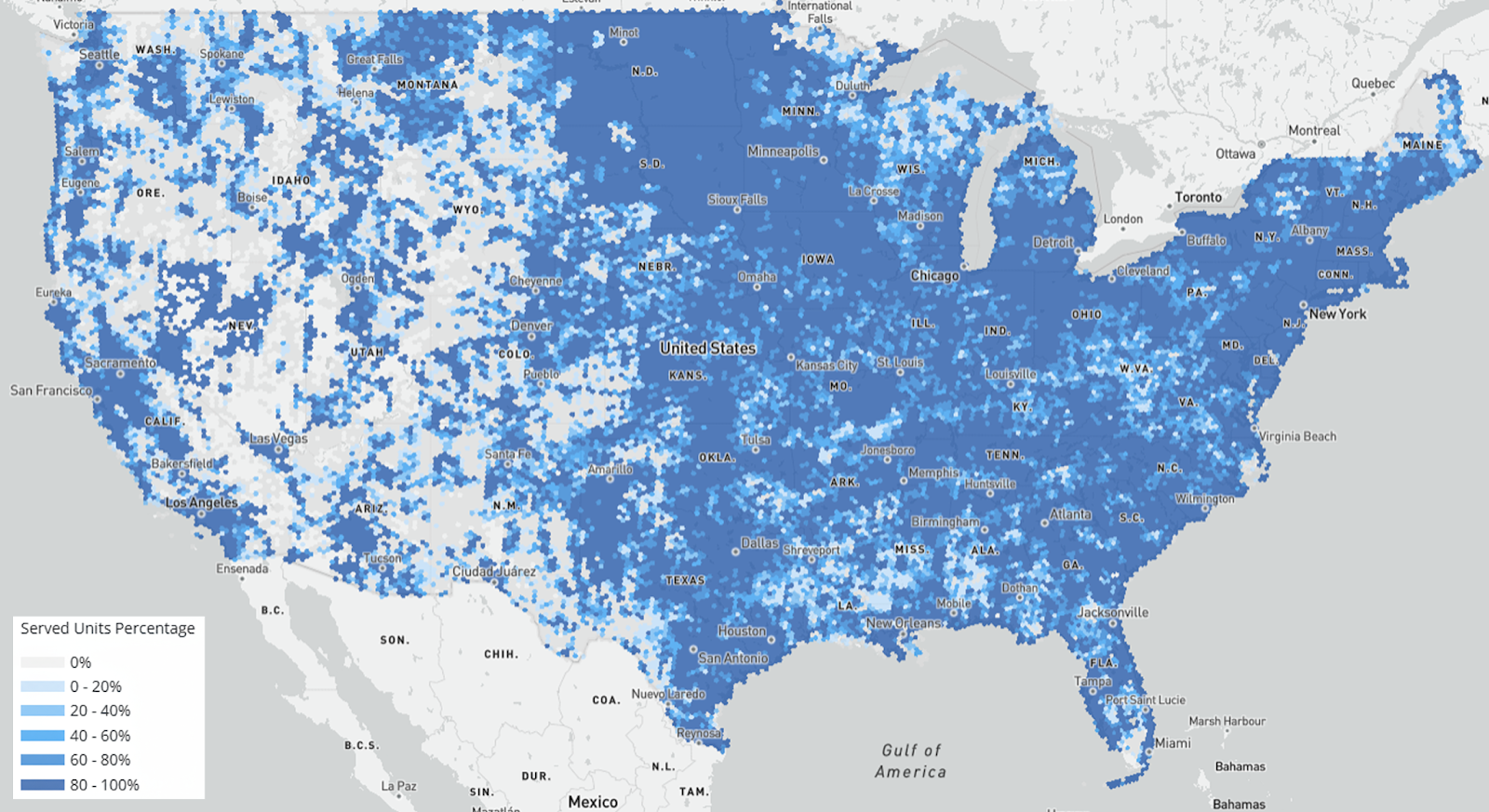
Screenshot from “FCC National Broadband Map,” Federal Communications Commission, December 31, 2024, broadbandmap.fcc.gov/home.
However, the availability of internet in an area does not guarantee quality of service, which is typically defined with respect to downlink and uplink throughput speeds. The Infrastructure Investment and Jobs Act of 2021 outlines requirements for “reliable broadband service,” categorizing areas as “unserved” if they have no broadband connectivity at all or have service less than 25/3 Mbps; and marked all areas with access to broadband service below 100/20 Mbps as “underserved.”3 These categories align with the FCC’s benchmark for broadband service at 100/20 Mbps with less than 100 milliseconds latency.4
Moreover, even when service is available, many users may still not subscribe to it. Cost of deployed service is consistently cited as a major driving factor inhibiting household connectivity, alongside lack of user interest and low digital skills.5 Despite recent gains in access and adoption, a small percentage of Americans still say that they do not use the internet at all—some because they are simply uninterested.6 This lack of interest can be associated with low digital skills, an area ripe for policy intervention where the United States is currently failing to act (for example, by instituting a framework for measuring digital skills rates or creating a federal digital upskilling program).7 While policy challenges remain to address all causes of the digital divide, technological advances embodied in LEO constellations have shrunk the scope of the problem by offering a new deployment method to reach the remaining unconnected.
LEO Satellite’s Role in Reaching the Remaining Unconnected
LEO satellites can aid digital divide efforts by helping address remaining deployment gaps and reducing the number of unserved and underserved households. LEO satellite systems rely on three main components—the satellite constellation, ground stations, and user terminals—to deliver internet services. Once a satellite constellation is launched, it can be recruited to provide internet service to any equipped area or household along its orbital path. While mountainous areas, tree canopies, and other geographic conditions may disrupt the necessary line-of-sight from ground terminals to LEO constellations, LEO satellite service remains uniquely equipped to reach many of the remaining unserved areas in the United States, especially rural, remote, and other hard-to-reach locations that are difficult to service through traditional terrestrial means. In addition, LEO satellites can provide improved speeds for areas that are underserved, such as those relying on relatively slow DSL service. By operating in the closest orbital range to Earth, low altitudes grant LEO systems the ability to deliver high-speed, low-latency service where capacity is available.
LEO systems’ potential to close deployment gaps has spurred projects to deliver broadband to unserved and underserved households. For example, public school districts are tapping into satellite connectivity to bring students online.8 In October 2020, the Ector County Independent School District in Texas became the first school district to pilot LEO satellite technology to help connect students to the internet.9 North Carolina launched a pilot program in 2021 using LEO satellites to support remote learning opportunities for students and educators. Tribal lands have also used LEO satellites to bring broadband to their communities. The remote Hoh Indian Reservation in Washington began using Starlink beta services in 2020, and in 2025, the Navajo Nation announced its own pilot to better connect five chapters. Several states, such as Alaska,10 Arizona,11 Maine,12 and Washington,13 are increasingly looking to LEO satellite technology to bring connectivity to rural and remote communities.
Working Internet ASAP: A Closer Look at Maine’s LEO Satellite Program
In October 2024, Maine Connectivity Authority (MCA) announced its Working Internet ASAP (WIA) program to bring internet connections to the remaining 1.5 percent—approximately 9,000 remote and rural homes—that have no access to any type of broadband service.14 The program aimed to provide those households with Starlink’s LEO satellite service by the end of 2025.
Under WIA, Maine purchased LEO satellite hardware in bulk and reserved network capacity to provide eligible households a near-immediate option for internet service while areas await connectivity projects funded by the Broadband Equity, Access, and Deployment (BEAD) program. For enrolled households, the MCA subsidized LEO hardware and installation support (which proved key to deployment, but is not covered by BEAD, the current major federal broadband deployment program). MCA also provided digital skills materials and partner information to facilitate service adoption. Rather than excluding those locations from future subsidy programs, MCA ensured program locations remain eligible for future terrestrial deployments funded by the BEAD program or would receive the same service offered by these future programs.15 In addition, MCA established provisions for reserving additional tranches of LEO network capacity for future connectivity under BEAD.
While the program has quickly rolled out internet connections to households with no other technology available, enrollments have been slow despite vigorous outreach efforts. Affordability remains a key barrier, with some eligible households declining service due to the $120 monthly cost. For those who did activate service, a majority of Maine Starlink users experience upload and download speeds that meet or exceed the state program requirements.
Maine’s WIA program offers valuable insight into how other state and federal programs can integrate emerging satellite technology to bridge the digital divide. WIA was able to rapidly deploy an internet connection option to those without any access while leaving itself the flexibility to scale both satellite and fiber connections. At the same time, the program maximized available funds while remaining aligned with federal deployment efforts. Indeed, MCA’s approach has helped inform connectivity plans in numerous other states.
However, lagging uptake signals that adoption must be incentivized in order to meaningfully bring everyone online. Although uptake in other areas of the country may vary—particularly since Maine, which has many vacation and second homes, may not be representative of the country as a whole—the overall trend still suggests that affordability remains a key barrier in satellite service adoption.
Considerations for Bridging the Digital Divide with LEO Satellites
All broadband solutions come with their own tradeoffs—service performance, capacity, outages and disruptions, cost and speed of deployment, and service affordability—that should be considered when choosing a solution to meet a community’s needs. Users can connect to the internet through wired connections (fiber-optic, coaxial cable, and DSL) or wireless connections (satellite, fixed wireless, and cellular service).16 Traditionally, fiber internet is seen as the gold standard for connectivity given its reliability, equipment longevity, high capacity, and potential to scale with demand. These features have led government programs to generally prioritize fiber deployment. However, the cost of deploying fiber can be high, especially in rural, hard-to-reach, and remote areas. Other connectivity methods, such as cable and cellular services, can offer fast speeds, but users are more likely to experience higher latency, service disruptions, or degradations, particularly during peak usage times. Older technologies, like DSL or Geostationary Earth Orbit (GEO) satellite internet, lag behind other forms of connectivity but have sometimes been the only solution available in an area.17
Recent satellite and launch technology advances have lowered costs of LEO system development and deployment, making the technology a viable option for broadband delivery. For U.S. policymakers determining if and how to best incorporate LEO satellites into state and federal broadband programs, we offer several key considerations in the following sections.
A. Speedy Deployment
LEO satellites require less on-the-ground infrastructure buildout than existing methods, which can result in speedy deployment in certain areas. Once a satellite constellation is launched and approved for commercial operation, it can be tapped to provide internet access to any area with the appropriate receiving terminals in view of supporting ground gateways. This means that LEO satellites can bring new households online without extensive route-by-route infrastructure deployments in the area. Where LEO satellite capacity is already available, service can be deployed to households relatively quickly with the installation of a user terminal. However, increasing the number of users a LEO system can serve while maintaining performance standards requires adding capacity to the network. This can be done by adding more satellites to the constellation or through satellite technology improvements.
For hard-to-reach and rural areas that would traditionally require extensive (and expensive) terrestrial buildout, LEO satellite service can be a faster, more cost-effective alternative. Unlike the cost model of a fiber build, in which very high up-front costs are incurred in return for decades of reliable service, LEO satellite operates on the premise that the significant fixed costs to launch a constellation will be offset by low marginal costs to add subscribers until the network’s capacity is reached. Since LEO satellites function as a single network constellation, the benefits and costs of increasing capacity are shared across the entire network rather than being location specific.18 On the other hand, technology upgrades and ongoing network maintenance costs are relatively more expensive for LEO systems (such as repeated replacement of individual satellites at the end of their lifespan—for Starlink, approximately five years) than for terrestrial networks. The fact that LEO systems typically have low up-front marginal costs, but higher operating expenditures, over long periods has significant implications for pricing and affordability, as well as how government subsidies are structured (discussed below).
This deployment structure also means that satellite providers’ cost models—and likely, in turn, the amount and form of subsidized deployment support they require—vary based on the location of the area intended to be served and the available capacity within the constellation network. However, true cost comparisons can be obscured by existing subsidies, which historically prioritized wireline (and recently fiber), that help networks cover the cost of delivering service to expensive-to-serve areas in order to lower the cost to the consumer. These subsidies can be directed at fixed deployments with ongoing support for operating expenditures (for example, the FCC’s High Cost program) or implicitly through affordability subsidies to users (for example, the federal Lifeline and the now-defunded Affordable Connectivity Program).19 While Starlink’s technology development, vertical integration, and growth has benefited enormously from U.S. government contracts, it does not receive Universal Service Fund (USF) subsidies for either deployment or operating costs, which makes apples-to-apples comparisons difficult.
B. Improving Performance
LEO satellite service performance continues to improve. Starlink, which is at present the only residential LEO satellite internet provider in the United States, has seen substantial improvements in performance since its initial launch in 2019. The FCC’s current benchmark for broadband service is 100/20 Mbps with less than 100 milliseconds latency.20 Starlink currently offers download speeds between 25 and 220 Mbps, with the claim that most users experience speeds over 100 Mbps and some users experience speeds as fast as 300 Mbps.21 Upload speeds are advertised between 5 and 20 Mbps. Starlink latency is listed between 25 and 60 milliseconds on land, with some remote areas experiencing latency of 100 milliseconds or more. While this range can meet the FCC’s reliable broadband service requirements, it means that Starlink’s service may not meet the standard consistently, in all areas, or for both fixed and mobile service. Starlink has previously struggled to meet these requirements, leading in part to the FCC’s 2022 decision to revoke its application for funding from the Rural Digital Opportunity Fund (RDOF), part of the USF’s High Cost program.22 Recent analysis shows that while users receive fast download speeds and low latency, which meets most modern internet user needs, lagging upload speeds mean only 17.4 percent of Starlink users are consistently getting broadband that meets FCC requirements.23
Improvements in satellite technology and increased satellites in orbit can improve LEO systems’ performance. Starlink has an application pending to launch a new generation of satellites that promise to reach gigabit speeds. At the same time, Kuiper, which is set to be fully operational in two years, claims its service will deliver speeds up to 400 Mbps for residential customers and up to 1 Gbps for commercial customers.24 Pending FCC rulemakings with proposals to increase the spectrum and transmit power for NGSO systems are likely to substantially enhance LEO capacity; this is discussed in Chapter I.
C. Capacity Challenges
Despite LEO satellite performance improvements, capacity remains its greatest challenge. Several factors can contribute to capacity constraints. Due to their orbital speed, a constellation of hundreds or thousands of LEO satellites is typically needed to provide consistent service to an area, with users connecting to a different satellite in a constellation every few minutes. Similarly, heavy traffic or oversubscription in a particular area can be detrimental to performance. Starlink has attempted to offset this challenge by charging hundreds of dollars in “congestion fees” to subscribers in heavily subscribed areas.25 In addition, insufficient numbers or proximity of the ground terminals and gateways that backhaul data traffic to and from the internet can limit a LEO system’s available capacity in a particular area. While LEO satellites may be able to reach most households, a LEO system does not have the capacity to serve all the locations it can reach. Indeed, a recent Vernonburg Group analysis found that Starlink has the capacity to serve only 26 percent of BEAD-eligible locations with broadband that reliably meets FCC performance standards (100/20 Mbps), which equates to less than seven eligible locations per square mile.26
Advances in technology are likely to mitigate some of these concerns: For example, LEO satellite providers are already able to use steerable beams to direct capacity to areas on a network that may be serving more users or experiencing a surge. Technological advancements, further constellation buildout, and pending FCC proposals to increase spectrum access and power levels are likely to boost LEO system capacity substantially in the near future. But for the time being, guaranteeing reliable broadband at the benchmark performance goal of 100/20 Mbps and less than 100 milliseconds of latency, particularly for all users in an area at once, remains a challenge.
D. Subscription Costs and Competition
Current LEO satellite subscription costs, while comparable to other rural provider costs, are still higher than the national average and may deter adoption. Starlink’s standard residential plan is priced at $120/month with a $349 fee for the standard hardware kit for advertised speeds up to 350+ Mbps download and 10–20 Mbps upload.27 Depending on location, users may face a one-time congestion fee—which in some states can be several hundreds dollars.28 These high up-front fees and monthly subscription prices will deter financially constrained consumers from subscribing. While Starlink recently debuted an $80 “residential lite” plan meant to offer an affordable alternative, the service offers slower speeds (advertised as reaching 45–130 Mbps download speeds and 10–20 Mbps upload speeds) and are deprioritized in favor of the full-cost home service. Starlink has offered promotional plans offering free consumer equipment, and most recently announced a $59/month-for-one-year promotional deal for new customers in certain areas—the cheapest satellite service that has been offered to consumers to date.29 Meanwhile, surveys show the national average for internet service ranges from $75–$90/month for packages that generally offer at least 100Mbps download speeds.30 Of course, it is generally the case that for those in rural areas, the types of internet services available—such as GEO satellite service—tend to be more costly on average, and more likely subject to congestion and monthly download limits. These problems have been ameliorated to some degree with LEO service, which offers a higher-quality user experience, but pricing concerns remain.
Moreover, one of the benefits of LEO satellite’s provision of broadband services is increased intermodal competition, which may eventually drive down prices for consumers. While Starlink has increased availability and access to internet service in many areas, satellite’s overall share of the broadband market is not yet large enough to put competitive pressure on most other internet service providers. However, it is unclear how and if other broadband providers will adapt to compete as more reliable, faster, and possibly lower-priced LEO satellite service becomes available. In particular, smaller telecommunications providers may have a harder time adjusting pricing than larger providers such as Starlink and Kuiper.
E. Targeted Use of LEO Satellite Service
LEO satellite broadband is promising, but it should be considered part of the connectivity toolkit rather than a standalone solution. Current LEO satellite capacity constraints should inform decisions for how, when, and to what degree to rely on it as a solution today. While capacity is likely to improve, LEO service’s potential trajectory implies scalability, which will reach some natural stopping point, rather than an unlimited ability to expand. While LEO systems may never be able to fully meet the needs of high-density urban and suburban areas (many of which are served by fiber), other communities, like those in remote and hard-to-reach areas, may find LEO systems to be their best option available for the foreseeable future. In other cases, LEO satellite service can serve as a stopgap measure or augment available connectivity for unserved and underserved areas. With 85 percent of Starlink consumers residing in rural areas, LEO broadband performance may still be an improvement in internet access—especially for the 11 percent of Starlink users who report they are first-time internet subscribers.31 LEO systems can also provide alternative methods for connectivity in areas or situations where existing solutions face heavy traffic or outages, providing supplemental broadband to city centers and major events, or in cases of disaster response.
LEO-based connectivity solutions are an emerging and constantly developing field, where existing challenges—such as performance, capacity, and price—may be relatively short-lived. The field has grown exponentially since Starlink first launched satellites in 2019, and policymakers should be cognizant of how ongoing developments of the field will impact the overall calculus of determining the viability, reliability, and cost-effectiveness of LEO broadband service. In the United States, Starlink is the only available residential broadband provider, but as Amazon’s Kuiper comes online in the United States during 2026, competition could increase, lowering prices or improving plans available to consumers. (See also Chapter II.) In addition, spectrum management decisions can also improve the efficiency and capacity of LEO systems.
The Existing Broadband Subsidy Landscape
Federal subsidy programs that help lower the cost of broadband are one important tool to help bring all households online. The FCC’s USF, which originally supported access to affordable phone service, has expanded to support the deployment of broadband infrastructure and provide subsidized services for low-income households, schools, libraries, and rural health care providers.32 In response to the COVID-19 pandemic, Congress established the Affordable Connectivity Program (ACP), a broadband subsidy program that defrayed the monthly cost of a broadband subscription for over 20 million households.33 Despite the program’s success and improved outcomes for participating households, ACP officially ended in May 2024 after Congress failed to renew funding, resulting in 23 million households losing support.34
Congress also dedicated $42.45 billion to the Broadband Equity, Access, and Deployment (BEAD) program.35 BEAD is the largest one-time federal investment in broadband infrastructure deployment to date, intended to finally close the infrastructure deployment gap to help bring remaining unconnected households online.
Of the programs working to address the digital divide in the United States, the vast majority of funding focuses on deployment of the necessary infrastructure to provide all households with access to broadband service. Today’s unserved and underserved households are largely those in hard-to-reach, rural, remote areas, and tribal lands. These “high-cost” areas often lack access because the necessary infrastructure for service is too expensive to build out or maintain.36 Cost challenges can result from geographic complexities, such as difficult terrains or long distances to households that require more materials and labor for deployment. If an area is sparsely populated, providers may determine there are not enough potential consumers to cover the cost of operating in the area, nor enough expected ongoing revenue to generate an adequate return. As a result, broadband access in these high-cost areas is often heavily subsidized, with government programs supporting both deployment and operating expenses.
Historically, these programs have prioritized terrestrial wireline technologies—most recently, fiber-optic cable—as the most reliable long-term technology. This can be seen in satellite’s general exclusion from the federal USF High Cost program that has long been the cornerstone for subsidizing access to broadband in the United States. Through much of these programs’ lifespan, the only commercially available satellite service relied on GEO satellites and was generally incapable of meeting many programmatic guidelines.37 More recently, LEO satellite providers have been allowed to participate in some universal service programs but have still faced concerns over the service’s ability to reliably meet programmatic performance benchmarks.38
LEO satellites were also initially deprioritized within BEAD. Following the congressional directive to subsidize technologies able to easily scale with growing needs, NTIA’s initial guidance prioritized mainly fiber-optic cable technology and lumped LEO service together with unlicensed fixed wireless as an “alternative” technology that could only be funded in areas where no other, more reliable technology was feasible.39 Early state bid results under the original program’s rules suggested that satellite service made up a fraction of many states’ final selections.40 Until very recently, LEO satellite service has been resoundingly passed over by a broadband policy landscape with an appetite for fiber.
A. The Turn Toward Tech Neutrality
In June 2025, with many states on the cusp of starting BEAD deployment through their selected providers, the Trump administration released new programmatic guidelines that required states to reopen the selection process and evaluate new bids on a more tech-neutral basis. In the guidelines, the Department of Commerce removed the end-to-end fiber preference and redirected the program to prioritize minimizing BEAD outlays per project so long as applicants meet some baseline quality standards.41 Many states have now revised their BEAD plans to incorporate LEO to varying degrees. Although NTIA approval is still pending, it appears that while some states have still found fiber-to-the-home to be the best solution in many locations, some are projecting significant reliance on satellite coverage (sometimes upward of 40 or 50 percent).42
The shift comes as satellite service quality and capacity have markedly improved since the RDOF era. The LEO satellite service offered (and ultimately rejected) as part of the 2020 RDOF reverse auction is not the same service that is offered today. Satellite technology has improved both in quality and in capacity. Starlink has upwards of 8,000 satellites already in orbit,43 and Amazon’s Kuiper has begun launching its own constellation.44 While LEO satellite service cannot match the performance of a fiber connection, it can typically meet or exceed the average consumer’s current daily needs.45 It also has some qualities—like resilience in the face of disasters and speed to deployment—that allow it to outperform terrestrial broadband in some head-to-head comparisons.46 In a handful of years, satellite technology has grown up, and it is now robust enough to compete as a home broadband provider in the traditionally fixed arena.
Setting priorities and acknowledging budgetary tradeoffs is even more necessary if the resources saved on deployment can be turned toward broadband adoption and affordability instead—each of which today is a comparatively larger cause of the digital divide.47 While satellite’s current capacity and quality constraints mean that it cannot serve as a stand-in for fiber or serve every area lacking broadband, the FCC has several proceedings pending to increase the amount of spectrum available and raise allowable power levels, intended to significantly increase satellite’s capacity and performance.48
The idea of a “tech neutral” broadband policy also becomes more relevant as we near the upward sweep of the broadband deployment cost curve. Infrastructure now covers much of the United States. Unserved areas are generally disproportionately expensive and difficult to reach, and even areas with gains in broadband infrastructure deployment may be confronted with a lack of competitive and affordable service options. Broadband deployment policies must take into account existing geographic, budgetary, and logistical constraints. And subsidy programs must evolve with the broadband landscape to incorporate new technologies as they emerge.
B. Fully Incorporating LEO Technology into the Current Subsidy Landscape
Given improvements in quality, the policy question has shifted from whether LEOs can play a role in bridging the digital divide to how that role should be structured. The current system incorporates LEO satellites and other technologies in some programs but not others. It counts satellite service as broadband in some circumstances but deems it insufficient in others. This patchwork of approaches is imbalanced, inefficient, and unsustainable.
If U.S. broadband policy requires the complex balancing of short-term results with long-term benefits—all done within the constraints of a budget—all viable technologies must be utilized where appropriate. As a general matter, so long as LEO satellite service normally meets the minimum 100/20 Mbps performance standard and provides generally functional broadband service to users, it should be eligible for all existing broadband subsidy programs. This would mark a true shift toward tech neutrality in both federal and state broadband policy by gating participation based on quality of service, not kind of technology.
Of course, such a shift would not entail using LEOs to fill in every remaining deployment gap. Instead, LEO satellite service should be eligible for all programs under fair programmatic guidelines that assess it (and other competing technologies) on the merits. This means that in cases where the highest and most reliable level of performance is key, or where the marginal cost of extending an existing wireline network is low, a fiber connection may win out over satellite. In scenarios where the cost of laying fiber would exceed the likely expected value of the investment relative to the performance and cost of satellite service, satellite service may be tapped to fill the gaps. A smart, forward-looking, and tech-neutral approach would mean remaining open to all viable forms of broadband and making choices based on the totality of circumstances (and being transparent in cases where certain criteria are prioritized above the rest).49
Like other kinds of broadband deployment, both the quality and price of service and efficiency of a satellite deployment should be considered when choosing among contenders for a subsidy program. Some of the most meaningful metrics to be assessed up front include the requested subsidy amount, the quality and longevity of proposed service, how well the service meets consumers’ needs, and the speed and cost to deployment. These metrics can be incorporated to varying degrees depending on the context of each individual deployment.
Challenges with Incorporating LEOs
There are also areas where satellite technology diverges from other technologies, and assessing them creates new challenges for policymakers grappling with LEO technology’s inclusion in existing programs.
A. Technical and Deployment-Related Challenges
Despite being relatively immune to some of the challenges faced by terrestrial broadband (such as geography and distance), LEO satellite providers do not enjoy an unfettered capacity to scale. Major restrictions on capacity include access to spectrum (and limitations on the use of that spectrum, such as coordination requirements and required power levels), topographical constraints (users must retain a clear view of the sky), permitting requirements and FCC restrictions on licensing ground infrastructure like earth station gateways, and the overall number of satellites in orbit, all of which are governed by various entities. Some of these restrictions mean that certain areas—such as crowded suburbs or urban canyons without a view of the sky—will likely never be able to rely on satellite service. Others, including spectrum access, power levels, and restrictions on earth station gateways used to backhaul data, will depend on a series of pending and future FCC rulemakings for a clear path forward.
These differences from traditional terrestrial networks also mean that the established method of subsidizing broadband deployment—which focuses on the marginal cost of location-specific infrastructure rather than the overall cost of adding capacity to an orbiting network—may need to be rethought. As noted above, reliance on satellite service must account for higher ongoing costs, including the regular replacement of satellites with more advanced capabilities, in return for a smaller marginal cost of deployment up front. For example, under USF, the FCC has historically relied on formulas that incorporate the up-front cost of deployment to determine High Cost funding awards. If satellite’s inclusion overly complicates this calculus, an alternative could be a general subsidy model that offers funding through installments contingent on outcomes (sustained service that meets minimum standards for a certain number of households) rather than being tied to specific kinds of expenditures, such as cost of deploying certain infrastructure.
In a similar vein, satellite deployment cannot be tracked through physical buildouts. While LEO networks have the potential to connect users almost anywhere, service is only actually transmitted to a location where a resident elects to subscribe. These differences in buildout and cost models complicate efforts to fit satellite connectivity into any subsidy program designed for terrestrial broadband, which is specifically place-based.
BEAD attempted to grapple with this by stipulating that grants to LEO providers be conditioned by requirements to maintain “reserved capacity” sufficient to ensure service to eligible (unserved) households for a period of time. The program rules also require that free consumer premises equipment (CPE) be included as part of the services and allow program administrators to reimburse satellite providers on the basis of adoption metrics.50 Since BEAD-funded deployments are only a slice of total satellite coverage, this has led to a paradoxical outcome in which only previously unserved households served by LEO providers funded through BEAD will be considered served. At the same time, only some LEO users receive free CPE, while others have to pay for it themselves, regardless of their relative income levels.
B. Market Structure Challenges
LEO satellite’s market structure diverges sharply from that of other providers (see Chapter II). While the emergence of satellite connectivity as a whole adds more robust competition to the total marketplace of broadband providers, there is a near-monopoly within the satellite connectivity space itself, with only one active residential provider and another still months away from offering service. This problem may be gradually solving itself: Kuiper has already won bids to serve a substantial number of locations in states’ proposed BEAD plans and will be in default if its residential service fails to materialize in those areas. However, the general lack of competition and adequate capacity is putting upward pressure on prices that threatens to raise the monthly cost of service and deter the very households that subsidy programs aim to help get online.
So long as network capacity remains constrained and demand exceeds supply in many areas, providers may charge higher monthly rates and use fees to control the flow of subscribers in particular areas. Put another way, LEO satellite service is nearly ubiquitous, but the number of subscribers that can be served in each local area is limited, leading providers to discourage uptake through their fee structure in areas that are already well-subscribed.51 Consumers in those areas with no other technology available may have no choice but to pay or to go without connectivity altogether.
The consumer market is fraught as well. Recipients of Starlink’s residential service have been paying $120/month for regular service in addition to hundreds in up-front fees and consumer equipment.52 These same consumers are excluded from consumer-side subsidy programs if their provider is ineligible for participation, and satellite providers have no real obligation to offer an affordable basic plan that still meets broadband benchmarks. Professional installation of CPE is not always included with the subscription, and the technically challenging installation can stymie consumers left to do it themselves.
Even addressing these financial barriers may not be enough. Maine’s pilot program saw relatively low participation despite offering Starlink to unserved households with free CPE and installation included.53 For a subsidy program to have any chance of success, widespread adoption needs to be reasonably guaranteed, and it remains at best unclear whether LEO satellite service providers can inspire widespread public interest and overcome adoption barriers to make that claim.
C. Policy Challenges
Like other wireless technologies, both LEO satellite’s sustainability and its improvement in capacity and overall performance are contingent on steady and increasing access to spectrum, permission to function at the necessary power levels, and a reasonably predictable trajectory for both. Indeed, Starlink’s application for a far larger constellation of new satellites with enhanced capabilities is pending approval at the FCC, as are multiple regulatory proceedings that would give them the access to the spectrum and higher transmit power levels they need. This means that LEO service’s ability to scale is somewhat out of the hands of service providers or NTIA. Instead, the FCC’s spectrum decisions will play a significant role in determining satellite’s future advances.
In addition to spectrum availability, satellite deployment comes with some necessary infrastructure buildouts that may face barriers of their own. For example, restrictions on building earth station gateways (which connect satellite constellations to terrestrial internet infrastructure) close to urban areas or even major roadways can limit or impede the expansion of satellite service capacity in certain zones. Satellite providers trying to expand service must navigate both federal licensing and local permitting restrictions.54
State broadband offices and similar local decision makers tasked with dispensing funding may be less versed in determining whether a satellite provider’s promises are feasible than those of a terrestrial provider, especially because some of those advances hinge on federal decision-making with an opaque or uncertain trajectory. Nevertheless, it remains important to verify up-front that bidders in deployment programs have the technical ability, finances, and capacity to pull off programmatic commitments. While the recent BEAD guidelines put the onus of verifying technical capacity on NTIA, expecting state broadband offices to navigate a world of LEO satellite-as-broadband service over the long term, without full ability to vet providers themselves, is an unsustainable solution.
This is not the only policy challenge satellite service faces. Mapping satellite deployment is also unexplored terrain since there are no fixed deployments to track: A satellite operator’s ability to service an area is dependent on whether consumer uptake in other regions justifies the capital expenditure to expand the constellation’s capacity, which is shared by the network as a whole. This is a problem that federal and state programs have largely ignored, resulting in an incoherent landscape where current maps classify households with LEO service as unserved, even as those very providers remain eligible to receive the BEAD funding meant to expand home broadband coverage. One option that could provide transparency and policy-relevant information is to map available capacity across geographic units that are, for example, roughly comparable to the coverage area of a LEO satellite transmission beam. This would highlight potential congestion and, in aggregate, illuminate the degree to which the operator needs to expand overall network capacity to meet both its obligations and growing demand.
Subsidy programs—and the federal, state, and local governments that dispense funding—may also be charged with assessing the benefits of their programs beyond infrastructural buildout. For any form of connectivity including satellite service, these benefits can include improved access to services like health care and education, as well as job creation related to the deployment itself.55 Though the deployment of a satellite network does not generally directly create local jobs to the same degree as a fiber network, the existence of ground infrastructure such as points of presence (earth station gateways for fiber backhaul) means that there are some direct workforce benefits to satellite deployment as well. These benefits may just be less uniformly localized. To the degree policy programs seek to ensure these ancillary benefits of broadband buildouts as well, satellite’s return on investment can be harder to track.
Recommendations
Rather than the current piecemeal approach that gates satellite’s participation in some programs but not others, U.S. broadband subsidy programs need an overhaul that equips program administrators to rigorously evaluate technologies on the merits, allows LEO satellite service to compete, and maximizes the service quality for consumers. This can be achieved through both short-term and long-term changes.
Short-Term Recommendations
Since satellite inclusion across subsidy programs is not standardized, the most immediate issue at hand is to ensure satellite broadband service is integrated and standardized as an option in all relevant federal and state broadband access and affordability programs, including any future USF High Cost program. This means standardizing service quality expectations and broadband performance benchmarks across all programs and data collection (such as through the FCC’s regular data collecting and reporting). Subsidy programs will also need to be adjusted to accommodate the differences in LEO satellite service’s underlying cost and deployment models.
1. Adjust Programs to Require and Track Satellite Service Commitments
First, policymakers should determine the necessary metrics and reporting required to ascertain whether satellite providers are satisfying the terms of their bid agreements without harming existing customers. This can be done by verifying reserved capacity for a period of time, but policymakers must be cognizant of the fact that requiring operators to hold too much capacity in reserve—in effect, leaving it fallow—may ultimately lead to other customers being denied service or charged higher prices. At the same time, satellite service quality may be variable depending on a network’s overall capacity, the number of customers in a given area, and other factors, leading to consumers of the same service potentially encountering a significantly different user experience. While all technologies suffer quality dips at times, the risk is significant with satellite, and program managers funding LEO providers to serve an area should vet its quality over time accordingly. More generally, policymakers should also collect data to better understand satellite’s viability as a high-speed broadband solution, including practical considerations and potential constraints.
As long as a LEO operator can provide evidence that it will follow through on its commitments—and, for example, has a history and technical expertise that suggest it will be able to perform—program administrators should require a sufficient, but not excessive, amount of capacity in reserve. It should be the responsibility of the provider to ensure compliance with deployment commitments. These agreements should provide for enforcement actions in cases where operators fail to follow through. These kinds of metrics should be standardized and applied uniformly across programs, and program administrators should be given the tools to verify them. NTIA should offer some basic instruction on vetting and verifying satellite providers’ capacity to serve an area to interested state offices.
2. Subsidize All the Necessary Infrastructure
Second, programs should ensure the necessary consumer education, free or subsidized CPE, and optional professional installation of household equipment. These steps of a satellite deployment are just as critical as the final stages of a terrestrial deployment and are particularly important for satellite service, since the terminal (receiver) is mounted outdoors. Traditional programs subsidize wireline fiber or cable up until the point where the consumer plugs in their home Wi-Fi router. Similarly, for satellite deployments, professional installation of the terminal and necessary wiring—which can be particularly technically challenging given the need for the terminal to maintain line of sight to the sky—should be included in the bidding process for any subsidy program. Basic customer service and technical support are particularly important for new satellite subscribers, but they should be considered as technology-neutral conditions that apply to all subsidized providers.
3. Adjust the Application Process to Accommodate LEO Providers
The application process should be adjusted to better facilitate LEO participation. As global providers that offer nationwide service, LEO providers are disadvantaged by application processes that involve duplicative submissions for small geographic areas, and stakeholders are often not well-positioned to evaluate the many facets of their applications through a process designed for terrestrial providers with discrete deployment zones. Policymakers should determine the specific information that LEO providers must offer as part of their applications, which may include the projected uptake of the service by eligible users, current and planned capacity, and policies concerning any guarantees or prioritization of the basic level of service being subsidized. In addition, policymakers should standardize a format that allows bidders to easily provide all the necessary application information relevant to satellite service. For example, this may include aggregating bids for individual geographic areas. At the same time, program administrators should be given the opportunity to assess a provider’s claims based on its total capacity and planned service across the country, since service continues across county and state lines.
Long-Term Recommendations
The broadband policy landscape no longer reflects either the causes or the potential solutions to the digital divide. This needs to change.
1. Use LEO Connectivity Where Appropriate as a Broadband Solution and Assess Its Potential Across Other Sectors
LEO connectivity is one tool out of many to close the digital divide. Incorporating LEO satellite service into the existing broadband landscape means using it where it makes sense—in otherwise high-cost, low-density areas—rather than attempting to shoehorn it in as the solution in every scenario. While policymakers should give it a fair shot, the end goal should be to create a competitively neutral process that matches consumers with the technologies that make sense for them. At the same time, policy decisions should enable satellite’s growth and ability to serve locations. For example, since a limiting factor in LEO satellite providers’ capacity to serve customers is access to spectrum, the FCC should make opening up more spectrum or creating additional sharing frameworks in existing bands a priority (see Chapter II).
In addition to broadband coverage, the FCC should study and seek to promote, where appropriate, the integration of satellite connectivity into other areas, such as direct-to-device services (see Chapter I), community networks using hotspots, backhaul (which is complicated by restrictions around earth stations in urban areas), and facilities-based VoIP (which would include adhering to the FCC’s stringent public safety requirements, such as offering enhanced 911 emergency calling capabilities, direct PSAP access, and automated dispatchable location requirements). As direct-to-cell services, such as those offered through the Starlink and T-Mobile partnership, proliferate and in some contexts replace standard telephone services, satellite providers will need to provide the same degree of public safety and certainty as their terrestrial precursors.
2. Ensure LEO Service Is Eligible for Any Future Deployment Programs
On the deployment side, any future High Cost programs that fund buildouts or operational expenses in high-cost areas should include LEO satellite service alongside any other technologies that reliably meet minimum performance standards. This is the only way to enact a truly balanced approach to deployment policy that treats all technologies as potentially viable tools. Additional support for satellite technology could help defray the high costs faced by consumers today and ensure future upgrades to the service. As satellite service becomes more common as a connectivity solution, subsidy programs may also need to adjust to match its unique cost structure. With advances in satellite technology and BEAD’s promise to finish deployment across the country, there is good reason to anticipate that high up-front deployment costs may become a thing of the past and future High Cost and any similar deployment programs should shift significantly to funding operational expenses instead (or otherwise defraying ongoing costs that are passed to consumers through subscription prices).
3. Include LEO Satellite Service in All Current and Future Affordability Programs
LEO satellite service generally imposes higher prices on consumers (particularly through its additional up-front fees) in return for widely available service, and it is not currently eligible for consumer-side subsidies.56 At least for the time being, even Starlink’s low-cost option ($80) is pricier than the low-cost options offered by many other national providers.57 Nor does it account for the one-time equipment and potential congestion fees.
LEO satellite should be incorporated into a broader affordability program that accounts for both and brings subscription prices down to the level that households can afford. If a technology provides service that qualifies for participation in deployment programs for unserved and underserved communities, it should be eligible for affordability support as well—if not as a fully designated eligible telecommunications carrier, then at least through a limited process that allows it to participate in affordability programs, which is what the government did for ACP. More widespread use of LEO satellite service may warrant higher monthly affordability subsidies, as the current amount given to households through the Lifeline program—approximately $10—would not, if applied to satellite providers, bring the service to a level comparable to other offerings.
In a truly tech-neutral landscape—one with a diverse set of technologies with varying cost models—the most competitively neutral and efficient means of subsidizing technologies long-term may be to defray costs on the user side with vouchers or credits. These subsidies could be determined on the basis of need, with amounts calculated based on consumer income and the cost of serving a location. Participating providers could then recoup ongoing costs by acquiring and retaining users based on service quality and competitive subscription prices. The subsidies could be portable to allow consumers to switch if another provider could better meet their needs.
4. Develop a New Mapping Process That Incorporates Satellite Coverage
The FCC should also look to modernize mapping and data collection to be more inclusive of satellite’s reach. Right now, LEO satellite service is available almost everywhere, but not everywhere all at once. There are no current, comprehensive broadband maps that accurately show its true availability, particularly with respect to the capacity available in particular communities. As states create and refine individual maps of their territories based on BEAD bids—indeed, the most accurate and granular maps yet—NTIA and the FCC should plan to reintegrate those maps into one nationwide picture. But these maps as well fail to accurately capture the full coverage of satellite service.
At a certain point, policymakers should consider moving beyond static mapping altogether in favor of another method that better captures all forms of broadband coverage and correctly identifies gaps. For example, a form of mapping that incorporates wireless signal propagation and reflects the impact of terrain and other physical obstructions (e.g., heavy tree cover) could better show a satellite service’s true availability and performance level. A mapping technique that accounted for a constellation’s overall capacity and showed how many households in an area could be served would depict satellite’s actual availability rather than marking it as feasible almost anywhere, as the current FCC maps do. An overlay that incorporated satellite service and other less easily tracked services, such as fixed wireless, could be used to verify unserved areas and indicate whether those areas were in need of a fixed broadband deployment or whether another form of broadband was available.
Citations
- Rafi Goldberg, “New NTIA Data Show 13 Million More Internet Users in the U.S. in 2023 than 2021,” National Telecommunications and Information Administration, June 6, 2024, source.
- “FCC Increases Broadband Speed Benchmark,” Federal Communications Commission, March 14, 2024, source; Federal Communications Commission, Inquiry Concerning the Deployment of Advanced Telecommunications Capability to All Americans in a Reasonable and Timely Fashion, 2024 Section 706 Report, GN Docket No. 22-270 (rel. March 14, 2024), source.
- Infrastructure Investment and Jobs Act, H.R. 3684, 117th Cong. (2021), source. In the original BEAD guidance released in January 2024, BEAD did not include LEO satellite broadband as a “reliable broadband service” but instead as an alternative technology. The latest guidance eliminated distinctions between fiber, other reliable broadband services, and alternative technologies. See “Reliable Broadband Service & Alternative Technologies Guidance,” National Telecommunications and Information Administration, January 2024, source; see also “BEAD Restructuring Policy Notice,” National Telecommunication and Information Administration, June 6, 2025, source.
- “FCC Increases Broadband Speed Benchmark,” Federal Communications Commission, source.
- Anna Read, “How Can the United States Address Broadband Affordability?,” Pew, April 29, 2022, source; Michelle Cao and Rafi Goldberg, “New Analysis Shows Offline Households Are Willing to Pay $10-a-Month on Average for Home Internet Service, Though Three in Four Say Any Cost Is Too Much,” National Telecommunications and information Administration, October 6, 2022, source; Jessica Dine, The Digital Inclusion Outlook: What It Looks Like and Where It’s Lacking (Information Technology and Innovation Foundation, 2023), source; NTIA Data Explorer, “Main Reason Not Online at Home: Too Expensive,” National Telecommunications and Information Administration, June 6, 2024, source; NTIA Data Explorer, “Main Reason Not Online at Home: Don’t Need or Not Interested,” National Telecommunications and Information Administration, June 6, 2024, source.
- Rafi Goldberg, “New NTIA Data Show 13 Million More Internet Users in the U.S. in 2023 than 2021,” source; Andrew Perrin and Sara Atske, “7% of Americans Don’t Use the Internet. Who Are They?,” Pew Research Center, April 2, 2021, source.
- Jessica Dine, Exploring Paths to a U.S. Digital Skills Framework (and Why We Need One), 52nd Research Conference on Communications, Information, and Internet Policy (Open Technology Institute at New America, 2024), source.
- David Ingram, Kailani Koenig, and Cal Perry, “Elon Musk’s Satellite Internet Flies under the Radar at Public Schools Nationwide,” NBC News, February 2, 2022, source.
- Mike Adkins, “ECISD Becomes First School District to Utilize SpaceX Satellites to Provide Internet for Students,” Ector County Independent School System, October 20, 2020, source.
- “OneWeb Joins Connecting Alaska Consortium in Strategic Partnership to Connect Alaska’s Tribes and Villages,” Eutelsat OneWeb, June 7, 2023, source.
- Melissa Sevigny, “Tuba City Households Get Starlink Internet Pilot Program,” KNAU, June 14, 2021, source.
- Ari Bertenthal, “Maine to Hand Out Free Starlink Terminals to Unserved,” Broadband Breakfast, October 17, 2024, source.
- Low Earth Orbit (LEO) Satellite Feasibility Report (Washington State Department of Commerce, December 2023), source.
- “New State Program to Provide Internet Connectivity to Maine Homes and Businesses with No Current Option” Maine Connectivity Authority, October 14, 2024, source; “Working Internet ASAP (WIA),” Maine Connectivity Authority, source.
- “WIA FAQ External,” Maine Connectivity Authority, source.
- David Anders and Sean Jackson, “Home Internet 101: Which Internet Connection Is the Best?” CNET, July 12, 2025, source.
- Kate Fann, “DSL v Fiber v Cable: What’s the Best Wired Internet?” Broadband Now, August 1, 2025, source; “Exploring the Evolution of Satellite Communications–from GEO to LEO,” Reliasat, January 26, 2024, source.
- “Large Constellations of Low-Altitude Satellites: A Primer,” Congressional Budget Office, May 2023, source.
- “High Cost,” Universal Service Administrative Co., source; “Affordable Connectivity Program & Lifeline FAQ,” Federal Communications Commission, source.
- “FCC Increases Broadband Speed Benchmark,” Federal Communications Commission, source.
- “Starlink Specifications,” Starlink, source.
- “FCC Rejects Applications of LTD Broadband and Starlink for Rural Digital Opportunity Fund Subsidies,” Federal Communication Commission, August 10, 2022, source; Federal Communications Commission, Rural Digital Opportunity Fund Auction, Order on Reconsideration, WC Docket No. 19-126 (rel. Aug. 30, 2024).
- Sue Marek, “Starlink’s U.S. Performance Is on the Rise, Making It a Viable Option for Broadband in Some States,” Ookla, June 10, 2025, source.
- Thomas Konstamm, “Everything You Need to Know About Project Kuiper, Amazon’s Broadband Network,” Amazon, June 3, 2025, source.
- Michael Kan, “Starlink Imposes Eye-Popping ‘Demand Surcharge’ for New Sign-Ups in this State,” PCMag, June 20, 2025, source.
- “What Percentage of BEAD Eligible Locations Can LEO Satellite Providers Serve at Scale?,” Vernonburg Group, August 7, 2025, source.
- “Starlink Residential,” Starlink, source.
- Michael Kan, “Starlink Imposes Eye-Popping ‘Demand Surcharge’ for New Sign-Ups in this State,” PCMag, June 20, 2025, source; Michael Kan, “SpaceX Increases Starlink Congestion Charge in Several U.S. Cities,” PCMag, April 22, 2025, source; Andreas Rivera, “Starlink Begins Charging an Extra $500 to $1000 in High Demand Areas,” SatelliteInternet.com, July 1, 2025, source.
- Michael Kan, “Starlink for Only $59 Per Month? SpaceX Offers Cheapest Satellite Deal Yet,” PCMag, September 12, 2025, source.
- Camryn Smith, “Internet Costs About $76 a month,” All Connect, September 8, 2025, source; Bobbi Dempsey, “Internet Service Provider Cost and Speed Report,” U.S. News & World Report, April 2, 2024, source.
- Masha Abrarinova, “Starlink Outshines Cable in Reliable Service with Mostly Rural Footprint,” Fierce Network, August 19, 2024, source.
- Sarah Forland and Raza Panjwani, What is the Universal Service Fund? (Open Technology Institute at New America, 2024), source.
- Infrastructure Investment and Jobs Act, H.R. 3684, 117th Cong. (2021) source; “Support for the Affordable Connectivity Program,” New America, September 6, 2023, source.
- Brian Fung, “FCC Ends Affordable Internet Program Due to Lack of Funds,” CNN, May 31, 2024, source; “FCC Brings Affordable Connectivity Program to a Close,” Federal Communications Commission, May 31, 2024, source.
- “Broadband Equity and Access Deployment Program,” National Telecommunications and Information Administration, source.
- “BEAD Allocation Methodology,” National Telecommunications and Information Administration, source. According to the NTIA, high-cost areas are “areas where at least 80 percent of the locations are unserved, and in which the cost of building out broadband service is higher than the average for all such unserved areas.” NTIA calculates the cost of serving an area by looking at factors such as (1) topography, (2) remoteness, (3) population density, and (4) poverty.”
- Nathan Smith, “Lessons from RDOF for BEAD,” Connected Nation, April 30, 2025, source.
- See, for example, Jason Rainbow, “FCC Upholds Denial of Starlink’s 900 Million Rural Broadband Subsidies,” SpaceNews, December 13, 2023, source. As noted above, LEO reliability in meeting the necessary benchmarks is impacted by multiple factors. As a consequence, the FCC reversed the awards to Starlink following post-auction review.
- “Final Guidance for BEAD Funding of Alternative Broadband Technology,” National Telecommunications and Information Administration, January 2, 2025, source.
- Kevin Taglang, “What Do We Know About LEO BEAD Bids,” Benton Institute for Broadband & Society, June 12, 2025, source.
- In addition to submitting the lowest bid, LEO satellite applicants are generally required to demonstrate that they have sufficient network capacity to deliver high-speed connectivity to all unserved and underserved locations within the proposed funding area, as well as a credible plan to scale capacity in line with future demand. Moreover, state broadband offices retain discretion to select among bidders when proposed costs are within 15 percent of each other. See “BEAD Restructuring Policy Notice,” National Telecommunication and Information Administration, June 6, 2025, source; see also Jessica Dine, “Thanks to New Guidance, We’re Pouring Billions into a Broadband Program That’s Doomed to Fail,” Newsweek, June 20, 2025, source.
- “Planned BEAD Awards,” Broadband Breakfast, September 4, 2025, source.
- Tereza Pultarova, “Starlink Satellites: Facts, Tracking, and Impact on Astronomy,” Space.com, August 1, 2025, source.
- “Kuiper Mission Updates,” Amazon, accessed on August 29, 2025, source.
- Proponents argue that fiber offers sufficient bandwidth to the home to make it “future proof” against any increase in consumer demand (such as increased reliance on video-streaming applications or telemedicine). This must be weighed against the much greater time and expense needed to deploy fiber, the continuing expense of supporting fiber-network operating expenses with a small and dispersed customer base, and the expectation that satellite capability will continue to improve over time.
- “Starlink for Emergency Response,” Starlink, source.
- Jessica Dine, The Digital Inclusion Outlook: What it Looks Like and Where It’s Lacking, source.
- See, for example, Federal Communications Commission, Satellite Spectrum Abundance, Further Notice of Proposed Rulemaking and Notice Of Proposed Rulemaking, SB Docket No. 25-180 (rel. May 27, 2025), source; Federal Communications Commission, Modernizing Spectrum Sharing for Satellite Broadband, Notice of Proposed Rulemaking, SB Docket No. 25-157 (rel. Apr. 29, 2025), source.
- Jessica Dine, “So You Want BEAD to Be Tech Neutral?,” Open Technology Institute at New America, March 21, 2025, source.
- “BEAD Restructuring Policy Notice,” National Telecommunication and Information Administration, 2025.
- Cameron Marx, “Starlink Imposes $750 Surcharge on New Customers in Major Northwestern Cities,” Broadband Breakfast, June 23, 2025, source.
- “Service Plans,” Starlink, source.
- “Working Internet ASAP (WIA),” source.
- “Overview of Earth Station Licensing and License Contents,” Federal Communications Commission, updated December 7, 2023, source.
- Wolfgang Briglauer, Jan Krämer, and Nicole Palan, “Socioeconomic Benefits of High-Speed Broadband Availability and Service Adoption: A Survey,” Telecommunications Policy 48 (August 2024), source; Jessica Dine, Enabling Equity: Why Universal Broadband Access Rates Matter, (Information Technology and Innovation Foundation, 2023), source.
- While LEO satellite plans are often cited as imposing comparatively higher costs on consumers, it is important to note that rural-broadband pricing more broadly tends to exceed suburban and urban benchmarks. Many smaller fiber and fixed wireless ISPs in rural markets charge rates at or above LEO entry points. See, for example, “Pricing & Service Offerings,” NEK Broadband, source (lowest residential tier $80/month, excluding fees); “Service Plans,” CVFiber, source. National surveys of broadband pricing frequently rely on plan data from large ISPs and may not capture the pricing practices of the 2,000–3,000 smaller ISPs serving rural areas.
- See, for example, “Internet Essentials,” Xfinity, source (“Internet Essentials provides affordable home Internet for qualifying households ($14.95/month for up to 75 Mbps, or $29.95/month for up to 100 Mbps)—as well as low-cost computers, free WiFi hotspots, and free Internet training.”).
More About the Authors

Michael Calabrese
Director, Wireless Future, New America; Senior Advisor, Technology & Democracy, New America
Kristian Stout
Director of Innovation Policy, International Center for Law & Economics

Gerald Adams
George Sharswood Fellow, University of Pennsylvania Carey Law School

Jessica Dine
Policy Analyst, Open Technology Institute and Wireless Future, New America

Sarah Forland
Policy Analyst, Open Technology Institute, New America