
Table of Contents
Remote Learning and Digital Access
Remote Learning
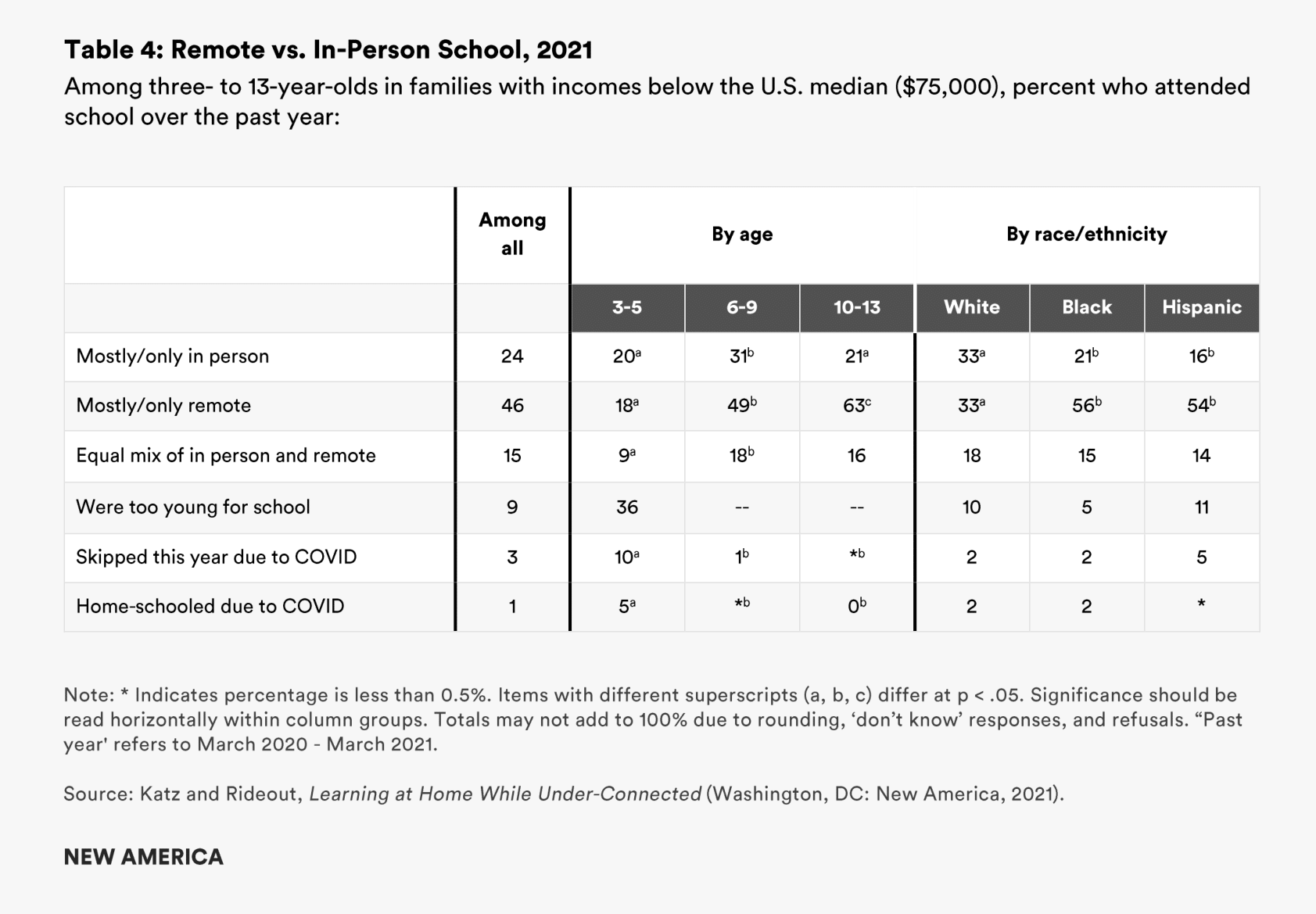
Nearly half (46 percent) of parents reported that their child had attended school either “mostly” or only remotely since March 2020, a quarter (24 percent) had attended mostly or only in-person, and 15 percent reported an equal mix of in-person and remote learning. The remainder were too young for school, skipped this school year due to the pandemic, or were being formally home-schooled due to the pandemic (see Table 4).
The likelihood of attending school remotely versus in person did not differ significantly by poverty status, or (among Hispanics) by immigrant generation. There were, however, significant differences by race/ethnicity, with majorities of Black children (56 percent) and Hispanic children (54 percent) attending school primarily remotely, compared with one-third (33 percent) of White children.
Many of the youngest children in lower-income families missed a year of or kindergarten due to the pandemic, with parents choosing either not to enroll them at all, or to homeschool them for the year instead. Ten percent of children who would normally have been in or kindergarten skipped school entirely due to COVID, and an additional 5 percent were home-schooled by their parents because of COVID (children who are normally home-schooled were excluded from the survey).
Even students who were enrolled in school during the pandemic –whether remotely or in person –ended up missing large chunks of school, a measure of COVID’s broad, disruptive impact on children. Among those in kindergarten or elementary school grades, 23 percent had missed two or more weeks of school for some reason during the pandemic. The likelihood of having missed weeks of school was even higher among children with special needs (37 percent, vs. 18 percent of those without special needs) and disproportionately reported by parents raising children on incomes below the federal poverty line. Thirty percent of these children missed at least two weeks of school, compared with 19 percent of those reporting incomes above the poverty line, but still below the median household income.
Remote Learning Interruptions Due to Being Under-connected
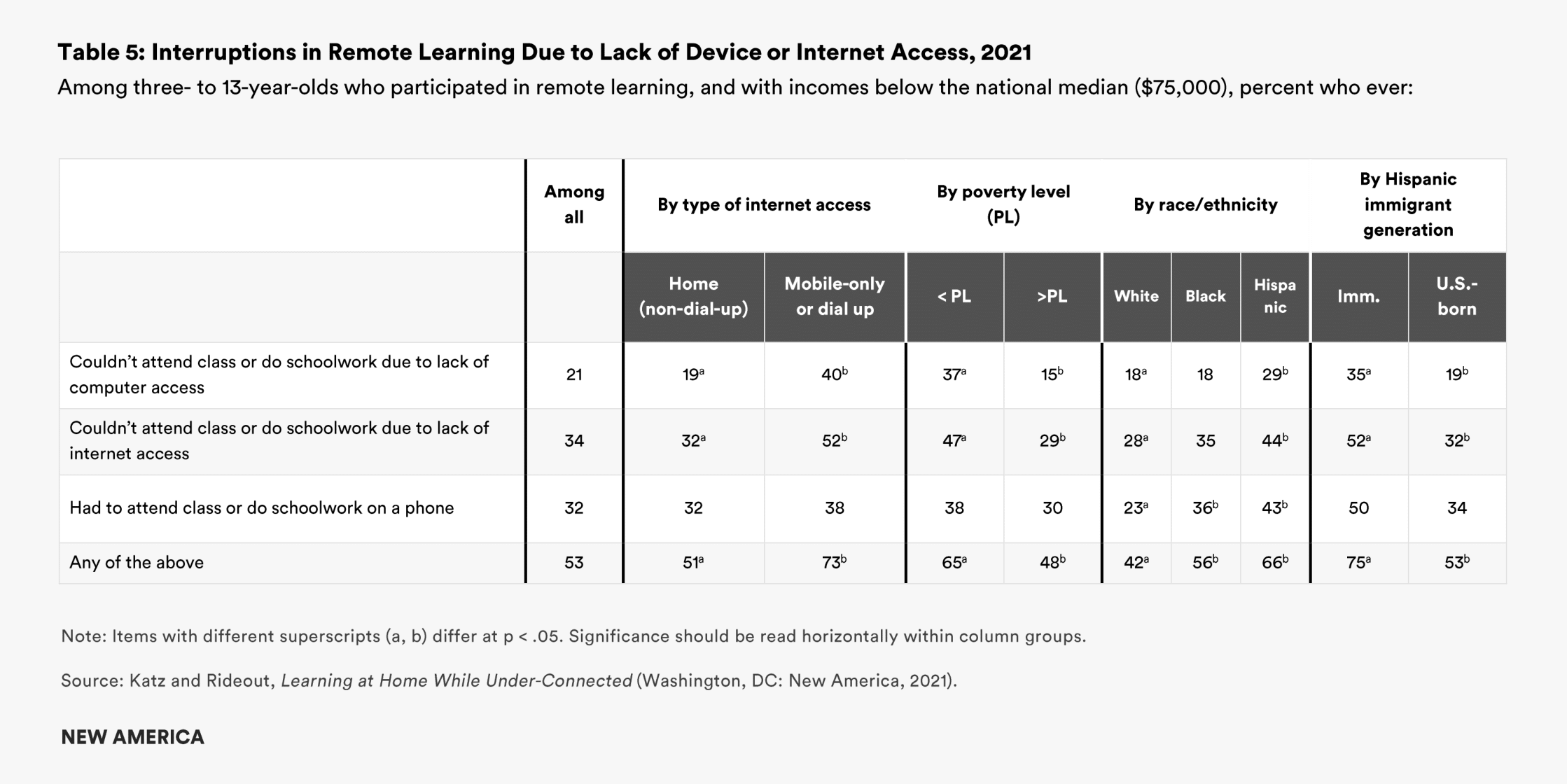
Roughly half (53 percent) of parents reported that their children had not been able to attend school remotely at some point during the past year due to being under-connected. About one-third of students were unable to participate in class or complete their schoolwork due to a lack of internet access (34 percent), and a similar number (32 percent) had to participate on a cell phone for some period of time. One in five students (21 percent) were unable to participate in school or finish their schoolwork at some point because they could not access a computer (see Table 5).
These measures clearly show how type and quality of internet access affects students’ school participation. Among parents with mobile-only or dial-up internet, half (52 percent) said their lack of internet access prevented their children from participating or completing their work at some point over the past year, compared with 32 percent of families with home broadband access.
Although youth without broadband were significantly more likely to experience schooling disruptions during the pandemic than youth with broadband, it is startling that so many students with broadband also experienced such disruptions (32 percent, as mentioned above). This highlights the importance of underconnectivity even among those with internet and internet-capable devices. Similarly, our results suggest that computer ownership alone did not prevent device-related schooling disruptions. Of course it makes sense that 34 percent of students without a computer at home couldn’t participate or do their required schoolwork because of their lack of a computer. But even among those with a computer, 20 percent sometimes couldn’t participate in school or complete schoolwork because they couldn’t access the computer, that is, because they were under-connected despite owning the device.
The challenges of remote learning hit the lowest-income families and families of color hardest. About two-thirds (65 percent) of families with incomes below the federal poverty level either reported times when they could not participate in class or do their schoolwork due to a lack of computer or internet access, or when they had had to participate via smartphone. Among families with incomes above the poverty line, a smaller but still very high percentage (48 percent) experienced these disruptions. Majorities of Hispanic (66 percent) and Black (56 percent) students also felt the impact of these obstacles to their remote learning participation, as compared with 42 percent of White students. And among families headed by immigrant Hispanics, fully 75 percent experienced these disruptions, with lack of internet access being the most common reason (52 percent) that students were unable to attend school or do their schoolwork.
Examples of Helpful Remote Learning Tools
A small subset of respondents whose children attended school remotely were asked to give examples of any apps or online programs their child used for school during the past year that “helped their learning a lot.” Among those who received this question (n=128), 71 percent gave an example. Whether the 29 percent who did not give an example felt that there was no app or online tool that helped their child’s learning a lot, or they simply could not recall any particular titles, cannot be discerned from this survey.
Of the 91 parents who provided the name of a helpful learning app or program, a total of 51 different brands or titles were mentioned, with the vast majority (42) being named fewer than four times. Google products were mentioned 21 times and Zoom was mentioned 11 times. Canvas, Dreambox, ABC Mouse, i-Ready, Epic, Seesaw, and Schoology were mentioned by four to six respondents each.
Coders classified each title into categories. The first was virtual learning support (web-based platforms used to organize virtual classrooms, collect assignments, or communicate with parents). The second was one of three types of e-learning tools: literacy-related, math-related, or multi-subject. More than half (58 percent) of parents who named a specific online program mentioned a virtual learning tool (Google Classroom, Zoom, Canvas, Schoology); 16 percent named a math-related product (Dreambox, SplashMath); 15 percent named multi-subject e-learning tools (ABC Mouse, IXL, BrainPop), and 14 percent named literacy- or reading-related e-learning tools (Epic, Sparkle, Lexia). Coders also classified apps by whether or not they require payment. Nineteen parents (21 percent of those giving an example of a learning app or tool) mentioned ones that require payment after a free trial period.