
Table of Contents
Families Learning with Technology Together
Family members learning with and about technology together may have been especially important during the pandemic, but it is hardly a new phenomenon. Whether parents are guiding children, children are helping parents, or siblings are working together, lower-income family members often enable each other to develop technology-related skills. These collaborative learning experiences are an important family asset.
We first asked these questions about how family members learn with technology in our 2015 survey. In both surveys, we found extensive intra- and inter-generational learning with technology within lower-income families. How consistent these forms of family engagement are clearly shows that this is another family strength that educators should leverage post-pandemic to maintain strong home-school connections.
In the survey, we explored three kinds of co-learning: parents helping children with technology; children helping parents with technology; and siblings learning together with technology and other types of media.
Parents Helping Children with Technology
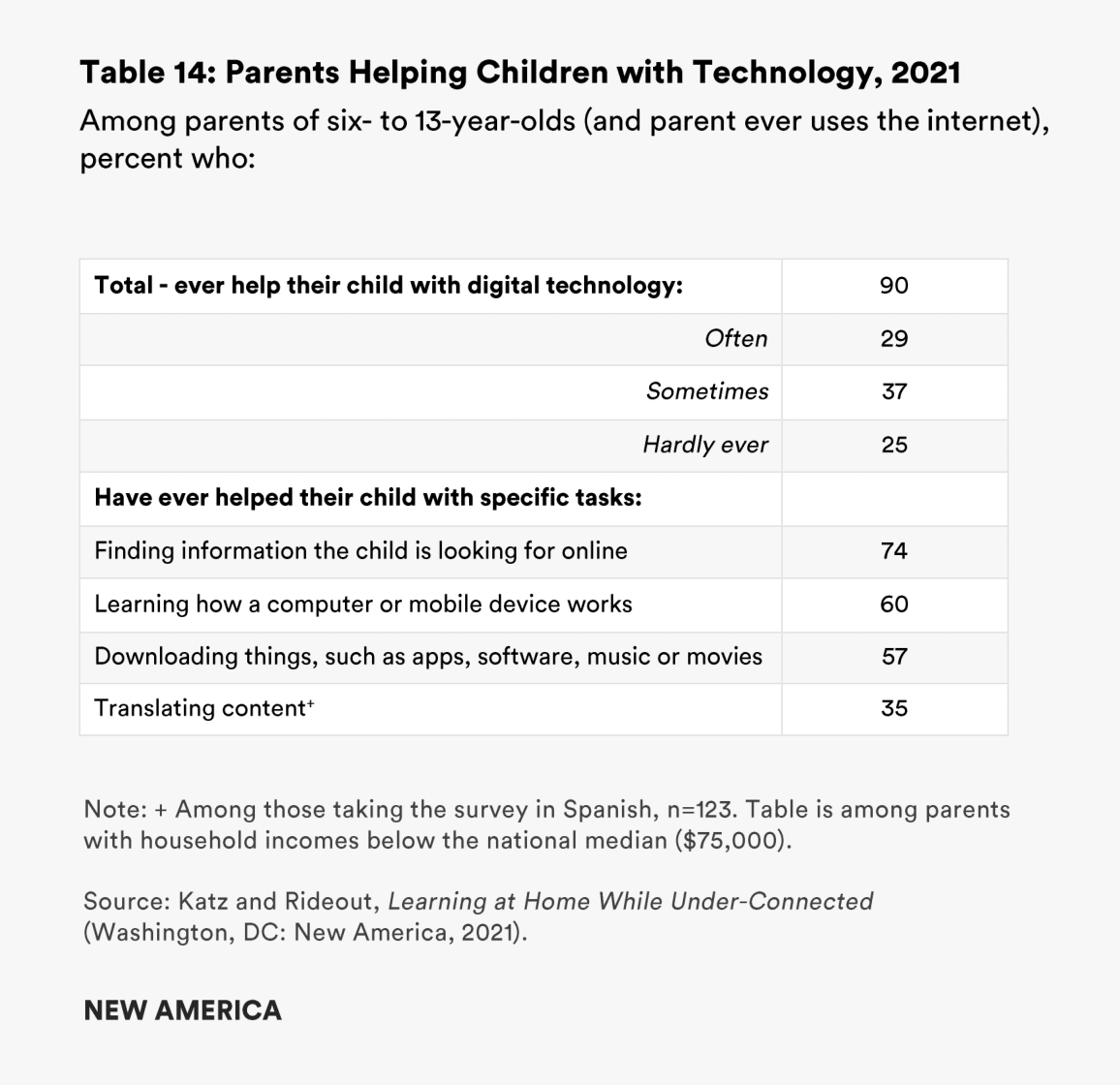
Two in three (66 percent) parents say they often or sometimes help their children (ages six or older) to use computers, tablets, or smartphones, including 29 percent who say they “often” do so. The proportion of parents who “often” help their children with digital devices does not vary substantially by household income, race/ethnicity, or parent education. Not surprisingly, parents are more likely to help their younger children: 37 percent “often” help their six- to nine-year-olds, compared with 21 percent who often help their 10- to 13-year-olds (see Table 14).
To better understand what kinds of tech-related activities children depend on their parents’ guidance to do successfully, we asked about four distinct kinds of tasks: finding information online; learning how computers or mobile devices work; downloading content or tools; and, for those whose primary language is Spanish, translating online content.1 Among parents who took the survey in Spanish (and who ever use the internet, n=123), 35 percent said they have helped their child with translating content from the web. Among all parents, 74 percent have helped their children find information they were looking for online, 60 percent have helped them learn how a computer or mobile device works, and 57 percent have helped them download content such as apps, software, music, or movies.
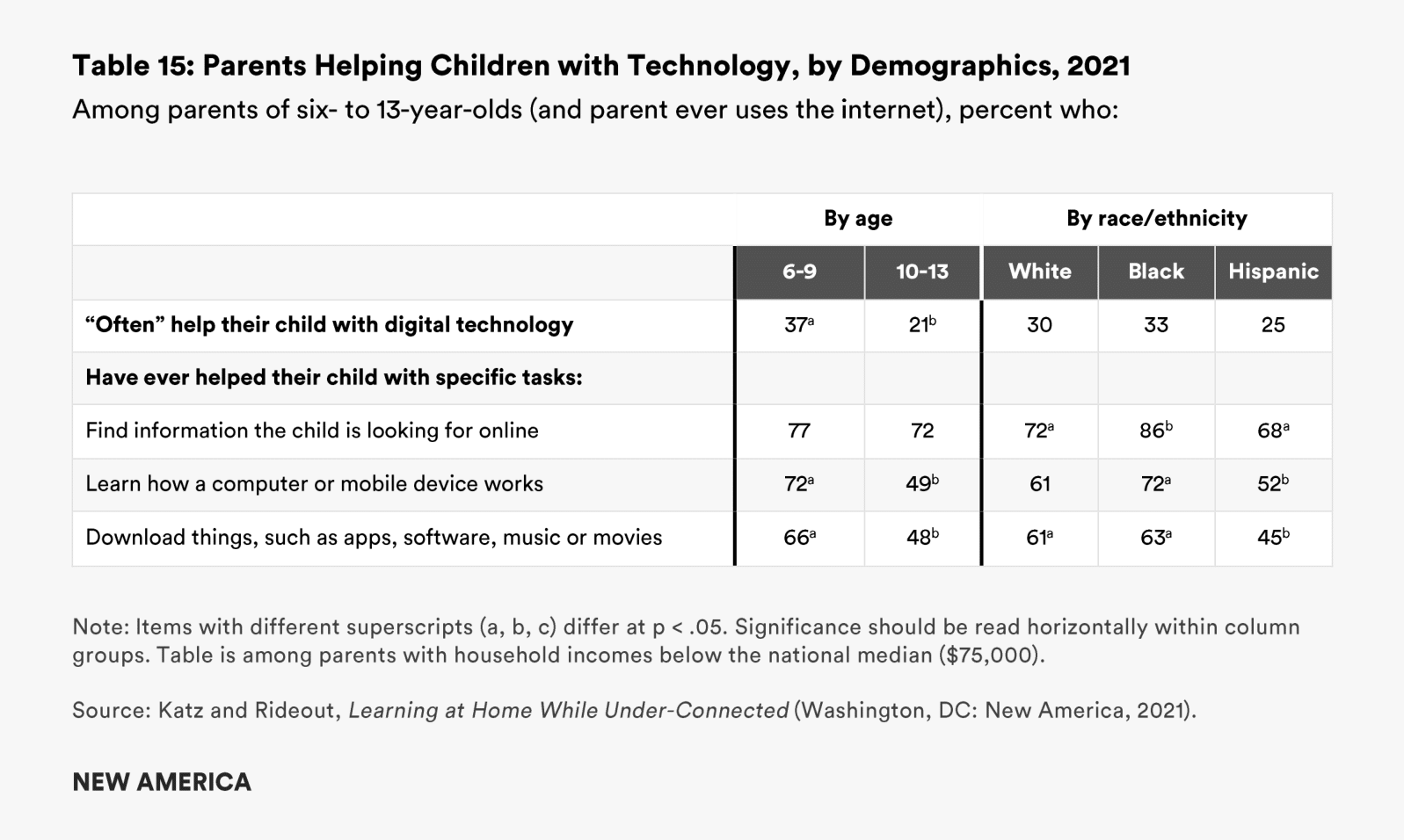
Black parents are more likely to have helped their children with each of these tasks (other than translating content) than White or Hispanic parents (see Table 15). Sample sizes were too small to compare results for translating content by demographic subgroups; comparisons between U.S.-born and immigrant Hispanic parents were not possible for the same reason. There were no differences in whether parents had helped their children with these tasks based on family incomes being below or above the federal poverty line. There was only one statistically significant variation in helping with these tasks based on parent education: those with a college degree were more likely to have helped their children understand how a computer or mobile device works than parents with only some college (72 percent vs. 58 percent).
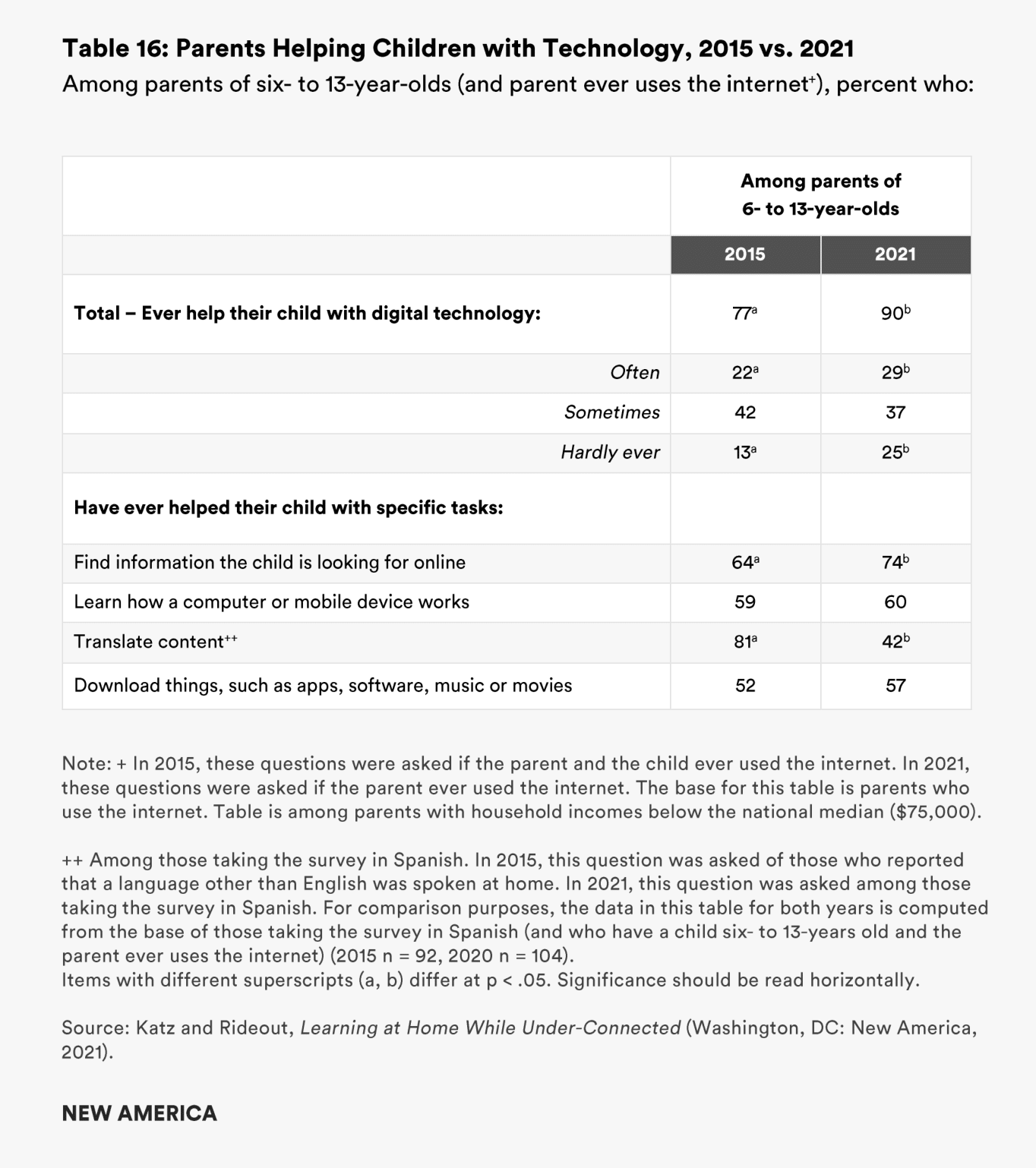
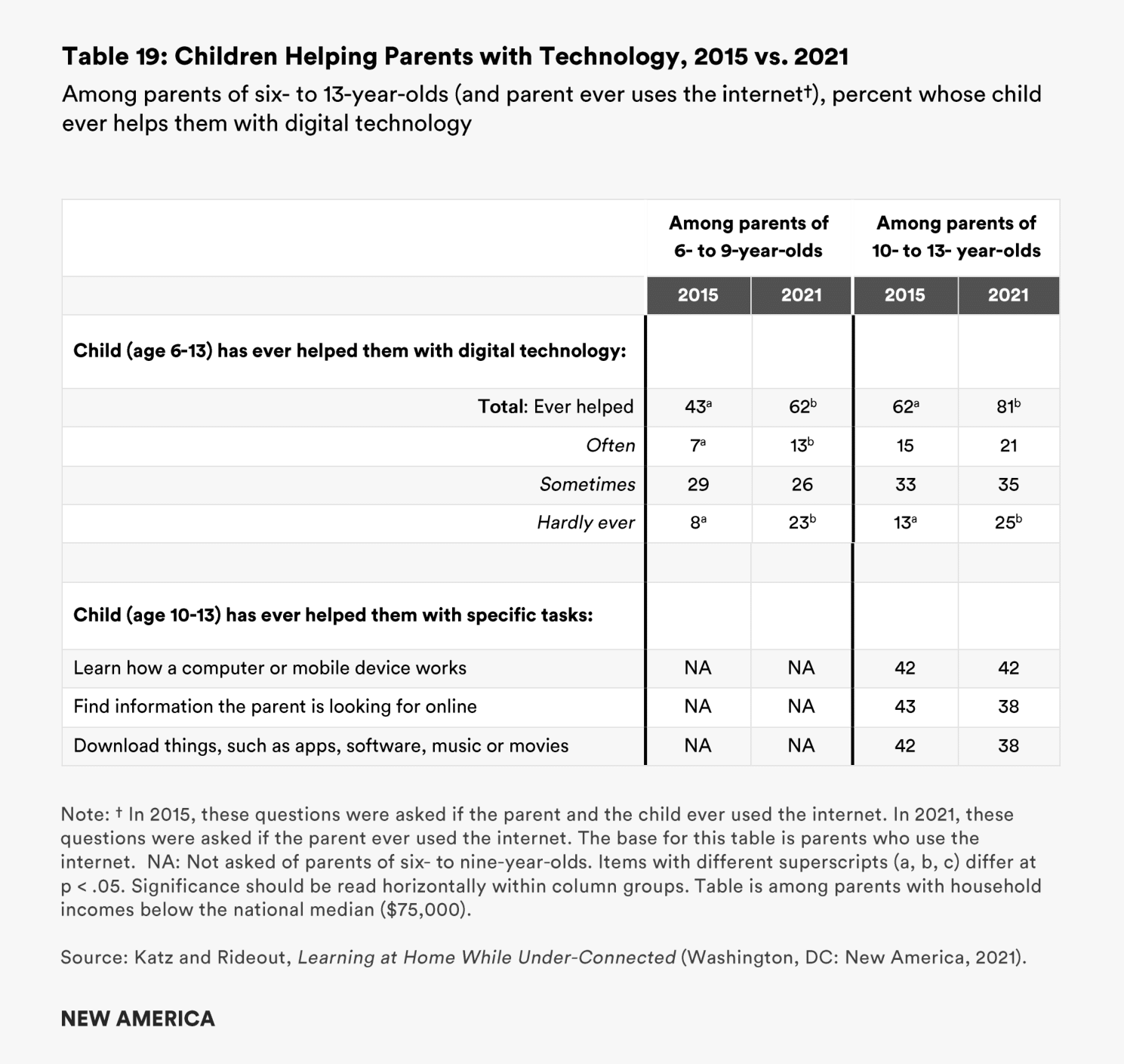
Rates of parental technology guidance have increased modestly over the past six years; nearly three in 10 (29 percent) parents say they “often” help their kids with digital devices, compared with 22 percent in 2015 (see Table 16). Parents are also more likely to help their child find information online (74 percent today, vs. 64 percent in 2015). These changes may be a function of increased reliance on the internet for schoolwork during the pandemic, but likely also reflect more general trends as technology has become more integral to K–12 education over time.
Children Helping Parents with Technology
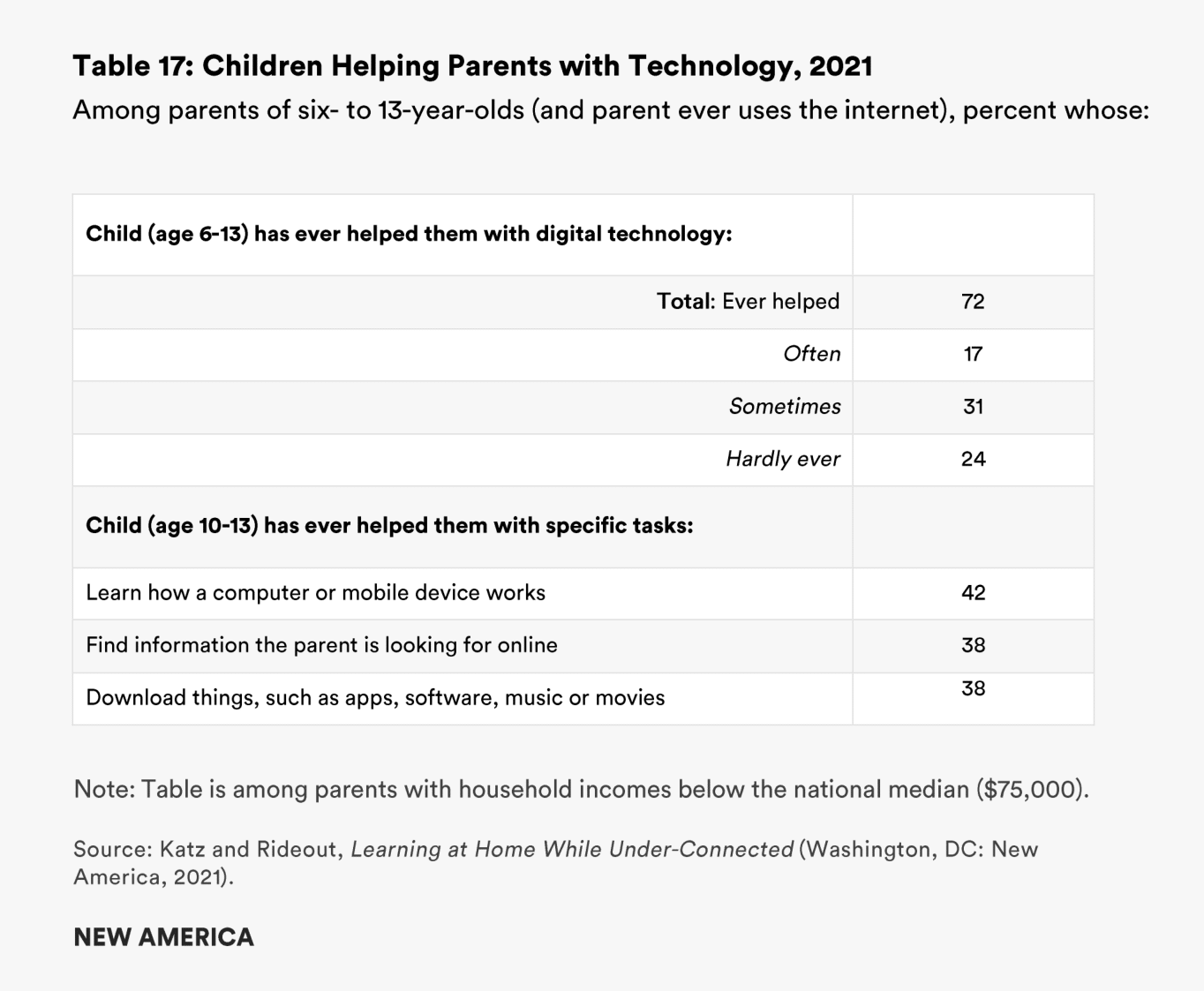
Parents also frequently rely on their children’s help to use technology. About half (48 percent) of all parents with six- to 13-year-olds say their child often (17 percent) or sometimes (31 percent) helps them with devices such as computers, smartphones, or tablets. In families with 10- to 13-year-olds, children help their parents with technology as often as parents help them with technology (21 percent “often” help each other; see Table 17). This finding underscores how fluidly parents and children can exchange expert and learner roles when it comes to technology, benefiting all family members in the process.
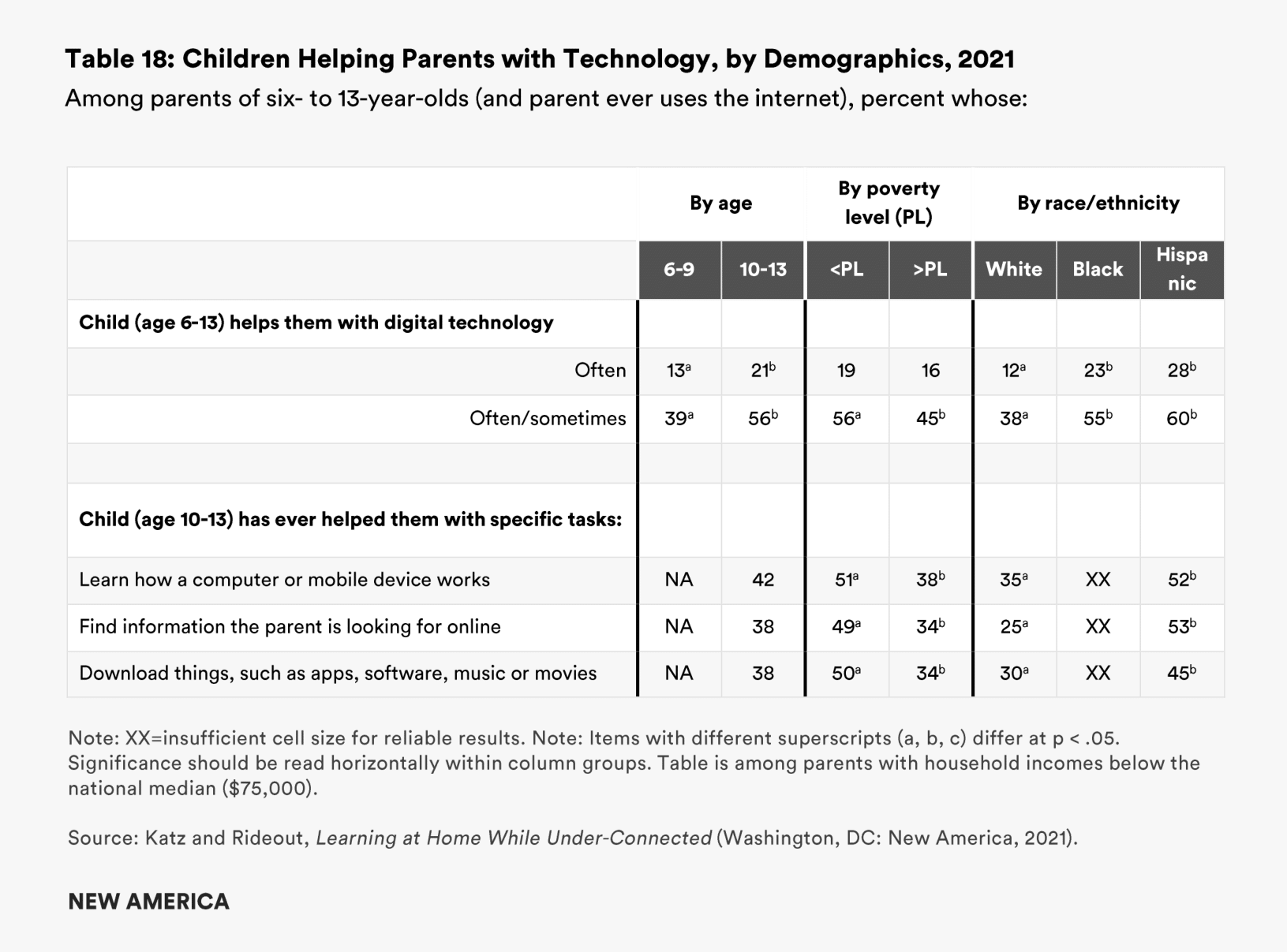
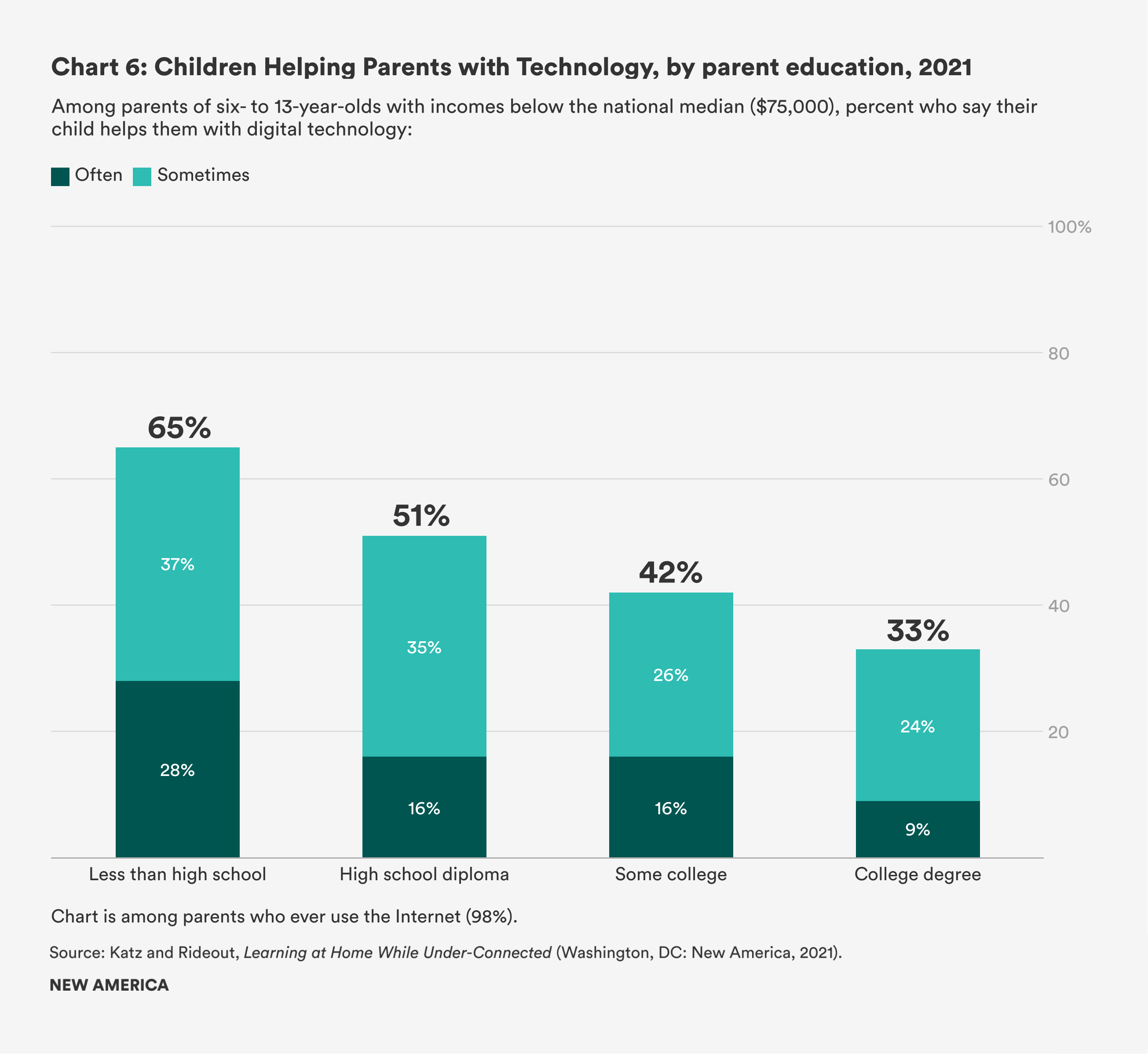
Children of color, those living in households with incomes below the federal poverty line, and those with less highly-educated parents are the most likely to help their parents with technology. Sixty percent of Hispanic parents say their six- to 13-year-old often or sometimes helps them, as do 55 percent of Black parents, compared with 38 percent of White parents. Over half (56%) of parents with incomes below the poverty line say their child often or sometimes helps them, compared to 45% of those with incomes above the poverty line (but still below the median income). Two-thirds of parents (65 percent) without a high school diploma say their six- to 13-year-olds often or sometimes help them with technology, compared with 33 percent of parents with a college degree (see Chart 6).
Parents with older children (ages 10 to 13) were asked which specific tasks their children help them with: finding information online; understanding how devices such as computers, tablets, or smartphones work; and downloading content or applications. About four in 10 said their children had helped them with these tasks, ranging from 38 percent to 42 percent.
Parents’ reliance on children’s help with technology varied by family income level. Parents reporting incomes below the federal poverty level were more likely to say that their child had helped them with each technology task. For example, 49 percent said their 10- to 13-year-old child had helped them look for information online, compared with 34 percent of parents reporting incomes above the federal poverty line, but still below the national median (see Table 18).
There are also variations by race, ethnicity, and immigrant generation in terms of the frequency with which children support their parents on specific tasks. For example, more than half of Hispanic children (53 percent) help their parents find information online, compared with 25 percent of White children. And among families headed by Hispanic immigrants, 62 percent said their child had helped them find information online. These sociodemographic patterns are consistent with our 2015 findings: children play crucial roles in facilitating technology engagement in families challenged by financial, educational, and linguistic constraints or some combination of these factors.
The proportion of parents who rely on their children for help with technology has increased substantially since 2015. Some of that increase is certainly an artifact of an extraordinary year, where parents and children had to use technology at home for a much broader range of activities than they had previously. However, there is likely more to glean from this change over time. Since families’ rates of home access to broadband internet and digital devices have increased significantly since 2015 as well, greater parental reliance on children’s assistance likely reflects one or both of the following dynamics: children’s proficiency and familiarity with devices and navigating the internet has increased, thanks to having daily opportunities to use them, and/or more parents are using technology more frequently, for the same reasons. In 2015, 62 percent of 10- to 13-year-olds had helped their parents with digital devices; today, 81 percent have done so (see Table 19).
Siblings Learning and Creating Together
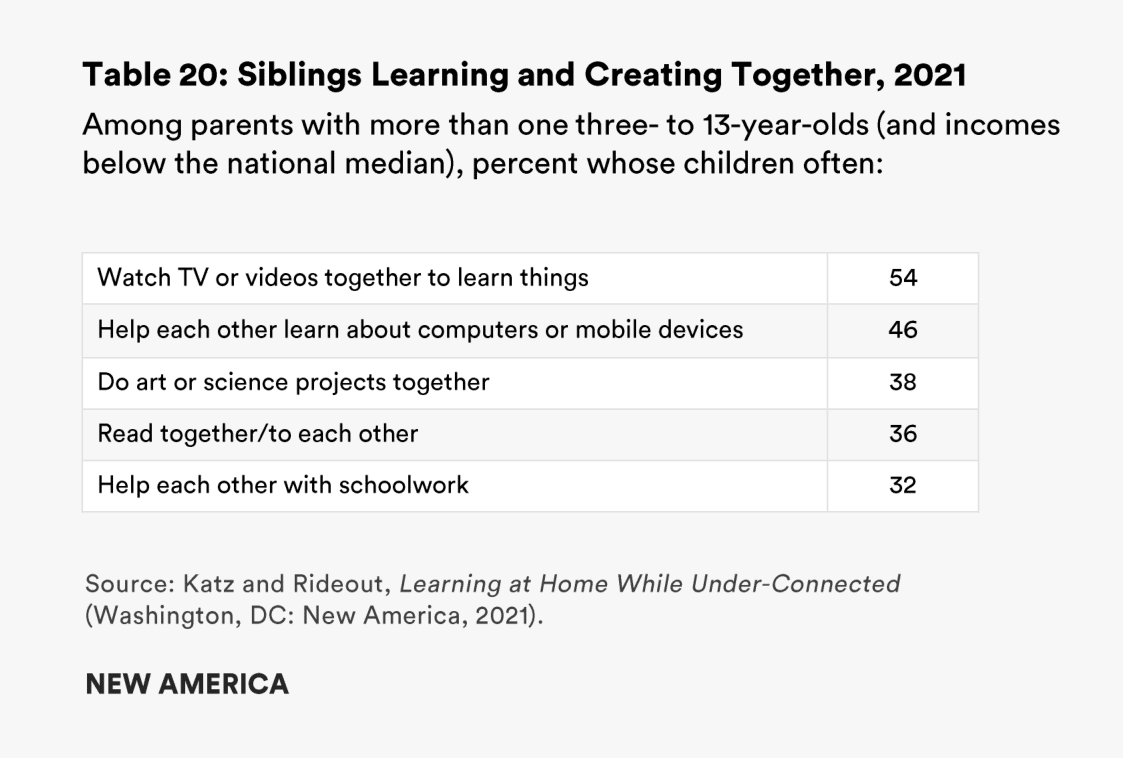
In families with more than one child in the three- to 13-year-old age group, we asked how often siblings engage in various learning activities together. Children helping each other can be an important element of their learning environment; when one child learns something new, it can be passed on to another child. In a year when contact with anyone outside the family home was so constrained, siblings were particularly important learning partners for each other.
About half of surveyed parents (54 percent) with two or more children ages three- to 13 noted that siblings often or sometimes watch TV shows or videos together to learn things; this aspect of co-viewing is often overlooked in the children’s media literature, which more often focuses on parental co-viewing or co-engagement. Nearly half (47 percent) help each other learn about computers or mobile devices, an aspect of technology engagement where shared knowledge and experience can be especially helpful. And roughly one-third of children with siblings in this age group do art or science projects together (38 percent), read together or to each other (36 percent), and help each other with schoolwork (32 percent; see Table 20).
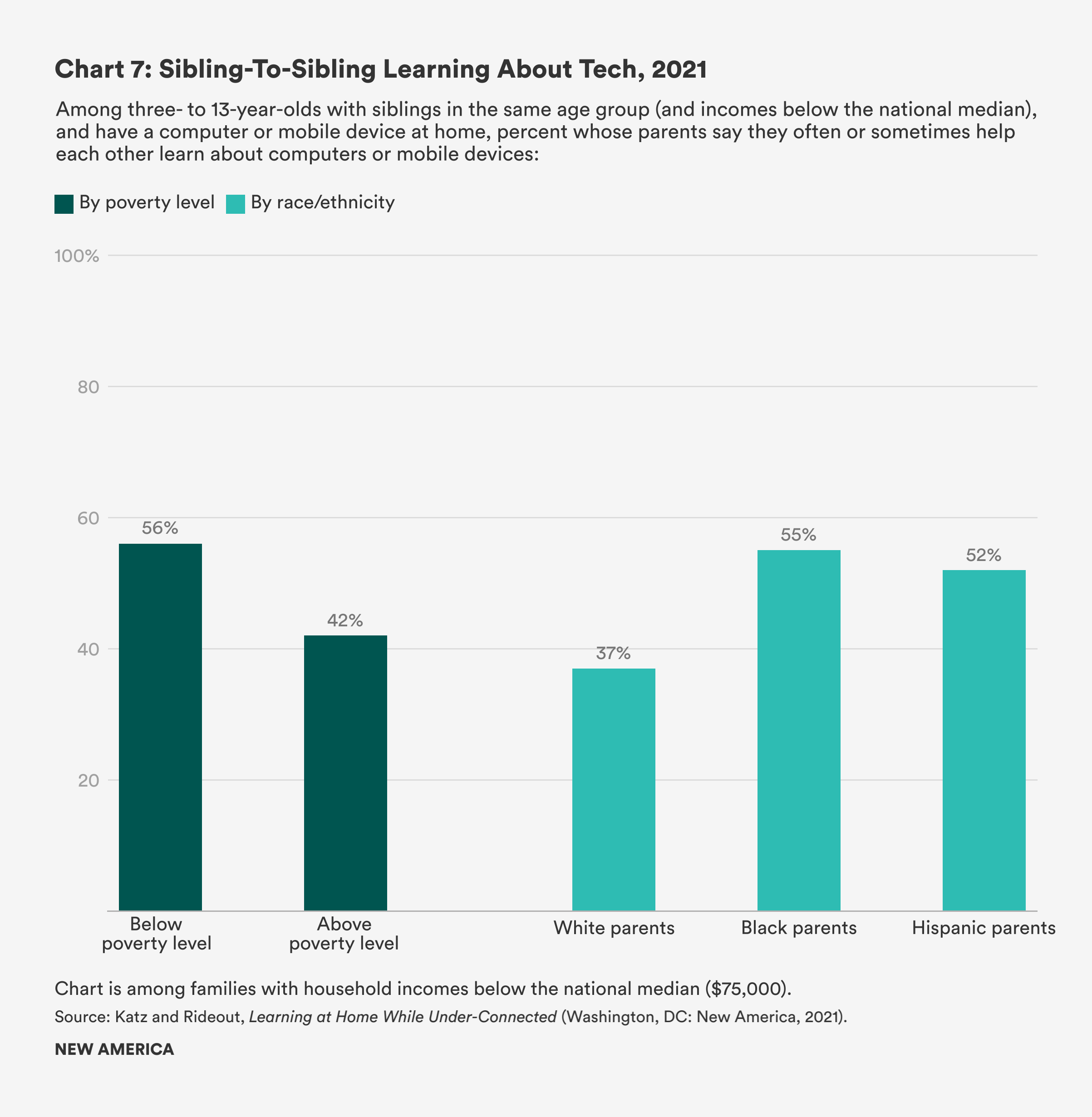
Siblings’ co-learning activities did not vary across poverty status or race/ethnicity, with one important exception: helping each other learn about technology. Children of color and those from households with incomes below the poverty level are all more likely to engage in shared learning about computers and mobile devices (see Chart 7).
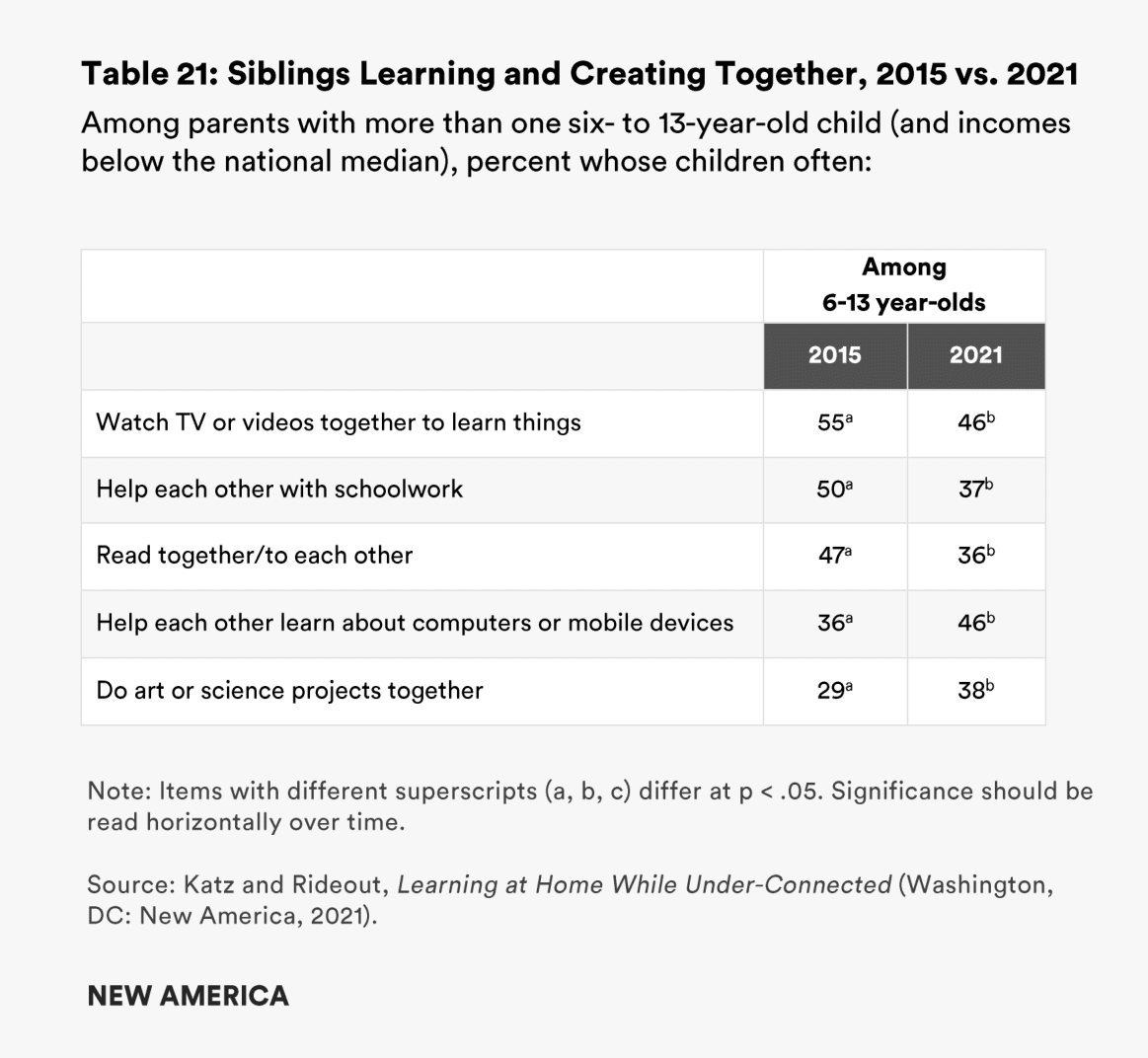
In 2015, we asked these same questions of parents with six- to 13-year-olds, so we can compare the results over time for that age group (see Table 21). Surprisingly, six- to 13-year-old children were less likely to help each other with their schoolwork during the pandemic than they had been during 2015; they were also less likely read together or to watch TV or videos together to learn things. These are all somewhat counterintuitive results, given that kids were more likely to be home together doing schoolwork and to have more time to watch TV or read together than ever before. These findings may reflect parents’ greater involvement in children’s schoolwork, obviating the need for siblings to assist each other. It is also possible that spending less time with educational media together reflects siblings having to share the devices to complete schoolwork, so that technology use was more characterized by device hand-offs than by shared experiences in some households.
On the other hand, siblings are now more likely to help each other learn about computers and other digital devices: 46 percent do so today, compared with 36 percent in 2015. This is not surprising, given that the presence of such devices in the home has expanded substantially. And, encouragingly, children are also more likely to do art or science projects together today (38 percent) than they were six years ago (29 percent).
Citations
- These categories were informed by qualitative interviews with 170 parents and their children (N=336) prior to the 2015 wave of this survey.