
Table of Contents
Educational Media use During COVID
In a year where remote learning disruptions have been common for lower-income families, we wanted to understand whether parents have relied on informal educational media (media that parents consider educational, but that is not directly related to school or schoolwork), particularly if they were without easy access to other supplemental educational services for their children. Accordingly, the survey asked parents how often their children have watched educational TV shows or online videos, played educational games, or engaged in creative activities such as making art or music using their digital devices during the pandemic.
The survey sought to document which types of educational media children are using (outside of what they were assigned for school), and how their usage varies by content type (TV show, game, video, or content creation), and what this looks like demographically. For children who do use educational media often, we also asked parents how helpful these media were for keeping children learning and growing during the pandemic. Finally, we asked whether parents had relied on educational media to help them to explain the COVID-19 pandemic to their children.
Children’s Use of Educational Media
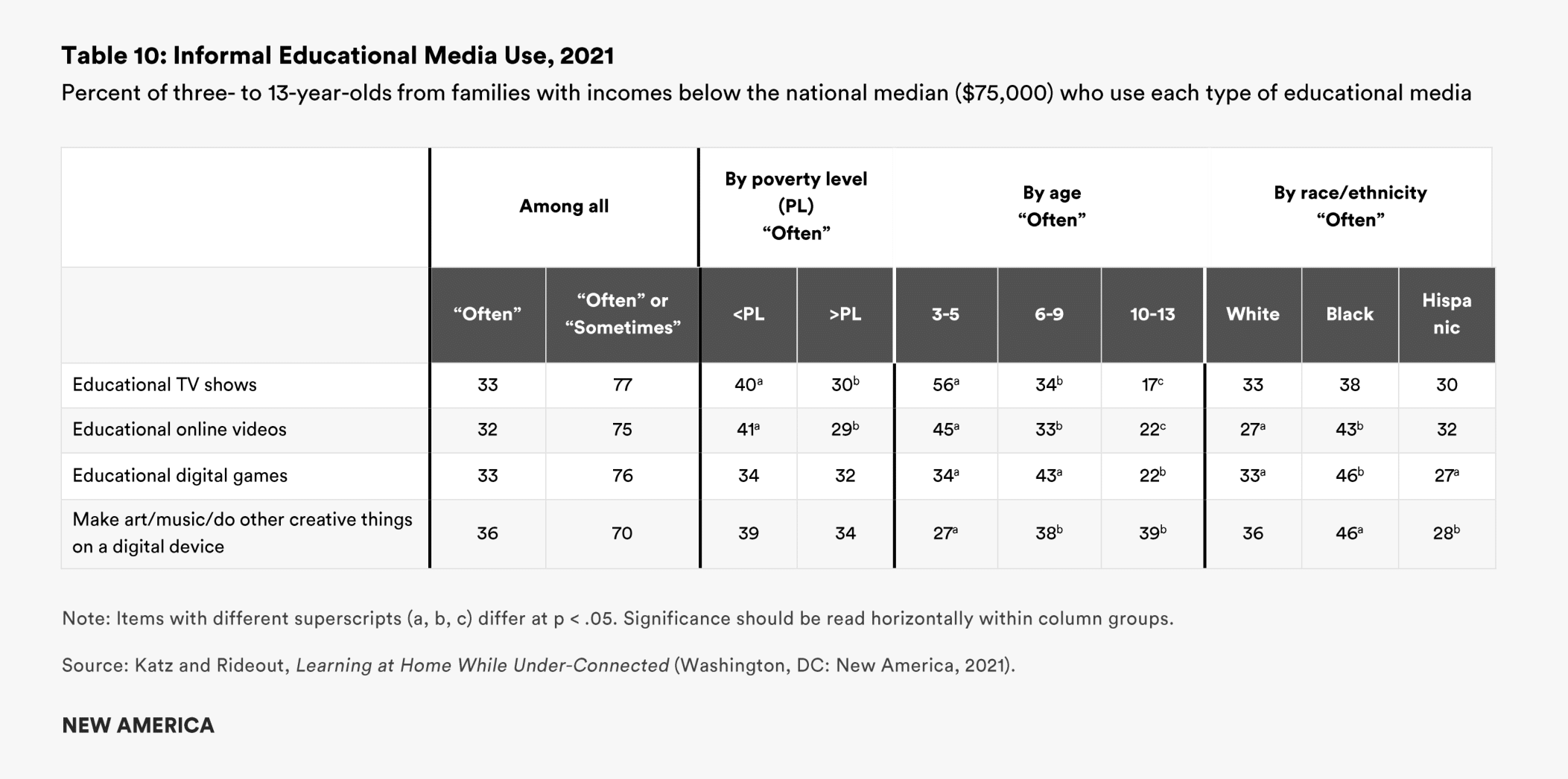
In our survey, more than seven out of 10 children use each type of informal educational media we asked about, and about one in three do so “often.” There are virtually no differences in the frequency with which children use the types of media we asked about; 33 percent of parents say their children often watch educational TV, 33 percent say they often play educational electronic games, and 32 percent say they often watch educational videos online. Thirty-six percent say their children often use a computer, tablet, or phone to make art or music or engage in other creative activities (see Table 10).
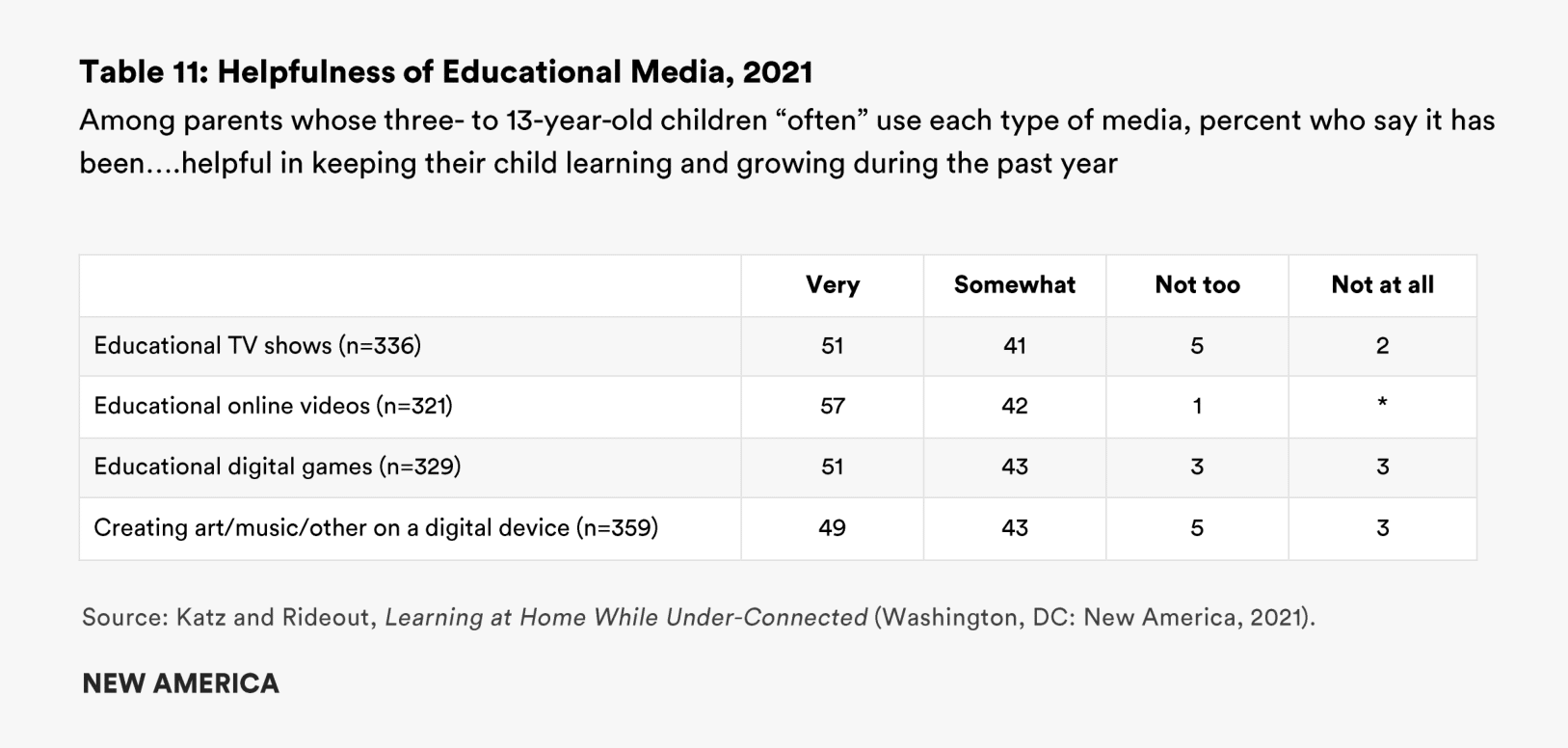
Most parents whose children use educational media say these resources have helped them keep their child learning and growing during the past year. About half of parents whose children “often” use each type of media say they have been “very” helpful, and more than nine out of 10 say they have been at least “somewhat” helpful. Parents’ ratings did not vary substantially by media type, with 57 percent saying the educational videos their child watched were “very” helpful, and 51 percent saying the same about educational TV shows and educational games played on digital devices (see Table 11).
Educational media have been most important to children in the most economically disadvantaged families, who have also been disproportionately affected by being under-connected and experiencing disruptions in their remote learning. These are the children making the most use of informal educational TV shows and videos. Four in 10 children (41 percent) in households with incomes below the federal poverty line “often” watch educational videos online, compared with 29 percent of children in families with incomes above the federal poverty line. We see a similarly significant difference between the proportion of children from families with incomes below and above the poverty line who “often” watch educational TV shows (40 percent vs. 30 percent, respectively).
Survey results also showed that informal educational media engagement varies by race/ethnicity. Black children make greater use of educational online videos and video games than White or Hispanic children and are more likely to engage in creative activities on their digital devices as well. There were no notable differences in frequency of educational media use based on immigrant generation among Hispanics, the type of internet access families relied on, or whether the family had a child with special needs. But children who have a computer in the home are more likely to make art or music or engage in other creative digital activities, as compared with children their age who do not have a computer (37 percent vs. 24 percent who “often” do so, respectively).
The frequency with which children watch educational TV shows decreases quite dramatically with age. While 56 percent of three- to five-year-olds “often” watch educational TV, that proportion drops to 34 percent among six- to nine-year-olds, and to just 17 percent for 10- to 13-year-olds.
Just under half (46 percent) of parents with more than one child ages six to 13 say their children “often” watch TV shows or videos together to learn things. This is a decline from 2015, when 55 percent of siblings “often” co-viewed educational TV shows and videos. It is possible that the need for siblings to share devices for schoolwork meant that they had less time available for watching TV shows or videos together on those devices.
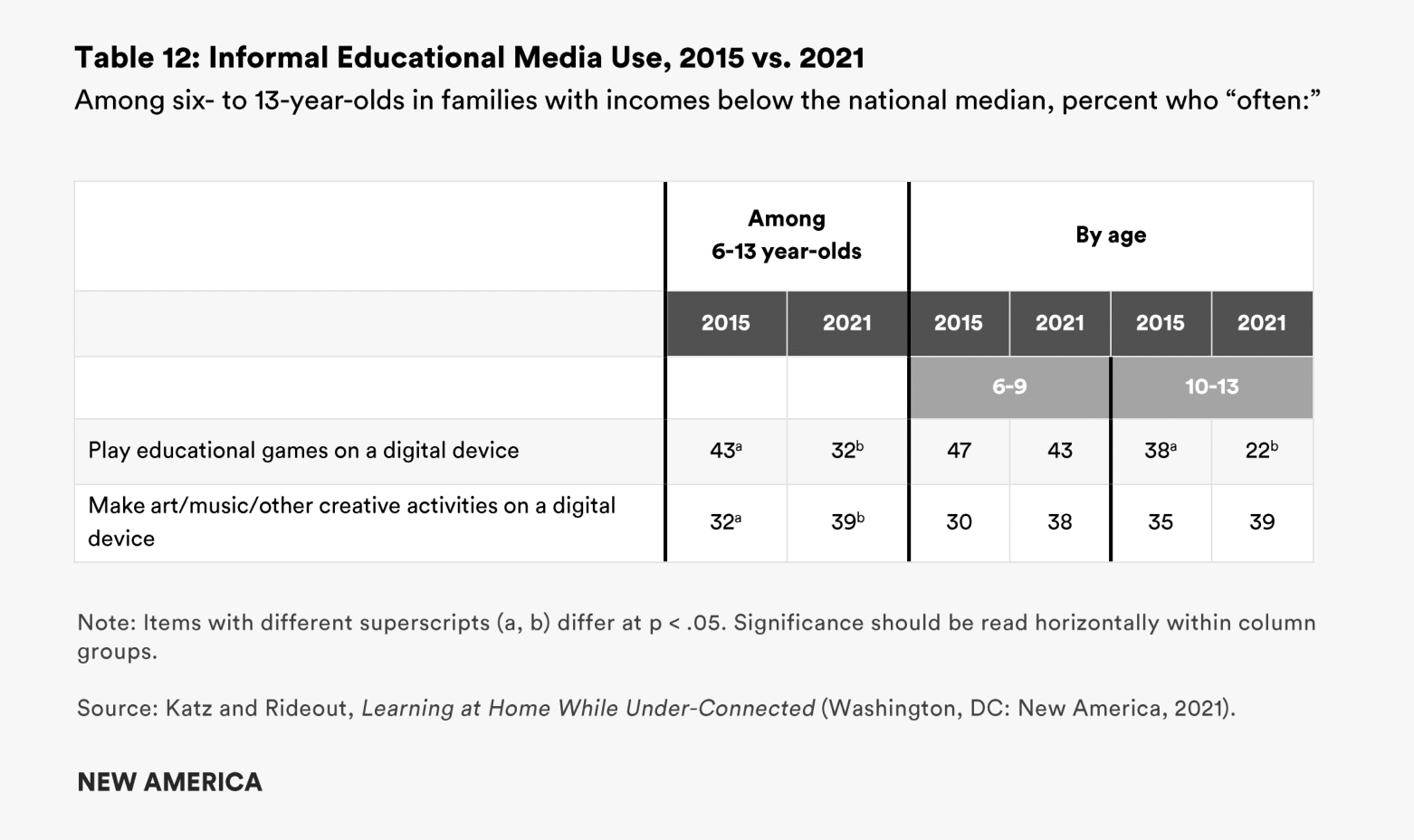
We also collected data in our 2015 survey on children using digital devices for educational games or for creative activities, among those ages six to 13 (see Table 12). Among this age group, use of educational games has declined (from 43 percent who played them often in 2015, to 32 percent who do so now), with the decline being most dramatic among 10- to 13-year-olds. On the other hand, children using computers, tablets, and phones for making art, music, or other creative activities has increased (from 32 percent to 39 percent who do those activities often). It may be that the expanded access to computers in the home since 2015 contributed to the growth in use of digital devices for these purposes.
Examples of Helpful Educational Media
Parents who said their child “often” watched educational TV shows or videos—and that those programs were “very” helpful in keeping their child learning and growing during the past year—were asked to give an example. Of the respondents who received this question (n=238), 84 percent provided an answer.
ABCmouse received the single most mentions (24), followed by Sesame Street (14), Blippi (9), Cocomelon (7), and Wild Kratts (6). Many shows that were mentioned are available on multiple platforms (e.g., Cocomelon, on Netflix and YouTube), while others are available only on a single platform (e.g., Dino Dana on Amazon Prime). Of parents who offered an answer, 21 percent mentioned titles on PBS (Sesame Street, Daniel Tiger, Wild Kratts, Xavier Riddle), and 17 percent mentioned shows or videos that are only available on YouTube (El Mono Silabo, Brave Wilderness, Jack Hartmann Kids Music Channel). Between 7 percent and 10 percent mentioned shows or videos on Nickelodeon (PAW Patrol, Team Umizoomi, Blue’s Clues, Dora the Explorer), Disney (The Mickey Mouse Clubhouse, How Things Work), and Netflix (Waffles and Mochi, StoryBots, The Who Was? Show).
Media for Learning about the Pandemic
We asked parents of six- to 13-year-olds whether their children had watched any TV shows or videos that were helpful in explaining the coronavirus pandemic: 40 percent said they had. The fact that fewer than half of families turned to TV shows or videos designed for this purpose is somewhat surprising, given how all-consuming and often confusing the topic was, even for adults. Whether this finding reflects that families chose not to watch pandemic-related programming created for children or were unaware that such resources were available is not possible to determine from this survey.
Most parents who had watched content intended to educate young people about the pandemic found it helpful, including just under half (46 percent) who said it was “very” helpful (see Chart 5). Black and Hispanic children and those in families living below the poverty level were more likely than others to have watched such programming and, although the subsample sizes are small, it appears their parents were more likely to find the content helpful as well. Over half of Black (54 percent, out of 88 who watched such shows) and Hispanic (56 percent, out of 132 who watched) parents whose children had watched TV shows or videos that explained the pandemic found them “very” helpful, compared with 21 percent of White parents (out of 98 who watched).
