
Introduction
The use of student data to inform decision-making and communication tactics is still an evolving practice in higher education. Colleges and universities may collect and leverage a variety of data on students—including their demographics, financial aid status, academic performance, and more—to help target and tailor their outreach and support efforts. The COVID-19 pandemic has prompted discussions about new ways institutions can collect and use students’ location and social media data to monitor (and sometimes report) their behavior and prevent campus virus outbreaks. Moreover, the pandemic has heightened campus interest in tracking student data to better understand how students are faring in online learning environments and the need to intervene with the right resources at the right time. The Chronicle of Higher Education recently published an article titled, “The Surveilled Student,” which outlined the ways that students’ information is used to track their location and use of institutional resources, and how that tracking has been heightened for public health and other reasons during the pandemic.1
Often missing from campus conversations about use of student data, however, are student voices about their preferences and needs. While institutions consider student needs and experiences in the abstract, those may not align with students’ realities and actual preferences. NASPA – Student Affairs Administrators in Higher Education and New America—a policy research organization—engaged in a joint research effort to better understand student perceptions of data use within higher education.
NASPA and New America conducted five semi-structured focus groups with a diverse mix of 18 students (see Figure 1).
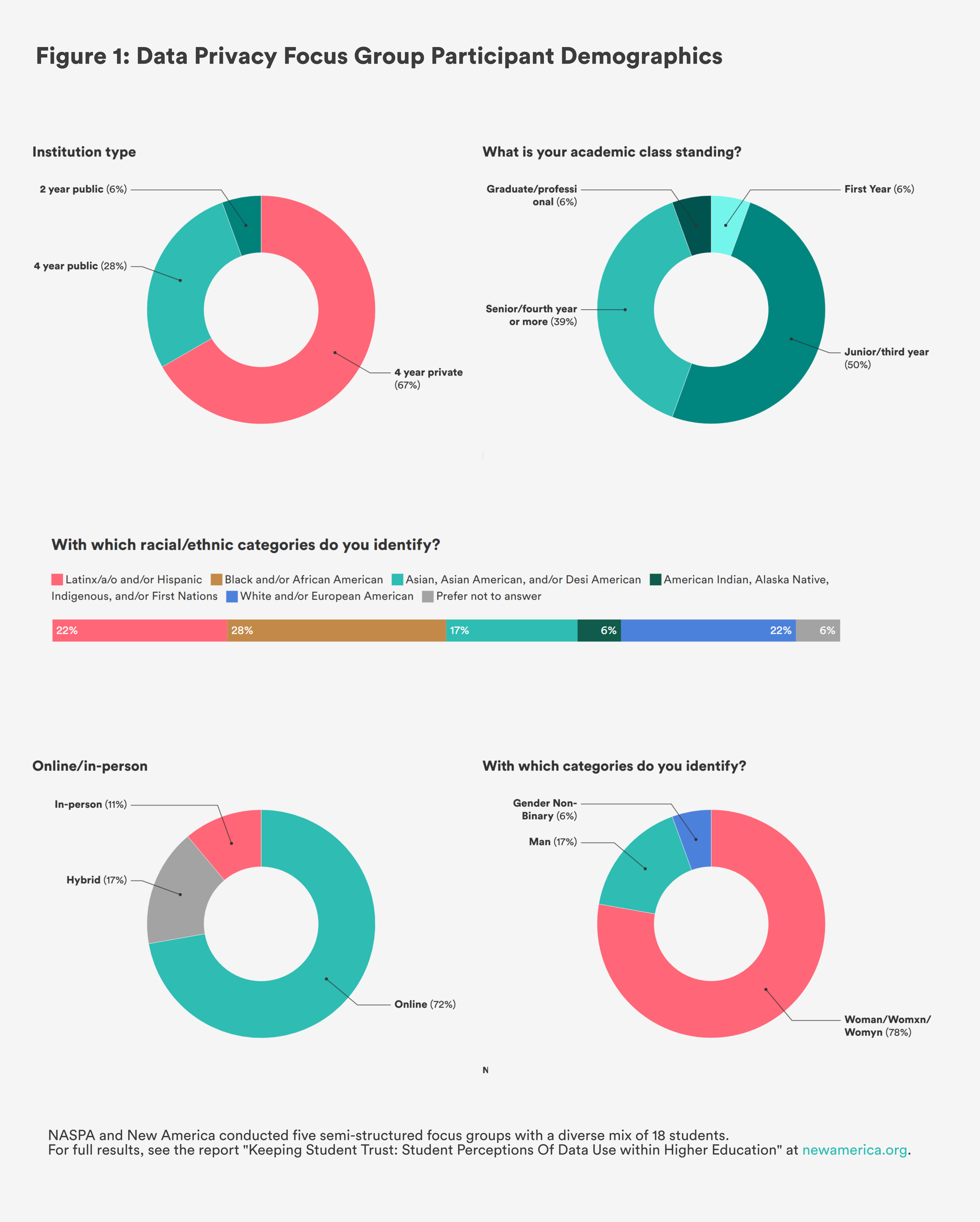
Students were asked to react to a variety of scenarios with questions about how colleges may use or track student data (see the appendix for more on the methodology). Questions focused on understanding how students’ comfort levels may change based on:
- Whether data are collected by a higher education institution vs. a third-party company
- Type of data collected (i.e., data about student location, demographics, financial aid, and academic performance)
- Data used in COVID-19-related monitoring scenarios (i.e., social media monitoring, contact tracing mobile applications, and proctoring software)
- Data used for resource sharing and targeted outreach (i.e., notice about eligible scholarship opportunities, on-campus financial resources, social clubs and events, and tutoring and advising services)
Insights from these discussions led to a set of recommendations for institutions and campus administrators related to different uses of data; tools for collecting and sharing data; areas of data-related training; and framing and delivery of outreach messages informed by student data.
Citations
- Katherine Mangan, “The Surveilled Student,” The Chronicle of Higher Education, February 15, 2021, source