
Table of Contents
Long-Term Effects of Kansas’s Fusion Ban: Single-Party Hegemony and the Two-Party Duopoly
The intent and effect of the 1901 reform law was overtly known at the time of its passage. The St. Louis Post-Dispatch wrote that the “new law forbids fusion.…No matter what the two parties may do, complete, or even a complete approximation of, fusion, under the new election law, is impossible in Kansas.”1 Simply, “the outlook…for successful fusion this year is not hopeful.”2 The 1902 elections showed that fusion, and party competition itself, was indeed dead in Kansas.
The results of the 1902 election manifested the success of the Republican law. The first effect was a massive decline in voter turnout. While more than 350,000 votes were cast in the 1900 governor’s race, just 287,000 were cast in 1902—a nearly 20 percent decline.3 Most dramatically, Populist-Fusion votes in the governor’s contest fell from 164,000 to just 635 votes.4 As intended, the anti-fusion law disenfranchised any political efforts opposed to the dominant Republican party.5 Populists and their former supporters were now left with Hobson’s choice: A sizable minority of Populist fusion voters had to decide between casting a symbolic protest vote for a minor third party or simply not voting at all.6 Altogether, the 1902 election marked a return to Kansas’s pre-fusion political alignments: The Republican and Democratic vote shares correlated significantly with the Republican and Democratic vote of the 1880s.7 Accordingly, Democrats were unable to mount an electoral challenge, and Republicans were again solidly in control. The enhanced political competition during the fusion era was a thing of the past.
The ban on fusion in Kansas also resulted in a sobering reality: a largely one-party state. Between 1899 and 1923, Kansas had just one Democratic governor, who won in 1912 by 29 votes (out of nearly 350,000 cast).8 This upset occurred in an odd year—the upstart Bull Moose Party, led by former President Theodore Roosevelt, split the traditional Republican vote. Moreover, between 1915 and 1957, Kansas would see just three Democratic governors.9 Since 1901, Kansas has had just two Democratic U.S. Senators.10
One-party dominance of the state legislature has been even more dramatic. After winning back both houses from the Fusionists in 1901, the Republicans have almost never surrendered control of the legislature.11 With the lone exception when Democrats used the Bull Moose phenomenon to control the Kansas legislature very briefly in 1913–1914, Republicans have never lost control of both houses of the legislature.12 In fact, in the 123 years since the 1901 legislature, the party has only lost control of one house of the legislature twice, in 1977–1978 and 1991–1992, for a total of four of the past 123 years.13
The anti-fusion approach was not unique to Kansas. In the late nineteenth and early twentieth centuries, the majority parties in many states enacted laws limiting suffrage or creating legal structures that were intended to establish one-party rule.14 Sometimes, the motivation was benign, as with the Australian Ballot. The goal there was to establish a rational, bureaucratic form of “scientific government,” with centralized election authority and “experts” to run elections.15 Less justifiable was the attempt to use political power to weaken democracy, particularly if it involved bringing women, young people, immigrants, and the poor into politics. Historian Michael McGerr has documented how election laws helped create the “vanishing voter.”16 He showed that turnout in presidential elections (outside the South, where turnout was already low due to Jim Crow restrictions) declined from an average of 86 percent in 1896–1900 to 58 percent between 1900–1926. In Congressional elections, the decline was even more profound, from 70 percent in 1894–1896 to 42 percent in 1922–1926. McGerr concluded that the prior operation of elections in the late nineteenth century had “made it easier for men to envision new [political] alternatives and organize to bring them to life.”17
Historian Mark Wahlgren Summers assessed the anti-democratic efforts—like the one in Kansas—as part of a paradigm in which the political establishment shut off any valves of political competition.18 Summers observes that the political leaders who were challenged by reformers, like the Populists, were unable to surrender their authority graciously. In the late nineteenth century, they resorted to tactics such as slander, manipulation, deceit, trickery, fraud, and violence. Laws banning fusion, while seemingly less reprobate, had a similar effect on political competition and voter choice.
According to Summers, leading politicians of the established parties did not want big turnouts and, thus, actively worked to ensure that only their supporters were able to vote. To do this, Kansas Republicans of 1901 sought to establish a narrow definition of the “people.” Accordingly, voter registration rules, identity requirements, and government-printed ballots all sought to segregate the ballot box from those entitled to participate in democracy from those excluded from it—which included fusion parties and supporters. The result was a severe contraction of the more participatory democracy of the late nineteenth century. A comparative analysis of the 1900 and 1902 elections in Kansas reveals that political competition in the state simply vanished along with the Populist Party, resulting in nearly 123 years of Republicans controlling the legislature.19
Such one-party dominance was emblematic of the anti-fusion reforms that swept the nation at the turn of the nineteenth and twentieth centuries. Outside of Kansas, a prime example of how election law was used to exclude voters and install one-party systems during this era comes from the South. North Carolina had similarly experienced fusion between the Populists and Republicans to wrest control from the dominant Democratic Party in the 1894 election.20 There, fusion brought together white former Democrats and members of the mostly Black Republican party. North Carolina’s Fusionists won the state legislature and, like the Kansas Fusionists in 1893, enacted a series of election reforms, including redesigning ballots to allow illiterate citizens to vote (which led to an increase of registered voters by over 80,000).21 They also authorized self-governance at the community level, which Jim Crow Democrats opposed in majority Black communities. In 1896, as in Kansas, fusion helped the Republicans shut Democrats out of power for the first time since Reconstruction.22 Only 26 Democrats were elected to the 120-member House, and only seven in the 50-member Senate.23 All statewide offices, including the governor’s, were held by Populists or Republicans.24
However, as in Kansas, fusion’s success prompted a swift response. In the 1898 election, a “White Supremacy Campaign” led by future U.S. Senator Furnifold M. Simmons, chairman of the Democratic Executive Committee, brought Democrats back to power with violence, threats, racial fear-mongering, and brutal identity politics.25 Shouts of “negro rule” and “negro domination,” along with extensive fraud at the ballot box, swept the Democrats to a resounding victory in the 1898 election.26 Once back in power, Democrats delivered the North Carolina version of Kansas’s anti-fusion legislation. They changed the Constitution and passed sweeping election laws, including ending fusion, which were designed to disenfranchise their opponents—particularly African Americans.27 Would-be voters now faced a battery of barriers, including the literacy test, a “Grandfather Clause” that was intended to prevent Black voting, poll taxes, and eventually the White Primary, which ensured that internally controlled Democratic primaries were the only real elections.28 Although over 330,000 persons cast ballots in the 1896 presidential election, only about 200,000 did so in 1904.29
Overall, the result was very similar to that in Kansas: one-party dominance. After Republican Governor Daniel Russell left office in 1901, North Carolina would not elect another Republican to the state’s highest office until 1972, and it would not send another African American to the U.S. Congress until 1992.30 Both houses of the state legislature were controlled by Democrats for over 90 years, from 1901 to 1995.31 The motives and functions of North Carolina election laws mirrored those in Kansas.32
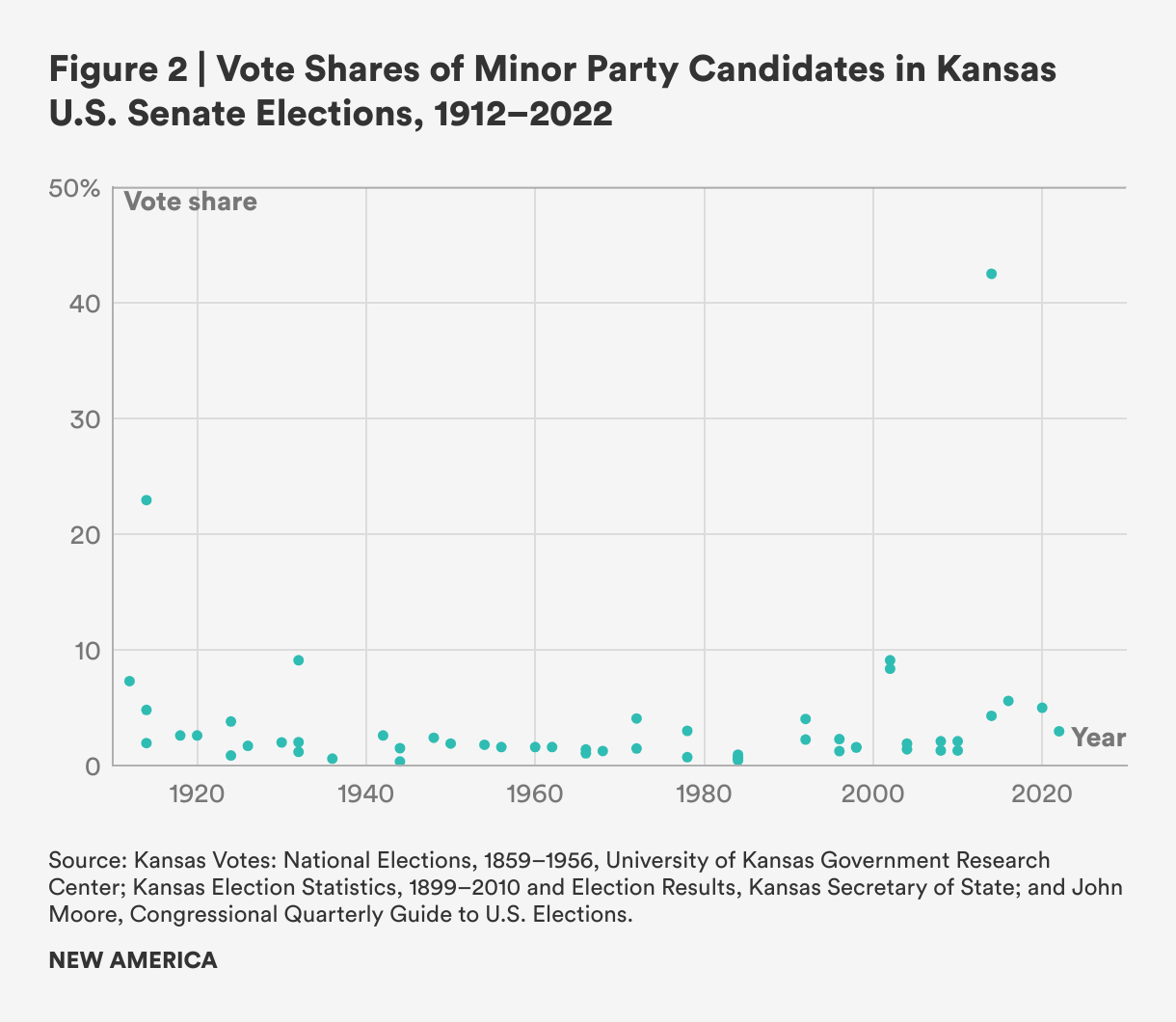
Anti-fusion legislation in Kansas has not only affected individual voters but has had a dramatically negative impact on parties outside the permitted duopoly. Since the prohibition of fusion, electoral victory has been all but nonexistent for Kansas’s minor parties. No minor-party candidate has won a statewide or federal election in Kansas since the passage of the 1901 fusion ban. The most recent occurrence was the 1900 victory of the Democratic and Populist Party that nominated Congressional candidate Alfred Jackson.33 Virtually all recorded minor-party victories at the federal and statewide level—19 out of 20 minor-party U.S. Representatives and both minor-party governors—occurred between 1890 and 1900, when fusion was permitted.34 Since fusion’s ban, minor-party candidates in federal and statewide elections have rarely surpassed single-digit support.35 The handful of candidates who have garnered substantial support all did so in races without Democratic challengers (for example, Independent Senate candidate Greg Orman earned 42.5 percent of the vote in his 2014 race, and Libertarian Congressional candidate Joel Balam earned 31.5 percent in 2012).36 In three- or four-way races with both major parties offering candidates, minor parties have been relegated to political footnotes. Figures 1 and 2 below illustrate the total collapse of minor party vote share post-1901 in Kansas elections for the U.S. House and Senate.37
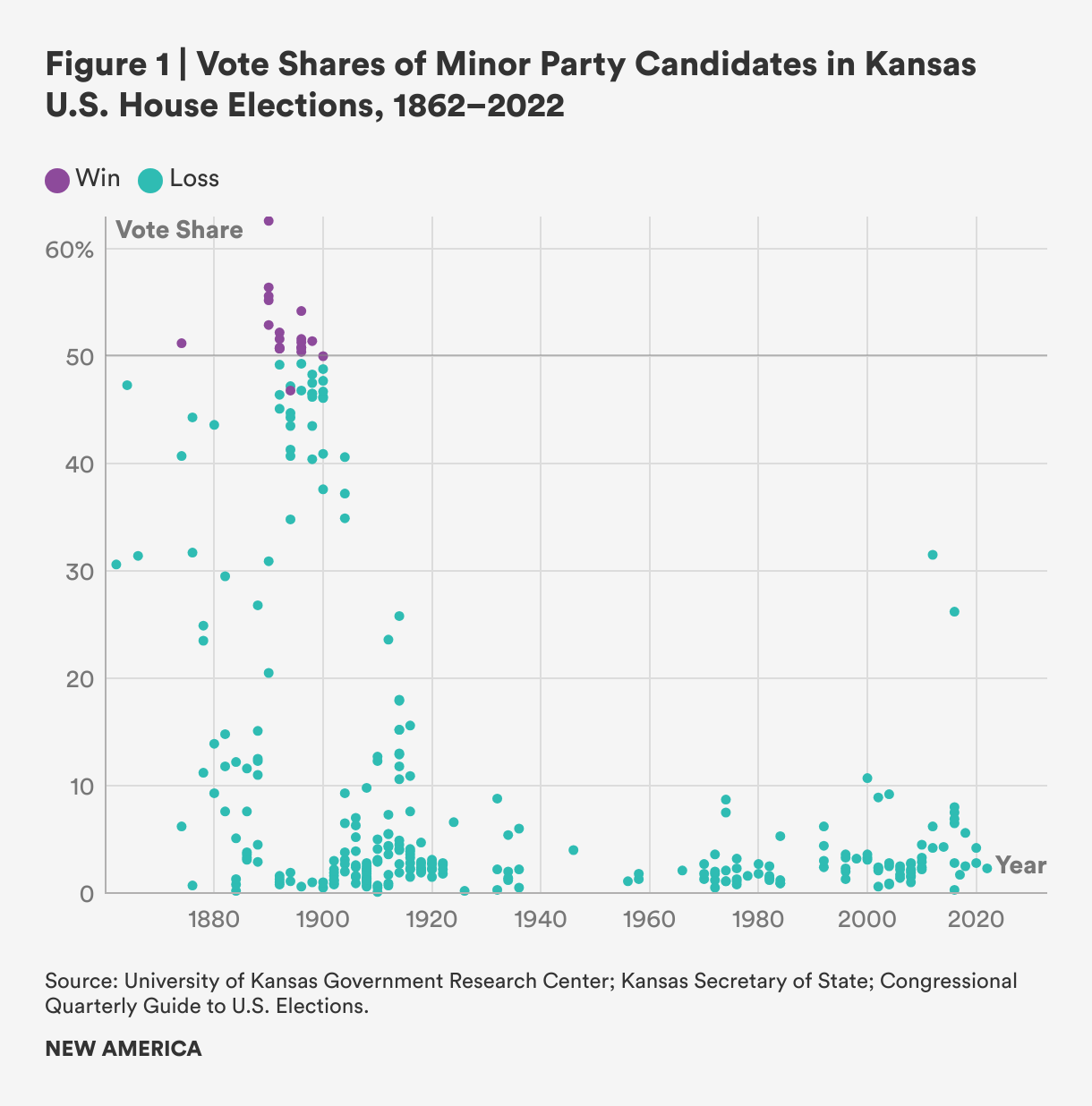
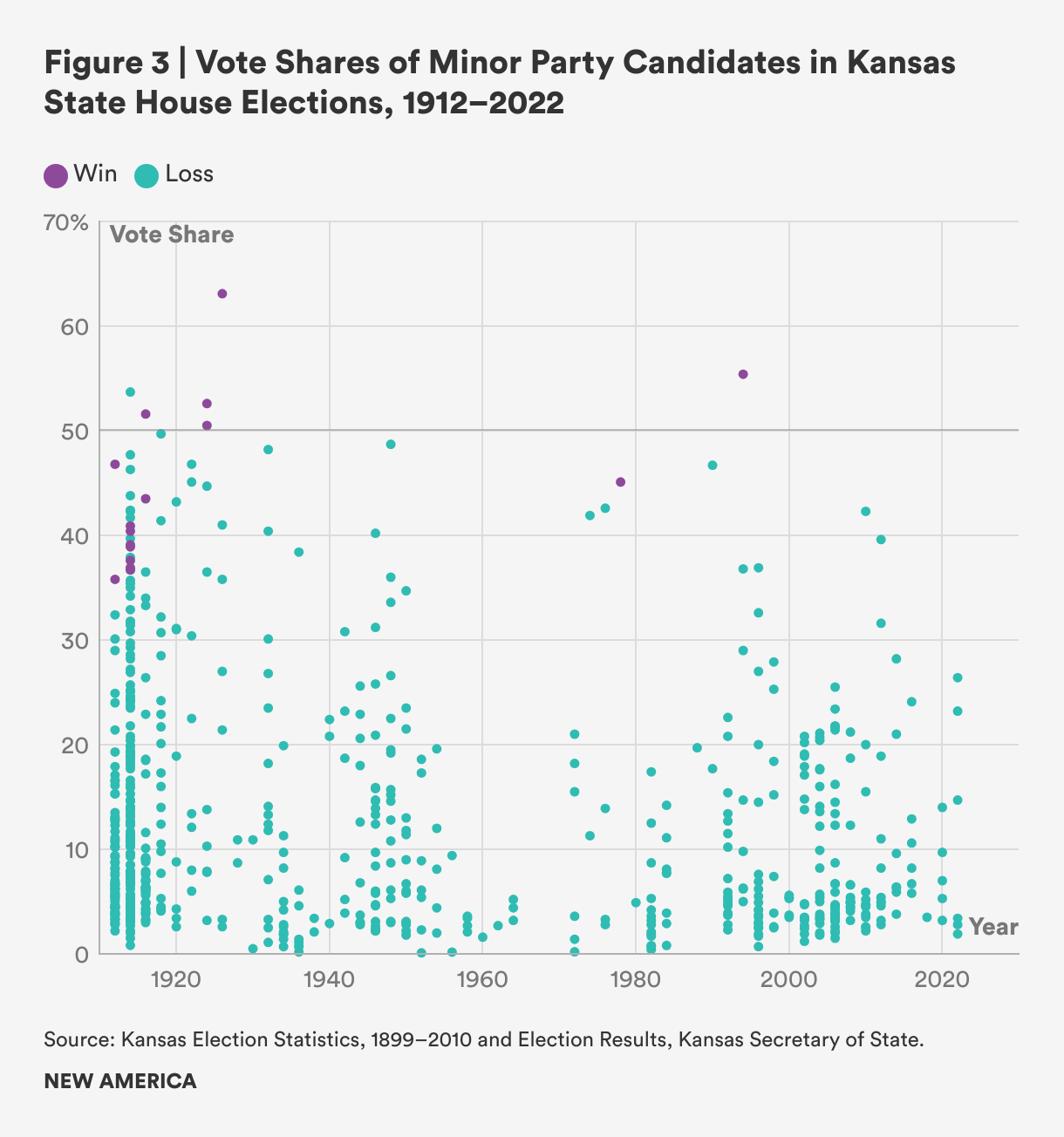
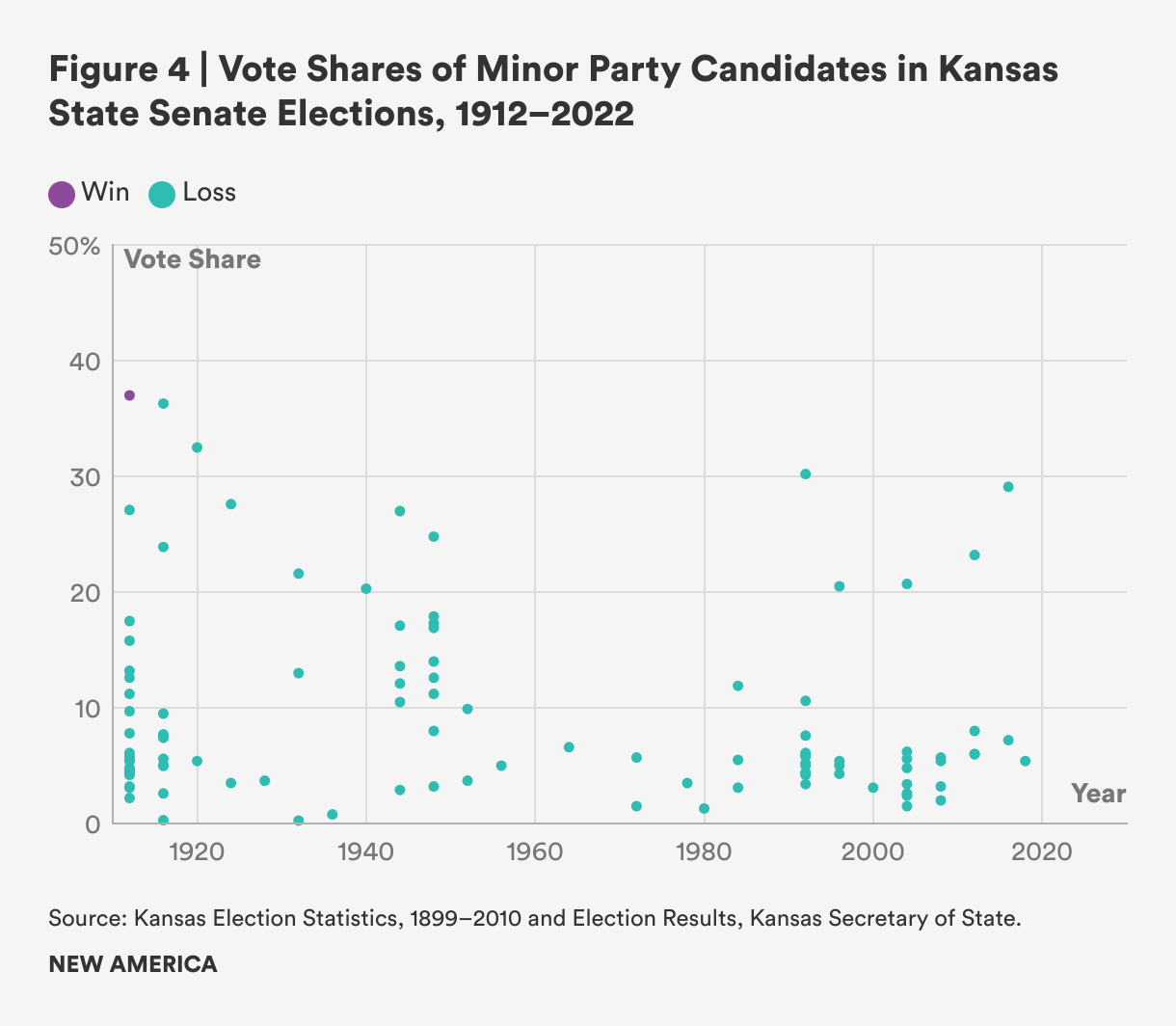
Predictably, minor-party performance in state legislative elections has likewise deteriorated since fusion’s prohibition. Since 1912, all but 17 state legislative races—99.8 percent of elections in this time period—have been won by Democratic or Republican candidates.38 As noted, there has not been a single non-Republican majority in both houses of the legislature since 1914.39 Only two minor-party legislators have served in the past 50 years.40 Before the 1901 fusion ban, minor parties not only consistently held dozens of seats in the Kansas legislature but commanded majorities several times in the last decade of the nineteenth century. In the election of 1890, for instance, Populists won 91 state representative seats, nearly 75 percent of the Kansas legislature.
Minor-party vote share in Kansas’s gubernatorial elections rivals the paltry performance of third-party candidates for the U.S. Senate. Since the 1901 prohibition of fusion, a minor-party candidate for governor has garnered more than 10 percent of the vote just five times. Compare that to the four pre-fusion ban instances where a minor-party candidate garnered over 45 percent of the vote, including two victories.
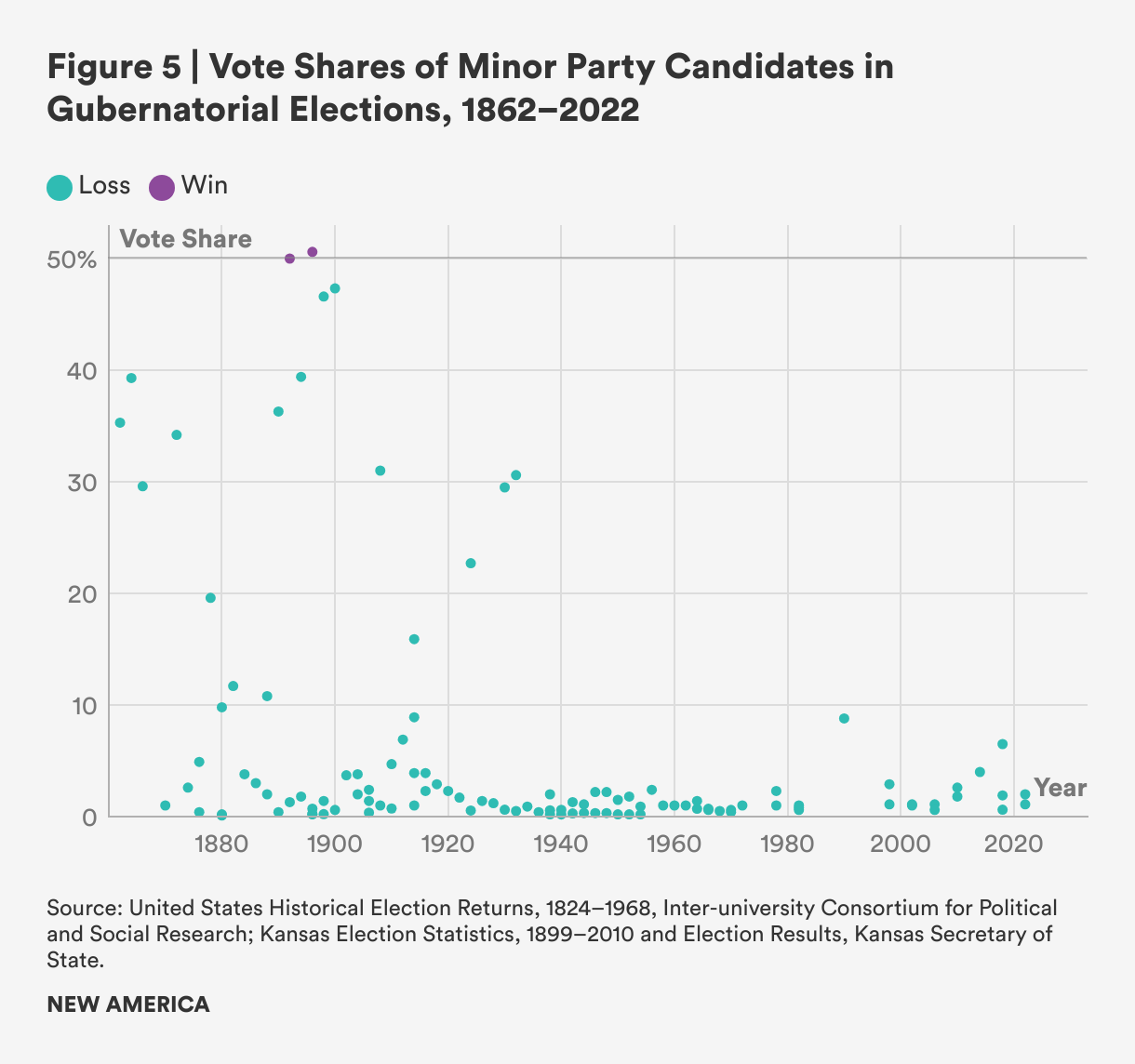
The dynamic political alliances and realignments that fusion-enabled tickets facilitated in Kansas all but disappeared following the outlaw of fusion. Minor party activity has been reduced to negligible rates.
Citations
- “Little Chance for Fusion Now: Kansas Democrats and Populists in a Stew,” St. Louis Post-Dispatch, May 4, 1902, 3, source.
- “Little Chance for Fusion Now,” source.
- Hein and Sullivant, Kansas Votes, source. Compare page 37 (1900 election vote total of 350,611) with page 39 (1902 election vote total of 287,169).
- Hein and Sullivant, Kansas Votes, source.
- Argersinger, “‘A Place on the Ballot,’” 303, source.
- Argersinger, “‘A Place on the Ballot,’” 303, source.
- Argersinger, “‘A Place on the Ballot,’” 303, source.
- Hein and Sullivant, Kansas Votes, 49, source.
- Hein and Sullivant, Kansas Votes, 52–93, source.
- Cabe and Sullivant, Kansas Votes, 70–71, source.
- See generally Kansas Election Statistics, 1899–2010 (Topeka, KS: Office of the Kansas Secretary of State, Kansas Government Information Online Library, 2021), source.
- See generally “Official Statement of Votes Cast at the General Election, November 5, 1912” in Kansas Election Statistics, 1899–2010, source.
- See generally “1976 Primary Election and 1976 General Election” and “1990 Primary and General Elections” in Kansas Election Statistics, 1899–2010, source.
- Argersinger, The Limits of Agrarian Radicalism, 175.
- Robert H. Wiebe, The Search for Order, 1870–1920 (New York: Hill & Wang, 1967), 168–170.
- Michael E. McGerr, The Decline of Popular Politics: The American North, 1865–1928 (New York: Oxford University Press, 1986).
- McGerr, The Decline of Popular Politics, 205–206, 218.
- Mark Wahlgren Summers, Party Games: Getting, Keeping, and Using Power in Gilded Age Politics (Chapel Hill, NC: University of North Carolina Press, 2004), 252, 260, 277.
- Summers, Party Games, 252, 260, 277; McGerr, A Fierce Discontent, 216.
- Ronnie W. Faulkner, “Fusion Politics,” North Carolina History Project, source.
- Faulkner, “Fusion Politics,” source.
- Faulkner, “Fusion Politics,” source.
- Faulkner, “Fusion Politics,” source.
- Faulkner, “Fusion Politics,” source.
- Faulkner, “Fusion Politics,” source.
- Faulkner, “Fusion Politics,” source.
- Faulkner, “Fusion Politics,” source.
- James L. Hunt, “Fusion of Republicans and Populists,” in Encyclopedia of North Carolina (Chapel Hill, NC: University of North Carolina Press, 2006), source.
- Compare “1896 Presidential General Election Results: North Carolina,” source, with “1904 Presidential General Election Results: North Carolina,” source, in Dave Leip’s Atlas of U.S. Presidential Elections.
- Nicholas Graham, “The Election of 1898 in North Carolina: An Introduction,” North Carolina Collection, June 2005, source.
- “The Balance of Power in N.C. Politics Since Reconstruction,” Carolina Journal, November 23, 2020, source.
- The story was essentially identical in all of the former Confederate states. All used election laws to ban Black voting and reduce ballots from poorer and less educated whites. One historian has calculated the following percentages of men not voting in elections between 1904 and 1908: Alabama, 76 percent; Arkansas, 57 percent; Florida, 75 percent; Georgia, 78 percent; Louisiana, 81 percent; Mississippi, 84 percent; North Carolina, 48 percent; South Carolina, 79 percent; Tennessee, 52 percent; Texas, 64 percent; Virginia, 72 percent. Considering that women of any race could not vote in those elections, the actual electorate was reduced to only 10–20 percent of the adult population. See J. Morgan Kousser, The Shaping of Southern Politics: Suffrage Restriction and the Establishment of the One-Party South, 1880–1910 (New Haven, CT: Yale University Press, 1974), 226.
- Cabe and Sullivant, Kansas Votes, 41, source.
- See generally Cabe and Sullivant, Kansas Votes, source.
- See generally Cabe and Sullivant, Kansas Votes, 102–147, source; Kansas Election Statistics, 1899–2010, source.
- “Election Results,” Kansas Secretary of State, source.
- Displayed data retrieved from Cabe and Sullivant, Kansas Votes, source; Kansas Election Statistics, 1899–2010, source; “Election Results,” source; John L. Moore, Congressional Quarterly Guide to U.S. Elections, 6th Edition (Washington, DC: CQ Press, 2009); “United States Historical Election Returns, 1824–1968,” Inter-university Consortium for Political and Social Research, April 26, 1999, source. Each data point represents one minor-party candidate in one race. Fusion candidates cross-nominated by several parties, including Populists, Republicans, or Democrats, are contained in this dataset and similarly represented by one point.
- Kansas Election Statistics, 1899–2010, source.
- Kansas Election Statistics, 1899–2010, source.
- Kansas Election Statistics, 1899–2010, source.