K-12 Federal COVID Relief_What Can We Learn from Doing School Funding Different
Abstract
Between March 2020 and March 2021, Congress allocated $189.5 billion for a new Elementary and Secondary School Emergency Relief (ESSER) Fund. The arrival of this federal aid was a lifeline for schools attempting to serve students amid the COVID-19 pandemic. This funding was distributed in a very different manner, and with very different rules and requirements, than we see with other forms of federal and state education aid. This report explores the most significant ways in which this funding differed from school districts’ standard funding allocations, and what those differences can teach policymakers both about how to evaluate the ESSER investment and about how to structure and manage future school funding distributions. Our conclusions are informed by in-depth interviews with a number of district and state officials involved in administering and using ESSER dollars.
Acknowledgments
This report was produced as part of the Education Funding Equity Initiative at New America, which is supported by the Bill & Melinda Gates Foundation. New America thanks the foundation for its support. The findings and conclusions contained within are those of the author and do not necessarily reflect positions or policies of the foundation. The author would like to thank Sabrina Detlef for her copyediting support; Katherine Portnoy, Amanda Dean, and Naomi Mourduch Toubman for their communications and data visualization support; and Chad Aldeman, Jess Gartner, Qubilah Huddleston, and Christine Pitts for their thoughtful review of an earlier draft of this report. Special thanks to all those state and district officials who shared their time and reflections in interviews, including Hannah Barrick, Amanda Brownson, John Carlson, Alex Charles, Audra Chilton, Jeni Corn, Dorrell Green, Matthew Lentz, Tracy O’Connell Novick, Keri Randolph, Travis Reeves, and Miriam Rubin, among others.
Downloads
Executive Summary
Between March 2020 and March 2021, Congress allocated $189.5 billion for a new Elementary and Secondary School Emergency Relief (ESSER) Fund. The arrival of this federal aid was a lifeline for schools attempting to serve students amid the COVID-19 pandemic. This funding was distributed in a very different manner, and with very different rules and requirements, than we see with other forms of federal and state education aid. This report explores the most significant ways in which this funding differed from school districts’ standard funding allocations, and what those differences can teach policymakers both about how to evaluate the ESSER investment and about how to structure and manage future school funding distributions. Our conclusions are informed by in-depth interviews with a number of district and state officials involved in administering and using dollars.
Though approximately one year still remains in the grant term, it is important to begin considering what can be learned from this period. Lawmakers are already proposing significant changes to school funding policy based on an incomplete assessment of the ESSER experience. Now is the time to make sure that our understanding of it is accurate and thorough, and to learn what we can about how to construct school funding policies for the greatest impact.
Our research into the ESSER experience yielded policy lessons in four areas:
- Purpose: the need to define an investment’s goals and evaluate its use accordingly. While the relief dollars were intended to help manage the effects of the pandemic on schools, this meant different things at different points. Initially, the focus was on health and safety. Over time, pandemic response came to include mental health support and academic recovery. Meanwhile, ESSER dollars were also part of, and meant to support, larger economic stimulus efforts. More recent discourse has focused primarily on the efforts to address the effects of disrupted learning, but when evaluating the return on the ESSER investment, policymakers should recall the full range of goals that districts sought to achieve.
- Size: the consequences of providing funds in such large amounts, and how best to do so. The size of the ESSER allocations affected district choices and experiences in three main ways. First, some interviewees felt that the spending timeline was too short for such a large grant, and that may have undermined longer-term academic recovery efforts. Second, the large amount of money created opportunities and challenges with regard to spending decisions. It enabled districts to spend both on new priorities and on addressing long-standing problems that were exacerbated by the pandemic. However, because the majority of districts’ expenses are for staff, deploying the full amount effectively often meant using short-term dollars for hiring and salaries, and accepting the risk of layoffs after the end of the grant term. Third, the size of the grant strained district finance teams, which saw an increase in workloads and turnover; districts would have benefitted by reserving some grant funds for administrative costs.
- Timing: the impact of deadlines, delays, and the simultaneous funding of different entities. The limited-time nature of the relief prompted many districts to attempt new or experimental initiatives—something that could be further encouraged through good guidance about evidence-based strategies. Districts generally spent the first ESSER allocation quickly, on urgent health and safety needs. Subsequent allocations saw delays related to planning challenges, difficulty hiring, and materials shortages. Simultaneous funding of so many districts at once was also a factor: They faced competition for staff, materials, and contractors, which sometimes disadvantaged high-need districts. When possible, policymakers should consider prioritizing higher-need school districts in disbursement schedules. Since states, counties, and towns received pandemic relief funding alongside school districts, there were chances for collaboration and coordination. These opportunities can be fostered in the future through purposeful, simultaneous funding of different government entities responsible to the same community.
- Flexibility: how to give latitude without engendering wasteful spending. One of the distinguishing features of ESSER funding was its flexibility, at least at the level of formal usage requirements and limitations. In reality, however, district leaders encountered constraints along the way. First, most general requirements for spending federal money still applied. Some states applied their own preexisting requirements or added new processes for receiving or using ESSER dollars. And some expenditures that were formally allowed were impeded by a lack of clarity about the rules. Still, districts did make use of the latitude afforded to them, which had the effect of heightening existing local strengths and weaknesses. Districts where leaders had experience handling flexible funds were more prepared to make good use of ESSER money; districts whose leaders were not ready and eager to implement fresh ideas were less able to do so. One important form of flexibility with these funds was the unusual ability to use ESSER dollars for both operational and capital expenses. Given the importance of school facilities for student learning, this ability should be far more common.
ESSER money differed greatly from the school funding norm. Now is the time to consider what policymakers can learn from this experience.
Introduction
On March 13, 2020, Governor John Carney of Delaware added his state to the growing list of those closing schools to slow the spread of COVID-19.1 Teachers had been making contingency plans all week, bringing home laptops and chargers each night and distributing work packets for students to complete at home in case school was canceled before the next morning. When the order came down, the closure was to last two weeks, from March 16 to 27.
On Monday, March 30, school doors were still closed. Dorrell Green, Superintendent of Red Clay Consolidated School District—the state’s largest district, serving a slice of the city of Wilmington and its western suburbs—was not surprised. He and his team had already begun to make plans for a longer haul, starting the process of purchasing laptops for students and reaching out to experts in online teaching. By the end of April, the state announced that there would be no return to in-person learning that school year.2
In Red Clay, as in most districts, the transition was not without its challenges. Green initially announced that remote-learning grades could only boost, not lower, students’ grade point averages so as not to disadvantage those who were having trouble logging on; some parents were displeased, seeing the policy as a retreat from rigorous academic standards.3 That summer, the district surveyed families to see how many lacked reliable internet—about 400, it turned out—and sought grant money from the county to help with internet connectivity.4
Red Clay entered the fall of 2020 with a new host of challenges. It was trying to operate a hybrid system with both remote and in-person learning options, and there were stumbles on both sides. Instead of virtual instruction from a classroom teacher, Red Clay initially offered remote learners self-directed learning on a web-based platform. Parents pushed back, wanting live teaching, and district leadership had to quickly make adjustments In-person learning began in November, then was shut down again by order of the governor in December.5 In the meantime, over 100 Red Clay students and staff had tested positive for COVID-19. Alongside these challenges, however, the district now also had some support: The first federal relief dollars had arrived.
When Red Clay reopened for hybrid learning in January 2021, in-school students stopped at new dispensers to sanitize their hands, wore masks at group-work tables divided by plexiglass barriers, and stayed three feet apart on spots marked by floor decals.6 Remote students logged in from home for virtual learning along with their in-person peers, and office staff fielded calls about new virus cases and reached out to close contacts of COVID-positive students and staff. By May, the district had pivoted from spending relief dollars on safety measures to focus on learning recovery, which Green knew would be a much longer-term project.7 It is an effort that is still ongoing.
The arrival of federal aid was a lifeline for schools attempting to continue serving students amid these new and difficult circumstances. Between March 2020 and March 2021, three COVID relief bills were signed into law, each including funding for schools through the new Elementary and Secondary School Emergency Relief (ESSER) Fund.8 (These allocations are sometimes called by the names of their authorizing bills, or more colloquially, as ESSER I, ESSER II, and ESSER III.) This support was unprecedented in its swiftness and its size.
Each aid package was larger than the last, and in total, Congress allocated $189.5 billion in ESSER dollars. From the start of the ESSER I spending period to the end of the ESSER III spending period, the money was available for use over a period of four and a half school years.9 The largest and final tranche, ESSER III, must be fully spent by January 28, 2025, barring any specially granted extensions.
The grant funds were disbursed to state departments of education with a legislative mandate to pass 90 percent of the money directly to local education agencies (that is, school districts and charter schools) with the urgent but expansive purposes of helping them to reopen schools, continue operating amid the COVID-19 pandemic, and address the many harmful effects of the pandemic on students.10 To apportion the funding, lawmakers used readiest federal tool for targeting the students with the greatest needs: the Title I formula, which usually determines the annual aid for districts serving students in poverty. The grant dollars were split among districts in proportion to their prior-year share of Title I funds.
This money was vital for district leaders like Superintendent Green, allowing him and his team to establish safer learning spaces and support students personally and academically. However, it was also an enormous challenge for school systems around the country to spend and manage this funding to best effect in the context of the ongoing pandemic and rising economic challenges, which included illness and absences among students and staff; intensifying student needs in a range of areas; staff turnover and hiring challenges; supply chain disruptions; and state budget unpredictability. Some critics, including researchers, interest groups, and even members of Congress, have questioned whether ESSER funding has been spent quickly or well enough, reviving older conversations about whether school funding investments actually yield valuable returns for students.11 The fact is, though, that ESSER funds were not a typical school funding investment. This funding was distributed in a very different manner, and with very different rules and requirements, than we see with other forms of federal and state education aid.
We already know that ESSER money helped districts continue operations during the height of the COVID-19 pandemic, maintain adequate staffing, and provide new services to struggling students. The ultimate effects of the funds on student welfare and academic achievement will not be fully known until education officials and policy researchers are able to consider several years of post-ESSER data, including indicators like standardized test scores, attendance rates, and mental health survey results. This report seeks to fill in the knowledge gap between the immediate and the long term: to determine the most significant ways in which this funding differed from school districts’ standard funding allocations, and what those differences can teach policymakers about both how to evaluate the ESSER investment and how to structure and manage future school funding distributions.
Though approximately one year still remains in the grant period, it is important to begin considering these lessons now. Some lawmakers have already rushed to judge districts’ handing of the money, pointing to as-yet unspent relief fund balances as justification for massive proposed cuts to regular federal education aid.12 Meanwhile, leaders in a few states have proposed rejecting all federal K-12 funding, arguing that the money carries too many conditions.13 With such radical changes under consideration, now is the time to make sure that our understanding of the ESSER period is accurate and thorough, and to learn what we can about constructing better school funding policies going forward.
Our research into the ESSER experience yields important policy lessons. One is the need to define an investment’s purpose and evaluate its use accordingly. A second area of learning is the consequences of providing funds in such large amounts, and how to do so to best effect. A third is the impact of timing factors like spending deadlines and simultaneous funding of many different government agencies, and how to adjust timelines for greater equity and effectiveness. The final lessons relate to making funding available for truly flexible use without engendering wasteful spending.
To arrive at these conclusions, we conducted in-depth interviews with a number of district and state officials involved in administering and using dollars. Interview subjects included district leaders (superintendents, chief finance officials, and one school board member) from nine districts; multi-person teams in two state education agencies; and senior staff at two state affiliates of the Association of School Business Officials. Interviewees came from nine states, including red, blue, and purple states. Local leaders came from urban, suburban, and rural districts, with enrollments ranging from approximately 3,000 to over 80,000. Total ESSER allocations among interviewees’ districts were under $4 million in the smallest instance and over $400 million in the largest.14 To contextualize interview responses, we also reviewed ESSER rules, regulations, and guidance; general rules regarding the use of federal dollars; and academic studies about federal education aid.
It is important to note at the outset that while the various practitioners interviewed had different experiences receiving, budgeting, and using these funds, they were quick to express gratitude for the money. Those who led school districts and state education agencies during the height of the COVID-19 pandemic generally felt that if they had not received these funds, the result would have been far worse outcomes for students.
Citations
- Natalia Alamdari, “Governor Orders Delaware Schools to Close for Two Weeks in Response to Coronavirus Outbreak,” Delaware News Journal, March 14, 2020, source.
- Natalia Alamdari, “What Can Delaware Students Expect next School Year? Lots of Assessments and Review,” Delaware News Journal, May 1, 2020, source.
- Natalia Alamdari, “More Delaware Students Than Ever Are Failing Because of COVID-19 Pandemic,” Delaware News Journal, December 5, 2020, source.
- Cris Barrish, “New Castle County Offers Schools $4.3 Million in Distance Learning Grants,” WHYY, August 28, 2020, source.
- Cris Barrish, “‘Too Much Too Fast’: Teachers Union Objects to Delaware Schools’ Hybrid Return,” WHYY, January 13, 2021, source.
- WITN, “Red Clay Keeping Kids Safe from COVID in Hybrid Learning,” YouTube, January 29, 2021, source.
- Larry Nagengast, “Schools Grapple with Helping Students Bounce Back from COVID Compromised Learning,” Delaware Public Media, October 20, 2021, source.
- Office of Elementary & Secondary Education (website), “ESSER Reporting,” last modified June 13, 2023, source.
- Office of Elementary & Secondary Education (website), “Deadlines and Announcements,” last modified October 4, 2023, source.
- Mark Washington, “Final Requirements-American Rescue Plan Act Elementary and Secondary School Emergency Relief Fund,” Federal Register 87, no. 110 (June 8, 2022): 14790–94, source.
- See, for example, Lauren Lumpkin and Sahana Jayaraman, “Schools Got $122 Billion to Reopen Last Year. Most Has Not Been Used,” Washington Post, October 26, 2022, source; Marguerite Roza and Katherine Silberstein, “A Year Ago, School Districts Got a Windfall of Pandemic Aid. How’s That Going,” Brookings, March 31, 2022, source; Ryan Lanier, “School Districts are Wasting COVID Relief Funds,” The Hill, November 7, 2021, source; Committee on Oversight and Accountability (website), “Comer & Foxx Reveal New Evidence of COVID Relief Dollars Funding Woke Initiatives,” press release, October 11, 2022, source; and Casey Harper, “Questionable COVID Relief Spending Allegations Pile Up,” The Center Square, April 12, 2023, source.
- Matt Barnum, “House Republicans Seek 80% Cut to Federal Programs for Students From Low-Income Families,” Chalkbeat, July 14, 2023, source.
- Vivian Jones, “Tennessee Gov. Bill Lee Open to Rejecting $1.8B in Federal School Funding, Cites ‘Excessive Overreach,” The Tennessean, September 27, 2023, source; Kara Arundel, “Just Say No: Oklahoma Considers Rejection of Federal Ed Funding,” K–12 Dive, February 6, 2023, source; and Sara Gregory, “Weaver Says SC Should Consider Rejecting Federal Education Funding,” The Post and Courier, November 6, 2023, source.
- ESSER funding amounts throughout the brief sourced from United States Department of Education, Education Stabilization Fund Data Download: ESF-SEA (2021) Data File (December 2022), distributed by the Education Stabilization Fund (ESF) Public Transparency Portal, source.
Purpose: What Was the Money For?
The bottom-line purpose of ESSER funding was, of course, emergency relief. The swiftness of the federal response reflected this urgency. Tracy O’Connell Novick, a school board member of Worcester Public Schools in Massachusetts, noted how unusual this was: “The uniformity, everybody deciding together that this was important enough, that they needed to do it and do it fast, was kind of a novelty, at least in my experience in observing the federal government.” Still, that uniformity soon gave way to a more complex reality. The emergency was fast-moving, and the measures needed to address it changed over time. Additionally, districts were expected to achieve a broad range of objectives with the funding, and at times, they found these to be in conflict.
Shifting Purposes
Jeni Corn serves as the Director of Research and Evaluation for the new, ESSER-funded Office of Learning Recovery and Acceleration at the North Carolina Department of Public Instruction. Speaking about the evolving nature of the crisis, she referenced the words of former West Virginia Governor Bob Wise,1 saying, “ESSER I was really triage, and then ESSER II was about transition, and then ESSER III was around transformation.” She explained that ESSER I was largely devoted to safety and health measures, and ESSER II was about the return to in-person learning ESSER. III brought a pivot to thinking about research-backed, innovative ways to advance student learning and well-being.
As the early days of the pandemic recede in the public mind, it’s important not to discount both the necessity and the difficulty of the initial triage phase. Amanda Brownson, associate executive director of Policy & Research for the Texas Association of School Business Officials, remembered “what districts were up against…trying to get kids to log in [for remote learning]. And then, after we were done logging in, to come to school when their parents were still, in many communities, afraid of letting them out of the house. And then, trying to get staff into buildings.” She said, “it's very hard to tell people, ‘Lock down. Don't get within six feet of anybody else, even if you're outside,’ [and then] to pretty quickly [transition to saying], ‘No, it's fine. You can be in a classroom full of 20 people, no worries.’” She concluded, “Don't discount how hard it was just to keep the doors open and the buildings open and the trains on the tracks.”
Later that first year, though, it became clear that schools and districts would need to address the pandemic’s broader impacts on students. Multiple interviewees recalled that their earliest expenditures were on establishing safe learning environments (including by shifting to remote learning; investing in masks, sanitizing, and COVID testing; creating classrooms in expanded areas or outdoors to facilitate social distancing; and seeking to clean indoor air). Their later efforts, though, focused more on learning acceleration—especially through tutoring, summer learning, and curriculum changes—and on addressing the mental and behavioral health impacts on students of social isolation and grief. Federal rules reflected these shifting priorities. It was only with ESSER III, signed into law in March 2021, that Congress introduced a requirement for a large portion of the money (20 percent of that tranche) to be spent on “addressing learning loss” rather than just dealing with the immediate practicalities of the pandemic.2
Conflicting Purposes
The relief dollars were also intended to support multiple goals, some of which may have been in conflict with each other. While ESSER funding was narrowly meant to help manage the effects of the pandemic on schools, it was also provided through legislation intended to simulate the economy. This second goal was widely understood to be part of the purpose of the ESSER money. For instance, the National Conference of State Legislatures, the National League of Cities, and several state departments of education have referred to ESSER funds or their authorizing legislation as “stimulus.”3 Brownson said that purpose loomed large for districts, and added, “I think there were real and legitimate concerns that we were about to head into a very serious recession,” and “the need to get those dollars out into the economy quickly is one that you can't totally disregard as you think about what pressures districts were under to spend.” That imperative, though, cut against the need to deploy these resources thoughtfully and effectively.
To better understand this conflict, it’s instructive to compare ESSER with two other one-time federal education funding allocations that were referenced often by interviewees: the general education stabilization funds provided as part of the American Recovery and Reinvestment Act (ARRA) during the Great Recession in 2009, and Race to the Top (RTTT) funding, a competitive grant program during the Obama administration meant to incentivize states and ultimately districts to enact transformational changes to improve academic outcomes.4
When the Center for Education Policy looked back on ARRA’s education stabilization investment, it described the fund’s goal as “to restore the total level of public education funding” to what it was before state and district revenues were hit by the recession, with the chief aim of “saving or creating K–12 teaching jobs and other education-related jobs,” though districts were secondarily encouraged to pursue academic improvement.5 Initially, many expected ESSER funds (especially the earlier tranches of ESSER funds) to serve this purpose, and it was a core argument for increased federal support. In April 2020, after the passage of the first ESSER allocation, education finance expert Mike Griffith warned in a blog post for the Learning Policy Institute that since “the International Monetary Fund has predicted that this will be the worst economic downturn since the Great Depression,” COVID “will impact state tax revenue and thus result in reduced state P–12 education spending.” He added, “While the additional federal funding is helpful, it is not nearly sufficient to make up for potential state budget cuts.”6 Other commentators had similar worries.7
Ultimately, though, state budgets didn’t take nearly the predicted hit.8 The economics of the pandemic weren’t as expected, and much of the anticipated revenue loss was mitigated by other elements of the relief packages, like direct aid to taxpaying individuals and businesses. As a result, attention shifted—as did expectations for districts’ use of ESSER funds. After ARRA, the White House celebrated that “the rapid distribution of [State Fiscal Stabilization] funding helped fill the gaps and avert layoffs of essential personnel in school districts and universities across the nation.”9 Many school districts also used ESSER dollars to keep teachers on staff, but that isn’t often cited as a success of the funding.
This may be an instance in which hindsight is unkind to districts’ rational, in-the-moment decision-making. COVID brought a sudden shock to districts’ enrollment and attendance rates, negatively impacting district budgets in many places because state aid amounts are largely calculated based on student counts.10 This also affected individual schools’ budgets in districts with a similar funding approach. For example, Boston Public Schools determines its allocations to schools mostly based on enrollment, adjusted to account for differences in student characteristics. Miriam Rubin, former budget director of the district, said,
We knew that schools and students were experiencing a lot of uncertainty, so we made a decision early on to do as much as we could to reduce the impact of enrollment declines on school budgets. We provided money to hold schools harmless for the declines and avoided making large cuts. But it was tricky, because the conversation with schools was like, “Wait, you're going to fill in a million-dollar budget gap for me for how long?” And we were like, “I don't know.” So people were worried about that. But the fact that we didn't have to create more instability in those years was huge.
It was hoped, and expected, that student numbers would bounce back as the pandemic abated, but it was not to be.11 The most recently available federal data indicates that public K–12 enrollment declined by about 1.2 million students from 2019 to 2021, or about 2.4 percent—an immense percentage drop, one not seen the Second World War.12 While actual enrollment data for subsequent years are not available as of this writing, it is clear that the federal government has lowered its expectations. In the year before the pandemic, the National Center for Education Statistics predicted that public K–12 enrollment would be 49.2 million students in 2024 and would hold steady for the following five years.13 By 2023, that projection for 2024 had been cut to 47.4 million, with an expected loss of 1.7 million more students five years later.14
If enrollment had actually rebounded as expected, using ESSER dollars to maintain budgets and staffing levels would likely have been seen as a prudent, short-term stabilization choice. John Carlson, chief administrative officer of Rochester Public School in Minnesota, said, “Like most districts in America, we were not planning to be a smaller school district in the fall of 2020 than we were in the spring of 2020… I’ve worked here 12 years, and every year we’ve counted on another hundred kids, another hundred kids. It kept growing naturally, organically, over time. So yes, we should have cut some at the end of 2020, but we had no data to tell us that we were going to drop 660 students, so therefore we should also reduce some of our staff.” Now that enrollments haven’t rebounded, however, this approach is being reevaluated in some corners as irresponsible can-kicking or a failure to adjust to new trends.
Instead of judging budget stabilization as a successful use of federal funding in the mold of ARRA, ESSER is now being evaluated more in the vein of Race to the Top. Much as that grant program tried to foster school transformation, people want to know what this funding is going to do to reinvent the school experience.15 In part, this is driven by the fact that the ESSER III allocation, the largest tranche, came at a slightly better economic moment and included a specific focus on addressing the academic effects of interrupted learning. And with such a huge disruption to the normal business of schooling, it’s reasonable to wonder not just how we will come back from this pandemic, but what will be different, and better, when that process is complete. Many districts, in fact, did use ESSER funding to support experimentation and innovation, as discussed below. Still, it is important to be clear about the purposes of the funding. ARRA was meant for economic stimulus and fiscal stability. RTTT was intended to spur transformation and academic improvement. ESSER was expected to do both. We should recall both purposes when evaluating the investment’s returns.
Citations
- Rishabh Chatterjee, “Public School Transformation Now Kickoff,” National School Boards Association, November 20, 2020, source.
- Office of Elementary & Secondary Education, U.S. Department of Education Fact Sheet: American Rescue Plan of 2021: Elementary and Secondary School Emergency Relief Fund (ARP ESSER), (Washington, DC: U.S. Department of Education, March 11, 2021), 2, source.
- See, for example, National Conference of State Legislatures (website), “Elementary and Secondary School Emergency Relief Fund Tracker,” updated January 25, 2022, source; National League of Cities (website), “American Rescue Plan Act,” source; California Department of Education (website), “Federal Stimulus Funding,” last reviewed May 5, 2023, source; State of Vermont Agency of Education (website), “American Rescue Plan Act (ARPA) Fund Hub,” source; and Louisiana Department of Education, “Pandemic Relief Stimulus Funding Overview: Budget Hearings 2021,” source.
- U.S. Department of Education, “Fiscal Year 2011 ED Budget Summary—February 1, 2010: II. The American Recovery and Reinvestment Act of 2009,” source; and The White House of President Barack Obama (archived website), “Race to the Top,” source.
- Diane Stark Rentner and Alexandra Usher, What Impact Did Education Stimulus Funds Have on States and School Districts? (Washington, DC: Center on Education Policy, July 2012), 3, source.
- Mike Griffith, “COVID-19 and School Funding: What to Expect and What You Can Do,” Learning in the Time of COVID-19 (blog), Learning Policy Institute, April 22, 2020, source.
- Marguerite Roza, “How the Coronavirus Shutdown Will Affect School District Revenues,” Brown Center Chalkboard, Brookings, April 9, 2020, source.
- Jeffrey Clemens, “The Resilience of State and Local Government Budgets in the Pandemic,” EconoFact, March 29, 2022, source.
- Educational Impact of the American Recovery and Reinvestment Act (Washington, DC: Domestic Policy Council (Barack Obama White House) and the U.S. Department of Education, October 19, 2009), 4, source.
- As noted by the National School Boards Association, some states compensated for these losses with policies that held districts harmless for these losses in state aid calculations; these extra state dollars were themselves often drawn from state ESSER and other COVID relief funds. How States Implement Hold-Harmless Provisions in 2020 and 2021 (Alexandria, VA: National School Boards Association, 2021), 1-2, source.
- Anya Kamenetz, “Enrollment Is Dropping In Public Schools Around the Country,” NPR, October 9, 2020, source; Kalyn Belsha, Gabrielle LaMarr LeMee, and Annie Ma, “After Enrollment Dips amid COVID, Schools Hope for Rebound,” Chalkbeat, June 16, 2021, source; and California Department of Education (website), “California Department of Education Releases 2020–21 Statewide School Enrollment Data,” news release, April 22, 2021, source.
- National Center for Education Statistics, "Table 203.10. Enrollment in Public Elementary and Secondary Schools, by Level and Grade: Selected Years, Fall 1980 through Fall 2031," source; and Libby Stanford, “School Enrollment Crashed in Fall 2020, the Steepest Drop since 1943,” Education Week, June 10, 2022, source.
- National Center for Education Statistics, "Table 203.10. Enrollment in Public Elementary and Secondary Schools, by Level and Grade: Selected Years, Fall 1980 through Fall 2029," source.
- National Center for Education Statistics, “Table 203.10.”
- See, for example, Linda Darling-Hammond, Abby Schachner, and Adam K. Edgerton, “Reinventing School in the COVID Era and Beyond,” Learning in the Time of COVID-19 (blog), Learning Policy Institute, September 15, 2020, source; and Jenny Curtin Melanie Dukes and Saskia Levy Thompson, “Not Just Recovery, But Reinvention: Lessons in COVID School Innovations,” The 74, November 2, 2021, source.
Size: More Money Than Ever Before
Several interviewees, when asked about the key differences between their experience with ESSER funding and general school funding, pointed to the sheer size of the allocation. In total, the three COVID relief bills included $189.5 billion for ESSER: $13.2 billion in the Coronavirus Aid, Relief, and Economic Security (CARES) Act, $54.3 billion in the Coronavirus Response and Relief Supplemental Appropriations (CRRSA) Act, and $122 billion in the American Rescue Plan (ARP) Act, all signed into law within a 12-month period.1
Whether this is truly a lot of money is a matter of perspective. As some observers have noted, it amounts to approximately 6 percent more (about $856) per pupil for annual spending on average over the course of the four-and-a-half-year grant cycle—not necessarily a game-changing increase.2 Still, interviewees comparing it to standard federal distributions had good reason to think of it as a very large amount of money to administer and spend. In 2019, the last year untouched by COVID aid, the entire federal government contribution to K–12 school district funding was $57.9 billion, less than a third of the ESSER total and only 37 percent more than a one-year share of the ESSER dollars.3 The largest single federal funding category is Title I funding, which in 2019 was $14.07 billion.4 Four and a half years of funding at that level would be $63.3 billion, and ESSER is almost exactly triple that. The largest share of the relief dollars came last—ESSER III comprised $122 billion out of the $189.5 billion total—and was made available for use all at once, starting with the 2022 budget year (Figure 1).5
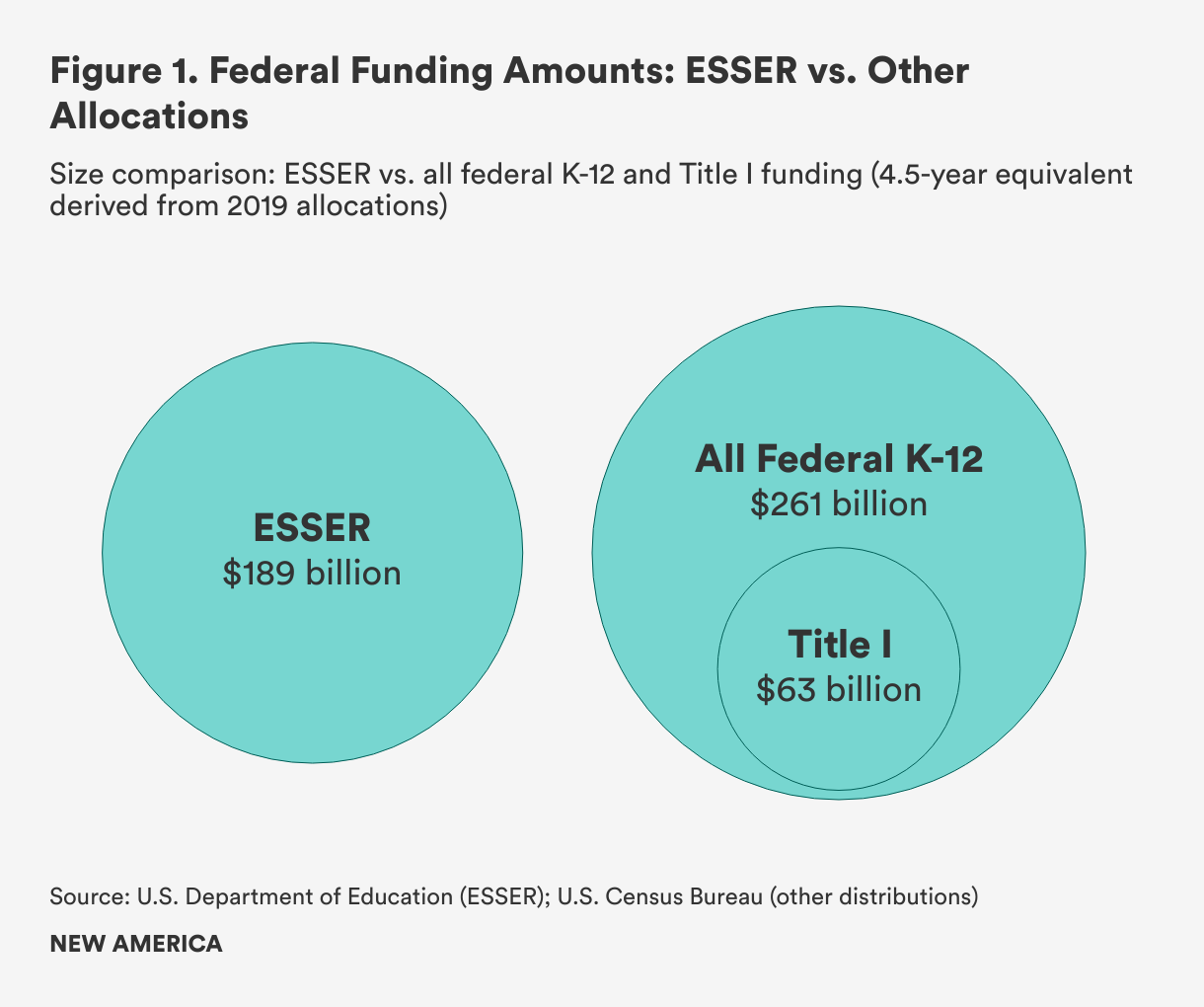
This large infusion of funds demonstrates policymakers’ recognition of the scale and urgency of the problem. The size of districts’ ESSER allocations also affected district officials’ experiences of spending, including their navigation of spending timelines, their usage choices, and their administration of the money.
An Unusually Large Amount, On a Deadline
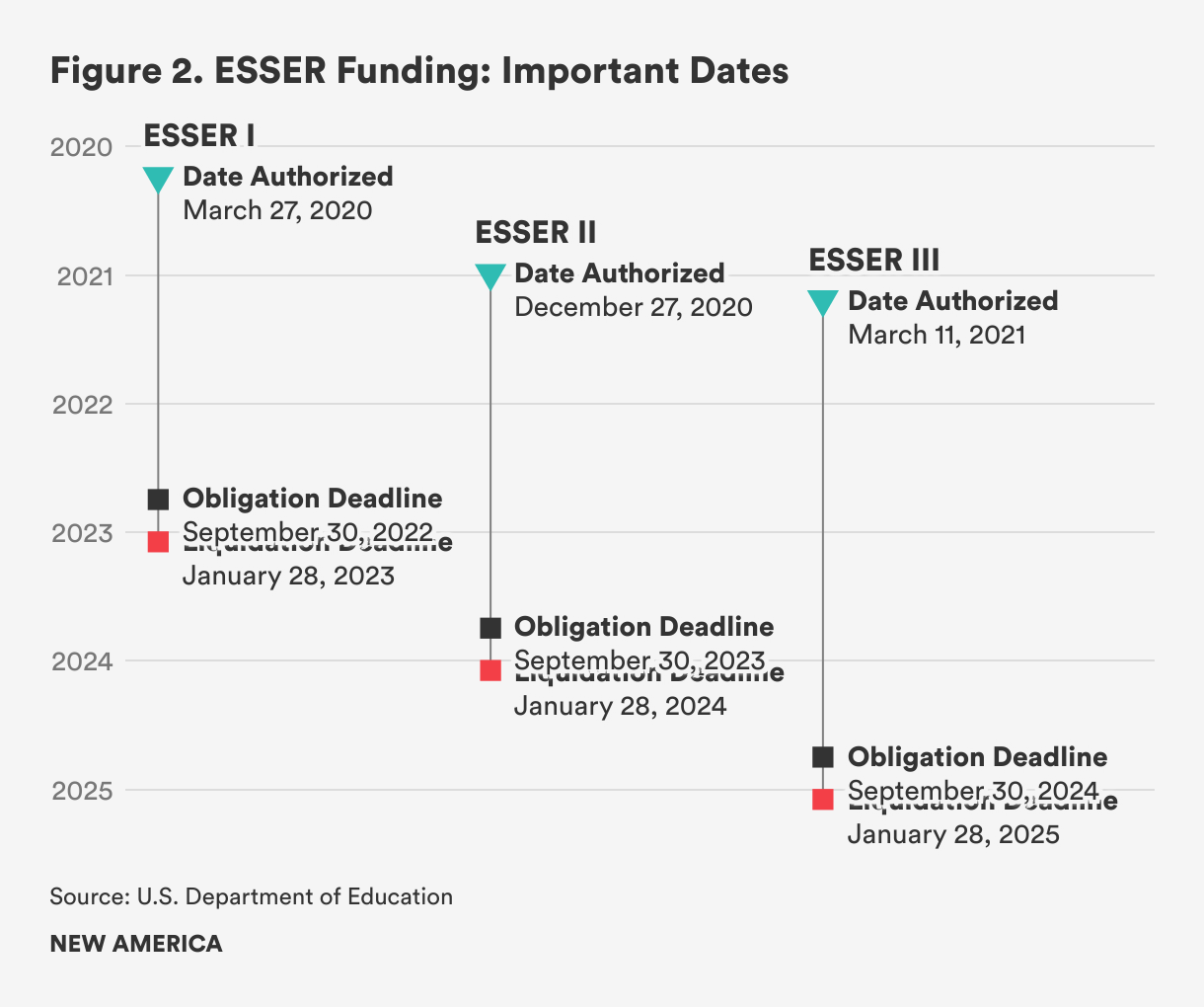
Broadly, districts were given 4.5 years to spend ESSER funding, though the different allocations came with different deadlines. Obligation deadlines for the first two tranches of funding have passed.6 (“Obligation” occurs when the district has a binding commitment to spend the money; this can occur when services are received, as when an employee works and is entitled to pay, or when a contract is made that will require payments in the future.)7 The largest portion, ESSER III, must be obligated by September 30, 2024 and fully spent 120 days later (Figure 2).8 The relatively short spending timeline reflected Congress’ urgency about addressing an immediate problem.
Some interviewees, especially those who received smaller allocations, felt they had enough time to make good use of the funds. Matthew Lentz is chief financial officer and board secretary of Upper Moreland School District in Pennsylvania, which enrolls just over 3,000 students and received a total of $3.7 million in ESSER funds. He explained that in the early part of the pandemic, outlays were unpredictable as the district dealt with sudden safety and technology expenses, as well as increases in staff costs as new employees were needed to cover for others’ paid medical leaves. Given all that, he said, it was beneficial to have aid that came quickly but didn’t come with immediate spending mandates. “I think because it rolled out and there were laddered deadlines” for the different ESSER allocations, he said, “that really helped you to incorporate it in your budget cycle. And we really made it a point to identify, year to year, what we were spending.” For Upper Moreland, Lentz said, four and a half years was a reasonable timeline, allowing the district to plan and spend intentionally.
Other interviewees, though, felt that the timelines for spending the funds weren’t appropriate for such a large grant. Districts were repeatedly warned about the “fiscal cliff,” the time at which the ESSER money would be gone and district budgets would drop precipitously. To avoid running short of operational dollars after the relief dollars run out, districts have been advised by many experts to direct these funds to one-time expenditures rather than recurring costs.9 But Hannah Barrick, executive director of the Pennsylvania Association of School Business Officials, represented the views of several respondents when she said, “While [it was] fantastic that schools had these resources to be able to get through COVID and then try to recover… those big Title I districts got so much money in such a short amount of time. [It’s] really hard to spend hundreds of millions of dollars on one-time expenditures within that window.” One of her chief takeaways from the ESSER period was that spending timelines should match the size of the allocation. Spending well and responsibly in the time frame provided, she said, “probably made this already really chaotic period of COVID and post-COVID a lot more challenging than it needed to be… and just a lot of chaos in terms of how to spend dollars well in the best interest of students.” This difficulty affected districts’ choices about how to use the funds, as discussed in the next subsection.
Deadlines are a particular issue in the realm of efforts to address learning loss. As recent testing data and research indicate, the impact of disrupted schooling on students’ academic growth is ongoing and seems likely to outlast the final ESSER spending deadline.10 Recovery efforts, then, will still be part of COVID response whether they are charged to ESSER or not. As Barrick said, if spending deadlines had been extended another two or three years, “you could have been more effective in being able to sustain some of the learning loss or other remediation programs. Schools could have been a little bit more confident in being able to do that without the fiscal cliff right on the horizon.”
Districts’ experiences with trying to spend down their ESSER amounts in the allotted time point to two potential improvements to future funding distributions: Spending deadlines should be set such that there is more time to spend larger allocations, and deadlines could also be matched to particular purposes, such that funding put towards high-priority initiatives that are inherently longer-term are assigned longer spending timelines.
Big Amounts and Big Spending Choices
The interaction of the large size of the allocation with the limited timeline for spending also affected districts’ choices of how to use the money.
In cases where districts received larger allocations, it was often tempting to spend on items that were on the long-term wish list, even if they were not related to the current crisis. Sometimes, though, long-standing needs were also connected to pandemic problems. One lead finance official for a large, East Coast urban district said it was sometimes hard to parse what was an “immediate and emergent need” rather than a long-deferred investment. For instance, 20 percent of ESSER III funds had to be spent on evidence-based efforts to accelerate learning, but academic opportunity and learning gaps had long preceded the pandemic. He explained, “You have a ton of money right now to spend. You must earmark a certain percentage of it. How are you directing things…if you consider the opportunity gap something that existed and was exacerbated by the pandemic? So, it’s emergent versus things we really want to get done with it. And I think that shift was always present in our planning.” Air filters and outdoor classrooms were clearly new needs (even though aging HVAC systems and poor air quality were long-standing problems in many older school buildings). Initiatives like improving district literacy instruction and training educators in social-emotional learning strategies, though, were meant to address issues that both preexisted the pandemic and were worsened by it.
When it came to spending a large amount within the allotted time, districts often found that the advice to avoid using the money for recurring costs like staff salaries was hard to apply in practice. One large district received about $250 million in ESSER dollars. Its lead budget official said that once the district allocated funding for environmental health and safety, their core needs were operational: “You have this fiscal cliff coming up… but everybody wants to put expenses into their specific area. And they want to hire more people, because education is a people business. Eighty percent of our annual spend is salaries and benefits, and then probably a good majority of the rest of our spend is on outside contractors basically providing services and labor.”
The official cited this challenge as frustrating from a financial management perspective, but ultimately, the size of the distribution was a main reason that many districts felt they had to use the money to hire and pay employees. Education is indeed a “people business.” Practically all worthwhile initiatives require instructional or support staff. While smaller amounts were spent on goods like personal protective equipment, technology, and curricular materials, it likely would have triggered accusations of wasteful spending to use all the relief money for things that could be bought without any hiring. (This is not unique to ESSER dollars; the large majority of Title I funding is also spent on staff.11) Faced with questions about how to spend well, many districts chose to focus on the hiring that they felt would make the greatest difference and accepted the fiscal-cliff challenges as the lesser problem.
Superintendent Travis Reeves of Surry County Public Schools in North Carolina said, “There’s two things I noticed real quick that our kids, our students, needed, and that was more academic time, with more adults. Because they had been home, there was a lack of structure, a lack of rigor, and we really had to focus on getting our kids back in our schools full time. And then we had to focus on [using] our funds for personnel.” His district generally operates on a lean budget, without a large staff. Reeves knew that wouldn’t work for the recovery period. “We used the majority of the funds to fund people, to reduce class size, to hire [teacher assistant] interventionists,” he said. “We just knew kids needed more time with more people. That’s been the basis of the way we spent the money. And now, going into year three [of ESSER spending]—and we knew this—we couldn’t sustain funding. We knew these were temporary, and we made good use of the positions while we had them, and we are now beginning to get back to pre-COVID [staff] numbers, just because we have to, out of necessity.”
Experts worried about the fiscal cliff may have advised making only non-recurring outlays for COVID-exclusive needs, but districts faced a more complex reality. In many cases, best use of the money required spending on new hires or long-standing but deferred priorities. Students didn’t experience COVID in a vacuum; they entered the pandemic at different academic starting points, in differently equipped districts and communities. Districts’ responses to the crisis had to take local circumstances into account, and that often meant using the funds to address long-standing needs or, in districts without high pre-pandemic staff-to-student ratios, staffing up to address new problems.
A Lot of Money to Manage
A specific challenge cited by multiple interviewees was administering the money effectively when little was spent to increase the number of finance and grants management staff at the district level.
This problem was less present at the state level. The American Rescue Plan Act specified that state education agencies (SEAs) could use up to 0.5 percent of their ESSER money for administrative costs. In a way, this explicit permission was a corrective to a shortcoming in the American Recovery and Reinvestment Act (ARRA) of 2009. When the Center for Education Policy looked back on the education stabilization funds provided through that bill, it noted that “the funding benefits of ARRA appear, to a large extent, to have bypassed state education agencies, which play a crucial role in implementing the ARRA and state reform agendas. Many SEAs report having experienced funding cuts and staffing reductions over the past few years, which have affected their capacity to improve K–12 education.”12 With ESSER, specific allowances were made for state administrative needs.
There was no such explicit amount permitted for administration at the district level, and districts often didn’t choose invest in additional finance capacity. This took a toll. One lead finance official for a large, East Coast urban district reports that a while a couple of people on his team were focused on ESSER, there was a fiscal-cliff concern related to adding grant administration staff, in the same way that school leaders worried about adding instructional staff for whom funding would disappear at the end of the grant timeline. As a result, the official said, some finance team members saw their workload double as they tried to master new rules and process such large amounts of money without more support.
Miriam Rubin, former budget director of Boston Public Schools, said there was a clear need for more finance staff to handle her district’s $430 million ESSER allocation. ESSER III carried a requirement to do “meaningful consultation” with stakeholders when crafting a plan for the money.13 Boston undertook a community engagement process, which Rubin said that the central office team initially lacked the infrastructure to support.
More generally, she recalled the stresses of that time. “We were just killing ourselves to move things forward quickly, and we knew what was at stake,” Rubin said. “We got this huge influx of money outside our normal budgeting process. At the same time, we were all dealing with our own COVID issues…people were sick, many of us didn’t have child care and were managing online schooling, so we were already operating significantly under our normal capacity.” Schools needed assistance urgently, and that translated into pressure on an overburdened team. “If people want masks, they want masks tomorrow, and that push, over and over again, gets to people,” she said. “At the end of the day, we were public servants and stuck it out for as long as we needed to, but after things calmed down, many of us were burnt out and there was a lot of turnover on the team, including myself and other senior people.” If administrative teams like Rubin’s had been given the staff capacity needed to process things faster, the aid would likely have been deployed more efficiently, with less of a long-term impact on staff members.
It is probably not a coincidence that out of all of our interviewees, the ones who found the ESSER experience most challenging were finance officials in large districts with especially big funding allocations. Still, small and mid-sized districts also struggled with the administrative stresses. Travis Reeves of Surry County Schools in North Carolina said, “We had 100 percent turnover in the finance department,” including resignations and retirements. One senior person even took a lower-level position in another county to relieve the pressure. The district did add one finance position, though. “We were threatened that we were going to be audited, and we didn’t want to be the example…[so] we hired an additional person just to track the funds,” Reeves said.
It’s important to acknowledge that there was no rule against school districts using money for administration. Clearly, many would have benefited from doing so, or doing so to a greater extent. However, it is rarely politically popular to put money towards “overhead costs,” even if finance office capacity is needed to facilitatebetter, faster uses of funds for the benefit of students. It would have been helpful for the federal government to explicitly allow a set proportion of district ESSER dollars to be used for this purpose, much as it did for state education agencies. Such permission would have provided political cover to local education agencies and pointed towards administration as an important aspect of ESSER plan implementation.
Citations
- Office of Elementary & Secondary Education (website), “Elementary and Secondary School Emergency Relief Fund,” last modified September 12, 2023, source.
- “Dollars to Dashboards: A Winning Strategy for ESSER Transparency,” Allovue, n.d., source.
- United States Census Bureau, 2019 Public Elementary-Secondary Education Finance Data: Summary Tables (October 2021), distributed by the United States Census Bureau, source.
- U.S. Census Bureau, 2019 Public Elementary-Secondary Education Finance Data.
- “Dollars to Dashboards: A Winning Strategy for ESSER Transparency,” Allovue, n.d., source.
- Office of Elementary & Secondary Education (website), “Deadlines and Announcements,” last modified October 4, 2023, source.
- Code of Federal Regulations (website), “§ 76.707 When obligations are made,” title 34, subtitle A, last amended October 10, 2023, source.
- Frequently Asked Questions: Elementary and Secondary School Emergency Relief Programs; Governor’s Emergency Education Relief Programs (Washington, DC: U.S. Department of Education, May 2021), Question E-2, source. Per a letter issued on September 18, 2023, the Department may approve select districts for spending extensions, but no delays to the obligation deadline will be granted. This may allow districts to extend certain projects covered by already-obligated funds, such as capital construction occurring under existing contracts, but will not allow districts to continue paying employees with ESSER funds beyond the legislated deadline. Deputy Assistant Secretary Adam Schott, Washington, DC, ARP Liquidation Extension Request Letter, September 18, 2023, source.
- See, for example, “Steering Clear of the Fiscal Cliff,” The Bottom Line (blog), Allovue, source; Marguerite Roza, “There’s a Fiscal Cliff Coming, and Some Districts Appear Hell-Bent on Making It Worse,” Flypaper (blog), Thomas B. Fordham Institute, September 23, 2021, source; and Beverly Bunch, “Responsible Budgeting in the Stimulus Age,” PowerPoint, National Conference of State Legislatures, July 31, 2022, source.
- See, for example, Matt Barnum, “NAEP Scores Show Big Drop in Wake of COVID,” Chalkbeat, August 30, 2023, source; Thomas Kane, “Kids’ Learning Losses Are Worse than Educators Are Acknowledging,” The Atlantic, May 22, 2022, source; and Sarah Schwartz, “What Two New Studies Reveal about Learning Recovery,” Education Week, August 11, 2023, source.
- Kerstin Carlson Le Floch, Jesse Levin, Drew Atchison, Courtney Tanenbaum, Steven Hurlburt, Karen Manship, and Stephanie Stullich, Study of Title I Schoolwide and Targeted Assistance Programs: Final Report (Washington, DC: U.S. Department of Education, 2018), 14, source.
- Rentner and Usher, What Impact Did Education Stimulus Funds Have on States and School Districts? 2.
- Secretary Miguel Cardona, “American Rescue Plan Act Elementary and Secondary School Emergency Relief Fund: Interim Final Requirements,” Federal Register 86, no. 76 (April 22, 2021): 21195, source.
Timing: All at Once, and Then It’s Gone
As noted above, the three ESSER allocations were all authorized within a 12-month period, and districts were given four and a half years to spend the money, with different specific deadlines for different traches of funding. The specifics of the timing of ESSER funds—the limited but multi-year timeline, the time it took to spend on planned projects, and the fact that so many different districts and government entities received COVID relief simultaneously—significantly affected practitioners’ experiences with the money.
Limited-Time Funding: Experimentation and Expiration
In addition to the interactions between the grant size and the spending timeline already discussed, the limited-time nature of the funds also affected districts’ choices about how best to use them. Limited-time funds are, by definition, supplemental dollars, because they will not be integrated into districts’ regular operating budgets going forward. Jess Gartner, CEO of the school finance services company Allovue, commented on the potential of this kind of funding:
There's a unique opportunity for innovation and experimentation with ESSER funds. In an environment of highly constrained resources like we traditionally see in K–12 finance, there are very few incentives (and, in fact, there are often disincentives) for trying anything new unless the current practice is widely acknowledged to be a spectacular failure, with a clearly superior option in reach….If you look at how private companies approach research and development, they typically don't abandon their current product offerings while developing something new—they might test several new products behind the scenes and pick the most successful ones to expand, all while maintaining their current offerings. K–12 has very little in the way of research and development dollars, which means they often default to maintaining the status quo. This is why supplemental resources can be hugely valuable.
Many districts focused on new initiatives in academics and student services. The Office of Learning Recovery and Acceleration in North Carolina was focused on pointing local education agencies towards potential innovative uses of the money and providing access to data to help guide local decisions. The office directly supported ideas like the Summer Career Accelerator grant program, through which districts and charter schools could offer students work-based learning opportunities in local and regional businesses, and math enrichment programs offering both academic and social-emotional learning opportunities.1 The office also highlighted promising district practices to encourage imitation, like a program at Macon County Schools focused on engaging students in science and engineering through hands-on activities facilitated by external partnerships; teacher-sharing across multiple districts in a rural area in order through hybrid remote and in-person learning arrangements; and the hiring of bilingual parent educators in Burke County Schools.2
Some school systems in the country also sought to innovate in the realm of district policy. For instance, Miriam Rubin, former budget director for Boston Public Schools, noted that her district used some of its ESSER funds towards an effort to develop a new funding model for schools. The updated system seeks to address a number of challenges with the prior model, including some revealed by the pandemic experience, like its lack of accounting for out-of-classroom concerns like student mental health. This policy change will hopefully improve support for students many years into the future. All of these new efforts drew on COVID relief dollars.
Keri Randolph, former chief strategy officer of Metro Nashville Public Schools, affirmed that because these were extra funds, and decisions about them couldn’t imperil core staff or services, “we could really dig in on strategy.” One example was her district’s ESSER-supported shift to a new English language arts curriculum. The emerging research consensus about the best way to teach literacy pointed away from the district’s former approach, but new curricula are expensive and require a significant investment in staff training to implement well. With the support of ESSER dollars, the district was able to purchase and fully implement a high-quality, research-backed curriculum. “And,” Randolph adds, “we could afford the professional development to go with it. We could support our educators and have strong implementation. That was really important, because normally we’re scrimping and saving and often making tradeoffs—purchasing materials but not getting all the professional development supports.”
Randolph now works in Chattanooga, and its school district, Hamilton County Schools, made a similar investment. She said, “That was a really effective use of funds that would have been really nearly impossible for both districts, because of funding models, to do on their own in such a robust way.” In addition to trying new things, Randolph said, “we tried to use this as an opportunity to let go. I think it's so hard…as a school K–12 person, where you often feel like you're operating from a mindset of scarcity, it's really hard to let anything go.” With extra dollars, it was possible to have more critical conversations about current services, programs, and staff roles, and schools became more willing to jettison ineffective approaches. Schools and districts could also set aside funding to assess the impact of new initiatives. Although not many interviewees mentioned doing this, Metro Nashville budgeted for evaluation of a number of ESSER-backed experiments in the hope that evidence of success would inspire state and local lawmakers to sustain those efforts after ESSER dollars were gone.
An experimental approach is far less likely with recurring dollars. For instance, a 2018 U.S. Department of Education report on Title I funds found that 80 to 90 percent of principals reported no or only minor changes in how they used these funds over the previous three years.3 When a funding source becomes a normal portion of annual planning, districts tend to use those funds in standard ways—something affirmed by several interviewees for this project when they were asked about comparing ESSER with Title I. This suggests that providing time-limited funds can be an effective way of spurring innovation.
Of course, not every district applied its ESSER funding in innovative ways. One interviewee lamented that in the absence of a clear vision or strong ideas from district leadership, staff were focused less on creativity and more on spending down the funds so that they wouldn’t be confiscated at the end of the grant period. He recalled one senior official driving around the district looking for library furniture that needed replacing, dryly commenting, “stuff like that probably wasn’t the best use of the funds.” The district might have benefitted from the creation of a new state office, like the Office of Learning Recovery and Acceleration in North Carolina, that provided guidance to districts about high-impact potential strategies. Such support, coupled with flexibility over limited-time funding and an emphasis on the importance of evaluating investment impact, can do much to foster experimentation and innovation.
Speed of Spending: Hurry Up and Wait
Another timing factor that emerged as important to district experiences with ESSER funds was the speed with which they were able to use the funds. Districts heard calls from many lawmakers and the press to spend down the relief money quickly, and some accounts cast unspent aid balances as evidence that districts lacked urgency about the crisis or that the funding was unneeded.4 The truth of the matter, however, is that school systems were not always able to spend money at their preferred pace. Quick early outlays gave way to slowdowns as district officials encountered logistical challenges crafting and implementing their ESSER plans.
Many interviewees talked about very fast initial spending of ESSER I funds on things needed for immediate operations at the height of COVID. Several mentioned immediately purchasing personal protective equipment and paying for increased cleaning and sanitation. Districts also had to stand up COVID testing operations and contact-tracing and reporting systems. Another common theme was needing to quickly purchase computers, internet hot spots, and other items required for remote learning. Matthew Lentz of Upper Moreland School District also remembered how important it was that the district could apply the ESSER I award retroactively to COVID-related expenditures that had occurred even before the grant was awarded, because so much unanticipated spending had to happen so quickly.
For subsequent ESSER allocations, though, it was sometimes difficult for districts to plan for and use the funding in the time provided. Planning was a particular challenge for ESSER III, which was by far the biggest tranche, at $122 billion, and which was authorized by Congress less than three months after ESSER II.5 This large allocation carried a new, potentially time-intensive federal requirement to consult with community stakeholders about how the money should be used.6 Despite this requirement, some states set quite a short timeline for districts to complete and submit their ESSER III plans. Money reached states in the spring, and some set a deadline in the fall, essentially allowing districts to use the summer as a planning period.7 Others offered less time; Texas, for instance, gave districts only until July 27, 2021, just three months after the state education agency announced districts’ ESSER III award amounts.8
When it came to executing initiatives beyond those first expenditures on safety and remote learning, districts’ urgent plans often ran up against practical barriers. Miriam Rubin, former budget director of Boston Public Schools, spoke about staffing-related slowdowns. “Even ideas that were good and are going to be sustainable,” she said, “it just took a long time for them to get up and running for a variety of reasons, hiring being one.” She added, “Our vacancy rates were so high across the board.” This affected school sites and the central office. For instance, some schools identified literacy coaching as a pressing need but couldn’t fill coach positions. Important school building improvements were proposed, but the district office struggled to staff up its infrastructure team to support those projects. Applicants were sometimes hesitant to take on a role once they heard it was funded by the temporary ESSER funding. Similar challenges affected many of the interviewees’ districts.
Availability was a problem for materials as well, not just staff. “The supply chain challenges made it really difficult for them to spend the ESSER II bucket of money on [capital projects] and get projects completed because they couldn't get equipment,” said Hannah Barrick, executive directorPennsylvania Association of School Business Officials. The budget director of one large midwestern school district affirmed that this was a challenge, and said, “We couldn’t buy anything…. We still have probably $70 million in bond proceeds sitting in the bank from before COVID that should have been spent, but those projects were just delayed and delayed and delayed, because we can’t get anything… So the supply chain stuff was really hurting us, making it hard to actually expend that money.
These realities must be borne in mind as we consider the timing and execution of districts’ plans: Not all final spending choices and timetables reflect districts’ original plans for the money. In some cases, the lack of availability of staff or materials forced slower or second-best expenditures.
Simultaneity in Funding: Competition and Collaboration
The bills that authorized ESSER funding, and the American Rescue Plan Act (ARPA) in particular, included huge aid allocations not only for the vast majority of school districts, but also for other government entities. The immense amount of simultaneous funding had the effect of creating an environment of both competition and collaboration.
Multiple interviewees mentioned challenges completing building improvements within the ESSER timeline because so many districts were seeking to hire the same contractors at once. This had the effect of creating some of the slowdowns and project cancellations discussed in the above section.
Other interviewees talked about competition for staff when so many districts had relief money to offer. Travis Reeves, Superintendent of Surry County School District in North Carolina, said his district used some of the relief funding to offer a retention bonus of $1,000 to staff, but “two counties away, they paid $5,000. You know, that created a lot of pressure on everybody across the state: ‘Well, this county’s giving this and this county’s giving that.’” He said, “that creates jealousy with teachers and a lot of finger-pointing.” In the end, Reeves worried, the bonus may have actually been harmful for morale.
This competition may have especially disadvantaged higher-need school districts. Districts serving higher concentrations of students in poverty, students of color, and English learners already face challenges in attracting experienced and skilled teachers and staff.9 When ESSER money was given to so many districts at the same time, prospective staff suddenly had openings to choose from in many lower-need districts, making it even harder for higher-need districts to fill vacancies and staff up new initiatives. To address this equity problem, policymakers should consider targeting funding not only in amount (as with Congress’s decision to send more ESSER money to districts serving higher percentages of students in poverty) but also in timing, sending the money sooner to higher-need districts. The need for ESSER I health and safety expenditures hit all districts at the same time, but later tranches of the funding could have been provided in need-based stages, allowing higher-need districts to be first in line for staff, materials, and services.
Simultaneous funding also had the positive effect of creating opportunities for collaboration between governments. Many school districts were located in counties or towns that received their own sizeable relief allocations, because ARPA also included $350 billion for the Coronavirus State and Local Fiscal Recovery Funds (SLFRF) program.10 While ARPA included an explicit requirement to meaningfully consult with local stakeholders when crafting spending plans, the fact that other local governments also had relief money to spend was itself a prompt to coordinate efforts.
Some interviewees reported drawing on municipal or county aid to provide community-based tutoring, food aid, and summer programs offered in partnership with agencies like town departments of parks and recreation. Dorrell Green is Superintendent of Red Clay Consolidated School District, in New Castle County, DE. The county received quite a lot of recovery funds—it was in the 96th percentile of recipient counties nationally. Even before ARPA, the county provided grants to help districts implement distance learning.11 Green said that once ARPA passed, “New Castle County got a substantial amount, and a lot of that funding was focused on supporting schools,” with funds from “the county [for] wastewater treatment and testing to see the prevalence of COVID in our schools, and [for] outdoor classrooms.” Red Clay “It was really looking at the braiding of the funding to see how we can maximize the funding we received,” he said.
The realities revealed by the pandemic, Green said, made clear the need for collaboration and a focus on community issues beyond academics. “Even now, I think a lot of folks are just focused on [academic] proficiency and proficiency rates. And I think we all want students to be proficient, but I think what we’ve learned through this COVID process is that schools,” he said, “serve a broader need for children, for a family, and for the community at large.” He mentioned feeding families through expanded school nutrition programs that have now ended, and the challenge of sustaining funding to meet the “legitimate and real needs” that are not traditionally thought of as educational concerns, but that were revealed as school functions when they were impacted by building closures and the transition to remote learning.
Because these needs are community-wide, Green said, “anytime we can look at this from a collective impact framework, I think it helps all of us align goals, even strengthen policymaking, because… the same community-based organization, school, employer, faith-based organizations and groups, we all serve the same community. And I think we were forced to collaborate and work together, and we formed some amazing partnerships,” he said, since the community “maximized our collective efforts to support the children and families that we all serve.” While successes like those Green described in Red Clay were certainly not universal, they do support the idea that there may be value in funding different but geographically overlapping units of government at the same time, promoting collaboration between school districts, towns, counties, and other entities that have distinct capabilities but are responsible to the same communities.
Citations
- North Carolina Department of Public Instruction (website), “Summer Career Accelerator (PRC 177),” source; and North Carolina Department of Public Instruction (website), “Afterschool Math Enrichment Programs (PRC 189),” source.
- North Carolina Department of Public Instruction (website), “Promising Practices Clearinghouse,” source; Deena C. Bouknight, “Macon County Schools STEM Programs Going Strong this Spring,” Macon County News, May 12, 2022, source; Cheyenne McNeill, “These Rural NC Districts Are Tackling the Teacher Shortage in an Innovative Way,” The 74, March 23, 2023, source; and Maria Ramirez Uribe, “Burke County Parent Educator Uses Personal Experience to Connect with Latino Families,” WFAE, February 5, 2022, source.
- Carlson Le Floch, Levin, Atchison, Tanenbaum, Hurlburt, Manship, and Stullich, Study of Title I Schoolwide and Targeted Assistance Programs, 38.
- See, for example, Lumpkin and Jayaraman, “Schools Got $122 Billion to Reopen Last Year. Most Has Not Been Used”; David Lerman, “Unspent Funds Color Debate Over Additional Pandemic Relief,” Roll Call, January 28, 2022, source; Sam Brodey, “Why Are States Sitting on Hundreds of Billions in Unspent COVID Relief Money?” The Daily Beast, January 20, 2022, source; and U.S. House Budget Committee (website), “GAO Confirms Over $1 Trillion in Unspent COVID Funding,” July 27, 2021, source.
- Office of Elementary & Secondary Education (website), “Elementary and Secondary School Emergency Relief Fund,” last modified September 12, 2023, source.
- Secretary Miguel Cardona, “American Rescue Plan Act Elementary and Secondary School Emergency Relief Fund,” Federal Register 86, no. 76 (April 22, 2021): 21195–207, source.
- See, for example, Oregon Department of Education (website), “ESSER III (ARP ESSER) State Plan,” source; and ESSER III Application for FIN 160 (St. Paul: Minnesota Department of Education, n.d.), source.
- Cory Green and Tasha Clifton, “Statewide Training for LEAs: ARP ESSER III Application for Funding,” slide deck, Texas Education Agency, 2021, Slide 30, source.
- Dan Goldhaber, Lesley Lavery, and Roddy Theobald, “Uneven Playing Field? Assessing the Teacher Quality Gap between Advantaged and Disadvantaged Students,” Educational Researcher 44, no. 5 (June 1, 2015): 293, source; and Patricia Gándara, “Overcoming Triple Segregation,” ASCD, June 29, 2021, source.
- U.S. Department of the Treasury (website), “Coronavirus State and Local Fiscal Recovery Funds,” source.
- Barrish, “New Castle County Offers Schools $4.3 Million in Distance Learning Grants.”
Flexibility: Local Choices Amid a Global Pandemic
One of the chief distinguishing features of ESSER funding, especially when compared with other federal grants, was its flexibility. There were few formal usage requirements or constraints written into ESSER’s authorizing bills. The funds simply had to be used to “prevent, prepare for, and respond to COVID-19.”1 While the American Rescue Plan Act further defined these uses, the parameters were still quite broad; they encompassed all activities authorized by the major preexisting federal education statutes, as well as activities focused on specific high-need populations, expenditures necessary to maintain services and employ staff, efforts to coordinate with other government entities, and a few other purposes. It would be hard to find an educational purpose not allowed by these rules as long as there was a plausible connection to COVID-19—a link that, given the pandemic’s broad effects on student learning, physical health, mental health, and socialization, was usually quite easy to make. The only true usage directive for districts was the obligation, introduced with ESSER III, to use 20 percent of that funding to address learning loss.2
Given different local situations and rapidly shifting circumstances, it made a great deal of sense for Congress to give districts a high degree of autonomy and discretion. Several district leaders expressed gratitude for the ability to respond to the needs of their school community, whether those needs were related to safety, technology, academics, mental health, or any number of other concerns.
Beyond providing space for districts to tailor their COVID responses, the federal government specifically encouraged creative uses of the money. In a cover letter announcing districts’ ESSER I awards, U.S. Secretary of Education Betsy DeVos wrote, “My Department will not micromanage how you spend these funds, but I encourage you during these challenging times to see this unprecedented disruption as an opportunity to rethink the way students access education,” and emphasized the value of technological investments.3 A year and a half later, a federal guide for spending ESSER III dollars advised that, although the money was meant to support pandemic response, “the significant support provided should also be viewed as a rare opportunity for investing in planning and implementation of long-term improvements. Many schools and districts have thought about doing things differently or developing a comprehensive improvement plan to better serve all students, but never had the time, money, or expertise to do so. Now may be the time.”4
The true experience of using ESSER funds, however, differed somewhat from this ideal of flexibility. District leaders encountered a variety of formal, political, and practical constraints along the way, even as they made extensive use of the latitude afforded to them.
Restrictions and Limitations
As districts began to spend ESSER dollars, they encountered three main types of limitation: federal rules, state procedures, and effective constraints arising from a lack of clarity about the funds.
First, while ESSER’s own rules were quite loose, most general requirements for spending federal money still applied to ESSER dollars. Federal grants are governed by uniform guidance requiring that expenditures fall under 55 broad headings.5 Spending within that list must be “necessary and reasonable”—a requirement that serves less as useful advance guidance and more to put districts on notice that audits are always possible. This is not an idle warning. Audra Chilton, director of finance of Surry County Schools in North Carolina, said, “if it's federal funds, you're always a little bit more nervous with it…I feel like we get audited on them six different ways.”
She also mentioned having had to complete many duplicative reports about ESSER funds, which is not surprising. Federal grants carry general reporting requirements: monthly reports for any award exceeding $30,000 total, as required by the Federal Funding Accountability and Transparency Act (FFATA) of 2006.6 Over 90 percent of ESSER allocations exceeded this threshold. Surry County Schools received more than $19 million in total ESSER dollars.
Despite the specific reports mandated for ESSER—quarterly reports for ESSER I and detailed annual reports for ESSER II and III—FFATA requirements were not waived or loosened, and ESSER money was not earmarked for enlarging the administrative teams that handle federal reporting. General federal procurement rules applied to the use of ESSER dollars as well. Any purchase over $10,000 had to go through competitive bidding; anything above $250,000 had to go through a formal competition with sealed bids or proposals.7 Some federal rules affected specific uses of the money. For example, federally funded construction projects must pay workers at rates set by the Department of Labor under a law called the Davis-Bacon Act.8 Together, these federal requirements—all separate from, and unchanged by, ESSER’s authorizing legislation—took time and administrative capacity, and in some cases limited usage or increased costs.
Second, some states added their own requirements or processes for receiving or using ESSER dollars, or applied preexisting requirements to the money in ways that slowed or limited districts’ deployment of the relief dollars. ESSER grants were first given to state education agencies to pass along to districts. Some states distributed the money prospectively, while others did so on a reimbursement basis.
One lead finance official for a large, East Coast urban district expressed frustration with his state agency’s process. Because of the money’s emergency purpose, it was made available for spending as early as possible, but the state agency couldn’t match that speed when it came to formally processing the grant, so individual grant expenditures were often authorized by the state after they had already occurred. Making allowability determinations after spending had already happened created uncertainty, especially with such a large grant. “If something is determined not allowable after we've spent the money,” the official explained, “suddenly we have local pressure that we have to cover [the cost] in order to be compliant with the grant.” In this way, late disbursement may have had a chilling effect on ambitious expenditures. And such lagging or retroactive approvals were not unusual. Jess Gartner, CEO of the school finance services company Allovue, said, “Many districts didn’t get [state] approval to spend ESSER III—the majority of ESSER funds—until nearly a year after the [American Rescue Plan Act] legislation was passed. Media were asking how dollars were spent before…districts even had their plans green-lit.”
Interviewees also generally reported that states’ usual requirements for spending, such as mandated competitive processes for procurement, remained in place, separate and apart from federal purchasing rules. And some states imposed federal-style requirements not demanded by ESSER’s authorizing laws; the budget director of one Minnesota district said that the state education agency treated the money like the more restrictive Title I dollars, and mandated reporting on staff time and attendance that is often required for federal grants but was largely unneeded in the case of ESSER.
From the state side, Alex Charles, head of the Federal Programs Office in the North Carolina Department of Public Instruction, said that his compliance-focused team was a bit thrown by the openness of the grant funding. “It took us a little bit of time to get over that hurdle,” he said. “I think for us, it was getting over those things that were inherently unallowable under most [federal education] grants, like the construction pieces and capital projects, and now with them being allowable, having to retrain our brains.” He said, “I was the guy who was known as saying no, because I’m going to keep them safe. The last thing I want is for to ever be in the situation of repayment.”
Third, some expenditures were impeded less by formal requirements or processes and more by a lack of clarity in a fast-moving situation. John Carlson, who in addition to being chief administrative officer for Rochester Public Schools is also the president of the Minnesota Association of School Business Officials, said that the association held webinars with the state education agency to share information and offer an opportunity for local officials to ask questions. This was necessary because “there was a lot of trying to understand on the fly.” He said, “We always want to try to do the right thing. And so we're trying to be careful and make sure we completely understand, and not just start spending, spending, spending without understanding what the boundaries are with that money.”
Sometimes state departments of education were equally unsure of the rules, with frustrating consequences for districts. Keri Randolph, former chief strategy officer of Metro Nashville Public Schools, reports having to crowd-source information. “[Our] federal programs team hosted a meeting of similarly sized districts where we just compared notes,” she said. “TDOE [the Tennessee Department of Education] was not there. We were trying to understand, because we weren’t getting information in a timely or consistent manner from the state. Things were moving quickly, and we had lots of questions at all levels—state, district, school—so we hosted the monthly meetings and more districts asked to join over time, because there wasn’t always timely, clear, or consistent information coming out. It was challenging for everyone.” She said that system and building leaders wanted to make their investments quickly. If one plan was going to be disallowed, they wanted to know so that they could pivot to a new strategy right away, but the confusion slowed districts’ COVID response.
Several interviewees also felt that the rules were interpreted more loosely as time went on. Districts’ many questions about allowable uses appear to have prompted federal and state education officials to expand their parameters for a COVID-related expense. While this category was initially understood to include very specific health and safety measures and remote learning expenditures, later, it came to encompass any effort that would help the district support students academically and personally after COVID-related setbacks. As a result, districts’ use of the money became freer as the pandemic wore on, but this late-breaking flexibility may have heightened the concerns about spending deadlines discussed above.
Overall, practitioners’ experiences suggest that, if the priority is flexible funding, it is not enough to simply authorize aid without legislating new restrictions. Where possible, Congress and federal agencies should waive or loosen preexisting federal rules. States should meet federal flexibility with flexibility of their own, avoiding additional process or compliance requirements. And federal and state agencies should provide prompt, clear, and consistent guidance, erring on the side of permission rather than prohibition.
Local Capacities and Local Politics
One effect of allowing districts to make flexible spending decisions is that iplaces the money within the current structures and politics of the district. Any existing tendencies, whether functional or dysfunctional, are likely to be heightened in more locally controlled process.
In districts without a strong leadership vision or a clear plan for the funds, this sometimes manifested in scattered spending. One budget official for a large, northeastern school district said, “We didn’t have the strength in leadership and the clarity of vision of where we’re headed, and that vision being informed by… what students needed. If that anchor was there, then we would know very clearly what we needed to put the money towards. But without that anchor, we’re throwing money at anything that pops up that people say is important. And that’s not moving us towards what we need.” That’s not to say that her district failed to make any high-impact choices—many of its investments, including in new curricula, comprehensive school libraries, tutoring support, and programs for English learners, are likely to pay off in the long run. Still, the process left much to be desired in terms of efficient and targeted spending.
The budget director of another big, urban district pointed to a similar challenge, one borne of local political circumstances. He explained that although district leadership had made plans for ESSER III, it was engaged in labor negotiations at the same time and ended up dedicating a large portion of relief funds to staff salaries. That served a purpose, but it meant that the district didn’t deploy nearly as much of the funding as planned for new initiatives. His district’s greatest success in spending, he said, came out of the most restricted category: the 20 percent of ESSER III dollars that had to be spent on addressing learning loss. The district is using most of that money on a helpful new academic intervention for struggling students. But beyond the health and safety expenditures in the beginning of the pandemic, he had trouble pointing to another big investment that is making change in the district. Such challenges were less present in districts with strong leaders who made clear plans and were committed to executing them. When asked about local pressure to spend in suboptimal ways, several interviewees responded that the goals had been clear, and by sticking to their approved ESSER plans, they managed to forge ahead without too much pushback.
Local flexibility was also easier to deploy in districts where leaders were accustomed to handling flexible funds. Keri Randolph recalled that Metro Nashville did spend a great deal of its $426 million in ESSER funds centrally, but a substantial portion was transferred to schools for their use. School leaders were experienced with this responsibility, because the district already used a flexible model known as “student-based budgeting” for allocating funding to schools. Many were poised to make use of the dollars creatively. For school leaders who needed more support, Randolph said, these new dollars were actually the most helpful, because they were forced to develop plans that would make a difference for student achievement and engagement. The district also had resources and staff in place to help school leaders make use of the federal dollars. These included Title I facilitators and community superintendents, who were marshalled to support the budgeting process and who received training on the district’s strategic vision for this pot of funds. Flexible federal dollars, funneled through all of these preexisting structures and capacities, set the district up for a better ESSER experience.
The varied experiences of different districts with these funds show that flexibility is most likely to pay dividends in districts with experience with, and good support for, creative budgeting. Meanwhile, districts with less effective leadership or more dysfunctional local politics could see flexibility turned into some amount of infighting or inefficiency. For these districts, broad but clear directives, like the 20 percent set-aside to address learning loss in ESSER III, can be helpful for putting funding to good purpose.
Flexibility Regarding Capital Projects
The funding was also flexible in a specific and notable way: It was permissible to use ESSER dollars for both operational and capital expenses. (Operational expenses are those related to the goings-on in a school or district, like instructional and staff costs, as well as ongoing services such as transportation and food service. Capital expenses are those related to specific infrastructure projects, like new construction, furniture, or building improvements.) This is rare. Generally, operational and capital budgets are separate and draw upon different funding sources, and very little financing for facilities improvements comes from the federal government; the lion’s share comes from local revenues.9 ESSER dollars were a rare opportunity for districts to take a single pot of funding and consider what their students needed most, ranking potential capital and operational investments on the same priority list. It was also a unique chance for high-poverty, low-wealth districts to address critical infrastructure needs with federal dollars, since they tend to have a much harder time raising the local dollars that usually support these projects.10
It was understood from the beginning that certain kinds of physical plant improvements would be considered an allowable form of COVID response. This permitted category broadened over time. ESSER II and ESSER III were both explicitly authorized for “projects to improve the indoor air quality in school facilities,” and “repairs and improvements… to reduce risk of virus transmission and exposure to environmental health hazards.”11
The federal Office of Elementary & Secondary Education held an information session on the topic in late 2021.12 It advised that districts could use the dollars for COVID-related improvements like air conditioning and air filtration systems, the replacement of water fountains, and renovations to permit social distancing. It also emphasized the overall health and academic benefits of better indoor air quality (for instance, for students with asthma and allergies) and the value of selecting air quality improvements that increase energy efficiency. In answering audience questions at the end of the session, Department officials said that replacing a roof with ESSER dollars would be easily justifiable if a leak was creating mold that affected air quality, and they confirmed that the relief funds could be used for mold, radon, and asbestos abatement.13 The answers emphasized environmental health benefits but did not make any connection to specifically COVID-based hazards.
Keri Randolph of Metro Nashville Public Schools spoke of the ability to use ESSER dollars for capital projects as an exciting opportunity, but not an easy one to take advantage of. “We have large capital needs, including a huge amount in deferred maintenance [costs],” she said. “The hard part was that those were some of the hardest funds to deploy. Capital funds are almost never federal funds.” She referred to the Davis-Bacon Act rules regarding construction wages as a particular challenge and noted that the state department of education was also unfamiliar with the rules for federally funded construction projects.
Still, she said Nashville made a lot of HVAC improvements, which everyone agreed were permissible under ESSER rules, and also did some playground projects, which allowed for social distancing and more outdoor time for students. Surry County Schools in North Carolina took a similar tack, focusing capital spending on narrowly COVID-related needs. In addition to $2 million in air quality upgrades, Superintendent Travis Reeves remembers spending on tents, tables, and chairs to serve lunch outdoors (rented from a local Boy Scout camp), as well as computer equipment and internet services.
Superintendent Dorrell Green of Red Clay Consolidated School District in Delaware mentioned the value of being able to consider capital and non-capital priorities alongside each other. “The flexibility actually gives you the opportunity to address the real need,” he said, adding, “I can just speak from us as a district in looking at capital improvements. We probably have some of the oldest facilities in the state.” Normally, he explained, districts receive state aid for operational purposes, but for capital expenditures, they need to put a state-approved referendum on the ballot for local voters to approve the funds. (This is not unusual nationally; much school construction is financed by specific, voter-approved taxes or bonds.) ESSER provided a different avenue. He said, “the money was pre-loaded: Here are the parameters that you can use it for, whether that’s programmatic, operational, facility-wise. You just have the need [and] you’re held accountable for the spending.” That latitude, he said, “allowed us to be intentional, whether that was air quality, additional supplies that may have been needed around [personal protective equipment] or specific cleaning of facilities, or programmatically, looking at the behavioral health needs, the mental health needs, the learning recovery, [or asking ourselves,] what does that out-of-school time or wraparound services and supports look like, [or looking at the need] for additional tutoring. I think the flexibility was refreshing.”
Though Department officials did not make this connection, there would have been a powerful reason to expand the permissible capital expenditures to a broader range of building improvements than just those related to air quality and larger spaces. ESSER III contained a strong emphasis on academic recovery, and research has repeatedly shown the negative academic effects of poor school facilities. For instance, student absenteeism is higher in schools affected by mold, vermin, poor ventilation, and other visible problems; students perform worse academically in hot weather when their schools lack air conditioning (a problem that is becoming more widespread with advancing climate change); poor school facilities can harm teacher retention; and overcrowding has a harmful effect on student achievement.14 Investments in school facilities should rightly be seen as investments in learning. This was not an approach that interviewees reported taking, however.
The U.S. Department of Education did not encourage using ESSER for all kinds of construction. In December 2022, updated federal guidance advised against using the funds for new construction out of concern that such large and time-intensive projects might run afoul of the spending deadlines or displace spending on “other essential needs or initiatives.”15 Those were real challenges in many districts. Miriam Rubin, former budget director of Boston Public Schools, confirmed that there was a concern that large construction projects would have to extend past the ESSER spending deadline. Smaller investments were made on things like window-unit air conditioners, air filters, and window repairs. Big projects might have been more feasible if they had begun earlier, but Rubin recalls that initially, the desire to build ran up against more urgent concerns. “This is really bringing me back,” she said, “but that first year, we didn’t know how much money we would need to just return to school. So we didn’t really know how much money we were going to have to do stuff like that. And we needed to be able to say we had endless money if we were going to enter into big capital projects.”
If this was a challenge in Boston Public Schools, which received over $430 million in COVID relief funding, then it was prohibitive in districts that got smaller allocations. John Carlson of Rochester Public Schools said that relatively few Minnesota districts did large capital projects, even ones directly related to COVID safety like HVAC system replacement. While Rochester did purchase smaller items like air-scrubbing machines and air purifiers, he said, “I don’t know that we would have had a single bucket of our money, though, that would have been big enough to even tackle an indoor air quality project. I’m doing one [with non-ESSER dollars] at a high school this year that’s $40 million. If I would have taken every penny from this [relief money], that would have covered one project.” Instead, Rochester focused its ESSER plan on operational expenses, like paying for social workers and counselors to support student mental health and running its Summer of Discovery learning and enrichment program.
Tracy O’Connell Novick, board member of Worcester Public Schools in Massachusetts, drew an analogy between the costs of responding to the COVID-19 crisis and the size and expense of big facilities improvements. Of the pandemic, she said, “it was a big enough problem where really only the federal government could tackle it.” School construction, she believes, needs its own emergency relief package, since “when I think of the massive amount of need in terms of school facilities across the country…that’s absolutely one where, really, only the federal government can tackle it.” (Notably, the last comprehensive federal survey of K–12 public school infrastructure estimated that the needed investment for repair and modernization was $197 billion, an amount fairly close to the total ESSER allocation.)16
Ultimately, districts’ approaches to using the ESSER dollars for capital purposes show how valuable it can be to be able to deploy flexible funds this way, considering capital priorities alongside operational priorities to determine what will best support the school community. Districts’ experiences also show how compliance concerns and formal rules can limit their use of federal funds for this purpose. Spending timelines must be realistic if funds are to be used for construction, and designated, large infusions of federal funds may be necessary if districts are to make larger or more systemic facilities improvements. Districts are also unaccustomed to viewing capital expenditures as investments in student learning. More direct federal guidance could help shift this thinking.
Citations
- ESSER Monitoring—Fiscal and Program Requirements Domains—Grantee Self-Assessment (Washington, DC: Office of Elementary & Secondary Education, May 2023), source.
- Office of Elementary & Secondary Education, U.S. Department of Education Fact Sheet: American Rescue Plan of 2021.
- The Secretary of Education, Washington, DC, elementary and secondary school emergency relief fund award letter, April 23, 2020, source.
- Mark Fermanich and Justin Silverstein, ESSER III Investment Decision Guide User and Resource Companion (Rockville, MD: Region 5 Comprehensive Center at Westat, November 2021), 3, source.
- Code of Federal Regulations (website), “Subpart E—Cost Principles,” title 2, subtitle A, last amended August 23, 2023, source.
- Office of Elementary & Secondary Education (website), “ESSER Reporting,” last modified June 13, 2023, source.
- New Hampshire Department of Education, “Procurement Methods: Bureau of Federal Compliance in Accordance with Uniform Compliance,” slide deck, Slide 3, source.
- U.S. Department of Labor, Wage and Hour Division (website), “Davis-Bacon and Related Acts,” source.
- Mary Filardo, 2021 State of Our Schools: America’s PK–12 Public School Facilities (Washington, DC: 21st Century School Fund, 2021), source.
- Filardo, 2021 State of Our Schools, 9, 31–35.
- U.S. Department of Education, “American Rescue Plan; Elementary and Secondary School Emergency Relief (ESSER) Program; Using COVID-Relief Funds for Facility Upgrades, Renovations, and Construction,” PowerPoint, September 2, 2021, Slide 5, source; Pub. L. No. 116-260, 134 Stat. 1182, 751, source; and American Rescue Plan Act of 2021, Pub. L. No. 117-2, 135 Stat. 4, 19, source.
- U.S. Department of Education, “American Rescue Plan,” slides 5–6, 40.
- U.S. Department of Education,” American Rescue Plan Elementary and Secondary School Emergency Relief (ESSER) Program: Using COVID-Relief Funds for Facility Upgrades, Renovations, and Construction,” audio recording,” September 2, 2021, source.
- Elinor Simons, Syni-An Hwang, Edward F. Fitzgerald, Christine Kielb, and Shao Lin, “The Impact of School Building Conditions on Student Absenteeism in Upstate New York,” American Journal of Public Health 100, no. 9 (September 2010): 1679–86, source; R. Jisung Park, Joshua Goodman, Michael Hurwitz, and Jonathan Smith, “Heat and Learning,” American Economic Journal: Economic Policy 12, no. 2 (May 2020): 306–39, source; Jack Buckley, Mark Schneider, and Yi Shang, The Effects of School Facility Quality on Teacher Retention in Urban School Districts (Washington, DC: National Clearinghouse for Educational Facilities, February 2004), source; Glen I. Earthman, School Facility Conditions and Student Academic Achievement (Los Angeles, CA: UCLA Institute for Democracy, Education, and Access, October 2002), source.
- Frequently Asked Questions, Question E-2.
- Debbie Alexander, Laurie Lewis, and John Ralph, Condition of America’s Public School Facilities: 2012–13, (Washington, DC: National Center for Education Statistics, U.S. Department of Education, March 2014), 3, source.
Lessons and Policy Recommendations
This research yielded some important lessons about how the framing, process, and structure of school funding can affect its usage and impact. These lessons fell into four general categories: the purposes of the funding, and how it should shape our assessment of ESSER’s success; how to effectively provide such large funding allocations; considerations related to timing, including spending deadlines and simultaneous funding of different government entities; and how to successfully support school districts with flexible dollars.
Purpose
It is important to remember that, at the time of this writing, we are not yet done with the effects of the COVID-19 pandemic, and ESSER dollars are still being spent. As we consider the strengths and shortcomings of this relief funding, we should note its success at budget stabilization for districts and its role in the larger economic stimulus effort, as well as its vital support for health and safety expenditures and for remote learning. Policymakers can and should recognize these achievements even as they bring appropriate scrutiny to districts’ ESSER-funded efforts to promote learning recovery and student well-being and to address other school concerns.
The ESSER experience is also instructive for policymakers considering how to best structure specific school funding allocations going forward.
Size
Big allocations require time to spend well. Most recipients of large grants would benefit from a spending timeline that is commensurate with the size of the award. Additionally, certain priorities may be inherently longer-term those priorities would be better served by extended spending deadlines.
When school districts receive a large allocation of one-time funds, it may not be practical to spend all the money on non-recurring costs. Districts in this situation may have to use a good portion of those dollars on staff and accept possible future layoffs as the price of making effective use of the funds. When policymakers judge district decision-making, they should make room for such tradeoffs.
Large infusions of funding offer districts rare opportunities to address long-standing problems, like persistent academic gaps or longtime deferred maintenance. As long as these problems bear a meaningful connection to the purpose of the grant, districts should not be criticized for investing in such efforts. Attempts to silo new grant expenditures from the rest of the budget or from the preexisting circumstances of the school district will only result in illogical or wasteful spending.
Big distributions also carry a large administrative burden. In order to facilitate efficient and effective spending, districts must have the finance staff needed for procurement, processing, and reporting. When policymakers make large grant allocations to school districts, they should explicitly allow a set amount of grant funds to be used for administrative purposes, providing direction and political cover to districts to make such investments.
Timing
There is very little redundancy in school district budgets; a district is rarely able to experiment with a new practice while maintaining current operations. Because limited-time funds are thought of as “extra,” districts are more likely to use them to innovate. They can also dedicate money for the evaluation of new initiatives. However, in districts without leadership ready and eager to implement fresh ideas, such funding is also more likely to be wasted, since it cannot be relied on for core expenses. Limited-time funding therefore is best paired with strong state or federal guidance about effective, high-impact strategies.
When funding is provided for an emergency purpose, it is important for money to be made available quickly, and, if appropriate, to permit grant funds to be applied retroactively. More broadly, practical circumstances—whether these are staffing challenges, problems with the availability of supplies, or other challenges—may affect the speed with which districts are able to make use of grant funding. Policymakers should allow districts to amend grant plans in response to changing circumstances, and regulators and evaluators should be conscious of the ways in which such circumstances may shape spending choices.
Simultaneous, purpose-aligned funding of different government entities with different capabilities that are responsible to the same population—such as overlapping counties, towns, and school districts—can promote collaboration and encourage more holistic efforts to serve a community and its children.
Conversely, simultaneous funding of many school districts at once can foster competition. When districts compete in hiring and purchasing, higher-need school districts often lose out. While policymakers are accustomed to thinking about equity in education funding amounts, they do not typically consider equity when that funding. Sometimes, immediate, emergency expenditures are necessary, and all districts must be funded at once. Non-immediate or longer-term funding initiatives, though, could prioritize higher-need school districts in the disbursement schedule, in order to help them be first in line for vital staff, materials, and services.
Flexibility
Spending flexibility can be extremely beneficial. Different strategies may work more or less well in different contexts, and district leaders appreciate the ability to prioritize the expenditures that are most important for their school communities.
However, it is not enough to grant flexibility with an individual funding stream. The use of the funds may be hampered by preexisting or general restrictions and processes. Where possible, federal and state lawmakers should waive cumbersome requirements that are separate from, but applicable to, the money being provided. Federal and state officials must also provide prompt, clear, and consistent guidance about how money can and should be used, and they should err on the side of allowing a broader range of uses to promote a focus on creativity and effectiveness over compliance.
Because flexible funding puts local choices front and center, its impact hinges on local competence. Discretion is a muscle that must be exercised. In school systems where the general budget model is flexible, school and district leaders have more experience with this kind of spending and are more likely to be prepared for it. States and districts should consider implementing more flexible funding policies to allow for more need-tailored spending and to promote the development of that muscle. To foster effective spending in districts where leaders are unused to exercising discretion, policymakers should set broad but clear instructions about the purpose of the grant as a whole or of portions of the money.
One rare form of flexibility in school funding is the ability to use a single pot of money for both operational and capital purposes. This ability should be far more common. It matters greatly for student learning and well-being whether the school environment is safe, healthy, well-maintained, and properly equipped. District and school leaders should be more often able to rank their spending needs—operational and capital—on the same priority list. When grant funding is available for capital use, spending deadlines should be realistically set for such projects; amounts should be sufficient to support true facilities improvements rather than stopgap repairs; and in the case of federal grants, districts should receive support in complying with federal requirements for construction projects. Explicit federal and state guidance would also be helpful in promoting the notion that spending on school facilities can be important investments in student learning.
Conclusion
The ESSER experience was extremely unusual for school district administrators. This is obviously true in the sense that the COVID-19 pandemic was an exceptional, and exceptionally harrowing, time for public schools and their communities, but it is true in another way as well: This isn’t usually how we do school funding. The ESSER allocations differed from the norm not only in their emergency purpose, but in their large size, their time limitations, their simultaneous funding of many districts at a time when other government agencies were also receiving aid, and their relative—though not total—flexibility. ESSER spending has occurred in a chaotic context, and there has been little opportunity for reflection. With approximately one year remaining in the ESSER timeline, lawmakers are already proposing significant changes to school funding policy based on an incomplete assessment of the ESSER experience. For the sake of students, now is the time to consider what we can learn about this funding, and about the best way to allocate similar school funding in the future.
More About the Authors

Zahava Stadler
Project Director, Education Funding Equity Initiative
Issues
Programs/Projects/Initiatives
Topics
Related