Key Issues for U.S.-Iraqi Relations After ISIS
While the U.S.-Iraqi relationship is undergirded by a set of strong military, cultural, and economic ties, unresolved issues require attention in the post-ISIS U.S.-Iraqi relationship. These issues include the maintenance and protection of Iraq’s democracy, the challenge posed by Iraq’s militias, the status of Kurdistan, Iraq’s place within the regional diplomatic architecture, reconstruction and reintegration of those areas most affected by ISIS, and the coming 2018 national elections.
Iraq’s Democracy
Iraq’s democratic achievements, given the challenges of the context, are unique in history. Since January 2005, Iraqis have peacefully and successfully participated in four national parliamentary elections and a constitutional referendum, as well as many elections for provincial, and local bodies. From Ayad Allawi to Ibrahim al Jafari in 2005, to Nouri al Maliki in 2006, to Haider al-Abadi in 2014, there have been three democratic and peaceful changes of power in Iraq over the last dozen years.
(The latter three prime ministers all belong to the same political party, but have led different factions of it and came to power through competing coalitions.)
Even in Iraqi Kurdistan, governed as a pair of neighboring family oligarchies, democracy has had some impressive moments. A third party, Goran (“Change”) split from the Eastern PUK in 2009 and has been represented in the Baghdad parliament ever since. In 2017, former KRI Prime Minister and Representative to the U.S. Barham Salih registered a new party, called “Alliance for Democracy and Justice.” Meanwhile, Iraq’s press (outside of the KRI) is almost wildly free, with hundreds of newspapers and TV channels representing a plethora of viewpoints. That said, the formal regulatory framework for the media is inconsistent and reporters often labor under threats to their safety.1
Iraq has achieved its democracy without formalizing an identitarian carve-up of the polity as Lebanon has done, making Iraq and Tunisia the only true democracies among Arab nations. The odds against which Iraqis have come together to achieve this, albeit with the help of many allies led by the United States, make the accomplishment even more impressive.
Much can be done to strengthen Iraqi democracy further. Government responsiveness to the public, and standards of governance generally, are lamentably poor. Transparency is low and corruption is high. The current “national unity” practice, in which parties in a governing coalition effectively receive guaranteed ministries that they manage with little accountability, is a major factor in the dysfunction. While including all ethno-sectarian groups in the government is admirable, if ministers cannot be fired, and if they see their ministries largely as patronage pots, government does not deliver what the people need. Improving security and advancing “normalcy” in theory would help to solve this by leading parties to compete on issues rather than identity.
Iraq’s parliamentary electoral system aggravates much of this. The country’s 328 parliamentary seats are currently allocated according to a party list system: Each party enters an election with a ranked list of names with its leader at the top, and the party’s share of the national vote determines how many of these individuals take their seats. Many candidates who are effectively unknown to voters thus take their place in Parliament. The system entrenches cronyism, prioritizes loyalty to party chieftains over public accountability, and precludes any real link between legislators and their constituents. The solution is single-member geographical constituencies, as in most parliamentary systems or the U.S. House of Representatives.
Just as Iraq’s fundamental domestic need is the reintegration of the Sunnis into the Baghdad political system, so Iraq’s perennial political problem has been the difficulty to-date of finding respectable political leadership for its Sunni communities.
This is in part because Iraq’s diverse Sunni Arab citizens—the tribesmen of Anbar, the merchants of Mosul, the farmers of Diyala and Sal-a-Din and the elites in Baghdad—have not before seen themselves as one political entity in the way that Iraq’s Kurds and Shi’a Arabs, despite their own internal divisions, often have. Post-Saddam Sunni leaders have all too frequently been Baathists, Islamists, or warlords of other stripes. They have been Turkish clients or Qatari clients or Saudi clients.
Former Prime Minister Ayad Allawi, a secular Shi’a and former member of the Baath Party, is to-date the sole post-Saddam political figure in Iraq to have been anything like a unifying figure on the Sunni side—and he had the Sunni jihadi and Baathist insurgencies against him. As has been noted, the moderate Shi’a Prime Minister al-Abadi does enjoy high favorability in the Sunni west of the country.
The key element of Iraq’s constitution is federalism. The word “federal” is mentioned dozens of times in the constitution for good reason: it represents the only way a country made up of Kurds and Arabs, Shi’as and Sunnis and many others, can work. It is also a bulwark against the strong centralized state that in the Iraqi context yielded Saddamism.
Iraq will always require a functional center that is strong enough to hold the country together by exploiting and then distributing the nation’s hydrocarbon wealth in a way that rewards all Iraqis equally.2 It is ultimately this wealth that will make the national project worthwhile in all parts of the country. But the principle of federalism should be respected and encouraged in Iraq, and any movement toward devolution of some ministerial functions to the provinces should be encouraged and reinforced.
Kurdistan
Kurdistan presents constitutional issues for Iraqi society, mainly connected with oil and the question of who has the right to sign oil deals and export the results. Here the Iraqi constitution has at least three things to say, not all of them consistent, and active U.S. diplomacy will likely be required to clear these up.
In Iraq, a “federal region” is any bloc of one or more provinces that has duly voted to become one. Federal regions enjoy a significant amount of autonomy under the constitution, and the KRI is currently the only one of these. The federal government, says the constitution, must manage “present” fields in coordination with regional and provincial authorities. What happens to new fields is left unsaid and this loophole has been exploited by the KRI to develop an independent oil policy.3 It is also open to interpretation whether the definition of a new field means fields that have been discovered but unexploited, as the KRI asserts—or fields that are as yet undiscovered, as Baghdad states.
Elsewhere, the document says that the natural resources of Iraq are “owned by all the people of Iraq.”4 This would imply that all parts of the country have an equal stake in all Iraqi oil.
The constitution also says that the federal government has “exclusive authorities” in “formulating foreign sovereign economic and trade policy.”5 Once again, the key term—foreign sovereign economic and trade policy—was left undefined. Presumably, constructing pipelines to neighboring countries and exporting hydrocarbons would qualify. The Federal Supreme Court will eventually have to rule on these questions.
Iraqi Kurdish leaders visit Washington frequently to lobby for support for a formal breakaway from Iraq and to present their region as a suitable location for U.S. bases. Undoubtedly, their location is strategic and the people and leaders of the western half of the KRI are generally pro-American. What the KRI leaders and their many lobbyists fail to tell interlocutors in Washington is how shaky things are back home on the ground.
Disappointing oil exploration and decades of corrupt rule by the leading families have led to massive economic problems and seething political discontent in Iraqi Kurdistan. During the Arab Spring, Baghdad saw minor demonstrations for better water and electricity; in Kurdistan, the ruling oligarchies nearly fell. In the KRI terrorism and violent crime are largely absent, but the political situation is far more unstable and unhappy than Iraq’s. Every sizable business in the KRI must one way or another tie itself to the central power, and the free press is all but dead, with all major outlets openly owned by major political families. In non-KRI Iraq, the streets are not as safe as they are in Erbil or Suleymaniya, but there is growth, freedom, and a political system that bends and does not break. The only constitutional or political institutions in the KRI are the national elections that every five years or so send Kurdish MPs to Baghdad.
In a symbolic exercise like last September’s referendum, every Kurd will always express his longing for independence. When it comes to real decisions, many know they may be better off tied loosely to Baghdad as their predecessor province (the Ottoman pashalic and then vilayet of Mosul) was since the sixteenth century.
The United States must continue the long-standing policy that it will reject formal Kurdish separatism until such time as Baghdad considers a divorce desirable. For Washington, a larger and rising ally with potentially world-leading oil reserves and a resilient democracy is much more useful than a smaller, nearly bankrupt one. Meanwhile, the western part of the KRI is already a friend to the United States, and the eastern half may not be leaving Iran’s orbit any time soon. Most importantly, to swap the U.S.-Iraqi alliance for a Kurdish one would be to forego the most successful part of the Trump Administration’s current effort to break up the Shi’a crescent that Tehran is trying to build across Iraq and Syria to Lebanon.
Breakaway countries tend to work only when their independence has the support or at least acceptance of the original sovereign. Without this acceptance, airlines cannot fly to the new country; the IMF, World Bank and others cannot support it; world-class business cannot be done because international insurers will not insure; and membership of organizations like the UN is effectively impossible. An independent Kurdistan that goes the way of Montenegro would be positive for all; a KRI that becomes Trans-Dniestria or Western Sahara would not.
Kurdish independence from Iraq would likely be desirable for the United States under three conditions. First, it must not come at the cost of our alliance with Iraq. Second, it must strengthen, not weaken, the pro-U.S., anti-Iran tendencies among Iraq’s governing Shi’a majority. Third, the new entity would have to be peaceful and functional. The good news is that by pushing al-Abadi to re-take the disputed territories, the KRI leadership’s referendum last year has rendered any real independence talk moot for now. Without Kirkuk’s oil, the Iraqi Kurds do not reckon they could survive independently.
Militias
Iraq has a militia problem, with paramilitary forces of all flavors included in the now-official Popular Mobilization Units (PMUs). The PMUs number, according to parliament’s 2018 budget allocations, about 110,000 men in arms.6 The bulk of these are Shi’a, with the strongest linked to Iran, but perhaps 35-40 percent are local Sunni and minority (Christians, Yezidis, and others) units.
In the short term, it would be difficult for the Iraqi state simply to disband or otherwise eliminate the PMUs. But it is within Baghdad’s power, with U.S. help, to make the militias unnecessary to either the state or local communities. Ultimately, denying popular legitimacy to the PMUs will be the solution. Iraqi communities, to the extent that they support militias of various kinds, do so not out of offensive priorities but rather for self-defense. The more successfully the Iraqi state provides day-to-day security through normal channels, the less need there is for militias. Success with other priorities that the authors address elsewhere—avoiding Shi’a majoritarianism, fostering economic growth, and encouraging national sentiment—will also rob the militias of popular oxygen over time.
Regional Diplomacy
America’s regional allies, no less than the United States itself, have a major opportunity in Iraq. Washington’s job here is, first, to help the Gulf states and Jordan to understand this; and, second, to get to work on the many ways to cooperate. The Gulf Cooperation Council (GCC) states and Jordan are of course neighbors of Iraq’s, and “speak the language.” But the U.S. experience on the political and security fronts in Iraq has been far deeper.
Led by Saudi Arabia and the United Arab Emirates, the United States’ friends in the Gulf have two major interests in Iraq. Unsurprisingly, these are not so different from U.S. interests. First, the GCC benefits from a stable, jihad-free neighbor. Second, they want to prevent Iran from dominating Iraq and completing its “Shi’a crescent”—an arms highway, among other things—from Tehran to Beirut.
The key is for the GCC and Jordan to understand that Iraq is not a natural victory for Iran. This is true in a general historical sense, and is today especially true given the theocratic-nationalist regime in Tehran.
On the religious side of Iraqi Shi’a life, the regime in Tehran faces huge obstacles to its hegemonic intentions. One of these bulwarks is the towering figure of Grand Ayatollah Ali Sistani, now 87 years old. Based in Najaf, south of Baghdad, Sistani is the global leader of the mainstream Shi’a marja, or clergy. Although born in Iran himself, Sistani has long spoken out against foreign intrusion in Iraqi affairs.
More deeply, Iraqis subscribe to the traditional brand of Shiism that is strongly opposed to the politicized version of the faith invented by Ayatollah Khomeini in the 1970s. Traditional Shiism—exemplified by Sistani himself—takes an approach to politics known as “quietism,” which essentially means that the clergy should stay out of politics because all worldly affairs are corrupt. Khomeinism, the earthly rule of the clergy, is anathema to the orthodox majority among Iraq’s Shi’as. Any concerns among U.S. policymakers and analysts about a possible Iranian takeover in Najaf, the Shi’a “Vatican,” ignore the history of the Shi’a faith.7
Meanwhile the ethnic difference between the Iraqi and Iranian majority groups is just as significant as the Iraqi Shi’as’ theological discomfort with Khomeinism. Iran is majority Persian. Iraq is majority Arab. The two ethnic groups speak different languages, do not look like each other, and are separated by huge differences of blood and history. The Shi’a masses of Iraq provided Saddam’s foot-soldiers in the murderous Iran-Iraq War (1980-88), fighting very hard for their country and its Sunni dictator against their co-religionists to the east. The U.S.’s Gulf allies, of course, are Arabs too, and have this ethnicity in common with their Iraqi neighbors.
The final thing in Iraq’s favor, from the perspective of the U.S.’s Gulf allies as they consider investing with the United States to defeat Iran in Iraq, is that Iraqis enjoy a freedom and dynamism in their society that makes repressed, isolated, Khomeinist Iran next door a dismal exemplar. Iran’s main regional accomplishment sits on Iraq’s western border: the smoking wreck that formerly was Syria. This specimen of Tehran’s tender mercies is hardly appealing to Iraqis today, as they begin to enjoy their wealth, free press and politics, and growing national spirit.
There can be a tendency to overreact to, or misinterpret, elements of Iran’s undoubted visibility in Iraq. Any neighbor in Iran’s position, enjoying deep historical ties, a long land border, and a much larger population, will enjoy significant influence in Iraq. Many Iraqis of various sectarian stripes remember that it was Iran, not the United States, that initially came vigorously to the fight against ISIS in western Iraq. Washington’s job in defeating Iran in Iraq is partly one of distinguishing between the malignant and the natural.
The best way to contest Iranian influence in Iraq, given its significant inherent obstacles in the country, is not to withdraw in defeat just as the United States and local allies are winning in Iraq, but instead to become more deeply engaged. Iran has its economic and diplomatic influence in Iraq in no small part because the United States, the Gulf states, and Europe are not as engaged as they ought to be.
Nor is it only the Western-oriented factions in Iraq that are seeking to moderate Iranian influence. In August 2017, Moqtada al-Sadr, Iraq’s most outspoken Shi’a cleric, paid a remarkable visit to Saudi Arabia, meeting with Crown Prince Mohamed bin Salman. It was a sign of the extraordinary potential in Iraqi-Saudi relations. Al-Sadr is the populist leader of what is probably Iraq’s largest and most motivated Shi’a demographic: the urban poor of Baghdad and the south. Al-Sadr’s forces had been the only Iraqis to fight the U.S. head-on in the years following the fall of Saddam. They did this not on criminal or religious grounds like the Baathist/jihadi Sunni insurgency, but on nationalist grounds. Al-Sadr’s people then participated in the key 2005 elections, making themselves effectively allies of the United States when it mattered most, and underwriting the democratic basis of today’s free Iraq.
The most important point about the Sadrist tendency among Iraq’s Shi’a majority is usually misunderstood in both Washington and the Sunni Gulf. This powerful faction has always been strongly nationalist. This is why they make natural partners of the arch-Sunni Saudis—and now, potentially, of the United States—in keeping Iraq out of Iranian hands. The Shi’a poor who fought so well for Saddam against Khomeini were the parents and grandparents of today’s Sadrists.
According to a Reuters report at the time, “the opening of border crossings for trade” featured in a list of objectives that al-Sadr’s office said he hoped to accomplish during the visit to Riyadh.8 Two weeks after al-Sadr’s visit, the Iraqi-Saudi border was reopened for the first time since Saddam’s invasion of Kuwait in 1990. Since then air links have been re-established and a number of trade and investment deals have been agreed. U.S. influence with the UAE and Saudi Arabia in particular should help to ensure that our Gulf allies make the most of Iraq’s natural inclination to counter Iran.
President Trump was absolutely right in his speech at Riyadh in May of 2017: The United States’ Gulf allies must contribute more, and stop their citizens funding Sunni extremists and terrorists. Under the leadership of the liberalizing Mohamed bin Salman, the Saudi reputation has, in the experience of these authors, been improving in Iraq. There are many ways that the Saudis and Emiratis can help the ascendant liberal-nationalists in Iraq to deliver the improvements in daily life that will in turn deliver electoral victory against Iran. Chief among these is the rebuilding of the region that suffered most from ISIS: Mosul, Ramadi, Tikrit, and the Sunni west. The key is to do this in a way that is not frightening to the Shi’a center and south. Helping the religious minorities of the Nineveh Plain, and restoring the region’s pre-Islamic cultural heritage sites, are excellent ways to send the right signals.
Iraqis do not particularly want their shelves packed with undesirable Iranian cola and soap when the alternative is to be part of the global economy. An important way to diversify Iraqi trade away from the current excessive reliance on Iran will be securing the overland route to the Jordanian port of Aqaba.
An innovative public private partnership, planning to use U.S.-owned firms as the prime contractors, aims to secure the vital highway from Baghdad to the Jordanian border and rebuild the route, including three bridges destroyed in the fight against ISIS.9 Service stations and rest areas will be constructed and drivers will pay a toll to use the newly secure and functioning road. Providing a quick and safe route to the modern port at Aqaba, the project will provide an alternate route for Iraq’s trade, significantly disintermediating Iran as a supplier to the Iraqi market. It will also bring Iraq closer to Jordan, a solid and vital U.S. ally, and spark significant trade and investment in the Sunni parts of the country through which the highway passes. For U.S. interests, it is one of the more strategic commercial projects anywhere in the world. Iran is pushing back hard against it in Baghdad, and the United States, while currently supportive, should make the project a higher-level priority.
Reconstruction and Reintegration
Reintegration of those communities most impacted by ISIS will be a generational challenge in Iraq. The aftermath of the ISIS occupation leaves two distinct and equally challenging problems: that of the smaller minorities—Christians, Yezidis, Turkomans, and others—and that of the Sunni Arabs.
Before the Sunni-dominated centralized state that led to Saddam, Iraq’s various identitarian communities cohabited the land largely separate from each other in daily life, except in more cosmopolitan parts of the bigger cities, and the country was largely peaceful internally. There were occasional episodes of serious ethnic or religious violence, but much of this was simply in the nature of such a diverse land. The lesson of Iraq’s history is that live-and-let-live is all that works in this ancient land of three regions, two large minorities (Sunni and Kurd) and many small ones. This history also teaches us that a certain amount of endemic difficulty does not mean one should panic about the overall dispensation.
The work of rebuilding homes and infrastructure in northern and western Iraq is a massive task. Many of Iraq’s Sunnis, as well as members of smaller religious minorities (the genocide-targeted Yezidis in particular), have lost virtually everything—home, possessions, wealth, infrastructure, communities. Education and healthcare have also suffered in these communities, often dramatically.
Finding the resources to fix these problems will be difficult. The World Bank and the Iraqi government recently issued an estimate of $45.7 billion for the cost of physical damage from the ISIS war.10 The pledges of support that came out of this month’s Iraq reconstruction conference in Kuwait come to $25-30 billion.11 Prioritizing these reconstruction monies, finding ways to expedite contracts to faithfully spend them and—critically—protecting these funds from corruption, must be top priorities of the Iraqi government moving forward.
Reintegrating Iraq’s ISIS-Targeted Minorities
The problems facing Iraq’s minorities are vast and do not lend themselves to easy fixes. For two of these minorities in particular—the Assyrian Christians and the Yezidis—there is a danger that without outside help the genocide attempted by ISIS may be successful in the long term. As the members of these communities flee Iraq for safer shores in Europe and elsewhere, it is far from clear that they will retain a sufficient demographic mass in Iraq to maintain their communities in a generation or two. It is difficult to critique the decision of members of these communities who have had enough of death, rape, and impoverishment in the wake of the failures of Iraqi federal forces and Kurdish Peshmerga alike to protect them. The Assyrian Patriarch of Babylon has been quite forcefully encouraging his flock to stay in Iraq, but with mixed success.12
It is in the U.S. interest for these communities to be as healthy as possible. The authors have seen with their own eyes during the past year the commitment of many Christians and other minorities around Mosul to rebuilding their towns and villages. We must encourage the viability of the famously diverse Nineveh Plain. Iran is pushing into this region of Iraq, and must be resisted here as elsewhere; and ISIS’ evil work cannot be rewarded by a “cleansing” of the area’s non-Sunnis.
The Iraqi Christian and Yezidi communities have a centuries-old reputation as tough fighters in this violent region. Somewhat softened over the last generation by relying on the Kurds or the Iraqi state for their protection, in 2014 and 2015 they re-learned the lessons of self-reliance. A population of this size can be counted on to produce perhaps 50,000 men of fighting age, who in this case are natural friends of the West. This is a significant asset for the U.S. in this complex neighborhood, and one to be cultivated. Most important, an Iraq where these and other minorities thrive will always be the Iraq that comes closest to reaching its potential for freedom, prosperity, and stability.
As Washington and Baghdad work out the arrangements for, ideally, a long-term U.S. presence, the Nineveh Plain would be the most favorable place for a permanent U.S. base, with Qayyarah Air Base being the most obvious facility. The local population is mostly Christians and other minorities who, more even than Iraqis generally, see the United States as saviors from the jihadi and Iranian threats. This would provide the best possible security environment available to American forces in Iraq. Equally important, Iraq’s future will be determined by its ability to accommodate its various ethnic and religious identities, and the Mosul region—by far the most mixed part of Iraq—is the key location where these big questions will be determined.
Baghdad would benefit from U.S. basing in the Nineveh Plain in three ways. First, the long-term U.S. presence in Iraq would be located in a place where it is actively welcomed by the local people. Second, thanks to proximity to Iraq’s two main problem areas, the KRI and the Sunni northwest, this location would have a strong deterrent effect on any future violence aiming to alter the current dispensation. Third, it is key, if the United States is going to be in Iraq at all, that Iraq’s most sensitive area be a clear U.S. zone of influence; it is similarly essential to keep Iran and its proxies out of Iraq’s most incendiary spot. Now, with U.S. prestige in Iraq at an all-time high and an election looming in which the Iraqi government needs U.S. help, is as good a time as the United States will foreseeably have to secure informal agreement on securing such a desirable long-term asset.
Reintegrating Iraq’s Sunnis
Iraq’s Sunni Arabs face a very different calculus from that of the smaller minorities. As a demographic group, the Sunnis remain a majority, or at least a plurality, throughout western and northwestern Iraq. But Iraq’s Sunni Arabs were the largest group of ISIS victims, if also the largest group of collaborators. The temptation to settle scores in inter-tribal and intra-tribal disputes will be powerful. Iraq does not need another round of violence. Finding ways to minimize retribution will be key in Nineveh and surrounding provinces. Tribal mechanisms for resolving these disputes may provide some of the difficult answers here. However, tribal mechanisms rely on collective accountability as a feature, and are therefore problematic when trying to avoid issues of collective guilt.
The biggest political challenge in Iraq today is the re-integration of the Sunni population into a politics that is national in nature. It was Maliki’s Shi’a chauvinism and heavy-handed anti-Sunni misrule that gave ISIS fertile ground in western Iraq. Al-Abadi is an altogether different character. Technocratic by nature, he has walked the sectarian tight-rope as well as could be hoped for to-date.
Further, al-Abadi’s reclaiming of the disputed territories for Federal Iraq was largely a win for the Sunni Arabs, as well as smaller minorities. Shi’a Arabs as a group have very few equities in Nineveh, Kirkuk and the other disputed areas. Baghdad’s reclamation of the western disputed territories, and Kirkuk in particular, is among other things a case of the central government coming to the aid of the Sunnis. Along with al-Abadi’s humane prosecution of the fight against ISIS, his dramatic contrast with Maliki, and his relative distance from Iran, this explains much of the Prime Minister’s popularity among Sunnis in western and northwestern Iraq.
The elections this May will come at just the right time for Sunni re-integration. A nationalist coalition based on excluding Iranian interference is likely to form the next government, as long as the U.S. and Iraq’s other allies do not miss the opportunity to help al-Abadi gain the victory he deserves. The Sunnis, primarily fighting the election in a bloc led by the secular-Shi’a Allawi, will be at the heart of this nationalist coalition.
The 2018 Elections
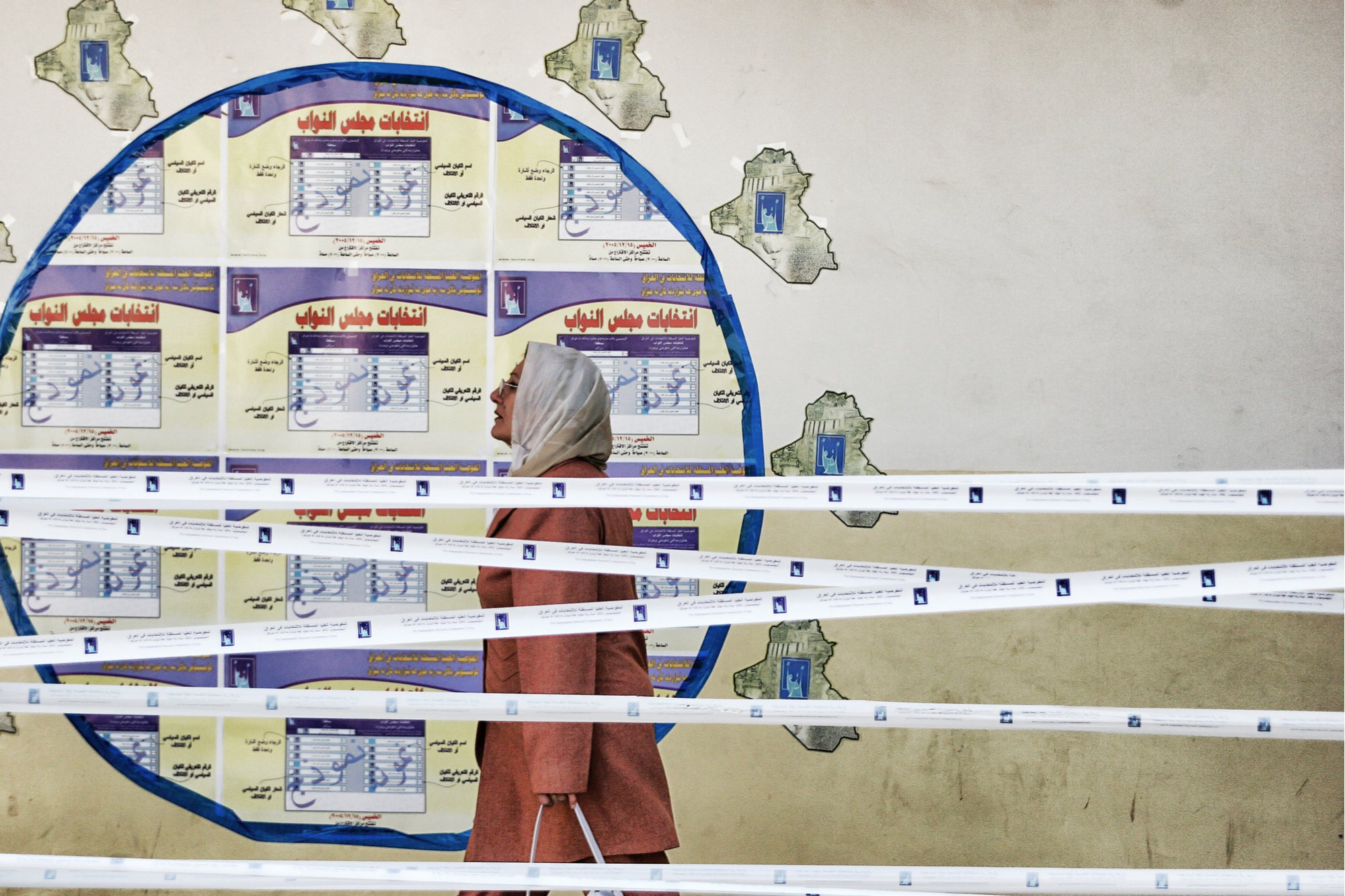
Iraq’s next parliamentary election is scheduled for May 12th of this year. Almost nobody in top-level U.S. policy circles is paying enough attention. It is time for the United States to get serious about this key date. Iran, and its Iraqi clients, are already working hard to supplant al-Abadi with Maliki or another Iranian client. Al-Abadi’s successes on the ISIS and Kurdish fronts stand him in good stead with the Iraqi public, but Maliki is building a coalition of Shiites, Sunnis, and Kurds opposed to al-Abadi.
The U.S. interest in Iraq’s coming election ultimately comes down to two main issues. First, Iraq’s extraordinary record since 2003 of electoral integrity, riding high voter turnouts, must be sustained. Second, the United States needs to back its friends against Tehran’s alternatives. Much has been made of the registration of political parties by several leaders of Shi’a militias, but the real power on this side of Iraqi politics remains with Maliki. In addition, while all Kurdish parties seek to maintain good relations with the United States, several factions of the PUK, based in Suleymaniya near the Iranian border, maintain close ties with the Tehran regime and would have difficulty pushing hard against Iranian interests.13
On the first point, the United States should highlight and help to manage the technical difficulty that May’s election presents. The Sunni parties who requested the election be delayed14 have a very valid point—millions of Iraqi citizens, largely Sunni Arabs, are internally displaced. Permitting, for example, a displaced Moslawi living in Baghdad or Irbil to get a Nineveh provincial ballot—and verifying that she is authorized for that Nineveh ballot—is not a simple task. Technical assistance should be requested from the United Nations and the various NGOs in this space. Even allegations of electoral irregularities are damaging. In addition, Iraq should request, and the world should be happy to provide, a robust contingent of election monitors.
On the second electoral matter, defeating Iran, visible signs of support for Prime Minister al-Abadi would likely be helpful in the run up to the May election. A visit from a major U.S. figure—the secretary of defense or state, if not the president or vice president—may be helpful to highlight U.S. support. Iraqis want the benefits of the modern, liberal order and it should be made clear that the United States will be a far more enthusiastic ally of Iraq should al-Abadi get a second term. Behind the scenes, we should be using our considerable power and prestige to help the nationalist coalition—ultimately this will mean al-Abadi, Allawi and the Sunnis, Sadr, secular Shi’as, and as many Kurds as possible—to come together, whether before or after the elections.
Citations
- ”Iraq Freedom of the Press 2016,” Freedom House. source
- Douglas Ollivant, “Iraq will continue to need a strong central government,” Al Jazeera, January 16, 2015. source
- “Iraqi Constitution” via source
- Ibid.
- Ibid.
- Suadad al-Salhy, “Iraq’s paramilitary troops angered after budget snub,” Arab News, March 5, 2018. source
- Hayder al-Khoei, “Post-Sistani Iraq, Iran, and the Future of Shi’a Islam,” War on the Rocks, September 8, 2016. source
- ”Saudi Arabia to reopen border with Iraq for first time in 27 years,” Reuters, August 15, 2017. source
- Tim Arango, “U.S. Sees a Vital Toll Road, but Iran Sees a Threat,” New York Times, May 27, 2017. source
- Michael R. Gordon and Isabel Coles, “Defeat of ISIS Caused $45.7 Billion in Damage to Infrastructure, Study Finds,” Wall Street Journal, February 11, 2018.
- Isabel Coles and Ali Nabhan, “Iraq’s Allies Pledge $30 Billion Toward Reconstruction,” Wall Street Journal, February 14, 2018. source
- Inés San Martín, “Patriarch Sako: Iraqi Christians must ‘reclaim’ lands of their parents,” Crux, July 14, 2017. source
- Jeremy Hodge, “Iran’s—and Russia’s—Influence Is Growing in Iraqi Kurdistan,” The Nation, October 25, 2017. source
- “Iraq: War-ravaged Iraq not ready for elections, say Sunnis calling for delay,” Rudaw, January 7, 2018. source