Investing in Children

We hear a lot of rhetoric from politicians about how America’s future depends on investing in our children. But this rhetoric is not translating into spending realities. A new report from First Focus, “Children’s Budget 2008,” provides information on federal spending for children’s programs. The report slices the data in a number of different ways, but the overall theme is that the federal government is not prioritizing children when it comes to allocating resources.
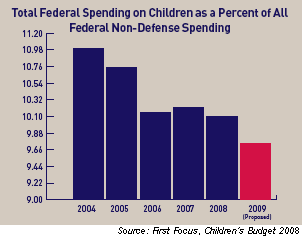 The report indicates that federal domestic discretionary spending on children in 2008 was only about 10% of all non-defense spending (a 23% decline since 1960). That’s a pretty surprising number when you think about it—it means that as a nation we spend only 10 cents of every discretionary dollar on children.
Recent budget decisions have only exacerbated the downward trend. In the last five years, domestic spending on children’s programs has decreased by 6.7%. While mandatory spending on children increased by 5.7% in that time period, overall federal spending was increasing at a much faster rate (almost 10%), meaning that other types of spending are outpacing spending on children. Of all the new real non-defense spending in the past five years, only one penny of every dollar has gone toward children’s programs.
Lower Priority for Education Funding
For those who believe education is a sound investment in the nation’s future, the news is not good. According to the report, spending on children’s education has been relatively flat in real terms, and declined by 9.9% over the last 5 years when adjusted for inflation. (Although we’d be remiss if we did not point out that using a 5 year period doesn’t capture increases in education funding from 2001-2004).
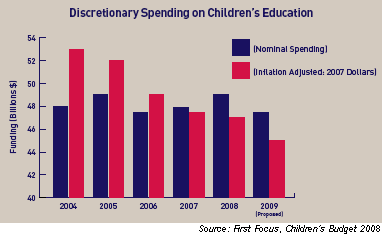
Over the long term, funding levels that do not keep up with inflation have real consequences for education programs and students. They can mean fewer teachers in the classroom, fewer early education services through programs like Head Start, and less money to provide the type of support that students with disabilities and from low-income backgrounds need to succeed.
Funding for children’s education has also declined as a share of total federal spending. From 2004 to 2008, the share of federal spending on education fell from 2.2% to 1.8%. As a percent of the national Gross Domestic Product, federal spending on children’s education dropped from 0.43% of GDP to 0.35%. Spending on children has not kept up with overall economic growth, raising the question: How much continued economic growth will the nation enjoy if we do not sufficiently invest in education and human capital, which drive that economic growth?
Where’s the Money Going?
If children’s issues are not the priority, what is? Where is the money going? Clearly, increased spending over the last couple of years has funded the war in Iraq. But that isn’t the only answer—even with defense spending excluded, the share of federal spending on children’s programs has decreased.
The report doesn’t delve in to the government’s spending priorities, but a larger and larger portion of federal spending is going to fund programs for the elderly. Social Security and Medicare are taking up an ever increasing share of federal funds. As baby boomers age, the number of elderly Americans will only increase, setting up a generational war over resources that is already starting to play out. With children lacking money and the ability to vote, it’s not hard to foresee where this is headed…
There’s more to come about this issue in future Ed Money Watch blog posts as we keep track of the generational funding wars and what they mean for education funding.
More About the Authors
Issues
Related

Representation Matters for Women of Color in Youth Apprenticeships

Meet the Commissioners

New America & ACCT Invite Community Colleges to Apply for Work-Based Learning Capacity-Building Cohort