Table of Contents
- Executive Summary
- Introduction
- Initial Fact Pattern
- Context: The Strategic Logic of Russian PMSC Operations in Syria
- Investigation Redux: New Videos Appear and with Them a New Mystery
- Syria’s Energy Protection Racket: Digging into Wagner Group Social Networks
- Conclusion: From War Crime to Internet Meme
- Appendix A: Research Methodology
- Appendix B: Breakdown of Reported Russian PMSC Areas of Operations and Projects as of June 2019
Syria’s Energy Protection Racket: Digging into Wagner Group Social Networks
Exploring Claims about the Hamdi Bouta’s Killing on Vkontakte
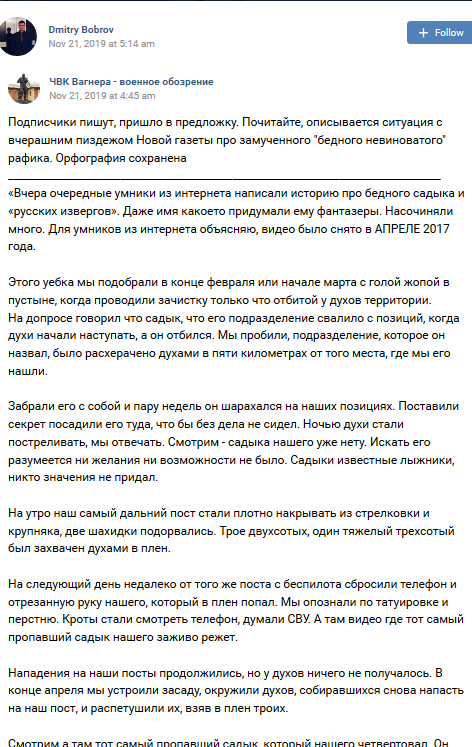
On a November 21, 2019, the same day Novaya Gazeta published its second expose on the al-Shaer incident, naming Stanislav D. as one of Bouta’s killers, a Vkontakte user who uses the profile name “Dmitry ‘Crow’ Bobrov” reposted an excerpt of a discussion thread that appeared to give a fuller accounting of the incident.1 As can be seen in the screenshot below from Bobrov’s account (Figure 22), the post seemed to imply that its author had been present during the incident and indicated that Russian forces first encountered Bouta during a skirmish in Syria in the spring of 2017. The anonymous post indicated that the video was shot in April 2017 after Bouta was captured and held prisoner during clashes with ISIL fighters and then later freed during a raid on a Russian position.
“We picked up this fuck in late February or early March with his bare ass hanging out in the desert when we were sweeping the territory that had just been retaken from the enemy,” the anonymous poster wrote. “During the interrogation, he said that his unit had retreated from his position when the enemy began to attack and he fought back. They took him with him and for a couple of weeks he was shadowing our positions.” According to the account given in the repost, Bouta apparently was soon recaptured again when Russian and pro-regime Syrian forces finally retook control of al-Shaer near the end of April.2 The post seems to imply that the video was taken on a cell phone and that the phone’s owner later somehow lost his phone during a battle.
Since many of Bobrov’s other posts appeared to show an abiding interest in military affairs, spetsnaz forces, and the war in Donbas, the November post about the al-Shaer incident raised questions about whether he might know someone involved in Bouta’s killing or if he himself might be a member of the Wagner Group. A closer examination of Vkontakte user Dmitry Bobrov’s account revealed that at one point he listed the Russian resort town of Sochi as his place of residence in September 2015.3 Further analysis also indicated significant overlap between Bobrov’s social circles and several other Vkontakte users who appear to have fought in either Syria or Donbas or both. This does not indicate Bobrov’s involvement in the incident, and there is no evidence on his Vkontakte pages pointing to any direct knowledge of the facts of the case.4
What Bobrov’s repost does suggest, however, is a certain affinity with the narrative of the incident as recounted by a Vkontakte user who purports to have been an eye witness to Bouta’s killing. While these virtual connections are not dispositive of direct involvement of those in Bobrov’s social media networks, an exploration of Bobrov’s profile reveals significant overlaps between his online social circles and those in his immediate network of Vkontakte friends who reportedly served with Russian separatist contingents who fought in Ukraine and later fought to secure the al-Shaer plant and other oil and gas facilities in Syria.
A review of Bobrov’s account in November 2019, indicated that, at one point, Bobrov listed Sochi5 as his place of residence at the time and that he served with a Russian airborne VDV assault unit and who fought in eastern Ukraine. As explained in further detail below, the VDV connection—though tenuous—is curious because images from the video clearly indicated the perpetrators carved the words “VDV 31-Razvedka” on the dismembered torso of the victim, Hamdi Bouta.
Presumably, VDV 31 is a reference to the 31st Separate Guards Order of Kutuzov 2nd class Air Assault Brigade, a Russian an airborne infantry brigade based in Ulyanovsk. One of several airborne units that was reorganized during Russian efforts to reform its military after the Soviet collapse, the VDV 31st Brigade fought in the Second Chechen War and the Russo-Georgian War. During the start of the Ukraine crisis in 2014, elements of the brigade were located in Crimea and in the summer of 2014 the brigade's units began washing up on the frontlines in Donbas.6
An analysis of Vkontakte users who posted images with geocoded tagging indicating close proximity to the al-Shaer site in the January to September 2017 timeframe revealed links to at least two users who claim to have served in a VDV unit. Those two Vkontakte users also appeared in Bobrov’s list of Vkontakte friends. While Bobrov’s claims on social media about his military service with the VDV may or may not be accurate, an analysis our team conducted indicates that it is not uncommon for Vkontakte users to openly identify their past or current service in the Russian military and to identify their military unit affiliations.
In fact, a separate analysis of 9,500 Vkontakte users connected to the Vkontakte user who posted the original November 2019 account of Bouta’s killing that we conducted in September 2019 turned up large numbers of individuals who are part of a burgeoning online movement of Russian ultranationalists with an abiding interest in mercenary culture who claimed to have served in Russian military units. Further analysis and verification is required to assess users’ claims about their time in service. But in an analysis conducted from November to April 2020, we identified a subset of a little over 380 users out of that 9,500 who indicated their professed interest in the Wagner Group and claimed past or present service in a variety of Russian military units.7 The vast majority of users in that subset indicated that they had served in spetsnaz units with headquarters located in the southern and western military districts of Russia.
In a separate assessment of a subset of users connected to that same network, we found 74 users who directly identified themselves as members of specific Russian military units in a Vkontakte discussion thread. Like those in the larger dataset, all 74 indicated a strong interest in news about the Wagner Group and developments about the Russian mercenary lifestyle. A preliminary assessment of users in this second group of self-identified fans of the Wagner Group who indicated their military affiliations also showed that the vast majority also indicated having served in spetsnaz units based in Russia’s Southern and Western military districts with district headquarters located in Rostov-on Don and St. Petersburg, respectively.8 Many appear to have served in VDV airborne divisions, motor-rifle brigades, and artillery units. More analysis and verification needs to be done to assess what, if any, patterns of affiliation are indicated in the data but at minimum this initial exploration suggests strong overlapping social ties between the growing number of right-wing ultra nationalist militarist communities on Vkontakte and Bobrov’s social circles.
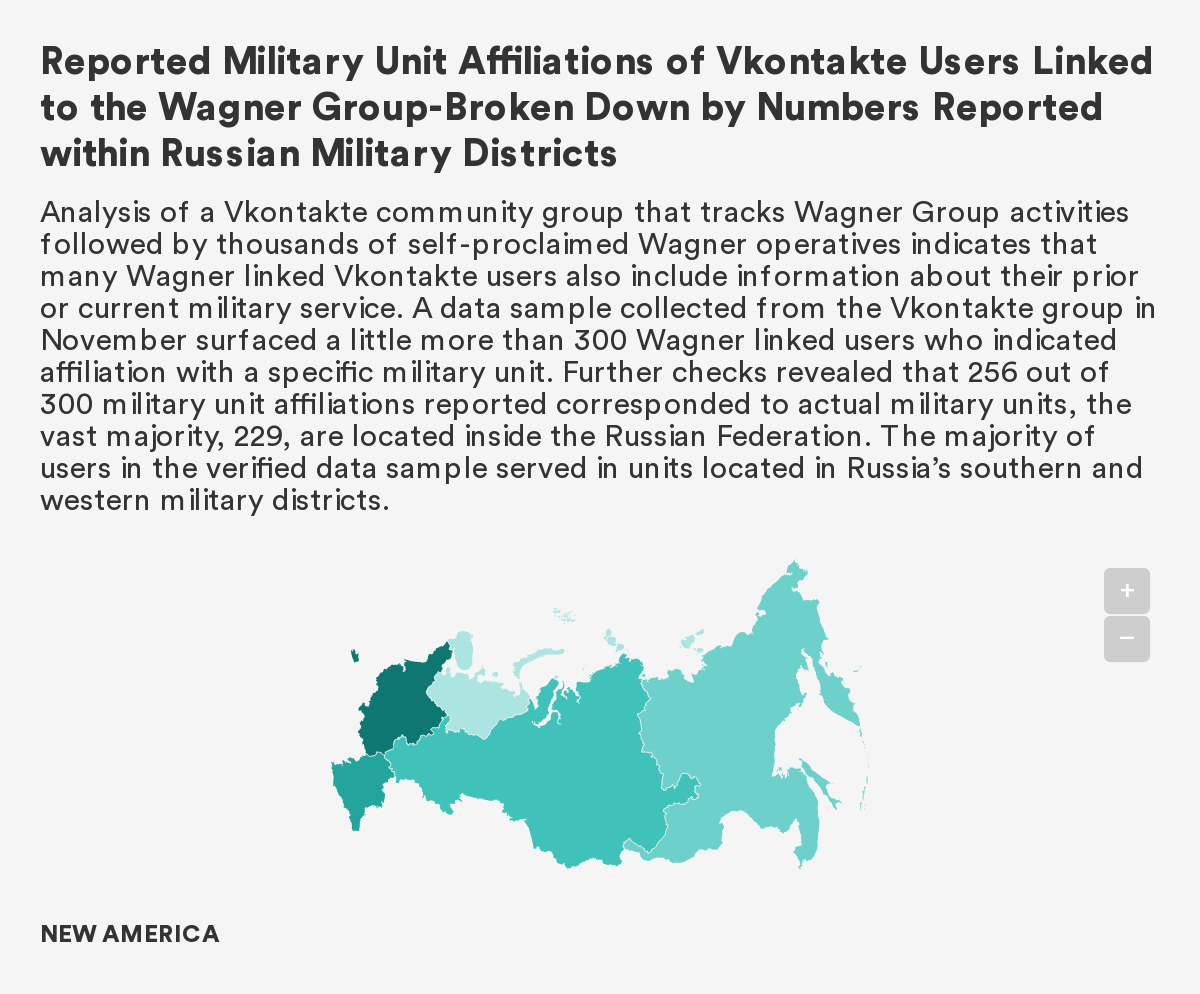
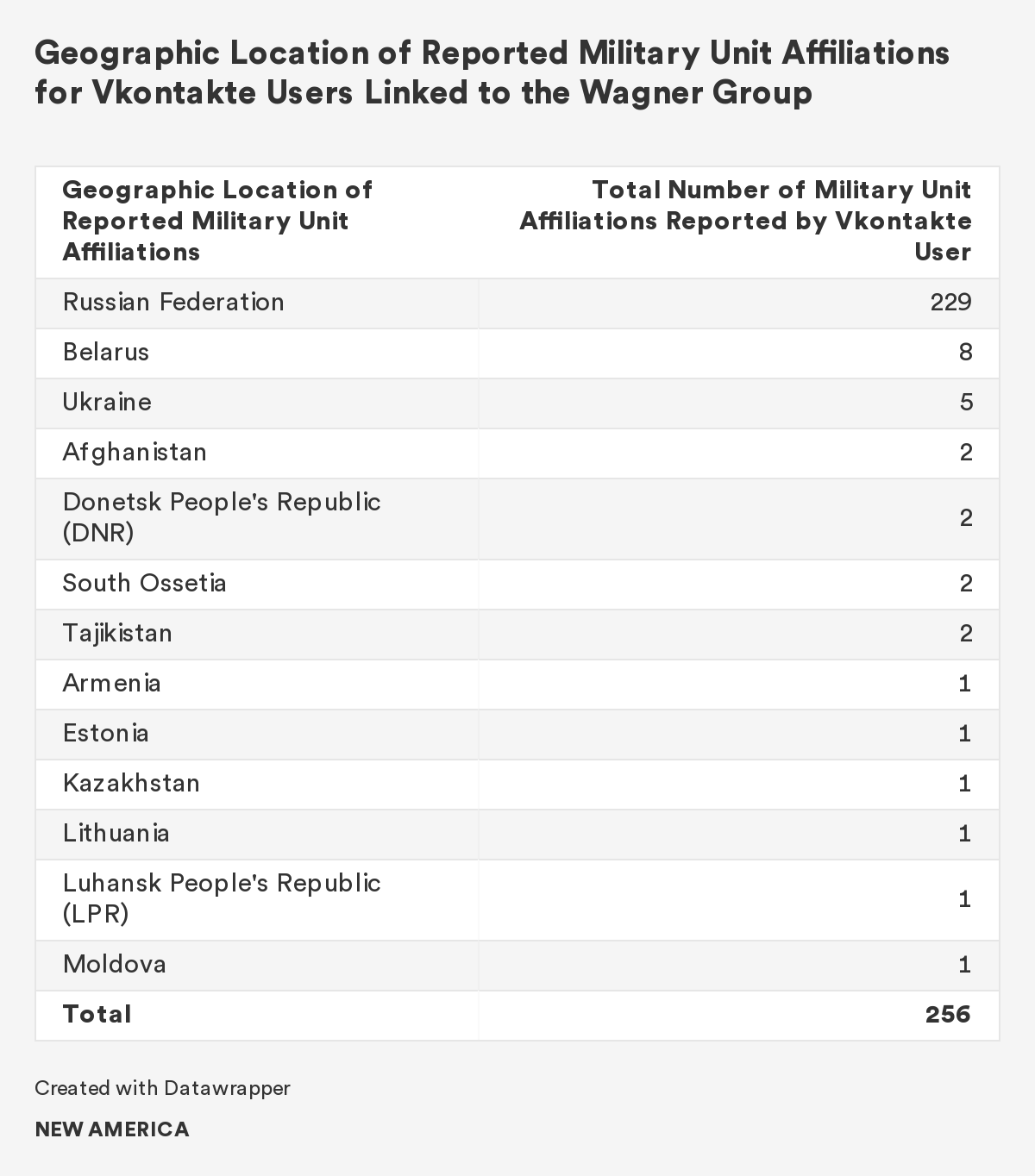
Figure 23: Analysis of a spring 2018 Vkontakte discussion thread post 74 users self-identified as contractors who served in the Russian military. The majority served in units located in Russia’s southern and western military districts.
Indeed, exploration of Dmitry Bobrov’s Vkontakte account and friends network seems to suggest a possible tie to several VDV veterans who may have, at one time, served as contractors and fought in Ukraine with Rusich, (ДШРГ «Русич») a Russian-backed separatist fighting contingent that fought in Donbas and is closely tied to the Russian Imperial Movement and other offshoot branches of white supremacist groups based in St. Petersburg.9 Dmitry Bobrov’s friend Denis Mokrinsky, for instance, appears to have several friends who have served in VDV units, fought in Donbas, and are within the friend network of Alexey Milchakov, the self-proclaimed commander of Rusich who, by his own published account, traveled from St. Petersburg to Donbas in June 2014.10
In a photo posted by both Bobrov and Mokrinsky on his Vkontakte account on May 10, 2019, Bobrov appears alongside Mokrinsky in an unknown location. Both men are sporting Novorossiya flag patches and orange and black St. George’s ribbons, indicating a possible link to separatist fighting units in Donbas. Both Bobrov and Mokrinsky posted the same photo on their individual Vkontakte accounts. A closer examination of both Bobrov and Mokrinsky’s user accounts suggest overlapping ties with several other Vkontakte users who are members of Rusich’s official Vkontakte group page and with other Vkontakte users who posted photos from apparent battle sites in Syria.
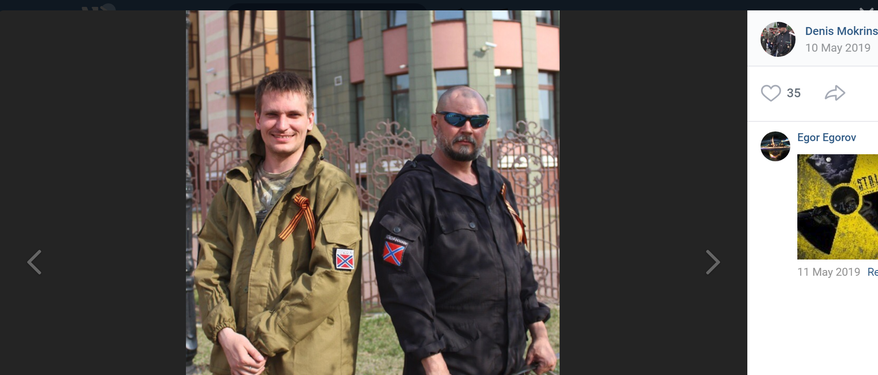
Bobrov and Morkrinsky seem to have quite a few friends in their network who have, at one time or another, been affiliated with VDV airborne paratrooper units, including several friends who posted pictures of themselves posing with Rusich leader Alexey Milchakov in front of VDV memorials in Russia. These connections are curious and would seem to provide additional insights into published reports in 2018 about Milchakov’s presence at the al-Shaer plant site as well as others with apparent social ties to Russian PMSC contingents that operated in Syria and Ukraine.11
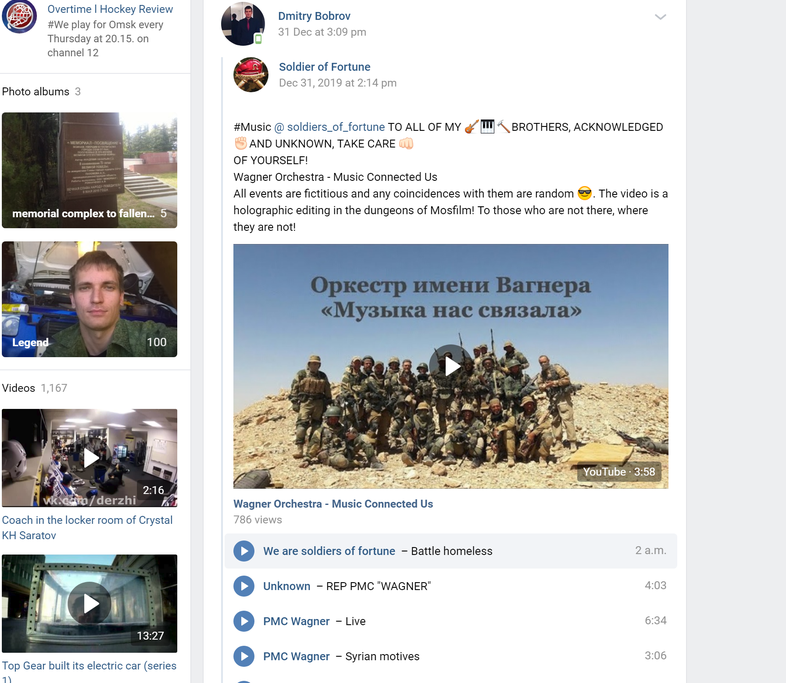
Whether Milchakov was present in Syria at the time at the time of Bouta’s death in 2017 remains unclear but several clues suggest that friends linked to his social media circles and Milchakov’s Rusich compatriots likely were in the Palmyra area and not far from the al-Shaer site in the spring of 2017. One of the early clues of a possible link first publicly surfaced on social media six months after the bloody February 2018 battle of Khasham that killed scores of Wagner Group operators. On September 12, 2018 a YouTube user with the profile name “Ilya Moskovchenko,” posted a five-minute long video memorializing and listing the names of Wagner Group fighters killed near the Conoco gas plant.12
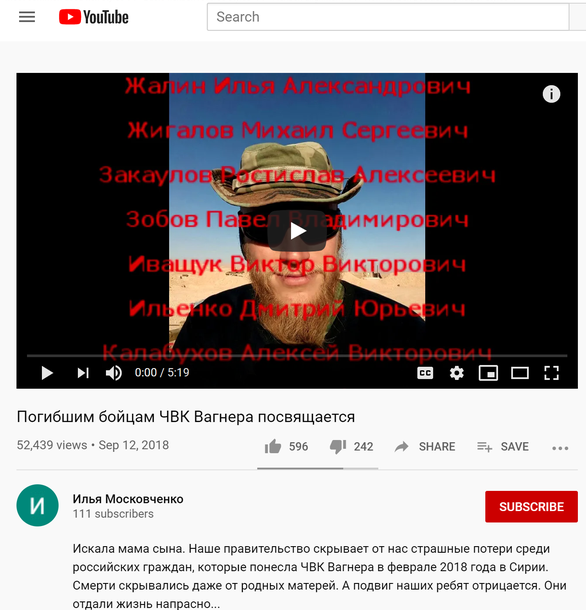
The video features a press conference with Russian foreign ministry spokeswoman Marina Zakharova and lists the names of about 50 individuals allegedly killed in the U.S. military strike on the Conoco gas plant, including one Vladislav Apostol, the dual Russian-Moldovan citizen reportedly born on January 13, 1988 who was also reportedly identified as one of Bouta’s assailants. In the short five-minute long video, Zakharova denies any Russian citizens were killed in the February 2018 battle. Yet, media reports and other evidence suggest otherwise.
Historical flight data authenticated by C4ADS and shared with our team, however, indicate that Apostol booked a Grozny-Avia flight from Belgorod International Airport to Simferopol International Airport in Crimea on September 23, 2014 for a man named Vladislav Apostol bearing the same birthdate.13 Apostol’s cross-border flight from Russia on the now defunct airline established by Ramzan Kadyrov arrived in Russian-occupied Crimea two months after the downing of Malaysia Airlines flight MH17 and the same month that NATO confirmed the presence of Russian military forces in Donbas.14 While not dispositive of Apostol’s involvement in the battle of Khasham or his direct involvement in fighting in Donbas, the flight billing records do appear to place Apostol in Donbas at the peak of Russian-sponsored operations in the eastern Ukraine region in 2014.
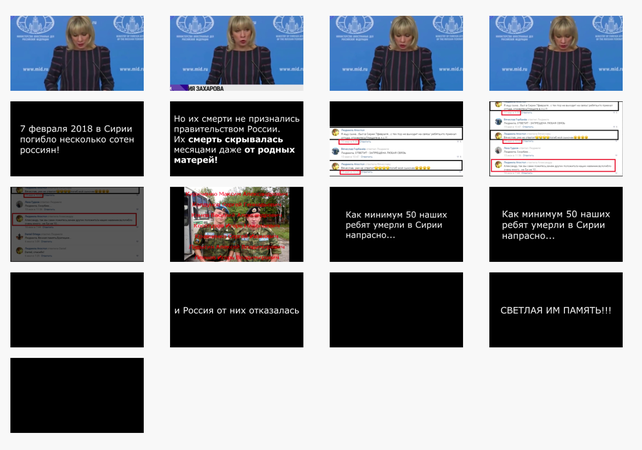
Four years later, after EvroPolis apparently booked Apostol’s flight into Crimea, images of Apostol posing near a Christmas tree in Syria with a gas plant in the backdrop were shown in the video memorial to the fallen at Khasham on YouTube.15 Then on Oct. 9, 2018, the Ukrainian Russian language blog InformNapalm reported that its investigators had geolocated the site of a picture taken of Apostol at the al-Shaer site of Conoco gas plant in Deir Ezzor.16 The story cited Ukraine’s SBU intelligence service as one of its sources, and suggested Rusich commander Milchakov was also pictured at the same area in a courtyard pool area on the Jihar facility site in the Hayan Block.
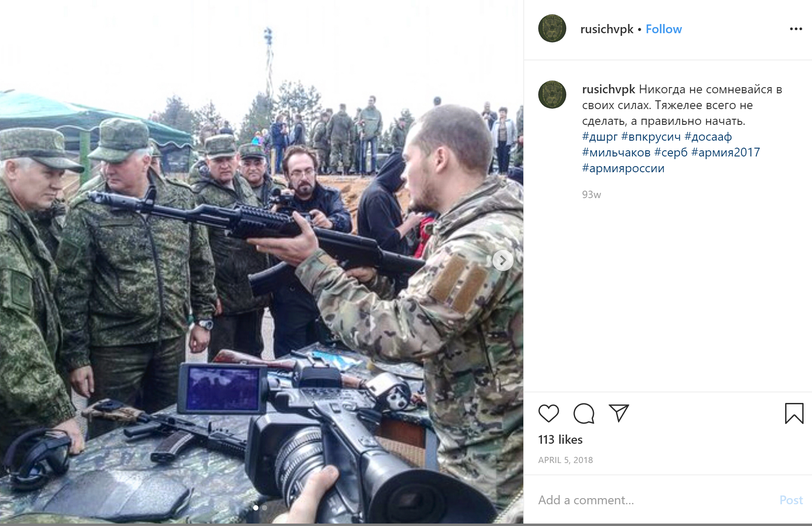
A further review of Bobrov’s account and others linked to him turned up links to posts from the Rusich Instagram account, which in turn led to an interesting series of posts by the apparent owner of Rusich’s Instagram account (see Figures 28, 29) from the summer of 2019. This July 1, 2019 post, which depicts a memorial statue dedicated to Russian volunteers who fought in Syria, appears to corroborate reporting by InformNapalm and others that Rusich members like Milchakov may at one time have been based at the al-Shaer site on the Hayan Block where the statue is reportedly located. Another photo posted of a soldier with a kolovrat symbol on his uniform standing near the ruins of Palmyra posted on the Rusich Instagram account in April 2019 also would seem to indicate that Rusich members were in the area at some point during the Syrian civil war. But, to understand how Rusich, Milchakov, and Apostol fit into the picture, it is important to start at the beginning in Russia and Ukraine.

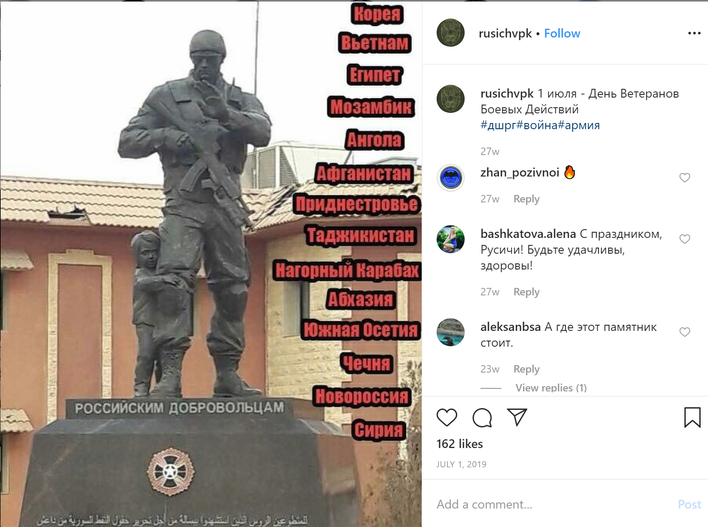
Picking Up Clues on the Trailhead: The 31st (VDV) Air Assault Guard and Rusich
One of the strongest hints that there is that there may be a link between Rusich social circles and those involved in Hamdi Bouta’s killing at al-Shaer comes from clues left by the killers themselves. After the victim’s body is dismembered and hung from its feet from a metal structure at the site, four of the men at the scene pose near the body with their faces forward. On closer inspection, the number 31 and the Russian letters for VDV and the word “razvedka” appear to be seared into the corpse’s torso.
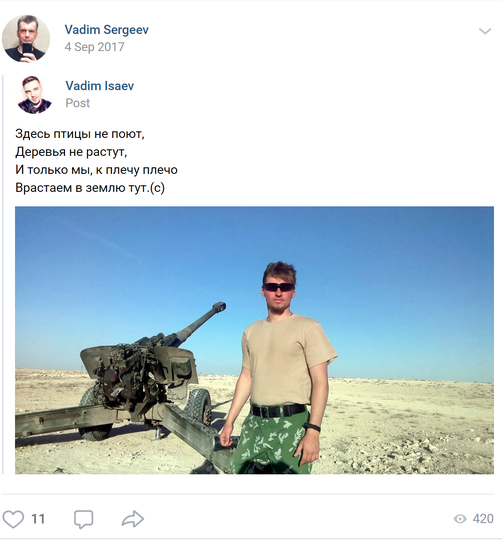
When our team at Frontline Forensics conducted a search for geotagged photos posted on Vkontakte in the January to September 2017 timeframe that bore geotagged markers for locations within a 50km radius of the al-Shaer gas plant facility, we found photos posted by two individuals who apparently served in the Russian military at one point in their careers. Among the results, was a photo posted on Sept. 4, 2017 (See Figure 30) on a Vkontakte account for an individual who uses the profile name Vadim Isaeev.
The artillery piece pictured in the background of the photo is a 2A65 “MSTA-B” 152mm howitzer. This Russian towed-artillery piece has seen extensive service in the Second Chechen War and the Syrian civil war, especially by units of the Syrian Arab Army and supporting Russian units.17 The flat terrain and chalky-white rocks are consistent with the Hamad Desert. Also referred to alternately as the Syrian, Eastern, or Western Desert, this region extends east and south from Palmyra to the Euphrates River Valley and the Tri-Border region. The al-Shaer gas fields fall within Hamad Desert boundaries.
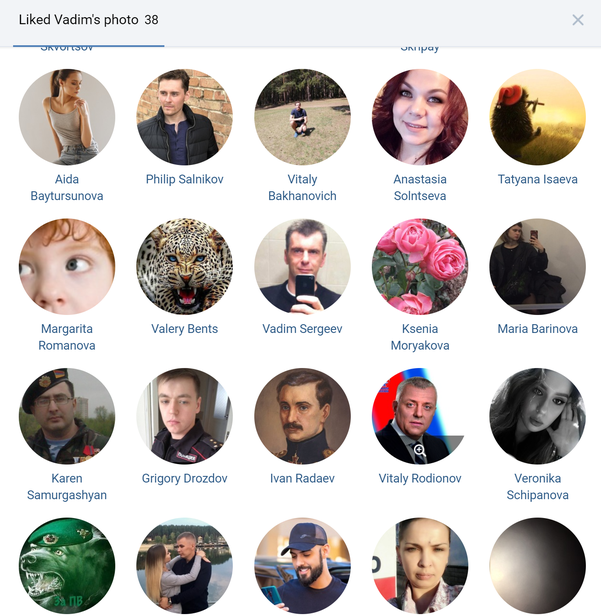
Another interesting detail included in Vadim Isaev’s photo in the Syrian Desert is the inclusion in the comments section of an excerpt from the song “We Need Another Victory (Our 10th Airborne Battalion)”, which is featured in the well-known 1970 Russian feature film about frontline camaraderie between a group of paratroopers, Belarus Train Station.18 Relatedly, and likely not coincidentally, one of the individuals who liked the photo of Vadim Isaev was another Vkontakte user named Vadim Sergeev who also posted a separate photo in the vicinity of Palmyra not far from al-Shaer in 2016.
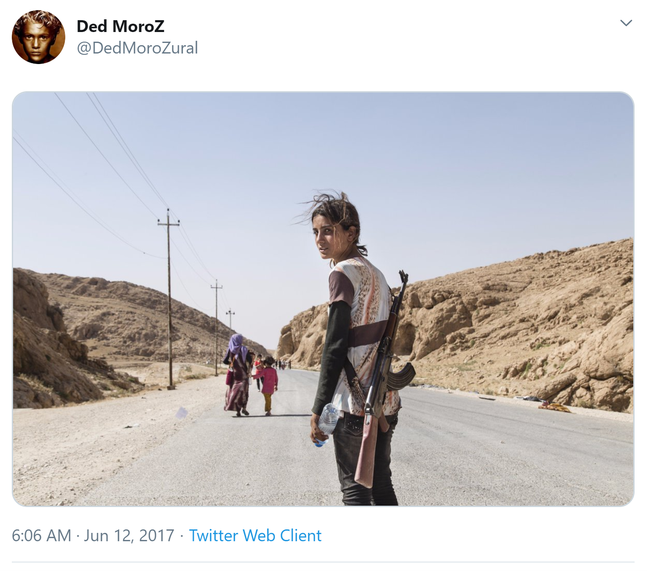
Like Isaev, Sergeev shows a clear proclivity for ultra-right Russian nationalist ideology and an abiding interest in memes and folklore about Russian airborne paratroopers. A check of the Twitter handle Sergeev posted on his Vkontakte profile page—@DedMoroZural—reveals another June 12, 2017 post of a picture of a young woman fleeing ISIS somewhere in Syria. Further exploration of a Facebook account linked to a YouTube account of the same handle reveals that a person using the same handle, DedMoroZural, lists Chelyabinsk, Russia as a place of residence. The Facebook account19 for the person using the same handle as Sergeev indicates that the owner of the account also attended the now defunct Chelyabinsk Higher Military Aviation School for Navigators. Before the Russian air force academy was disbanded in 2011 it was well known for training an elite cadre of forward air controllers.20
The appearance of geo-tagged photos in the vicinity of Palmyra and al-Shaer during two significant battles in 2016 and 2017 for control of the al-Shaer complex and Palmyra is interesting because there is little chance that anyone would be capable of traveling—or have a desire to travel—to the region without a military purpose. It is also equally unlikely that two Russian speaking individuals with a clear history of military service in Russia’s airborne special forces who cross-post likes of photos taken in such a remote part of Syria would do so coincidentally. This set of observations about the potential connections between Vadim Sergeev and Vadim Isaev’s photo posts during the same timeframe when two critical battles for control of the al-Shaer site and nearby facilities in Palmyra took place indicated to our team that a more thorough analysis of Isaev and Sergev’s social networks on Vkontakte might yield additional insights.
While collecting evidence on VKontakte connected to the video in October 2019, we cross-checked Sergeev and Isaev’s account links against a dataset of members of a VKontakte community that track soldier of fortune news, culture, and developments. In addition to confirming that both Isaev and Sergeev were members of that group, we found on closer inspection that other individuals who posted photos on Vkontakte geotagged in the Palmyra area in the spring 2016 timeframe at the height of a key battle for control of the area belonged to the same friends network as Isaev and Sergeev. Included in that group is a Vkontakte user named “Ali Syria.”
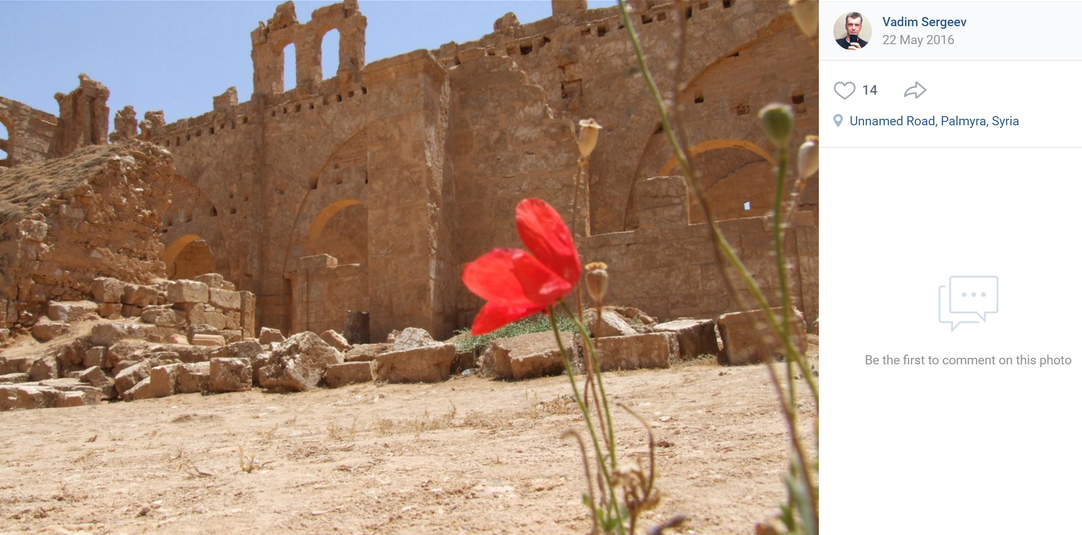

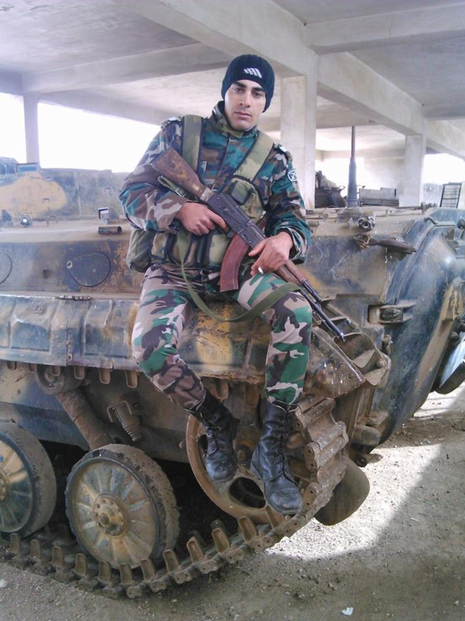
We located and verified the geocoordinates for photos posted to Vkontakte during the spring 2016 and spring 2017 time frame when the two battles for al Shaer occurred. That search turned up Sergeev’s May 2016 photo post and a photo posted by Ali Syria in the same area in March 2016. In fact, it turns out both Ali Syria and Sergeev have mutually posted on each other’s Vkontakte pages and they list several mutual friends in common. Ali Syria indicates he is a member of spetsnaz and he has posted an audio file of the “Wagner Group” rap song on his page. He appears to have traveled extensively with militias affiliated with the 5th Corps and ISIS Hunters, a Syrian militia believed to have been trained and supplied by the Wagner Group.
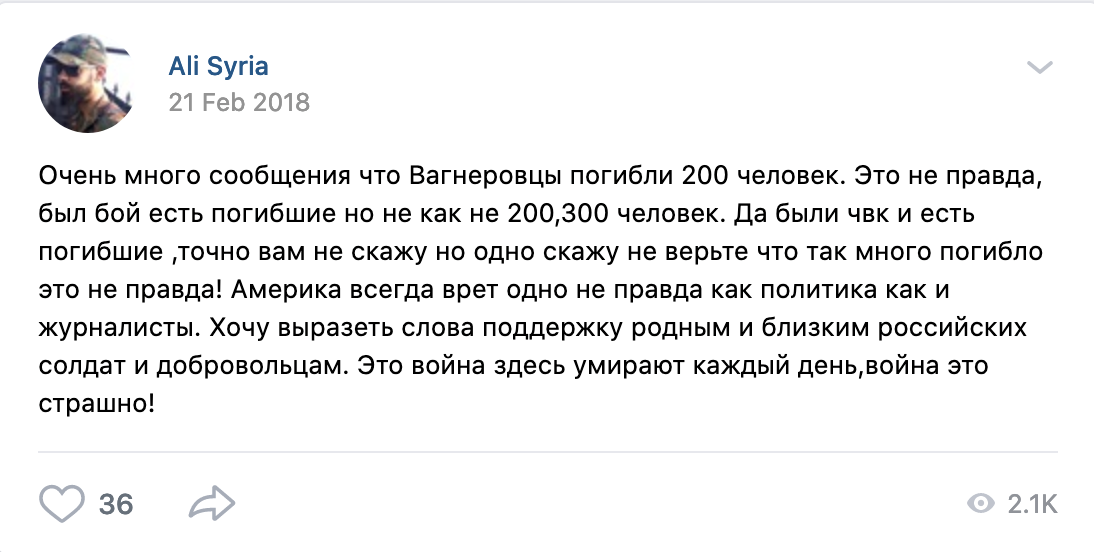
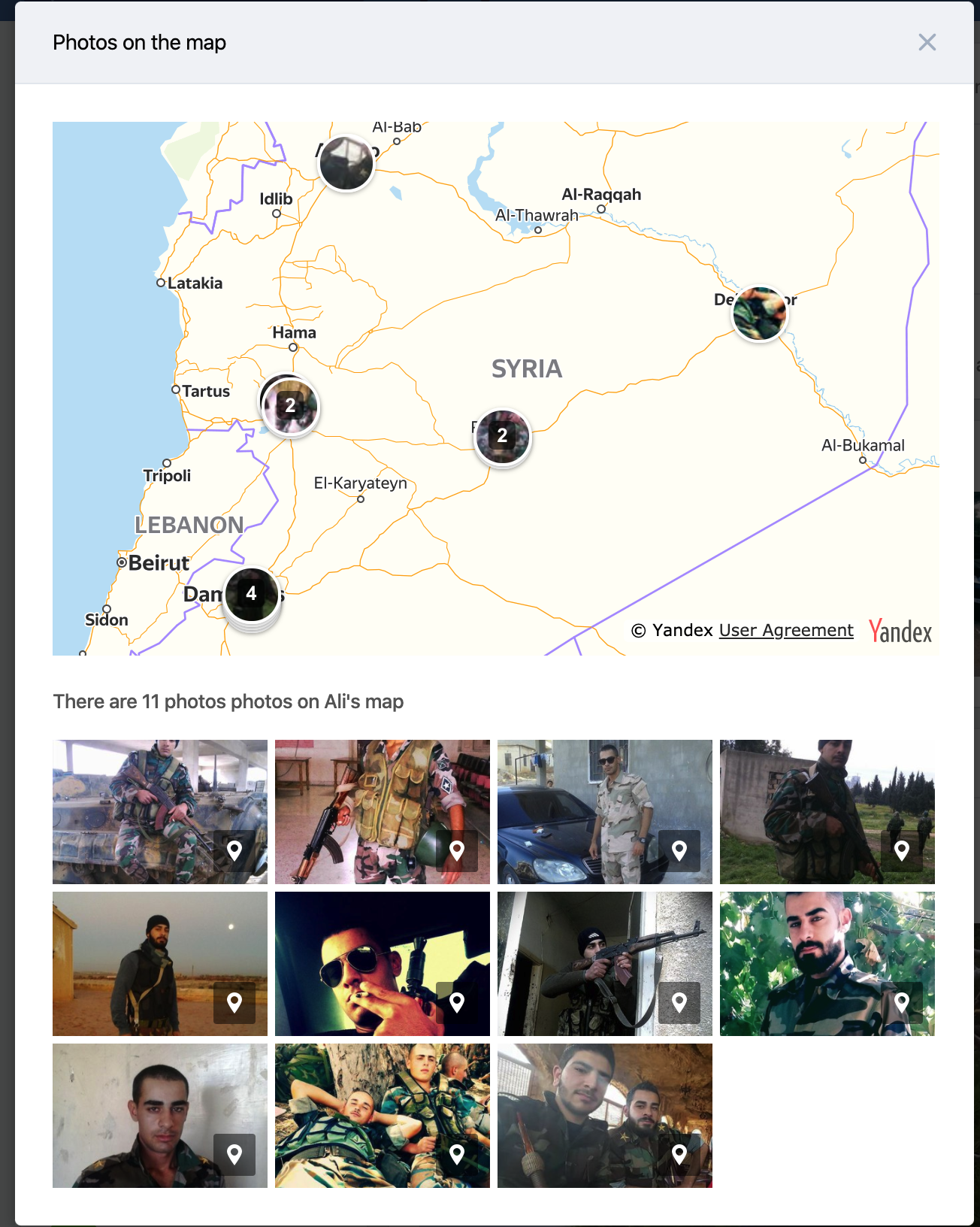
Ali Syria’s profile contains multiple references to Syria and Assad as well as a post addressing the death of Wagner PMSCs in Deir Ezzor in February 2018. As can be seen below, a map of his geotagged photos on Vkontakte indicates he posted from several hotspots in Syria.

Based on the content collected in our initial review, a deeper analysis was conducted on Ali Syria’s social networks to see which members shared friendships, likes, and cross-posts that overlapped with posts by Vkontakte users in his circle who indicated having fought in Syria or Donbas or both. The review of data from Ali Syria’s account indicated that he is friends with a man named Andrey Spekhov. Spekhov appears in at least one photo posted on his own VK account in September 2019 alongside Rusich commander Milchakov and confirms in commentary with the photo that Milchakov is with Rusich and that the photo of them together was taken in Moscow
According to a report prepared by the Eastern Ukrainian Center for Public Initiatives, a Ukrainian civil society organization, Spekhov is one of several Russian citizens suspected of having fought on the side of Russian-backed separatists in the Donbas town of Shirokhine during the 2014-2016 period.21 The report includes a photo of Spekhov posted on his Vkontakte account in 2017 showing a tattoo on his shoulder of the insignia for the elite 45th Special Purpose Airborne Brigade (45th opSn) on Vkontakte.22 Several photos posted on Spekhov’s Vkontakte account during the summer of 2015 at the height of a second wave of fighting in Donbas indicate he likely served as s sniper scout, including one posted on June 2, 2015 showing Spekhov near a Donetsk windfarm dressed in a forest camouflage uniform typically worn by members of the scout reconnaissance 45th opSn and cradling a sniper rifle in his arms.

Curiously,23 but probably not coincidentally, the report makes reference to several other Russian nationals who fought in the same area of Donbas during the same period and later traveled to Syria to fight, including Konstantin Zadoroshzny, who was reportedly killed in Syria in 2017 along with another Russian Donbas veteran Ivan Slyshkin,24 one of several of Spekhov’s Vkontakte friends who appears to have overlapping friendship ties with Rusich leaders, according to our analysis of publicly available Vkontakte data.
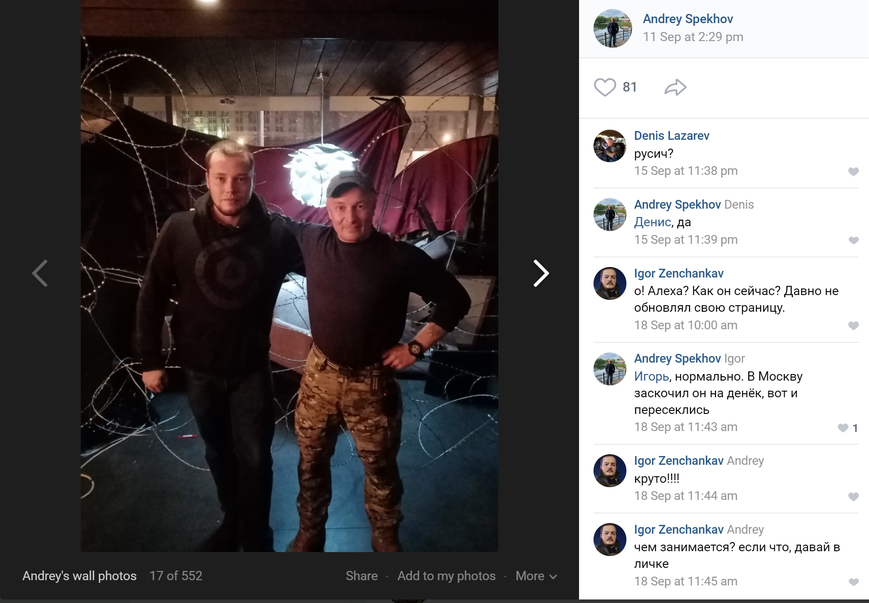
Further analysis of Isaev, Sergeev, Spekhov and Ali Syria’s Vkontakte accounts and digital trails revealed tight overlap between close-knit networks of about 100 Vkontakte users who subscribe to the official Vkontakte account for Rusich, and more specifically, overlap with Rusich’s co-commanders Milchakov and his compatriot Jan Petrovsky. We noted with interest that at least three of Ali Syria’s friends also have multiple friends in common who indicate that they are members of or have an abiding affinity for related Donbas separatist tactical groups, such as the Sparta Battalion, Batman Battalion, and Prizrak Battalion.
Again, while none of these links are dispositive of any specific connection to the incident and events at the center of the inquiry into Hamdi Bouta’s death, the tightly meshed relations between Isaev, Sergeev, Spekhov, Milchakov, and Petrovsky—all of whom appear to have spent time supporting Russian separatist operations in Donbas—raises questions about whether, when, how, and why their paths may have connected. To understand those connections, a brief exploration of Rusich’s origin story is in order.
St. Petersburg’s Ultranationalist Frontline Phantoms: Rusich and the Wagner Group
There are different dates given for the start of the paramilitary unit now known as Diversionary Guerilla Reconnaissance Group Rusich (ДРШГ Русич/DrShG Rusich), but its genesis is rooted in the rise of ultra-right nationalism in Russia in the 1990s after the collapse of the Soviet Union. During the two decades leading up to the start of the Russian-separatist putsch in eastern Ukraine, the former imperial capital of St. Petersburg figured prominently in this respect, playing host to several of the earliest progenitors of the paramilitary contingents that would later turn up on the frontlines in Donbas and eventually Palmyra.25 At that time, in the 1990s, Russia’s gilded, artsy second city also was at the bleeding edge of leftist intellectualism, a heady punk scene, and, because of its many universities, it boasted a relatively diverse population.
But it wasn’t long after the start of the First Chechen War in 1994 that St. Petersburg then emerged as a central node in the highly fused networks of organized crime gangs, security agencies, and ultranationalists that today dominate the Russian government. Not incidentally, this all took place just as Vladimir Putin was transitioning from longtime service in the KGB to a career in politics in the St. Petersburg mayor’s office. At the time, Putin was deputy mayor under Anatoly Sobchak and charged with overseeing the city’s import-export business.26
Among the most lucrative deals overseen by Putin was a contract signed for the foreign trade of petroleum products processed by the Kirishinefteogsintez oil refinery petroleum products processed by the Kirishinefteogsintez oil refinery trade branch with Gennady Timchenko.27 Timchenko, who would eventually go on to become head of Stroytransgaz and the energy trading behemoth Gunvor, was a critical player in a deal with Putin that led to a three-way trade deal in which oil revenues sold on the open market were used to pay for food that was in short supply in the city. Not coincidentally, it was about this time that Yevgeny Prigozhin also began to make his way up the ranks of St. Petersburg’s emergent new money business class as a local restauranteur and caterer.28
It was against this backdrop that neo-fascist groups such as Pamyat (Memory) got their start and Alexander Dugin, a St. Petersburg-based political philosopher today known widely as “Putin’s brain,” began to stoke the fires of ultranationalism. Dugin has spent a lifetime reinvigorating a peculiar brand of religiously-tinged white supremacy that has deep roots in Russia’s conservative-monarchist traditions and has long found a ready home in St. Petersburg, the one-time imperial capital of Tsarist Russia. Born into the family of a former Soviet intelligence officer, Dugin, like Putin, came of age during the prelude to the Soviet collapse and has since risen to prominence as an adviser to Sergey Naryshkin, the director of Russia’s Foreign Intelligence Service.29
Dugin’s philosophy is immensely influential among the ultranationalist neo-fascist gangs that became feeders for St. Petersburg paramilitary contingents such as the Russian Imperial Movement (RIM) and related RIM offshoot branches, such as the Russian Imperial Legion of volunteers headed by former Donetsk People’s Republic Igor “Strelkov” Girkin and Alexey Milchakov’s Rusich. While the number of Russian volunteers, from St. Petersburg’s Duginist cadres are thought to be quite small—with perhaps the core numbering 200 at any given time during the 2014-2015 period—their contributions to major battles during the early part of the Donbas war were significant and few were more significant than Rusich and its affiliated paramilitary group E.N.O.T.30
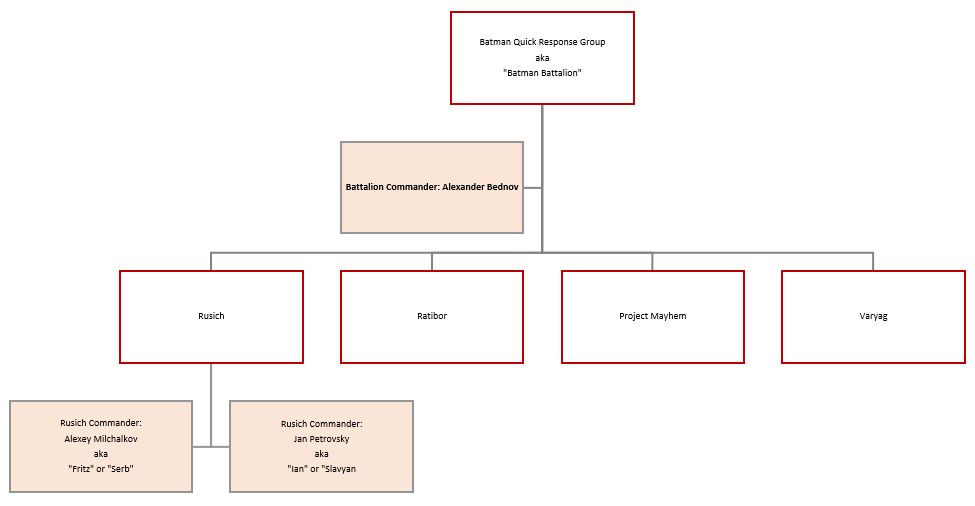
According to Milchakov’s own account, he first formed Rusich with Yan Peterovsky in St. Petersburg by volunteering with the Aid Coordination Center of Novorossiya (KTsPN), an Imperial Legion offshoot in June 2014.31 The aid coordination center facilitated “humanitarian” convoys to support fighters in the Batman Battalion and Prizrak (Ghost) Brigade.32 But, Milchakov’s involvement in neo-fascist activities in St. Petersburg reportedly predated Rusich’s entry on the scene in Donbas in the summer of 2014, first under the leadership of Alexander Bednov, the late head of the Batman Battalion tactical group.33 Born in 1991, Milchakov reportedly became active in the St. Petersburg neo-fascist scene in 2007 and one of his well-known early exploits involved the videotaped beheading of a dog, an act that quickly earned him a fearsome reputation among the St. Petersburg neo-fascist set.34
Not long after that, Milchakov reportedly joined up with the elite 76th Air Assault Guards (VDV) Division.35 Legendary for its leading role in WWII battles, the Chechen wars, and the 2008 Russian military assault on Georgia, the division was also the military alma mater of Dmitry Utkin, the Wagner Group’s titular commander.36 Whether Milchakov first encountered Utkin at the 76th VDV’s headquarters in Pskov is unclear, but the division’s 104th Guards Regiment is well-known for being one of the first to be reorganized into a contract reserve service in 2006, so it is likely that both Milchakov and Utkin have more than just their time in the trenches in eastern Ukraine in common.
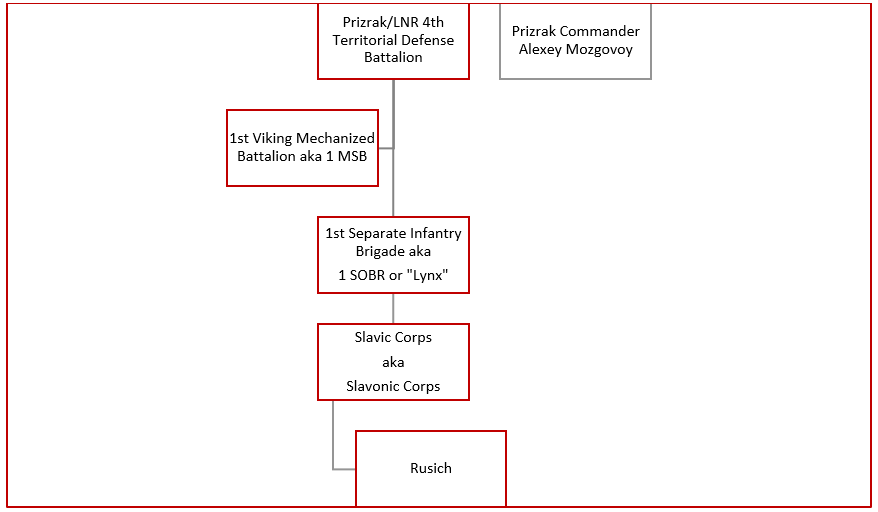
When Milchakov and Petrovsky, a dual citizen of Russia and Norway, formed Rusich in the summer of 2014 as a subunit under the command of Alexander Bednov’s Batman Battalion, there were already signs of trouble on the separatist front. A lack of discipline within the ranks of the Donbas militias led to the reorganization of a number of subunits including the Batman group. Rusich, first under Bednov’s command and later under the command Prizrak’s leader Alexey Mozgovoy, fought in some of the war’s most pivotal battles including the fight for control of the Donetsk airport and later, most notoriously, Milchakov and his crew led a brutal assault on the Ukrainian-backed militia known as the Aidar Battalion near the town of Metallist.37 The latter operation landed Milchakov on the Ukrainian government’s list of most wanted for war crimes in Donbas.38
But, as several scholars have pointed out, Rusich’s role was likely primarily propagandistic in nature.39 The ambush on Aidar battalion became the stuff of legend after videotaped segments from the grizzly battle scene appeared in a video posted by Colonel Cassad, a LiveJournal account known for its pro-Russian propagandistic commentary on the conflicts in Ukraine and Syria. Shortly before Milchakov reportedly pulled Rusich out of Donbas in the late summer of 2015, his participation in the International Russian Conservative Forum was widely publicized and as scholars of the Russian right have noted, he has emerged as an important influencer among neo-fascist youth in Russia.40
Upon his return to St. Petersburg from the Donbas in 2015, Milchakov formed the private paramilitary group known as E.N.O.T. and he maintains an active Vkontakte account for Rusich, which as of April 2019 boasted more than 3,700 followers and claimed a support branch in Poland.41
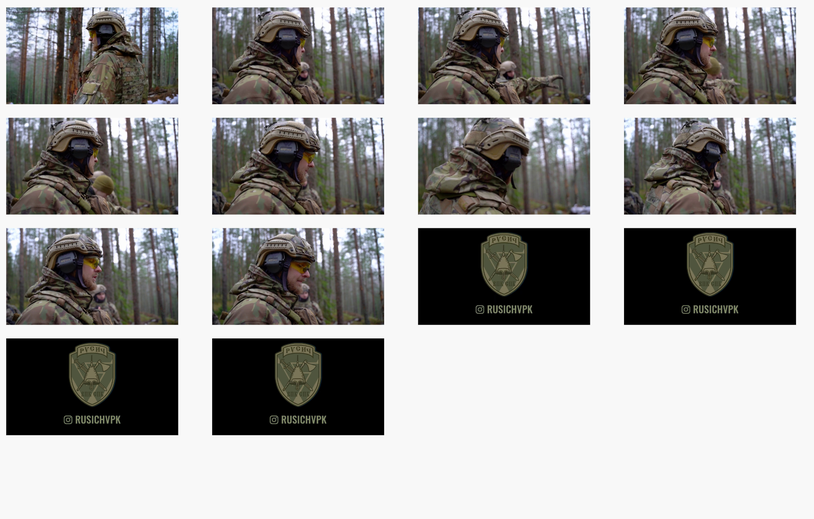
What is interesting about Milchakov’s post-Donbas chapter is that, despite widespread documentation about his participation in human rights abuses on the frontlines, he appears to enjoy at least passive support from authorities in St. Petersburg who apparently have chosen to overlook his highly public involvement in neo-fascist causes. Videos of Milchakov training Rusich volunteers in combat tactics in the forests at the outer edge of St. Petersburg appeared on YouTube as recently as the fall of 2019.42 Interestingly, Milchakov is one of the few identified as fighting for the Wagner Group in Syria to be untouched by scandal or arrest upon his return to Russia. This raises questions about the special status afforded to Rusich veterans and others in Milchakov’s group who fought in Syria and Donbas and their true role in Russia’s overall strategy.43
Citations
- Archived version of Dmitry “Crow” Bobrov’s Vkontakte user account from April 2019: source ; archived version of Bobrov’s Vkontakte page archived October 2015: source
- Archived version of Dmitry “Crow” Bobrov’s Vkontakte user account from April 2019: source ; archived version of Bobrov’s Vkontakte page archived October 2015: source
- Archived version of Bobrov’s Vkontakte page, archived October 2015: source
- In June 2020 our team attempted to contact Bobrov via direct message on Vkontakte but as of publication we have not yet received a response to that outreach.
- Archived version of Bobrov’s Vkontakte page, archived October 2015: source
- Igor Sutyagin, “Russian Forces in Ukraine,” Briefing Paper, Royal United Services Institute, (RUSI), March 2015, p. 2.
- Vkontakte is well known for the distinctive design of its personal profile settings. Unlike Facebook, the standard user profile information form on Vkontakte carries a number of closed-end questions pertaining to demographic characteristics and issue orientation, and the form also includes space for users to indicate their prior or current military service. This distinctive design feature is a reflection of the fact that, in Russia, male citizens aged 18-27 are required by law to fulfill one year of military service (всеобщая воинская обязанность) and so virtual claims about prior or current service in many cases are likely to be indicative of social bonds formed while in military service in the real world. For more background on the specific differences between Facebook and Vkontakte user profile interfaces see: Shanyang Zhao, Aleksandr V. Shchekoturov, and Svetlana D. Shchekoturova, “Personal Profile Settings as CulturalFrames: Facebook Versus Vkontakte,” Journal of Creative Communications12(3) 171–184, 2017. source
- The Russian order of battle has shifted over time and in recent years following the 2014 incursion in Crimea and Ukraine Russia’s military forces were reorganized. As of April 2019, the Russian military order of battle divided its forces across four districts: Western, Central, Southern and Eastern. For a detailed and accessible analysis of the Russian order of battle see: Lester Grau and Charles Bartles, The Russian Way of War: Force Structure, Tactics, and Modernization of theRussian Ground Forces, Fort Leavenworth, KS, Foreign Military Studies Office, 2017. source
- For detailed analysis on the intersection between Russia’s far right nationalist movements and pro-Russian separatist fighting contingents in Donbas see: Natalia Yudina and Alexander Verkhovsky, “Russian Nationalist Veterans of the Donbas War,” SOVA Center, Nationalities Papers (2019), 47: 5, 734–749. source
- Alexey Milchakov, “DshRG Rusich-The Beginning,” (“АЛЕКСЕЙ МИЛЬЧАКОВ – ДШРГ «РУСИЧ»: НАЧАЛО”), Novorossiya Dvizhenie-Igor Strelkova, undated. source ; archived version: source
- A check of the Twitter account for user “@lennutrajektoor” on May 4, 2020 indicated the account has been suspended but the original post referencing the InformNapalm article appeared here. source ; see also, Mikhail Kuznetsov, “Photo Located: The Permanent Operating Base for Russian Mercenaries Deployed to Syria,” InformNapalm, September 10, 2018. source
- YouTube User “Ilya Moskovenchko” posted this video on Sept.12, 2018, source ; archived version: source
- Historical Russian domestic flight data analysis provided by C4ADS.
- BBC, “Ukraine crisis-Timeline,” source
- YouTube User “Ilya Moskovenchko” posted this video on Sept.12, 2018, source ; archived version: source
- AVA MD, “Moldavian mercenary killed in Syria (photos and screenshots from social networks),” Sept. 5, 2018. source
- Southfront.org, “Soviet 2A65 MSTA-B Howitzers in the Syrian Civil War,” Nov. 1, 2016. source
- Evgeny Shragovits, “The Three Lives of the Belarus Station Theme Song,” Nov. 5, 2012, Gorky Magazine. source
- Archived version of “DedMoroZ.ural” Facebook account: source
- Russian Federation, Ministry of Defense, “Air Force Military Training and Scientific Center "Air Force Academy" (branch, Chelyabinsk)” source
- Eastern Ukrainian Center for Public Initiatives, “End Point: Respect for Human Rights and International Humanitarian Law in the Village of Shirokhine, Donetsk, (“Крайня точка,”) 2020, p. 36. source
- Eastern Ukrainian Center for Public Initiatives, “End Point: Respect for Human Rights and International Humanitarian Law in the Village of Shirokhine, Donetsk, (“Крайня точка,”) 2020, p. 36. source
- Andrey Spehkov’s Vkontakte account: source ; archived version: source
- Newsweek/Reuters, “Russia Suffered Losses in Syria Three Times Higher than Official Toll,” March 22, 2017. source
- For background on St. Petersburg’s right-wing nationalist movement, see: Martin Larys and Miroslav Mares, “Right-Wing Extremist Violence in the Russian Federation,” Europe-Asia Studies, Vol. 63, No. 1, Jan. 2011, 129-15; Natalia Yudina and Alexander Verkhovsky, “Russian Nationalist Veterans of the Donbas War,” SOVA Center, Nationalities Papers (2019), 47: 5, 734–749. source
- Karen Dawisha, “Putin in St.Petersburg, 1990-1996,” Chapter 3 in Putin’s Kleptocracy: Who Owns Russia?, New York: Simon & Schuster, 2014, pp. 104-162.
- Dawisha, op. cit., 2014, p. 111.
- Luke Harding, “Yevgeny Prigozhin: Who Is the Man Leading Russia's Push into Africa?” The Guardian, June 11, 2019. source
- Anton Barbashin and Hannah Thoburn, “Putin's Brain: Alexander Dugin and the Philosophy Behind Putin's Invasion of Crimea,” Foreign Affairs, March 31, 2014. source
- Yudina and Verkhovsky, op. cit.
- Alexey Milchakov, “DShRG Rusich – The Beginning,” Dvizhenie Novorossiya Igora Strelkova, (Igor Strelkov’s New Russia Movement) undated blogpost, source ; for more about YanPetrovsky’s career with Rusich see: Nadarajah Sethurupan, “Russian Detained in Norway,” October 20, 2016. source
- Imperial Legion supporter Alexey “Akella” Lyubimov gives a partial accounting of the KTsPN aid center’s history of activities in his LiveJournal blog here: source
- Boris Gonta, “On the Reasons for Rusich’s Pull Out from DNR, or How Mutilators Became Heroes,” (“О причинах вывода ДШРГ «Русич» из «ДНР», или как живодеры становятся героями,” Bukvu, June 13, 2015. source
- Boris Gonta, “On the Reasons for Rusich’s Pull Out from DNR, or How Mutilators Became Heroes,” (“О причинах вывода ДШРГ «Русич» из «ДНР», или как живодеры становятся героями,” Bukvu, June 13, 2015. source
- Boris Gonta, “On the Reasons for Rusich’s Pull Out from DNR, or How Mutilators Became Heroes,” (“О причинах вывода ДШРГ «Русич» из «ДНР», или как живодеры становятся героями,” Bukvu, June 13, 2015. source
- Grzegorz Kuczyński, “Putin’s Invisible Army,” The Warsaw Institute, March 30, 2018. source
- Martin Larys and Miroslav Mares, “Right-Wing Extremist Violence in the Russian Federation,” Europe-Asia Studies, Vol. 63, No. 1, Jan. 2011, 129-15.
- Filip Bryjka, “Contractors in the Service of the Kremlin,” The Warsaw Institute, Aug. 14, 2019. source
- Miroslav Mareš, Martin Laryš, Jan Holzer, Militant Right-Wing Extremism in Putin’s Russia: Legacies, Forms and Threats, London, New York: Routledge, 2019.
- Martin Larys and Miroslav Mares, “Right-Wing Extremist Violence in the Russian Federation,” Europe-Asia Studies, Vol. 63, No. 1, Jan. 2011, 129-15.
- For background on the Rusich ENOT connection, see: Filip Bryjka, “Contractors in the Service of the Kremlin,” The Warsaw Institute, Aug. 14, 2019. source More direct connections can be made also by a simple review of the Rusich Vkontakte group site: source (last accessed May 2020; archived version: source
- Rusich training video: source , last accessed May 2020; archived at: source
- Photo post on Rusich site of Alexey Milchakov posted in Oct. 2019: source archived version: source