Table of Contents
- Executive Summary
- Introduction
- Initial Fact Pattern
- Context: The Strategic Logic of Russian PMSC Operations in Syria
- Investigation Redux: New Videos Appear and with Them a New Mystery
- Syria’s Energy Protection Racket: Digging into Wagner Group Social Networks
- Conclusion: From War Crime to Internet Meme
- Appendix A: Research Methodology
- Appendix B: Breakdown of Reported Russian PMSC Areas of Operations and Projects as of June 2019
Initial Fact Pattern
The Life and Disappearance of Hamdi Bouta: Summary of Known Facts as of May 2020
Hamdi Bouta was born in August 1986 and grew up in a small village called Al-Khoraita, west of the Euphrates River in Deir Ezzor governorate, Syria.1 He attended high school in Deir Ezzor and completed two years of compulsory military service. After his brief stint in the Syrian Arab Army, Bouta went to work in the construction industry, working primarily as a bricklayer. He married and started a family before the civil war began while living in Deir Ezzor, and his wife and four children were believed to still be living in Syria as of February 2020.
In 2016, Bouta traveled to Lebanon in hopes of construction work after the situation in Syria deteriorated and large parts of Deir Ezzor came under the control of the Islamic State of Iraq and Syria (ISIS).2 Bouta traveled with several other young men from his area through portions of Deir Ezzor that were primarily under control of the Syrian Arab Army at the time, and so, reportedly, had no trouble reaching Lebanon. He crossed the border in the Damascus-Beirut corridor and arrived safely in September 16, 2016, according to Bouta’s relatives.
After working for a time in Lebanon, Bouta decided to return to his family in Deir Ezzor. On March 27, 2017, Bouta traveled across the border from Lebanon into Syria at the Beirut-Damascus crossing with a group of young men from his village. Syrian authorities arrested Bouta as he crossed the border and turned him over to members of the Syrian military. At this point, members of the group Bouta was traveling with notified Bouta’s brother-in-law, who was in Lebanon at the time, that the Syrian military had taken Bouta into custody.3 Bouta later got in touch with his brother-in-law directly and told him that members of the Syrian Arab Army had taken him to the al-Draij military camp in the northern suburban outskirts of the Syrian capital of Damascus.4
Almost from the outset of the war, the al-Draij camp served as a cantonment for Iranian, Russian, and Lebanese-Hezbollah military advisers to the Assad regime and a training base for the 4th and 5th Assault Corps, two of the main divisions established at the urging of Russian and Iranian military leaders after the Syrian Arab Army suffered a string of devastating losses in 2015 and 2016.5 The Syrian special forces and Republican Presidential Guard also reportedly camped at the base. Russian PMSCs tasked with training, equipping, and deploying with 4th and 5th Assault Corps contingents have also reportedly been housed at the base in al-Draij.6
After about a month of training with a reserve unit at al-Draij, Bouta was apparently deployed with a conscript unit to the Tiyas Airbase in Homs governorate.7 Situated west of Palmyra and also known as the T-4 Military Airbase, the base is home to the Syrian Arab Army Airforce (SyAAF) and it is the largest airbase in Syria.8 As noted by Bellingcat researchers, control of the route from T-4 east to Palmyra has been hotly contested since at least 2013,9 and in October 2013 Russian contractors affiliated with a contingent of the Moran Security Group famously suffered a number of casualties during a battle with rebel forces along the route near the city of Tadmur.10
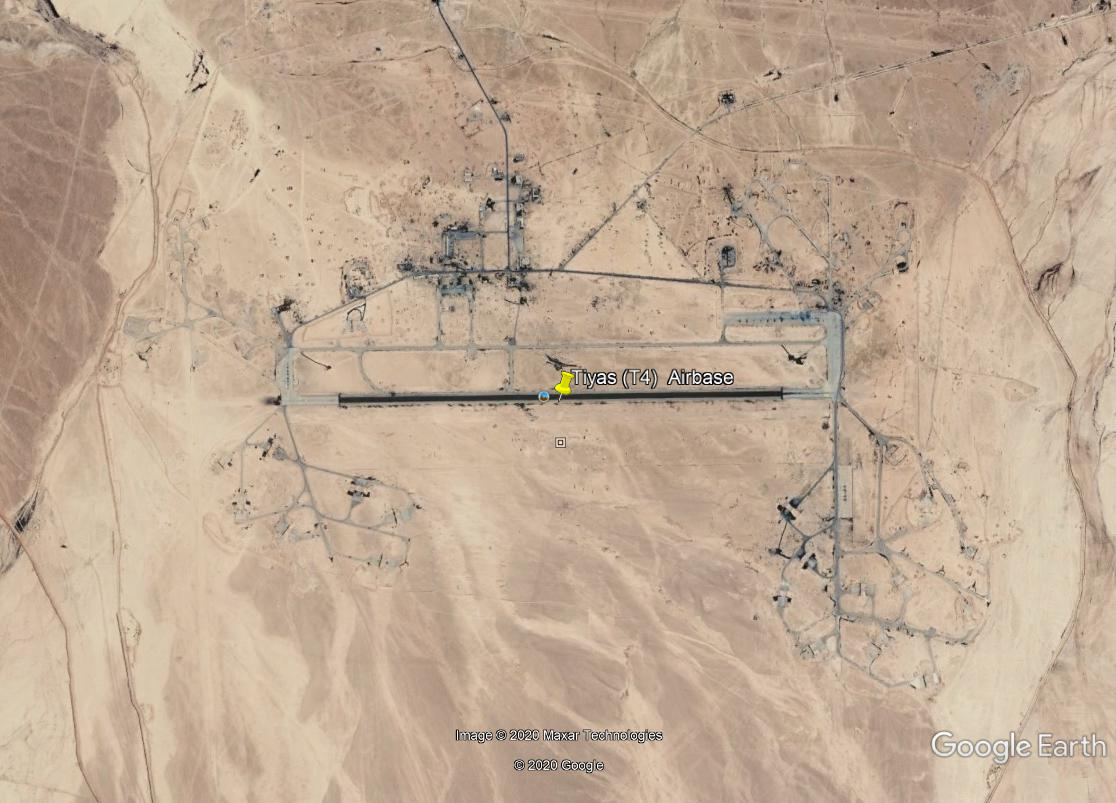
It is unclear when exactly Bouta arrived at the T-4 airbase, but according to accounts given by relatives and journalists familiar with his case, Bouta may have arrived there sometime in the mid-March to early April 2017 timeframe. According to accounts relayed to the press by Bouta’s brother-in-law, Bouta escaped the T-4 base on foot soon after arriving there. “He got lost in the big desert, so he sent a voice note message via WhatsApp to his brother-in-law in Lebanon—with difficulty because of the lack of network coverage in the desert,” a journalist from al-Jessr Press who is familiar with the case recalled in an interview. 11 “[Bouta] told him about his situation and told him he was lost. That was the last communication. It seems that when he got lost, the only place he could find refuge in was the Sha’er gas field. It was in ruins and it had just been liberated from ISIS and the guard present was a contingent of Russian soldiers who arrested him. He was tortured and killed during this period.”12 The voice message from Bouta in late March 2017 was reportedly the last communication he had with his family. According to local news reports, fighting contingents affiliated with ISIS hunters, a 5th Assault Corps militia trained and equipped by the Russian PMSC known as the Wagner Group, began closing in on al-Shaer in late April 2017.13
Death and Aftermath: A Video and a Secret Funeral
On June 30, 2017, a blogger named “Josh” posted commentary along with a 1:44 minute video for the combat veteran military specialist site Funker530.com with the headline, “Breaking: Terrifying Footage Of Russians Torturing Prisoner With Sledge Hammer.”14 The video (Video A) opens with a warning in English about graphic content and depicts several men in tan military uniforms beating an unidentified man with a sledgehammer and kicking him. At least two of the men have what appear to be AK-74 rifles slung over their shoulders. The man is lying on the ground amid what looks like debris from an industrial site. The man lying on the ground is curled up in a semi-fetal position and the blue and white shirt and dark blue jogging pants he is wearing are stained with blood.15 Not far from the man’s feet, there appears to be the severed head of the man. There is loud Russian rock music in the background and the men in military uniform laugh and joke with each other in a mix of Russian and Arabic.

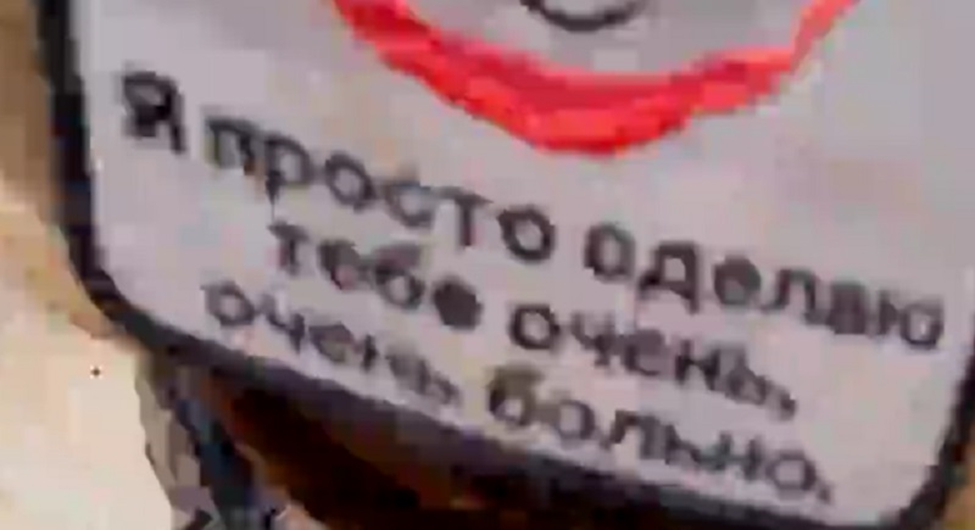
There are no other obvious identifying labels on the video, and it is unclear when and where the video was shot or how the Funker530.com obtained it. But, the posting notes that one of the men is wearing a patch on his uniform with Cyrillic writing. The patch says “я просто отделаю тебе очень очень больно” (“I’m just going to hurt you very very badly”). The video went viral within hours of the video posting on Funker530.com.
An open source investigator who uses the Twitter handle “Necro Mancer” (@666_mancer) was among the first to post a link to the site with commentary on Twitter. 16 Around the same time, Conflict Intelligence Team (CIT), an online investigative news outlet that tracks Russian military affairs,17 published a Facebook blog about the video on June 30, 2017.18 In that post, CIT indicated that the lyrics of the song playing in the background referenced Russia’s wars in Chechnya and Russian special forces or spetsnaz. Although CIT made a strong case for a link with the Wagner Group, no definitive proof of the identities of those depicted in the video emerged at the time. The location of the incident was unclear and the victim’s identity remained unknown. Although YouTube ultimately removed this first video, others were quick to preserve it in formats that are still accessible on Russian-language chat channels as recently as April 2020.19
Many facts remain unknown about what precisely occurred between the time Bouta arrived at al-Shaer and his death, but based on the timeline of events surrounding Bouta’s escape from the T-4 airbase as recalled by Syrian journalists who tracked down the victim’s family and the timeline of events surrounding the posting of the video, a crude assessment of the facts would suggest that Bouta was tortured and killed sometime in the late April to late June 2017 time frame. As will be seen below, this chain of events corroborates descriptions of the incident posted anonymously on Vkontakte by Russian-speaking Vkontakte users linked to subscriber groups on the platform that focus on news about Russian mercenaries and the military culture.
A little less than a year after Bouta’s death, in May 2018, members of Bouta’s family received a copy of a video depicting the same incident via WhatsApp.20 Unsure of the veracity of the video, Bouta’s family sent the video to a relative with close ties to Assad’s regime. “So, he inquired, and came back saying he [Bouta] was dead,” recalled a Syrian journalist familiar with the case. “They organized a funeral for him then, in 2018, and kept quiet. To this day they won’t file a lawsuit because they are in fear of the regime. It is already quite difficult for them to even transmit information to [us].”21 Another 18 months would pass after Bouta’s family held a secret funeral for him before new details about the incident would emerge that made clear a definitive link between the Russian men in the video, the Wagner Group, EvroPolis, and the Russian and Syrian energy companies charged with managing the al-Shaer site.
Contextual analysis of the circumstances surrounding the events that led to ISIL’s takeover of the gas plant, and the Syrian government’s long-battle to retake control of the site reveals that Hamdi Bouta’s death is likely part of a much larger pattern of potential war crimes perpetrated by Russian PMSC operators affiliated with specific contingents of the Wagner Group that also fought in the Donbas region of eastern Ukraine at the height of the Euromaidan crisis in the summer of 2014.
But, to understand how those pieces of the puzzle fit together it is important to first explore in some detail the history of the al-Shaer gas facility before the start of Syria’s civil war in 2011 and how EvroPolis played a critical role in the Assad regime’s decades-long struggle to exploit the gas basin surrounding the site known as the Hayan Gas Block.
Citations
- Biographical information about Bouta has been culled in large part from Arabic and Russian language press accounts and interviews with journalists, human rights activists, and lawyers familiar with the case. Al-Jessr (The Bridge) Press, an independent online news outlet run by Syrian exiles in Paris, has provided the most detailed account of Bouta’s life and death to date. Members of our team interviewed an al-Jessr staff member familiar with the case by phone on Feb. 10, 2020. See also: Al-Jessr Press Investigative Team, “Hamdi Was Terribly Tortured before His Death,” Nov. 17, 2019. source
- Phone interview with al-Jessr Press staff member, Feb. 10, 2020.
- Phone interview with al-Jessr Press staff member, Feb. 10, 2020.
- The precise geocoordinates for the town of al-Draij are: 33.620694, 36.260333.
- English language media coverage of operations at al-Draij is scant but interviews with Syrian reporters and a review of the few online articles available appears to corroborate descriptions of the camp as a key node in the training of opposition of detainees forcibly conscripted into units in the 4th and 5th Assault Corps. See: Urwa al-Sousi, “Syrian regime transfers detainees of 'Crematorium' Prison to unknown destination,” Zaman al-Wasl, May 18, 2017. source ; OrientNet News, “80,000 youths to be re-enlisted in Damascus alone,” Dec. 12, 2015. source ; Mojehidin.org, “Hezbollah Training Shiite Fighters in Syria,” Jan. 11, 2013. source
- Al-Alam News Network, “The Syrian army learns martial arts from Russian instructors,” (الجيش السوري يتعلم فنون القتال من مدربين روس), September 7, 2017. source
- Phone interview with al-Jessr Press staff member, Feb. 10, 2020.
- GlobalSecurity.org, “T-4 Airbase/Tiyas,” source
- Bellingcat, “Fortress T4: An Airbase at War,” June 29, 2015. source
- Michael Weiss, “The Case of the Keystone Cossacks,” Nov. 21, 2013. source
- Phone interview with al-Jessr Press staff member, Feb. 10, 2020.
- Phone interview with al-Jessr Press staff member, Feb. 10, 2020.
- Leith Aboufadel, “ISIS Hunters on the Verge of Liberating the Strategic al-Shaer Gas Fields,” Al-Masdar News, April 24, 2017. source
- Funker530.com, “Breaking: Terrifying Footage Of Russians Torturing Prisoner With Sledge Hammer,” June 30, 2017. source
- Our team acquired and analyzed several versions of Video A and conducted a frame-by-frame analysis and forensic analysis of EXIF metadata attached to the clip, but because the data files were likely only copies of originals, no immediate clues as to the origin of the video emerged and we were unable to determine what kind of mobile phone camera was used shoot the footage.
- On July 1, 2017, a Twitter user named “Necro Mancer” using the handle “@666_mancer” posted references to the Funker530.com blog post with the video: source
- The Conflict Intelligence Team has reported extensively on the activities of Russian PMSCs; for more insight see their website: source
- Conflict Intelligence Team, Untitled Facebook post, June 30, 2017. source
- The video can be viewed at: source ; Archived version of the site where the Video A is stored at: source
- Phone interview with al-Jessr Press staff member, Feb. 10, 2020.
- Phone interview with al-Jessr Press staff member, Feb. 10, 2020.