
Table of Contents
III. Overpriced and Underpaid: The History of the Modern U.S. Child Care System
For decades, the United States has taken a largely individualist, market-based approach to the care and education of its youngest citizens. While a national public education system for K–12 students has served families and youth since 1918 (with some states, notably Massachusetts, offering public education since the 1850s), there has never been a federally funded and publicly available system for the care of all children who need it from birth to age five.
Public schools continue to be subsidized and offered as a public good (though experts note that the K–12 system also needs bolstered investment and infrastructure, and that it contributes to inequality across race and class). Child care has been relegated to the highly individualistic, fragmented system we have today. A small portion of U.S. children benefit from the Early Head Start and Head Start programs, but the vast majority of families find child care independent of the state.
In 1971, the United States was on the precipice of change when Congress passed bipartisan legislation establishing a federally funded child care system. At the time, there were more women in the workforce, ample evidence of successful child care programs in other countries, and the political climate had supported reforms such as the 1965 creation of Medicare and Medicaid under president Lyndon B. Johnson. The Comprehensive Child Development Act would have made child care universal for all three- and four-year-old children with a sliding scale of costs based on income (and free to poor families).
The legislation was vetoed by Johnson’s successor, president Richard Nixon, who had touted the need for child care support in his campaign. Nixon, influenced by Cold War ideological battles, wrote in his veto statement that child care had “family-weakening implications.”
Nixon’s veto would set the tone of public child care debate and policy for decades to come. The entire child care industry has struggled since to provide affordable, quality care for children with livable wages for staff. Since 1971, demand for child care has skyrocketed. In 1975, when the U.S. Census Bureau first began reporting the number of women with children under age six in the labor force, the labor force participation rate for mothers with young children was just 39 percent. In 2020, 65.8 percent, nearly two-thirds of women with children under age six, were in the labor force. As of 2016, 60 percent of children too young to attend kindergarten spent at least one day a week in the care of a nonparent.
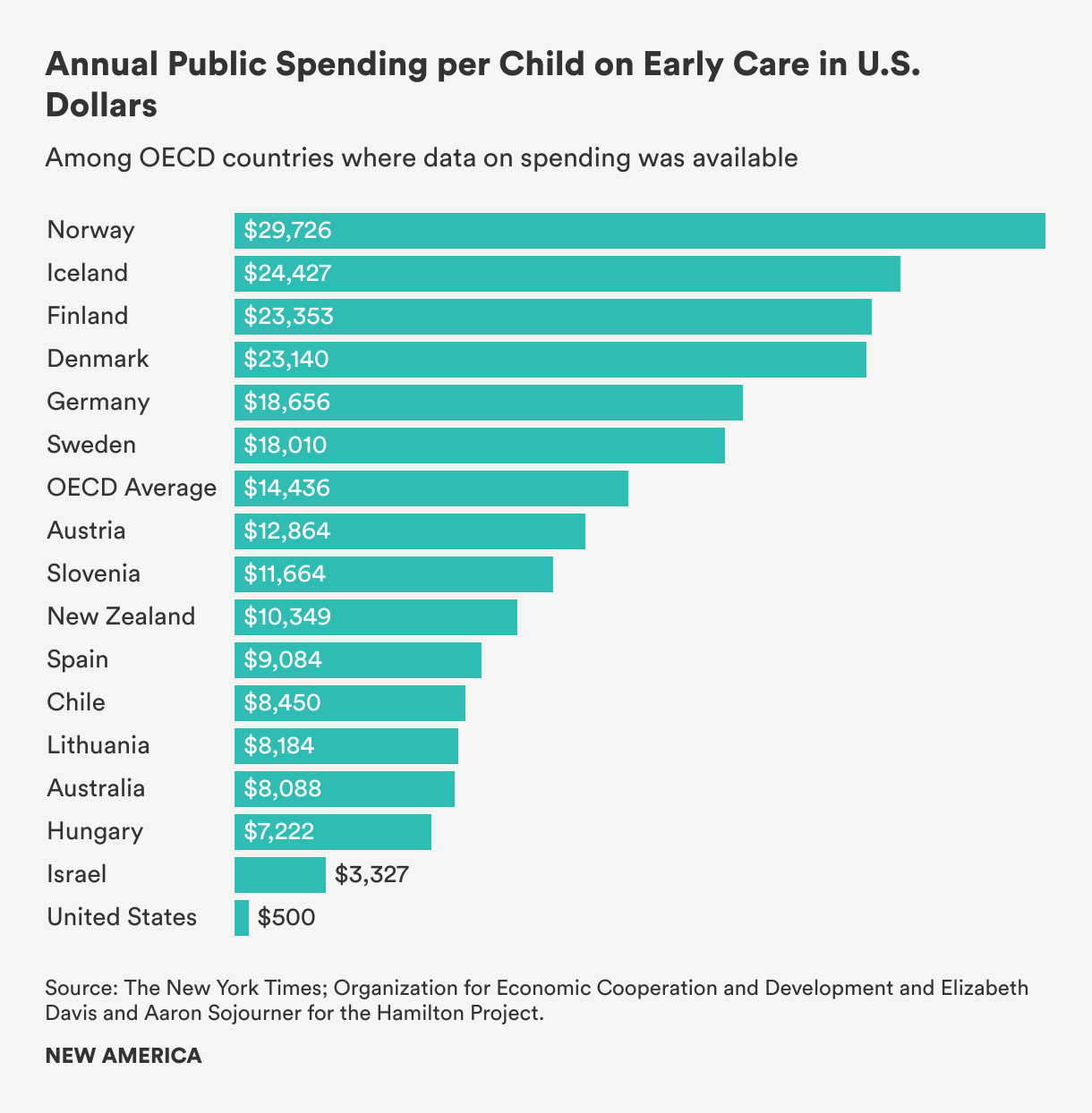
As New America’s Early Education team has reported, the United States continues to lag shockingly far behind its peer countries in the Organization for Economic Cooperation and Development (OECD) when it comes to investing in the care and education of young children. While the median spending per young child in other OECD countries averages $14,000, the United States spends just $500, most of it in the form of the aforementioned subsidies.
The federal government has played a limited role in improving access and affordability in more recent years. Beginning in 1990 with the passage of the Child Care and Development Block Grant (CCDBG) Act, the federal government has provided states flexibility in how they develop their child care programs and policies. These block grants subsidize child care for families with incomes up to 85 percent of state median income, and also provide funds for activities to improve the overall quality and supply of child care. Today, according to analysis by the Center for American Progress, just one in nine eligible children receives a child care subsidy.
Despite the fact that the Supreme Court has long held that undocumented children are owed unfettered access to public education, in practice, this protection has not been extended to young children prior to their entrance into K–12 schooling. Regulations under the CCDBG make it clear that child care subsidies serve children, therefore their parents’ immigration status cannot be considered a factor in qualifying. Yet the National Research Center on Hispanic Children and Families found that of the 13 states that contain 80 percent of the Latinx population, 12 states requested Social Security numbers for household members and seven of these states did not indicate that offering the information was optional. The percentage of Latinx children eligible for the Child Care and Development Fund is larger than the share of Hispanic children served by the program in 12 states.
Further limiting children’s access to these subsidies, some states require minimum weekly work requirements that must be formally documented. Families who work nonstandard hours and frequently only have short notification of their work schedules struggle to document their work hours from week to week.
The child care system in the United States would be even less robust than it is today if it weren’t for the child care workers who essentially subsidize it with their low wages. Yet the destruction wrought by the COVID-19 pandemic showed that a critical sector cannot continue to function on the backs of underpaid and underappreciated workers indefinitely. If early childhood education is a priority for the nation, then compensating and valuing the educators and other workers who make it possible must go hand in hand with efforts to expand access and opportunities for children.
Though millions of loving and dedicated child care providers make an undeniable impact on the children and families they support on a daily basis, the child care system—insofar as the network of decentralized, underfunded-yet-expensive, scarce, poverty-wage-paying providers that families rely on can really be called a system—is failing. Our own organization found as much in its 2016 Care Report and Index, which found that when it comes to cost, quality, and availability of child care, no single state was performing well across all three metrics.
In the following sections of this report, we shift our focus from the many problems with the child care system to bright spots and reasons for hope emerging even amid the crisis of the last few years. Many of the problems described above could be solved with bold legislative action. Unfortunately, the critical child care provisions in the Build Back Better budget reconciliation package first proposed by the Biden administration were reduced when it was ultimately passed as the climate and tax-focused Inflation Reduction Act in the summer of 2022.
This report serves as both evidence-based inspiration and a reality check on what can be done by dedicated practitioners, investors, and educators in the meantime, and what future state and federal action should consider and include.