
Table of Contents
II. Methodology: The Solutions Journalism Approach
In 2021, the Better Life Lab team at New America set out to better understand the most critical pain points in U.S. child care and realistic solutions that could pave the way for a universal and equitable child care system in the United States. Over the last year, we have interviewed dozens of parents of young children and more than fifty experts and innovators in the child care space. Along the way, we have asked interviewees to tell us about the problems they’ve identified in the child care space, how they came to identify certain innovations as promising, the details of the changes they are trying to make, and their success or any barriers encountered thus far.
Our reporting and our findings are by no means comprehensive or exhaustive. However, our findings are supported by numerous experts and evaluated based on the experiences and insights of multiple sources. As the United States reimagines how to design and build an equitable, universal early care and learning system that works for children, for families who rely on stable child care in order to work, and for child care educators and providers who need and deserve to earn living wages for such valuable work, we believe all of these stakeholders in the child care system will find this report useful as a starting roadmap for next steps and questions.
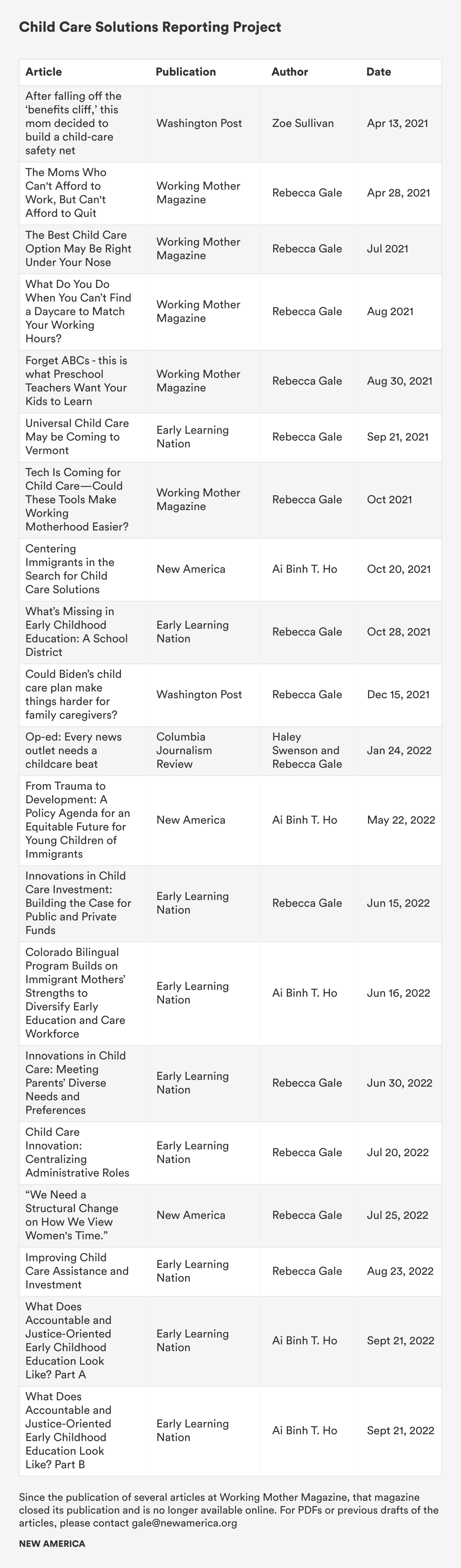
Along the way, we surfaced several key themes about innovations and impact. We published standalone articles on the topic of child care in the Washington Post, the Columbia Journalism Review, Working Mother magazine, and Early Learning Nation, among others. In each case, we used a solutions journalism framework to articulate bright spots and explain which innovations could work in multiple instances and be scaled for wider adoption.
A complete list of the articles is below:
The solutions journalism framework has become one route for journalists to pivot from reporting on seemingly intractable problems to seeking out and focusing on available solutions. The Solutions Journalism Network (SJN), founded in 2013, has sought to formalize and promote solutions-oriented reporting by “leading a global shift in journalism, focused on what the news misses most often: how people are trying to solve problems and what we can learn from their successes or failures.”
The SJN has conducted research using case studies and experimental A/B testing to show that engaging with solutions-oriented reporting versus traditional reporting impacts individuals by increasing their emotional connection to the issues described, their belief that they can play a role in developing and implementing solutions, and their intent to learn more about the issue.
Our own organization, New America, has invested in solutions journalism in various ways in the last decade. Our RiseLocal pilot for reporting grants supported journalists exploring policy solutions underway in states, cities, or even organizations in the United States that might—when scaled, resourced, or translated—promise solutions to major problems outside their current context. Our solutions reporting, including some by authors of this report, has shone a spotlight on promising attempts at eradicating homelessness, supporting immigrants in attaining health care and other services despite the chilling effects of the so-called public charge rule, and a social entrepreneurship model where women in poverty are offered jobs and job training at the same time.
There are challenges to applying the solutions journalism lens to one-off stories about child care however. As two of the report authors, Haley Swenson and Rebecca Gale, argued in a 2022 Columbia Journalism Review op-ed, there may be no other complex public policy topic that affects so many people that is still not covered with dedicated journalists who understand the intricacies and fragilities of the U.S. child care system. There are coverage verticals of nearly every stripe and size, but child care is still too often considered an add-on to parenting and, more recently, to political or economics coverage. In reality, its complicated nature requires a dedicated reporter to understand both the intersecting circumstances causing the child care crisis and the ways that it might be solved. Our goal in bringing multiple authors from different backgrounds together for over a year of reporting on this subject has been to provide a deep, contextualized narrative about what is currently underway to improve child care across the country and what major barriers still stand in the way of progress.
Additionally, our reporting has been influenced greatly by the insights of the fields of early childhood education policy and research, which have grown and deepened their influence over the last few decades. Unlike a traditional newsroom, this report’s authors have been reporting from within a nonpartisan think tank. When we began our exploration of key areas of innovation for universal child care, we consulted with experts in the Early and Elementary Education Policy program at New America and came up with an initial list of known problems in the existing child care system to explore. Those included the following problems:
- Low investment and inefficient/ineffective distribution of public money
- Fragmented, decentralized options for child care, which make parents’ search more difficult and complicated
- Vast inequality and uneven experiences across the system, especially across race, class, and immigration status
- Absence or invisibility of child care in places where its most needed
- Communities and families that have been excluded from the system or underserved by existing options
- Integrating, coordinating, and administering mixed delivery within the federally subsidized system
- Improving job quality and the retention of diverse teachers
In this report and our reporting elsewhere, we have sought to highlight what we see as promising solutions—what we have called innovations—for pushing the child care system toward a better future.
Note: For the purposes of this report, innovation is defined as a group, entity, idea, movement, or organization that improves access to high-quality early care and learning, with the potential to scale or be applied elsewhere, in pursuit of just, equitable, and truly universal child care.
What does high-quality early learning and care look like?
Our approach to child care innovation in this report meant looking for and reporting promising solutions to the United States’s child care crisis that are possible even without major federal intervention. We interviewed stakeholders about and explored the real limitations of those solutions, especially absent robust federal investment or other modes of scaling these solutions or transferring them to different locations. We have therefore provided critical historical and demographic context, not only in this introduction but in each of our stories, which our reporting suggests is critical to understanding the child care system as it is today and the real steps our communities, states, and federal government must take to ensure high-quality child care is available and affordable for all children in the United States.
According to our review of the latest research among early childhood experts, high-quality early childhood education—or ECE, which we use interchangeably with the phrase “child care” in this report—promotes children's physical, mental, and emotional well-being and development through a consistent, positive, caring relationship between child and caregiver. The economic evidence of early education’s benefits on the economy and the workplace are clear, but that should not overshadow the potential of early education to create a better and more just society.
Early education should be more than an early version of K–12 schooling, in which children learn new academic information and develop skills. Many young children, especially children of refugees and immigrants, have experienced trauma that has been associated with reduced size of the brain cortex, which is responsible for many complex functions including memory, attention, perceptual awareness, thinking, language, and consciousness. Young children enter child care with a variety of needs and a range of experiences and capabilities. The best child care makes space to recognize those differences and to provide or connect families with whatever type of support will best benefit those children and ensure them healthy, happy futures. Holistic and accountable approaches may need to fall outside of the classroom, such as connecting families with pediatricians and health services, mental health care, parenting groups, and home visiting services. Families are best supported in facilitating their children’s development and mental health when services are available in their native languages.
This report highlights innovations that promote more universal access to care that acknowledges the structural injustice toward marginalized families and the richness of their cultures and traditions, as well as their preferences and the types of care they feel most comfortable receiving. In this report, we explore a variety of types of child care providers and settings, and focus on building systems that can translate across locales to train and prepare educators as the latest research on quality develops. The context in which we have been searching for and reporting on child care solutions, one with both great public interest but a seemingly uphill struggle to pass those policies at a federal level, has shaped the focus of the reporting on particular areas of intervention. They range from the types of campaigns we think show the most promise in widening the current policy “Overton window” to make space for more ambitious policy changes, to smaller, more incremental changes (such as changes in the subsidy model or local plans for centralizing administrative tasks), to changes made by state policymakers and administrators, child care providers, and even technologists and philanthropists absent shifts in the policy landscape.