
Table of Contents
I. Introduction: The Decades-Long Deepening of a Child Care Crisis
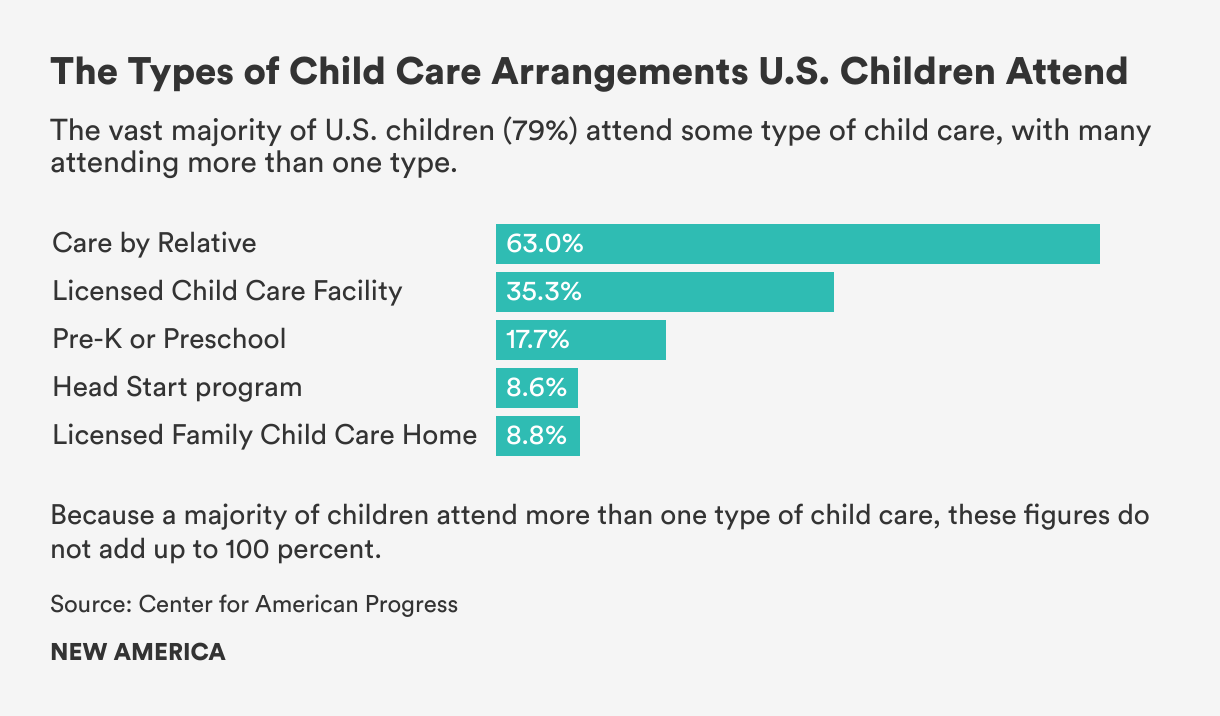
Receiving care and education from someone who isn’t a parent is an increasingly common part of life for the majority of children in the United States. According to the most recent available census data, analyzed by the Center for American Progress, the majority of children aged zero to five in the United States spend time each week in nonparental care. Of children who receive care from a nonparent, more than half receive care from more than one provider. Of those children who spend time in nonparental child care on a weekly basis, the majority (63 percent) are cared for by a relative, like a grandparent or sibling; 36.9 percent spend time in a licensed care setting; and 19 percent receive care from an unlicensed nonrelative, such as a home-based care provider, a friend, or a neighbor.
Beginning in March 2020, the lockdown phase of the COVID-19 pandemic shifted child care burdens back home and forced families to rely on unstable or untenable arrangements. Parents juggled caring for their young children out of their normal child care settings while working from home, in some cases also while helping older children with their remote schooling. Many parents of color, who are disproportionately represented in occupations that do not allow telework and therefore could not work from home, were forced to leave their jobs or scramble to find new child care arrangements, including arrangements they did not prefer, like having older children watch younger children.
The COVID-19 pandemic has had profound detrimental effects on marginalized children. More than 75 percent of children dying from COVID-19 are minorities, mirroring the disproportionate death rates of adults. The disproportionate representation of minority deaths may result from, among other things, mistrust of and lack of access to health services. Additionally, child poverty rose between 2018 and 2020 for Black and Latinx children. Analysis of data from the National Survey of Children’s Health reveals that before the pandemic, Black and multiracial parents experienced child care–related job disruptions—such as quitting a job, not taking a job, or changing their job—due to problems with child care at nearly twice the rate of white parents.
In many immigrant families (like those with green cards or whose children are U.S. citizens), adults who lost their jobs or had their hours reduced during the pandemic did not qualify for most forms of federal aid, such as unemployment insurance or recovery rebates. Because of their immigration status, many also fear applying or don’t qualify for federal public benefit programs like Supplemental Nutrition Assistance Program (SNAP), Medicaid, Supplemental Security Income, or Temporary Assistance for Needy Families.
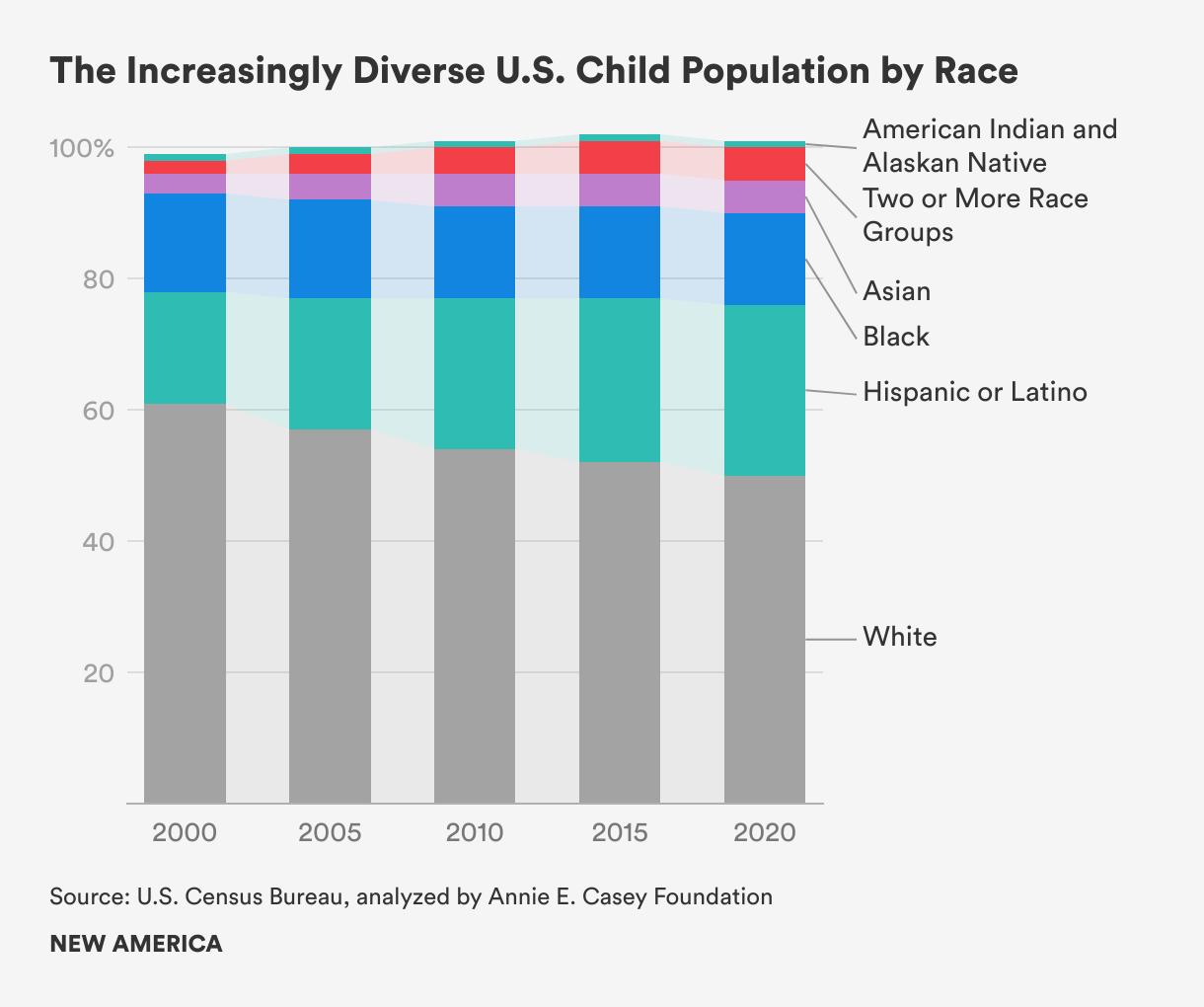
The U.S. child population has become increasingly diverse in recent decades; children of immigrants make up the fastest-growing population of children. Each area of inequality for children and families of color has a pronounced impact on the overall well-being of children.
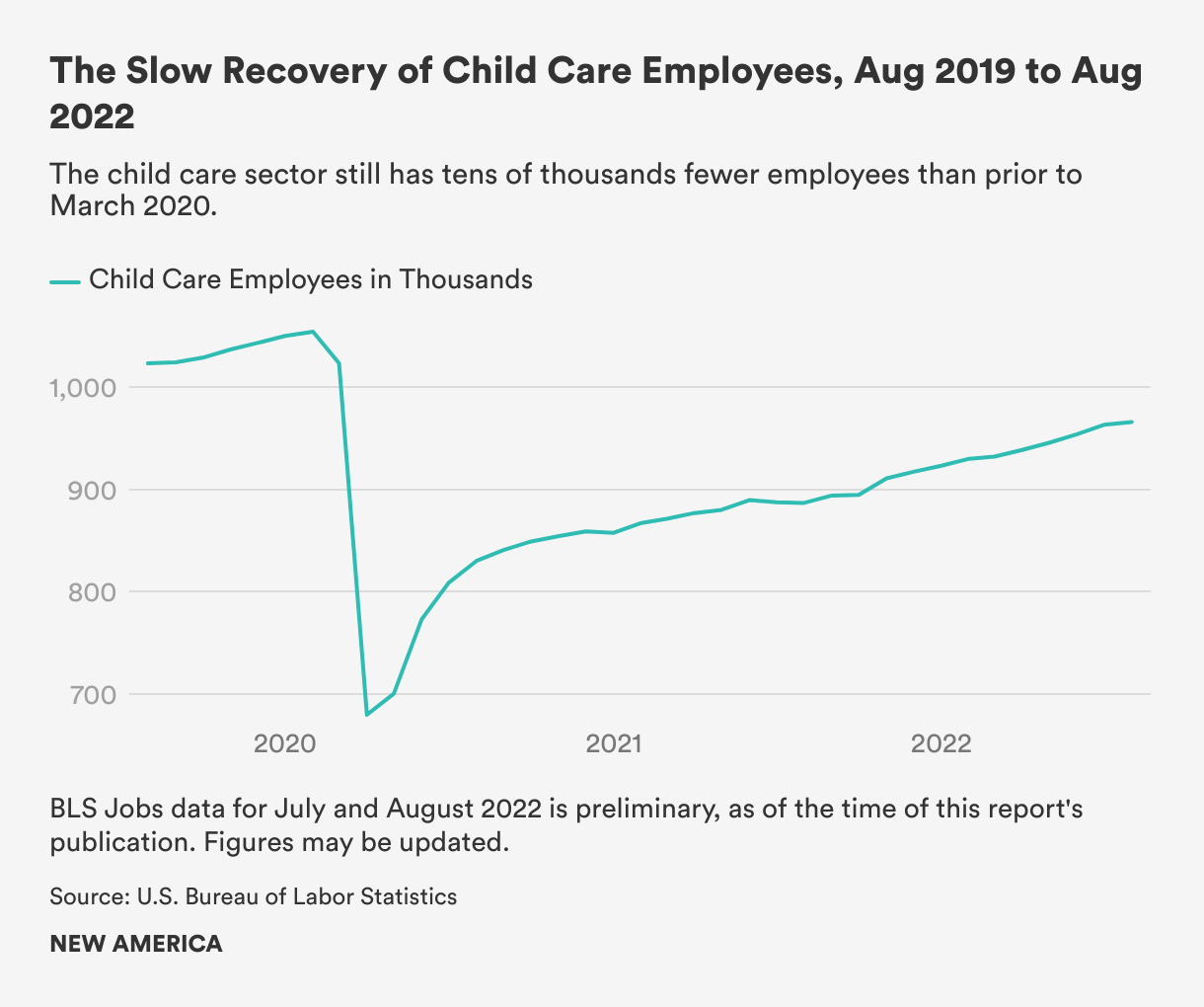
Between 2019 and 2021, 8,899 child care centers and 6,957 family child care providers closed, according to Child Care Aware. Because women continue to perform the majority of housework and caregiving, managing these gaps in child care has often fallen to them. More than two years after the pandemic began, an estimated 1 million fewer women are in the workforce, and many cite the need to care for children as a reason why. Furthermore, the child care workforce also shrunk, dropping from 1,054,200 workers in pre-lockdown February 2020 to just under 680,000 by April 2020, according to data from the U.S. Bureau of Labor Statistics (BLS). By August 2022, the most up-to-date (but preliminary) BLS data available at the time of publication, many of those workers had returned to the child care sector, but still 88,000 fewer than prior to the pandemic.
The child care workforce also represents a site of ongoing racial inequality. Although virtually all child care workers are women, women of color and immigrant women disproportionately do not enjoy adequate wages or benefits. More than one in five (22 percent) child care workers is foreign born, 15 percent of child care workers are Black, and 21 percent are Latinx. Data from the National Survey of Early Care and Education in 2019 show that wages for early childhood teachers differ by race: Black women earned 76.3 percent and Latinx earned 85.2 percent of what white teachers were earning. Perhaps even more troubling is that the wage disparities worsened for both Black and Latinx teachers between 2012 and 2019. While inflation-unadjusted hourly wages for white women increased 92 cents, they decreased for Black and Latinx women by 40 cents and $1.05, respectively. The low wages child care workers earn has undoubtedly slowed the sector’s employment recovery, as some experienced teachers seek higher wages and more stable employment in other sectors.
As a result of pandemic-related closures and the decline in staffing, millions of children, including millions with disabilities, were cut off from critical resources. According to data from ChildTrends, approximately 7 million infants, toddlers, and children with disabilities struggled with the sudden absence of health services and learning accommodations as providers closed and schools grappled with providing remote instruction.
Devastating outcomes like these made child care a subject of national debate for the first time in decades. Despite years of public underinvestment in early care, recent studies suggest the U.S. public is, by and large, open to a much more assertive public role in the sector. A 2022 poll by Morning Consult showed overwhelming bipartisan support for child care investments, including 72 percent of all adults and a majority (60 percent) of Republicans favoring expanding subsidies to make child care more affordable for parents. Yet efforts by U.S. President Joe Biden’s administration to champion child care and prekindergarten investments in 2020 through its Build Back Better framework were met with staunch opposition, despite several members of Congress championing the early care and education portions of the legislation.
We know from other peer-competitive economies, as well as experiments with public child care in the United States like the Lanham Act during World War II, that a high-quality, accessible, affordable universal early care and education system—with a well-compensated, well-trained workforce—helps everyone thrive. Until more robust federal investment plays a role in our nation’s child care infrastructure, it is up to private innovators, nonprofits, and forward-thinking state and local governments to deliver this public good. This report discusses such innovations in more detail.