
V. Recommendations
With these findings, we have several broad recommendations for additional tax filing assistance funding.
Simplifying the Process Overall
The single most important improvement would be simplifying the process of tax filing overall. This would mean collecting only data that the IRS does not have, like household composition. Filing taxes is difficult and intimidating, and as the tax code becomes an increasingly important delivery mechanism for benefits, it is essential that this process become more accessible. Simplified filing during the pandemic was a crucial first step. Using the GetCTC tool, over 115,000 households, about a quarter of which had never filed taxes before, also successfully filed their taxes, claiming around $440 million in tax benefits. However, that simplified filing option is not currently available. Bringing back the simplified filing portal, and incorporating additional benefits for those who do not have a filing obligation (such as the EITC, which the recently released revenue procedure does), would be an important step. Moreover, providing a public option for tax filing for all Americans, as we have previously argued, should be the long-term goal. Despite existing programs, millions of Americans do not receive the assistance they are entitled to and need, and simplifying the process would decrease the amount of assistance required while simplifying interactions with the IRS.
However, for the current tax season, before simplified filing is available, some smaller changes could help improve the process for tax filers. In the figure below, we outline how the process could work to address many of the challenges in the previous section, each step of which is laid out in detail in the following recommendations.
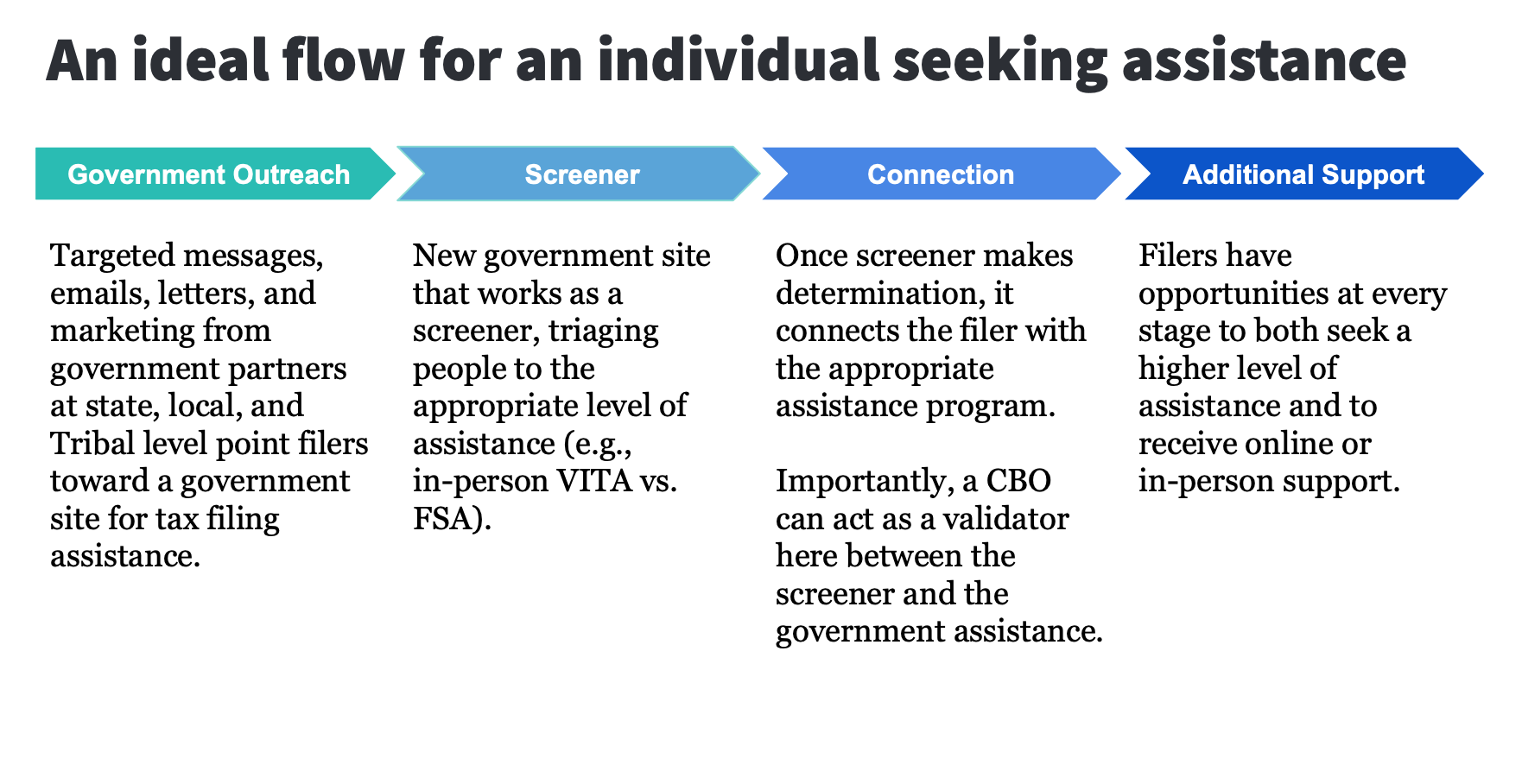
Getting People to the Door
- Improved Outreach: Research suggests that simplifying the return process for tax filing paired with text outreach is more effective than mailers that simply seek to raise awareness. The most effective outreach this past tax season consisted of state government agencies texting all of their users clear, actionable information about tax filing. This indicates that increased data sharing and outreach across programs could be a powerful tool for increasing uptake. In addition, funding could go toward embedding tax filing assistance programs with other social programs, including Head Start and legal aid bureaus, that the community trusts.
- Data Collection and Metrics: The IRS should collect nationwide VITA data, including on demographics of filers and the average costs of filing in different communities. Such data would better enable the IRS and VITA to find areas with the most need and target them. Data collection could also work to find best practices and share them in reports.
Getting People to the Right Door
- New Front Door: One expert, who runs a call center helping with tax filing assistance, said, “What you need is a trained group of intake specialists to help do the triaging,” and the, after triaging, use “trained tax preparers that give their time, talents, and efforts to tax law application.” Scaling such a call center would be challenging, and the government could instead aim to have a better online front door. Either GetYourRefund or a new online portal must better triage people to the right level of services. The GetCTC tool provides a useful example of a triage/screener, which funnels those who qualified for GetCTC into the tool and could point others toward more appropriate resources.
VITA sites are overwhelmed and lack the ability to scale their volunteer base. By relying on a better triaging system, VITA can best serve those taxpayers that need the most assistance. Such a system can also point taxpayers with greater savvy or those who have familiarity with tax filing to utilize FSA. Providing a one-stop-shop for all services, whether it is simplified filing, FSA, VITA, or Free File, and allowing clients to channel themselves to the appropriate level of assistance and then “upgrade” if necessary would improve outreach by simplifying communications and save resources by providing only as much support as is necessary. It is essential for such a one-stop-shop to be a government organization as the consolidation of outreach efforts and trust in government resources lead to success. More broadly, both the tax filing process and tax benefit programs are government-run, and the government should play a leading role in helping Americans access both.
This New Front Door solution is not for everyone though. While increased technology and referrals for callers to use online portals can work for those with broadband access and updated devices that allow them to access such online assistance, there must be support for local VITA programs that serve marginalized and rural residents that do not have adequate access to broadband, home scanners, and any device but a flip phone. Until there is universal broadband access and there are mechanisms for all filers to have devices that will allow them to file their taxes online, there has to be VITA support for in-person and remote drop-off sites for families to receive tax services.
Getting People Through the Process
- Expanding FSA: Only about three percent of eligible households utilize VITA services. One expert said that across the nation, probably only 200,000 households utilize FSA. Although FSA is not the right level of service for every household, FSA can scale if targeted to people with digital skills (for example, the 35 million people who pay for online tax software). FSA is currently offered by United Way and Code for America at the national level, as well as at local VITA sites. Expanding how people access this program could increase uptake, and advertising it along other services would increase awareness. Moreover, as those providing support through FSA are not preparing tax returns, they can be paid, indicating that additional funding could be used to ramp up this offering quickly, and with training now online, potential assisters could get paid to do training and provide assistance from their own home. If people with greater digital literacy and more confidence in their filing ability utilize FSA, that will open up VITA sites for those with greater need for full assistance. Additionally, those who currently pay for online tax prep could also benefit from this program, as they would be able to save more of their refund.
- More Flexibility for Matching Funds in VITA: Matching funds are harder to access for some organizations than others. For example, small non-profits that serve particularly disadvantaged communities, such as rural areas, Native, and immigrant communities, have greater difficulties matching funding. However, these are the communities that would most benefit from these interventions. Increasing flexibility in matching funds, including taking into account expenses and needs, would do much to increase access.
For example, while it is currently permissible to use volunteer hours as matching funds, not all sites do, and the amount assigned to each hour of labor varies. If the IRS assigned a standardized hourly rate in line with the tax accounting firms (approximately $200/hour), this would increase the capacity of VITA sites to absorb new funds while also more accurately measuring their value.
- National Digital Infrastructure: Investment could close the digital divide and improve digital literacy. The need for digital infrastructure is greatest in communities with the most need, such as Native communities.