
Table of Contents
- Executive Summary
- Preface: Why We Need Good Policy and Good Implementation of Public Paid Family and Medical Leave programs
- Research Process
- Key Learnings
- Learnings Part 1: Communicating Effectively about PFML
- Learnings Part 2: Outreach
- Learnings Part 3: Applications, Processing, and Delivery
- Learnings Part 4: IT Infrastructure and Culture
- Conclusion
- Additional Resources
Learnings Part 1: Communicating Effectively about PFML
1.1. Job Protections
1.2. Mapping Programs to Life Events
1.3. Cultural Considerations
1.4. Plain-language and User-tested Materials
Despite what program administrators may think, PFML programs can be confusing and overwhelming for potential beneficiaries to understand. All of the 15 beneficiaries and potential beneficiaries we interviewed expressed a misunderstanding of a foundational aspect of the program—about eligibility, application timing, job protections, or other issues. How administrators talk about their programs matters. This section discusses some of the most common misconceptions among New Jersey beneficiaries, and steps administrators can take to resolve them.
1.1. Job Protections
A paramount factor in whether eligible workers take TDI/FLI, and the single greatest source of confusion for potential beneficiaries, is job protection for leave-takers. Job protection came up in all of our user interviews during the sprint—and advocacy groups with hotlines to help educate potential PFML beneficiaries, like A Better Balance, also report that job protection is nearly always the first question people ask. Especially for low-income families, the assurance that an employer will not retaliate against leave-takers is not a luxury—it is an absolute prerequisite for taking leave. Taking time off if a job will not be waiting on the other end is simply not viable.
“Once I realized I was protected, it was ‘instant Xanax’. . . This is not going to throw my life off any more than it already is.” – Interviewee #12
Ironically, job protection is primarily—with one exception, discussed below—not part of TDI/FLI at all. Thankfully, many workers’ jobs in New Jersey are protected if they take family or medical leave, whether paid or unpaid—but only because they have concurrent protections under partially overlapping state and federal laws. The federal FMLA allows certain workers at employers with more than 50 employees1 to take 12 weeks of unpaid leave in a 12-month period to care for a newborn or ill family member, or recover from their own illness; while the New Jersey Family Leave Act (NJFLA) allows certain workers at employers with more than 30 employees2 to take 12 weeks of unpaid leave within a 24 month period to bond with an infant or care for a family member, with a notably more expansive definition of family,3 though these expanded state protections are relatively recent. For use cases that do not overlap, these protections can run in succession; but, if the use case is covered under both, protections are exhausted concurrently. (For example, a mother who just gave birth could in principle take 12 weeks of job protection from FMLA to recover from childbirth,4 and then another 12 weeks from NJFLA to bond with her newborn; but the same woman taking time off to care for her seriously ill child will exhaust 12 weeks of FMLA and NJFLA concurrently, and will only have job protection for 12 total weeks.5
To make matters still more complex, FMLA is enforced by the U.S. Department of Labor (USDOL), while NJFLA is enforced by the NJ Office of the Attorney General’s Division on Civil Rights (DCR)—neither of which, of course, is NJDOL, which administers the state’s PFML program.
Meanwhile, finally, there is in fact a third set of legal protections for workers, in the form of anti-retaliation provisions in the TDI/FLI law itself; but no agency is empowered to enforce these provisions, and as a result they have no teeth and are usually overlooked in favor of FMLA and NJFLA in practice.6
This patchwork job protection would be hard enough to explain to the general public or potential beneficiaries, even with the best intentions to do so. But NJDOL had historically—and somewhat understandably—viewed job protection as a problem for agencies with the proper jurisdiction to solve, suggesting beneficiaries with job protection questions reach out to USDOL or DCR, but without providing a specific point of contact that provides direct service. Under the new administration, NJDOL had begun to collaborate with DCR to improve messaging and facilitate handoffs, and DCR had worked with paid leave advocates, but both were still making up for the prior disconnects, and as of 2019, the agencies still to a degree presented themselves to citizens as two distinct bodies when it came to PFML. (Since the sprint, in response to the findings, the partnership between NJDOL and DCR grew especially stronger, so that NJDOL is no longer a “wrong door” with regards to job protections.) Collaboration between state agencies and the USDOL on the issue of FMLA job protection enforcement, meanwhile, had been nearly nonexistent, according to interviews with TDI/FLI staff.7
The result was that, at the time of the sprint, widespread confusion remained. Many of our interviewees conflated job protection programs with paid leave programs,8 and NJDOL’s implicit policy of deferring questions on job protection information to the agency with jurisdiction was generally viewed on the outside as poor service; citizens said they expected the different arms of the state government to communicate with one another. NJDOL employees also reported regularly receiving FMLA applications—which are federal documents leave takers can optionally deliver to their employers, not intended for submission to any government agency at all. Even more confusing, several interviewees reported being misled by their own employers about job protections, and not having the independent information needed to contest them.
Overall, many potential beneficiaries saw both the PFML program and the system to ensure job protection as a confusing alphabet soup at best, which can be a significant barrier to their applying for or taking leave:
“I knew that I was able to get time off, but I wasn't exactly sure the amount of time with family leave, and the federal FMLA and everything. So, it was a little bit anxiety-provoking figuring that out, and not wanting to take too long because I didn’t want my employer to come back over time and saying you know what, you took too much time.” – Interviewee #1
Overall, many potential beneficiaries saw both the PFML program and the system to ensure job protection as a confusing alphabet soup at best, which can be a significant barrier to their applying for or taking leave.
A related result was the relative rarity of legal actions to enforce job protection. In the five years before 2019, according to DCR, there were on average under a dozen complaints filed per year under the NJFLA.9 Of course, it is better that protections be made clear up front, and employers prevented from retaliating before it occurs, since complaints typically take multiple years to resolve, and generally do not provide much relief to the complainant. But, with a state the size of New Jersey, this low number of complaints could mean that many workers simply do not know how to file a complaint (or even that they have the right to do so), and that a number of employers may be pressuring their employees into not taking leave, with impunity.
New Jersey is not unique in this regard. Many other states also have gaps between the job protection available to workers and the paid family or medical leave that may be available to them, and some also have different agencies administering the different laws. (In some states, such as Rhode Island and New York, job protections are written into paid family leave laws—though not paid medical leave laws. Even in these states, different agencies may administer the leave and the protection; and there is still the issue of USDOL-enforced FMLA protections.)
In an ideal world, job protections would be provided by the same statute and enforced by the same agency that distributes leave payments. In practice, as long as unpaid FMLA remains on the books and PFML programs are administered by states, this solution is not entirely feasible. As a second best option, state agencies that administer PFML benefits need strong partnerships with enforcement agencies. Information about job protections should be clearly presented alongside information about PFML itself; agencies providing PFML must see it as their responsibility to address their users’ concerns regarding job protections.10 When enforcement agencies have to get involved, PFML administering agencies should provide direct connections to the relevant offices, making handoffs as smooth as possible.
Recommendations:
- [Statutory] Empower the same agency to both enforce job protections and administer PFML benefits as much as possible.
- Agencies with jurisdiction over PFML benefits should collaborate with agencies responsible for job protection/enforcement to create protocols for “warm” handoffs, a “no wrong door” policy, and messaging and resources that each agency can deploy to prevent confusion and provide consistent, helpful information. Legislators may consider statutorily mandating such cooperation as a core component of both the PFML program and the job protection regulations.
1.2. Mapping Programs to Life Events
PFML programs, by design, cover a wide variety of life events—taking care of a family member, bonding with a newborn, recovering from a temporary disability that leaves you unable to work. This range is a feature, not a bug. But the variation creates challenges for administrators who have to communicate clearly about different use cases to potential beneficiaries.
The nuances at play in New Jersey are not universally applicable, but they are instructive. As discussed above, New Jersey has two paid family leave programs: the long-running (since 1948) TDI that covers a worker’s own temporary disability (including but of course not limited to pregnancy), and the newer (since 2009) family leave program (FLI) that covers bonding with a new family addition, caring for a loved one, or coping with sexual or domestic violence. Furthermore, in practice, potential beneficiaries have to apply to one of three separate programs: TDI, FLI-Bonding, or FLI-Care, each of which have slightly different applications and slightly different rules. And a birthing parent can in fact apply for two programs: TDI to cover their own pregnancy and FLI-Bonding thereafter.11 (Such nuanced distinctions extend beyond the bounds of the PFML program as well; a temporary disability incurred outside the workplace is covered by TDI, but one incurred within the workplace would be covered instead by workers compensation.)
Unsurprisingly, this breakdown was not intuitive to users. That birthing and non-birthing parents seeking to take leave would have to apply to different programs was not intuitive; that maternity leave falls into the same category as breaking a leg or suffering from carpal tunnel syndrome and needing time to convalesce was not intuitive; that a birthing parent seeking their full leave would need to use two programs was not intuitive. This last point was especially prevalent throughout our research. In a card sorting exercise we ran during the sprint on different social insurance use cases, 90 percent of respondents grouped caring for an infant, adopting a child, and having a baby into one common use case, labeled “maternity leave” — it was not intuitive that this is in fact composed of two different programs.
“It’s odd there are two separate applications. Most parents want to spend as much time at home with their child as possible. It should just be one application.” – Interviewee #1
The human resources (HR) managers we interviewed frequently described needing to devise their own tricks to outline the differences between programs to their confused employees. One interviewee reported that even their doctor could not get the programs straight: “My doctor wouldn’t sign it [the TDI application]. They just kept saying ‘you’re pregnant. Not disabled’,” said Interviewee #11. And the confusion was also borne out in program applications: application examiners we interviewed estimated that 15-20 percent of FLI applications were submitted to the wrong program—often FLI-Care rather than FLI-Bonding, for newborn bonding claims.
The simplest solution is to eliminate—at least in public-facing materials—the distinctions between different types of PFML programs. To the degree that statute and regulation allow it, states could very simply administer paid leave, and determine the type of leave in one common application. In cases where the text of the legislation or path dependence of administration prevent the complete collapse of programs into one bucket, administrators should still try to communicate about the respective programs analogously to how users think about them: in terms of the life events that precipitate them. Agencies can talk about a program for new parents, a program for temporary disabilities, a program for caregiving—and not try to explain confusing and unproductive distinctions to beneficiaries any more than is required by law.
Recommendations:
- Learn how beneficiaries think about programs in terms of their own real life experiences, and talk about them that way, rather than adhere to alphabet soup acronyms.
- Consider running all of PFML as a single program on the front end as much as possible, so that eligible applicants do not have to identify the flavor that suits their use case, or reapply for benefits in the middle of their leave. Identify and address any regulatory or statutory barriers that prevent the program office from talking about PFML in a way that users can understand. (Note that this is a far larger issue in Calif., N.J., N.Y., and R.I. than in states designing new, holistic programs.)
1.3. Cultural Considerations
In a country where family leave remains non-normative, cultural perceptions of leave play a role in preventing potential beneficiaries from taking PFML—or taking the full amount of leave they are entitled to.
“I want to maximize my time but I’m the only one who can do what I do. I’m not worried but it feels selfish to take too much time off.” – Interviewee #12, on why she will work up to her delivery date, only took TDI and not take FLI, thereby likely sacrificing eight to 10 weeks of paid leave
“Even though people legally qualify [for PFML] many do not feel comfortable [taking advantage of the program]. You need that time to exist with your baby. There’s so much pressure to bounce back. When at work, you’re not allowed to be a mommy and when at home, you’re not allowed to have a job.” – Labor and Delivery Nurse
“Everyone has kids but they are all men. They just give the guys two weeks’ vacation… Having a pregnant woman in the office wasn’t something they were used to. I was nervous and super early in my pregnancy. I felt like I needed to give them as much time as possible. I needed to make sure if I’d have a job and medical [coverage].” – Interviewee #9, on why she was nervous to speak to her employer about taking leave
These concerns—about employers viewing PFML as an inconvenience or accommodation rather than an ordinary part of managing a workforce with caregiving responsibilities—came up repeatedly in our interviews with mothers, even in a state that has had some version of paid maternity leave for over half a century, and with (as discussed in the next section) fairly widespread use of maternity benefits.
"I want to maximize my time but I’m the only one who can do what I do. I’m not worried but it feels selfish to take too much time off."
Meanwhile, all evidence suggests that such cultural pressure not to take PFML plays out doubly strongly for non-birthing parents and for men in general. As discussed below, use of leave by non-birthing parents is more than 80 percent lower than maternity leave in New Jersey.12 While our research did not include fathers, our interviews with mothers, businesses, and advocates, as well as other recent Better Life Lab research, indicate that cultural barriers and workplace practices that reinforce traditional gender roles (of men as primary breadwinners and women as primary caregivers) play a large role in explaining this discrepancy.
Again, while the sprint did not explicitly focus on this population, best practices research and other efforts in the United States and abroad have valuable lessons to offer in the effort to increase men’s uptake of PFML.
- Policy Design and Implementation. Most successful policies where high rates of men use PFML are funded through social insurance, include high wage replacement rates and job protection, and also provide a specific entitlement for each parent. (Thankfully, several of these aspects are already in place in most U.S. programs, with separate entitlements for each parent, and social insurance funding.) Here in the United States, men file a relatively large share of bonding claims In Rhode Island,13 which advocates say may be because Rhode Island’s program offers both strong job protection and high wage replacement. Meanwhile, internationally, Austria, Croatia, and Romania have individual entitlements for men to take paid parental leave, but the wage replacement rate is so low that men tend not to use it. PFML programs in Nordic countries include job protection, a non-transferrable individual entitlement for men, dubbed a “Daddy quota,”14 and wage replacement rates in the 70-80 percent range, leading to uptake rates in the 90 percent range.
- Active and Inclusive Messaging to Effect Cultural Change. But good policy design alone isn’t enough to enable men to overcome workplace expectations and cultural barriers and actually use PFML. For instance, Japan has one of the most generous paid family leave programs for men, yet one of the lowest uptake rates—barely 7 percent, with more than half taking five days or less. The barrier is cultural. Here in the United States, Better Life Lab research has found that men say they anticipate needing time off from work to care for others at the same rate as women, but do not take leave because of fears of cultural stigma or retaliation at work. Administrators of successful PFML programs help bring about the needed culture change. They ensure that all materials—photos, text, brochures, FAQs, etc.—are gender-inclusive and reflect men and women as caregivers, and they mount active publicity campaigns to encourage men to use paid leave. For instance, when Sweden passed the first paid paternity leave law in 1974, take up rates for men were very low; men taking leave were denigrated as “velvet dads,” risking career ruin. A “Project Dad” publicity campaign featuring famous and pioneering men taking paid paternity leave began to shift mindsets. Similarly, several states in the United States—including, this year, New Jersey—have begun running Facebook ads targeting men.
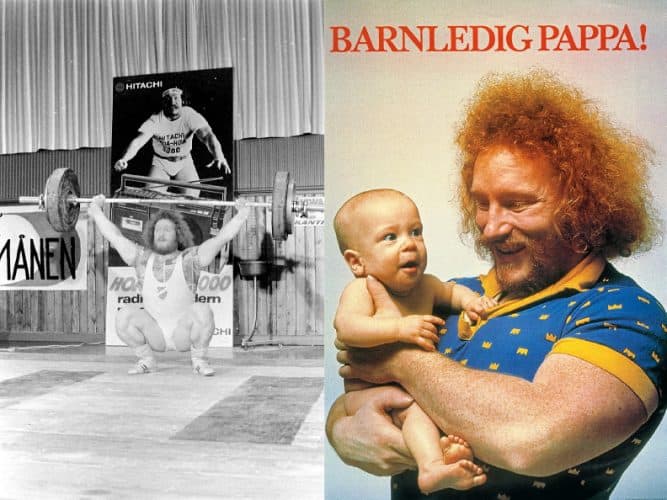
If program administrators hope to see widespread program use, they need to help affect the cultural change needed to overcome these barriers—for all workers, but especially for men. Achieving that cultural change, through program materials and proactive marketing campaigns, indeed needs to be an explicit goal of the administrators. Further research about how to optimize such campaigns in the twenty-first century may be fruitful.
1.4. Plain-language and User-tested Materials
On an instrumental level, administrators can put many of the above changes into effect by using plain language in their program communications and testing materials with real users before publishing them—and regularly updating materials as the program discovers remaining deficiencies in its messaging. Such measures should be standard across the government, but are all the more pressing given the subtle complexities of many PFML programs, the constellation of overlapping laws governing them, and the urgency that prospective beneficiaries learn about and understand the programs quickly because of time-sensitive and often unpredictable caregiving responsibilities.
New Jersey had revamped many of the program’s online materials shortly before our research, but our interviews—many with mothers who had only recently sought to use the program—suggested that potential beneficiaries still struggled to understand most public-facing materials:
“A lot of the wording was confusing or tricky.” – Interviewee #1
“I don’t think I really grasped it for a while… everything has similar initials.” – Interviewee #2
To begin with, agencies should follow federal plain language guidelines and web writing standards, which provide detailed guidance to help governments ensure that regular people can understand what they say and find the information they are looking for. But this isn’t enough; it is hard to game out what language to use and how to present it without putting program materials in front of potential beneficiaries, and having them tell you what they find misleading or hard to follow. (Needless to say, the user testing participants should be representative of the actual beneficiary population, especially those who are more likely to face barriers in learning about the program.)
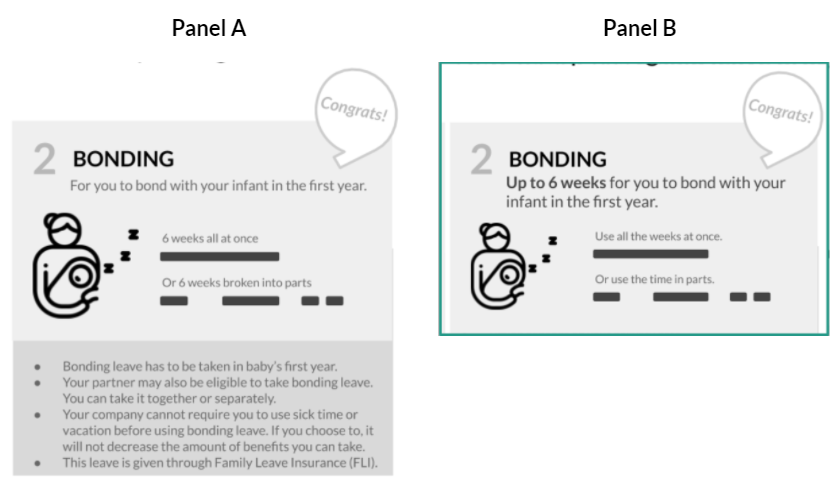
During the sprint, we created some mock-up materials and tested them, to help illustrate this point. Panel A below shows some material regarding FLI bonding leave, as we initially drafted it. In testing, users regularly skimmed over the fact that there was a choice between six weeks of continuous leave or six weeks of leave broken into parts, instead surmising they could take both six continuous and six intermittent weeks of leave. The version in Panel B, highlighting the six-week total limit, ameliorated this confusion.
Procurement regulations can, admittedly, be a meaningful barrier for agencies doing user testing, not just because even a small contract to a user experience (UX) expert may require an onerous public bidding process,15 but because even offering research participants small incentives—which is critical to getting good participation—may run afoul of regulations. Implementing agencies should work with their contracting office to see if there are creative solutions to these barriers; in some cases, legislative changes may be in order.
Such restrictions have indeed been a challenge for the TDI/FLI team, who quickly sought to make user testing a more routine part of their process after the 2019 sprint, but have been partially stymied by difficulty compensating research participants (not to mention the global pandemic).
User testing means more work up front, but it pays dividends in creating a better experience for beneficiaries, generating correct applications up front, and reducing customer service back-and-forth on the back end.
Recommendations:
- Use plain language about eligibility, reasons for using PFML, and application processes in all public facing materials, and hire/train staff who can apply this mindset to all communications work.
- Test all public facing materials with real users—either by contracting with experts, or testing in house.
- Work with contracting offices—or, if needed, legislatures—to find ways to contract out UX research, or to provide research participants incentives.
Citations
- To qualify for FMLA, workers need to meet job tenure and work hours requirements: at least 12 months of tenure with the employer, and 1,250 hours worked during the 12 months prior to leave: source
- Again, to qualify for NJFLA, workers need to meet slightly less stringent job tenure and work hours requirements: at least 12 months of tenure with the employer, and 1,000 hours worked during the 12 months prior to leave: source
- For FMLA, only a child, spouse, or parent is a qualifying family member for purposes of caregiving. NJFLA is much broader, recognizing leave to care for any close family relation, or anyone with whom the caregiver has a close relationship that is the “equivalent” of family. (NJFLA fact sheet: source)
- Admittedly, in practice, it is rare for a doctor to certify the need for 12 weeks of physical recovery, absent serious complications.
- This hypothetical assumes she works at a business of over 50 employees, thus meeting baseline eligibility for both programs; There are other strange cases that can come up at the margins of these programs. A mother who works at a business with 40 employees, for example, cannot take job-protected leave due to her own pregnancy (because she is not covered by FMLA, and NJFLA does not cover own disability), but can use state law for job protection after birth, to bond with her child.
- The provisions were added in the recent legislation: Section 24 of P.L.2019, c.37: “An employer shall not discharge, harass, threaten, or otherwise discriminate or retaliate against an employee with respect to the compensation, terms, conditions, or privileges of employment on the basis that the employee requested or took any temporary disability benefits pursuant to P.L.1948, c.110 (C.43:21-25 et al.), or family temporary disability leave benefits pursuant to P.L.2008, c.17 (C.43:21-39.1 et al.), including retaliation by refusing to [restore] reinstate the employee to employment following a period of leave[, except that, pursuant to section 2 of P.L.1948, c.110 (C.43:21-26), nothing in this section or any other section of P.L.1948, c.110 (C.43:21-25 et al.) or P.L.2008, c.17 (C.43:21-39.1 et al.) shall be construed as increasing, reducing or otherwise modifying any entitlement provided to a worker by the provisions of the "Family Leave Act," P.L.1989, c.261 (C.34:11B-1 et seq.) to be restored to employment by the employer after a period of family temporary disability leave] in the position held when the leave commenced or an equivalent position of like seniority, status, employment benefits, pay and other terms and conditions of employment, except that if, during period of leave, the employer experiences a layoff and the employee would have been laid off if the employee had not been on leave, the employee shall not be entitled to reinstatement, but only if the employer notifies the employee of the employee’s right to file a claim for unemployment benefits after the leave period ends provided by paragraph (2) of subsection (c) of R.S.43:21-19.” source
- DCR may collaborate with USDOL on job protections but we did not explore this collaboration during the sprint.
- Saying, for example, that they had applied for FMLA when they actually were talking about TDI.
- Filing a complaint was at the time also a relatively onerous process, which generally required complainants to travel to one of four DCR offices to file in person. An online option launched in 2020; Notably, DCR does get more inquiries about the protections, averaging about 10 phone calls per week.
- Like all other materials, as discussed in Learning 1.4, it is important to user-test materials describing job protections, to ensure the language is clear and accessible to potential beneficiaries.
- New fathers and non-birthing parents, on the other hand, can only apply for FLI-Bonding leave—and workers needing to care for a family member would apply for only FLI-Care.
- We estimated that 51.1 percent of eligible mothers use the state paid family and medical leave program, versus only 8.1 percent of eligible fathers. Note that limitations of the data meant that we were able to estimate usage for non-birthing fathers only, not for non-birthing parents in general.
- Men filed four in 10 of all bonding claims made in 2018, higher than in other states: source
- The Nordic programs initially offered a certain amount of leave that could be split between parents at their own discretion. The “Daddy quota” is a minimum portion of the leave which cannot be transferred to the other parent. In U.S. programs, where PFML is generally an individual rather than a family entitlement, the point is moot.
- Of course, this process will depend on the state’s contracting rules. Some states have high enough minimum contract sizes to do small UX contracts without triggering onerous processes.