
Implementing Paid Family and Medical Leave
Table of Contents
- Executive Summary
- Preface: Why We Need Good Policy and Good Implementation of Public Paid Family and Medical Leave programs
- Research Process
- Key Learnings
- Learnings Part 1: Communicating Effectively about PFML
- Learnings Part 2: Outreach
- Learnings Part 3: Applications, Processing, and Delivery
- Learnings Part 4: IT Infrastructure and Culture
- Conclusion
- Additional Resources
Abstract
Passing a major new social program like paid family and medical leave (PFML) is only the first step in creating change. To achieve real impact, PFML programs must be well implemented — and as more and more states pass PFML programs, the urgency of such good implementation has never been higher. In 2019, New America staffed a discovery sprint team to explore New Jersey’s pioneering PFML program, using a mixture of beneficiary interviews, data analysis, and business processing mapping. Based on that research, this report outlines key implementation learnings for administrators in other states, focusing on: (a) communicating about PFML, (b) outreach strategies, (c) applications and processing, and (d) IT infrastructure.
Acknowledgments
This report is based on the work of the sprint team in October and November 2019: Jessie Posilkin, Micae Brown, Lindsey Wagner, and Gabriel Zucker.
The author, sprint team, and teams from the Better Life Lab and New Practice Lab would like to thank our partners at the New Jersey Department of Labor (NJDOL) for their incredible collaboration on this project. The NJDOL team's radical transparency, their drive to constantly improve, and their endless passion for serving the families and children of New Jersey have been an inspiration. Thank you to Gillian Gutierrez, Jeff Flatley, Jenni Seeds, Holly Low, Robert Asaro-Angelo, and everyone else who assisted this sprint at NJDOL.
We are grateful to the external reviewers who shared their time and expertise to make this report more complete and useful: Sarah Jane Glynn, senior fellow at the Center for American Progress; Jessica Mason, senior policy analyst at the National Partnership for Women and Families; and, from Family Values@Work, FMLI campaign advisor Gayle Goldin and national implementation director Marianne Bellesort.
At the New Practice Lab, thanks to Tara McGuinness, founder of the lab, for her vision and efforts to get this innovative project launched and executed. Thanks, too, to Afua Bruce and Andrea Ochoa for helping get the project off the ground, and Elizabeth Garlow for seeing this work through to completion. The Better Life Lab would like to thank Brigid Schulte, Sade Bruce, and Jahdziah St. Julien, as well as former BLL team members, Amanda Lenhart, who initially spearheaded the project, Alieza Durana, and Leah Crowder. Special thanks to senior fellow Vicki Shabo for helping to coordinate a briefing for advocates and providing insightful review and report edits. And a shout out to the New America Events, Production, Editorial, and Communications teams.
This discovery sprint and report were conducted with support from Pivotal Ventures, an investment and incubation company created by Melinda Gates.
Downloads
Executive Summary
Paid family and medical leave (PFML) programs have the potential to be transformative for American families. But, as with so many programs, passing PFML legislation is only the first step. It takes committed and compassionate implementation to actually get benefits to those who need them—and in the case of a short-term and still often relatively novel program like PFML, good implementation can be a real challenge.
To further explore the unique implementation challenges of PFML, and highlight ways to improve delivery, New America staffed a multi-disciplinary team to conduct a four-week discovery sprint around New Jersey’s pioneering PFML program in late 2019. Discovery sprints are time-bound periods of intensive problem investigation, prioritizing the experience of the beneficiaries programs aim to serve. This sprint focused primarily on leave for birthing parents, and included interviews with program staff, potential and past beneficiaries, employers, community advocates, and staff at other state agencies; user testing sessions; and analysis of program data.
This report outlines key learnings from the discovery sprint with wider applicability to PFML programs outside of New Jersey. While the paper discusses details of New Jersey’s program, it is not a deep dive into this program per se; any such details are meant to be emblematic of broader trends. The recommendations are actionable primarily for state-level administrators of PFML programs, although some may have implications for legislators as well, and many of the principles could be relevant for a national program.
Among the key findings are:
- Use Plain Language and User-Test Public-Facing Materials, Especially Applications
- Programs should use plain language and avoid jargon on all forms and in all program materials, tying the information to life events that people can readily understand, rather than a confusing alphabet soup of program acronyms. Programs must iteratively test the language with actual beneficiaries and make improvements.
- Using plain language is especially important for program applications. Not only do confusing applications turn off potential beneficiaries, but they lead to incomplete or incorrect submissions, which in turn lead to higher rejection rates, creating more work for examiners to chase down information, and yielding delays in approving claims and getting timely benefits to applicants.
- Recognize Job Protection as Critical for Workers
- For workers, learning whether their job is protected—whether an employer must hold their position or its equivalent while they are on leave—is confusing and difficult. While New Jersey’s PFML programs largely do not guarantee job protection themselves,1 many workers do have job protection under federal and state unpaid leave statutes, enforced by other agencies. But potential beneficiaries struggle to understand whether and how these protections apply to them, or how to invoke them if their employers give them trouble—and this lack of understanding can be a serious barrier to taking leave at all.
- Programs should design and disseminate communication materials to clarify leave-taking worker rights in all state materials, and make it simple and seamless for potential beneficiaries to contact the relevant enforcement agencies if needed.
- Treat Employers as a Critical Part of Outreach
- Most beneficiaries we spoke to expressed that they expected to receive complete and reliable information about PFML from their employers. But many also described an experience with their employers’ human resources department as either negligent, or providing inaccurate information.
- Employers who support PFML are often the best ambassadors. Programs should think of the business community as a critical part of the research and application process and create employer toolkits, webinars, and training programs; and do usability testing with employers to improve these materials.
- Help Effect Cultural Change Around Leave and Caregiving
- Workers we spoke to often felt guilty about taking leave from work. Programs should see it as part of their mandate to help affect the cultural change needed to diminish this guilt, especially for workers with caregiving responsibilities. They should use language and provide information that encourages self and family care.
- This process of cultural change also involves direct work with employers, to help achieve cultural and workplace shifts to normalize leave taking.
- Use Data To Drive Effective Implementation
- Administrators during the sprint did not have sufficient real-time data on key aspects of their program. This played out most clearly in two specific arenas: (1) relative to the universe of potential beneficiaries, leadership were not sure who was and was not applying, so outreach could not be effectively targeted to working families most in need; and (2) leadership did not have clear visibility into which applicants were being rejected, how long it took to process an application, and what was causing delays.
- Using existing program data combined with publicly-available Census data, the sprint team was able to identify high-level trends in program usage, as well as begin to prototype a simple dashboard that could display these figures over time. Programs should use real-time data in this manner to keep track of their outreach progress, and identify any issues.
- Using existing program data, the team was also able to conduct a high-level analysis of trends in application processing times, and significant causes of delays. Likewise, the team began to prototype a simple dashboard that would allow leadership to better understand where delays were occurring, so problems could be quickly identified and addressed. Programs should, again, use real-time data this way to keep track of their application processing, and identify any issues. Certain statistics from this dashboard could also be shared with the public in the interest of transparency for potential beneficiaries.
- Prioritize Quick and Easy Application Processes, and Foster a Culture that Prioritizes Access and Service
- As a short-term benefit, often used during major live upheavals or crises, PFML programs must operate especially efficiently if they are to serve beneficiaries during their time of need. As such, administrators must make every effort to ensure applying is easy and frictionless, and that applications can be processed within a few weeks.
- In service of this goal, administrators should require as little direct documentation as possible from beneficiaries and employers, relying on their own data systems wherever possible.
- Administrators should also foster a culture that prioritizes benefit access rather than fraud prevention, and incentivizes staff to err on the side of granting quick access to benefits rather than bogging down applications in minutiae.
The report is structured as follows. First, the preface describes the landscape of PFML policies, and the details and context of New Jersey’s program in particular. The research process section briefly describes the discovery sprint method, and the research steps the 2019 sprint team undertook. The key learnings form the heart of the paper, are organized into four chapters: communicating about PFML, outreach, applications and processing, and IT.
Citations
- The recent legislation did add anti-retaliation provisions to the TDI/FLI statute, which protect some workers’ jobs when they take leave. However, no agency is empowered to enforce those provisions, and as a result, in practice, the two other statutes with more teeth are generally the ones advocates and program staff focus on.
Preface: Why We Need Good Policy and Good Implementation of Public Paid Family and Medical Leave programs
By Brigid Schulte
Advocates and lawmakers with the best of intentions can work for years, decades even, to get legislation passed with the goal of helping families and improving the lives of people in America. But passing a good policy is only the first step. Implementing it well is what ensures that the good intentions of the policies actually work to make people’s lives better.
That’s certainly the case with paid family and medical leave (PFML).1 PFML has the potential to help parents form healthier bonds with their children and protect their health and their babies’ health; to help keep workers—especially women—connected to the workforce and improve their economic security; to help people with health issues of their own or who are caring for a loved one make ends meet; and much more. But if people don’t know about the policy, they can’t use it. If forms are so complicated that few can fill them out properly, if the process is confusing or onerous, if the benefits of the program are so delayed that they don’t help when families need it most, or if administrators don’t have the data they need to see what is and isn’t working, then it’s the very families that the policy was intended to help who suffer most.
We set out to better understand the critical role that implementation plays in making PFML policies work, and how to ensure they work better for working families. We formed a unique partnership between New Jersey and two programs at New America, a nonpartisan think and action tank—the Better Life Lab, the work-family and gender justice program, and the New Practice Lab, which works at the intersection of ideas and experimentation to improve the design and delivery of policies focused on family economic security and wellbeing. The learnings in this paper are the result of a four-week discovery sprint by a cross-disciplinary team of designers, technologists, user researchers, subject matter experts and others in October and November 2019.
Perhaps most importantly, the sprint learnings make clear how important it is for those designing and implementing policies to think through the whole process from the user’s point of view. Using plain language, being transparent about the application process and the length of time it will take to consider applications, explaining the program and benefits through actual life events, like giving birth or bonding with a child or caring for a loved one, rather than through an alphabet soup of programs acronyms, can all go a long way to improving the user experience, smoothing the application process, with the potential to increase uptake rates and achieve the positive outcomes associated with PFML.
Another key learning is that timing is everything. While delays in longer-term benefit programs are a real problem for beneficiaries, delays in a short-term program like PFML make the program entirely unworkable, with workers struggling to cover household bills and medical expenses and provide care while wondering if the promised benefits will arrive before the short-term leave is over.
For this work, we built on the implementation best practice work of advocates and researchers with the Center for Law and Social Policy, Family Values @ Work, A Better Balance, the National Partnership for Women & Families, and others. These sprint findings are broadly applicable—not only useful for administrators and civil servants in charge of implementing the program in the state of New Jersey, but for administrators, agencies, and civil servants in states that have their own PFML policies. The learnings can also be useful for those implementing COVID19-related emergency paid leaves, as well as for lawmakers who are developing or considering PFML laws on the state or federal level, in order to design good policies with good implementation in mind from the start. Many of these principles are applicable to other benefit programs as well.
The Paid Family and Medical Leave Landscape
The United States, alone among advanced economies, has no national paid maternity leave policy for mothers and birthing parents.2 It is one of six with no paid leave for fathers or non-birthing parents. Some workers are eligible for 12 weeks of unpaid leave under the 1993 federal Family Medical Leave Act (FMLA),3 but there is no national PFML policy to help support workers who need time away from work to take care of themselves, a new child or a loved one. The current system that relies on employers voluntarily offering PFML covers just 21 percent of the civilian workforce, with the highest-wage workers (36 percent) about seven times more likely to be covered than the lowest-wage workers (5 percent).
With a majority of children being raised in families where all available parents are working (that is, single-parent families or dual-income families), and with a coming elder care crisis, most workers will, at some point, need time off work for caregiving responsibilities. And workers themselves get sick; a recent analysis of the unpaid FMLA found that half of all leaves were taken by workers needing time to recover from their own medical illness. With 40 percent of Americans unable to cover an unexpected $400 expense—more now for those who’ve lost jobs due to the pandemic—most workers need supportive workplaces and policies to be able to manage their care responsibilities without risk of economic ruin.
The need is great: The Better Life Lab found in a nationally-representative survey that six in 10 adults say they anticipate needing to take time off in the future to care for a new child or adult family member. And, in a surprising finding, the share of men saying they anticipate needing time off work to provide care for a loved one was equal to that of women, defying conventional notions that women are the only ones with primary caregiving duties.
At the same time, a raft of research from competitive economies around the world that guarantee PFML, as well as from the handful of states that have stepped into the policy vacuum in the United States and created their own public policies, makes clear that PFML policies have enormous benefits. PFML policies have been shown to improve the health and wellbeing of workers and their children and families—increasing breastfeeding rates, reducing rates of infant mortality, maternal depression and stress levels, and creating more family stability. Though the research on the benefits of family caregiving and medical leave is less robust, a recent analysis of unpaid FMLA found that workers needing leave who couldn’t afford it or worried about workplace repercussions delayed or forewent needed medical treatment. Without access to paid leave and flexible work, informal family caregivers, men and women alike, are forced to reduce work hours or drop out of the workforce entirely, which a recent RAND study has calculated costs the U.S. economy $522 billion a year. PFML can also boost gender equity when men take leave, and counter economic and racial inequity. PFML not only increases labor force participation, particularly of women, it benefits businesses by fostering higher retention and lower turnover rates, reducing presenteeism (when sick or burned out employees force themselves to go to work but aren’t at their best), and increasing worker loyalty and morale, with a neutral to positive impact on productivity.
In New Jersey alone, a 2016 analysis by the Federal Reserve found that the state paid leave policy has had a “positive impact on wages and employment for women” and helped close the gender wage gap between women and men, helping to bring it down from 38 percent in 1996, to 27 percent in 2014, with an acceleration after 2009, when the state’s paid Family Leave Insurance (FLI) program went into effect.
As of January 1, 2021, six states—California, Rhode Island, New Jersey, New York, Washington and Massachusetts—and the District of Columbia have active PFML programs. Three more states—Colorado, Connecticut and Oregon—have passed laws that will go into effect between January 2022 and 2024. And momentum is building for a national PFML, which a number of surveys show has widespread bipartisan support. In the meantime, these state programs have been critical for supporting working families.
State PFML Programs: How They Started, and Who Pays
New Jersey was one of the first and remains one of the few states to operate a state-run Temporary Disability Insurance (TDI) program,4 which was enacted in 1948. (Rhode Island was first, in 1942, followed by California in 1946. New York passed its state TDI program in 1949 and Hawaii created an employer mandate to provide temporary disability in 1969.) As the name implies, these programs cover time off for workers to cope with or recover from their own medical issues, which leave them temporarily unable to work. After Congress passed the Pregnancy Discrimination Act of 1978, with the exception of Hawaii, these state TDI programs, including New Jersey’s, began to cover pregnancy and birth-related leaves for new mothers and birthing parents.
Over time, as more women entered the workforce and became important earners to their families’ economic security, as an aging population began to require more care, and as men sought to become more active caregivers, it became clear that these state TDI funds were not sufficiently meeting the care needs of a changing workforce and culture.
So some states, including New Jersey, began to pass legislation to create a new paid leave program, in addition to TDI, to cover more of these caregiving responsibilities. California, in 2002, became the first state to add paid family leave (PFL)—time off work to bond with or care for family and loved ones. New Jersey followed with Family Leave Insurance (FLI) in 2008, Rhode Island with Temporary Caregiver Insurance (TCI) in 2013 and New York with PFL in 2016. As a result of this legislative history, these states make a sharp institutional/statutory distinction between taking time off work to care for oneself, and time to care for others, which can be a source of confusion for workers and employers.
These paid leave programs are largely social insurance funds,5 paid for either by employees or by both employers and employees, through a payroll deduction, much like federal Social Security. Rhode Island and the District of Columbia offer coverage only through a state public fund. Other states, like California and New Jersey, allow employers to purchase private insurance or self-insure outside of the state public insurance fund, although such private plans are heavily regulated and remain very much the exception rather than the rule.6 In these states, TDI to cover medical leave to care for oneself is generally paid for by a mix of employee and employer contributions, while paid family leave to care for others is typically funded through contributions by employees only.
Around the world, the vast majority of national PFML programs in advanced economies are paid similarly through social insurance funds, sometimes with additional contributions from general revenue funds. Because both risk and resources are pooled, and because the life events that trigger PFML are relatively infrequent, researchers at the National Academy of Social Insurance argue that paid leave “can be provided universally at a low per-person cost.” Such universal programs have been shown to ameliorate inequality, whereas the current voluntary private paid leave system in the United States, because high-wage and white workers are so much more likely to have access to the benefit, has worsened economic and racial inequality.
Many of the more recent states to have passed PFML laws have no existing TDI programs and are creating new systems from scratch. These newer states fund programs through a mix of employee and employer contributions. For instance, PFML will be funded by employees only in Connecticut, employers only in Washington, D.C., and a mix of employer and employee contributions in Oregon and Colorado.
New Jersey’s PFML Program: How it Works
In New Jersey, as with the four other states with long-standing TDI programs, PFML is actually two distinct programs. The more established TDI, passed in 1948, provides benefits for workers who need time to recover from their own illness, injury or disability; since the 1970s, TDI has also covered leaves due to pregnancy and childbirth. The newer FLI, passed in 2008 and expanded in 2019, covers workers’ time off to care for loved ones, bond with a new family addition (a newborn, foster, or adoptive child), or cope with domestic or sexual violence. (Technically, FLI has two sub-programs FLI-Bonding and FLI-Care.) That means that birthing parents can apply for both TDI and FLI. Non-birthing parents and workers needing to care for other family members can apply only for FLI. For expediency, FLI was implemented using the legacy software system of the older TDI program. Both TDI and FLI are run by the New Jersey Department of Labor (NJDOL).7
Although workers can claim up to 26 weeks for TDI in New Jersey if medically certified for their disability, birthing parents are typically covered up to four weeks before delivery and up to six weeks after birth (eight weeks after a Cesarean delivery), or longer if there are complications certified by a healthcare provider.
When FLI first went into effect July 1, 2009, it offered six weeks of bonding leave for new (biological, adoptive, or foster) parents or caregiving leave for those needing to care for immediate family, to be taken all at once or 42 days taken intermittently throughout a one-year period. Paid through a modest payroll tax, capped at $33.50 per person per year, FLI paid 66 percent of an eligible workers’ salary, to a cap of $633 a week, or the annualized equivalent of about $32,000, about the same as New Jersey’s true poverty standard.
New Jersey’s FLI was championed and passed in 2008 at the end of Gov. Jon Corzine (D-N.J.)’s administration. But implementation was largely left to Gov. Chris Christie (R-N.J.), who did not see the new FLI program as a priority, later vetoing a $3 million proposal to boost outreach efforts as well as a proposal to expand the law’s provisions.
Gov. Phil Murphy (D-N.J.) campaigned vigorously on prioritizing and expanding both TDI and FLI, and in 2019 signed into law sweeping new expansions. As of July 2020, TDI and FLI beneficiaries now receive 85 percent of their average weekly wage, up to a maximum in 2021 of $903 a week. Workers eligible for FLI can now take 12 consecutive weeks or 56 intermittent days in one year of FLI to care for a loved one (who need not be an immediate family member), and for oneself or a loved one in the case of domestic or sexual violence.
Throughout this paper, we use TDI when referring to paid medical leave and FLI to discuss the state’s paid family leave. We refer to the overall New Jersey PFML program as “TDI/FLI.”
Many Eligible Workers Aren’t Using State PFML Programs
The goal of paid family leave and medical programs like New Jersey’s TDI and FLI programs is to provide needed support to help families through the joyful yet often overwhelming experience of becoming new parents, as well as through difficult, often unexpected, and potentially devastating illnesses or caregiving crises. That support, as stated above, has been shown to improve the health, wellbeing, and stability of families, children, communities, and businesses. So if people don’t know about or aren’t using the program, the policy isn’t working to its full potential, and states aren’t able to reap the full potential rewards associated with PFML.
Prior to the discovery sprint, formal and informal data showed that states with PFML programs faced real challenges. First, many workers didn’t know their states have paid family leave programs, much less that they could qualify for benefits. Surveys in California in both 2011 and 2015, for instance, found that more than half of California workers were still not aware of the state’s paid family leave program, which was passed in 2002 and went into effect in 2004. In New Jersey, three years after its FLI law went into effect, a 2012 poll found that fewer than four in 10 New Jersey residents had seen or heard anything about the program, with young people and people of color least likely to have heard of the program (although recent surveys show this low rate has since improved).
Partially as a result of low awareness, data suggested that many working families were not using PFML programs. One study found that New Jersey has an estimated 1.2 million family caregivers, but that fewer than 1 percent of family caregivers used Family Leave Insurance between 2009 and 2015.8 In many states, while birthing parents may take TDI paid temporary disability leave, fewer go on to take paid bonding leave. And few men take bonding or caregiving leave, which studies have found is crucial for family health and for promoting gender equity. In 2017, men accounted for just 12 percent of FLI bonding claims in New Jersey. Men made up about 30 percent of paid bonding leave in California and Rhode Island in the same period.
Anecdotal evidence also suggested that processing delays were a major challenge for PFML applicants, with reports circulating in the media of beneficiaries waiting months to receive payments. Those delays can degrade trust in the system and, via word-of-mouth, discourage others from applying in the first place.
It’s important to point out that low take-up rates for PFML do not mean that there is limited demand, or that people don’t need paid caregiving leave. Instead, it’s critical to identify, understand and resolve the barriers that people face—culturally, financially, administratively, and otherwise, including in how the program is implemented—that keep them from using and benefiting from a PFML program. That’s what this discovery sprint was intended to do.
This project was designed to better understand challenges, identify barriers and find solutions in order for states like New Jersey—and potentially the federal government—to effectively implement PFML programs. The need is great; nearly six in 10 people in a recent nationally-representative survey said they anticipated needing to take time off work in the near future to care for a loved one. And the benefits of PFML to individuals, children, families and businesses—and to efforts to improve equity—are clear. Failing to implement good policy is tantamount to subverting good policy—a phenomenon known as “policy by other means.” Implementing good policy well, on the other hand, can make all the difference in the health, wellbeing and in the lives of the very people it was designed to help.
Citations
- Throughout this report, we refer to paid family and medical leave programs, in general, as PFML. This primarily encompasses: parental leave (including both recovery from pregnancy for birthing parents, and bonding leave for birthing and non-birthing parents), temporary disability leave to care for one’s own injury or illness, and caregiving leave to care for other family members and loved ones. New Jersey’s PFML program also includes leave to cope with domestic or sexual violence, or to support a loved one in the same.
- Although it is common practice to use terms like maternity and paternity leave for mothers and fathers, in this report, we primarily refer to birthing parents and non-birthing parents to reflect the experience of trans men and those who identify as non-binary who can give birth, as well as non-birthing parents in same sex couples.
- Workers who have worked full-time for one year for an employer with 50 or more people are eligible for FMLA. FMLA covers about 56 percent of the U.S. workforce, according to a 2020 U.S. Department of Labor analysis: source
- TDI is also known as paid medical leave or State Disability Insurance (SDI).
- New York’s program includes a state fund along with highly regulated private insurance options, though most employers cover employees through private plans.
- Short-Term Disability Insurance (STDI) is an insurance product that employers can choose to offer their employees, to help workers cover the cost of taking time off work for health-related reasons including pregnancy. Some employer-offered policies are fully paid by employers, some are fully paid by workers and some employers require workers to pay a portion of the costs. Workers can also purchase STDI from insurance companies on their own. Some employers also provide, or employees can purchase, private long-term disability insurance.
- Employers in New Jersey can offer their own paid family and medical leave in place of the state option, provided it meets the state’s minimum standards.
- Note that the sprint team’s research found that certain other usage estimates in this paper were misleading; see Learning 2.2.
Research Process
The learnings in this paper are the result of a four-week discovery sprint executed by New America in New Jersey in October–November 2019. Discovery sprints are time-bound periods of intensive problem investigation conducted by cross-disciplinary teams composed of designers, technologists, user researchers, subject matter experts, and others. Discovery sprints typically entail user research and testing with the individuals and families that programs and policies aim to serve, making proximate connections and inviting them into a process to shape policy design and delivery. The four-member sprint team for this engagement had expertise in communications, user research, procurement, data science, and program administration.
Due to time constraints, the sprint focused primarily on leave for birthing parents, rather than bonding leave for their partners, caregiving leave, or other disability leave. Given that parental leave can be relatively simpler than other types of PFML to administer, it is possible that some more complex issues—around medical certification, for example—may not have surfaced in this work.
The team’s research included:
- Interviews with two dozen employees throughout the TDI/FLI program at the NJDOL—in program and agency leadership, outreach, information technology, reporting, and all divisions of application processing and customer service.
- User experience interviews with 15 maternity leave beneficiaries (that is, women taking pregnancy-related leave or bonding leave), recruited through community organizations and online ads. The interviewees were a mix of previous beneficiaries, current beneficiaries, and potential beneficiaries.
- Five testing sessions of communications materials with potential beneficiaries.
- Interviews with nine NJ-based employers.
- Interviews with four community-based PFML advocates or employer associations.
- Interviews with staff at the NJ Division on Civil Rights (Office of the Attorney General), whose work intersects with PFML.
- Analysis of program use data and application processing data provided by NJDOL, in conjunction with reference data from the U.S. Census Bureau.
This report largely documents findings as the program stood at the time of the discovery sprint, in late 2019, with only limited follow-up since that time about how recent developments may have impacted the findings. Specifically:
- The sprint occurred before the 2019 amendments to extend the duration of paid leave and improve wage replacement rates took effect in mid-2020. Those program changes were viewed by administrators and advocates alike as critical, and reasonably expected they would address some of the existing shortfalls in the program. To the degree they have done so, that success story is not recorded here.
- At the time of the sprint in late 2019, the new administration’s TDI/FLI team had only been in place for about a year and a half. The leadership had indeed made real and impressive progress in cleaning up the neglect of the previous eight years, but many planned changes at the time simply remained incomplete for lack of time. (Also, the experiences of past beneficiaries interviewed may not have reflected the new team’s reforms at all.)
- The report does not go into depth about the significant changes NJDOL undertook in response to the findings of the sprint team—or the destructive role of the pandemic in stymying (for now) some of those reforms, with NJDOL resources disproportionately reassigned to the unemployment insurance system, and outside outreach partners focused on the pandemic to the detriment of other programs. That said, it is important to note that NJDOL did indeed move quickly to implement the findings of the sprint team, even managing to implement key changes despite the global pandemic, and had indeed made substantial progress on a variety of other items in the year before the sprint occurred. The program’s progress is proof that strong and committed leaders, empowered by agency leadership, can make real changes that meaningfully improve outcomes for their beneficiaries, and can do so quickly.
Key Learnings
This paper focuses on learnings that not only matter to TDI/FLI administrators, but also have wider applicability for PFML outside of New Jersey’s program. While details of New Jersey’s program are frequently reflected in the analysis, the paper is not explicitly intended as a deep dive into this specific program, and details are offered here to be emblematic of broader trends, or illustrative of the types of research other programs might undertake. For example, we mention disconnects between specific state agencies involved in PFML as an example of the types of disconnects that may occur between agencies in other states, not as a comment on or an analysis of New Jersey’s program per se. Likewise, we mention findings from an analysis of who is and who is not applying for TDI/FLI in New Jersey as examples of the kind of findings that other states may glean from similar analyses.
Generally, the recommendations presented here are actionable for state-level administrators of PFML programs. A few of the findings require statutory changes or are targeted at IT procurement, but these are included only when they directly interact with administrative concerns. This report focuses on user experience, and is not intended to be exhaustive in providing design recommendations for legislators, for IT offices, for advocates, or for other outside actors.
While this paper generally assumes a state-level program, the recommendations may also be relevant to federal advocates and policymakers, as support grows for Congress to pass a national PFML program.
The key learnings here are presented in the following categories:
- Communicating about PFML: how administrators should talk about their programs, including common misunderstandings or points of friction.
- Outreach: what administrators need to do to ensure potential beneficiaries know about their programs and are able and willing to apply.
- Applications, processing, and delivery: how administrators should set up their application procedures to ensure quick and effective benefit delivery
- IT infrastructure and culture: key principles to ensure that technology supports, rather than hinders, program implementation.
Before delving deeper, a critical word of context about this entire analysis: Readers accustomed to traditional government timelines for benefit delivery would be well advised to revisit their assumptions of acceptable wait times in the context of paid family leave. In the administration of major entitlements that will be paid for years or whole lifetimes, wait times of months, while unfortunate, might be considered acceptable. For a short-term program like PFML, such familiar government wait times are wholly inadequate; a beneficiary who waits two months for benefits will more than likely return to work before they get paid.1 Potential PFML beneficiaries are generally in the middle of major life upheavals if not outright crises, when they have the least amount of time and energy to navigate red tape. Programs must aim to process the vast majority of applications within two to three weeks at most. The stakes are illustrated by a quote from one of our interviewees:
“If we knew I wasn’t going to get approved, I would have gone back to work. I had to put things on credit cards while we were waiting. Those 6 weeks were tough.” – Interviewee #4
None of this is to excuse any benefit delays in any government program; all beneficiaries deserve prompt and compassionate service from the government. But for some programs, an extra three-week delay is an inconvenience; for PFML, an extra three-weeks delay may well mean that potential beneficiaries simply give up on the program and go back to work. And, when that happens, they may tell everyone they know that the program is unusable, dissuading others from applying and further diminishing the program’s impact. Those accustomed to the wait time horizons of other government programs must intentionally and drastically adjust their expectations and standards when it comes to PFML: Because it serves families in health emergencies or in the immediate aftermath of births and adoptions, the program must operate very quickly to meet families in their moment of need.
Because it serves families in health emergencies or in the immediate aftermath of births and adoptions, the program must operate very quickly to meet families in their moment of need.
Learnings Part 1: Communicating Effectively about PFML
1.1. Job Protections
1.2. Mapping Programs to Life Events
1.3. Cultural Considerations
1.4. Plain-language and User-tested Materials
Learnings Part 2: Outreach
2.1 Messengers
2.1.1 The Program Office as the Primary Source of Information
2.1.2 Employers
2.1.3 Other Sources
2.2. Using Data to Track Progress and Target Outreach
Learnings Part 3: Applications, Processing, and Delivery
3.1. Conceptual and Cultural Considerations
3.1.1 Set Realistic Expectations and be Transparent
3.1.2 Track Progress—in a Process Led by Program Leadership—and React Quickly
3.1.3 Foster a Culture of Equity, Access, and Service; Not One of Preventing Fraud
3.2. Technical Recommendations
3.2.1 Simple Applications, Written in Plain Language and Informed by User Testing
3.2.2 Modern Online Application, with a Status Checker
3.2.3 Minimize the Information Required to Submit an Application
3.2.4 Accommodate Advance Claims
3.2.5 Follow Up by Phone or Email when Needed
3.2.6 (If relevant) Effect Smooth Transitions between Program Phases
3.2.7 Create a Beneficiary-centric Payment Delivery System
Learnings Part 4: IT Infrastructure and Culture
4.1 Empower a Single Product Manager
4.2 Ruthlessly Prioritize User-facing Issues
4.3 Ship Iteratively, Even (and Especially) when Transitioning from Legacy Systems
4.4 Beware of Unproven Commercial-off-the-shelf (COTS) Products that are Not Well Suited to the Program
Citations
- Lawmakers in New Jersey have recognized this point. In 2019, during debate over the expansion package, the then-acting commissioner of NJDOL reported that it regularly took 25-45 days to process a mail application. Sen. Teresa Ruiz (D- Essex) said such wait times were unacceptable: "If you're someone who lives check to check, a 25-to-45 day timeframe for review, just to be notified whether you're going to receive benefits or not, is something that we can't afford to have here in the state of New Jersey. And we must get better at it." source
Learnings Part 1: Communicating Effectively about PFML
1.1. Job Protections
1.2. Mapping Programs to Life Events
1.3. Cultural Considerations
1.4. Plain-language and User-tested Materials
Despite what program administrators may think, PFML programs can be confusing and overwhelming for potential beneficiaries to understand. All of the 15 beneficiaries and potential beneficiaries we interviewed expressed a misunderstanding of a foundational aspect of the program—about eligibility, application timing, job protections, or other issues. How administrators talk about their programs matters. This section discusses some of the most common misconceptions among New Jersey beneficiaries, and steps administrators can take to resolve them.
1.1. Job Protections
A paramount factor in whether eligible workers take TDI/FLI, and the single greatest source of confusion for potential beneficiaries, is job protection for leave-takers. Job protection came up in all of our user interviews during the sprint—and advocacy groups with hotlines to help educate potential PFML beneficiaries, like A Better Balance, also report that job protection is nearly always the first question people ask. Especially for low-income families, the assurance that an employer will not retaliate against leave-takers is not a luxury—it is an absolute prerequisite for taking leave. Taking time off if a job will not be waiting on the other end is simply not viable.
“Once I realized I was protected, it was ‘instant Xanax’. . . This is not going to throw my life off any more than it already is.” – Interviewee #12
Ironically, job protection is primarily—with one exception, discussed below—not part of TDI/FLI at all. Thankfully, many workers’ jobs in New Jersey are protected if they take family or medical leave, whether paid or unpaid—but only because they have concurrent protections under partially overlapping state and federal laws. The federal FMLA allows certain workers at employers with more than 50 employees1 to take 12 weeks of unpaid leave in a 12-month period to care for a newborn or ill family member, or recover from their own illness; while the New Jersey Family Leave Act (NJFLA) allows certain workers at employers with more than 30 employees2 to take 12 weeks of unpaid leave within a 24 month period to bond with an infant or care for a family member, with a notably more expansive definition of family,3 though these expanded state protections are relatively recent. For use cases that do not overlap, these protections can run in succession; but, if the use case is covered under both, protections are exhausted concurrently. (For example, a mother who just gave birth could in principle take 12 weeks of job protection from FMLA to recover from childbirth,4 and then another 12 weeks from NJFLA to bond with her newborn; but the same woman taking time off to care for her seriously ill child will exhaust 12 weeks of FMLA and NJFLA concurrently, and will only have job protection for 12 total weeks.5
To make matters still more complex, FMLA is enforced by the U.S. Department of Labor (USDOL), while NJFLA is enforced by the NJ Office of the Attorney General’s Division on Civil Rights (DCR)—neither of which, of course, is NJDOL, which administers the state’s PFML program.
Meanwhile, finally, there is in fact a third set of legal protections for workers, in the form of anti-retaliation provisions in the TDI/FLI law itself; but no agency is empowered to enforce these provisions, and as a result they have no teeth and are usually overlooked in favor of FMLA and NJFLA in practice.6
This patchwork job protection would be hard enough to explain to the general public or potential beneficiaries, even with the best intentions to do so. But NJDOL had historically—and somewhat understandably—viewed job protection as a problem for agencies with the proper jurisdiction to solve, suggesting beneficiaries with job protection questions reach out to USDOL or DCR, but without providing a specific point of contact that provides direct service. Under the new administration, NJDOL had begun to collaborate with DCR to improve messaging and facilitate handoffs, and DCR had worked with paid leave advocates, but both were still making up for the prior disconnects, and as of 2019, the agencies still to a degree presented themselves to citizens as two distinct bodies when it came to PFML. (Since the sprint, in response to the findings, the partnership between NJDOL and DCR grew especially stronger, so that NJDOL is no longer a “wrong door” with regards to job protections.) Collaboration between state agencies and the USDOL on the issue of FMLA job protection enforcement, meanwhile, had been nearly nonexistent, according to interviews with TDI/FLI staff.7
The result was that, at the time of the sprint, widespread confusion remained. Many of our interviewees conflated job protection programs with paid leave programs,8 and NJDOL’s implicit policy of deferring questions on job protection information to the agency with jurisdiction was generally viewed on the outside as poor service; citizens said they expected the different arms of the state government to communicate with one another. NJDOL employees also reported regularly receiving FMLA applications—which are federal documents leave takers can optionally deliver to their employers, not intended for submission to any government agency at all. Even more confusing, several interviewees reported being misled by their own employers about job protections, and not having the independent information needed to contest them.
Overall, many potential beneficiaries saw both the PFML program and the system to ensure job protection as a confusing alphabet soup at best, which can be a significant barrier to their applying for or taking leave:
“I knew that I was able to get time off, but I wasn't exactly sure the amount of time with family leave, and the federal FMLA and everything. So, it was a little bit anxiety-provoking figuring that out, and not wanting to take too long because I didn’t want my employer to come back over time and saying you know what, you took too much time.” – Interviewee #1
Overall, many potential beneficiaries saw both the PFML program and the system to ensure job protection as a confusing alphabet soup at best, which can be a significant barrier to their applying for or taking leave.
A related result was the relative rarity of legal actions to enforce job protection. In the five years before 2019, according to DCR, there were on average under a dozen complaints filed per year under the NJFLA.9 Of course, it is better that protections be made clear up front, and employers prevented from retaliating before it occurs, since complaints typically take multiple years to resolve, and generally do not provide much relief to the complainant. But, with a state the size of New Jersey, this low number of complaints could mean that many workers simply do not know how to file a complaint (or even that they have the right to do so), and that a number of employers may be pressuring their employees into not taking leave, with impunity.
New Jersey is not unique in this regard. Many other states also have gaps between the job protection available to workers and the paid family or medical leave that may be available to them, and some also have different agencies administering the different laws. (In some states, such as Rhode Island and New York, job protections are written into paid family leave laws—though not paid medical leave laws. Even in these states, different agencies may administer the leave and the protection; and there is still the issue of USDOL-enforced FMLA protections.)
In an ideal world, job protections would be provided by the same statute and enforced by the same agency that distributes leave payments. In practice, as long as unpaid FMLA remains on the books and PFML programs are administered by states, this solution is not entirely feasible. As a second best option, state agencies that administer PFML benefits need strong partnerships with enforcement agencies. Information about job protections should be clearly presented alongside information about PFML itself; agencies providing PFML must see it as their responsibility to address their users’ concerns regarding job protections.10 When enforcement agencies have to get involved, PFML administering agencies should provide direct connections to the relevant offices, making handoffs as smooth as possible.
Recommendations:
- [Statutory] Empower the same agency to both enforce job protections and administer PFML benefits as much as possible.
- Agencies with jurisdiction over PFML benefits should collaborate with agencies responsible for job protection/enforcement to create protocols for “warm” handoffs, a “no wrong door” policy, and messaging and resources that each agency can deploy to prevent confusion and provide consistent, helpful information. Legislators may consider statutorily mandating such cooperation as a core component of both the PFML program and the job protection regulations.
1.2. Mapping Programs to Life Events
PFML programs, by design, cover a wide variety of life events—taking care of a family member, bonding with a newborn, recovering from a temporary disability that leaves you unable to work. This range is a feature, not a bug. But the variation creates challenges for administrators who have to communicate clearly about different use cases to potential beneficiaries.
The nuances at play in New Jersey are not universally applicable, but they are instructive. As discussed above, New Jersey has two paid family leave programs: the long-running (since 1948) TDI that covers a worker’s own temporary disability (including but of course not limited to pregnancy), and the newer (since 2009) family leave program (FLI) that covers bonding with a new family addition, caring for a loved one, or coping with sexual or domestic violence. Furthermore, in practice, potential beneficiaries have to apply to one of three separate programs: TDI, FLI-Bonding, or FLI-Care, each of which have slightly different applications and slightly different rules. And a birthing parent can in fact apply for two programs: TDI to cover their own pregnancy and FLI-Bonding thereafter.11 (Such nuanced distinctions extend beyond the bounds of the PFML program as well; a temporary disability incurred outside the workplace is covered by TDI, but one incurred within the workplace would be covered instead by workers compensation.)
Unsurprisingly, this breakdown was not intuitive to users. That birthing and non-birthing parents seeking to take leave would have to apply to different programs was not intuitive; that maternity leave falls into the same category as breaking a leg or suffering from carpal tunnel syndrome and needing time to convalesce was not intuitive; that a birthing parent seeking their full leave would need to use two programs was not intuitive. This last point was especially prevalent throughout our research. In a card sorting exercise we ran during the sprint on different social insurance use cases, 90 percent of respondents grouped caring for an infant, adopting a child, and having a baby into one common use case, labeled “maternity leave” — it was not intuitive that this is in fact composed of two different programs.
“It’s odd there are two separate applications. Most parents want to spend as much time at home with their child as possible. It should just be one application.” – Interviewee #1
The human resources (HR) managers we interviewed frequently described needing to devise their own tricks to outline the differences between programs to their confused employees. One interviewee reported that even their doctor could not get the programs straight: “My doctor wouldn’t sign it [the TDI application]. They just kept saying ‘you’re pregnant. Not disabled’,” said Interviewee #11. And the confusion was also borne out in program applications: application examiners we interviewed estimated that 15-20 percent of FLI applications were submitted to the wrong program—often FLI-Care rather than FLI-Bonding, for newborn bonding claims.
The simplest solution is to eliminate—at least in public-facing materials—the distinctions between different types of PFML programs. To the degree that statute and regulation allow it, states could very simply administer paid leave, and determine the type of leave in one common application. In cases where the text of the legislation or path dependence of administration prevent the complete collapse of programs into one bucket, administrators should still try to communicate about the respective programs analogously to how users think about them: in terms of the life events that precipitate them. Agencies can talk about a program for new parents, a program for temporary disabilities, a program for caregiving—and not try to explain confusing and unproductive distinctions to beneficiaries any more than is required by law.
Recommendations:
- Learn how beneficiaries think about programs in terms of their own real life experiences, and talk about them that way, rather than adhere to alphabet soup acronyms.
- Consider running all of PFML as a single program on the front end as much as possible, so that eligible applicants do not have to identify the flavor that suits their use case, or reapply for benefits in the middle of their leave. Identify and address any regulatory or statutory barriers that prevent the program office from talking about PFML in a way that users can understand. (Note that this is a far larger issue in Calif., N.J., N.Y., and R.I. than in states designing new, holistic programs.)
1.3. Cultural Considerations
In a country where family leave remains non-normative, cultural perceptions of leave play a role in preventing potential beneficiaries from taking PFML—or taking the full amount of leave they are entitled to.
“I want to maximize my time but I’m the only one who can do what I do. I’m not worried but it feels selfish to take too much time off.” – Interviewee #12, on why she will work up to her delivery date, only took TDI and not take FLI, thereby likely sacrificing eight to 10 weeks of paid leave
“Even though people legally qualify [for PFML] many do not feel comfortable [taking advantage of the program]. You need that time to exist with your baby. There’s so much pressure to bounce back. When at work, you’re not allowed to be a mommy and when at home, you’re not allowed to have a job.” – Labor and Delivery Nurse
“Everyone has kids but they are all men. They just give the guys two weeks’ vacation… Having a pregnant woman in the office wasn’t something they were used to. I was nervous and super early in my pregnancy. I felt like I needed to give them as much time as possible. I needed to make sure if I’d have a job and medical [coverage].” – Interviewee #9, on why she was nervous to speak to her employer about taking leave
These concerns—about employers viewing PFML as an inconvenience or accommodation rather than an ordinary part of managing a workforce with caregiving responsibilities—came up repeatedly in our interviews with mothers, even in a state that has had some version of paid maternity leave for over half a century, and with (as discussed in the next section) fairly widespread use of maternity benefits.
"I want to maximize my time but I’m the only one who can do what I do. I’m not worried but it feels selfish to take too much time off."
Meanwhile, all evidence suggests that such cultural pressure not to take PFML plays out doubly strongly for non-birthing parents and for men in general. As discussed below, use of leave by non-birthing parents is more than 80 percent lower than maternity leave in New Jersey.12 While our research did not include fathers, our interviews with mothers, businesses, and advocates, as well as other recent Better Life Lab research, indicate that cultural barriers and workplace practices that reinforce traditional gender roles (of men as primary breadwinners and women as primary caregivers) play a large role in explaining this discrepancy.
Again, while the sprint did not explicitly focus on this population, best practices research and other efforts in the United States and abroad have valuable lessons to offer in the effort to increase men’s uptake of PFML.
- Policy Design and Implementation. Most successful policies where high rates of men use PFML are funded through social insurance, include high wage replacement rates and job protection, and also provide a specific entitlement for each parent. (Thankfully, several of these aspects are already in place in most U.S. programs, with separate entitlements for each parent, and social insurance funding.) Here in the United States, men file a relatively large share of bonding claims In Rhode Island,13 which advocates say may be because Rhode Island’s program offers both strong job protection and high wage replacement. Meanwhile, internationally, Austria, Croatia, and Romania have individual entitlements for men to take paid parental leave, but the wage replacement rate is so low that men tend not to use it. PFML programs in Nordic countries include job protection, a non-transferrable individual entitlement for men, dubbed a “Daddy quota,”14 and wage replacement rates in the 70-80 percent range, leading to uptake rates in the 90 percent range.
- Active and Inclusive Messaging to Effect Cultural Change. But good policy design alone isn’t enough to enable men to overcome workplace expectations and cultural barriers and actually use PFML. For instance, Japan has one of the most generous paid family leave programs for men, yet one of the lowest uptake rates—barely 7 percent, with more than half taking five days or less. The barrier is cultural. Here in the United States, Better Life Lab research has found that men say they anticipate needing time off from work to care for others at the same rate as women, but do not take leave because of fears of cultural stigma or retaliation at work. Administrators of successful PFML programs help bring about the needed culture change. They ensure that all materials—photos, text, brochures, FAQs, etc.—are gender-inclusive and reflect men and women as caregivers, and they mount active publicity campaigns to encourage men to use paid leave. For instance, when Sweden passed the first paid paternity leave law in 1974, take up rates for men were very low; men taking leave were denigrated as “velvet dads,” risking career ruin. A “Project Dad” publicity campaign featuring famous and pioneering men taking paid paternity leave began to shift mindsets. Similarly, several states in the United States—including, this year, New Jersey—have begun running Facebook ads targeting men.
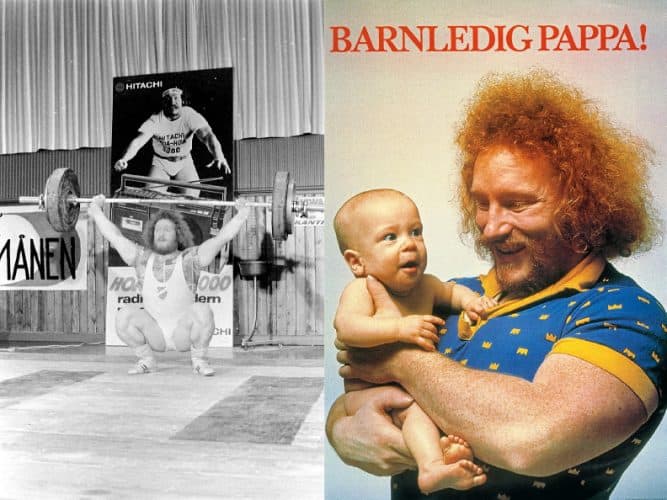
If program administrators hope to see widespread program use, they need to help affect the cultural change needed to overcome these barriers—for all workers, but especially for men. Achieving that cultural change, through program materials and proactive marketing campaigns, indeed needs to be an explicit goal of the administrators. Further research about how to optimize such campaigns in the twenty-first century may be fruitful.
1.4. Plain-language and User-tested Materials
On an instrumental level, administrators can put many of the above changes into effect by using plain language in their program communications and testing materials with real users before publishing them—and regularly updating materials as the program discovers remaining deficiencies in its messaging. Such measures should be standard across the government, but are all the more pressing given the subtle complexities of many PFML programs, the constellation of overlapping laws governing them, and the urgency that prospective beneficiaries learn about and understand the programs quickly because of time-sensitive and often unpredictable caregiving responsibilities.
New Jersey had revamped many of the program’s online materials shortly before our research, but our interviews—many with mothers who had only recently sought to use the program—suggested that potential beneficiaries still struggled to understand most public-facing materials:
“A lot of the wording was confusing or tricky.” – Interviewee #1
“I don’t think I really grasped it for a while… everything has similar initials.” – Interviewee #2
To begin with, agencies should follow federal plain language guidelines and web writing standards, which provide detailed guidance to help governments ensure that regular people can understand what they say and find the information they are looking for. But this isn’t enough; it is hard to game out what language to use and how to present it without putting program materials in front of potential beneficiaries, and having them tell you what they find misleading or hard to follow. (Needless to say, the user testing participants should be representative of the actual beneficiary population, especially those who are more likely to face barriers in learning about the program.)
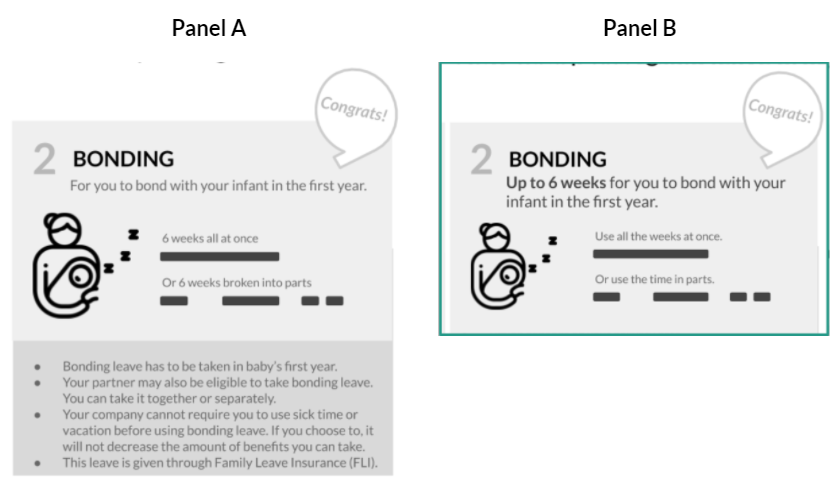
During the sprint, we created some mock-up materials and tested them, to help illustrate this point. Panel A below shows some material regarding FLI bonding leave, as we initially drafted it. In testing, users regularly skimmed over the fact that there was a choice between six weeks of continuous leave or six weeks of leave broken into parts, instead surmising they could take both six continuous and six intermittent weeks of leave. The version in Panel B, highlighting the six-week total limit, ameliorated this confusion.
Procurement regulations can, admittedly, be a meaningful barrier for agencies doing user testing, not just because even a small contract to a user experience (UX) expert may require an onerous public bidding process,15 but because even offering research participants small incentives—which is critical to getting good participation—may run afoul of regulations. Implementing agencies should work with their contracting office to see if there are creative solutions to these barriers; in some cases, legislative changes may be in order.
Such restrictions have indeed been a challenge for the TDI/FLI team, who quickly sought to make user testing a more routine part of their process after the 2019 sprint, but have been partially stymied by difficulty compensating research participants (not to mention the global pandemic).
User testing means more work up front, but it pays dividends in creating a better experience for beneficiaries, generating correct applications up front, and reducing customer service back-and-forth on the back end.
Recommendations:
- Use plain language about eligibility, reasons for using PFML, and application processes in all public facing materials, and hire/train staff who can apply this mindset to all communications work.
- Test all public facing materials with real users—either by contracting with experts, or testing in house.
- Work with contracting offices—or, if needed, legislatures—to find ways to contract out UX research, or to provide research participants incentives.
Citations
- To qualify for FMLA, workers need to meet job tenure and work hours requirements: at least 12 months of tenure with the employer, and 1,250 hours worked during the 12 months prior to leave: source
- Again, to qualify for NJFLA, workers need to meet slightly less stringent job tenure and work hours requirements: at least 12 months of tenure with the employer, and 1,000 hours worked during the 12 months prior to leave: source
- For FMLA, only a child, spouse, or parent is a qualifying family member for purposes of caregiving. NJFLA is much broader, recognizing leave to care for any close family relation, or anyone with whom the caregiver has a close relationship that is the “equivalent” of family. (NJFLA fact sheet: source)
- Admittedly, in practice, it is rare for a doctor to certify the need for 12 weeks of physical recovery, absent serious complications.
- This hypothetical assumes she works at a business of over 50 employees, thus meeting baseline eligibility for both programs; There are other strange cases that can come up at the margins of these programs. A mother who works at a business with 40 employees, for example, cannot take job-protected leave due to her own pregnancy (because she is not covered by FMLA, and NJFLA does not cover own disability), but can use state law for job protection after birth, to bond with her child.
- The provisions were added in the recent legislation: Section 24 of P.L.2019, c.37: “An employer shall not discharge, harass, threaten, or otherwise discriminate or retaliate against an employee with respect to the compensation, terms, conditions, or privileges of employment on the basis that the employee requested or took any temporary disability benefits pursuant to P.L.1948, c.110 (C.43:21-25 et al.), or family temporary disability leave benefits pursuant to P.L.2008, c.17 (C.43:21-39.1 et al.), including retaliation by refusing to [restore] reinstate the employee to employment following a period of leave[, except that, pursuant to section 2 of P.L.1948, c.110 (C.43:21-26), nothing in this section or any other section of P.L.1948, c.110 (C.43:21-25 et al.) or P.L.2008, c.17 (C.43:21-39.1 et al.) shall be construed as increasing, reducing or otherwise modifying any entitlement provided to a worker by the provisions of the "Family Leave Act," P.L.1989, c.261 (C.34:11B-1 et seq.) to be restored to employment by the employer after a period of family temporary disability leave] in the position held when the leave commenced or an equivalent position of like seniority, status, employment benefits, pay and other terms and conditions of employment, except that if, during period of leave, the employer experiences a layoff and the employee would have been laid off if the employee had not been on leave, the employee shall not be entitled to reinstatement, but only if the employer notifies the employee of the employee’s right to file a claim for unemployment benefits after the leave period ends provided by paragraph (2) of subsection (c) of R.S.43:21-19.” source
- DCR may collaborate with USDOL on job protections but we did not explore this collaboration during the sprint.
- Saying, for example, that they had applied for FMLA when they actually were talking about TDI.
- Filing a complaint was at the time also a relatively onerous process, which generally required complainants to travel to one of four DCR offices to file in person. An online option launched in 2020; Notably, DCR does get more inquiries about the protections, averaging about 10 phone calls per week.
- Like all other materials, as discussed in Learning 1.4, it is important to user-test materials describing job protections, to ensure the language is clear and accessible to potential beneficiaries.
- New fathers and non-birthing parents, on the other hand, can only apply for FLI-Bonding leave—and workers needing to care for a family member would apply for only FLI-Care.
- We estimated that 51.1 percent of eligible mothers use the state paid family and medical leave program, versus only 8.1 percent of eligible fathers. Note that limitations of the data meant that we were able to estimate usage for non-birthing fathers only, not for non-birthing parents in general.
- Men filed four in 10 of all bonding claims made in 2018, higher than in other states: source
- The Nordic programs initially offered a certain amount of leave that could be split between parents at their own discretion. The “Daddy quota” is a minimum portion of the leave which cannot be transferred to the other parent. In U.S. programs, where PFML is generally an individual rather than a family entitlement, the point is moot.
- Of course, this process will depend on the state’s contracting rules. Some states have high enough minimum contract sizes to do small UX contracts without triggering onerous processes.
Learnings Part 2: Outreach
2.1 Messengers
2.1.1 The Program Office as the Primary Source of Information
2.1.2 Employers
2.1.3 Other Sources
2.2. Using Data to Track Progress and Target Outreach
Especially when PFML programs are new, administrators must pursue explicit outreach strategies to ensure that potential beneficiaries know about the programs and how to access them—and that businesses in the state understand their new obligations, and the rights of their employees. The quality and design of these efforts have significant bearing on the success of the programs.
2.1. Messengers
2.1.1 The Program Office as the Primary Source of Information
The program office should ultimately own communications about its own program. This is not to say that the government should go it alone on outreach; other non-government actors—including workplaces, health and medical offices, and advocacy organizations—play important roles in getting the word out. But program administrators should create clear and versatile enough materials that they remain the core—and, perhaps more importantly, a trusted—source of information.
This means that outreach and communications have to be an explicit focus of the program office—and, in this sense, New Jersey under the current administration is a role model, with a highly empowered outreach team reporting directly to agency leadership.
But this empowered outreach team is a relatively recent development. New Jersey’s experience in previous years also demonstrates what happens when the program office does not take charge of communications, and responsibility falls to outside actors. Because the previous administration made such little effort to publicize and communicate about the program, it had become common for other players to create and disseminate their own program materials. During the course of our research in New Jersey, we came across written materials on the PFML program created by a coalition of outside advocates and service providers, by well-intentioned HR representatives, even by security staff in the NJDOL lobby in Trenton—all inspired by perceived deficiencies in the official materials.
These players were doing vital work to fill the void left by the program office, and are meaningfully to thank for the level of success the program had achieved. But even when these materials are accurate, they unfortunately and subtly help perpetuate a downward spiral. Beneficiaries rely ever more on informal sources of information, such as peer groups and Facebook pages, where the program office has even less control over the information circulating.
“It was quite confusing. . . I got most information from other moms that had kids.” – Interviewee #8.
As the process continues, the information can become increasingly less reliable, especially if there are changes in program requirements. Moreover, outside actors with less control can perpetuate a sense that the program is too complicated to understand, since—intentionally or not—their rhetoric can be seen as blaming excessive complexity on the program, rather than fully owning and addressing it.1
Ultimately, potential beneficiaries we spoke to faced an avalanche of information that they do not know how to parse, and do not know which parts of it to trust.
“Nobody knows anything, which includes my HR person. I’m getting conflicting information from all these forums, and you can’t get through to the state. I got through once, when I was four months pregnant, and it’s been impossible… I don’t know if they [the state] don’t want people to know about it, but there’s nothing helpful except for the facebook forum [a group run by advocates that assists with applications]… Like for this, you need a ‘maternity leave pay for dummies’ so people know what to do, when to do, and how to do it.” – Interviewee #1
Notably, New Jersey’s experience in this regard was not unique. Early paid leave states generally did not allocate sustained funds for outreach and education, and this has hampered awareness. Previous research by the National Partnership for Women & Families and others has found that “low program awareness is common,” and is often a key barrier that keeps eligible workers with care responsibilities from using PFML, particularly among workers with lower wages.
It bears repeating that the fault here does not lie with the outside actors, whose herculean efforts kept New Jersey’s PFML program afloat when the previous administration essentially declined to do so. Rather, the experience simply underscores that communicating clearly and proactively must be seen as a core part of the PFML program—one that administrators neglect, outsource, or leave to others at their own peril.
Recommendations:
- Take outreach and communication seriously as a core responsibility of the program. A devoted outreach and communication team should be a central division within the leave administering agency, with the team’s manager a member of leadership.
- If other actors begin circulating entirely separate publicity materials, this should be taken as a warning sign that the program office may need to communicate more clearly. Those shadow materials may also provide useful clues about what the formal materials are lacking.
2.1.2 Employers
Many workers rely on their employers as the primary, if not exclusive, source of information about PFML programs, and inaccurate or incomplete information from employers can easily prevent potential beneficiaries from using PFML at all. If program administrators were able to prioritize just one avenue of outreach partnership, it would be employers.2 Across all of our interviews in New Jersey, potential beneficiaries expected their employers to be reliable sources of information on the PFML program:
“I wish my HR person gave me a packet. She gave me no direction at all. Why even have an HR person?” – Interviewee #1, who resorted to other methods of communication only after HR was unhelpful.
Interviewee #16, on whether she knew about the program pre-pregnancy: “Nope, and honestly I didn’t expect to. I expected my employer to know.”
Previous research on state PFML programs supports this point as well. According to a brief by the National Partnership for Women & Families and the Main Street Alliance, “employers who embrace paid leave programs are among the most valuable people to educate employees about the programs and help them apply.” And yet, employers are generally found to be insufficiently informed about PFML programs. For instance, one survey of New Jersey small businesses found 40 percent did not know if FLI covered their employees, even though all NJ employers (save the federal government) must pay in to FLI and are required to post information about it.
Employers are central not only because potential beneficiaries expect to learn about work-related benefits from their employers, but also because of the central role of job protections in any decision to take leave. As discussed above (Learning 1.1), according to our user interviews, many beneficiaries’ use of PFML is completely contingent on the confidence that they can return to their job afterwards. And while the government has an important role to play in enforcing workers’ rights to job protection, in practice, job protections are frequently only as strong as employers understand them to be. Many workers have neither the capital nor the resources to bring civil rights complaints against their employers if their leave is denied. For them, according to our interviews, the limits of the job-protected leave they can take are dictated by their HR departments, and they will not take leave if their employer does not provide accurate and actionable information about its availability—regardless of what their doctors, their friends, or local community organizations tell them.
While our interviews with employers and employer associations were far from conclusive, our research suggested that program administrators may frequently find willing partners in this work—employers who are trying to do the right thing, and would like it to be just a little bit easier to gather and disseminate accurate information about TDI/FLI. One HR manager, who processes several dozen New Jersey leaves annually, talked about the lengths she goes to in order to help her employees access leave:
“We try to go back to the employees to ensure the whole form is correct before it goes to the state. We’re trying to help employees get their money and their benefits, and it is a frustrating process.” – Employer #9
The same manager reported the difficulty of identifying reliable program information: “If there’s a webinar we try and tap into it. We get a lot of emails, we google a lot. We are members of [the Employers Association of New Jersey, which provides training for members], which is extremely helpful.” Another senior HR coordinator said she would appreciate more direct support from the state around the PFML program:
“I’d love for them to bring back some courses; like a seminar, we can go and they’d give a presentation, they go over each different scenario.” – Employer #5
A third HR manager,3 who manages a predominantly Spanish-speaking workforce, spoke of regularly filling out both the employer4 and employee portions of the PFML applications, given language barriers. Surely, the sample of employers willing to talk to our team were biased towards cooperation, and other employers may be more recalcitrant; but administrators could make significant strides by starting with the employers that do embrace PFML and want to make sure it works well, and ensuring they have what they need.
Of course, on the other hand, there are also employers who implicitly or explicitly discourage their employees from taking leave—and most employees are not in a position to fight back individually. We heard this from several interviewees:
“All of the weird stuff was after I came back. Four weeks into my leave I started getting emails I was going to have to come back, even though I’d told everyone I’d be out for another couple months. It was nerve-wracking because apparently my date wasn’t good enough… I feel like I got put on the mom track.” – Interviewee #16
It may be too much to expect that such employers will suddenly become devoted and proactive messengers on behalf of PFML programs. But communicating clearly and concisely about the law to these employers is important for another reason: More concerted messaging to employers about what the law is, how they should be disseminating useful information, and what job protections workers are entitled to, is likely the fastest way to significantly change this discriminatory behavior.5
In disseminating information to employers, administrators should keep in mind the unique challenges facing employers that are based primarily in states with a different or no public paid leave policy. We heard from several employers and beneficiaries about HR departments struggling to keep straight the varying rules in different states, and about the steep learning curve of reading up on the New Jersey law just for a handful of employees in that state:
“The company doesn’t know a lot about rules and laws that other states have, and this is pretty new.” – Interviewee #1, whose company was headquartered in Pennsylvania, and had only a small footprint in New Jersey
As more and more states enact PFML programs, keeping track of the wide range of program details will add more complexity for multi-state employers. Navigating such complexity is no deal breaker for businesses well accustomed to the vagaries of operating in multiple states; but program administrators should keep these employers in mind and try to present their rules as clearly and transparently as possible. Meanwhile, in the long run, a national PFML program would go a long way toward getting all businesses on the same page, even if some states continue to offer more generous programs than the national baseline.
A systematic employer outreach program could include:
- Toolkit of materials for employers that have been user tested with employers and available on a specific page on the program website.
- Such materials could include recorded webinars or videos, if user testing suggests this would be valuable.
- Trainings delivered via business associations such as the Chamber of Commerce, business advocacy groups like the Main Street Alliance, or other employer or HR associations.
(TDI/FLI has implemented several of these since the sprint. A toolkit of employer materials went live in fall 2020, and the team did several presentations to HR associations in the state. The pandemic, however, served as a significant impediment to further outreach; according to the outreach team, COVID-related programs are currently the only ones employers want to hear about.)
In addition to testing materials directly with employers, administrators may consider best practices around employer messaging developed from other research. A case study by CLASP and Family Values @ Work in Washington State found that the employers responded best to messages around “need” (describing why employees would need to take leave) and “connection” (as the report puts it: “supporting employees when they need it most connects us to each other as human beings and creates a bond of loyalty and a sense of belonging within a company”).
Even though wage replacement comes through the state program for most employees, the pathway to PFML for getting job-protected paid leave approved runs directly through employers. While other sources of information (discussed below) may help workers learn and stand up for their rights, there is no denying the important, affirmative role that employers play. It is incumbent on administrators to ensure that all employers—and especially those that may not understand the program well—have what they need to provide workers with the right information, not only about the TDI/FLI program but about job protections as well.
2.1.3 Other Sources
A full-fledged outreach program may also pursue a variety of other avenues. Some major opportunities include medical professionals, community organizations, and other state programs—e.g. Medicaid or the Special Supplemental Nutrition Program for Women, Infants, and Children (WIC).
Healthcare providers are a robust route of outreach in New Jersey, especially for maternity leave, where doctors routinely tell their pregnant patients about it and encourage them to apply; several interviewees mentioned hearing about PFML and learning how to apply for it from their doctor. Such outreach indeed makes particular sense for TDI, where doctors are involved in certifying the beneficiary's own disability—and particularly for pregnancy, when a doctor has time to raise the issue well in advance. It may be slightly harder for FLI, when the medical provider may not have as much access to the relevant caregiver, at least in advance.
Meanwhile, community leaders and local organizations have played an especially large role publicizing FLI in New Jersey, especially given the limited outreach program under the Christie administration. That said, working through advocacy groups comes with challenges. Community organizations only have the reach they have, and ensuring comprehensive coverage via a patchwork of such organizations is challenging at best.
Working through these and other third-party messengers is important—though it is no replacement for creating clear public-facing materials and working through employers with access to every eligible worker in the state.
2.2. Using Data to Track Progress and Target Outreach
While the picture is somewhat more complicated for other types of leave, parental leave has a convenient feature: It is relatively easy to determine who is eligible for it, and who is not receiving it. Government records and even publicly available Census data record with reasonable accuracy the number of births per year, with geographic and sociodemographic detail. Administrators can use this data to determine what portion of their prospective beneficiaries they are reaching, within which populations, and how to better target outreach to potential beneficiaries.
When the team began its research in New Jersey, we asked the administrators this question: What portion of new parents in New Jersey use the state’s PFML program? Despite hundreds of reports the program receives on a weekly and monthly basis from the NJDOL analytics department, administrators did not know; the reports, designed and programmed decades ago, did not directly answer this question. They referred us to a New Jersey Policy Perspective report estimating 12 percent of new parents in the state take paid leave (referring only to FLI bonding leave, with no reference to TDI birth and recovery leave available only to birthing parents).
As part of our research, we set out to answer this question. (Note that this research looked only at usage of the state PFML program, not private temporary disability insurance plans that the state permits employers to offer in lieu of state TDI, and as such may somewhat understate the total portion of workers who take paid medical leave.) We derived the numerator from NJDOL’s table of all program users over the last ten years, and the denominator from American Community Survey (ACS) data from the Census. The following topline findings are specific to New Jersey, but they are offered as an illustration of the types of learnings that administrators may find from similar analyses. Many of these findings raise further research questions that should be explored with qualitative research akin to the interviews we did during the sprint.6
- Use of PFML by birthing parents was quite high overall; 51 percent of eligible mothers7 use PFML to some degree.
- However this high overall rate masked important and actionable discrepancies: although most birthing parents are eligible for both TDI (for birth and recovery) and FLI (for bonding), only about one-third of the eligible mothers used both programs. About a third used only TDI, and a third used only FLI. This analysis reveals an important and counterintuitive point: NJDOL can improve program coverage not just by reaching new populations, but by better communicating with existing beneficiaries.
- TDI-only beneficiaries among this group skewed significantly lower-income than overall beneficiaries, at the time of our analysis in fall 2019. One likely possibility is that the wage replacement rate at the time (66 percent) was insufficient to maximize use among lower-income workers, who could not afford to take more than six weeks off at such a rate. Advocates expect that full leave usage by low-income workers will have increased with the wage replacement rate rising to 85 percent in July 2020, and future research should investigate this hypothesis. It is also important to explore, though, whether there was insufficient messaging around FLI bonding leave for low-income birthing parents, whether those parents felt stronger pressures to return to work sooner, or whether the process of how to apply to and transition from one program to the other was particularly opaque for some populations.
- FLI-only beneficiaries in this group may not have been eligible for TDI,8 or may not have been aware that TDI is available for pregnancy and birth.
- Use of paternity leave was very low; only 8 percent of eligible fathers use FLI.9 Like with all other state paid leave programs, there remains much work to be done on engaging fathers.
- There was generally no clear geographic pattern to PFML usage throughout the state.10
- Lower-income people had lower usage: lower-income zip codes had lower overall usage and lower-income applications were more likely to be rejected. To a degree, this might be an expected outcome of policy design—many low-income workers have insufficient income to qualify11—but it also may be that lower-income people are struggling to navigate the red tape of the program.
- Zip codes with higher rates of graduate degrees had lower usage. There are several explanations. First, higher earners are more likely to have access to private, employer-provided paid parental leave. (Though just 21 percent of the civilian workforce has access to paid family leave, high earners are more than seven times more likely than the lowest earners to have access to employer-provided paid leave.) Second, wage replacement caps may also make the state PFML program less attractive to high earners, though this dynamic may have been ameliorated with the program updates.12 Third, they may work in demanding industries/professions or at companies which strongly discourage their employees from taking paid leave for caregiving. Because education level is not collected on TDI/FLI applications, this analysis was only done at the zip code level.
- Zip codes with higher rates of non-citizens had lower usage—and the correlation between usage and citizenship is much stronger than the correlation between usage and immigration status, or English-speaking status. More direct engagement with immigrant communities would be needed to better understand the barriers facing them.13
- Contrary to the hypotheses of program staff,14 after controlling for income, we did not find any correlation between program use and race at the zip code level.
For future research: Two other worthwhile pieces of analysis we aimed to do but were not possible with the data available:
- Program use by industry. New Jersey’s application collects occupation data; but because they ask applicants for it in a free text field, and applicants use a variety of terms, it is nearly impossible to standardize. New Jersey and other states interested in tracking these trends could likely merge industry information from the unemployment system to search for industry trends—or collect more systematized information from applicants on the front end (e.g., the form prompts applicants to select from a searchable list of industries). (On the other hand, if states cannot systematize the data this way, they should strike the question from the application entirely; the program should not put additional barriers in front of applicants unless there is good reason to do so.)
- Program use by race and ethnicity, at an individual level. Our analysis found no trends by race after controlling for income, at the zip code level. But because New Jersey’s application did not collect data on race and ethnicity until mid-2020,15 we could not perform any racial and ethnic analysis at the individual level.
The conclusion from this exercise is not that other jurisdictions are likely to have these same findings, but that this type of analysis is likely to be instructive, and implementing it on an ongoing basis in the form of a data dashboard is a powerful reality check for outreach efforts. In the simplest case, such a dashboard need not be especially difficult to implement. Here are a few data points that administrators could figure in a matter of days:
- Portion of birthing parents who take parental leave. In New Jersey, our analysis found that 73 percent of birthing parents were eligible for leave.16 While this fraction will vary by demographics and eligibility rules, it is arguably reasonable that around three quarters of birthing parents will be eligible.17 The number of births per year is readily discernible from the Census Bureau,18 and program use by new parents should be relatively easy to derive from program data.
- Portion of non-birthing parents who take leave. In New Jersey, our analysis found that, for 69 percent of births, there was a non-birthing parent eligible for leave.19 Again, the fraction will vary, but it is reasonable to assume around seven in 10 births will have another parent eligible for leave.
- For jurisdictions with clear geographic disparities, geographic breakdown of program use. As a rough approximation, programs could calculate the portion of usage that occurs in given geographies to the portion of population in those geographies. Some small mismatches are to be expected given that the number of eligible parents is not directly proportional to population, especially if program administrators use very small geographies. But if, say, a given geography has triple the population but half the usage of another, it is fair to conclude outreach efforts have flagged in that area.
- For programs that collect reliable industry data, industry breakdown of program use. As with geography, programs can calculate the portion of usage that occurs in given industries to the portion of the child-bearing age workforce in those industries. The latter data should be readily available to state departments of labor who usually implement these programs. Results would allow program administrators to better target outreach activities, to beneficiaries and employers.
- Income and demographic correlates with applications. (Technically this reflects more on the application pipeline than on the outreach process.) Most programs either collect income and demographic data in their applications, or can derive this from other administrative sources. While programs may expect some differences (lower-income applicants are more likely to be ineligible, which may be correlated with other demographic indicators), they should look for approximate socioeconomic parity between accepted and rejected applications, and investigate any discrepancies that occur.
Straightforward and commonsense checks like these can give administrators critical insights regarding where and how outreach and engagement efforts must be improved. Critically, these are not checks that require data science teams or months (or years) of custom development. A few staff and a calculator—and ideally a statutory mandate—can get these underway in a matter of days.
As noted above, such analysis is especially feasible for parental leave, where the universe of potential beneficiaries is relatively easy to define. That said, while it was outside the scope of this sprint, programs may be able to develop heuristics for other types of leave as well. Perhaps, for example, there may be data on injuries and illnesses that commonly require temporary caregiving.
On the other hand, one note of caution: It is easy to draw erroneous conclusions when such calculations get slightly more complex. For example: In New Jersey, the mean annual salary of a birthing parent approved for TDI in 2018 was $46,121, whereas the average salary in the state was $59,980. From these figures, one might conclude that parental leave is successfully reaching income workers. But the average parent is young, and the average young person tends to earn less than the average older person; and, moreover, birthing parents are usually women, who earn on average less than men. The comparison is misleading. It is easy to stumble into such mismatches.
Recommendations:
- Develop a few key metrics to summarize program usage along key dimensions, perhaps based on some of those outlined above (e.g. overall usage among birthing and non-birthing parents, usage by income bucket, usage by geographic area).
- Start simple and build out over time, rather than sinking large sums into a data product up front.
Citations
- Multiple interviewees reported that they first heard about the program from outside advocates, who sometimes leaned into the complexity, validating prospective beneficiaries’ prior views that the program was excessively intricate, and “taking the beneficiaries’ side,” so to speak, against the overwhelming program. This messaging stemmed from positive intentions, but ultimately helped perpetuate the veneer of inaccessibility around the program. Speaking about one prominent statewide advocate for paid leave, one interviewee said: “Every time I see her I say ‘can you break it down for me again, because I’m still not clear’ and she says yes it’s not really clear.” (Interviewee #2)
- This is something of a controversial political conclusion. In New Jersey, coalitions of community groups and advocates fought for the program’s passage, and single-handedly kept it afloat through years in which a Republican administration was not invested in its success. These community groups are significantly to thank for the programs’ existence at all, a fact not lost on the progressive leadership currently running these programs within the DOL, for whom the community groups are natural allies. Alliances with employers, on the other hand, are traditionally the province of more right-leaning traditionalists at DOL, who are, again, traditionally more skeptical of new progressive programs like PFML.
- Employer #3
- This was admittedly a bit of an outdated claim; the current program leadership, in the interest of reducing barriers to program access, eradicated the employer portion of the TDI/FLI application.
- One dynamic to keep in mind is that higher-income workers may be more likely to hear about PFML from their employers than low-income workers, according to recent research in the Bay Area: source
- Unfortunately, the sequencing of research was such that these findings were not clear until after the qualitative research was largely complete.
- Given the limits of available data, this estimate applies only to women who gave birth.
- Many employees receive temporary disability coverage from their employers, and use the state program only for FLI bonding leave after exhausting their private benefits covering their delivery and the immediate aftermath.
- The limits of available data meant that this analysis was limited to fathers, rather than non-birthing parents in general, but it is likely that the trend applies more broadly.
- We mapped usage rates by zip code and showed the maps to program staff and others familiar with the socioeconomic geography of New Jersey. No meaningful patterns presented themselves.
- This is a point worth highlighting: setting up paid family and medical leave programs — and especially paid maternity leave programs — as social insurance schemes funded through payroll taxes significantly restricts the beneficiary population, as it premises assistance on sufficient employment history. Indeed, we estimate that 27 percent of women who give birth in New Jersey every year are not eligible for PFML. Some birthing parents were not working at the time of giving birth (whether due to traditional gender roles that view women as primary caregivers, or because workplace practices and norms and pay rates made it difficult to combine work and care, or because they were young enough to have never entered the workforce). Still, about 40 percent of birthing parents who were ineligible for paid family and medical leave were employed and simply had insufficient work history to establish eligibility. The political trade-offs of social insurance and assistance are well known — targeted assistance programs can reach the poorest families, but more universal insurance programs may generate broader political buy-in and avoid charged political debate about the “deserving” poor — and the choice to implement PFML as insurance may well be reasonable. But legislators and advocates should be clear-eyed about the choices they make in designing and implementing policies.
- The program replaces a portion (previously 66 percent, now 85 percent) of income up to a weekly cap (previously $633, now $903 in 2021). Higher-income people will hit the cap, and thus have relatively smaller portions of their income replaced.
- This analysis was done at the zip code level since this data is not collected at the individual level. The analysis would be more precise if individual-level data on immigration status were collected — but collecting such data raises a number of concerns about the potential for discrimination or exploitation, and would probably cause some immigrants not to apply at all. As such, collecting such data would probably be ill-advised.
- Program staff were concerned that, despite their efforts, systemic racism would reproduce itself in access to the program, and that analysis would show that beneficiaries were overwhelmingly white.
- Race was added to the application in 2020, as part of a legislatively mandated program expansion.
- Sixteen percent were not recently—or ever—in the labor force, and 11 percent did have recent work history but not enough to establish eligibility, due to self-employment and/or limited hours.
- The figure in New Jersey, based on Census data, was 73 percent. States with higher workforce participation rates for young parents, or less stringent work history requirements, might plausibly see their rate as high as 85-90 percent; states with lower workforce rates for young parents or more stringent requirements might see the rate as low as 60-65 percent.
- A small source of error is that there are more babies than births due to twins, triplets, etc. In New Jersey, we estimated there were about 3 percent fewer births than babies.
- 22 percent of births were to single parents, and in 9 percent of cases there was a partner with insufficient work history to qualify for the program.
Learnings Part 3: Applications, Processing, and Delivery
3.1. Conceptual and Cultural Considerations
3.1.1 Set Realistic Expectations and be Transparent
3.1.2 Track Progress—in a Process Led by Program Leadership—and React Quickly
3.1.3 Foster a Culture of Equity, Access, and Service; Not One of Preventing Fraud
3.2. Technical Recommendations
3.2.1 Simple Applications, Written in Plain Language and Informed by User Testing
3.2.2 Modern Online Application, with a Status Checker
3.2.3 Minimize the Information Required to Submit an Application
3.2.4 Accommodate Advance Claims
3.2.5 Follow Up by Phone or Email when Needed
3.2.6 (If relevant) Effect Smooth Transitions between Program Phases
3.2.7 Create a Beneficiary-centric Payment Delivery System
Of course the heart of the PFML program is its direct administration: how applications are submitted, how they are reviewed, and how efficient the whole process is. Again, while many of our findings are unique to New Jersey, other learnings are likely more generally applicable to other states.
Our findings here are split into two sections. First, we discuss several high-level conceptual and cultural considerations that impact the entire processing pipeline. Second, we discuss a series of more nuts-and-bolts measures that can make a meaningful difference in implementation. IT procurement and development are implicated in many of these points, but we discuss them separately, in the following section.
Recall throughout this section the point raised above: because it is a short-term program administered during major leave upheavals or crises for beneficiaries, PFML must be held to an especially high timeliness standard. Processing time must be measured in days or weeks, not months; and there is lower margin for error. (New Jersey aims to process applications in two weeks, which is a reasonable benchmark.) For a PFML program to be successful, it must excel in administration.
3.1. Conceptual and Cultural Considerations
3.1.1 Set Realistic Expectations and be Transparent
Beneficiaries appreciate transparency over ungrounded optimism. In the best case, all applications would be processed in under two weeks. Barring that, beneficiaries would rather know what to expect than be primed with unrealistic expectations that may not pan out.
This finding came up again and again in interviews. Official materials all indicated a two-week processing time, but, because of variance in the outcomes, beneficiaries had no faith in that estimate. This led stressed out applicants to repeatedly and futilely check their application status online, or inundate overworked agency call centers with status check queries. In some cases, the uncertainty was so severe that potential beneficiaries decided it was not worth applying at all:
I wish there was a better explanation of what happens after your application is submitted. I don’t know how long it will take to get paid… I’ve heard nightmares. – Interviewee #17
My husband wanted to [take bonding leave] but he couldn’t cause we didn’t know when we’d get the checks. They [DOL] said 2 weeks but when he talked to people [HR department, and friends], they said it came when it wanted. We can’t have that. It’s not worth the risk. That’s our house. – Interviewee #14
And, when applications took longer than two weeks, beneficiaries were generally bewildered:
“I wish they would have just denied me a lot quicker. If there is something wrong or they have to review something it takes an extra 5-6 weeks. Why does it take that long if it takes 14 days to review the whole application?” – Interviewee #18
The irony here is that, in fact, New Jersey was processing most applications in two to three weeks—but, a sizable minority took significantly longer, and, as bad news travels faster than good, these were the horror stories that people heard about. Without clear transparency about timelines, the public got the impression that long wait times are the norm, giving the program a worse reputation than it deserved.
First, program offices should be forthright about what goes on behind the scenes, and provide applicants with regular status updates. Second, and while it may cut against administrators’ instincts to keep potentially unsavory data under wraps, the program office has little to lose and much to gain from publicly posting data about its wait times. A simple way to do so is along the lines of: “90 percent of applications are paid or rejected within X days,” with X updated based on program data. This way beneficiaries know the outer limit of what they must wait through, in all but the most exceptional cases. (Note that reporting the average time to completion can be misleading. A mean could easily overstate the typical experience by including a few long outliers; but a median is equally misleading, as half of beneficiaries will be disappointed to see the process take longer than the number they read.) Such an approach would build trust with beneficiaries and allow them to plan appropriately.
From a program administrator’s perspective this approach could also be helpful in ensuring adequate program resources. If the average time to determination gets so large that it increases media and political attention, it can help administrators advocate compellingly for additional resources they need to improve wait times.
Recommendations:
- Explain clearly what goes on behind the scenes after an application is submitted.
- Provide regular updates on application status.
- Provide regularly updated and reliable estimates on current processing times.
3.1.2 Track Progress—In a Process Led by Program Leadership—and React Quickly
For administrators to share externally how long applications take, they must have clarity on this information internally as well. In a program where reliably quick processing is critical, administrators need robust, real-time visibility into the application processing pipeline.
This is easier said than done. This project is more complex than just knowing the average wait time, or, for example, the longest a given application has been sitting in the system. Administrators need information about the distribution of outcomes occurring in their programs; for example, a program where one half of applications are processed in one day and the other half in two months has an average wait time of one month, but that is very different from a program where every application takes one month to process. And, depending on how the program is set up, the specific outcomes that administrators must track to reliably make updates may differ.
Partly as a result, the largest hurdle to implementing such analysis in New Jersey—and likely in other environments as well—was not a lack of reporting or resources per se, but an inherited disconnect between the analytics department and the program leadership about what exactly needed to be measured. At NJDOL, significant resources had been devoted to TDI/FLI reporting, and the analytics department regularly delivered detailed and thorough statistics to program leadership—and had for decades. There was no lack of data. Rather, the data was simply not aggregated and presented in a way that program leadership could understand, or that answered all of their key questions.
Reporting and analytics can indeed be game-changing for program administrators, but only if done right. This means dynamic collaboration between leadership, with its program expertise, and the reporting team, with its data expertise, who can together decide which measures must be tracked and how they can be calculated.
As with the outreach data above, we offer an example of this analysis in New Jersey, not because the findings (or in this case even the research questions) will apply directly in other jurisdictions, but because the process itself is instructive of the type of findings that may emerge.
First, we performed a thorough review of the application process and application routing, talking not just to program leadership but to individual claim examiners and processors to understand how claims were being routed in practice under different circumstances. This step is critical; it is impossible to measure a process without knowing what it is, and even in government, processes frequently play out differently in real life than they do on paper. At a high level, in New Jersey, the process is:
- There is a separate backlog of applications for each of the four primary claim types, (TDI web, TDI paper, FLI web, FLI paper) with examiners all working on claims that are n days old depending on the length of the backlog (usually one to three weeks), and with examiners focused exclusively on either FLI or TDI claims.
- The first step for examiners working on paper claims is to enter them, which takes up to about half an hour; for web claims, this step is of course skipped.
- Once entered, examiners will review a claim, and can generally approve it very quickly if it is complete and correct; the approval can take as little as a few minutes. If the claim is missing information or otherwise problematic, examiners may either reject it immediately, or they may leave the claim open and try to resolve outstanding issues.
- Initially rejected claims frequently end up in a separate reconsideration unit, where processing is triggered by another category of forms submitted by applicants, each with their own backlogs.
Second, we reviewed in detail the existing application processing reports output by the mainframe, including sitting with reporting and analytics staff to understand which statistics they use, and what is represented by each number (a nontrivial task given that the decades-old reports are not clearly labeled, and any detailed documentation has been lost). We also checked each interpretation by comparing multiple different reports and highlighting and resolving any sources of discrepancy.
At the end of this process, we were able to perform a reliable analysis of the range of processing times for different applications. Again, these findings give examples of the kinds of things other jurisdictions might glean from a similar analysis. We found:
- Administrators had estimated that the average claim was probably taking as much as about one per month to process. In practice, though, there was a very wide distribution of processing times. A majority of claims were processed within the promised two to three weeks, but a significant portion stretched on much longer, with 10-20 percent of claims taking more than eight weeks. A better way to improve the user experience is to make the latter more like the former, rather than speed processing across the board.
- In an attempt to reach faster resolution, program administrators had been attempting to enforce a policy of quickly rejecting incomplete claims, and routing them to reconsideration, where staff can research further details as needed to resolve the claim. In practice, however, routing claims to reconsideration was highly counterproductive. Most claims going to the unit were ultimately granted, but the unit was relatively backlogged compared to others, and so granting them took up to an order of magnitude longer than handling them in the initial examination unit—a matter of months, rather than weeks.
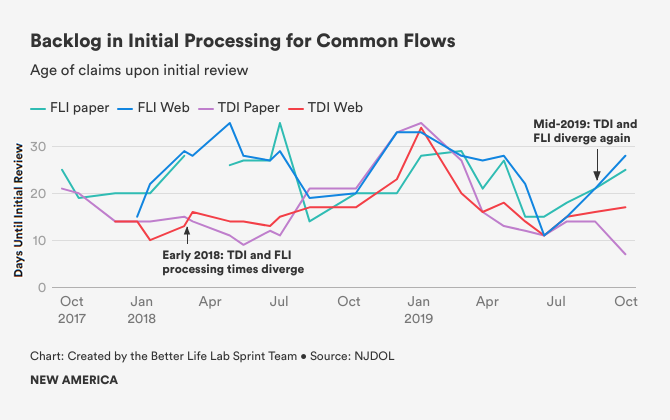
- Examiners’ rigid specialization in either TDI or FLI, rather than positively affecting economies of scale, was in fact likely hurting the program. Over the course of the previous months, there were periodic and unpredictable shifts in the volume of work coming in to the TDI and FLI programs. But because resources were not shifted between the two, wait times ballooned in one program then the other over time, with little done to keep the two waitlists concurrently in check. During the sprint, TDI claims were being reviewed within about one to two weeks, while FLI claims were taking up to a month.
- Almost all delays came from one of two sources: (a) the initial one to three week backlog, and (b) applications with incomplete data. Were it not for these factors, claims could be processed nearly instantly.
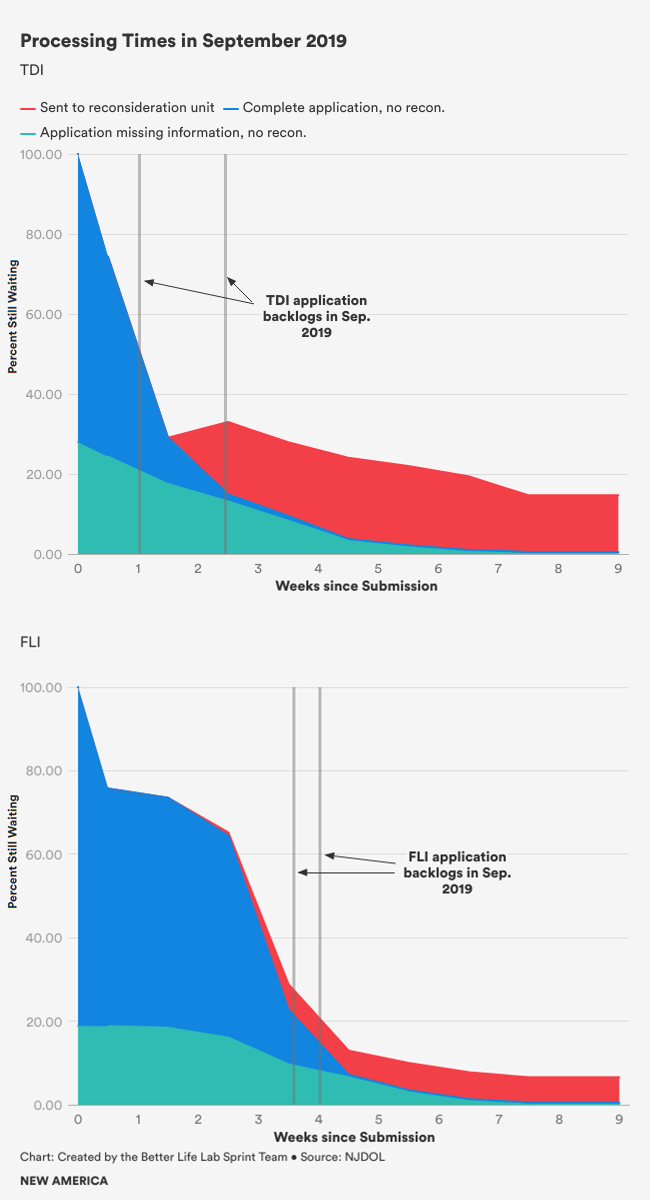
Ultimately, collaboratively producing a clear framework to analyze and understand the data, and working rigorously to measure the program’s progress through it, will help program offices learn what they need in order for the program to succeed.
Recommendations:
- PFML programs need real-time insight into how their application processing pipeline is working.
- The metrics programs track may depend on the details of their internal processes; analytics departments and program leadership should work collaboratively to develop the set of metrics that would be most helpful in tracking the applicant experience. As a rule of thumb, leadership should consider tracking:
- Portion of applications that are fully processed within two weeks (among applications submitted 2-6 weeks ago) — if applicable, broken out by application type
- Portion of applications that are fully processed within 30 days (among applications submitted 30-60 days ago) — if applicable, broken out by application type
- Current count of applications in each division’s work queue
- Portion of applications rejected, and, if applicable, reasons for rejection
- Program leadership should use the learnings from these analyses to set priorities and address delays, backlogs, and other issues as they arise.
3.1.3 Foster a Culture of Equity, Access, and Service; Not One of Preventing Fraud
In countless little decisions every day, program administrators must choose to err on the side of limiting the potential for fraud or increasing access. They should choose the latter, and do so clearly and unambiguously.
This choice plays out in obvious ways in the case of program-wide policy changes that the TDI/FLI leadership, to its significant credit, implemented in the last several years. A couple of examples illustrate the point:
- Claims that arrive later during the leave period require a valid reason for lateness outside the applicant’s control. But program leadership noticed that, in practice, many late applicants simply did not know about the program in time, often because their employers did not inform them. Rather than continue to punish these potential beneficiaries for the fact that no one told them about the program, the program chose to accept “my employer didn’t inform me of the program” as a valid reason for late claims.
- A common reason for delayed claim processing used to be minor mismatches in dates; a claimant wrote that their leave started on November 10, for instance, but their doctor wrote that it began on November 11. Previously, such claims were denied until the discrepancy could be resolved. Now, leadership’s guidance is to acknowledge that such mismatches are not actually evidence of a meaningful discrepancy, and to simply grant the claim.
It is important to foster this kind of understanding and empathetic workplace culture from top to bottom because front-line staff usually have discretion over numerous small decisions not visible to program leadership. An example from New Jersey: If an application came in without a required doctor’s note, the protocol was technically to reject the application out of hand, and to reopen processing in reconsideration if needed. But application examiners focused on getting to yes may have instead called the applicant, explained the situation, and found a way to get that note and grant the benefit. An office whose priority is inclusion will do this more frequently than an office that emphasizes zero tolerance for waste and fraud.
It is worth noting the relative difficulty of perpetrating a fraud in PFML programs—especially for parental leave. Not only would a would-be fraudster need to defraud the government, they would have to defraud their employer as well—or somehow manage to mislead the state about their legally-reported wages. And they would have to lie about life events that people are not generally inclined to lie about: as staff in New Jersey pointed out, how, and how frequently, does someone really fake having a child? For administrators, it is not simply that the risk of dissuading genuine applications is not worth the reward of weeding out a few fraudulent ones—it’s that there is in fact very little fraud to weed out at all.
Recommendations:
- Review program rules and restrictions, and remove those that serve to bar claimants from getting benefits without a commensurate benefit in weeding out true fraud.
- Communicate to employees the importance of inclusion, and, if applicable, ensure that performance criteria do not incentivize rejecting applications unnecessarily.
3.2. Technical Recommendations
The following recommendations are slightly more mechanical and detail-oriented, but still generic enough that they are likely to be broadly applicable to other states with PFML programs.
3.2.1 Simple Applications, Written in Plain Language and Informed by User Testing
The same guidance offered above with regards to program communications (Learning 1.4) applies with extra force on the development of an application. The application is the front door to a program, and if the program is to be accessible, the application must be as simple and straight-forward as humanly possible. Yet program staff can sometimes become mired in the minutiae of their program, and become unaware of their own blind spots when it comes to what potential applicants may find complex. The only reliable way to ensure a smooth process is to rigorously user-test the application with real claimants.
New Jersey’s experiences offer an illustration of the importance of user testing. Understanding the previous version could use improvement, TDI/FLI leadership undertook a significant overhaul of the program’s paper application in 2018, led by experienced program staff. The new application was far shorter than the previous one, and streamlined in powerful ways. But conversations with applicants and claim examiners during the sprint made clear that, while the overhaul had made very significant improvements, there were still some points of confusion. Examiners reported continuing to see frequent small errors: (1) claimants misrecorded the dates of leave submitted on claims, and (2) many claimants reported receiving Social Security Disability Insurance (SSDI) when they actually meant old-age Social Security, for example.
Two-thirds of our interviewees—some of whom used the older web application, which had not been recently updated and was widely acknowledged to be in worse shape than the paper one—had difficulty with the application. Many noted “guessing until they figured it out” when recording key dates, as they did not entirely understand what they were being asked: “I wasn’t sure about the stop date? I think they were looking for [the] last paid day [of work.] I figured it out by trial and error. I just kept guessing,” said Interviewee #5.1 Another mentioned that the application was not clear enough about the requirement to list all recent employers: “I didn’t add one employer because I didn’t work a lot of time with them. And then it stalled my application by 6 weeks. It wasn’t clear to add all employers,” and Interviewee #1.
There is no such thing as too simple or too streamlined in creating applications for benefits, and there is no substitute for testing the forms with a representative sample of real users. And, administrators should continue to monitor the applications that come in, looking for common errors and amending the application to prevent those mistakes.
3.2.2 Modern Online Application, with a Status Checker
A modern, well-tested, well-built, and well-designed web application—with functionality to submit and check the status of claims—is arguably the single greatest asset a program can have.
For one, most people expect to find government resources online, and strongly prefer online applications to legacy methods. (This is especially true for parental leave, where the user base is liable to skew younger.) In New Jersey, the paper (mail/fax) application is the legacy mainstay for many employers and community organizations, and is currently far more streamlined and easy to use than the web application; even so, the web application attracts 50 percent of applicants.
But, perhaps less obviously, web applications create enormous efficiency gains for the program, in multiple ways:
- Paper applications require manual data entry, which consumes a significant portion of claim examiners’ time; in New Jersey, processing a complete paper application took five to eight times longer than processing a complete web application.2
- Web applications can be validated and returned to users to correct errors before they are submitted. This is significant because incomplete claims accounted for a very large portion of delayed processing in New Jersey. Even with New Jersey’s imperfect web application, 87 percent of web claims were complete on receipt, compared with only 58 percent of paper claims, and web claims were only about a third as likely to get stuck in drawn-out determination processes.
- Claimants are understandably anxious about when their benefits will arrive and want regular updates. If they cannot do so online, they will seek the information some other way. In New Jersey, this phenomenon had played out in a major way: With an incomplete status check application inaccessible to many claimants, huge numbers of claimants instead called the department. These phone calls had, in turn, overwhelmed the call center, to the extent that every interviewee and program employee we spoke with cited call center traffic and delays as a major pain point in the application process.
A robust web application is not only a baseline expectation of customer service in the twenty-first century; it is also the simplest way to ease the pressure on other program divisions and improve efficiency. Note that the net result of these web improvements is not to remove humans from the process entirely, but rather to free up claim examiners and call center agents to provide useful services, rather than overwhelm them with purely clerical tasks.
As important as the web application is, it is important to keep in mind what it cannot do. A well-designed and sleek web application is no substitute for clear language that users can understand; in fact, using plain language on forms and testing them with users (as discussed in the previous section) is a prerequisite for developing a good web app. And, programs would be well-advised to maintain a paper form alongside the web application, for populations with connectivity issues.
More details about the design of a modern web app are described in the U.S. Web Design Standards. A few key points to keep in mind:
- Forms should be mobile responsive, as many Americans access the internet primarily or exclusively via smartphone. (One interviewee told us: “It was nice until I forgot my password. I couldn’t reset it because I was on a mobile device. I called, I waited a long time. When they told me I have to use a computer… I told them I don’t have one. They told me to go to the library. I have 7 kids. I can’t just get up and go.” -Interviewee #18)
- Forms should include a progress bar indicating to users how far along in the process they are, and should set clear expectations about how long sections will take.
- Forms should provide clarification about what exactly is being requested and why.
- Any personally identifiable information should be masked.
- Fields should be automatically validated, and return clear, actionable feedback where errors occur.
3.2.3 Minimize the Information Required to Submit an Application
Program administrators must resist the temptation to request every last piece of information that might be useful or interesting in application processing, program analysis, or audit readiness. Each additional piece of information requested is a potential barrier for prospective beneficiaries, and thus, critically, another source of delay in paying benefits. Administrators should source data on the back end where possible, and limit required documentation to the bare minimum.
New Jersey had taken several steps in this regard that bore dividends in improving access. A couple of examples:
- TDI/FLI used to require employers to submit records corroborating claimants’ wages, even though the state DOL necessarily has authoritative data on all wages paid in the state through the unemployment system. As this employer confirmation requirement was statutory, program leadership asked the state legislature to amend the law, and the legislature did so in early 2019. Now, staff rely entirely on the state’s system, and do not bog down employers’ HR departments compiling data that the government already has.
- FLI-Bonding claims—paid leave to bond with a newborn or newly adopted child—used to require formal documentation, for example a doctor’s note, akin to temporary disability claims. It became clear that the formality of getting a doctor to sign a letter that a baby was indeed born was a barrier for new parents who were understandably thinking about hundreds of other things before acquiring proof that their baby was indeed a baby. NJDOL administratively waived the documentation requirement for bonding claims.
It is impossible to estimate the quantitative effect of these changes on applications and approvals, but, anecdotally, they are significant for improving access, especially in a program where every added day and every added document matters.3 Our analysis found that the vast majority of processing delays came from applications that arrived incomplete, where additional information needed to be tracked down. Reducing the number of requirements mechanically decreases these delays. Administrators should always design their programs to minimize the onus placed on claimants, and their employers and doctors.
3.2.4 Accommodate Advance Claims
Some PFML users will have no advance warning, as in the case of a sudden illness or injury for them or a family member—but, frequently, beneficiaries can anticipate when they will need leave, and want to prepare. They know roughly when a baby will be born or when they or a family member has a scheduled surgery, and they want to prepare for it weeks in advance, rather than having to submit forms while in the hospital:
“Right after a baby, you’re a zombie. Will you remember to apply?” – Interviewee #1
“They didn’t want to talk to you until you were 60 days from the due date. I’m a planner; I wanted to talk sooner. It was stressful.” – Interviewee #8
As of late 2019, New Jersey partially allowed beneficiaries to file advance claims, but many interviewees reported confusion over how to do so. Programs should have a way for claimants to file most of a claim, and trigger it—with an absolute minimum of additional effort—when the moment is right. And programs should be able to review and provisionally approve these partial claims, so any issues can be worked out in advance.
3.2.5 Follow Up by Phone or Email when Needed
Well-designed web applications and streamlined lists of requirements should decrease the need for custom follow-up with individual applicants. Insofar as such follow-up is still necessary, though, in line with the spirit of prioritizing customer service over compliance, program staff should follow up with claimants via phone or email. In government, it is easy to default to mail notices, and indeed New Jersey’s program had historically done so, sending off form letters to claimants when there were issues in the application. Such letters—which are often imprecise and missing key information—waste several days in the mail in the best case scenario. Often, they waste weeks: The instructions are insufficient to correct the initial error and there is no way to get clarification from the department. Then, the applicant submits a second application that is equally flawed, and the whole process starts all over again. Examiners should make it easy for claimants to quickly correct issues so their applications can be processed.
Setting up policies like this can be slightly more complex than simply encouraging examiners to change their methods. In New Jersey, for example, many examiners did go above and beyond, calling or emailing claimants to quickly address issues. However, because they called or emailed from their direct lines or addresses, claimants frequently passed around that information to other friends with issues, recommending this contact as a quick way to resolve questions, to the point that the well-meaning examiner was inundated with extra work not their own. Examiners in this case need the ability to call or email from generic lines or addresses, like in any other customer service department. Another barrier is the exchange of personally identifiable information. New Jersey generally used Social Security Number as its key ID for applications, rather than an application ID. This practice of course raised challenges for examiners who (rightly) did not want to include such sensitive personally identifiable information in an email.
While these two barriers are perhaps unique to New Jersey’s specific system, it underscores the point that a good customer service solution to follow up with claimants must make it easier for examiners to do the right thing, not harder.
3.2.6 (If Relevant) Effect Smooth Transitions between Program Phases
As discussed, paid maternity leave beneficiaries in New Jersey are eligible for two different programs in succession: first, TDI for birthing parents to recover; second, FLI to bond with their new infant. Again, in the best case scenario, this would be one program that lasts for the full length of leave. Barring such a unification, though, the transition process from one type of leave to another must be incredibly seamless; new parents who think they have their benefits worked out are not in a position to navigate even relatively limited paperwork in the weeks immediately after childbirth.
New Jersey had made strides to “automate” these claims; there is a specific form for birthing parents transitioning from TDI to FLI, which is mailed to TDI beneficiaries pre-populated for them to send back. (Non-birthing parents, again, are not eligible for TDI leave.) This application, unlike other claims, did not have to be reviewed by a human at NJDOL. Even so, evidence suggested the process was still not simple enough. Multiple interviewees cited confusion over these so-called “transitional bonding” claims. Some were special cases (private plans covered the TDI portion of the leave, and they were switching to the public plan for the second portion), and some were confused because they had not been told what to expect. And, as discussed earlier, the curious divergence between TDI and FLI usage suggests this issue may have been more widespread still, with perhaps as many as half of birthing parents failing to transition to FLI when they could indeed do so.
3.2.7 Create a Beneficiary-centric Payment Delivery System
Like other DOL programs in a variety of states, TDI/FLI payments were delivered exclusively via a prepaid Bank of America (BoA) debit card. Making payments available via debit card for the meaningful fraction of Americans who are unbanked is a useful step in the name of accessibility, and states should offer the option when possible.4 But the default option—especially for a population that is formally employed, and thus likely to be banked—should be direct deposit; anything else is another unnecessary point of friction between claimants and their benefits.
Insofar as administrators pursue debit cards for PFML programs, there are a couple of points to keep in mind. First, while debit cards pose no structural issues for delivering long-term benefits like Social Security, the timeliness of PFML benefits poses a serious challenge. Even in the best case scenario, issuing a debit card generally takes a few days, since the card has to arrive in the mail, on top of whatever processing time is required at the bank. New Jersey eliminates this wait time by issuing the cards as soon as applications are received, whether or not the claim is approved, so that claimants have the card in hand if and when their benefits are approved. But this creative workaround caused confusion too, with claimants discarding the unmarked mystery cards when they arrived in the mail prior to the benefit approval notice, or with claimants unsure how to know when the benefits had been loaded onto the card. Given how long they take to issue (and the confusion created by workarounds), debit cards are simply not a great solution for programs with short time scales.
Second, implementation details matter, and the BoA contract, in the details, created trouble for beneficiaries. Under the terms of the contract New Jersey and BoA negotiated, the cards remained valid for several years and across any NJDOL program—meaning that if someone used unemployment benefits in 2017, their TDI/FLI benefits in 2019 would be sent to the same card. If the beneficiary had disposed of their card after moving off unemployment, they had to pay a fee for a new card. If beneficiaries had challenges with the cards they were referred to BoA customer service and the department had limited controls on response time and customer service after the hand-off.
We offer this caution, though, to new programs—the payment system can have significant long-term consequences for both users and state employees. Choose your contracts wisely and create terms that allow you to improve and measure customer service.
Citations
- Interviewee #8: “The wording for the dates was weird.”
- Examiners reported that it takes two minutes to approve a complete claim, and 10-15 minutes to manually enter data from a paper claim.
- Anecdotally, we were told that when the department announced the change about wage documentation at an employer association meeting, they got a standing ovation from the HR managers in attendance.
- DirectExpress also proves that benefits delivered via debit card can work at scale; source
Learnings Part 4: IT Infrastructure and Culture
4.1 Empower a Single Product Manager
4.2 Ruthlessly Prioritize User-facing Issues
4.3 Ship Iteratively, Even (and Especially) when Transitioning from Legacy Systems
4.4 Beware of Unproven Commercial-off-the-shelf (COTS) Products that are Not Well Suited to the Program
Many of the recommendations in the previous section require a robust and dynamic partnership with a modern IT department committed to iterative development and human-centered design. To paraphrase Tolstoy, to a meaningful degree, each happy IT setup is alike, and every broken IT setup is broken in its own way. However, we can offer a couple of words about key principles to keep in mind. Most of the material here is explicated at greater length, in, e.g., the U.S. Digital Service Playbook, which program leaders would be well advised to consult.
4.1. Empower a Single Product Manager
It is critical that program leadership empower a single product manager to oversee IT development, who can ensure that program priorities are indeed taking precedence in the IT shop.
Note that a product manager is not exactly the same as a project manager, though the roles can be filled by the same person. A project manager keeps track of day-to-day workloads and ensures work is proceeding apace. A product manager considers the full functionality of the system, ensures it is meeting the needs of users, and that it prioritizes enhancements according to the needs of the program. The product manager is aware of what IT is working on, but is intimately aware of the program’s needs.
In the absence of a product manager, prioritization in the face of competing workstreams becomes increasingly difficult, with the program often unable to quickly address important issues. Conversely, the IT shop may sink significant amounts of time and money into functionality that is not on the critical path, or in fact entirely unnecessary.
The additional resources needed to hire for this one position can pay meaningful dividends in better targeting all IT spending across the program.
4.2. Ruthlessly Prioritize User-facing Issues
Relatedly, in resource-limited state governments, there are inevitably more IT issues than the IT shop can fix. Again, especially given the sensitivity of PFML beneficiaries to time delays and red tape in the program, preference must be given to issues that directly impact end users. Note that empowering a single product manager who can determine priorities with some authority of program knowledge helps make this possible.
A small example from New Jersey illustrates the point. As of fall 2019, a bug in the NJDOL password reset system for certain TDI/FLI applications asked users to provide the answers to their security questions without actually displaying the questions:
This bug was known for at least two years—and yet remained unresolved. Such issues erode beneficiaries’ faith in the system (not to mention, in this instance, causing significant increases in call center backlogs and concomitant delays in claim processing), and the IT side of the house must have a way of prioritizing them.
This recommendation, admittedly, may have implications for legislators as well, insofar as some technological enhancements are mandated by legislation. Legislators should be careful to consider the IT team’s capacity when ordering such changes. If legislatively mandated changes fill the team’s hours, and the mandates come with no further IT resources, then the legislation may have the unintended effect of deprioritizing critical user-facing issues that the program leadership simply no longer has the flexibility to address.
4.3. Ship Iteratively, Even (and Especially) when Transitioning from Legacy Systems
It is old hat by now but still worth reiterating that the best IT development is iterative and modular—that is, rather than lay out a comprehensive plan up front and deliver an entire system in one go, tech teams should build small and operable pieces of functionality, collecting feedback and making corrections as they go, and delivering the overall system piece by proven piece.1 Program offices resort to the older monolithic approach (known as waterfall development) at their own peril—and this is true even (in fact especially) when, like New Jersey, states face the daunting prospect of transitioning away from outdated legacy systems. As hard as it is to replace only portions of an old and limitedly interoperable system, it is harder still to delay critical improvements for years while a new system is developed, and expect that everything will continue to function when flipping the switch suddenly, all at once.
Every system is different, but the following proposal that we developed for the TDI/FLI program leadership team about how it might think about transitioning iteratively away from a single legacy mainframe system may be instructive to other jurisdictions with similar legacy technology:
- Replace the web application. The new web application writes to a new database, which will, for the time being, push to the old one. (This write functionality, in New Jersey’s case, already existed.)
- Replace the payments process with a new direct deposit module. For now, it takes data from the old system, but can be rerouted to take data from the new system. (In New Jersey’s case, the payment system was already external to the core system, so the export ability already existed.)
- Build out internal processing, and then claim status check, for web apps submitted via the new system. Records are still pushed to the old system for payments. Mail applications continue to be processed on the old system.
- Move paper applications to the new system; continue pushing data to the old system.
- Move direct deposits to the new system; continue pushing data to the old system.
- Move mail processing to the new system; continue pushing data to the old system.
- Move reporting to the new system and retire the old system.
4.4. Beware of Unproven Commercial-off-the-shelf (COTS) Products that are Not Well Suited to the Program
Choosing whether to build or buy is one of the single biggest choices a program will make. See, for example, this article from federal digital service agency 18F about the tradeoffs.
PFML programs should explore all options in choosing to build or buy their IT—and commercial-off-the-shelf (COTS) products are a very appealing option when they fit the use case. But program leadership should think carefully about to what degree the COTS products they find actually do meet their programs’ requirements. State PFML programs, although not exceedingly complex, are rather unlike analogous programs from the private sector—and while vendors will make the case that their software is eminently customizable to the PFML use case, program leaders should be clear-eyed about how close COTS products really get them to their goals. A COTS product that has never been successfully implemented for an organization (or, better yet, government agency) with a nearly identical use case should be treated skeptically and thoroughly interrogated.
Program leadership should also think critically about the impact of COTS products down the line, not just in initial set-up. Program requirements will inevitably evolve over time, and COTS products can prove very difficult to continue amending over time. The extra $1M or extra six months a custom solution may require up front will likely pay for itself many times over during ongoing sustainment. States struggling to transition from monolithic, hard-to-modify legacy systems should consider whether they are willing to risk simply replacing one unwieldy monolith with another.
Citations
- For more on agile vs waterfall development, see 18F’s guide to agile development: source
Conclusion
This four-week discovery sprint was designed to better understand challenges, identify barriers and find solutions for states like New Jersey—and potentially the federal government—to effectively implement PFML programs. The need is great, and the benefits of PFML to individuals, children, families and businesses—and to the broader cause of advancing equity—are clear. But poor implementation seriously undermines good policy—a phenomenon known as “policy by other means.” Good implementation, on the other hand, can make all the difference for the people it was designed to help.
This paper presented learnings primarily focused on the following themes:
- Timing is everything. People who need PFML need benefits delivered quickly, timed to the relatively short and defined periods of leave.
- Programs must have forms and materials that families can understand and easily use. To do so, agencies must use plain language and user testing to make sure beneficiaries can really understand and use their materials and to ensure the application process runs smoothly.
- Data drives effective implementation. Programs should use their own records in association with publicly available data to assess and target their outreach activities, and identify pain points in their application processes.
- Job protection is critical for potential beneficiaries. Programs must communicate clearly what workers’ rights are, and make it simple to stand up for those rights.
- Employers are critical outreach partners. Programs should treat them as such, providing user-centered and tested, easily accessible toolkits, webinars, workshops, and trainings.
- Programs should prioritize quick and easy applications, fostering a culture of access. Application processes must be as painless as possible, and programs should make proactive choices in processing to err on the side of accessibility.
This project was limited in scope and there are plenty of directions for future research and exploration. As this sprint focused primarily on parental leave for birthing parents, future work should do similar explorations of other PFML use cases, especially caregiving leave, where cultural barriers may pose even more daunting obstacles. Conducting similar research in additional states would help confirm which issues are common in PFML implementations and which are unique to New Jersey. Updates to this New Jersey research since the 2019 program expansion took effect would be fruitful, especially to learn if the expansions increased take-up rates among low-income workers, and decreased the prevalence of birthing parents skipping their bonding leave. Much more work is needed to understand and address the barriers preventing men from taking parental bonding leave. And more work could better address how exactly to best reach employers and make them true partners in PFML outreach.
Additional Resources
Advocates and Experts:
Meeting the Promise of Paid Leave: Best Practices in State Paid Leave Implementation, by National Partnership for Women and Families
Messaging Paid Family and Medical Leave to Business; A Washington Case Study – Values-based Messaging Works with Employers, by Kiese Hansen, CLASP (Center for Law and Social Policy) and Family Values @ Work
How Small Employers Can Help Meet the Promise of Paid Leave, National Partnership for Women and Families and Main Street Alliance.
Paid Family and Medical Leave Programs: State Pathways and Design Options, by Sarah Jane Glynn, Alexandra L. Bradley and Benjamin W. Veghte, National Academy of Social Insurance
Passing Paid Leave Laws is Just the Beginning: Lessons from the Field on Raising Awareness, by Eileen Appelbaum and Mary Gatta, Center for Economic and Policy Research
Boosting Families, Boosting the Economy: How to Improve New Jersey’s Paid Family Leave Program, by Amy Dunford, New Jersey Policy Perspective
Streamlining the longest assistance application in America, a project of Civilla, a non-profit dedicated to changing the way public-serving institutions work
Paid Family Leave Market Research, Employment Development Department, state of California
Paid Leave Research, National Partnership for Women and Families
Preliminary Lessons from Implementing Paid Family & Medical Leave in Washington
State of New Jersey:
More About the Authors

Gabriel Zucker
Fellow, Public Interest Technology
Issues
Programs/Projects/Initiatives
Related

Fact Sheet: Care Economy Investments in Build Back Better

Want to design policies that really work? Test them on the users who need them first

Reaching all individuals and families with Paid Family and Medical Leave