Ben Miller
Former Higher Education Research Director, Education Policy Program
The U.S. Department of Education released its latest draft of the gainful employment regulation this morning. You can read the text here and a summary here. In this post, we’ll take a closer look at the estimated impact of this iteration.
The latest data file provided by the Department has information on 7,934 programs. This includes 4,420 programs with both debt-to-earnings and program cohort default rate data, 2,395 with only default rates, and 1,119 with only earnings information. As the table below shows, 16 percent, or 1,300 of all programs would fail one or both of the new tests, 8 percent would be in the zone, and 75 percent would pass.
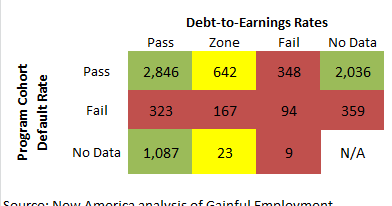
To get a better sense of why programs ended up in each category, the table below shows the number of programs by its performance on the program cohort default rates and debt-to-earnings rates, including whether they did not have any data on that metric.

As the table shows, very few programs end up failing both measures. This follows some of the logic laid out by the Department in the preamble to the regulation, which stressed the goal of pursuing complementary accountability measures. As we saw in the December version of the regulation as well, more programs fail because of the program cohort default rate alone (849) than the debt-to-earnings rates alone (357).
The vast majority of failing programs are located at for-profit institutions. Of the 1,300 failing programs, 1,218 or 94 percent are at private for-profit institutions versus 53 (4 percent) at public colleges. Similarly, all but five of the 665 programs in the zone are at private for-profit colleges. By contrast, 70 percent of the 5,969 passing programs are at for-profit institutions versus 24 percent at public colleges. Because they have so many more failing programs, the percentage of programs at private for-profit colleges that pass the measures is lower than other sectors, as the table below shows.
If you’re looking for programs to avoid based upon gainful employment data, then you’d best shy away from medical assisting. Of the 558 programs in that category, 118 failed at least one of the measures, while another 76 ended up in the zone. Cosmetology also did not fare all that well, with 79 of the 671 programs failing and another 115 ending up in the zone.
This morning’s data release is also the first time we’ve seen the names of institutions attached to programs since the first release of draft rates back in 2012. This makes it possible to better pinpoint exactly where the failures are. So without further ado, here are some notable results:
Former Higher Education Research Director, Education Policy Program