How the Senate Stimulus Drama Affects Early Education

Over the weekend, a group of Senators looking to forge compromise on the stimulus bill put together an amended version that would would significantly cut funding for education programs, relative to both the House-passed stimulus bill and the committee-passed version of the Senate stimulus bill. Here’s a run-down of funding for key early education programs in the House, Senate committee, and proposed Senate compromise versions of the bill:
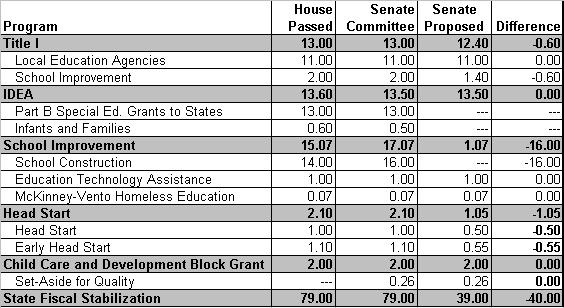
If accepted, the amended Senate version would cut education spending in the stimulus package by more than $60 billion, including significant reductions in the amount of funding provided for early education programs. Specifically, it cuts funding for Head Start and Early Head Start by over $1 billion, and it completely eliminates funding for school construction and renovation–which states and local school districts desperately need in order to expand access to high-quality early education programs.
But most troubling for early education supporters should be the large reduction in funding for state fiscal stabilization. Cash-strapped states, facing budget shortfalls, are desperately seeking spending cuts to bring their budgets back in balance. And increasingly, early education programs are on the chopping block. Just last week, we wrote about proposals in California to slash funding for the state’s First 5 Commission. Officials in Arizona, which already cut funding for the Early Childhood Block Grant program, are moving to transfer dedicated funding from the state’s First Things First early childhood program to the general fund in order to staunch budget shortfalls. And those are just a few examples. These cuts threaten not only to undo states’ progress in expanding access to quality early education programs, but also to dismantle crucial infrastructure that will be necessary to build these programs back up as the fiscal situation improves.
Federal stimulus funds can help plug the hole in state budgets, preventing early education cuts. But reducing the amount of fiscal stabilization funding, as the Senate proposal would do, means that early education programs will remain in peril. Our Ed Money Watch colleagues have a further breakdown of the state fiscal stabilization funds here.
On the plus side, the proposed Senate compromise plan does maintain language, from the committee bill, that sets aside 15 percent of new Title I and IDEA funds in the bill for preschool-aged students–an important increase in funding for early education that also sends a clear message about the importance of linking early childhood and K-12 education programs.
The Senate is scheduled to vote on the compromise tomorrow. We’ll be keeping track of developments as they emerge this week. After the Senate passes its version of the bill, then both House and Senate bills will go to conference committee, where House Democrats are expected to fight to restore funding levels cut in the Senate version. While we hope that a number of provisions in the House bill prevail over their likely counterparts in the Senate version, conferees should ensure that the final bill includes the Senate’s 15 percent set aside of Title I and IDEA funds for preschool programs.
More About the Authors
Issues
Programs/Projects/Initiatives
Related
Confronting Harmful Federal Disability Policy in Health and Human Services
Federal Early Education Update: March 2026
A Bureaucratic Shakeup Threatens Future Child Care Research