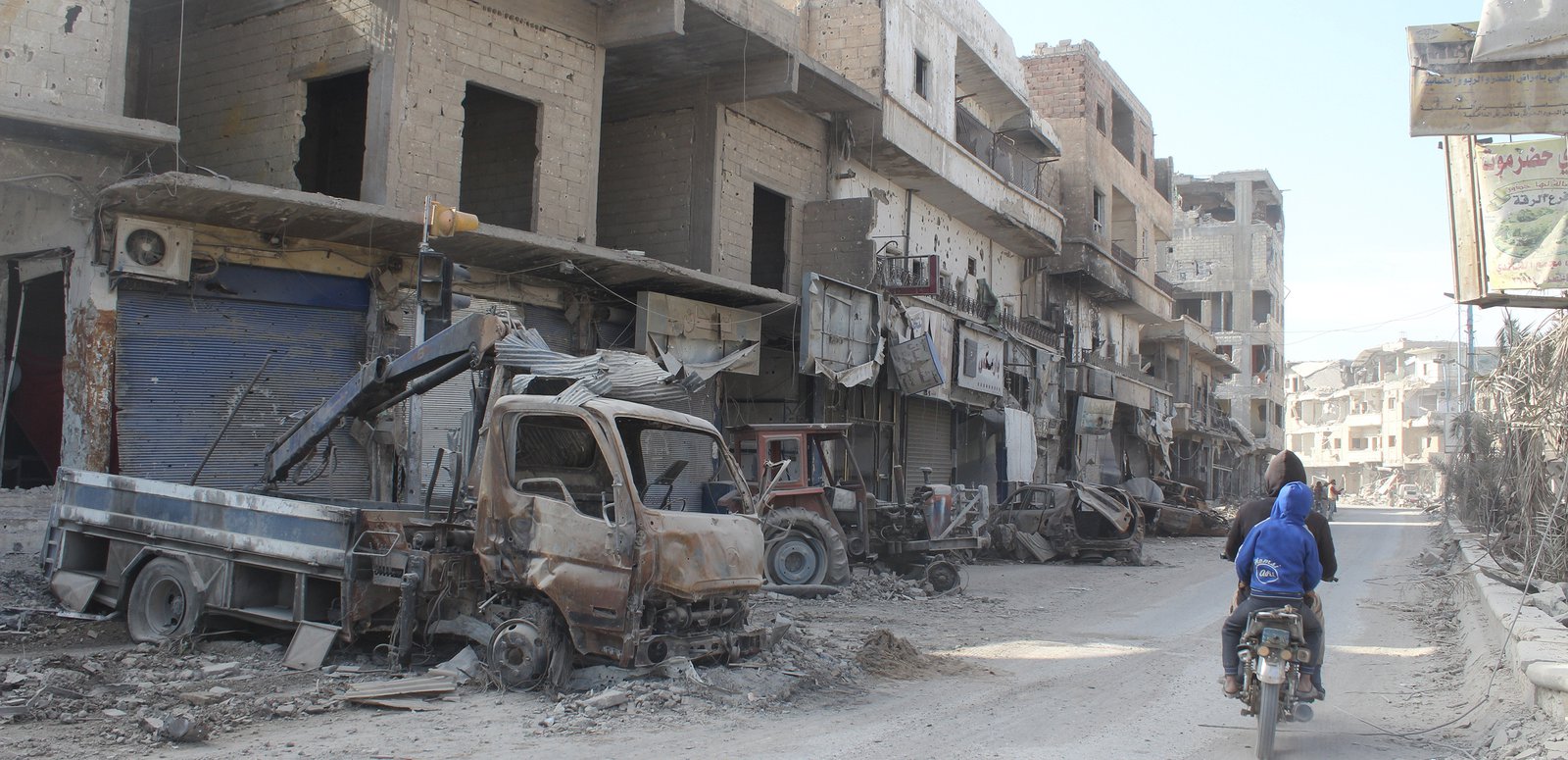
Revolutionary Rule in Raqqa (March 2013-November 2013)
For a time, Raqqa represented all that was exhilarating about Syria’s revolution: governance in the city was so democratic that no one appeared to be the leader. The revolutionary environment—typical of newly liberated cities in civil war1—meant that anyone could, and initially did, have a say. But the same characteristics that gave the movement so much democratic promise also contained the seeds of its demise: since everyone was in charge, no one was. The range of actors with different social bases, ties to transnational social movements, and external patrons posed deep challenges as local groups grappled with the act of governing. Everyone wanted to make the first liberated provincial capital in Syria a model for the rest of the country, but neither those in Raqqa nor those who supported them from afar were able to work together to make this a reality. The consequences of that failure would be devastating.
Raqqa: A “Test Lab for the Revolution”
The spontaneity and democratic spirit that so excited Syrians who had previously lived under a totalitarian government, with its reliance on rigid control and brutal repression, inspired many to risk their lives to protest Assad. The mood in Raqqa at the time was optimistic, as was evident in discussions with locals: “We didn’t fight and protest Assad to then have these fanatics,” explained a secular activist, already aware of religious hardline militias. He continued, “one thing that keeps us activists hopeful is our society. Although Raqqa is a tribal area, people are open and tolerant. Even those who are a bit conservative, are very open-minded compared to Jabhat al-Nusrah or ISIS. So, our society will resist [their] imposed regime.”2
The militants who seized Raqqa seemed astounded at the speed of their own success. While they may have had some plans to capture the city, it did not appear that they had plans to govern it. Residents exhibited a certain “learned helplessness,” evident also in other places where people habituated by long exposure to authoritarian government expected the regime to decide the smallest issues, and where showing individual initiative had for decades been a great way to get killed. This meant that, even if they had been prepared, local civil society leaders often lacked the necessary management knowledge and experience to run the city.
The result was chaos. Each of the various factions (described below) that had been involved in the city’s capture fought the others for control of parts of Raqqa while the Syrian government launched punitive airstrikes on the city. “Security is controlled by [armed] battalions. Each battalion has its own policy,” explained one resident, reflecting comments that were common at the time. “There is no policing system,” explained another, and a third rated security conditions as extremely bad, simply saying, “There are so many armed battalions!”3
Alongside maintaining control, the factions quickly learned that procuring basic goods and delivering crucial services were as important as military aspects of the conflict. For a while, the thrill of liberation papered over perceptions of insecurity and the lack of reliable services. In interviews during this time, there was a common, positive attitude of making do with what was available. “They evaluate the essential needs and try to secure them based on priorities and available resources,” explained one resident of the local governing council in May 2013. But communities can only tolerate chaos and uncertainty for so long.
For a while, the thrill of liberation papered over perceptions of insecurity and the lack of reliable services.
Militants from Ahrar al-Sham became the de facto leaders of Raqqa after it was liberated because they were the largest, best-organized, and most powerful armed group in the city. When Raqqa first fell in March 2013, Ahrar al-Sham fighters captured the central bank, the post office, and municipal offices that held personal information about local residents. This gave them an enormous advantage as governors of the city. But Ahrar al-Sham, like SARG before it, was over-stretched. “They were foreigners to Raqqa,” explained Mutasem Syoufi, executive director of the civil society group The Day After. Many “were from Hama and Idlib. I think Ahrar al-Sham saw [the fall of Raqqa] as an opportunity to be the strongest group in the area and they took it.”4
While Ahrar al-Sham played a key role in capturing Raqqa, they were neither prepared nor necessarily interested in governing. “They came, they took the money, and they promised to give it to the city; and they did not,” explained Syoufi.5 Ahrar al-Sham fighters generally stayed at their headquarters and did not come out to engage the population. For a while, they gave a weekly allowance to the local council to provide basic services in the city, but these funds were widely viewed as inadequate.6 Abdalaziz Alhamza, a Raqqa activist and founder of the group Raqqa is Being Slaughtered Silently, noted that AS mostly kept the money and assets it seized for itself, transferring them back to its base of operations in the Idlib and Hama provinces of northwestern Syria.7
In some ways, Ahrar al-Sham adopted a strategy of control not entirely dissimilar from Assad’s: making payments to local tribes in exchange for loyalty—the very strategy that had failed in the lead up to the city’s takeover. Aside from their Shari’a courts, Ahrar al-Sham’s main service was escorting aid deliveries to Raqqa. As one member of the local council explained, “As the Raqqa Local Council (LC), we are always escorted by members of Ahrar al-Sham when we try to get aid from the Turkish border crossing at Tal Abyad. When other armed groups see an Ahrar al-Sham flag on the car, they wouldn’t attack us.”8
But residents expected more from Ahrar al-Sham. They wanted effective administration of the city and economic support. And when ISIS started kidnapping prominent civilian activists, the ineffectual response of Ahrar al-Sham’s fighters engendered tremendous resentment among Raqqawis. All expected the group to protect them. By failing to keep the population safe, in effect Ahrar al-Sham failed to deliver the only service it had ever really provided, and its credibility suffered accordingly. As explained by Stathis Kalyvas in On the Logic of Violence in Civil War, and as observed directly by the authors in other war zones, popular collaboration with any particular group in Raqqa rested on that group’s ability to deliver safety and predictability for the population via control of territory.9 Political support followed effective presence, rather than vice versa—something that became increasingly evident as Ahrar al-Sham’s control, always halfhearted, eventually collapsed under pressure from ISIS.
Civil Society Mobilization in Raqqa’s “Test Lab of Revolution”
Raqqa presented a tremendous opportunity for Syrians to demonstrate that they could shape their post-Assad future. The revolutionary movement may have appeared weak in Raqqa before its capture—evidenced by the lack of protests during the Syrian revolution’s first two years. But its activists were “some of the most active and creative” in Syria’s revolutionary movement, according to Assad al-Achi, executive director for a nationwide organization that helped coordinate civil society. After Raqqa was captured by opposition forces, dozens of civil society organizations were established, including youth movements, aid delivery organizations, and a variety of local coordination groups that tried to ensure that basic services were available. Still, Raqqa’s activists were “completely unprepared for this liberation,” according to al-Achi. In fact, the loss of the regime’s control of the city revealed the groups’ lack of coordination and common mission; al-Achi explained that “their liberation gave them the first chance to realize how diverse they were.”10
But regional and international factionalism and poor planning undermined unity of purpose among political groups working in Raqqa. Syria was not only a battleground between those trying to protect or depose the government, it was also a place where regional powers fought wars that would be too costly to wage on their own soil. Saudi Arabia and Iran fought a war in Syria—with Iran supporting the government and Saudi Arabia seeking to depose it in favor of giving rule to the country’s opposition, which was mostly based in Syria’s Sunni Muslim majority. But within this Sunni Muslim community, there was a perhaps equally bitter ideological struggle fought between religious nationalists, mostly supported by Saudi Arabia and the United Arab Emirates, and those who supported the Muslim Brotherhood’s brand of political Islam—mainly Turkey and Qatar.11 These competing interests, along with others, waged war against each other on Syrian soil. But while their attention was focused on a chain of Syrian cities from Damascus in the south to Aleppo in the north, they ignored Raqqa’s place within these conflicts.
Within Syrian opposition groups, none faced a more important test than the Syrian National Coalition (the “Etilaf”). The Etilaf, founded in November 2012 in Doha, Qatar, was a grand Syrian opposition government-in-exile. At the time, it appeared that the Saudi and Qatari governments—both among the Etilaf’s key patrons—had reconciled their differences when the Etilaf formed. But other events in the region, particularly the July 2013 ouster of Egypt’s Muslim Brotherhood President Mohammed Morsi, who had been brought to power in the wake of the Arab Spring protests, would quickly reopen divisions and contribute to disunity in the Etilaf.12
Meanwhile, the United States was unprepared for how Syria’s uprising unfolded. American diplomats lacked the necessary leverage or support from the Obama administration, which remained wary of involvement in Syria, to influence regional actors to make compromises in the name of unifying the Syrian opposition.13 This was a product of the Obama administration’s attempt to learn the lessons of the Iraq war and not intervene in complicated Middle Eastern conflicts.14 As a result, neither the Etilaf nor its backers could unify in a meaningful way.
This became critical in the contest for control of Raqqa. As soon as the city was liberated, the Etilaf came under immediate pressure to show that it was a government and not just an advocacy group. Mutasem Syoufi, who worked for the Etilaf at the time, lobbied its leaders to establish an official branch in Raqqa to help residents develop a viable government. “Raqqa was the test lab for the whole revolution,” Syoufi explained. “It was the first capital that was liberated from the regime. It was not highly populated…there were high hopes for the [Etilaf] at the time.”15 Syoufi decided to go to Raqqa just after it was liberated on an impromptu fact-finding mission.
When Syoufi arrived in Raqqa, he found utter chaos. “People looked at me and asked me what they should do,” he explained. “I told them to establish a representative committee—a ‘provincial congress’—of 1,000 people that would then elect a provincial council to help get life back on track.” Syoufi promised to support this council with connections to the Etilaf and donors. He returned to Turkey to report on his findings.
At the same time, even though the Etilaf was widely seen as a successful reconciliation effort bringing together diverse elements in Syria’s opposition, its flaws were apparent mere months into its existence. Its first president was Moaz al-Khatib, the former imam of Damascus’ 1,300-year-old Ummayad mosque. Khatib was inspiring but not diplomatic, and he struggled to build consensus in an organization that, at the time, was better described as a loose collection of individuals with foreign backers rather than an institutionalized opposition.16 For example, Khatib did not want the Etilaf’s leadership to accept a salary for fear of the political consequences of their receiving foreign government support. Despite Khatib’s opposition, members of the Etilaf did accept salaries from the foreign governments who supported them.17 This meant that they rarely worked together, but instead pursued different (sponsor-influenced) agendas while nominally maintaining the same institutional affiliation.
Syoufi met with Khatib after he returned from Raqqa and set up a meeting between Khatib and local organizers from Raqqa in April 2013. “They told him to visit,” Syoufi explained of the meeting. But Khatib never went to Raqqa and never gave Syoufi an explanation for his decision. Khatib kept his own counsel and rarely shared his reasons for making one decision or another, which alienated potential supporters.18 Qutaiba Idlbi, a volunteer member of Khatib’s staff, did not disagree with this characterization of Khatib as a leader. But he emphasized that the Etilaf could not have had much influence on Raqqa even if Khatib wanted it to do more work there. “There was no institution to support him,” he said. “[The members of the Etilaf] wanted him to be the face of the Etilaf but with no authority. The first four months of the Etilaf was basically a fight for who would control it.”19
Syoufi suggested that Khatib and the Etilaf decided against establishing a headquarters in Raqqa because “their focus was on a different place—the politics of the Etilaf and on other parts of Syria. There was a dismissal of Raqqa as an important place in Syria; they wanted to know what was going on in Aleppo or Damascus instead.”20 Idlbi, a member of Khatib’s staff, agreed. “The opposition mostly came from metropolitan cities,” he explained. “The way they understand politics is that the only two important cities in Syria are Aleppo and Damascus and that’s it.” Raqqa was a poor and largely ignored region, and it received little attention from the Syrian opposition leadership.21 This would expose the fundamental flaws that crippled the Etilaf: its internal political divisions, exacerbated by foreign donors, and its inability to form connections inside the country.
The flaws and internal struggles of Syria’s opposition were embodied in its representative for Raqqa.
In its parliamentary-style governing body, the Etilaf designated one seat for each of Syria’s 14 main regions. Individuals were appointed as representatives for each province, serving as the Etilaf’s liaison with local communities. The flaws and internal struggles of Syria’s opposition were embodied in its representative for Raqqa, a man named Mustafa Ali al-Nawaf.22 Nawaf was born in Turaif, a Saudi town on the Jordanian border. While nominally representing Raqqa in the Etilaf, Nawaf spent little time there. At the outbreak of the revolution, reports suggested he hadn’t visited the town for about 15 years.23 Nawaf did not know many people in Raqqa and had little understanding of the city’s political terrain. And, like many Syrians who grew up in Saudi Arabia, he was considered close to the Muslim Brotherhood faction of the opposition—led by Mustafa Sabbagh, Etilaf’s secretary-general at the time. This not only made him disconnected from events in Raqqa, but also brought suspicion that he was using Etilaf resources to purchase support from specific individuals in Raqqa on behalf of the Syrian Muslim Brotherhood. As a result, in the first few months after March 2013, Raqqawis demanded that al-Nawaf be replaced with someone who knew their city better and could help them. The Etilaf refused.24
By the end of April 2013, militants controlled Raqqa’s administrative buildings. But they did little to help manage the city’s affairs. In turn, dozens of local community organizations were formed to provide services, but they lacked leadership. Raqqawis struggled to build a functioning municipality in the absence of clarity as to who was in charge. As one resident summarized at the time, “The problem is that the local council is very polarized. They have been divided over minor differences…this is one problem of many. The local council can’t confront ISIS, JAN, or other Islamist armed groups; therefore, it tries to compromise with them. I don’t know whether that’s a good thing.”25
Raqqa Starts Working Again
While various external actors—not only the Etilaf, but also regional and international governments and networks of wealthy donors—sought to influence or control Raqqa from the outside, so-called Local Councils emerged from the bottom up. These self-organized groups quickly emerged in many liberated areas, forming the backbone of a structure of municipal governance in towns captured from the SARG across Syria. On the whole, the councils were locally representative and responsible for coordinating and managing assistance and service provision in their communities. The councils were, as the name suggests, local responses—akin to a self-help initiative for governance—to specific municipal problems. As such, they tended to work best in small-scale situations. Because they lacked broad representative structures or administrative reach, they were unable to address the needs of large cities. Furthermore, local councils lacked a unifying umbrella structure that would have enabled them to work together to form a larger governance network. This was partly due to the complexity of the coordination involved, as well as to a failure on the part of the Etilaf to provide top-down support for these spontaneously-formed, bottom-up institutions, which some Etilaf members saw as rivals.
In the absence of clear leadership, the community created two distinct councils. One formed around a lawyer named Abdullah Khalil, who led the Etilaf’s council. Meanwhile, a group of activists elected by their peers formed another council modeled on other local councils in opposition-held Syria. After some early disputes, the two groups joined together several months later to form a single council to manage the affairs of the entire province of Raqqa.26 Under pressure, the activists agreed that the Etilaf’s council would govern the Raqqa Province under Khalil. This gave the Etilaf a critical inroad to build ties to Raqqa activists.27
Because there were so many armed groups in Raqqa, and especially so many armed groups with fighters from outside the area, lawlessness and inconsistent policing were frequent concerns for residents, according to interviews we conducted at the time.28 This was where Khalil was indispensable, since he had good relationships with local armed groups as well as with the political opposition abroad.
Because there were so many armed groups in Raqqa…lawlessness and inconsistent policing were frequent concerns for residents.
In a broader, proxy warfare sense, it seems that intermediaries, or brokers, of this kind—individuals with strong connections both to local groups and external sponsors—are both critical players and are likely to rise to personal prominence. In Khalil’s case, his overseas connections and working relationship with JAN and Ahrar al-Sham were critical. Even though JAN and Ahrar al-Sham were beginning to establish a court system of their own, Khalil was able to balance municipal responsibilities with his relationship to these militant groups because he was universally well-liked and respected. A lawyer who had defended opponents of the Syrian government before the 2011 uprising, Khalil had been a vigorous supporter of the revolution and had been arrested several times before Raqqa was liberated.29
Meanwhile, the militant groups in Raqqa maintained an uneasy peace. Ahrar al-Sham’s forces were ensconced in the city’s main administrative buildings until the summer of 2013, while the FSA had headquarters locations dotted throughout the city. The main Salafist militant group, JAN, was based on the outskirts of the city and did not interrupt the work of the local council or impose its strict interpretation of Islamic law on residents.
Despite (or perhaps because of) its tendency to emphasize persuasion rather than coercion at this time, JAN made the most substantial inroads into Raqqa’s society. Rania Abouzeid, a journalist reporting from the city at the time, covered JAN’s political outreach to other militant factions in the city. She recounted how JAN instigated, for a time, a “battle of flags,” replacing the green Syrian revolutionary flag in the city’s main square with its own black flag with white letters depicting the shahada.30 JAN also penetrated Raqqa’s society in a more significant way: by recruiting Raqqa’s native sons via Islamist ties and the network of cross-border tribal connections that links eastern Syria with western Iraq. According to Hassan Hassan, an expert on ISIS from eastern Syria, around 35 of the most notable members of JAN came from rural Raqqa. These members of JAN were recruited by their relatives in Iraq through the active, extended kinship networks that are common in tribal societies.31 This process took months, and during this time JAN—in Raqqa, as elsewhere—generally avoided confrontation. The group also accepted thousands of defectors from FSA groups across Syria.32
Meanwhile, the foreign-backed Supreme Military Council, a body once envisioned as the “defense ministry” of the Etilaf, failed to receive substantive international support, in part because its patrons were divided—in the Saudi-Qatari split noted earlier, and in regional competition between Arab powers and Turkey—and in part because of a lack of energetic engagement by the United States, one of the few actors that could have initially mustered the leverage to unify them.
Still, despite building strong links into Raqqa, JAN did not appear to want to enforce its rule over the city’s residents. Protests against JAN’s activities went unpunished.33 And, during this time, “Nusrah never stopped the local council from working or imposed their order” explained Syoufi. “My conclusion [at the time] was that they didn’t have a project to govern Raqqa either.”34
Raqqa Falls Apart
One month after Raqqa was liberated, Abu Bakr al-Baghdadi released an audio statement announcing that JAN would be folded into a new creation called the Islamic State of Iraq and al-Sham (ISIS). Baghdadi, who had headed both groups’ forerunner in Iraq, the Islamic State of Iraq (ISI), claimed authority to issue the declaration, but quickly clashed with Al Qaeda core leadership. Ayman al-Zawahiri opposed the announcement, as did JAN leader Abu Mohammed al-Jolani, a Syrian who himself had served as a regional leader of ISI, responsible for Iraq’s Nineveh province. For the first few months, this dispute made little difference to the fighters and residents of Raqqa: people seemed to see ISIS and JAN as interchangeable.35 Even the internal documents of ISIS did not appear to draw an important distinction.36 But by July, a clear break in the leadership appeared: Mohammed Saeed al-Abdullah (“Abu Sa’ad al-Hadrami”), JAN governor in Raqqa, opposed ISIS’ manipulations and detentions of other armed groups. The former blacksmith from Raqqa reaffirmed his support for JAN as a separate entity from ISIS.37 Hadrami, with his supporters, fled to a town outside of Raqqa, where they would form the last resistance to ISIS’ control of the region.38 But on September 12, 2013, al-Hadrami was kidnapped and found murdered—his body was recovered 150 kilometers outside Raqqa—and the JAN resistance soon dispersed.39
Meanwhile, the majority of fighters who had originally pledged allegiance to JAN remained part of the newly formed ISIS under Ali Moussa al-Shawakh (“Abu Luqman”), the JAN deputy governor for Raqqa. Abu Luqman, formerly in the business of smuggling jihadists to fight Americans in Iraq,40 and one of hundreds of suspected jihadists released by the Assad government in 2011, was a member of one of the four largest clans in Raqqa. His local prominence, combined with committed recruits from anti-Kurdish and Islamist elements of allied tribes, gave ISIS deep tribal ties in Raqqa. Luqman, who personally killed his former boss al-Hadrami as a testament to his loyalty to ISIS, therefore performed a similar intermediary role—connecting external sponsors with local groups—as noted earlier for Khalil. Luqman would become crucial for ISIS in Raqqa, including serving as its governor there. His current whereabouts are unknown.41
By the summer of 2013, ISIS had absorbed most of JAN and was growing increasingly brazen in confronting and regularly detaining militia commanders and civil society activists, with local ISIS commanders either acting on their own initiative or through a so-called legal “process,” established by the Shari’a courts they created. These detentions resulted in clashes between ISIS and other militant groups, which finally registered concerns from the FSA’s Supreme Military Council (SMC).42 Although the SMC formed a so-called Eastern Front group to address internecine conflicts in Raqqa, Deir Ez Zour, and al-Hasakeh, few SMC commanders knew Raqqa well.43 “In general, people—moderate Muslims and even some non-ISIS affiliated extremists—are afraid to even talk about what’s happening in Raqqa,” explained J.S., a Christian in Raqqa. He continued, “There were small protests by civil society organizations but what can these guys do? They can’t do anything about a problem [like ISIS].”44
ISIS kidnapped (and almost certainly murdered) many local residents who played critical roles in the delicate peace needed to govern the city. One of the most devastating kidnappings of all was that of Abdullah Khalil, the aforementioned head of the Raqqa Local Council. Khalil was traveling to his home in eastern Raqqa on May 19, 2013, when five armed men in a black Kia Rio stopped his car and demanded that he step out. Accusing him of being an Alawite and collaborating with the Syrian regime, the men grabbed Khalil and took him away. The three other men traveling with Khalil either managed to escape or were allowed to flee. This was a turning point, according to al-Achi, as Khalil was “the only respected middle man by everyone.”45
While Khalil’s whereabouts remain unknown and no group has claimed responsibility for his kidnapping, sources indicate the operation was planned and conducted by ISIS.46 In 2017, a Syrian media outlet obtained the notes of ISIS militants who were tracking Khalil in 2013, implicating ISIS in his abduction and likely murder, though the group did not take credit for his disappearance. The notes confirm what many believed at the time: that Khalil was the linchpin of civil society efforts in Raqqa. ISIS saw him as a significant threat; their notes about Khalil were meticulous. Describing him as a “civil society commander,” ISIS militants noted who Khalil met with and where, his office location, the guards stationed there, and what cars were most commonly parked outside. ISIS believed that Khalil had “unlimited” foreign contacts and had advocated for the “absurd idea” of a civil state influenced by Islamic law.47 In effect—while not necessarily putting it in these terms—the militants had recognized Khalil’s critical intermediary role connecting external sponsors with locally credible actors, and they moved to eliminate him as a threat.
A separate set of leaked documents, first recovered by Christoph Reuter in the Syrian town of Tel Rifaat and described in an article for the German publication Der Spiegel in 2015, offered proof that Khalil’s kidnapping was not unique to Raqqa. Rather, it formed part of a general ISIS strategy of assassinating influential local leaders to capture and govern towns and cities everywhere.48 These efforts appear linked to an ISIS strategy for infiltrating and capturing new territory. The strategy was developed by an Iraqi who went by the nom de guerre Haji Bakr, and whose given name is Samir Abd Muhammad al-Khlifawi. Haji Bakr was a colonel in Iraqi intelligence under Saddam Hussein, a regime that invested enormous resources over decades in linking detailed surveillance with brutal acts of repression. He lost his position due to the 2003 de-Ba’athification law imposed by the Coalition Provisional Authority in the early days of the American-led occupation of Iraq and was jailed together with some of those who later became senior planners of ISIS in Camp Bucca. After his release in 2008, Bakr gained enough influence in the group to help Abu Bakr al-Baghdadi become the next leader of the Islamic State of Iraq, ISIS’ forerunner, after the group’s previous leaders were killed in a raid in 2010.49
Bakr, according to the files reported by Reuter, not only developed an organizational chart for the entire ISIS state, but also made careful plans for seizing new territory with as little actual violence as possible. The newly announced ISIS, formed just as Raqqa was liberated, would expose the fault-lines within Syria’s opposition and enact Bakr’s plan in Raqqa to devastating effect.
The newly announced ISIS, formed just as Raqqa was liberated, would expose the fault-lines within Syria’s opposition.
The first step in Bakr’s plan was to establish a Da’wah office—an Islamic outreach center. Centers of this type appeared innocuous and ubiquitous and therefore drew little scrutiny. Of those who attended the center’s initial lectures on religious life, several were recruited to serve as the group’s spies. They would be asked to “list the powerful families and the powerful individuals in those families, find out their sources of income, name the powerful rebel groups in the area and who controls them, find out their illegal activities (according to Shari’a law), which could be used to blackmail them if necessary.”50 Using this information, ISIS then designed a strategy to penetrate the power structure of any village. ISIS also arrested and detained rival militants and local notables on trumped-up charges, bribing those for whom ISIS found incriminating evidence, and kidnapping and murdering the others. And, to cement its connections to local social networks, ISIS arranged marriages between its fighters and the daughters of influential households.
This is precisely the strategy that ISIS used to capture Raqqa. And, from that city, the group systematically implemented the same practices throughout the country. “ISIS has large operation rooms inside Syria,” explained a local source in October 2013. “They are mainly located in Raqqa. They are linked to high profile figures in Iraq. These guys are well organized. They have a comprehensive structure of how their future Islamic state would be. They don’t act based on reactions, because they have well-prepared plans.”51
As Reuter’s notes on Bakr’s strategy indicate, and as confirmed by our fieldwork, ISIS cells commonly killed opponents when they were unable to control them through bribes, threats, or blackmail.52 They would especially target activists working in media, according to Abdalaziz Alhamza, offering them money, equipment, cameras, and other opportunities.53 If their targets were popular, ISIS sought to co-opt their base of support. And, where this was impossible, the group kidnaped and killed both leaders and supporters, as in the case of Abdullah Khalil.
In Raqqa, ISIS’ strategy was both devastating and effective. By assassinating Khalil and other local leaders, the militants quickly dismantled a delicate peace that had just begun to work. Through brutal use of strategic violence to target and silence opponents and the intricate work of mapping the key individuals and networks—including the civil society networks — involved in efforts to control Raqqa, ISIS successfully disrupted the city’s emerging system of governance. In the absence of unified and powerful leadership among its opponents, ISIS achieved first-mover advantage in a social and political context of chaos and uncertainty.
One of the last armed groups to confront ISIS in Raqqa was a militia known as Ahfad al-Rasul. On the night of August 13, 2013, an ISIS suicide bomber detonated a car full of explosives at the Ahfad al-Rasul headquarters, killing the group’s commander and at least five other fighters.54 This attack was significant for two reasons. First, it was ISIS’ first suicide bombing against another rebel group in Syria.55 Second, it killed key members of the only remaining group with ties to the SMC, the Free Syrian Army’s military council discussed earlier.56 ISIS then arrested survivors of the attack. In response, the group’s remaining fighters joined JAN. As an FSA-affiliated rebel commander stated at the time, “half of the FSA has been devoured by ISIS and the other half joined JAN.”57 On September 15, 2013 ISIS forced all remaining FSA fighters out of Raqqa and placed placards at every entrance to the city welcoming outsiders to the “Islamic State of Iraq and al-Sham: Raqqa Province.”58
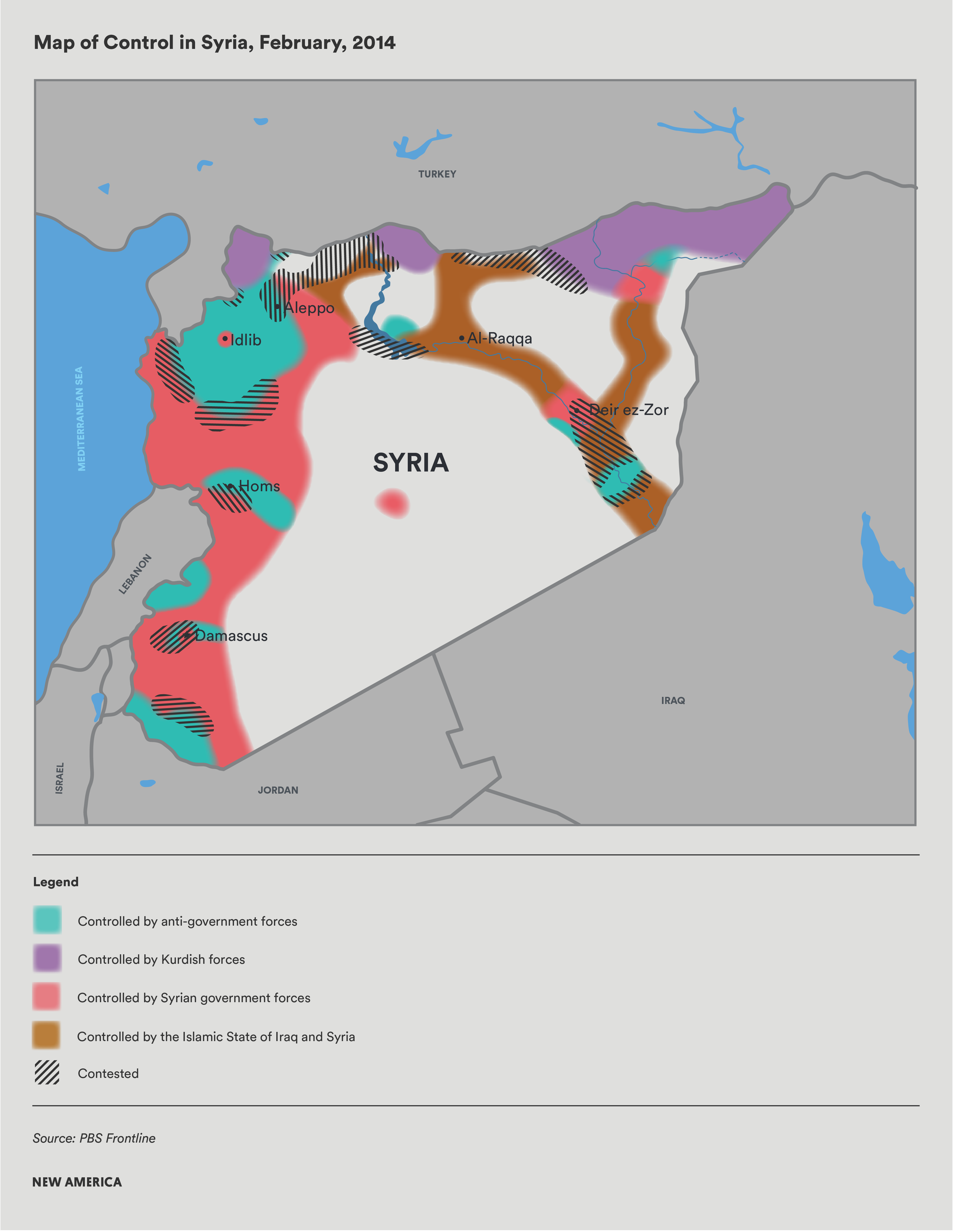
At this point, it may be useful to ask why Raqqa became the launchpad for ISIS. ISIS took the city when it seemed that every armed group was taking Raqqa for granted. The Syrian regime believed the city would remain loyal, but did not expend the military resources necessary to protect it. Once liberated, Raqqa was also not a focus for the national Syrian opposition, who in 2013 were more interested in Damascus and Aleppo. Meanwhile, JAN had scouted and built strong links to Raqqa’s tribes, but had not committed its own senior leadership to that place. When Abu Bakr al-Baghdadi sent a deputy to test JAN’s loyalty in 2013, he found that JAN’s leader, Abu Mohammed al-Jolani, was in Idlib and his deputy, Abu Maria al-Qahtani, was in Deir Ezzor. That meant JAN had assets in Raqqa that were well developed but were not being overseen by a senior leader. While the extent to which ISIS leadership recognized this gap and deliberately exploited it is a matter of speculation, but what is clear is that Raqqa was a major city left unclaimed by other militias (JAN, Ahrar al-Sham, SARG, or FSA) who were more interested in larger prizes.
By November 2013, it was clear that ISIS controlled the city. To celebrate, the group convened a meeting of local notables and chiefs from the fourteen largest clans in the area. The elders duly pledged allegiance to ISIS in exchange for payment, just as they had done for Assad almost exactly two years earlier.59
Citations
- See, for example, George Orwell’s description of Barcelona immediately after its fall to the revolutionary forces during the Spanish Civil War. George Orwell, Adam Hochschild, and Lionel Trilling, Homage to Catalonia, First Mariner Books edition (Boston: Mariner Books/Houghton Mifflin Harcourt, 2015): 546-547.
- Caerus interview with M.J., September 23, 2013.
- Caerus conducted 53 semi-structured interviews with residents in Raqqa in April and May, 2013. Those interviews inform this assessment.
- Author’s interview with Mutasem Syoufi, January 11, 2019.
- Ibid.
- Caerus interview with T.H.O., September 23, 2013.
- Author’s email exchange with Abdalaziz Alhamza, June 29, 2019.
- Caerus interview with M.M., November 1, 2013.
- Stathis N. Kalyvas, The Logic of Violence in Civil War, Reprinted, Cambridge Studies in Comparative Politics (Cambridge: Cambridge Univ. Press, 2009): 12-13.
- Author’s interview with Assaad al-Achi, January 10, 2019.
- There are many accounts of the ideological war between those governments in the region who supported Muslim Brotherhood factions in Syria and those who opposed them during the first four years of the war (2011-2015 ). One of the first was by Hassan Hassan, “How the Muslim Brotherhood Hijacked Syria’s Revolution,” Foreign Policy, March 3, 2013, source; also see a later summary of the effects of this ideological war on the Syrian uprising during this year by Raphael Lefevre, “Saudi Arabia and the Syrian Brotherhood,” Middle East Institute, September 27, 2013, source.
- Qatar and Turkey support Muslim Brotherhood-backed groups across the region. Saudi Arabia and the United Arab Emirates oppose these groups, fearing they could form the basis of an organized internal challenge. This division forms the basis of an ongoing region-wide dispute. In Syria, that wider regional dispute divided these groups, with Kuwait, Bahrain, and others in the region supporting nationalist and Islamist opposition groups as well.
- President Barack Obama, who promised not to intervene in other countries’ affairs during his 2009 Cairo speech, called the Libya intervention “the worst decision” of his presidency. Jeffrey Goldberg, “The Obama Doctrine,” The Atlantic, April 2016, source. His administration was not about to get seriously involved in Syria—and the countries of the Middle East knew that.
- Dorothy Wickenden, “Ben Rhodes Talks To David Remnick About America’s Role in Syria,” The New Yorker, October 31, 2016, source.
- Author’s interview with Mutasem Syoufi, January 11, 2019
- Author’s interview with Qutaiba Idlbi, May 23, 2019
- Ibid.
- Author’s interview with Mutasem Syoufi, January 11, 2019
- Author’s interview with Qutaiba Idlbi, May 23, 2019
- Author’s interview with Mutasem Syoufi, January 11, 2019.
- Author’s email exchange with Abdalaziz Alhamza, June 29, 2019.
- The Etilaf’s political structure set aside one seat for each of Syria’s fourteen governorates. “Official Page for Mustafa Ali Nawaf,” The National Coalition for the Syrian Revolution and Opposition, Retrieved from: source
- Caerus eye-witness notes on conditions in Raqqa Local Councils, April 19, 2013.
- Author’s interview with Mutasem Syoufi, January 11, 2019.
- Caerus interview with M.J., September 23, 2013.
- Caerus eye-witness reporting, April 19, 2013.
- Meanwhile, the activists in Raqqa would retain their grassroots organization led by long-time opposition activist Nabil Fawaz, who had been in prison under former president, Hafez al-Assad, for 15 years. That council would continue to manage issues in the city of Raqqa. “Raqqa’s social, political, and administrative transformations are coming (Ar.),” Ayn al-Medina, March 5, 2017, source.
- Caerus interviewed 53 residents of Raqqa in April and May 2013. These interviews lasted 1-1.5 hours and interviewees were asked questions regarding perceptions of safety, aid requirements, and local assessments of the municipal services they were receiving from the local council.
- “Urgent Action: Fears for Syrian Human Rights Lawyer,” (Amnesty International, March 22, 2012), source.
- The shahada is the Muslim profession of faith (“There is no God but God”) that has been coopted by Al Qaeda and is generally set in white letters over a black background. For reporting on the so-called battle of flags, see: Rania Abouzeid, “A Black Flag in Raqqa,” The New Yorker, April 2, 2013, source.
- Hassan Hassan, “The Battle for Raqqa and the Challenges after Liberation,” CTC Sentinel 10, no. 6 (July 2017), source.
- Mona Mahmood and Ian Black, “Free Syrian Army Rebels Defect to Islamist Group Jabhat Al-Nusra,” The Guardian, May 8, 2013, source.
- As Aymenn al-Tamimi writes of the time: “operation and accommodation rather than mutual hostility remain the norm at demonstrations.” Aymenn Jawad Al-Tamimi, “Jabhat Al-Nusrah and the Islamic State of Iraq and Ash-Sham: Raqqah Governorate,” Jihadology (blog), July 4, 2013, source.
- Author’s interview with Mutasem Syoufi, January 11, 2019
- Al-Tamimi, “Jabhat Al-Nusrah and the Islamic State of Iraq and Ash-Sham: Raqqah Governorate.”
- “Raqqa Docs Reveal How ISIS Tracked and Killed Prominent Civil Activist and Lawyer,” Zaman Al-Wasl, January 31, 2017, source.
- Al-Hikar, “Raqqa: Syria’s New Kandahar (Ar.).”
- Aymenn Jawad Al-Tamimi, “The Islamic State of Iraq and Ash-Sham Billboards in Raqqa,” Jihadology (blog), October 22, 2013, source.
- Al-Hikar, “Raqqa: Syria’s New Kandahar (Ar.).”
- Kyle Orton, “Raqqa Doesn’t Want to Be Liberated by the West’s Partners,” Kyle Orton’s Blog, May 30, 2017, source.
- Andrew Tabler, “Eyeing Raqqa: A Tale of Four Tribes” (Washington Institute for Near East Policy, 2017), source.
- Alison Tahmizian Meuse, “In Raqqa, Islamist Rebels Form a New Regime,” Syria Deeply, August 16, 2013, source.
- Author’s interview with Hassan Hassan, February 6, 2019.
- Caerus Interview with J.S., October 2, 2013.
- Author’s interview with Assaad al-Achi, January 10, 2019.
- Interviews by Caerus with members of the Raqqa City media office, May 19, 2013.
- “Raqqa Docs Reveal How ISIS Tracked and Killed Prominent Civil Activist and Lawyer.”
- Christoph Reuter, “Secret Files Reveal the Structure of the Islamic State,” Der Spiegel Online, April 18, 2015, source.
- “The Islamic State of Iraq and Greater Syria: A Primer,” TSG IntelBrief (The Soufan Group, June 13, 2014), source.
- Reuter, “Secret Files Reveal the Structure of the Islamic State.”
- Caerus Interview with J.S., October 2, 2013.
- Reuter, “Secret Files Reveal the Structure of the Islamic State.”
- Author’s email exchange with Abdalaziz Alhamza, June 29, 2019.
- Al-Hikar, “Raqqa: Syria’s New Kandahar (Ar.)”; Meuse, “In Raqqa, Islamist Rebels Form a New Regime.”
- Meuse, “In Raqqa, Islamist Rebels Form a New Regime.”
- Jeffrey White, Andrew J. Tabler, and Aaron Y. Zelin, “Syria’s Military Opposition: How Effective, United, or Extremist,” (Washington Institute for Near East Policy, September 2013), source.
- Meuse, “In Raqqa, Islamist Rebels Form a New Regime.”
- Al-Hikar, “Raqqa: Syria’s New Kandahar (Ar.).”
- Hassan, “The Battle for Raqqa and the Challenges after Liberation.”