Raqqa Today: 2013 Redux?
The situation in Raqqa today dangerously resembles that of 2013, when Raqqa went from opposition rule to ISIS control in a matter of months. Before the city fell to opposition forces, it was largely ignored by the regime, which assumed that Raqqawis would remain loyal and not support the insurgents. When Raqqa came under attack, SARG forces retreated, in effect acknowledging that Raqqa was not as important as bigger cities like Aleppo. Likewise, when the rebels captured Raqqa, they were no more committed to competently serving the local population’s needs than the regime had been. Ahrar al-Sham, the lead militia to capture the city, largely ignored its responsibilities to guarantee local security and help municipal services operate. While it is unclear whether Ahrar al-Sham leaders lacked the capacity or interest to govern, they certainly did not see themselves as responsible for governing Raqqa. The Syrian political opposition also did not put in sufficient effort to govern Raqqa. Like the regime, the Etilaf leadership was more interested in bigger cities like Aleppo and Damascus.
A “Power-Locked” Conflict?
As of mid-2019, the situation in Raqqa may seem to be an incipient (or resurgent) but low-level campaign being carried out by remnants of ISIS against a security force—drawn primarily from the U.S.-backed SDF—that has broad popular support but lacks the numbers, resources, and international support to ensure it can continue to keep the peace. This interpretation has been challenged by some observers, who see the SDF as an occupying force, ethnically and regionally foreign to the population of Raqqa, and lacking the capability or support to achieve long-term stability.1
We believe a more persuasive interpretation is that the conflict in Raqqa is, to draw on a concept from conflict transformation theory, “power-locked,” or temporarily frozen due to a large power imbalance among potential combatants.2 In Raqqa today, disparities of military and political power among parties to the conflict are so pronounced—and so locally skewed in favor of the SDF—that none of the SDF’s rivals are in a position to restart the conflict. This power disparity-induced appearance of calm is very far from the true reconciliation and resolution needed to end the conflict. This means that a shift in the power dynamic—for example, the removal of U.S. forces from Syria or a broader loss of support for the SDF—would likely presage a rapid resumption of conflict as the deterrent effect of SDF's currently dominant position erodes. The al-Na’im tribe, for example, has had an ongoing land dispute with Kurdish communities living nearby. While the Kurdish-dominated SDF currently controls the region, SDF’s military power hardly means that they have resolved this dispute.3 Consequently, should SDF’s ability to control the territory decline before substantive steps to resolve the land dispute occur, we would expect violence in that region to spike promptly.
Without an enduring American-led presence, especially to try to mediate disputes in this region, there is no clear guarantor of security. This is a side-effect of the proxy-actor status of SDF, in that its ability to dominate the region—and hence to pacify unresolved conflicts by deterring rival armed groups—depends more on the actions of its U.S. sponsor than on the proxy group’s inherent actions or capabilities. As a result, according to the former Deputy Head of the Counter-ISIL Coalition, Lieutenant General Terry Wolff, in the event of a change in U.S. posture, ISIS may well return and Raqqa may become a site of a renewed insurgency. Lt. Gen. Wolff explained that ISIS elements remain in Raqqa and that they are likely to compete for control of the population along with tribal leaders, the SARG, Russian forces, mainly Kurdish SDF forces and, possibly, Iranian proxies. All of these sponsors of Syria’s proxy conflict have been buying up tribes in this area, meaning Raqqa will remain unstable for some time.4
A journalist based in Iraq (who for personal safety reasons prefers to remain anonymous) who visited the city in February 2019 corroborated this assessment. “Security was on the tip of everyone’s tongue when we would get out on the street and talk to people,” she explained. “The first thing [people] would say is that the city is not safe.” And, she emphasized, the uncertainty came from robberies, muggings and kidnappings—not airstrikes. People she met were still trying to figure out the logic of violence in their city. When someone was kidnapped, people did not just try to figure out what had happened to them, but also why they had been targeted. “So far, it did not appear to me that people could distinguish between random kidnappings and targeted kidnappings,” she explained. There were, of course, a lot of complaints about the local (SDF) security forces.5
Rebuilding Raqqa
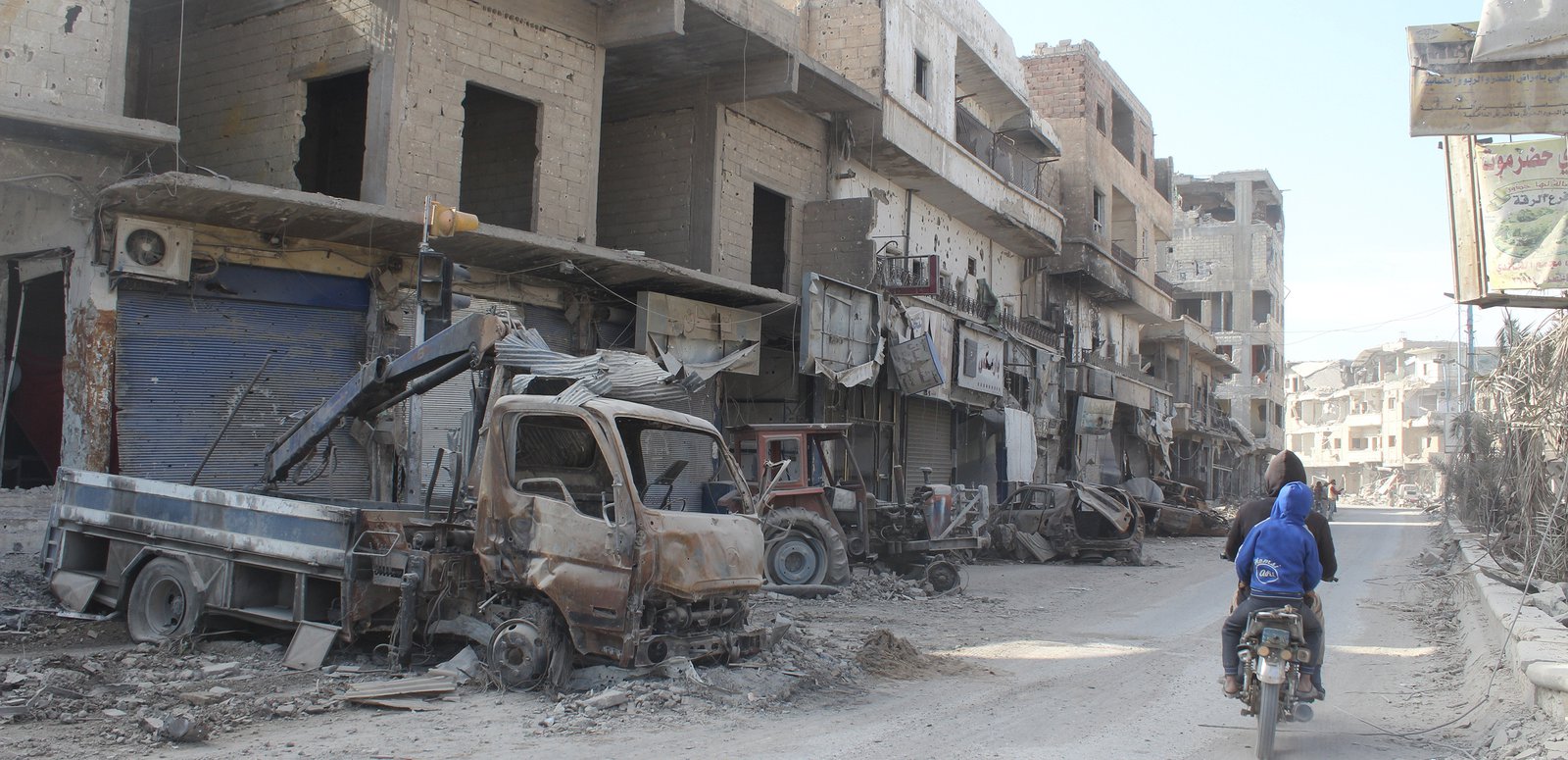
Instability in Raqqa will complicate the city’s acute reconstruction needs. The first author interviewed an analyst who conducted a recent damage assessment in Raqqa. She revealed that 10 out of Raqqa City's 23 neighborhoods have suffered at least 20 percent infrastructure damage. These neighborhoods were mainly clustered in the densely-populated city center: over half the buildings were damaged in two central neighborhoods.6 And, although tens of thousands of residents have returned to Raqqa, the city’s current population is roughly just 15 percent of its pre-war size.7 Raqqa was the breadbasket of Syria, but its agricultural output cratered during the war: one estimate found that it would cost half a billion dollars to bring Raqqa’s agriculture back to pre-war levels.8
One might argue that Raqqa’s relatively small current population—down to under 100,000 from a pre-war population of 500,000—should ease pressure on its agricultural production, but the United Nations estimated in 2018 that up to 95 percent of Raqqa City’s residents were food-insecure.9 Most income earned by residents came from fuel sales or remittances, yet more than half of Raqqawis are unable to meet basic needs through household income alone.10 In one disturbing report published in October 2018, residents reported ISIS sleeper cells in the city and felt that living conditions after liberation were harsher than under ISIS.11
There is little question that the conditions that allowed ISIS to capture Raqqa in 2013 are also present today.
There is little question that the conditions that allowed ISIS to capture Raqqa in 2013 are also present today. As ISIS no longer controls territory in the conventional sense, many emphasize the importance of addressing the causes that gave rise to the group in the first place.12 But Raqqa today is a perfect example of why “root causes” are inadequate in describing the processes through which insurgents like ISIS emerge. In Raqqa—as in other areas affected by civil wars and insurgencies—whichever local armed actor can create order and provide basic necessities is most likely to end up in control of population and territory, regardless of ideology or whether it addresses, for example, people’s identity-based grievances.
ISIS took advantage of chaotic conditions to make Raqqa the capital of its caliphate and the launch pad for its insurgency. This was not because residents of Raqqa had latent grievances that they needed ISIS to help them express. On the contrary, it was because ISIS deliberately created, and then took advantage of, chaotic conditions—allowing it to impose order by solving the very problem of chaos that its own actions had helped create. ISIS militants may not be capable governors, but they are adept insurgents and highly skilled at manipulating local power structures. Absent a serious plan to continue suppressing ISIS, the group thus enjoys favorable conditions for reemergence in Raqqa.
Citations
- Author’s email exchange with Abdalaziz Alhamza, June 29, 2019.
- For discussion of this concept, see: Neil Stammers, “Social Movements, Human Rights, and the Challenge to Power,” in Proceedings of the ASIL General Meeting 97 (2003): 299-301; and Patrick G. Coy, “Conflict Resolution, Conflict Transformation, and Peacebuilding” in Peace, Justice and Security Studies, eds. Timothy McAlwee, B. Welling Hall, Joseph Liechty, and Julie Garber (New York: Lynne Rienner Publishers, 2009): 63-78.
- Andrew Tabler, “Eyeing Raqqa: A Tale of Four Tribes” (Washington Institute for Near East Policy, 2017), source.
- Author’s interview with Lieutenant General Terry Wolff, February 16, 2019.
- Author’s interview with a journalist, March 1, 2019.
- Author’s interview with an analyst, March 1, 2019.
- Current estimates of Raqqa’s population are between 100,000-150,000, down from a pre-war population of 503,960. Population figures from UN-OCHA, July 2018 and UN-IA Mission, April 2018.
- “Situation Overview: Area-Based Assessment of Ar-Raqqa City” (REACH, October 2018), source.
- U.N. Internal Inter-Agency Mission Report. al-Raqqa City. April 2018
- Hamoud AlMousa, “The Economic Situation in Raqqa, from Neglect to Exploitation,” Raqqa Is Being Slaughtered Silently, February 28, 2017, source.
- Ruth Sherlock and Lama Al-Arian, “‘This Is Not Liberation’: Life in the Rubble of Raqqa, Syria,” NPR, October 26, 2018, source.
- Arguments about so-called Sunni grievances abound as explaining the reason for the rise of ISIS and other Sunni Muslim non-state militants. See, for example: Emily Anagnostos, Jessica Lewis McFate, Jennifer Cafarella, and Alexandra Gutowski, “Anticipating Iraq’s Next Sunni Insurgency,” Institute for the Study of War, November 30, 2016, source.