Introduction
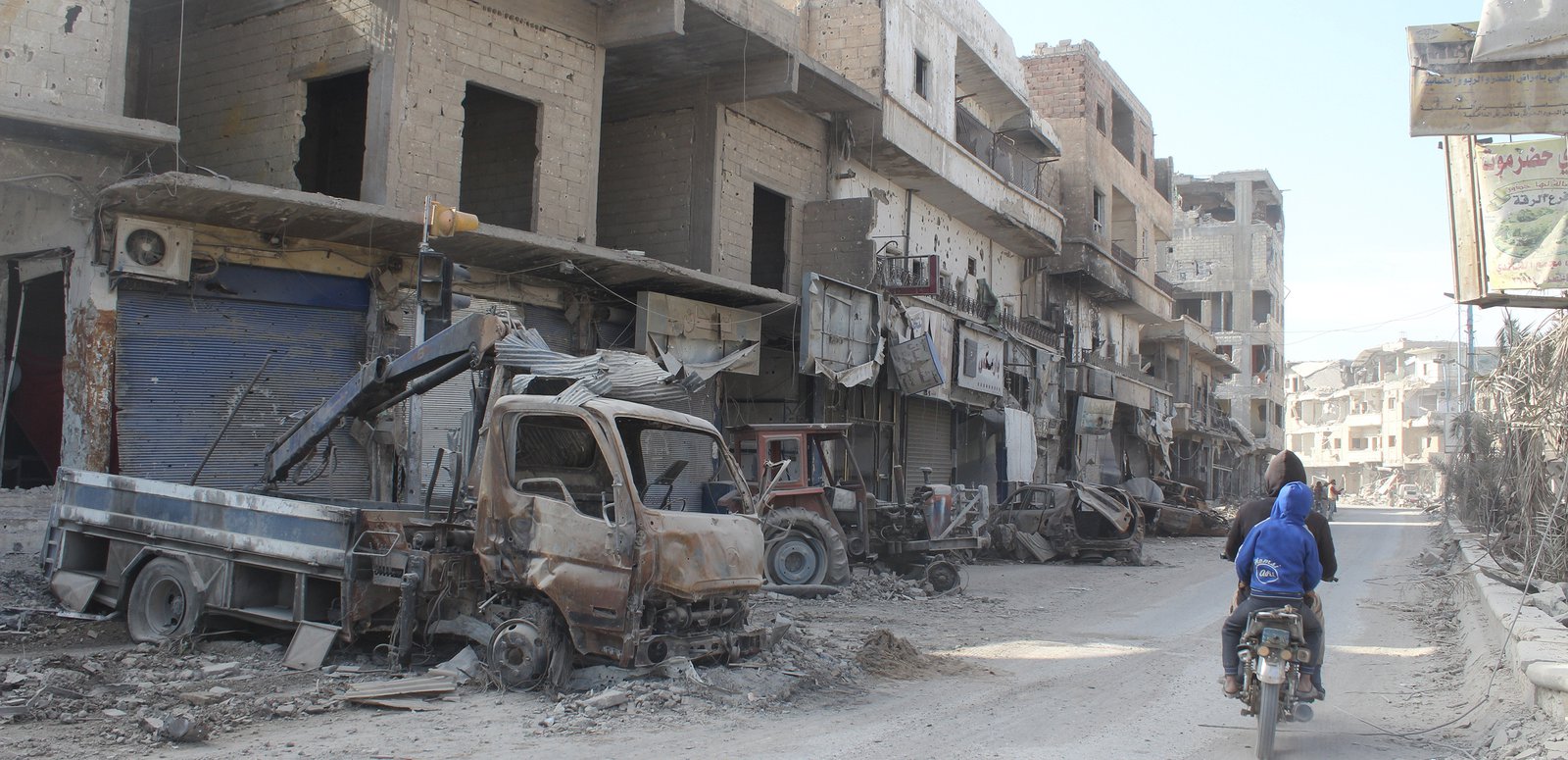
On March 6, 2013, Syria’s armed opposition liberated the city of Raqqa from the Assad regime in a matter of days, taking control of what had been, before the war, Syria’s sixth-largest city. Raqqa was the first provincial capital to be seized from government control, and many observers initially saw its fall as a good omen for the opposition’s victory. But by November that year, Raqqa had fallen to the Islamic State of Iraq and al-Sham (ISIS) and would become the capital of the organization’s soon-to-be-declared Caliphate.1 It took four years and an international intervention for U.S.-backed Syrian Democratic Forces (SDF) to recapture the city.
In many ways, Raqqa was a microcosm of Syria’s war—both the initial promise and the tragic shortcomings of the country’s anti-Assad uprising were laid bare in the city. Violence and instability in Raqqa drove hundreds of thousands out of the urban center, shrinking the city’s estimated peak population of 500,000 inhabitants by 25 percent only a couple of years after ISIS took control.2 More broadly, what happened in Raqqa is an example of the consequences of 21st century proxy wars. The failure of the Syrian opposition—proxies of bitterly divided patrons of even more localized political forces—led to the rise of ISIS in the city.
The failure of the Syrian opposition—proxies of bitterly divided patrons of even more localized political forces—led to the rise of ISIS in the city.
Raqqa reveals flaws in the classic approach to understanding proxy warfare, which often takes as its starting point an analysis of how great powers create and support proxies in multiple locations on a global chess board. This Cold War era realist model insufficiently addresses the role played by transnational movements and the local and international social networks that support them.3 Some analysts have argued that the Syrian war not only stretches the bounds of traditional views of proxy warfare—given the range and complexity of principal sponsors and proxy agents involved—but also tests plausible deniability in the digital age and norms around the lethal use of force.4 These dynamics are far from restricted to Syria, although the country’s conflict is a central example of what early 21st century proxy warfare looks like.
As a way of making sense of some of this complexity, this paper will focus on describing in detail what happened in Raqqa. Despite the Syrian city’s importance, few have thus far studied it in depth, most likely because reporting from the city went from difficult to near impossible once it became the capital of ISIS. The group used brutal violence and extensive surveillance to restrict the flow of information. They intimidated the population and abducted or murdered journalists, but some braved these threats and reported on what happened to their city anyway. This paper is possible because of their work.
This study draws on data on economic conditions, population attitudes, and local atmospherics collected in Syria from 2012 to 2015, as well as information gathered through interviews and social media archives, to address the question of what happened in Raqqa. Research materials have been carefully anonymized and edited to remove any personally identifiable information. We supplement these data with interviews, conducted both by the authors and local researchers, to capture the experiences of those living in the city from 2011 to the present.5 We also compared results from these surveys conducted in Raqqa to surveys conducted in other parts of Syria during the timeframe of December 2013 to November 2014.6
The paper begins chronologically—by tracing the evolution of the conflict in the city in four phases—and concludes with analytic reflections on larger lessons drawn from the Raqqa case. The first section describes conditions in Raqqa at the start of the revolution, exploring how and why armed groups captured the city from Syrian Arab Republic Government (SARG) forces in March 2013. The second describes how the rebels struggled and eventually failed to coalesce into something powerful enough to resist the ISIS takeover of November 2013. The third examines ISIS governance, demonstrating that the group was not administering a complex state but rather was quite incompetent at governing. The fourth examines conditions in Raqqa after its recapture by the SDF, and finds that acute insecurity in the city continues, making it ripe for ISIS resurgence. The conclusion examines the relevance of Raqqa’s experiences for the understanding of the conflict in Syria as both a civil war and proxy war.
Citations
- This paper uses the name “Islamic State of Iraq and al-Sham” (ISIS) because ISIS was the name of the group during the period of greatest focus in this paper (2013). The group changed its name to the “Islamic State” (IS) in July 2014 after it captured Mosul in Iraq.
- Eric Robinson, Daniel Egel, et. al., “Raqqah Capital of the Caliphate,” in When ISIS Comes to Town, (Santa Monica, CA: RAND, 2017), source.
- Candace Rondeaux and David Sterman, Twenty-First Century Proxy Warfare: Confronting Strategic Innovation in a Multipolar World, (Washington, D.C.: New America, 2019), source.
- R. Kim Cragin, “Semi-Proxy Wars and U.S. Counterterrorism Strategy,” Studies in Conflict & Terrorism 38, no. 5 (May 4, 2015): 311-27, source.
- Interviews conducted as part of the field research are referred to as “Caerus Interviews” while later interviews conducted by the authors of this paper are referenced as “Author’s Interviews.” Caerus interviews were conducted, whenever possible, in person in Raqqa from 2012-2015. These interviews ranged from semi-structured surveys collected in a snowball sampling method to fully structured surveys with subjects selected for diversity of gender and profession. Author’s interviews were conducted by the first author via Skype, and took place between January and June 2019.
- Surveys asked questions across Syria related to local conditions, such as perceptions of security and accessibility of basic goods and services. From December 2013 until November 2014, Caerus conducted 5,651 surveys in Raqqa, Damascus, Idlib, Hassakeh, Aleppo, Hama, Latakia, Dar'a, Deir Ezzor, Rif Damascus, and Homs. For the purposes of this paper, we compare survey results over this period in Raqqa (n=796) to the rest of Syria (n=4,855). While we did not survey each governorate previously listed across all four survey periods, each period included a sample of locations that reflected diverse conditions in Syria (i.e., opposition-controlled areas, SARG-controlled areas, contested or active conflict areas). This is why we believe it is reasonable to compare Raqqa to other places in Syria, despite the fact that the conflict was highly localized, and the locus of fighting shifted over the course of the war. Surveys were conducted by enumerators who selected respondents for each report through chain-referral sampling, modified to ensure minimum requirements for diversity in gender, socioeconomic status, and ethno-sectarian identities. Interviews were conducted in-person by local enumerators to ensure high-fidelity responses from interviewees.