How Internet Platforms Are Combating Disinformation and Misinformation in the Age of COVID-19
Table of Contents
Abstract
The unprecedented spread of COVID-19 across the globe has sparked a significant new wave of misinformation and disinformation online. In a time when the public must be armed with the most accurate information to combat this pandemic, many internet platforms have developed policies and practices to combat misleading and inaccurate information related to the virus. This report provides an overview of how various internet platforms are individually addressing the rapid spread of COVID-19-related misinformation and disinformation on their services. While this report aims to be comprehensive, it is important to note that platforms’ response efforts to the virus are rapidly changing and expanding, and as a result, this report may not encompass all efforts instituted by these companies. This report also offers recommendations on how these platforms can improve the efficacy of their efforts and also provide greater transparency to their users and the public. Further, the report includes recommendations on how U.S. policymakers can encourage further accountability and support efforts to combat the spread of misinformation and disinformation during this time.
Downloads
Introduction
During a speech in February, the director-general of the World Health Organization (WHO) explained how “fake news spreads faster and more easily than this virus, and is just as dangerous.”1 Indeed, the unprecedented spread of COVID-19 across the globe has sparked a significant new wave of misinformation and disinformation online. In late March, fact-checking organization Snopes was forced to scale back its routine content production, as the amount of misinformation related to the COVID-19 pandemic overwhelmed its fact-checkers.2 By April, a new report came out with analysis on how one-in-three people across Argentina, Germany, South Korea, Spain, the United Kingdom, and the United States say they have seen false or misleading information on social media linked to the coronavirus.3
The proliferation of misinformation in the time of COVID-19 has also spread harmful claims that unfortunately, appear to have resonated with marginalized communities. African-American communities have disproportionately suffered from the pandemic in some parts of the United States,4 and one reason behind this may be that misinformation has perpetuated mistrust and inaction toward public health entities in these communities.5 For example, one headline shared on Facebook read, “People Of Color May Be Immune To the Coronavirus Because of Melanin.”6 Further, a study indicated that the false belief that the coronavirus was created in a lab was more prevalent among Hispanic and African-Americans than among whites.7 The same study concluded that educational attainment is also a factor in being susceptible to misinformation.8 Specifically, those with a bachelor’s degree or more education were less likely than those with a high school diploma or less education to say the coronavirus was created in a lab.9
In a time when the public must be armed with the most accurate information to combat this pandemic, many internet platforms have developed policies to reduce the spread of (also known as downranking) and remove misleading and inaccurate information related to the virus. In response to the pressure to respond to misinformation and disinformation around this pandemic, Facebook, Google, YouTube, Microsoft, LinkedIn, Reddit, and Twitter announced that they are collaborating with one another and government health agencies in order to promote accurate information around the virus from authoritative sources.10 The majority of platform efforts during this time have centered on connecting users to authoritative information, moderating and reducing the spread of misleading content, and altering advertising policies to prevent exploitation and the marketing of misleading products and items. Although these efforts are valuable, platforms need to do more to provide transparency and accountability around how these initiatives are being implemented and how they are impacting users and their online expression.
This report will provide an overview of how various internet platforms are individually addressing the rapid spread of COVID-19-related misinformation and disinformation. While this report aims to be comprehensive, it is important to note that platforms’ response efforts to the virus are rapidly changing and expanding, and as a result, this report may not encompass all efforts instituted by these companies. This report concludes by offering recommendations on how these platforms can improve the efficacy of their efforts and also provide greater transparency to their users and the public. The report also includes recommendations on how U.S. policymakers can encourage further accountability and support efforts to combat the spread of misinformation and disinformation during this time.
Editorial disclosure: This report discusses policies by Google (including YouTube) and Facebook (including WhatsApp), both of which are funders of work at New America but did not contribute funds directly to the research or writing of this report. New America is guided by the principles of full transparency, independence, and accessibility in all its activities and partnerships. New America does not engage in research or educational activities directed or influenced in any way by financial supporters. View our full list of donors at www.newamerica.org/our-funding.
Citations
- Disease Pandemics and the Freedom of Opinion and Expression: Report of the Special Rapporteur on the Promotion and Protection of the Right to Freedom of Opinion and Expression, April 23, 2020, source
- Jon Porter, "Snopes Forced to Scale Back Fact-Checking In Face of Overwhelming COVID-19 Misinformation," The Verge, March 24, 2020, source
- Mark Scott, "One-Third Of People Have Seen Misleading Info On Covid-19 On Social Media," Politico, April 15, 2020, source
- John Eligon et al., "Black Americans Face Alarming Rates of Coronavirus Infection in Some State," The New York Times, April 7, 2020, source
- Jason Breslow, "Why Misinformation And Distrust Are Making COVID-19 More Dangerous For Black America," NPR, August 10, 2020, source
- Tom Kertscher, "Melanin Doesn't Protect Against Coronavirus," PolitiFact, last modified March 10, 2020, source
- Katherine Schaeffer, "Nearly Three-In-Ten Americans Believe COVID-19 Was Made In A Lab," Pew Research Center, last modified April 8, 2020, source
- Schaeffer, "Nearly Three-In-Ten," Pew Research Center.
- Tyler Sonnemaker, "Facebook, Google, Microsoft, Reddit, and Twitter Just Said They're Working Together To Fight Coronavirus Misinformation," Business Insider, March 16, 2020, source
Amazon
As a major e-commerce platform that sees 197 million global visitors visit daily, Amazon has been a critical supplier of household and medical goods for families wanting to employ responsible social distancing.11 However, as the pandemic has spread, thousands of sellers engaging in price gouging flooded the platform with high-priced listings. In early March, in response to reports of price gouging, Amazon shared it had removed 530,000 offers from the marketplace and suspended more than 2,500 seller accounts in its U.S. marketplace for violating its price-gouging policies.12 By the end of March, Amazon stated that it took down 3,900 selling accounts from the U.S. store alone for violating its fair pricing policies.13 Further, in a response to a letter sent by Sen. Ed Markey (D-Mass.) on this topic, the company explained that it uses machine learning models, in part, to detect price gouging, but has recently stepped up human monitoring as price gouging has spread in light of the coronavirus.14 Amazon is now deploying “an additional dedicated team” that’s working “24 hours, seven days a week” to spot price gouging on items such as protective masks and hand sanitizers.15
During the pandemic, misleading information has spread on Amazon primarily through product listings that make false claims, often related to cures or treatments for the virus. The company’s Prohibited Product Claims for Diseases policy states, “Amazon prohibits the sale of products that claim to cure, mitigate, treat, or prevent diseases in humans or animals without FDA approval.”16 The list of examples of diseases that products cannot claim to cure includes “Coronavirus and/or COVID-19.”17 In February, the company notified third-party merchants that it was taking down listings for items claiming to be a treatment, cure, or remedy for the coronavirus.18 After that notice, the company confirmed that it blocked or removed more than 1 million products for suspect or misleading claims.19 While Amazon has told sellers it would remove their listings for making unapproved medical marketing claims, the company has given sellers the opportunity to keep their valid product up without the prohibited medical claims.20
Given that Amazon has emerged as a crucial platform during the pandemic, the company needs to provide greater transparency and accountability around its operations during this time. In particular, Amazon should publish periodic updates during the pandemic outlining the number of listings the company has taken down and the number of sellers the company has banned for violating COVID-19 specific policies. Following the pandemic, the company should publish a comprehensive COVID-19 transparency report outlining the scope and scale of these enforcement actions more broadly. It should also expand this reporting to cover non-emergency periods. In addition, where appropriate, the Federal Trade Commission (FTC) should enforce Section (5)(a) of the Federal Trade Commision Act of 1914 and hold businesses accountable when they engage in unfair and deceptive trade practices on the platform.
Another issue Amazon has faced as the pandemic has spread worldwide is that “essential” goods such as face masks, cleaning products, and hand sanitizers rapidly sold out, leaving those who needed the items the most, like medical workers, without access to such supplies. In mid-March, to keep up with surging demand for essential goods, Amazon announced that it would no longer accept other items at its warehouses until April 5.21 This decision had immediate impacts on third-party sellers and vendors who came to rely on Amazon’s warehouse to get their products into the hands of consumers. By April 13, Amazon began allowing sellers to start shipping nonessential items again.22
Citations
- Disease Pandemics and the Freedom of Opinion and Expression: Report of the Special Rapporteur on the Promotion and Protection of the Right to Freedom of Opinion and Expression, April 23, 2020, source">source
- Jon Porter, "Snopes Forced to Scale Back Fact-Checking In Face of Overwhelming COVID-19 Misinformation," The Verge, March 24, 2020, source">source
- Mark Scott, "One-Third Of People Have Seen Misleading Info On Covid-19 On Social Media," Politico, April 15, 2020, source">source
- John Eligon et al., "Black Americans Face Alarming Rates of Coronavirus Infection in Some State," The New York Times, April 7, 2020, source">source
- Jason Breslow, "Why Misinformation And Distrust Are Making COVID-19 More Dangerous For Black America," NPR, August 10, 2020, source">source
- Tom Kertscher, "Melanin Doesn't Protect Against Coronavirus," PolitiFact, last modified March 10, 2020, source">source
- Katherine Schaeffer, "Nearly Three-In-Ten Americans Believe COVID-19 Was Made In A Lab," Pew Research Center, last modified April 8, 2020, source">source
- Schaeffer, "Nearly Three-In-Ten," Pew Research Center.
- Tyler Sonnemaker, "Facebook, Google, Microsoft, Reddit, and Twitter Just Said They're Working Together To Fight Coronavirus Misinformation," Business Insider, March 16, 2020, source">source
- “10 Fascinating Amazon Statistics Sellers Need To Know in 2019,” Big Commerce, January 10, 2020, source
- Annie Palmer, “Amazon removes hundreds of thousands of ‘high-priced offers’ amid coronavirus price gouging,” CNBC, March 6, 2020, source
- “Price gouging has no place in our stores,” Day One: The Amazon Blog, March, 23, 2020, source
- Palmer, “Amazon removes hundreds,” CNBC.
- Amazon, “Prohibited Product Claims,” Amazon Seller Central, accessed May 16, 2020, source
- Amazon, “Prohibited Product Claims,” Amazon Seller Central.
- Annie Palmer, “Amazon tells sellers it will take down listings for products that claim to kill coronavirus,” CNBC, February 20, 2020, source
- Catherine Thorbecke, “Amazon removes 1 million products for misleading claims, price gouging amid coronavirus outbreak,” ABC News, March 3, 2020, source
- Palmer, “Amazon tells sellers,” CNBC.
- Louise Matsakis, “Amazon Warehouses Will Now Accept Essential Supplies Only,” Wired, March 17, 2020, source
- Annie Palmer, “Amazon allows sellers to start shipping nonessential items again,” CNBC, April 13, 2020, source
Facebook is the largest social media platform in the world, with over 2.4 billion active users,23 the majority of whom are based outside the United States.24 The company therefore has significant global reach, as does the misinformation and disinformation that is spread on the platform.
Since the onset of the COVID-19 pandemic, false and misleading information related to COVID-19 has spread like wildfire on the platform, through user posts, in private groups, and through advertisements.25 Some of these posts have made innocuous claims, while others have shared more harmful ideas, such as promoting certain medicines or behaviors as preventive or curative measures, or suggesting that social distancing does not help stem the spread of the virus.26
In response, Facebook has launched a COVID-19 information center that houses all updates and information related to the platform’s efforts around the virus.27 This online hub includes a section called “Get the Facts,” which features articles that have been written by Facebook’s independent fact-checking partners and often link to fact-checked posts or articles.28 These articles are selected by Facebook’s News curation team and are updated weekly and available to Facebook’s U.S. users.29
According to Facebook, the company currently works with more than 60 fact-checking organizations that are responsible for reviewing and rating content in over 50 languages around the globe. The company has stated it is expanding its fact-checking partnerships to include more organizations and languages. It also announced the first set of recipients of the company’s $1 million grant program, which is hosted in collaboration with the International Fact-Checking Network, a forum for fact-checkers worldwide that is hosted by the Poynter Institute for Media Studies.30 Further, the company donated $1 million to the International Fact-Checking Network.31
These fact-checking organizations play an important role in misinformation and disinformation management on the platform. Pre-pandemic, when a piece of content was debunked by one of Facebook’s fact-checking partners, Facebook would append a warning label to the content and reduce the distribution of the content on the platform by demoting or downranking the post’s position in the platform’s algorithmic content ranking system. This was especially true for posts that shared misleading health information, such as sensational health claims, or that tried to sell products or services based on these exaggerated health claims.32 Facebook would also detect these types of content by identifying commonly used terms in such misleading posts and using them to predict and detect similar misleading posts.33 Facebook’s Community Standards outline that the platform does not remove false information, as there is a fine line between false news and satire and opinion.34 As a result, these fact-checking and downranking efforts have formed the foundation of Facebook’s efforts to counter such misinformation and disinformation.
Facebook’s efforts to downrank and reduce the distribution of COVID-19 misinformation and disinformation are based on these prior efforts. Through the use of automated tools, the platform is also able to identify duplicates of debunked stories and reduce their distribution.35 According to Facebook, these efforts are a continuation of work the company has been doing since 2018.36 The company has also begun directing users to authoritative sources on COVID-19 information37 and has stated that in the context of the pandemic, it will also remove content that contains misinformation that could lead to “imminent physical harm.”38
According to a Facebook post from CEO Mark Zuckerberg, over 2 billion users on Facebook and Instagram have been directed to “authoritative health resources,” and 350 million of those users actually clicked through to the resources.39 In addition, a blog post published by Facebook’s Vice President of Integrity Guy Rosen shared that the company had appended warning labels on approximately 40 million posts related to COVID-19 on the Facebook platform, based on the review of nearly 4,000 articles by the company’s independent fact-checking partners. 95 percent of the time, users did not click on content that had a warning label. 40 Additionally, when people search for information related to COVID-19 on Facebook, the platform will surface an educational pop-up with credible information from expert and governmental organizations such as the WHO and the U.S. Centers for Disease Control and Prevention (CDC).41 In addition, the company is giving free advertising credits to enable such organizations to run coronavirus education campaigns on Facebook and Instagram, and the company has said it is also discussing ways to provide additional assistance and support to health authorities.42
Further, on April 16, Facebook announced that it would begin alerting users if they had engaged with or viewed harmful misleading content related to the virus that had been debunked by the company’s fact-checking partners.43 Users who have liked, reacted to, or commented on these posts will receive alerts in their news feeds that direct them to the WHO’s “myth busters” page.44 This is a valuable method for providing transparency and accountability to users regarding their engagement with misleading content on the platform.
As highlighted above, Facebook’s Community Standards do not include clear policies related to the removal of false information. However, in the context of the pandemic, the platform has begun prioritizing the removal of COVID-19-related misinformation and disinformation that could cause imminent harm.45 Prioritizing the removal of this content during this time is especially important given that the company’s content moderation operations have radically transformed during the pandemic. Facebook announced that due to safety, privacy, and legal concerns, a large portion of their content moderation workforce, who are contractors, are unable to work from home.46 As a result, Facebook is increasingly relying on automated tools for content moderation. However, researchers and activists have extensively illustrated how these tools are limited and can often result in erroneous takedowns of content.47 In the absence of a robust content moderation workforce, Facebook has begun training a small group of its other employees, who have experience working in content policy, to moderate high-priority categories of content, such as COVID-19-related misinformation.48 The platform, however, has warned that users should expect numerous mistakes, given the decreased capacity for human review.49
During this time, the platform has also suspended its appeals process, instead enabling users to notify the company if they disagree with a moderation decision.50 This is concerning as it leaves users with no method for remedy or redress for erroneous decisions on whether to remove content.
Given that Facebook’s content moderation operations have changed drastically during this period, but are ever more important, the company should provide periodic updates on the scope and scale of its efforts to moderate and reduce the spread of misleading content during the pandemic. Following the pandemic, Facebook should publish a COVID-19-specific transparency report that outlines the scope and scale of these efforts throughout the entire pandemic. Further, Facebook should expand its general transparency reporting efforts to include data on the scope and scale of its efforts to remove and reduce the spread of misinformation more broadly.
Advertising can also promote the spread of misinformation on the platform. For example, some sellers have been advertising products that they claim can prevent or treat the virus. In response, Facebook has prohibited sellers from making COVID-19-related health or medical claims in product listings and has also banned ads that intend to foster panic related to the virus.51 In addition, the company has temporarily banned ads and commerce listings, such as those on Marketplace, which sell medical face masks,52 hand sanitizer, surface disinfecting wipes, and COVID-19 testing kits.53 The platform has also said it will remove organic posts that aim to sell these items.54 This is both to preserve this equipment for medical personnel and to prevent the sale of fraudulent or misleading items in these categories. Further, the company has established a dedicated channel for local governments to share listings they believe violate local laws.55 Going forward, Facebook should provide periodic updates on the number of listings it removes and the number of sellers it bans in Marketplace for violating its COVID-19-specific commerce policies, as well as its pre-existing commerce policies. Following the pandemic, Facebook should publish comprehensive data on its commerce policy enforcement efforts during this time. This reporting should also be expanded so that it is consistent and covers non-emergency periods as well.
Finally, after an investigation by The Markup, Facebook has removed the targeting category that enables advertisers to target users who are interested in pseudoscience. According to the investigation, this interest category contained over 78 million users, and it could enable advertisers to run and profit from ads that cater to users who are vulnerable to conspiracy theories and misleading information.56
As discussed, Facebook’s ad targeting and delivery tools can be used to promote the spread of misinformation. The platform has taken some important steps toward trying to prevent these misuses of their tools, however, there is little transparency around how effective these efforts have been. During the pandemic, Facebook should publish periodic updates on its efforts to enforce its advertising targeting and delivery policies. Following the pandemic, Facebook should publish comprehensive data that outlines the scope and scale of its ad policy enforcement during this time period, including data on the number of ads the company removed for violating its COVID-19-specific advertising policies, and data on the number of ads approved in error during this period. In addition, this is an area in which the U.S. government can use existing law to take action, as appropriate, against businesses and sellers who engage in unfair and deceptive trade practices during the pandemic. In particular, the FTC should enforce Section (5)(a) of the FTC Act to hold businesses and sellers who engage in unfair and deceptive trade practices through their online ad campaigns accountable.
Citations
- Disease Pandemics and the Freedom of Opinion and Expression: Report of the Special Rapporteur on the Promotion and Protection of the Right to Freedom of Opinion and Expression, April 23, 2020, <a href="source">source">source
- Jon Porter, "Snopes Forced to Scale Back Fact-Checking In Face of Overwhelming COVID-19 Misinformation," The Verge, March 24, 2020, <a href="source">source">source
- Mark Scott, "One-Third Of People Have Seen Misleading Info On Covid-19 On Social Media," Politico, April 15, 2020, <a href="source">source">source
- John Eligon et al., "Black Americans Face Alarming Rates of Coronavirus Infection in Some State," The New York Times, April 7, 2020, <a href="source">source">source
- Jason Breslow, "Why Misinformation And Distrust Are Making COVID-19 More Dangerous For Black America," NPR, August 10, 2020, <a href="source">source">source
- Tom Kertscher, "Melanin Doesn't Protect Against Coronavirus," PolitiFact, last modified March 10, 2020, <a href="source">source">source
- Katherine Schaeffer, "Nearly Three-In-Ten Americans Believe COVID-19 Was Made In A Lab," Pew Research Center, last modified April 8, 2020, <a href="source">source">source
- Schaeffer, "Nearly Three-In-Ten," Pew Research Center.
- Tyler Sonnemaker, "Facebook, Google, Microsoft, Reddit, and Twitter Just Said They're Working Together To Fight Coronavirus Misinformation," Business Insider, March 16, 2020, <a href="source">source">source
- “10 Fascinating Amazon Statistics Sellers Need To Know in 2019,” Big Commerce, January 10, 2020, source">source
- Annie Palmer, “Amazon removes hundreds of thousands of ‘high-priced offers’ amid coronavirus price gouging,” CNBC, March 6, 2020, source">source
- “Price gouging has no place in our stores,” Day One: The Amazon Blog, March, 23, 2020, source">source
- Palmer, “Amazon removes hundreds,” CNBC.
- Amazon, “Prohibited Product Claims,” Amazon Seller Central, accessed May 16, 2020, source">source
- Amazon, “Prohibited Product Claims,” Amazon Seller Central.
- Annie Palmer, “Amazon tells sellers it will take down listings for products that claim to kill coronavirus,” CNBC, February 20, 2020, source">source
- Catherine Thorbecke, “Amazon removes 1 million products for misleading claims, price gouging amid coronavirus outbreak,” ABC News, March 3, 2020, source">source
- Palmer, “Amazon tells sellers,” CNBC.
- Louise Matsakis, “Amazon Warehouses Will Now Accept Essential Supplies Only,” Wired, March 17, 2020, source">source
- Annie Palmer, “Amazon allows sellers to start shipping nonessential items again,” CNBC, April 13, 2020, source">source
- J. Clement, "Most Popular Social Networks Worldwide As Of April 2020, Ranked By Number of active users," Statista, last modified April 24, 2020, source
- J. Clement, "Leading Countries Based on Facebook Audience Size As Of April 2020," Statista, last modified April 24, 2020, source
- Mark Scott, "Facebook's Private Groups Are Abuzz With Coronavirus Fake News," Politico, March 30, 2020, source
- Avaaz, How Facebook can Flatten the Curve of the Coronavirus Infodemic, April 15, 2020, source
- Kang-Xing Jin, "Keeping People Safe and Informed About the Coronavirus," Facebook Newsroom, source
- Mark Zuckerberg, "I want to share an update on the work we're doing to connect people with accurate information and limit the spread of misinformation about Covid-19.," Facebook, April 16, 2020, 9:01 am, source
- Guy Rosen, "An Update on Our Work to Keep People Informed and Limit Misinformation About COVID-19," Facebook Newsroom, last modified April 16, 2020, source
- Rosen, "An Update," Facebook Newsroom.
- "Investing $100 Million in the News Industry," Facebook Newsroom, last modified March 30, 2020, source
- Tessa Lyons, "Increasing Our Efforts to Fight False News," Facebook Newsroom, last modified June 21, 2018, source
- Travis Yeh, "Addressing Sensational Health Claims," Facebook Newsroom, last modified July 2, 2019, source
- "Community Standards: False News," Facebook, source
- Rosen, "An Update," Facebook Newsroom.
- Lyons, "Increasing Our Efforts," Facebook Newsroom.
- Zuckerberg, "I want," Facebook.
- Rosen, "An Update," Facebook Newsroom.
- "Connecting People to Accurate Information and Helpful Resources," Facebook Newsroom, last modified February 26, 2020, source
- "Providing Helpful Information and Support," Facebook Newsroom, last modified January 30, 2020, source
- Rosen, "An Update," Facebook Newsroom.
- World Health Organization, "Coronavirus Disease (COVID-19) Advice For The Public: Myth Busters," World Health Organization, source
- "Keeping Our People and Our Platforms Safe," Facebook Newsroom, last modified March 16, 2020, source
- "Keeping Our People," Facebook Newsroom.
- Dia Kayyali and Raja Althaibani, "Vital Human Rights Evidence in Syria is Disappearing from YouTube," WITNESS Blog, entry posted August 2017, source Spandana Singh, Everything in Moderation: An Analysis of How Internet Platforms Are Using Artificial Intelligence to Moderate User-Generated Content, July 22, 2019, source Llansó, "COVID-19 Content Moderation Research Letter – in English, Spanish, & Arabic," Center for Democracy & Technology, last modified April 22, 2020, source
- "Press Call Transcript," Facebook, last modified March 18, 2020, source
- "Press Call," Facebook.
- "Keeping Our Platform Safe With Remote and Reduced Content Review," Facebook Newsroom, last modified March 19, 2020, source
- "Exploitative Tactics in Ads," Facebook Newsroom, last modified February 26, 2020, source
- "Banning Ads and Commerce Listings for Medical Face Masks," Facebook Newsroom, last modified March 6, 2020, source.
- "Banning Ads for Hand Sanitizer, Disinfecting Wipes and COVID-19 Testing Kits," Facebook Newsroom, last modified March 19, 2020, source
- "Banning Ads for Hand," Facebook Newsroom.
- "Banning Ads and Commerce," Facebook Newsroom.
- Aaron Sankin, "Want to Find a Misinformed Public? Facebook's Already Done It," The Markup, April 23, 2020, source
Google, one of the world’s largest technology companies and a wholly-owned subsidiary of Alphabet, took an important step in combating misinformation among its products by investing $6.5 million in the fight against misinformation.57 This funding will go toward fact-checkers, news organizations, and nonprofits around the world.58 The money will also help certain news outlets expose and track coronavirus misinformation.59 Sundar Pichai, CEO of Alphabet and Google, also announced that Google’s Trust and Safety team was working across the globe to safeguard users from phishing, conspiracy theories, malware, and misinformation, and is regularly on the lookout for new threats.60
Google Search, the platform’s search engine, is the most popular search engine worldwide with a recent statistic illustrating an 87.35 percent market share.61 As the year has progressed, COVID-19 has become the most searched topic, surpassing even some of the most common and consistent queries found in Search with questions such as “Is sneezing a sign of coronavirus?” and “What is PPE for coronavirus” dominating the search engine.62 Given the size and reach of this search engine, it is critical for the platform to combat misleading information.
Prior to the spread of the coronavirus, Google published a white paper in February 2019 describing its three strategies for dealing with misinformation across all of its products, including Search, by stating that they “make quality count in our ranking systems, counteract malicious actors, and give users more context.”63 Specifically, Google stated that it uses ranking algorithms to organize search results. These ranking algorithms are designed to surface content that the platform determines is high-quality and relevant to a user’s query. Although there has been some contention that the company uses its ranking algorithms to provide preference to content that aligns with certain ideological viewpoints,64 the company has stated that Search is designed to make determinations about the usefulness and relevance of a webpage based on a range of signals, and not to promote the political and ideological perspectives of the individuals who built or audited the system.65 When Search’s ranking algorithms identify content as misinformation, they will downrank that content so that it appears lower down in search results.66
Google employs other tools to combat misinformation including human review systems and systems that can reduce spam activity at scale.67 Google says its algorithms can detect the majority of spam and automatically prevent the ranking system from promoting such content by demoting or removing these webpages.68 The remainder of spam results are typically manually addressed by a spam removal team.69 They review the pages in question, typically based on user feedback, and flag them for penalty if they have been found to violate the webmaster guidelines.70 Manual actions can be used to penalize an entire website, subdomain, sections of a website, or specific pages.71 Manual action can also demote websites in search rankings and delist them.72 However, it is unclear how much manual action is taken in response to COVID-19 misinformation.
Finally, for some content, Google provides more context to users through mechanisms such as knowledge panels that connect a variety of sources on a topic, fact-check labels that illustrate verified information, and feedback buttons that directly send information to Google.73 These mechanisms play an important role in the search engine to help inform the user. Knowledge panels are information boxes that appear on Google when a user searches for entities (people, places, organizations, things) that are in the Knowledge Graph.74 The Knowledge Graph is the engine that powers the panel.75 Specifically, the Knowledge Graph is Google’s systematic way of putting facts, people, and places together to create interconnected search results that they determine are more accurate and relevant.76 Knowledge panels are automatically generated, and information that appears in a knowledge panel comes from various sources across the web.77
Fact-check labels are appended to articles that include information fact-checked by news publishers and fact-checking organizations.78 These labels appear when a user conducts a search on Google that returns an authoritative result containing fact-checks for one or more public claims.79 When this occurs, the user will see that information clearly on the search results page.80 The snippet will display information on the claim, who made the claim, and the fact-check of that particular claim.81 However, this information isn’t available for every search result, and there may be search result pages where different publishers checked the same claim and reached different conclusions.82
After COVID-19 was declared a public health emergency by the WHO in late January of 2020, Google launched an SOS Alert with resources and safety information from the WHO.83 Additionally, Google worked with relevant agencies and authorities in the United States to roll out a website focused on education, prevention, and local resources.84
Google has also taken major steps to prevent the spread of misinformation across its other products. For example, the platform announced it was blocking all ads in its Google Ads service that capitalize on the coronavirus.85 Google Ads is the primary mechanism through which businesses can deliver and place ads on Google.
In addition, Google updated their Inappropriate Content policy so that it amended their “Sensitive Events” category. The policy now prohibits acts:86
“Appearing to profit from a tragic event with no discernible benefit to users; price gouging or artificially inflating prices that prohibits/limits access to vital supplies; sale of products or services (such as personal protective equipment) which may be insufficient for the demand during a sensitive event; using keywords related to a sensitive event to attempt to gain additional traffic.”
This policy also includes a ban on the sale of face masks.87 Further, Google Play has begun prohibiting developers from capitalizing on sensitive events, in addition to enforcing their long-standing content policies that strictly prohibit apps featuring medical or health-related content that is misleading or potentially harmful. Additionally, Neil Kumaran, product manager for Gmail Security, and Sam Lugani, lead security of product marketing management for G Suite and Google Cloud, shared some steps for administrators to effectively deal with the rising tide of spam emails, and detailing best practices for users to avoid threats.88 According to them, Gmail blocked more than 240 million coronavirus-related spam messages.89
Given the massive changes occurring across Google’s many products, the company must provide greater transparency and accountability around its COVID-19-related efforts. Specifically, the company should provide periodic updates to consumers on a number of data points, including how many ads have been rejected and removed, how many COVID-19 misinformation-related search results have been downranked or removed, how many spam emails related to the pandemic have been blocked, and statistics on the types of searches made over the course of the global crisis (i.e. searches for specific treatments mentioned by policymakers, searches about the origin of the virus, and searches for critical products). The latter will allow researchers and civil society to better understand information-flow stemming from the virus. Following the pandemic, Google should also publish a comprehensive report on these factors. In addition, where appropriate, the FTC should hold businesses and sellers who run online ad campaigns accountable, by enforcing Section (5)(a) of the FTC Act against any who engage in unfair and deceptive practices.
Citations
- Disease Pandemics and the Freedom of Opinion and Expression: Report of the Special Rapporteur on the Promotion and Protection of the Right to Freedom of Opinion and Expression, April 23, 2020, <a href="<a href="source">source">source">source
- Jon Porter, "Snopes Forced to Scale Back Fact-Checking In Face of Overwhelming COVID-19 Misinformation," The Verge, March 24, 2020, <a href="<a href="source">source">source">source
- Mark Scott, "One-Third Of People Have Seen Misleading Info On Covid-19 On Social Media," Politico, April 15, 2020, <a href="<a href="source">source">source">source
- John Eligon et al., "Black Americans Face Alarming Rates of Coronavirus Infection in Some State," The New York Times, April 7, 2020, <a href="<a href="source">source">source">source
- Jason Breslow, "Why Misinformation And Distrust Are Making COVID-19 More Dangerous For Black America," NPR, August 10, 2020, <a href="<a href="source">source">source">source
- Tom Kertscher, "Melanin Doesn't Protect Against Coronavirus," PolitiFact, last modified March 10, 2020, <a href="<a href="source">source">source">source
- Katherine Schaeffer, "Nearly Three-In-Ten Americans Believe COVID-19 Was Made In A Lab," Pew Research Center, last modified April 8, 2020, <a href="<a href="source">source">source">source
- Schaeffer, "Nearly Three-In-Ten," Pew Research Center.
- Tyler Sonnemaker, "Facebook, Google, Microsoft, Reddit, and Twitter Just Said They're Working Together To Fight Coronavirus Misinformation," Business Insider, March 16, 2020, <a href="<a href="source">source">source">source
- “10 Fascinating Amazon Statistics Sellers Need To Know in 2019,” Big Commerce, January 10, 2020, <a href="source">source">source
- Annie Palmer, “Amazon removes hundreds of thousands of ‘high-priced offers’ amid coronavirus price gouging,” CNBC, March 6, 2020, <a href="source">source">source
- “Price gouging has no place in our stores,” Day One: The Amazon Blog, March, 23, 2020, <a href="source">source">source
- Palmer, “Amazon removes hundreds,” CNBC.
- Amazon, “Prohibited Product Claims,” Amazon Seller Central, accessed May 16, 2020, <a href="source">source">source
- Amazon, “Prohibited Product Claims,” Amazon Seller Central.
- Annie Palmer, “Amazon tells sellers it will take down listings for products that claim to kill coronavirus,” CNBC, February 20, 2020, <a href="source">source">source
- Catherine Thorbecke, “Amazon removes 1 million products for misleading claims, price gouging amid coronavirus outbreak,” ABC News, March 3, 2020, <a href="source">source">source
- Palmer, “Amazon tells sellers,” CNBC.
- Louise Matsakis, “Amazon Warehouses Will Now Accept Essential Supplies Only,” Wired, March 17, 2020, <a href="source">source">source
- Annie Palmer, “Amazon allows sellers to start shipping nonessential items again,” CNBC, April 13, 2020, <a href="source">source">source
- J. Clement, "Most Popular Social Networks Worldwide As Of April 2020, Ranked By Number of active users," Statista, last modified April 24, 2020, source">source
- J. Clement, "Leading Countries Based on Facebook Audience Size As Of April 2020," Statista, last modified April 24, 2020, source">source
- Mark Scott, "Facebook's Private Groups Are Abuzz With Coronavirus Fake News," Politico, March 30, 2020, source">source
- Avaaz, How Facebook can Flatten the Curve of the Coronavirus Infodemic, April 15, 2020, source">source
- Kang-Xing Jin, "Keeping People Safe and Informed About the Coronavirus," Facebook Newsroom, source">source
- Mark Zuckerberg, "I want to share an update on the work we're doing to connect people with accurate information and limit the spread of misinformation about Covid-19.," Facebook, April 16, 2020, 9:01 am, source">source
- Guy Rosen, "An Update on Our Work to Keep People Informed and Limit Misinformation About COVID-19," Facebook Newsroom, last modified April 16, 2020, source">source
- Rosen, "An Update," Facebook Newsroom.
- "Investing $100 Million in the News Industry," Facebook Newsroom, last modified March 30, 2020, source">source
- Tessa Lyons, "Increasing Our Efforts to Fight False News," Facebook Newsroom, last modified June 21, 2018, source">source
- Travis Yeh, "Addressing Sensational Health Claims," Facebook Newsroom, last modified July 2, 2019, source">source
- "Community Standards: False News," Facebook, source">source
- Rosen, "An Update," Facebook Newsroom.
- Lyons, "Increasing Our Efforts," Facebook Newsroom.
- Zuckerberg, "I want," Facebook.
- Rosen, "An Update," Facebook Newsroom.
- "Connecting People to Accurate Information and Helpful Resources," Facebook Newsroom, last modified February 26, 2020, source">source
- "Providing Helpful Information and Support," Facebook Newsroom, last modified January 30, 2020, source">source
- Rosen, "An Update," Facebook Newsroom.
- World Health Organization, "Coronavirus Disease (COVID-19) Advice For The Public: Myth Busters," World Health Organization, source">source
- "Keeping Our People and Our Platforms Safe," Facebook Newsroom, last modified March 16, 2020, source">source
- "Keeping Our People," Facebook Newsroom.
- Dia Kayyali and Raja Althaibani, "Vital Human Rights Evidence in Syria is Disappearing from YouTube," WITNESS Blog, entry posted August 2017, source">source Spandana Singh, Everything in Moderation: An Analysis of How Internet Platforms Are Using Artificial Intelligence to Moderate User-Generated Content, July 22, 2019, source">source Llansó, "COVID-19 Content Moderation Research Letter – in English, Spanish, & Arabic," Center for Democracy & Technology, last modified April 22, 2020, source">source
- "Press Call Transcript," Facebook, last modified March 18, 2020, source">source
- "Press Call," Facebook.
- "Keeping Our Platform Safe With Remote and Reduced Content Review," Facebook Newsroom, last modified March 19, 2020, source">source
- "Exploitative Tactics in Ads," Facebook Newsroom, last modified February 26, 2020, source">source
- "Banning Ads and Commerce Listings for Medical Face Masks," Facebook Newsroom, last modified March 6, 2020, source">source.
- "Banning Ads for Hand Sanitizer, Disinfecting Wipes and COVID-19 Testing Kits," Facebook Newsroom, last modified March 19, 2020, source">source
- "Banning Ads for Hand," Facebook Newsroom.
- "Banning Ads and Commerce," Facebook Newsroom.
- Aaron Sankin, "Want to Find a Misinformed Public? Facebook's Already Done It," The Markup, April 23, 2020, source">source
- Maggie Miller, “Google to Spend $6.5 Million in Fight against Coronavirus Misinformation,” The Hill, April 2, 2020. source
- Miller, “Google to Spend,” The Hill.
- Sundar Pichai, “Coronavirus: How We're Helping,” The Keyword, March 6, 2020, source
- Alex Chris, “Top 10 Search Engines In The World,” reliablesoft.net, April 23, 2020, source
- Emily Moxley, “Connecting People with COVID-19 Information and Resources,” The Keyword, March 21, 2020, source
- “How Google Fights Disinformation,” Google, last modified February 16, 2019, source
- Casey Newton, “The Real Bias on Social Networks Isn't against Conservatives,” The Verge, April 11, 2019, source
- “How Google Fights,” Google.
- “About Knowledge Panels – Knowledge Panel Help,” Google, Accessed May 16, 2020, source
- Edwin Toonen, “What is Google’s Knowledge Graph?”Yoast, source.
- Neil Patel, “The Beginner's Guide to Google's Knowledge Graph,” Neil Patel, January 24, 2020, source
- “About Knowledge Panels,” Google.
- Justin Kosslyn and Cong Yu, “Fact Check Now Available in Google Search and News around the World,” Google, April 7, 2017, source
- Kosslyn, “Fact Check Now,” Google.
- “COVID-19,” Google, source
- Pichai, “Coronavirus: How We're Helping,” Google.
- “Updates to Inappropriate Policy,” Google, last modified March 2020, source
- Ginny Marvin, “Google bans face mask ads globally due to misleading coronavirus claims,” Search Engine Land, March 11, 2020, source
- Neil Kumaran and Sam Lugani, “Protecting businesses against cyber threats during COVID-19 and beyond,” Google Cloud, source
- Kumaran, “Protecting businesses against,” Google Cloud.
Reddit is a popular social media platform that has approximately 330 million monthly active users around the world.90 The platform is distinct from other social media platforms in that it does not have a comprehensive top-down content moderation strategy. Rather, the platform operates using a high-level set of content guidelines that are enforced by a team of employee moderators (known as admins), and subreddit-specific content policies that are created and enforced by users who act as moderators of individual subreddits (known as mods).91 This localized approach to content moderation has permitted a number of niche communities and groups to flourish on the platform.92 However, this structure has also created conditions that can enable misinformation and disinformation to spread easily across the service.
In response, the company has begun promoting a number of resources containing authoritative information related to COVID-19, stating that unless a subreddit is focused on spreading misleading content, admins will prioritize educating and cooperating with users in the subreddit. If these efforts fail, the platform will then take steps to ban the subreddit, in a process known as “quarantining.”93 When a community is quarantined, it does not appear in search results. Additionally, if a user tries to visit the quarantined community, they will be notified that the subreddit may contain misleading content and they must explicitly opt-in to viewing the content.94
In addition to these efforts, Reddit has announced that its site integrity team is also working on investigating claims and evidence of coordinated attempts to spread misleading COVID-19 information across the platform. The company has stated that these efforts include detection experiments, which are being conducted in conjunction with other companies such as Microsoft and Google.95 Further, the company has been organizing “Ask Me Anything” (AMA) series in which users can ask scientific and medical experts, as well as public officials, questions about the virus, therefore enabling users to access verified, real-time information.96 The company is also using banners to highlight content that has been verified and deemed legitimate on the Reddit homepage and in search results.97
Reddit has also stated that it is working to equip both admins and mods with the necessary resources and guidance to remove misinformation. In a Reddit admin post on safety in late April, the company shared that it is striving to rapidly moderate content that contains claims that encourage violence (e.g. calls to vandalize phone towers or attack individuals of a specific nationality) or physical harm (e.g. suggesting that drinking bleach helps prevent or cure the virus).98 To this end, the company has compiled a set of resources outlining authoritative and verified information on COVID-19 for mods who are reviewing content for COVID-19-related misinformation. In its April post, Reddit also outlined that mods can use the AutoModerator tool (known as AutoMod) to identify and remove obvious forms of misinformation in their subreddits.99 The AutoMod is a built-in, customizable bot that provides basic algorithmic tools to mods to proactively identify, filter, and remove objectionable content. The AutoMod operates based on mod-chosen parameters such as keywords, website links, or specific users, that are not permitted in a particular subreddit.100 Mods who identify cases of misinformation that are spreading across the platform, or an account that is behaving suspiciously, can also report these instances to the platform.101 Reddit has stated that it will be giving all users the option to report such content shortly. 102 In this way, Reddit presents an interesting case study for fact-checking and review of misleading content during the pandemic, as rather than taking on these roles and responsibilities entirely, or partnering extensively with independent third-party groups, it distributes and localizes these tasks among a certain group of users.
Currently, Reddit’s transparency report does not outline how much content is being removed by admins or mods under the platform’s misinformation policies. During the pandemic, the company should provide periodic updates on their content moderation and advertising policy enforcement efforts, particularly related to misinformation. Following the pandemic, the company should publish a COVID-19-specific transparency report that outlines the scope and scale of content moderation efforts by both admins and mods, as well as ad policy enforcement efforts by the company. This report should also include granular information on the number and types of quarantined communities. Further, Reddit should expand its general transparency reporting to include data on removals of misleading content by admins and mods.
Citations
- Disease Pandemics and the Freedom of Opinion and Expression: Report of the Special Rapporteur on the Promotion and Protection of the Right to Freedom of Opinion and Expression, April 23, 2020, <a href="<a href="<a href="source">source">source">source">source
- Jon Porter, "Snopes Forced to Scale Back Fact-Checking In Face of Overwhelming COVID-19 Misinformation," The Verge, March 24, 2020, <a href="<a href="<a href="source">source">source">source">source
- Mark Scott, "One-Third Of People Have Seen Misleading Info On Covid-19 On Social Media," Politico, April 15, 2020, <a href="<a href="<a href="source">source">source">source">source
- John Eligon et al., "Black Americans Face Alarming Rates of Coronavirus Infection in Some State," The New York Times, April 7, 2020, <a href="<a href="<a href="source">source">source">source">source
- Jason Breslow, "Why Misinformation And Distrust Are Making COVID-19 More Dangerous For Black America," NPR, August 10, 2020, <a href="<a href="<a href="source">source">source">source">source
- Tom Kertscher, "Melanin Doesn't Protect Against Coronavirus," PolitiFact, last modified March 10, 2020, <a href="<a href="<a href="source">source">source">source">source
- Katherine Schaeffer, "Nearly Three-In-Ten Americans Believe COVID-19 Was Made In A Lab," Pew Research Center, last modified April 8, 2020, <a href="<a href="<a href="source">source">source">source">source
- Schaeffer, "Nearly Three-In-Ten," Pew Research Center.
- Tyler Sonnemaker, "Facebook, Google, Microsoft, Reddit, and Twitter Just Said They're Working Together To Fight Coronavirus Misinformation," Business Insider, March 16, 2020, <a href="<a href="<a href="source">source">source">source">source
- “10 Fascinating Amazon Statistics Sellers Need To Know in 2019,” Big Commerce, January 10, 2020, <a href="<a href="source">source">source">source
- Annie Palmer, “Amazon removes hundreds of thousands of ‘high-priced offers’ amid coronavirus price gouging,” CNBC, March 6, 2020, <a href="<a href="source">source">source">source
- “Price gouging has no place in our stores,” Day One: The Amazon Blog, March, 23, 2020, <a href="<a href="source">source">source">source
- Palmer, “Amazon removes hundreds,” CNBC.
- Amazon, “Prohibited Product Claims,” Amazon Seller Central, accessed May 16, 2020, <a href="<a href="source">source">source">source
- Amazon, “Prohibited Product Claims,” Amazon Seller Central.
- Annie Palmer, “Amazon tells sellers it will take down listings for products that claim to kill coronavirus,” CNBC, February 20, 2020, <a href="<a href="source">source">source">source
- Catherine Thorbecke, “Amazon removes 1 million products for misleading claims, price gouging amid coronavirus outbreak,” ABC News, March 3, 2020, <a href="<a href="source">source">source">source
- Palmer, “Amazon tells sellers,” CNBC.
- Louise Matsakis, “Amazon Warehouses Will Now Accept Essential Supplies Only,” Wired, March 17, 2020, <a href="<a href="source">source">source">source
- Annie Palmer, “Amazon allows sellers to start shipping nonessential items again,” CNBC, April 13, 2020, <a href="<a href="source">source">source">source
- J. Clement, "Most Popular Social Networks Worldwide As Of April 2020, Ranked By Number of active users," Statista, last modified April 24, 2020, <a href="source">source">source
- J. Clement, "Leading Countries Based on Facebook Audience Size As Of April 2020," Statista, last modified April 24, 2020, <a href="source">source">source
- Mark Scott, "Facebook's Private Groups Are Abuzz With Coronavirus Fake News," Politico, March 30, 2020, <a href="source">source">source
- Avaaz, How Facebook can Flatten the Curve of the Coronavirus Infodemic, April 15, 2020, <a href="source">source">source
- Kang-Xing Jin, "Keeping People Safe and Informed About the Coronavirus," Facebook Newsroom, <a href="source">source">source
- Mark Zuckerberg, "I want to share an update on the work we're doing to connect people with accurate information and limit the spread of misinformation about Covid-19.," Facebook, April 16, 2020, 9:01 am, <a href="source">source">source
- Guy Rosen, "An Update on Our Work to Keep People Informed and Limit Misinformation About COVID-19," Facebook Newsroom, last modified April 16, 2020, <a href="source">source">source
- Rosen, "An Update," Facebook Newsroom.
- "Investing $100 Million in the News Industry," Facebook Newsroom, last modified March 30, 2020, <a href="source">source">source
- Tessa Lyons, "Increasing Our Efforts to Fight False News," Facebook Newsroom, last modified June 21, 2018, <a href="source">source">source
- Travis Yeh, "Addressing Sensational Health Claims," Facebook Newsroom, last modified July 2, 2019, <a href="source">source">source
- "Community Standards: False News," Facebook, <a href="source">source">source
- Rosen, "An Update," Facebook Newsroom.
- Lyons, "Increasing Our Efforts," Facebook Newsroom.
- Zuckerberg, "I want," Facebook.
- Rosen, "An Update," Facebook Newsroom.
- "Connecting People to Accurate Information and Helpful Resources," Facebook Newsroom, last modified February 26, 2020, <a href="source">source">source
- "Providing Helpful Information and Support," Facebook Newsroom, last modified January 30, 2020, <a href="source">source">source
- Rosen, "An Update," Facebook Newsroom.
- World Health Organization, "Coronavirus Disease (COVID-19) Advice For The Public: Myth Busters," World Health Organization, <a href="source">source">source
- "Keeping Our People and Our Platforms Safe," Facebook Newsroom, last modified March 16, 2020, <a href="source">source">source
- "Keeping Our People," Facebook Newsroom.
- Dia Kayyali and Raja Althaibani, "Vital Human Rights Evidence in Syria is Disappearing from YouTube," WITNESS Blog, entry posted August 2017, <a href="source">source">source Spandana Singh, Everything in Moderation: An Analysis of How Internet Platforms Are Using Artificial Intelligence to Moderate User-Generated Content, July 22, 2019, <a href="source">source">source Llansó, "COVID-19 Content Moderation Research Letter – in English, Spanish, & Arabic," Center for Democracy & Technology, last modified April 22, 2020, <a href="source">source">source
- "Press Call Transcript," Facebook, last modified March 18, 2020, <a href="source">source">source
- "Press Call," Facebook.
- "Keeping Our Platform Safe With Remote and Reduced Content Review," Facebook Newsroom, last modified March 19, 2020, <a href="source">source">source
- "Exploitative Tactics in Ads," Facebook Newsroom, last modified February 26, 2020, <a href="source">source">source
- "Banning Ads and Commerce Listings for Medical Face Masks," Facebook Newsroom, last modified March 6, 2020, <a href="source">source">source.
- "Banning Ads for Hand Sanitizer, Disinfecting Wipes and COVID-19 Testing Kits," Facebook Newsroom, last modified March 19, 2020, <a href="source">source">source
- "Banning Ads for Hand," Facebook Newsroom.
- "Banning Ads and Commerce," Facebook Newsroom.
- Aaron Sankin, "Want to Find a Misinformed Public? Facebook's Already Done It," The Markup, April 23, 2020, <a href="source">source">source
- Maggie Miller, “Google to Spend $6.5 Million in Fight against Coronavirus Misinformation,” The Hill, April 2, 2020. source">source
- Miller, “Google to Spend,” The Hill.
- Sundar Pichai, “Coronavirus: How We're Helping,” The Keyword, March 6, 2020, source">source
- Alex Chris, “Top 10 Search Engines In The World,” reliablesoft.net, April 23, 2020, source">source
- Emily Moxley, “Connecting People with COVID-19 Information and Resources,” The Keyword, March 21, 2020, source">source
- “How Google Fights Disinformation,” Google, last modified February 16, 2019, source">source
- Casey Newton, “The Real Bias on Social Networks Isn't against Conservatives,” The Verge, April 11, 2019, source">source
- “How Google Fights,” Google.
- “About Knowledge Panels – Knowledge Panel Help,” Google, Accessed May 16, 2020, source">source
- Edwin Toonen, “What is Google’s Knowledge Graph?”Yoast, source">source.
- Neil Patel, “The Beginner's Guide to Google's Knowledge Graph,” Neil Patel, January 24, 2020, source">source
- “About Knowledge Panels,” Google.
- Justin Kosslyn and Cong Yu, “Fact Check Now Available in Google Search and News around the World,” Google, April 7, 2017, source">source
- Kosslyn, “Fact Check Now,” Google.
- “COVID-19,” Google, source">source
- Pichai, “Coronavirus: How We're Helping,” Google.
- “Updates to Inappropriate Policy,” Google, last modified March 2020, source">source
- Ginny Marvin, “Google bans face mask ads globally due to misleading coronavirus claims,” Search Engine Land, March 11, 2020, source">source
- Neil Kumaran and Sam Lugani, “Protecting businesses against cyber threats during COVID-19 and beyond,” Google Cloud, source">source
- Kumaran, “Protecting businesses against,” Google Cloud.
- Lauren Feiner, "Reddit Users Are The Least Valuable Of Any Social Network," CNBC, February 11, 2019, source
- Singh, Everything in Moderation.
- Reddit, "Misinformation and COVID-19: What Reddit is Doing," r/ModSupport, last modified April 16, 2020, source
- Reddit, "Misinformation and COVID-19," r/ModSupport.
- Singh, Everything in Moderation.
- Reddit, "Misinformation and COVID-19," r/ModSupport.
TikTok
The short-form video application, TikTok, was reported as the third-most downloaded non-game app of the year in 2019.103 Last year, it was estimated that TikTok, a China-based company, has around 625 million monthly active users globally,104 and as a result, the platform has become a lucrative service for spreading misinformation related to the pandemic.
Like many other platforms, TikTok has created a page that outlines their COVID-19 response efforts. This page features a number of announcements outlining how the company is partnering with the WHO to ensure that users have access to accurate information related to the virus. This includes an in-app notice that provides easy links to the WHO’s website and reminds users to report content that violates the platform’s Community Guidelines when users use hashtags related to the coronavirus.105 The platform also clearly states on their COVID-19 resource page that misinformation that could cause harm to an individual’s health or wider public safety will be removed.106 Additionally, in March 2020, TikTok announced the creation of a TikTok Content Advisory Council, which brings together thought leaders who can help develop policies and plans for the future. However, the announcement does not appear to be in response to the COVID-19 pandemic.107
In late April, TikTok’s director of trust & safety announced other efforts the platform was instituting to address misinformation related to COVID-19.108 Specifically, the platform introduced an enhanced in-app reporting feature.109 If users come across content they believe contains intentionally deceptive or misleading information, they can report it by selecting the new “Misleading Information” category within the app. Further, if the content pertains to COVID-19, they can choose a sub-category within the feature. When users report any content as “COVID-19 Misinformation,” it is sent to a priority moderation queue that is run by an internal taskforce and escalated to third-party fact-checkers.110 The taskforce has been set up as a proactive measure to strengthen the platform’s capabilities in addressing misinformation around COVID-19 and is supported by an internal team working on content safety across TikTok.111
TikTok does not appear to have any specific policies relevant to misinformation around COVID-19 in the context of advertising on the platform.
Given that TikTok is newer to the social media scene, the company has only released one transparency report, in December 2019.112 However, given the amount of misleading content on the platform, especially related to COVID-19, the company must provide greater transparency and accountability around its efforts to combat misleading content during the pandemic. Specifically, TikTok should provide periodic updates on their content moderation efforts during the pandemic. Following the pandemic, the company should publish a COVID-19-specific transparency report. In addition, the company should expand its general transparency reporting to include granular data around the moderation of misleading content.
Citations
- Disease Pandemics and the Freedom of Opinion and Expression: Report of the Special Rapporteur on the Promotion and Protection of the Right to Freedom of Opinion and Expression, April 23, 2020, <a href="<a href="<a href="<a href="source">source">source">source">source">source
- Jon Porter, "Snopes Forced to Scale Back Fact-Checking In Face of Overwhelming COVID-19 Misinformation," The Verge, March 24, 2020, <a href="<a href="<a href="<a href="source">source">source">source">source">source
- Mark Scott, "One-Third Of People Have Seen Misleading Info On Covid-19 On Social Media," Politico, April 15, 2020, <a href="<a href="<a href="<a href="source">source">source">source">source">source
- John Eligon et al., "Black Americans Face Alarming Rates of Coronavirus Infection in Some State," The New York Times, April 7, 2020, <a href="<a href="<a href="<a href="source">source">source">source">source">source
- Jason Breslow, "Why Misinformation And Distrust Are Making COVID-19 More Dangerous For Black America," NPR, August 10, 2020, <a href="<a href="<a href="<a href="source">source">source">source">source">source
- Tom Kertscher, "Melanin Doesn't Protect Against Coronavirus," PolitiFact, last modified March 10, 2020, <a href="<a href="<a href="<a href="source">source">source">source">source">source
- Katherine Schaeffer, "Nearly Three-In-Ten Americans Believe COVID-19 Was Made In A Lab," Pew Research Center, last modified April 8, 2020, <a href="<a href="<a href="<a href="source">source">source">source">source">source
- Schaeffer, "Nearly Three-In-Ten," Pew Research Center.
- Tyler Sonnemaker, "Facebook, Google, Microsoft, Reddit, and Twitter Just Said They're Working Together To Fight Coronavirus Misinformation," Business Insider, March 16, 2020, <a href="<a href="<a href="<a href="source">source">source">source">source">source
- “10 Fascinating Amazon Statistics Sellers Need To Know in 2019,” Big Commerce, January 10, 2020, <a href="<a href="<a href="source">source">source">source">source
- Annie Palmer, “Amazon removes hundreds of thousands of ‘high-priced offers’ amid coronavirus price gouging,” CNBC, March 6, 2020, <a href="<a href="<a href="source">source">source">source">source
- “Price gouging has no place in our stores,” Day One: The Amazon Blog, March, 23, 2020, <a href="<a href="<a href="source">source">source">source">source
- Palmer, “Amazon removes hundreds,” CNBC.
- Amazon, “Prohibited Product Claims,” Amazon Seller Central, accessed May 16, 2020, <a href="<a href="<a href="source">source">source">source">source
- Amazon, “Prohibited Product Claims,” Amazon Seller Central.
- Annie Palmer, “Amazon tells sellers it will take down listings for products that claim to kill coronavirus,” CNBC, February 20, 2020, <a href="<a href="<a href="source">source">source">source">source
- Catherine Thorbecke, “Amazon removes 1 million products for misleading claims, price gouging amid coronavirus outbreak,” ABC News, March 3, 2020, <a href="<a href="<a href="source">source">source">source">source
- Palmer, “Amazon tells sellers,” CNBC.
- Louise Matsakis, “Amazon Warehouses Will Now Accept Essential Supplies Only,” Wired, March 17, 2020, <a href="<a href="<a href="source">source">source">source">source
- Annie Palmer, “Amazon allows sellers to start shipping nonessential items again,” CNBC, April 13, 2020, <a href="<a href="<a href="source">source">source">source">source
- J. Clement, "Most Popular Social Networks Worldwide As Of April 2020, Ranked By Number of active users," Statista, last modified April 24, 2020, <a href="<a href="source">source">source">source
- J. Clement, "Leading Countries Based on Facebook Audience Size As Of April 2020," Statista, last modified April 24, 2020, <a href="<a href="source">source">source">source
- Mark Scott, "Facebook's Private Groups Are Abuzz With Coronavirus Fake News," Politico, March 30, 2020, <a href="<a href="source">source">source">source
- Avaaz, How Facebook can Flatten the Curve of the Coronavirus Infodemic, April 15, 2020, <a href="<a href="source">source">source">source
- Kang-Xing Jin, "Keeping People Safe and Informed About the Coronavirus," Facebook Newsroom, <a href="<a href="source">source">source">source
- Mark Zuckerberg, "I want to share an update on the work we're doing to connect people with accurate information and limit the spread of misinformation about Covid-19.," Facebook, April 16, 2020, 9:01 am, <a href="<a href="source">source">source">source
- Guy Rosen, "An Update on Our Work to Keep People Informed and Limit Misinformation About COVID-19," Facebook Newsroom, last modified April 16, 2020, <a href="<a href="source">source">source">source
- Rosen, "An Update," Facebook Newsroom.
- "Investing $100 Million in the News Industry," Facebook Newsroom, last modified March 30, 2020, <a href="<a href="source">source">source">source
- Tessa Lyons, "Increasing Our Efforts to Fight False News," Facebook Newsroom, last modified June 21, 2018, <a href="<a href="source">source">source">source
- Travis Yeh, "Addressing Sensational Health Claims," Facebook Newsroom, last modified July 2, 2019, <a href="<a href="source">source">source">source
- "Community Standards: False News," Facebook, <a href="<a href="source">source">source">source
- Rosen, "An Update," Facebook Newsroom.
- Lyons, "Increasing Our Efforts," Facebook Newsroom.
- Zuckerberg, "I want," Facebook.
- Rosen, "An Update," Facebook Newsroom.
- "Connecting People to Accurate Information and Helpful Resources," Facebook Newsroom, last modified February 26, 2020, <a href="<a href="source">source">source">source
- "Providing Helpful Information and Support," Facebook Newsroom, last modified January 30, 2020, <a href="<a href="source">source">source">source
- Rosen, "An Update," Facebook Newsroom.
- World Health Organization, "Coronavirus Disease (COVID-19) Advice For The Public: Myth Busters," World Health Organization, <a href="<a href="source">source">source">source
- "Keeping Our People and Our Platforms Safe," Facebook Newsroom, last modified March 16, 2020, <a href="<a href="source">source">source">source
- "Keeping Our People," Facebook Newsroom.
- Dia Kayyali and Raja Althaibani, "Vital Human Rights Evidence in Syria is Disappearing from YouTube," WITNESS Blog, entry posted August 2017, <a href="<a href="source">source">source">source Spandana Singh, Everything in Moderation: An Analysis of How Internet Platforms Are Using Artificial Intelligence to Moderate User-Generated Content, July 22, 2019, <a href="<a href="source">source">source">source Llansó, "COVID-19 Content Moderation Research Letter – in English, Spanish, & Arabic," Center for Democracy & Technology, last modified April 22, 2020, <a href="<a href="source">source">source">source
- "Press Call Transcript," Facebook, last modified March 18, 2020, <a href="<a href="source">source">source">source
- "Press Call," Facebook.
- "Keeping Our Platform Safe With Remote and Reduced Content Review," Facebook Newsroom, last modified March 19, 2020, <a href="<a href="source">source">source">source
- "Exploitative Tactics in Ads," Facebook Newsroom, last modified February 26, 2020, <a href="<a href="source">source">source">source
- "Banning Ads and Commerce Listings for Medical Face Masks," Facebook Newsroom, last modified March 6, 2020, <a href="<a href="source">source">source">source.
- "Banning Ads for Hand Sanitizer, Disinfecting Wipes and COVID-19 Testing Kits," Facebook Newsroom, last modified March 19, 2020, <a href="<a href="source">source">source">source
- "Banning Ads for Hand," Facebook Newsroom.
- "Banning Ads and Commerce," Facebook Newsroom.
- Aaron Sankin, "Want to Find a Misinformed Public? Facebook's Already Done It," The Markup, April 23, 2020, <a href="<a href="source">source">source">source
- Maggie Miller, “Google to Spend $6.5 Million in Fight against Coronavirus Misinformation,” The Hill, April 2, 2020. <a href="source">source">source
- Miller, “Google to Spend,” The Hill.
- Sundar Pichai, “Coronavirus: How We're Helping,” The Keyword, March 6, 2020, <a href="source">source">source
- Alex Chris, “Top 10 Search Engines In The World,” reliablesoft.net, April 23, 2020, <a href="source">source">source
- Emily Moxley, “Connecting People with COVID-19 Information and Resources,” The Keyword, March 21, 2020, <a href="source">source">source
- “How Google Fights Disinformation,” Google, last modified February 16, 2019, <a href="source">source">source
- Casey Newton, “The Real Bias on Social Networks Isn't against Conservatives,” The Verge, April 11, 2019, <a href="source">source">source
- “How Google Fights,” Google.
- “About Knowledge Panels – Knowledge Panel Help,” Google, Accessed May 16, 2020, <a href="source">source">source
- Edwin Toonen, “What is Google’s Knowledge Graph?”Yoast, <a href="source">source">source.
- Neil Patel, “The Beginner's Guide to Google's Knowledge Graph,” Neil Patel, January 24, 2020, <a href="source">source">source
- “About Knowledge Panels,” Google.
- Justin Kosslyn and Cong Yu, “Fact Check Now Available in Google Search and News around the World,” Google, April 7, 2017, <a href="source">source">source
- Kosslyn, “Fact Check Now,” Google.
- “COVID-19,” Google, <a href="source">source">source
- Pichai, “Coronavirus: How We're Helping,” Google.
- “Updates to Inappropriate Policy,” Google, last modified March 2020, <a href="source">source">source
- Ginny Marvin, “Google bans face mask ads globally due to misleading coronavirus claims,” Search Engine Land, March 11, 2020, <a href="source">source">source
- Neil Kumaran and Sam Lugani, “Protecting businesses against cyber threats during COVID-19 and beyond,” Google Cloud, <a href="source">source">source
- Kumaran, “Protecting businesses against,” Google Cloud.
- Lauren Feiner, "Reddit Users Are The Least Valuable Of Any Social Network," CNBC, February 11, 2019, source">source
- Singh, Everything in Moderation.
- Reddit, "Misinformation and COVID-19: What Reddit is Doing," r/ModSupport, last modified April 16, 2020, source">source
- Reddit, "Misinformation and COVID-19," r/ModSupport.
- Singh, Everything in Moderation.
- Reddit, "Misinformation and COVID-19," r/ModSupport.
- Arjun Kharpal, Elizabeth Schulze, and Saheli Roy Choudhury, “How TikTok went from a fun viral app to caught in the crosshairs of the US government,” CNBC, December 16, 2019, source
- Kharpal, “How TikTok went,” CNBC.
- TikTok, “Supporting Our Community Through COVID-19,” Safety Center, accessed May 16, 2020, source
- TikTok, “Supporting Our Community,” Safety Center.
- Vanessa Pappal, “Introducing the TikTok Content Advisory Council,” TikTok, March 18, 2020, source
- Arjun Narayan, “Our efforts towards fighting misinformation in times of COVID-19,” TikTok, April 30, 2020, source
- Narayan, “Our efforts towards,” TikTok.
- TikTok, “TikTok Transparency Report,” Safety Center, released December 30, 2019, source
Twitter is one of the world’s most popular social media platforms,113 with over 330 million monthly active users around the globe.114 Like other social media platforms, Twitter has been heavily scrutinized for its role in facilitating the spread of misinformation and disinformation, particularly related to COVID-19. In response, Twitter launched a range of initiatives and efforts, which are documented, alongside regular updates, in an online repository hosted on the company’s website.115
In January 2020, the company shared that it expanded its dedicated search prompt feature to ensure content from authoritative sources appears at the top of search results related to COVID-19. According to the company, this feature is now available in approximately 70 countries, and the company has partnered with national public health agencies, the WHO, and local partners to ensure users have access to verified information.116 Twitter has also prevented its auto-suggest feature from directing users to misleading sources when they enter COVID-19 related search terms.117 This change was part of an expansion of the company’s “Know the Facts” prompt,118 which was established in 2019 to provide users with access to clear, legitimate information related to immunizations and vaccinations.119
Like Facebook, Twitter has stated that it is increasingly relying on automated and machine learning tools to moderate content during the pandemic.120 In particular, these automated tools will be used to identify reports related to pieces of content that are likely to cause harm and surface them for priority review and proactively identify violating content before it is reported.121 As a result of this increased reliance on automated tools, users have been told to expect more moderation errors.122 Consequently, the company has said it will not permanently suspend any accounts as a result of automated enforcement decisions. The company has also said it will maintain its appeals process, although there may be delays, and it will implement human review procedures where possible.123 The company shared that, during this pandemic, it will prioritize the review of content that poses a direct risk to the health and well-being of individuals124 and that content that requires contextual analysis, including misleading content related to the pandemic, will undergo human review.125 The platform has warned, however, that it will not be able to review every tweet that contains misleading or disputed information about the virus during this time.126
In addition, Twitter has responded to the rapid spread of misleading information related to the virus on the platform by expanding its definition of harmful content to include content that goes against guidance provided by “authoritative sources of global and local public health information.”127 Twitter enforces these policies with the support of its trusted partners, which include public health authorities and governments, and reviews content flagged for violating these policies against information provided by these trusted partners.128 In addition, the platform has shared that it will continue to enforce its policies on platform manipulation during this time, which prohibits the use of the Twitter platform “in a manner intended to artificially amplify or suppress information or engage in behavior that manipulates or disrupts people’s experience on Twitter.”129 The company has said that it has not yet seen any major coordinated platform manipulation efforts related to the virus.130
On April 22, the company also announced that it will prioritize the removal of content that could lead to the destruction or damage of critical 5G infrastructure.131 This policy shift is in response to the spread of an internet conspiracy theory that claims radio waves emitted by 5G technology are eliciting changes in people’s bodies that make them more susceptible to the coronavirus. The spread of such misinformation has resulted in dozens of acts of arson against wireless towers and telecom equipment, as well as the harassment of countless telecom employees in many countries.132
Under Twitter’s COVID-19 content policies, the company does not permit tweets that:
- Deny global or local health authority recommendations (e.g. related to social distancing)
- Deny established scientific facts about transmission of the virus and the difference between the virus and other diseases
- Promote unproven or harmful treatments, protection measures, diagnostic criteria, and cures for the virus
- Share claims that intend to manipulate behavior to support a third-party (e.g. the virus is not real, leave your house and support business X)
- Propagate information that creates panic, unrest, and disorder
- Share claims made by an individual who is impersonating a government or health official or organization (e.g. parody accounts)
- Promote the notion that certain nationalities or groups are more or less susceptible to the virus133
The company has outlined, however, that it may apply its public interest exception policy to cases in which world leaders and elected and other government officials have violated these COVID-19 content guidelines. In these cases, the company will determine that there is public interest value in keeping the content on the service, such as, the public will be able to know that these leaders are publishing misinformation. Therefore, instead of removing the content, Twitter will place the content behind a notice that provides context about the violation and allow people to view the content only if they wish to see it.134 Users have a right to access information, including from world leaders and elected and other government officials, as well as a right to know what their leaders are saying, especially during a crisis period such as this one. Online platforms are a major outlet for information and as a result companies should institute such a public interest exception and notice policy. However, companies should institute this policy responsibly. If a leader’s content violates the platform’s content policies, in most cases, it should be left up with a clear notice that explains why the content has been left up. In addition, this content should be fact-checked and platforms should provide additional context to users in the notice detailing whether the post contains misleading information. However, if content posted by these leaders poses imminent harm, platforms should remove this content just as they would for content from anyone else, as it can have significant offline consequences.
In an update on April 1, the company shared that since the expansion of its content policies during the pandemic, the company has removed over 1,100 Tweets with misleading and harmful content, and its automated tools have challenged over 1.5 million accounts for spam or manipulative behavior in COVID-19 discussions.135 These periodic updates are valuable for providing transparency and accountability around the platform’s efforts to combat misleading content during the pandemic. However, the company’s existing Twitter Rules Enforcement report does not currently cover moderation of misleading content. Going forward, Twitter should continue to provide periodic updates on its moderation efforts during the pandemic. Following the pandemic, the company should publish a comprehensive COVID-19-specific transparency report outlining the scope and scale of these moderation efforts during the pandemic as a whole. Further, the company should begin regularly reporting on the moderation of misleading content in its regular transparency report.
On May 11, Twitter also announced that it will begin appending labels to tweets that feature potentially misleading or harmful information related to the virus. These labels will direct users to a page, curated by the company or by an external trusted source, that contains additional information on the content of the tweet. The company has also stated that it will append a warning to certain tweets depending on their “propensity for harm and type of misleading information.” These warnings will notify users, before they view the tweet, that the information in the tweet goes against public health guidance. The company shared an infographic,136 included below, that outlines the scenarios in which the company would add a label, add a warning, remove, or take no action against a tweet that potentially contains misinformation during this time. Labels may be visible on tweets even when they are embedded or when they are being viewed by individuals who are not logged in.137 This new policy will also apply to posts shared by public officials, and may be applied retroactively.
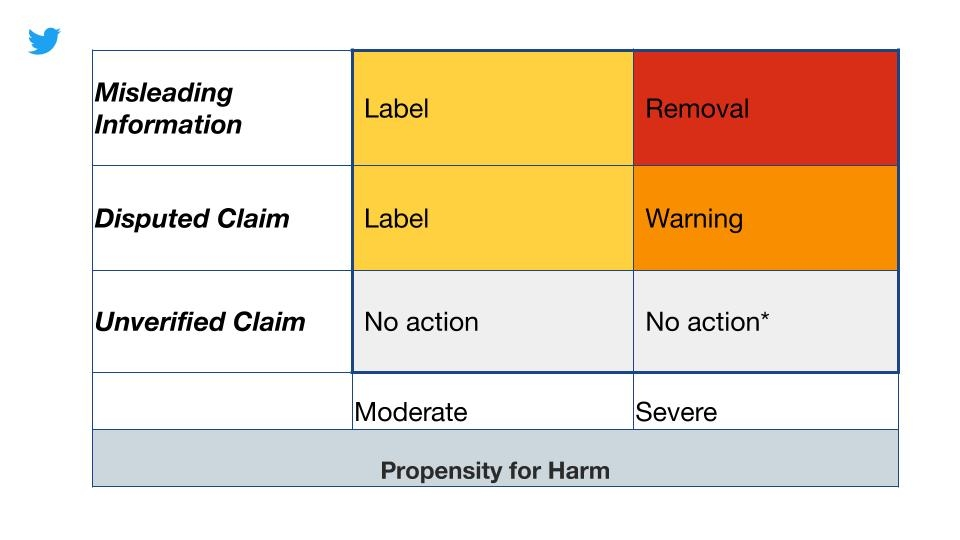
According to Twitter, the company will use its internal tools to proactively monitor content on the platform and to make sure that the company is not amplifying content by appending labels to them. Twitter is also working with its trusted partners to flag content that could yield harmful offline consequences, and will be prioritizing the review and labeling of content that could result in increased exposure to or transmission of the virus.138
As previously highlighted, advertising can also be a source of COVID-19-related misinformation and disinformation. As a result, Twitter has introduced new rules that only permit advertisers to explicitly or implicitly mention the virus in their ads if they are discussing “adjustments to business practices and/or models in response to COVID-19” and “support for customers and employees related to COVID-19.”139 Twitter does not permit advertisers to run ads that feature sensational content and inflated product prices, or which are for products that are in high demand as a result of the pandemic (e.g. face masks, alcohol hand sanitizers, etc.).140 Under Twitter’s political ads content policy,141 news publishers receive an exemption to these advertising rules and are able to promote content that discusses vaccines, treatments, and test kits.142 The company is also permitting government entities to disseminate public health information through advertising on the platform. Further, Twitter is using its “Ads for Good” program to provide advertising credit to nonprofit organizations so that they can run advertising campaigns for fact-checking services and promote reputable health information.143
During the pandemic, Twitter should publish periodic updates on its ad enforcement efforts, including the number of ads the company has removed for violating its COVID-19-specific ad policies and the number of ads that were erroneously permitted. Following the pandemic, Twitter should publish more comprehensive data outlining the scope and scale of its ad enforcement efforts during this time, especially as they relate to COVID-19-specific advertising policies. In addition, where appropriate, the FTC should enforce Section (5)(a) of the FTC Act, and hold businesses and sellers accountable when they engage in unfair and deceptive trade practices through online ad campaigns.
Citations
- Disease Pandemics and the Freedom of Opinion and Expression: Report of the Special Rapporteur on the Promotion and Protection of the Right to Freedom of Opinion and Expression, April 23, 2020, <a href="<a href="<a href="<a href="<a href="source">source">source">source">source">source">source
- Jon Porter, "Snopes Forced to Scale Back Fact-Checking In Face of Overwhelming COVID-19 Misinformation," The Verge, March 24, 2020, <a href="<a href="<a href="<a href="<a href="source">source">source">source">source">source">source
- Mark Scott, "One-Third Of People Have Seen Misleading Info On Covid-19 On Social Media," Politico, April 15, 2020, <a href="<a href="<a href="<a href="<a href="source">source">source">source">source">source">source
- John Eligon et al., "Black Americans Face Alarming Rates of Coronavirus Infection in Some State," The New York Times, April 7, 2020, <a href="<a href="<a href="<a href="<a href="source">source">source">source">source">source">source
- Jason Breslow, "Why Misinformation And Distrust Are Making COVID-19 More Dangerous For Black America," NPR, August 10, 2020, <a href="<a href="<a href="<a href="<a href="source">source">source">source">source">source">source
- Tom Kertscher, "Melanin Doesn't Protect Against Coronavirus," PolitiFact, last modified March 10, 2020, <a href="<a href="<a href="<a href="<a href="source">source">source">source">source">source">source
- Katherine Schaeffer, "Nearly Three-In-Ten Americans Believe COVID-19 Was Made In A Lab," Pew Research Center, last modified April 8, 2020, <a href="<a href="<a href="<a href="<a href="source">source">source">source">source">source">source
- Schaeffer, "Nearly Three-In-Ten," Pew Research Center.
- Tyler Sonnemaker, "Facebook, Google, Microsoft, Reddit, and Twitter Just Said They're Working Together To Fight Coronavirus Misinformation," Business Insider, March 16, 2020, <a href="<a href="<a href="<a href="<a href="source">source">source">source">source">source">source
- “10 Fascinating Amazon Statistics Sellers Need To Know in 2019,” Big Commerce, January 10, 2020, <a href="<a href="<a href="<a href="source">source">source">source">source">source
- Annie Palmer, “Amazon removes hundreds of thousands of ‘high-priced offers’ amid coronavirus price gouging,” CNBC, March 6, 2020, <a href="<a href="<a href="<a href="source">source">source">source">source">source
- “Price gouging has no place in our stores,” Day One: The Amazon Blog, March, 23, 2020, <a href="<a href="<a href="<a href="source">source">source">source">source">source
- Palmer, “Amazon removes hundreds,” CNBC.
- Amazon, “Prohibited Product Claims,” Amazon Seller Central, accessed May 16, 2020, <a href="<a href="<a href="<a href="source">source">source">source">source">source
- Amazon, “Prohibited Product Claims,” Amazon Seller Central.
- Annie Palmer, “Amazon tells sellers it will take down listings for products that claim to kill coronavirus,” CNBC, February 20, 2020, <a href="<a href="<a href="<a href="source">source">source">source">source">source
- Catherine Thorbecke, “Amazon removes 1 million products for misleading claims, price gouging amid coronavirus outbreak,” ABC News, March 3, 2020, <a href="<a href="<a href="<a href="source">source">source">source">source">source
- Palmer, “Amazon tells sellers,” CNBC.
- Louise Matsakis, “Amazon Warehouses Will Now Accept Essential Supplies Only,” Wired, March 17, 2020, <a href="<a href="<a href="<a href="source">source">source">source">source">source
- Annie Palmer, “Amazon allows sellers to start shipping nonessential items again,” CNBC, April 13, 2020, <a href="<a href="<a href="<a href="source">source">source">source">source">source
- J. Clement, "Most Popular Social Networks Worldwide As Of April 2020, Ranked By Number of active users," Statista, last modified April 24, 2020, <a href="<a href="<a href="source">source">source">source">source
- J. Clement, "Leading Countries Based on Facebook Audience Size As Of April 2020," Statista, last modified April 24, 2020, <a href="<a href="<a href="source">source">source">source">source
- Mark Scott, "Facebook's Private Groups Are Abuzz With Coronavirus Fake News," Politico, March 30, 2020, <a href="<a href="<a href="source">source">source">source">source
- Avaaz, How Facebook can Flatten the Curve of the Coronavirus Infodemic, April 15, 2020, <a href="<a href="<a href="source">source">source">source">source
- Kang-Xing Jin, "Keeping People Safe and Informed About the Coronavirus," Facebook Newsroom, <a href="<a href="<a href="source">source">source">source">source
- Mark Zuckerberg, "I want to share an update on the work we're doing to connect people with accurate information and limit the spread of misinformation about Covid-19.," Facebook, April 16, 2020, 9:01 am, <a href="<a href="<a href="source">source">source">source">source
- Guy Rosen, "An Update on Our Work to Keep People Informed and Limit Misinformation About COVID-19," Facebook Newsroom, last modified April 16, 2020, <a href="<a href="<a href="source">source">source">source">source
- Rosen, "An Update," Facebook Newsroom.
- "Investing $100 Million in the News Industry," Facebook Newsroom, last modified March 30, 2020, <a href="<a href="<a href="source">source">source">source">source
- Tessa Lyons, "Increasing Our Efforts to Fight False News," Facebook Newsroom, last modified June 21, 2018, <a href="<a href="<a href="source">source">source">source">source
- Travis Yeh, "Addressing Sensational Health Claims," Facebook Newsroom, last modified July 2, 2019, <a href="<a href="<a href="source">source">source">source">source
- "Community Standards: False News," Facebook, <a href="<a href="<a href="source">source">source">source">source
- Rosen, "An Update," Facebook Newsroom.
- Lyons, "Increasing Our Efforts," Facebook Newsroom.
- Zuckerberg, "I want," Facebook.
- Rosen, "An Update," Facebook Newsroom.
- "Connecting People to Accurate Information and Helpful Resources," Facebook Newsroom, last modified February 26, 2020, <a href="<a href="<a href="source">source">source">source">source
- "Providing Helpful Information and Support," Facebook Newsroom, last modified January 30, 2020, <a href="<a href="<a href="source">source">source">source">source
- Rosen, "An Update," Facebook Newsroom.
- World Health Organization, "Coronavirus Disease (COVID-19) Advice For The Public: Myth Busters," World Health Organization, <a href="<a href="<a href="source">source">source">source">source
- "Keeping Our People and Our Platforms Safe," Facebook Newsroom, last modified March 16, 2020, <a href="<a href="<a href="source">source">source">source">source
- "Keeping Our People," Facebook Newsroom.
- Dia Kayyali and Raja Althaibani, "Vital Human Rights Evidence in Syria is Disappearing from YouTube," WITNESS Blog, entry posted August 2017, <a href="<a href="<a href="source">source">source">source">source Spandana Singh, Everything in Moderation: An Analysis of How Internet Platforms Are Using Artificial Intelligence to Moderate User-Generated Content, July 22, 2019, <a href="<a href="<a href="source">source">source">source">source Llansó, "COVID-19 Content Moderation Research Letter – in English, Spanish, & Arabic," Center for Democracy & Technology, last modified April 22, 2020, <a href="<a href="<a href="source">source">source">source">source
- "Press Call Transcript," Facebook, last modified March 18, 2020, <a href="<a href="<a href="source">source">source">source">source
- "Press Call," Facebook.
- "Keeping Our Platform Safe With Remote and Reduced Content Review," Facebook Newsroom, last modified March 19, 2020, <a href="<a href="<a href="source">source">source">source">source
- "Exploitative Tactics in Ads," Facebook Newsroom, last modified February 26, 2020, <a href="<a href="<a href="source">source">source">source">source
- "Banning Ads and Commerce Listings for Medical Face Masks," Facebook Newsroom, last modified March 6, 2020, <a href="<a href="<a href="source">source">source">source">source.
- "Banning Ads for Hand Sanitizer, Disinfecting Wipes and COVID-19 Testing Kits," Facebook Newsroom, last modified March 19, 2020, <a href="<a href="<a href="source">source">source">source">source
- "Banning Ads for Hand," Facebook Newsroom.
- "Banning Ads and Commerce," Facebook Newsroom.
- Aaron Sankin, "Want to Find a Misinformed Public? Facebook's Already Done It," The Markup, April 23, 2020, <a href="<a href="<a href="source">source">source">source">source
- Maggie Miller, “Google to Spend $6.5 Million in Fight against Coronavirus Misinformation,” The Hill, April 2, 2020. <a href="<a href="source">source">source">source
- Miller, “Google to Spend,” The Hill.
- Sundar Pichai, “Coronavirus: How We're Helping,” The Keyword, March 6, 2020, <a href="<a href="source">source">source">source
- Alex Chris, “Top 10 Search Engines In The World,” reliablesoft.net, April 23, 2020, <a href="<a href="source">source">source">source
- Emily Moxley, “Connecting People with COVID-19 Information and Resources,” The Keyword, March 21, 2020, <a href="<a href="source">source">source">source
- “How Google Fights Disinformation,” Google, last modified February 16, 2019, <a href="<a href="source">source">source">source
- Casey Newton, “The Real Bias on Social Networks Isn't against Conservatives,” The Verge, April 11, 2019, <a href="<a href="source">source">source">source
- “How Google Fights,” Google.
- “About Knowledge Panels – Knowledge Panel Help,” Google, Accessed May 16, 2020, <a href="<a href="source">source">source">source
- Edwin Toonen, “What is Google’s Knowledge Graph?”Yoast, <a href="<a href="source">source">source">source.
- Neil Patel, “The Beginner's Guide to Google's Knowledge Graph,” Neil Patel, January 24, 2020, <a href="<a href="source">source">source">source
- “About Knowledge Panels,” Google.
- Justin Kosslyn and Cong Yu, “Fact Check Now Available in Google Search and News around the World,” Google, April 7, 2017, <a href="<a href="source">source">source">source
- Kosslyn, “Fact Check Now,” Google.
- “COVID-19,” Google, <a href="<a href="source">source">source">source
- Pichai, “Coronavirus: How We're Helping,” Google.
- “Updates to Inappropriate Policy,” Google, last modified March 2020, <a href="<a href="source">source">source">source
- Ginny Marvin, “Google bans face mask ads globally due to misleading coronavirus claims,” Search Engine Land, March 11, 2020, <a href="<a href="source">source">source">source
- Neil Kumaran and Sam Lugani, “Protecting businesses against cyber threats during COVID-19 and beyond,” Google Cloud, <a href="<a href="source">source">source">source
- Kumaran, “Protecting businesses against,” Google Cloud.
- Lauren Feiner, "Reddit Users Are The Least Valuable Of Any Social Network," CNBC, February 11, 2019, <a href="source">source">source
- Singh, Everything in Moderation.
- Reddit, "Misinformation and COVID-19: What Reddit is Doing," r/ModSupport, last modified April 16, 2020, <a href="source">source">source
- Reddit, "Misinformation and COVID-19," r/ModSupport.
- Singh, Everything in Moderation.
- Reddit, "Misinformation and COVID-19," r/ModSupport.
- Arjun Kharpal, Elizabeth Schulze, and Saheli Roy Choudhury, “How TikTok went from a fun viral app to caught in the crosshairs of the US government,” CNBC, December 16, 2019, source">source
- Kharpal, “How TikTok went,” CNBC.
- TikTok, “Supporting Our Community Through COVID-19,” Safety Center, accessed May 16, 2020, source">source
- TikTok, “Supporting Our Community,” Safety Center.
- Vanessa Pappal, “Introducing the TikTok Content Advisory Council,” TikTok, March 18, 2020, source">source
- Arjun Narayan, “Our efforts towards fighting misinformation in times of COVID-19,” TikTok, April 30, 2020, source">source
- Narayan, “Our efforts towards,” TikTok.
- TikTok, “TikTok Transparency Report,” Safety Center, released December 30, 2019, source">source
- Clement, "Most Popular," Statista.
- "Twitter by the Numbers: Stats, Demographics & Fun Facts," Omnicore, last modified February 10, 2020, source
- "Coronavirus: Staying Safe and Informed on Twitter," Twitter Blog, source.
- "Launch Of A New Dedicated #KnowTheFacts Search Prompt," Twitter Blog, last modified January 29, 2020, source.
- "Launch Of A New Dedicated," Twitter Blog.
- Del Harvey, "Helping You Find Reliable Public Health Information On Twitter," Twitter Blog, entry posted May 10, 2019, source.
- Harvey, "Helping You Find," Twitter Blog.
- Vijaya Gadde and Matt Derella, "An Update On Our Continuity Strategy During COVID-19," Twitter Blog, entry posted March 16, 2020, source.
- Gadde and Derella, "An Update," Twitter Blog.
- "Platform Manipulation and Spam Policy," Twitter General Guidelines and Policies, last modified September 2019, source
- "Our Zero-Tolerance Approach To Platform Manipulation," Twitter Blog, last modified March 4, 2020, source
- "Broadening Our Guidance On Unverified Claims," Twitter Blog, last modified April 22, 2020, source
- Adam Satariano and Davey Alba, "Burning Cell Towers, Out of Baseless Fear They Spread the Virus," The New York Times, April 10, 2020, source
- Gadde and Derella, "An Update," Twitter Blog.
- "World Leaders On Twitter: Principles & Approach," Twitter Blog, last modified October 15, 2019, source
- Gadde and Derella, "An Update," Twitter Blog.
- Yael Roth and Nick Pickles, "Updating our Approach to Misleading Information," Twitter Blog, last modified May 11, 2020, source
- Roth and Pickles, "Updating our Approach," Twitter Blog.
- "Our Ads Policy For COVID-19," Twitter Blog, last modified April 2, 2020, source
- "Our Ads Policy," Twitter Blog.
- "Political Content," Twitter Business, source
- "Our Ads Policy," Twitter Blog.
- " #AdsForGood Support and Additional Protections," Twitter Blog, last modified March 4, 2020, source
YouTube
YouTube, one of Google’s subsidiaries, is the most popular video platform on the market with approximately 2 billion users on the service worldwide.144 Given its reach, the website has become a major provider of health information. In an interview, Chief Product Officer Neal Mohan said YouTube’s response to the spread of COVID-19 misinformation on its platform has been focused on a twofold approach: “making authoritative information more prominent and aggressively removing policy-violating content.”145
While the video service reports that it has been working quickly to remove misleading videos, one watchdog organization, the Tech Transparency Project, found instances of YouTube profiting from videos pushing unproven treatments for the coronavirus.146 Specifically, the platform was running advertisements with videos pushing herbs, meditative music, and potentially unsafe over-the-counter supplements as cures for the coronavirus.147 Yet, around this same time, analysis from other researchers showed that among a sample of 320 videos related to the pandemic, four-fifths of the channels sharing coronavirus news and information are maintained by professional news outlets and that search results for popular coronavirus-related terms returned mostly factual and neutral video results.148 Since the publication of both these studies, YouTube has taken other actions to address misleading information.
YouTube has taken a number of proactive steps to educate users from verified sources and to dissuade misinformation attempts, however, some of their efforts may have negative consequences for content creators. First, the company established clear guidelines and restrictions for demonetizing content related to COVID-19, including content that misinforms users about health matters related to the virus.149 Additionally, the site is directing users from YouTube’s homepage to the WHO or other locally relevant authoritative organizations when they search for terms related to COVID-19 on the site.150 Further, the company has committed to donating ad inventory to governments and NGOs in affected regions to use for education and information.151
In addition, in late April, YouTube announced that it would expand the use of its algorithmically-recommended information panels to connect users to authoritative information when they search for COVID-19-related queries. Information panels were originally introduced in 2018, and they provide users with contextual information from third-party fact-checked articles. With regard to broad misinformation, these panels were primarily used to surface contextual and authoritative information related to longstanding misinformation stories, such as “flat earth” theories.152
Information panels have also been employed by YouTube to provide the user with topical context. As mentioned above, when a user engages with videos or search results related to COVID-19, the information panels will connect them to information from the WHO, CDC, or local health authorities. Additionally, in order to tackle misinformation that spreads as part of the rapidly-moving news cycle, when a user enters a query seeking information that relates to a specific claim for which the platform has a relevant third-party fact-checked article, YouTube may display an information panel at the top of the search results that includes: the fact-checked article title, a link to the article, and the publisher’s name. If more than one relevant fact-checked article exists, YouTube will show a carousel that allows users to scroll through the available articles.153 In addition to this roll out, YouTube announced that it will provide $1 million through the Google News Initiative to the International Fact-Checking Network to bolster fact-checking and verification efforts across the world.154
Like Facebook and Twitter, YouTube’s content review capacity has significantly decreased during the pandemic, and the company is increasingly relying on automated tools for content review and moderation. Therefore, while these efforts to combat misinformation should yield positive results, YouTube has warned that the service’s reliance on automated tools may lead to an increase in erroneous removals of videos that appear to be in violation of YouTube’s policies.155 Typically, YouTube utilizes machine learning algorithms to flag potentially harmful content, which is then sent to human moderators for review.156 One major consequence of the shift to a mostly automated system is that content creators who feel that their content was mistakenly taken down or demonetized may face delays in the appeals process. Although the process has not changed, decreased human content review capacity means it will take longer to assess appeals.157 However, despite the delays, it is important that the company is still maintaining an appeals review process, as this is a vital source of redress and remedy in the content moderation process.
YouTube’s shift in content moderation operations will undoubtedly have a major impact on the amount of content that is removed. It is therefore important for YouTube to provide periodic updates on its content moderation efforts during the pandemic. In addition, following the pandemic, YouTube should create a comprehensive COVID-19 report that highlights the scope and scale of content moderation efforts during this time, and that provides data showing the amount of content that was removed as a result of automated detection as well as human flags. This reporting will help civil society organizations and researchers further understand the use of automated tools in moderating misleading content. In addition, YouTube should expand its general transparency reporting to include more granular data on the moderation of misleading content.
Citations
- Disease Pandemics and the Freedom of Opinion and Expression: Report of the Special Rapporteur on the Promotion and Protection of the Right to Freedom of Opinion and Expression, April 23, 2020, <a href="<a href="<a href="<a href="<a href="<a href="source">source">source">source">source">source">source">source
- Jon Porter, "Snopes Forced to Scale Back Fact-Checking In Face of Overwhelming COVID-19 Misinformation," The Verge, March 24, 2020, <a href="<a href="<a href="<a href="<a href="<a href="source">source">source">source">source">source">source">source
- Mark Scott, "One-Third Of People Have Seen Misleading Info On Covid-19 On Social Media," Politico, April 15, 2020, <a href="<a href="<a href="<a href="<a href="<a href="source">source">source">source">source">source">source">source
- John Eligon et al., "Black Americans Face Alarming Rates of Coronavirus Infection in Some State," The New York Times, April 7, 2020, <a href="<a href="<a href="<a href="<a href="<a href="source">source">source">source">source">source">source">source
- Jason Breslow, "Why Misinformation And Distrust Are Making COVID-19 More Dangerous For Black America," NPR, August 10, 2020, <a href="<a href="<a href="<a href="<a href="<a href="source">source">source">source">source">source">source">source
- Tom Kertscher, "Melanin Doesn't Protect Against Coronavirus," PolitiFact, last modified March 10, 2020, <a href="<a href="<a href="<a href="<a href="<a href="source">source">source">source">source">source">source">source
- Katherine Schaeffer, "Nearly Three-In-Ten Americans Believe COVID-19 Was Made In A Lab," Pew Research Center, last modified April 8, 2020, <a href="<a href="<a href="<a href="<a href="<a href="source">source">source">source">source">source">source">source
- Schaeffer, "Nearly Three-In-Ten," Pew Research Center.
- Tyler Sonnemaker, "Facebook, Google, Microsoft, Reddit, and Twitter Just Said They're Working Together To Fight Coronavirus Misinformation," Business Insider, March 16, 2020, <a href="<a href="<a href="<a href="<a href="<a href="source">source">source">source">source">source">source">source
- “10 Fascinating Amazon Statistics Sellers Need To Know in 2019,” Big Commerce, January 10, 2020, <a href="<a href="<a href="<a href="<a href="source">source">source">source">source">source">source
- Annie Palmer, “Amazon removes hundreds of thousands of ‘high-priced offers’ amid coronavirus price gouging,” CNBC, March 6, 2020, <a href="<a href="<a href="<a href="<a href="source">source">source">source">source">source">source
- “Price gouging has no place in our stores,” Day One: The Amazon Blog, March, 23, 2020, <a href="<a href="<a href="<a href="<a href="source">source">source">source">source">source">source
- Palmer, “Amazon removes hundreds,” CNBC.
- Amazon, “Prohibited Product Claims,” Amazon Seller Central, accessed May 16, 2020, <a href="<a href="<a href="<a href="<a href="source">source">source">source">source">source">source
- Amazon, “Prohibited Product Claims,” Amazon Seller Central.
- Annie Palmer, “Amazon tells sellers it will take down listings for products that claim to kill coronavirus,” CNBC, February 20, 2020, <a href="<a href="<a href="<a href="<a href="source">source">source">source">source">source">source
- Catherine Thorbecke, “Amazon removes 1 million products for misleading claims, price gouging amid coronavirus outbreak,” ABC News, March 3, 2020, <a href="<a href="<a href="<a href="<a href="source">source">source">source">source">source">source
- Palmer, “Amazon tells sellers,” CNBC.
- Louise Matsakis, “Amazon Warehouses Will Now Accept Essential Supplies Only,” Wired, March 17, 2020, <a href="<a href="<a href="<a href="<a href="source">source">source">source">source">source">source
- Annie Palmer, “Amazon allows sellers to start shipping nonessential items again,” CNBC, April 13, 2020, <a href="<a href="<a href="<a href="<a href="source">source">source">source">source">source">source
- J. Clement, "Most Popular Social Networks Worldwide As Of April 2020, Ranked By Number of active users," Statista, last modified April 24, 2020, <a href="<a href="<a href="<a href="source">source">source">source">source">source
- J. Clement, "Leading Countries Based on Facebook Audience Size As Of April 2020," Statista, last modified April 24, 2020, <a href="<a href="<a href="<a href="source">source">source">source">source">source
- Mark Scott, "Facebook's Private Groups Are Abuzz With Coronavirus Fake News," Politico, March 30, 2020, <a href="<a href="<a href="<a href="source">source">source">source">source">source
- Avaaz, How Facebook can Flatten the Curve of the Coronavirus Infodemic, April 15, 2020, <a href="<a href="<a href="<a href="source">source">source">source">source">source
- Kang-Xing Jin, "Keeping People Safe and Informed About the Coronavirus," Facebook Newsroom, <a href="<a href="<a href="<a href="source">source">source">source">source">source
- Mark Zuckerberg, "I want to share an update on the work we're doing to connect people with accurate information and limit the spread of misinformation about Covid-19.," Facebook, April 16, 2020, 9:01 am, <a href="<a href="<a href="<a href="source">source">source">source">source">source
- Guy Rosen, "An Update on Our Work to Keep People Informed and Limit Misinformation About COVID-19," Facebook Newsroom, last modified April 16, 2020, <a href="<a href="<a href="<a href="source">source">source">source">source">source
- Rosen, "An Update," Facebook Newsroom.
- "Investing $100 Million in the News Industry," Facebook Newsroom, last modified March 30, 2020, <a href="<a href="<a href="<a href="source">source">source">source">source">source
- Tessa Lyons, "Increasing Our Efforts to Fight False News," Facebook Newsroom, last modified June 21, 2018, <a href="<a href="<a href="<a href="source">source">source">source">source">source
- Travis Yeh, "Addressing Sensational Health Claims," Facebook Newsroom, last modified July 2, 2019, <a href="<a href="<a href="<a href="source">source">source">source">source">source
- "Community Standards: False News," Facebook, <a href="<a href="<a href="<a href="source">source">source">source">source">source
- Rosen, "An Update," Facebook Newsroom.
- Lyons, "Increasing Our Efforts," Facebook Newsroom.
- Zuckerberg, "I want," Facebook.
- Rosen, "An Update," Facebook Newsroom.
- "Connecting People to Accurate Information and Helpful Resources," Facebook Newsroom, last modified February 26, 2020, <a href="<a href="<a href="<a href="source">source">source">source">source">source
- "Providing Helpful Information and Support," Facebook Newsroom, last modified January 30, 2020, <a href="<a href="<a href="<a href="source">source">source">source">source">source
- Rosen, "An Update," Facebook Newsroom.
- World Health Organization, "Coronavirus Disease (COVID-19) Advice For The Public: Myth Busters," World Health Organization, <a href="<a href="<a href="<a href="source">source">source">source">source">source
- "Keeping Our People and Our Platforms Safe," Facebook Newsroom, last modified March 16, 2020, <a href="<a href="<a href="<a href="source">source">source">source">source">source
- "Keeping Our People," Facebook Newsroom.
- Dia Kayyali and Raja Althaibani, "Vital Human Rights Evidence in Syria is Disappearing from YouTube," WITNESS Blog, entry posted August 2017, <a href="<a href="<a href="<a href="source">source">source">source">source">source Spandana Singh, Everything in Moderation: An Analysis of How Internet Platforms Are Using Artificial Intelligence to Moderate User-Generated Content, July 22, 2019, <a href="<a href="<a href="<a href="source">source">source">source">source">source Llansó, "COVID-19 Content Moderation Research Letter – in English, Spanish, & Arabic," Center for Democracy & Technology, last modified April 22, 2020, <a href="<a href="<a href="<a href="source">source">source">source">source">source
- "Press Call Transcript," Facebook, last modified March 18, 2020, <a href="<a href="<a href="<a href="source">source">source">source">source">source
- "Press Call," Facebook.
- "Keeping Our Platform Safe With Remote and Reduced Content Review," Facebook Newsroom, last modified March 19, 2020, <a href="<a href="<a href="<a href="source">source">source">source">source">source
- "Exploitative Tactics in Ads," Facebook Newsroom, last modified February 26, 2020, <a href="<a href="<a href="<a href="source">source">source">source">source">source
- "Banning Ads and Commerce Listings for Medical Face Masks," Facebook Newsroom, last modified March 6, 2020, <a href="<a href="<a href="<a href="source">source">source">source">source">source.
- "Banning Ads for Hand Sanitizer, Disinfecting Wipes and COVID-19 Testing Kits," Facebook Newsroom, last modified March 19, 2020, <a href="<a href="<a href="<a href="source">source">source">source">source">source
- "Banning Ads for Hand," Facebook Newsroom.
- "Banning Ads and Commerce," Facebook Newsroom.
- Aaron Sankin, "Want to Find a Misinformed Public? Facebook's Already Done It," The Markup, April 23, 2020, <a href="<a href="<a href="<a href="source">source">source">source">source">source
- Maggie Miller, “Google to Spend $6.5 Million in Fight against Coronavirus Misinformation,” The Hill, April 2, 2020. <a href="<a href="<a href="source">source">source">source">source
- Miller, “Google to Spend,” The Hill.
- Sundar Pichai, “Coronavirus: How We're Helping,” The Keyword, March 6, 2020, <a href="<a href="<a href="source">source">source">source">source
- Alex Chris, “Top 10 Search Engines In The World,” reliablesoft.net, April 23, 2020, <a href="<a href="<a href="source">source">source">source">source
- Emily Moxley, “Connecting People with COVID-19 Information and Resources,” The Keyword, March 21, 2020, <a href="<a href="<a href="source">source">source">source">source
- “How Google Fights Disinformation,” Google, last modified February 16, 2019, <a href="<a href="<a href="source">source">source">source">source
- Casey Newton, “The Real Bias on Social Networks Isn't against Conservatives,” The Verge, April 11, 2019, <a href="<a href="<a href="source">source">source">source">source
- “How Google Fights,” Google.
- “About Knowledge Panels – Knowledge Panel Help,” Google, Accessed May 16, 2020, <a href="<a href="<a href="source">source">source">source">source
- Edwin Toonen, “What is Google’s Knowledge Graph?”Yoast, <a href="<a href="<a href="source">source">source">source">source.
- Neil Patel, “The Beginner's Guide to Google's Knowledge Graph,” Neil Patel, January 24, 2020, <a href="<a href="<a href="source">source">source">source">source
- “About Knowledge Panels,” Google.
- Justin Kosslyn and Cong Yu, “Fact Check Now Available in Google Search and News around the World,” Google, April 7, 2017, <a href="<a href="<a href="source">source">source">source">source
- Kosslyn, “Fact Check Now,” Google.
- “COVID-19,” Google, <a href="<a href="<a href="source">source">source">source">source
- Pichai, “Coronavirus: How We're Helping,” Google.
- “Updates to Inappropriate Policy,” Google, last modified March 2020, <a href="<a href="<a href="source">source">source">source">source
- Ginny Marvin, “Google bans face mask ads globally due to misleading coronavirus claims,” Search Engine Land, March 11, 2020, <a href="<a href="<a href="source">source">source">source">source
- Neil Kumaran and Sam Lugani, “Protecting businesses against cyber threats during COVID-19 and beyond,” Google Cloud, <a href="<a href="<a href="source">source">source">source">source
- Kumaran, “Protecting businesses against,” Google Cloud.
- Lauren Feiner, "Reddit Users Are The Least Valuable Of Any Social Network," CNBC, February 11, 2019, <a href="<a href="source">source">source">source
- Singh, Everything in Moderation.
- Reddit, "Misinformation and COVID-19: What Reddit is Doing," r/ModSupport, last modified April 16, 2020, <a href="<a href="source">source">source">source
- Reddit, "Misinformation and COVID-19," r/ModSupport.
- Singh, Everything in Moderation.
- Reddit, "Misinformation and COVID-19," r/ModSupport.
- Arjun Kharpal, Elizabeth Schulze, and Saheli Roy Choudhury, “How TikTok went from a fun viral app to caught in the crosshairs of the US government,” CNBC, December 16, 2019, <a href="source">source">source
- Kharpal, “How TikTok went,” CNBC.
- TikTok, “Supporting Our Community Through COVID-19,” Safety Center, accessed May 16, 2020, <a href="source">source">source
- TikTok, “Supporting Our Community,” Safety Center.
- Vanessa Pappal, “Introducing the TikTok Content Advisory Council,” TikTok, March 18, 2020, <a href="source">source">source
- Arjun Narayan, “Our efforts towards fighting misinformation in times of COVID-19,” TikTok, April 30, 2020, <a href="source">source">source
- Narayan, “Our efforts towards,” TikTok.
- TikTok, “TikTok Transparency Report,” Safety Center, released December 30, 2019, <a href="source">source">source
- Clement, "Most Popular," Statista.
- "Twitter by the Numbers: Stats, Demographics & Fun Facts," Omnicore, last modified February 10, 2020, source">source
- "Coronavirus: Staying Safe and Informed on Twitter," Twitter Blog, source">source.
- "Launch Of A New Dedicated #KnowTheFacts Search Prompt," Twitter Blog, last modified January 29, 2020, source">source.
- "Launch Of A New Dedicated," Twitter Blog.
- Del Harvey, "Helping You Find Reliable Public Health Information On Twitter," Twitter Blog, entry posted May 10, 2019, source">source.
- Harvey, "Helping You Find," Twitter Blog.
- Vijaya Gadde and Matt Derella, "An Update On Our Continuity Strategy During COVID-19," Twitter Blog, entry posted March 16, 2020, source">source.
- Gadde and Derella, "An Update," Twitter Blog.
- "Platform Manipulation and Spam Policy," Twitter General Guidelines and Policies, last modified September 2019, source">source
- "Our Zero-Tolerance Approach To Platform Manipulation," Twitter Blog, last modified March 4, 2020, source">source
- "Broadening Our Guidance On Unverified Claims," Twitter Blog, last modified April 22, 2020, source">source
- Adam Satariano and Davey Alba, "Burning Cell Towers, Out of Baseless Fear They Spread the Virus," The New York Times, April 10, 2020, source">source
- Gadde and Derella, "An Update," Twitter Blog.
- "World Leaders On Twitter: Principles & Approach," Twitter Blog, last modified October 15, 2019, source">source
- Gadde and Derella, "An Update," Twitter Blog.
- Yael Roth and Nick Pickles, "Updating our Approach to Misleading Information," Twitter Blog, last modified May 11, 2020, source">source
- Roth and Pickles, "Updating our Approach," Twitter Blog.
- "Our Ads Policy For COVID-19," Twitter Blog, last modified April 2, 2020, source">source
- "Our Ads Policy," Twitter Blog.
- "Political Content," Twitter Business, source">source
- "Our Ads Policy," Twitter Blog.
- " #AdsForGood Support and Additional Protections," Twitter Blog, last modified March 4, 2020, source">source
- Maryam Mohsin, “10 Youtube Stats Every Marketer Should Know in 2020,” Oberlo, November 11, 2019, source
- Ina Fried, “YouTube pulls coronavirus misinformation videos,” Axios, April 7, 2020, source
- Kari Paul, “YouTube profits from videos promoting unproven Covid-19 treatments,” The Guardian, April 3, 2020, source
- Paul, “YouTube profits from,” The Guardian.
- Nahema Marchal, Hubert Au, and Philip N. Howard, “Coronavirus News and Information on YouTube: A Content Analysis of Popular Search Terms,” The Computational Propaganda Project, April 20, 2020, source
- “Monetization update on COVID-19 content,” YouTube Help, Accessed May 16, 2020, source
- Pichai, “Coronavirus: How We're Helping,” Google.
- “Expanding fact checks on YouTube to the United States,” YouTube: Official Blog, April 28, 2020,source
- “Expanding fact checks,” YouTube: Official Blog.
- “Protecting our extended workforce and the community,” YouTube: Creator Blog, Google, March 16, 2020, source
- Sarah Perez, “YouTube warns of increased video removals during COVID-19 crisis,” Tech Crunch, March 16, 2020, source
- “Actions to reduce the need for people to come into our offices,” The Keyword, March 16, 2020, source
WhatsApp is the world’s largest messaging app, with over 1.6 billion users around the globe.158 The messaging platform, which was acquired by Facebook in 2014, has received significant criticism for fueling the spread of misinformation and disinformation globally, particularly during the COVID-19 pandemic.159
While Facebook and WhatsApp jointly post updates on their efforts through Facebook’s COVID-19 information center, the fact that WhatsApp is an end-to-end encrypted messaging platform raises other challenges related to combating disinformation and misinformation. Encryption is vital for privacy and security, and therefore, managing misinformation and disinformation in an encrypted environment requires different approaches. Because the company cannot see the content of messages, WhatsApp cannot identify and fact-check misleading content and/or subsequently append warnings and explanations to such content. Instead, the platform has worked to connect users with legitimate and authoritative information related to the virus.160 On March 20, WhatsApp launched the WHO’s Health Alert, a free tip line feature that enables users to access timely and legitimate information related to the virus, such as how it is spread, travel guidance, and information that debunks commonly circulated misinformation stories. The service was initially launched in English, and will also be available in Arabic, Chinese, French, Spanish, and Russian.161
In addition, in early April, the company also placed new, stricter limits on the number of times a forwarded message can be shared.162 If a message has already been forwarded five times, the receiving user can only pass it on to other chats one at a time. These restrictions are far more stringent than those that were previously introduced. For example, two years ago, WhatsApp limited forwarding to 250 groups at once, and one year ago, these restrictions were tightened so that forwarding was limited to five groups.163 According to Whatsapp, the latest restrictions have resulted in a 70 percent drop in the spread of “highly forwarded messages” around the globe.164
WhatsApp also has the capability to detect and ban accounts that engage in spam or suspicious behavior.165 To the extent that WhatsApp is using these approaches to combat the spread of misinformation and disinformation on the service during the pandemic, the company should publish data outlining the scope and scale of these enforcement actions during the pandemic. This data should be published periodically during the pandemic as well as in a COVID-19-specific transparency report following the pandemic. Whatsapp does not currently publish this data generally. Going forward, the company should also begin publishing this data during non-emergency time periods as well.
Citations
- Disease Pandemics and the Freedom of Opinion and Expression: Report of the Special Rapporteur on the Promotion and Protection of the Right to Freedom of Opinion and Expression, April 23, 2020, <a href="<a href="<a href="<a href="<a href="<a href="<a href="source">source">source">source">source">source">source">source">source
- Jon Porter, "Snopes Forced to Scale Back Fact-Checking In Face of Overwhelming COVID-19 Misinformation," The Verge, March 24, 2020, <a href="<a href="<a href="<a href="<a href="<a href="<a href="source">source">source">source">source">source">source">source">source
- Mark Scott, "One-Third Of People Have Seen Misleading Info On Covid-19 On Social Media," Politico, April 15, 2020, <a href="<a href="<a href="<a href="<a href="<a href="<a href="source">source">source">source">source">source">source">source">source
- John Eligon et al., "Black Americans Face Alarming Rates of Coronavirus Infection in Some State," The New York Times, April 7, 2020, <a href="<a href="<a href="<a href="<a href="<a href="<a href="source">source">source">source">source">source">source">source">source
- Jason Breslow, "Why Misinformation And Distrust Are Making COVID-19 More Dangerous For Black America," NPR, August 10, 2020, <a href="<a href="<a href="<a href="<a href="<a href="<a href="source">source">source">source">source">source">source">source">source
- Tom Kertscher, "Melanin Doesn't Protect Against Coronavirus," PolitiFact, last modified March 10, 2020, <a href="<a href="<a href="<a href="<a href="<a href="<a href="source">source">source">source">source">source">source">source">source
- Katherine Schaeffer, "Nearly Three-In-Ten Americans Believe COVID-19 Was Made In A Lab," Pew Research Center, last modified April 8, 2020, <a href="<a href="<a href="<a href="<a href="<a href="<a href="source">source">source">source">source">source">source">source">source
- Schaeffer, "Nearly Three-In-Ten," Pew Research Center.
- Tyler Sonnemaker, "Facebook, Google, Microsoft, Reddit, and Twitter Just Said They're Working Together To Fight Coronavirus Misinformation," Business Insider, March 16, 2020, <a href="<a href="<a href="<a href="<a href="<a href="<a href="source">source">source">source">source">source">source">source">source
- “10 Fascinating Amazon Statistics Sellers Need To Know in 2019,” Big Commerce, January 10, 2020, <a href="<a href="<a href="<a href="<a href="<a href="source">source">source">source">source">source">source">source
- Annie Palmer, “Amazon removes hundreds of thousands of ‘high-priced offers’ amid coronavirus price gouging,” CNBC, March 6, 2020, <a href="<a href="<a href="<a href="<a href="<a href="source">source">source">source">source">source">source">source
- “Price gouging has no place in our stores,” Day One: The Amazon Blog, March, 23, 2020, <a href="<a href="<a href="<a href="<a href="<a href="source">source">source">source">source">source">source">source
- Palmer, “Amazon removes hundreds,” CNBC.
- Amazon, “Prohibited Product Claims,” Amazon Seller Central, accessed May 16, 2020, <a href="<a href="<a href="<a href="<a href="<a href="source">source">source">source">source">source">source">source
- Amazon, “Prohibited Product Claims,” Amazon Seller Central.
- Annie Palmer, “Amazon tells sellers it will take down listings for products that claim to kill coronavirus,” CNBC, February 20, 2020, <a href="<a href="<a href="<a href="<a href="<a href="source">source">source">source">source">source">source">source
- Catherine Thorbecke, “Amazon removes 1 million products for misleading claims, price gouging amid coronavirus outbreak,” ABC News, March 3, 2020, <a href="<a href="<a href="<a href="<a href="<a href="source">source">source">source">source">source">source">source
- Palmer, “Amazon tells sellers,” CNBC.
- Louise Matsakis, “Amazon Warehouses Will Now Accept Essential Supplies Only,” Wired, March 17, 2020, <a href="<a href="<a href="<a href="<a href="<a href="source">source">source">source">source">source">source">source
- Annie Palmer, “Amazon allows sellers to start shipping nonessential items again,” CNBC, April 13, 2020, <a href="<a href="<a href="<a href="<a href="<a href="source">source">source">source">source">source">source">source
- J. Clement, "Most Popular Social Networks Worldwide As Of April 2020, Ranked By Number of active users," Statista, last modified April 24, 2020, <a href="<a href="<a href="<a href="<a href="source">source">source">source">source">source">source
- J. Clement, "Leading Countries Based on Facebook Audience Size As Of April 2020," Statista, last modified April 24, 2020, <a href="<a href="<a href="<a href="<a href="source">source">source">source">source">source">source
- Mark Scott, "Facebook's Private Groups Are Abuzz With Coronavirus Fake News," Politico, March 30, 2020, <a href="<a href="<a href="<a href="<a href="source">source">source">source">source">source">source
- Avaaz, How Facebook can Flatten the Curve of the Coronavirus Infodemic, April 15, 2020, <a href="<a href="<a href="<a href="<a href="source">source">source">source">source">source">source
- Kang-Xing Jin, "Keeping People Safe and Informed About the Coronavirus," Facebook Newsroom, <a href="<a href="<a href="<a href="<a href="source">source">source">source">source">source">source
- Mark Zuckerberg, "I want to share an update on the work we're doing to connect people with accurate information and limit the spread of misinformation about Covid-19.," Facebook, April 16, 2020, 9:01 am, <a href="<a href="<a href="<a href="<a href="source">source">source">source">source">source">source
- Guy Rosen, "An Update on Our Work to Keep People Informed and Limit Misinformation About COVID-19," Facebook Newsroom, last modified April 16, 2020, <a href="<a href="<a href="<a href="<a href="source">source">source">source">source">source">source
- Rosen, "An Update," Facebook Newsroom.
- "Investing $100 Million in the News Industry," Facebook Newsroom, last modified March 30, 2020, <a href="<a href="<a href="<a href="<a href="source">source">source">source">source">source">source
- Tessa Lyons, "Increasing Our Efforts to Fight False News," Facebook Newsroom, last modified June 21, 2018, <a href="<a href="<a href="<a href="<a href="source">source">source">source">source">source">source
- Travis Yeh, "Addressing Sensational Health Claims," Facebook Newsroom, last modified July 2, 2019, <a href="<a href="<a href="<a href="<a href="source">source">source">source">source">source">source
- "Community Standards: False News," Facebook, <a href="<a href="<a href="<a href="<a href="source">source">source">source">source">source">source
- Rosen, "An Update," Facebook Newsroom.
- Lyons, "Increasing Our Efforts," Facebook Newsroom.
- Zuckerberg, "I want," Facebook.
- Rosen, "An Update," Facebook Newsroom.
- "Connecting People to Accurate Information and Helpful Resources," Facebook Newsroom, last modified February 26, 2020, <a href="<a href="<a href="<a href="<a href="source">source">source">source">source">source">source
- "Providing Helpful Information and Support," Facebook Newsroom, last modified January 30, 2020, <a href="<a href="<a href="<a href="<a href="source">source">source">source">source">source">source
- Rosen, "An Update," Facebook Newsroom.
- World Health Organization, "Coronavirus Disease (COVID-19) Advice For The Public: Myth Busters," World Health Organization, <a href="<a href="<a href="<a href="<a href="source">source">source">source">source">source">source
- "Keeping Our People and Our Platforms Safe," Facebook Newsroom, last modified March 16, 2020, <a href="<a href="<a href="<a href="<a href="source">source">source">source">source">source">source
- "Keeping Our People," Facebook Newsroom.
- Dia Kayyali and Raja Althaibani, "Vital Human Rights Evidence in Syria is Disappearing from YouTube," WITNESS Blog, entry posted August 2017, <a href="<a href="<a href="<a href="<a href="source">source">source">source">source">source">source Spandana Singh, Everything in Moderation: An Analysis of How Internet Platforms Are Using Artificial Intelligence to Moderate User-Generated Content, July 22, 2019, <a href="<a href="<a href="<a href="<a href="source">source">source">source">source">source">source Llansó, "COVID-19 Content Moderation Research Letter – in English, Spanish, & Arabic," Center for Democracy & Technology, last modified April 22, 2020, <a href="<a href="<a href="<a href="<a href="source">source">source">source">source">source">source
- "Press Call Transcript," Facebook, last modified March 18, 2020, <a href="<a href="<a href="<a href="<a href="source">source">source">source">source">source">source
- "Press Call," Facebook.
- "Keeping Our Platform Safe With Remote and Reduced Content Review," Facebook Newsroom, last modified March 19, 2020, <a href="<a href="<a href="<a href="<a href="source">source">source">source">source">source">source
- "Exploitative Tactics in Ads," Facebook Newsroom, last modified February 26, 2020, <a href="<a href="<a href="<a href="<a href="source">source">source">source">source">source">source
- "Banning Ads and Commerce Listings for Medical Face Masks," Facebook Newsroom, last modified March 6, 2020, <a href="<a href="<a href="<a href="<a href="source">source">source">source">source">source">source.
- "Banning Ads for Hand Sanitizer, Disinfecting Wipes and COVID-19 Testing Kits," Facebook Newsroom, last modified March 19, 2020, <a href="<a href="<a href="<a href="<a href="source">source">source">source">source">source">source
- "Banning Ads for Hand," Facebook Newsroom.
- "Banning Ads and Commerce," Facebook Newsroom.
- Aaron Sankin, "Want to Find a Misinformed Public? Facebook's Already Done It," The Markup, April 23, 2020, <a href="<a href="<a href="<a href="<a href="source">source">source">source">source">source">source
- Maggie Miller, “Google to Spend $6.5 Million in Fight against Coronavirus Misinformation,” The Hill, April 2, 2020. <a href="<a href="<a href="<a href="source">source">source">source">source">source
- Miller, “Google to Spend,” The Hill.
- Sundar Pichai, “Coronavirus: How We're Helping,” The Keyword, March 6, 2020, <a href="<a href="<a href="<a href="source">source">source">source">source">source
- Alex Chris, “Top 10 Search Engines In The World,” reliablesoft.net, April 23, 2020, <a href="<a href="<a href="<a href="source">source">source">source">source">source
- Emily Moxley, “Connecting People with COVID-19 Information and Resources,” The Keyword, March 21, 2020, <a href="<a href="<a href="<a href="source">source">source">source">source">source
- “How Google Fights Disinformation,” Google, last modified February 16, 2019, <a href="<a href="<a href="<a href="source">source">source">source">source">source
- Casey Newton, “The Real Bias on Social Networks Isn't against Conservatives,” The Verge, April 11, 2019, <a href="<a href="<a href="<a href="source">source">source">source">source">source
- “How Google Fights,” Google.
- “About Knowledge Panels – Knowledge Panel Help,” Google, Accessed May 16, 2020, <a href="<a href="<a href="<a href="source">source">source">source">source">source
- Edwin Toonen, “What is Google’s Knowledge Graph?”Yoast, <a href="<a href="<a href="<a href="source">source">source">source">source">source.
- Neil Patel, “The Beginner's Guide to Google's Knowledge Graph,” Neil Patel, January 24, 2020, <a href="<a href="<a href="<a href="source">source">source">source">source">source
- “About Knowledge Panels,” Google.
- Justin Kosslyn and Cong Yu, “Fact Check Now Available in Google Search and News around the World,” Google, April 7, 2017, <a href="<a href="<a href="<a href="source">source">source">source">source">source
- Kosslyn, “Fact Check Now,” Google.
- “COVID-19,” Google, <a href="<a href="<a href="<a href="source">source">source">source">source">source
- Pichai, “Coronavirus: How We're Helping,” Google.
- “Updates to Inappropriate Policy,” Google, last modified March 2020, <a href="<a href="<a href="<a href="source">source">source">source">source">source
- Ginny Marvin, “Google bans face mask ads globally due to misleading coronavirus claims,” Search Engine Land, March 11, 2020, <a href="<a href="<a href="<a href="source">source">source">source">source">source
- Neil Kumaran and Sam Lugani, “Protecting businesses against cyber threats during COVID-19 and beyond,” Google Cloud, <a href="<a href="<a href="<a href="source">source">source">source">source">source
- Kumaran, “Protecting businesses against,” Google Cloud.
- Lauren Feiner, "Reddit Users Are The Least Valuable Of Any Social Network," CNBC, February 11, 2019, <a href="<a href="<a href="source">source">source">source">source
- Singh, Everything in Moderation.
- Reddit, "Misinformation and COVID-19: What Reddit is Doing," r/ModSupport, last modified April 16, 2020, <a href="<a href="<a href="source">source">source">source">source
- Reddit, "Misinformation and COVID-19," r/ModSupport.
- Singh, Everything in Moderation.
- Reddit, "Misinformation and COVID-19," r/ModSupport.
- Arjun Kharpal, Elizabeth Schulze, and Saheli Roy Choudhury, “How TikTok went from a fun viral app to caught in the crosshairs of the US government,” CNBC, December 16, 2019, <a href="<a href="source">source">source">source
- Kharpal, “How TikTok went,” CNBC.
- TikTok, “Supporting Our Community Through COVID-19,” Safety Center, accessed May 16, 2020, <a href="<a href="source">source">source">source
- TikTok, “Supporting Our Community,” Safety Center.
- Vanessa Pappal, “Introducing the TikTok Content Advisory Council,” TikTok, March 18, 2020, <a href="<a href="source">source">source">source
- Arjun Narayan, “Our efforts towards fighting misinformation in times of COVID-19,” TikTok, April 30, 2020, <a href="<a href="source">source">source">source
- Narayan, “Our efforts towards,” TikTok.
- TikTok, “TikTok Transparency Report,” Safety Center, released December 30, 2019, <a href="<a href="source">source">source">source
- Clement, "Most Popular," Statista.
- "Twitter by the Numbers: Stats, Demographics & Fun Facts," Omnicore, last modified February 10, 2020, <a href="source">source">source
- "Coronavirus: Staying Safe and Informed on Twitter," Twitter Blog, <a href="source">source">source.
- "Launch Of A New Dedicated #KnowTheFacts Search Prompt," Twitter Blog, last modified January 29, 2020, <a href="source">source">source.
- "Launch Of A New Dedicated," Twitter Blog.
- Del Harvey, "Helping You Find Reliable Public Health Information On Twitter," Twitter Blog, entry posted May 10, 2019, <a href="source">source">source.
- Harvey, "Helping You Find," Twitter Blog.
- Vijaya Gadde and Matt Derella, "An Update On Our Continuity Strategy During COVID-19," Twitter Blog, entry posted March 16, 2020, <a href="source">source">source.
- Gadde and Derella, "An Update," Twitter Blog.
- "Platform Manipulation and Spam Policy," Twitter General Guidelines and Policies, last modified September 2019, <a href="source">source">source
- "Our Zero-Tolerance Approach To Platform Manipulation," Twitter Blog, last modified March 4, 2020, <a href="source">source">source
- "Broadening Our Guidance On Unverified Claims," Twitter Blog, last modified April 22, 2020, <a href="source">source">source
- Adam Satariano and Davey Alba, "Burning Cell Towers, Out of Baseless Fear They Spread the Virus," The New York Times, April 10, 2020, <a href="source">source">source
- Gadde and Derella, "An Update," Twitter Blog.
- "World Leaders On Twitter: Principles & Approach," Twitter Blog, last modified October 15, 2019, <a href="source">source">source
- Gadde and Derella, "An Update," Twitter Blog.
- Yael Roth and Nick Pickles, "Updating our Approach to Misleading Information," Twitter Blog, last modified May 11, 2020, <a href="source">source">source
- Roth and Pickles, "Updating our Approach," Twitter Blog.
- "Our Ads Policy For COVID-19," Twitter Blog, last modified April 2, 2020, <a href="source">source">source
- "Our Ads Policy," Twitter Blog.
- "Political Content," Twitter Business, <a href="source">source">source
- "Our Ads Policy," Twitter Blog.
- " #AdsForGood Support and Additional Protections," Twitter Blog, last modified March 4, 2020, <a href="source">source">source
- Maryam Mohsin, “10 Youtube Stats Every Marketer Should Know in 2020,” Oberlo, November 11, 2019, source">source
- Ina Fried, “YouTube pulls coronavirus misinformation videos,” Axios, April 7, 2020, source">source
- Kari Paul, “YouTube profits from videos promoting unproven Covid-19 treatments,” The Guardian, April 3, 2020, source">source
- Paul, “YouTube profits from,” The Guardian.
- Nahema Marchal, Hubert Au, and Philip N. Howard, “Coronavirus News and Information on YouTube: A Content Analysis of Popular Search Terms,” The Computational Propaganda Project, April 20, 2020, source">source
- “Monetization update on COVID-19 content,” YouTube Help, Accessed May 16, 2020, source">source
- Pichai, “Coronavirus: How We're Helping,” Google.
- “Expanding fact checks on YouTube to the United States,” YouTube: Official Blog, April 28, 2020,source">source
- “Expanding fact checks,” YouTube: Official Blog.
- “Protecting our extended workforce and the community,” YouTube: Creator Blog, Google, March 16, 2020, source">source
- Sarah Perez, “YouTube warns of increased video removals during COVID-19 crisis,” Tech Crunch, March 16, 2020, source">source
- “Actions to reduce the need for people to come into our offices,” The Keyword, March 16, 2020, source">source
- J. Clement, "Most Popular Global Mobile Messenger Apps As Of October 2019, Based On Number Of Monthly Active Users," Statista, last modified April 24, 2020, source
- Guy Davies, "Coronavirus Misinformation On WhatsApp Is Going Viral, Despite Steps To Combat Its Spread," ABC News, March 24, 2020, source Paige Leskin, "WhatsApp Is Touting Steps Taken To Cut The Viral Spread Of Coronavirus Misinformation, But Experts Question Whether It's Done Enough," Business Insider, May 7, 2020, source
- "Launching the WHO Health Alert on WhatsApp," Facebook Newsroom, last modified March 20, 2020, source
- "Launching the WHO Health," Facebook Newsroom.
- Manish Singh, "WhatsApp's New Limit Cuts Virality Of 'Highly Forwarded' Messages By 70%," TechCrunch, April 27, 2020, source
- Hadas Gold, "WhatsApp Tightens Limits On Message Forwarding To Counter Coronavirus Misinformation," CNN Business, April 7, 2020, source
- Singh, "WhatsApp's New Limit".
- Priya Pathak, "WhatsApp Is Banning 2 Million Accounts Every Month And Will Ban Yours If You Do Any Of These Things," India Today (New Delhi), February 8, 2019, source
Recommendations
As indicated by health experts around the world, the COVID-19 pandemic is likely to last for some time. It is therefore imperative that companies begin thinking about how they can combat the spread of misinformation and disinformation related to the virus while also providing transparency and accountability around their efforts. The recommendations below center on how companies can improve their efforts to connect users to authoritative information, moderate or reduce the spread of misleading content, alter and enforce advertising policies, and provide transparency around their efforts during the pandemic. This section also includes recommendations for how U.S. policymakers can encourage further accountability, and support efforts to combat the spread of misinformation during this time.
Internet Platforms
Connecting Users To and Uplifting Authoritative Information:
In the context of efforts to combat COVID-19 and health-related misinformation and disinformation, platforms should:
- Partner with reputable fact-checking organizations and authoritative entities such as the WHO, CDC, and public health organizations to verify or refute information circulated through organic content as well as advertisements.
- Fund vetted fact-checking organizations around the world to ensure that fact-checking efforts can adequately tackle the growing volume of COVID-19-related misinformation and disinformation.
- Educate users about potential attacks and scams related to COVID-19 that may appear on the platform and on methods to avoid becoming a victim of such nefarious efforts.
- Institute a public interest exception policy that enables companies to leave content that has been posted by world leaders and elected and other government officials on their services, even if the content has been fact-checked and deemed to contain misinformation. In such instances, the company should append a label to the content that provides additional context, including notice that the content has been fact-checked and contains misleading information. Companies should also direct users viewing such content to authoritative sources of information. However, where companies determine that content posted by such officials could result in imminent harm, they should not apply this public interest policy, and should instead promptly remove the content as they would with any other user.
- Provide adequate notice to users who have engaged with misleading content related to COVID-19 in the past and direct them to authoritative sources of information.
- Conduct regular periodic reviews of algorithmic recommendation and ranking tools, and recalibrate them as necessary so they do not direct users to or surface misleading content when they search for COVID-19-related topics.
Moderating and Reducing the Spread of Misleading Information:
Companies that have specific policies related to how COVID-19 or health-related misinformation and disinformation content is moderated or downranked should:
- Remove or reduce the spread of content that has been fact-checked and deemed to contain misinformation.
- Publish a detailed description of these policies online including examples of how these policies are enforced. Companies should also provide public notice if these policies change and should include an archive of past policies.
- Explain to users to what extent content that violates these policies is reviewed and moderated by human reviewers and by automated tools. Users should be notified of any updates to these procedures.
- Provide adequate notice to users who have had their content removed or who have had their content downranked.
- Give users the opportunity to appeal moderation decisions. Given that many companies have chosen to increase their reliance on automated tools to detect and remove content at scale during the pandemic, they should enable users to appeal moderation decisions which have resulted in the removal or suspension of their content and accounts. This appeals process should be timely and should enable users to provide additional information on the case and have their case reviewed by someone new. Users who flag content and accounts should also have access to an appeals process. In addition, given the high potential for error when increasingly relying on automated tools, companies should consider not permanently suspending accounts during the pandemic.
Altering and Enforcing Advertising Policies:
Companies that have specific policies related to how COVID-19 or health-related information appears in advertisements should:
- Publish a detailed outline of their ad content and targeting policies online including examples of how these policies are enforced. Companies should also provide public notice if these policies change and should include an archive of past policies.
- Explain how the company’s ad content and targeting policies are enforced and whether and how this process is reliant on automated tools and human review.
- Establish and disclose a comprehensive process to review ads and targeting categories that are related to COVID-19, as they can have significant real-life consequences. Companies’ policies should require them to review ads before they are permitted to run on a platform. The company should disclose whether and how this process is reliant on automated tools and human review.
- Give advertisers who have their ads flagged or removed for violating COVID-19-specific advertising policies the opportunity to appeal these decisions. Given that companies are increasingly relying on automated tools to review ads during the pandemic, an appeals process is necessary to ensure legitimate advertisers are not undermined.
Providing Transparency Around COVID-19-Related Moderation and Enforcement Efforts:
Companies that have specific moderation and advertising policies related to COVID-19 should:
- Publish a COVID-19-specific transparency report following the pandemic that outlines the scope and scale of content moderation efforts and efforts to reduce the spread of misinformation during this period. At a minimum, this should include data on:
- The number of accounts flagged, the number of accounts suspended, and the number of accounts removed
- The number of pieces of content that were flagged, the number of pieces of content that were removed, the number of pieces of content that were downranked, and the number of pieces of content that were left up but labeled
- How much of the content that was flagged was identified proactively through automated tools and how much of the content was identified through human flags (from users, Trusted Flaggers, etc.)
- How much of the content that was removed or downranked was identified proactively through automated tools and how much of the content was identified through human flags (from users, Trusted Flaggers, etc.)
- A breakdown of content that was removed or downranked by product
- A breakdown of content that was removed or downranked by format (e.g. video, image, text)
- A breakdown of content that was removed or downranked by category of misinformation/disinformation (e.g. fake cures, public health, false origin narratives, claims that impact public safety, etc.)
- The number of appeals received for action taken against content and accounts in this category
- The number of pieces of content restored and the number of accounts restored as a result of appeals in this category
- The number of pieces of content restored and the number of accounts restored as a result of proactive recognition of errors by the company
- Publish a COVID-19-specific transparency report that includes data on the number of listings that the company has removed and the number of sellers the company has banned for violating its COVID-19 specific policies as well as its preexisting commerce policies. This pertains to companies operating a marketplace or e-commerce service.
- Provide periodic public updates on content moderation, advertising policy enforcement, and commerce policy enforcement efforts during the pandemic. This is particularly important given that the pandemic is likely to be ongoing for some time.
- Expand their reporting to include information on their efforts to remove or reduce the spread of misleading content in their general transparency reports, if they do not currently publish this information.
- Create a publicly available online database of all ads in categories related to COVID-19 that a company has run on its platform. This database should include search functionality. In order to protect privacy, the information in this database should not enable the identification of users who received the ad. At a minimum, this database should disclose the following information about each of the ads in the database, including ads that were approved in error:
- The format of the ad (e.g. text, video, etc.)
- The name of the advertiser
- What region the ad was run in
- How much the spend for the ad was
- The time period during which an ad was active
- Granular engagement and interaction information, such as how many users saw the ad, and the number of likes, shares, and views that an ad received
- What targeting parameters the advertiser selected
- What categories of users the ad was eventually delivered to (i.e. what targeting parameters did the ad delivery system eventually select and optimize for)
- Whether the ad was delivered to custom sets of users or ones generated by an automated system
- Publish a COVID-19-specific transparency report that provides a granular overview of the platform’s advertising policy enforcement procedures. At a minimum, this transparency report should disclose the following information for ads that have been flagged or removed from the platform during the pandemic:
- The total number of ads flagged for violating the platform’s preexisting advertising content policies and its COVID-19-specific content policies
- The total number of ads removed for violating the platform’s preexisting advertising content policies and its COVID-19-specific content policies
- The total number of ads flagged for violating the platform’s preexisting ad targeting policies and any COVID-19-specific targeting policies
- The total number of ads removed for violating the platform’s preexisting ad targeting policies and any COVID-19-specific targeting policies
- A separate breakdown of the ads and accounts flagged and removed for violating the platform’s preexisting advertising content policies and COVID-19-specific content policies by:
- The advertising content policy they violated
- The format of the ad’s content (e.g. text, audio, image, video, live stream)
- The country of the advertiser
- For companies that operate more than one platform, the product or service on which the ad was run
- The detection method used (e.g. user flag, automated tool). Note that the identity of individual flaggers should not be revealed
- A separate breakdown of the ads and accounts flagged and removed for violating the platform’s ad targeting policies by:
- The ad targeting policy they violated
- The format of the ad’s content (e.g. text, audio, image, video, live stream)
- The country of the advertiser
- For companies that operate more than one platform, the product or service on which the ad was run
- The detection method used (e.g. user flag, automated tool). Note that the identity of individual flaggers should not be revealed
Policymakers
The U.S. government is limited in the extent to which it can direct platforms how to decide what content to permit on their sites. However, in the context of the pandemic, the U.S. government can take certain steps to improve accountability mechanisms from platforms and to support efforts to combat the spread of misinformation.
- Policymakers should enact rules to require greater transparency from online platforms, including regular reporting regarding their content moderation, ad targeting and delivery, and commerce enforcement efforts.
- The FTC should enforce Section(5)(a) of the FTC Act, as appropriate, against businesses that engage in unfair and deceptive trade practices during the pandemic, including through online ad campaigns and e-commerce.
- Government agencies and representatives should ensure that they are disseminating verified information related to the pandemic and are not contributing to the spread of unproven or debunked information.
- Government public health officials (such as those from the CDC) and relevant agencies (such as the U.S. Department of Health and Human Services and the Federal Emergency Management Agency) should collaborate with internet platforms to provide and promote verified and legitimate information related to the pandemic on their platforms. These entities should also help debunk misleading claims and information using their own online accounts.
- Given the increase of misinformation-fuelled discrimination, policymakers should clarify that all offline anti-discrimination statutes apply in the digital environment. Congress and state legislatures should also enact appropriate legislation where necessary in order to fill gaps or clarify the applicability of such laws.
- Policymakers should fund vetted fact-checking organizations around the world to ensure that fact-checking efforts can adequately tackle the growing volume of COVID-19-related misinformation and disinformation across the globe.
Citations
- Disease Pandemics and the Freedom of Opinion and Expression: Report of the Special Rapporteur on the Promotion and Protection of the Right to Freedom of Opinion and Expression, April 23, 2020, <a href="<a href="<a href="<a href="<a href="<a href="<a href="<a href="source">source">source">source">source">source">source">source">source">source
- Jon Porter, "Snopes Forced to Scale Back Fact-Checking In Face of Overwhelming COVID-19 Misinformation," The Verge, March 24, 2020, <a href="<a href="<a href="<a href="<a href="<a href="<a href="<a href="source">source">source">source">source">source">source">source">source">source
- Mark Scott, "One-Third Of People Have Seen Misleading Info On Covid-19 On Social Media," Politico, April 15, 2020, <a href="<a href="<a href="<a href="<a href="<a href="<a href="<a href="source">source">source">source">source">source">source">source">source">source
- John Eligon et al., "Black Americans Face Alarming Rates of Coronavirus Infection in Some State," The New York Times, April 7, 2020, <a href="<a href="<a href="<a href="<a href="<a href="<a href="<a href="source">source">source">source">source">source">source">source">source">source
- Jason Breslow, "Why Misinformation And Distrust Are Making COVID-19 More Dangerous For Black America," NPR, August 10, 2020, <a href="<a href="<a href="<a href="<a href="<a href="<a href="<a href="source">source">source">source">source">source">source">source">source">source
- Tom Kertscher, "Melanin Doesn't Protect Against Coronavirus," PolitiFact, last modified March 10, 2020, <a href="<a href="<a href="<a href="<a href="<a href="<a href="<a href="source">source">source">source">source">source">source">source">source">source
- Katherine Schaeffer, "Nearly Three-In-Ten Americans Believe COVID-19 Was Made In A Lab," Pew Research Center, last modified April 8, 2020, <a href="<a href="<a href="<a href="<a href="<a href="<a href="<a href="source">source">source">source">source">source">source">source">source">source
- Schaeffer, "Nearly Three-In-Ten," Pew Research Center.
- Tyler Sonnemaker, "Facebook, Google, Microsoft, Reddit, and Twitter Just Said They're Working Together To Fight Coronavirus Misinformation," Business Insider, March 16, 2020, <a href="<a href="<a href="<a href="<a href="<a href="<a href="<a href="source">source">source">source">source">source">source">source">source">source
- “10 Fascinating Amazon Statistics Sellers Need To Know in 2019,” Big Commerce, January 10, 2020, <a href="<a href="<a href="<a href="<a href="<a href="<a href="source">source">source">source">source">source">source">source">source
- Annie Palmer, “Amazon removes hundreds of thousands of ‘high-priced offers’ amid coronavirus price gouging,” CNBC, March 6, 2020, <a href="<a href="<a href="<a href="<a href="<a href="<a href="source">source">source">source">source">source">source">source">source
- “Price gouging has no place in our stores,” Day One: The Amazon Blog, March, 23, 2020, <a href="<a href="<a href="<a href="<a href="<a href="<a href="source">source">source">source">source">source">source">source">source
- Palmer, “Amazon removes hundreds,” CNBC.
- Amazon, “Prohibited Product Claims,” Amazon Seller Central, accessed May 16, 2020, <a href="<a href="<a href="<a href="<a href="<a href="<a href="source">source">source">source">source">source">source">source">source
- Amazon, “Prohibited Product Claims,” Amazon Seller Central.
- Annie Palmer, “Amazon tells sellers it will take down listings for products that claim to kill coronavirus,” CNBC, February 20, 2020, <a href="<a href="<a href="<a href="<a href="<a href="<a href="source">source">source">source">source">source">source">source">source
- Catherine Thorbecke, “Amazon removes 1 million products for misleading claims, price gouging amid coronavirus outbreak,” ABC News, March 3, 2020, <a href="<a href="<a href="<a href="<a href="<a href="<a href="source">source">source">source">source">source">source">source">source
- Palmer, “Amazon tells sellers,” CNBC.
- Louise Matsakis, “Amazon Warehouses Will Now Accept Essential Supplies Only,” Wired, March 17, 2020, <a href="<a href="<a href="<a href="<a href="<a href="<a href="source">source">source">source">source">source">source">source">source
- Annie Palmer, “Amazon allows sellers to start shipping nonessential items again,” CNBC, April 13, 2020, <a href="<a href="<a href="<a href="<a href="<a href="<a href="source">source">source">source">source">source">source">source">source
- J. Clement, "Most Popular Social Networks Worldwide As Of April 2020, Ranked By Number of active users," Statista, last modified April 24, 2020, <a href="<a href="<a href="<a href="<a href="<a href="source">source">source">source">source">source">source">source
- J. Clement, "Leading Countries Based on Facebook Audience Size As Of April 2020," Statista, last modified April 24, 2020, <a href="<a href="<a href="<a href="<a href="<a href="source">source">source">source">source">source">source">source
- Mark Scott, "Facebook's Private Groups Are Abuzz With Coronavirus Fake News," Politico, March 30, 2020, <a href="<a href="<a href="<a href="<a href="<a href="source">source">source">source">source">source">source">source
- Avaaz, How Facebook can Flatten the Curve of the Coronavirus Infodemic, April 15, 2020, <a href="<a href="<a href="<a href="<a href="<a href="source">source">source">source">source">source">source">source
- Kang-Xing Jin, "Keeping People Safe and Informed About the Coronavirus," Facebook Newsroom, <a href="<a href="<a href="<a href="<a href="<a href="source">source">source">source">source">source">source">source
- Mark Zuckerberg, "I want to share an update on the work we're doing to connect people with accurate information and limit the spread of misinformation about Covid-19.," Facebook, April 16, 2020, 9:01 am, <a href="<a href="<a href="<a href="<a href="<a href="source">source">source">source">source">source">source">source
- Guy Rosen, "An Update on Our Work to Keep People Informed and Limit Misinformation About COVID-19," Facebook Newsroom, last modified April 16, 2020, <a href="<a href="<a href="<a href="<a href="<a href="source">source">source">source">source">source">source">source
- Rosen, "An Update," Facebook Newsroom.
- "Investing $100 Million in the News Industry," Facebook Newsroom, last modified March 30, 2020, <a href="<a href="<a href="<a href="<a href="<a href="source">source">source">source">source">source">source">source
- Tessa Lyons, "Increasing Our Efforts to Fight False News," Facebook Newsroom, last modified June 21, 2018, <a href="<a href="<a href="<a href="<a href="<a href="source">source">source">source">source">source">source">source
- Travis Yeh, "Addressing Sensational Health Claims," Facebook Newsroom, last modified July 2, 2019, <a href="<a href="<a href="<a href="<a href="<a href="source">source">source">source">source">source">source">source
- "Community Standards: False News," Facebook, <a href="<a href="<a href="<a href="<a href="<a href="source">source">source">source">source">source">source">source
- Rosen, "An Update," Facebook Newsroom.
- Lyons, "Increasing Our Efforts," Facebook Newsroom.
- Zuckerberg, "I want," Facebook.
- Rosen, "An Update," Facebook Newsroom.
- "Connecting People to Accurate Information and Helpful Resources," Facebook Newsroom, last modified February 26, 2020, <a href="<a href="<a href="<a href="<a href="<a href="source">source">source">source">source">source">source">source
- "Providing Helpful Information and Support," Facebook Newsroom, last modified January 30, 2020, <a href="<a href="<a href="<a href="<a href="<a href="source">source">source">source">source">source">source">source
- Rosen, "An Update," Facebook Newsroom.
- World Health Organization, "Coronavirus Disease (COVID-19) Advice For The Public: Myth Busters," World Health Organization, <a href="<a href="<a href="<a href="<a href="<a href="source">source">source">source">source">source">source">source
- "Keeping Our People and Our Platforms Safe," Facebook Newsroom, last modified March 16, 2020, <a href="<a href="<a href="<a href="<a href="<a href="source">source">source">source">source">source">source">source
- "Keeping Our People," Facebook Newsroom.
- Dia Kayyali and Raja Althaibani, "Vital Human Rights Evidence in Syria is Disappearing from YouTube," WITNESS Blog, entry posted August 2017, <a href="<a href="<a href="<a href="<a href="<a href="source">source">source">source">source">source">source">source Spandana Singh, Everything in Moderation: An Analysis of How Internet Platforms Are Using Artificial Intelligence to Moderate User-Generated Content, July 22, 2019, <a href="<a href="<a href="<a href="<a href="<a href="source">source">source">source">source">source">source">source Llansó, "COVID-19 Content Moderation Research Letter – in English, Spanish, & Arabic," Center for Democracy & Technology, last modified April 22, 2020, <a href="<a href="<a href="<a href="<a href="<a href="source">source">source">source">source">source">source">source
- "Press Call Transcript," Facebook, last modified March 18, 2020, <a href="<a href="<a href="<a href="<a href="<a href="source">source">source">source">source">source">source">source
- "Press Call," Facebook.
- "Keeping Our Platform Safe With Remote and Reduced Content Review," Facebook Newsroom, last modified March 19, 2020, <a href="<a href="<a href="<a href="<a href="<a href="source">source">source">source">source">source">source">source
- "Exploitative Tactics in Ads," Facebook Newsroom, last modified February 26, 2020, <a href="<a href="<a href="<a href="<a href="<a href="source">source">source">source">source">source">source">source
- "Banning Ads and Commerce Listings for Medical Face Masks," Facebook Newsroom, last modified March 6, 2020, <a href="<a href="<a href="<a href="<a href="<a href="source">source">source">source">source">source">source">source.
- "Banning Ads for Hand Sanitizer, Disinfecting Wipes and COVID-19 Testing Kits," Facebook Newsroom, last modified March 19, 2020, <a href="<a href="<a href="<a href="<a href="<a href="source">source">source">source">source">source">source">source
- "Banning Ads for Hand," Facebook Newsroom.
- "Banning Ads and Commerce," Facebook Newsroom.
- Aaron Sankin, "Want to Find a Misinformed Public? Facebook's Already Done It," The Markup, April 23, 2020, <a href="<a href="<a href="<a href="<a href="<a href="source">source">source">source">source">source">source">source
- Maggie Miller, “Google to Spend $6.5 Million in Fight against Coronavirus Misinformation,” The Hill, April 2, 2020. <a href="<a href="<a href="<a href="<a href="source">source">source">source">source">source">source
- Miller, “Google to Spend,” The Hill.
- Sundar Pichai, “Coronavirus: How We're Helping,” The Keyword, March 6, 2020, <a href="<a href="<a href="<a href="<a href="source">source">source">source">source">source">source
- Alex Chris, “Top 10 Search Engines In The World,” reliablesoft.net, April 23, 2020, <a href="<a href="<a href="<a href="<a href="source">source">source">source">source">source">source
- Emily Moxley, “Connecting People with COVID-19 Information and Resources,” The Keyword, March 21, 2020, <a href="<a href="<a href="<a href="<a href="source">source">source">source">source">source">source
- “How Google Fights Disinformation,” Google, last modified February 16, 2019, <a href="<a href="<a href="<a href="<a href="source">source">source">source">source">source">source
- Casey Newton, “The Real Bias on Social Networks Isn't against Conservatives,” The Verge, April 11, 2019, <a href="<a href="<a href="<a href="<a href="source">source">source">source">source">source">source
- “How Google Fights,” Google.
- “About Knowledge Panels – Knowledge Panel Help,” Google, Accessed May 16, 2020, <a href="<a href="<a href="<a href="<a href="source">source">source">source">source">source">source
- Edwin Toonen, “What is Google’s Knowledge Graph?”Yoast, <a href="<a href="<a href="<a href="<a href="source">source">source">source">source">source">source.
- Neil Patel, “The Beginner's Guide to Google's Knowledge Graph,” Neil Patel, January 24, 2020, <a href="<a href="<a href="<a href="<a href="source">source">source">source">source">source">source
- “About Knowledge Panels,” Google.
- Justin Kosslyn and Cong Yu, “Fact Check Now Available in Google Search and News around the World,” Google, April 7, 2017, <a href="<a href="<a href="<a href="<a href="source">source">source">source">source">source">source
- Kosslyn, “Fact Check Now,” Google.
- “COVID-19,” Google, <a href="<a href="<a href="<a href="<a href="source">source">source">source">source">source">source
- Pichai, “Coronavirus: How We're Helping,” Google.
- “Updates to Inappropriate Policy,” Google, last modified March 2020, <a href="<a href="<a href="<a href="<a href="source">source">source">source">source">source">source
- Ginny Marvin, “Google bans face mask ads globally due to misleading coronavirus claims,” Search Engine Land, March 11, 2020, <a href="<a href="<a href="<a href="<a href="source">source">source">source">source">source">source
- Neil Kumaran and Sam Lugani, “Protecting businesses against cyber threats during COVID-19 and beyond,” Google Cloud, <a href="<a href="<a href="<a href="<a href="source">source">source">source">source">source">source
- Kumaran, “Protecting businesses against,” Google Cloud.
- Lauren Feiner, "Reddit Users Are The Least Valuable Of Any Social Network," CNBC, February 11, 2019, <a href="<a href="<a href="<a href="source">source">source">source">source">source
- Singh, Everything in Moderation.
- Reddit, "Misinformation and COVID-19: What Reddit is Doing," r/ModSupport, last modified April 16, 2020, <a href="<a href="<a href="<a href="source">source">source">source">source">source
- Reddit, "Misinformation and COVID-19," r/ModSupport.
- Singh, Everything in Moderation.
- Reddit, "Misinformation and COVID-19," r/ModSupport.
- Arjun Kharpal, Elizabeth Schulze, and Saheli Roy Choudhury, “How TikTok went from a fun viral app to caught in the crosshairs of the US government,” CNBC, December 16, 2019, <a href="<a href="<a href="source">source">source">source">source
- Kharpal, “How TikTok went,” CNBC.
- TikTok, “Supporting Our Community Through COVID-19,” Safety Center, accessed May 16, 2020, <a href="<a href="<a href="source">source">source">source">source
- TikTok, “Supporting Our Community,” Safety Center.
- Vanessa Pappal, “Introducing the TikTok Content Advisory Council,” TikTok, March 18, 2020, <a href="<a href="<a href="source">source">source">source">source
- Arjun Narayan, “Our efforts towards fighting misinformation in times of COVID-19,” TikTok, April 30, 2020, <a href="<a href="<a href="source">source">source">source">source
- Narayan, “Our efforts towards,” TikTok.
- TikTok, “TikTok Transparency Report,” Safety Center, released December 30, 2019, <a href="<a href="<a href="source">source">source">source">source
- Clement, "Most Popular," Statista.
- "Twitter by the Numbers: Stats, Demographics & Fun Facts," Omnicore, last modified February 10, 2020, <a href="<a href="source">source">source">source
- "Coronavirus: Staying Safe and Informed on Twitter," Twitter Blog, <a href="<a href="source">source">source">source.
- "Launch Of A New Dedicated #KnowTheFacts Search Prompt," Twitter Blog, last modified January 29, 2020, <a href="<a href="source">source">source">source.
- "Launch Of A New Dedicated," Twitter Blog.
- Del Harvey, "Helping You Find Reliable Public Health Information On Twitter," Twitter Blog, entry posted May 10, 2019, <a href="<a href="source">source">source">source.
- Harvey, "Helping You Find," Twitter Blog.
- Vijaya Gadde and Matt Derella, "An Update On Our Continuity Strategy During COVID-19," Twitter Blog, entry posted March 16, 2020, <a href="<a href="source">source">source">source.
- Gadde and Derella, "An Update," Twitter Blog.
- "Platform Manipulation and Spam Policy," Twitter General Guidelines and Policies, last modified September 2019, <a href="<a href="source">source">source">source
- "Our Zero-Tolerance Approach To Platform Manipulation," Twitter Blog, last modified March 4, 2020, <a href="<a href="source">source">source">source
- "Broadening Our Guidance On Unverified Claims," Twitter Blog, last modified April 22, 2020, <a href="<a href="source">source">source">source
- Adam Satariano and Davey Alba, "Burning Cell Towers, Out of Baseless Fear They Spread the Virus," The New York Times, April 10, 2020, <a href="<a href="source">source">source">source
- Gadde and Derella, "An Update," Twitter Blog.
- "World Leaders On Twitter: Principles & Approach," Twitter Blog, last modified October 15, 2019, <a href="<a href="source">source">source">source
- Gadde and Derella, "An Update," Twitter Blog.
- Yael Roth and Nick Pickles, "Updating our Approach to Misleading Information," Twitter Blog, last modified May 11, 2020, <a href="<a href="source">source">source">source
- Roth and Pickles, "Updating our Approach," Twitter Blog.
- "Our Ads Policy For COVID-19," Twitter Blog, last modified April 2, 2020, <a href="<a href="source">source">source">source
- "Our Ads Policy," Twitter Blog.
- "Political Content," Twitter Business, <a href="<a href="source">source">source">source
- "Our Ads Policy," Twitter Blog.
- " #AdsForGood Support and Additional Protections," Twitter Blog, last modified March 4, 2020, <a href="<a href="source">source">source">source
- Maryam Mohsin, “10 Youtube Stats Every Marketer Should Know in 2020,” Oberlo, November 11, 2019, <a href="source">source">source
- Ina Fried, “YouTube pulls coronavirus misinformation videos,” Axios, April 7, 2020, <a href="source">source">source
- Kari Paul, “YouTube profits from videos promoting unproven Covid-19 treatments,” The Guardian, April 3, 2020, <a href="source">source">source
- Paul, “YouTube profits from,” The Guardian.
- Nahema Marchal, Hubert Au, and Philip N. Howard, “Coronavirus News and Information on YouTube: A Content Analysis of Popular Search Terms,” The Computational Propaganda Project, April 20, 2020, <a href="source">source">source
- “Monetization update on COVID-19 content,” YouTube Help, Accessed May 16, 2020, <a href="source">source">source
- Pichai, “Coronavirus: How We're Helping,” Google.
- “Expanding fact checks on YouTube to the United States,” YouTube: Official Blog, April 28, 2020,<a href="source">source">source
- “Expanding fact checks,” YouTube: Official Blog.
- “Protecting our extended workforce and the community,” YouTube: Creator Blog, Google, March 16, 2020, <a href="source">source">source
- Sarah Perez, “YouTube warns of increased video removals during COVID-19 crisis,” Tech Crunch, March 16, 2020, <a href="source">source">source
- “Actions to reduce the need for people to come into our offices,” The Keyword, March 16, 2020, <a href="source">source">source
- J. Clement, "Most Popular Global Mobile Messenger Apps As Of October 2019, Based On Number Of Monthly Active Users," Statista, last modified April 24, 2020, source">source
- Guy Davies, "Coronavirus Misinformation On WhatsApp Is Going Viral, Despite Steps To Combat Its Spread," ABC News, March 24, 2020, source">source Paige Leskin, "WhatsApp Is Touting Steps Taken To Cut The Viral Spread Of Coronavirus Misinformation, But Experts Question Whether It's Done Enough," Business Insider, May 7, 2020, source">source
- "Launching the WHO Health Alert on WhatsApp," Facebook Newsroom, last modified March 20, 2020, source">source
- "Launching the WHO Health," Facebook Newsroom.
- Manish Singh, "WhatsApp's New Limit Cuts Virality Of 'Highly Forwarded' Messages By 70%," TechCrunch, April 27, 2020, source">source
- Hadas Gold, "WhatsApp Tightens Limits On Message Forwarding To Counter Coronavirus Misinformation," CNN Business, April 7, 2020, source">source
- Singh, "WhatsApp's New Limit".
- Priya Pathak, "WhatsApp Is Banning 2 Million Accounts Every Month And Will Ban Yours If You Do Any Of These Things," India Today (New Delhi), February 8, 2019, source">source