Stephen Burd
Senior Writer & Editor, Higher Education
This piece contains excerpts from The Subprime PLUS Loan Crisis: How Universities Steer Low-Income Families Into Unaffordable Debt, which New America published in February.
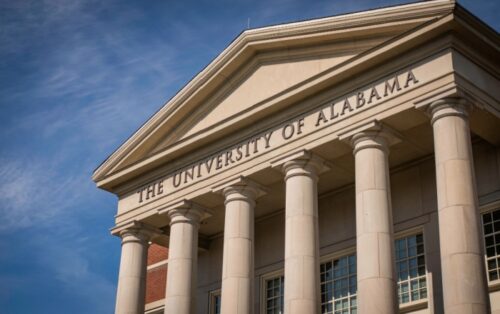
On paper at least, the University of Alabama and Baylor University have little in common.
One is a large public flagship university located in a vibrant and bustling college town. The other is the country’s largest Baptist University residing in the heart of Texas, but separated—in what’s known on campus as “the Baylor Bubble”—from downtown Waco by Interstate 35. One is a top party school, where Greek life plays a dominant role on campus. The other maintains a dry campus, with strict prohibitions against drinking and sex outside of marriage.
Despite these stark differences, Baylor and the University of Alabama have followed a remarkably similar path over the last two decades as they have sought greater national prominence. To achieve their ambitions, the leaders of Baylor and the University of Alabama needed lots of money. As a result, they hiked up tuition at their institutions year after year. They borrowed hundreds of millions in the bond market, allowing them to go on a building and faculty-hiring spree. And they both hired the same private enrollment management consulting firm—Noel Levitz (which later merged with the enrollment and fundraising management company RuffaloCODY and became Ruffalo Noel Levitz) to help them develop admissions and financial aid strategies and algorithms to increase their revenue.
Over the past twenty years, each of these institutions have been zealous participants in an arms race for the students they desire the most: the best and wealthiest applicants they can attract. As a result, these institutions spend hundreds of millions of dollars of their own financial aid dollars each year on students who lacked financial need, while leaving left less-privileged students with hefty funding gaps that these individuals and their families can cover only by taking on substantial debt. Even worse, working with enrollment management consultants, both universities have deliberately steered low- and lower-middle-income families to Parent PLUS loans in order to raise revenue to make their institutions’ ambitious makeover plans a reality.
The bottom line is that both of these universities engage in financial aid leveraging, in which analysts determine the precise price points at which these institutions can enroll different groups of students without spending a dollar more than is necessary. At selective colleges, both private and public, the largest discounts go to the most desirable students, typically the highest-achieving applicants, who can help the schools rise up the U.S. News & World Report rankings, and the wealthiest, who, even with the tuition break, can boost the institutions’ bottom line. While lower-income students will often receive some aid, those dollars won’t come anywhere close to meeting their financial need, which means that these students’ families are left with little choice but to borrow federal Parent PLUS loans to cover the funding gaps.
The Parent PLUS loan program was never intended for this purpose. Congress created the program in 1980 to help middle- and upper-middle-income families afford to send their children to expensive private colleges. For low-income families with few assets, taking on PLUS loans is extremely risky. Unlike federal student loans, which are strictly limited to $5,500 to $7,500 per year for dependent students (those under the age of 24), PLUS loans, for much of their history, have allowed parents to borrow up to the full cost of attendance, which includes not only tuition and fees but living expenses as well, regardless of their income.
Parent PLUS debt, like federal student loans, generally can’t be discharged in bankruptcy, and the loans are subject to the government’s extraordinary debt collection powers, including wage garnishment and partial offsets of defaulted borrowers’ Social Security benefits and income tax refunds. As a result, failure to repay these loans can lead to financial disaster, particularly for older Americans with few resources.
In October 2021, The Wall Street Journal ran a front-page exposé entitled “How Baylor Steered Lower-Income Parents to Debt They Couldn’t Afford.” The article revealed that Baylor had been pushing low-income families to take out “no limit” Parent PLUS loans to help pay for its plans “to transform itself from a regionally known Baptist college into a national brand.” The newspaper cited U.S. Education Department College Scorecard data showing that 47 percent of PLUS loan borrowers with kids who graduated or withdrew from Baylor in 2018 and 2019 and were the parents of Pell Grant recipients. These families incurred a median of $43,500 in PLUS debt while their children were in college, more than the vast majority of them earn in a year.
Confronted by The Wall Street Journal journalists, Linda Livingstone, Baylor’s president, acknowledged that her predecessors had acted irresponsibly by enrolling “students who really couldn’t afford Baylor,” and vowed to change the university’s admissions and financial aid policies to make the university more affordable for lower-income families.
When examining the Education Department’s College Scorecard data, it is remarkable to see just how similar the University of Alabama’s data are to Baylor’s. In Tuscaloosa, 45 percent of PLUS loan borrowers with children who graduated or withdrew from the flagship campus in 2019 and 2020 were the parents of Pell Grant recipients. They borrowed a median of $40,819 in PLUS debt while their children were in college.
The similarities between the two universities run even deeper.
According to The Wall Street Journal, Baylor’s inability or unwillingness to adequately support low-income students did not discourage university recruiters from seeking them out. If anything, Baylor officials recruited these students even more aggressively. Between 2010 and 2015, Pell Grant recipients made up between 20 and 25 percent of the student body annually. A former recruiter told the newspaper that she had been tasked with “visiting poor neighborhoods in Texas to sell prospective students on a college they couldn’t afford.”
During the same time period, the University of Alabama made its own push to recruit more low-income students. The share of Pell Grant recipients in its student body grew from 17 percent in 2009 to 21 percent a year later, according to the Education Department. These students made up at least a fifth of the class for the next five years, rising as high as 23 percent in 2011.
Normally, college access advocates would applaud universities for enrolling so many low-income students. However, under the financial aid leveraging programs that enrollment management firms market to colleges, institutional aid is not used to meet financial need. Covering low-income students’ financial need is considered inefficient and wasteful. The aim is for universities to reel in the students they desire, without spending a dollar more than necessary.
At the University of Alabama, the average amount of financial need that the school met of its student aid recipients dropped substantially in the years after it started working with Noel Levitz. The average share of financial need that the institution met plummeted, from 75 percent in 2002 to 53 percent by 2013. As a result, low- and lower-middle-income students were left with larger and larger funding gaps, offering them little choice but to take out PLUS loans if they wanted to send their children to the school.
Indeed, PLUS loan borrowing soared at the University of Alabama during this period. Between 2010 and 2016, the number of families borrowing Parent PLUS loans to send their children there grew by 60 percent, to 3,402, and the amount they borrowed doubled, to $96 million, according to the U.S. Department of Education. (Back in 2002, before the university embraced financial aid leveraging, only 595 families borrowed and their total debt was the equivalent of $8.5 million in 2025 dollars.) Today, the Education Department’s College Scorecard reports that nearly 13,000 families of former University of Alabama students owe about $723 million in outstanding Parent PLUS loan debt, the second biggest total among all colleges in the country, public or private.
Unlike Baylor, University of Alabama officials have never acknowledged any fault for their policies. They have never admitted that their incessant drive for growth, and their aggressive use of aid leveraging to achieve it, have put some of their most vulnerable students’ families in dire financial straits.
The University of Alabama’s lack of contrition is frustrating to parents who are buried in PLUS loan debt and see no end in sight. One such victim, a single mother and teacher from a rural part of Northern Alabama, told the Hechinger Report that she would probably never be able to repay the $25,000 PLUS loan she felt she had no choice but to take out to get her daughter into the flagship. She hopes other low- and lower-middle-income PLUS loan borrowers will come forward to tell their stories. “Maybe if more people knew they weren’t the only ones, something would change,” she said.
Senior Writer & Editor, Higher Education