Introduction
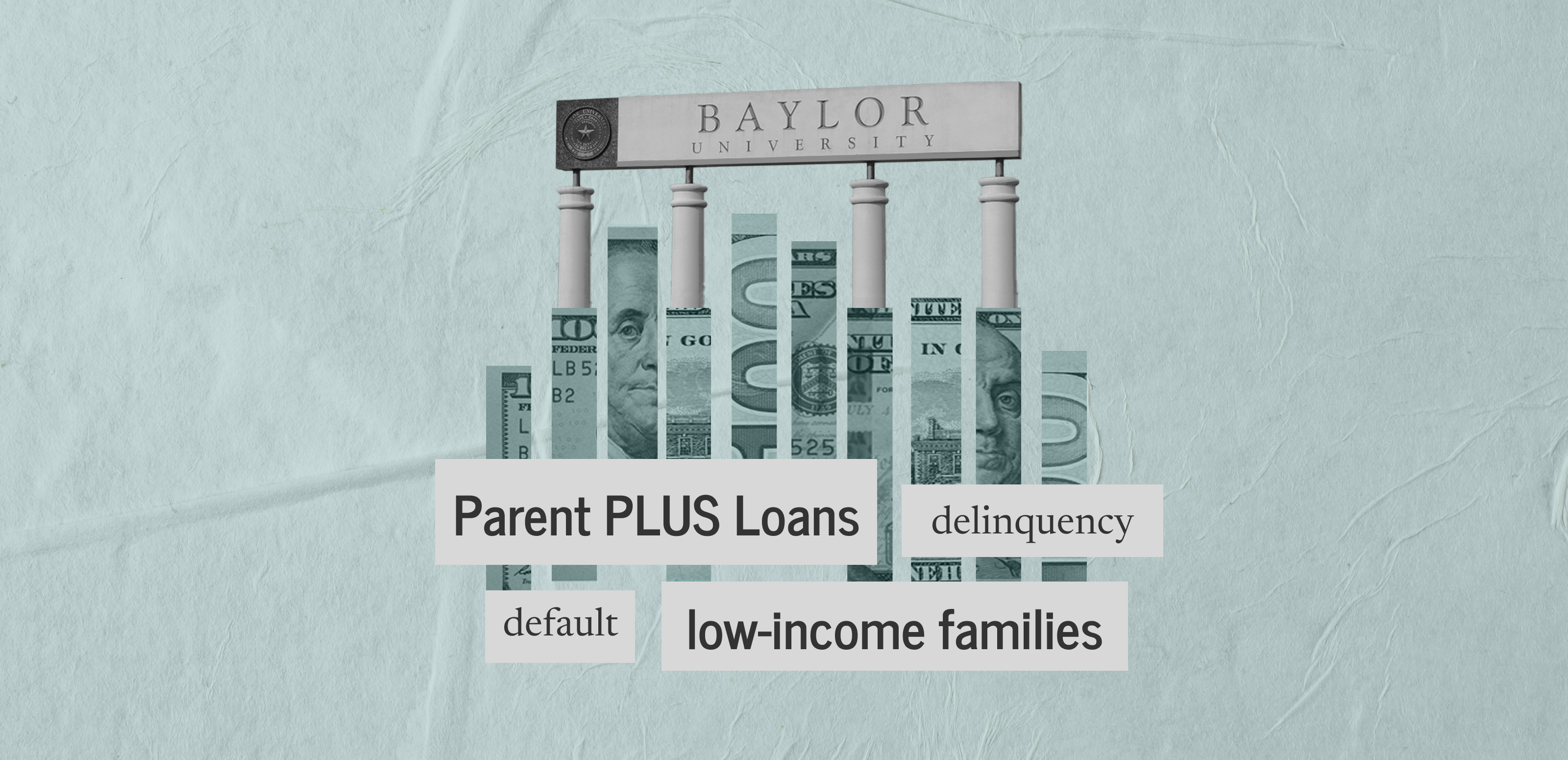
On October 13, 2021, Baylor University officials woke up to a public-relations nightmare: an exposé in The Wall Street Journal entitled “How Baylor Steered Lower-Income Parents to Debt They Couldn’t Afford.”1
The newspaper revealed that the world’s largest Baptist university had been pushing low- and lower-middle-income families to borrow substantial amounts of federal Parent PLUS loans “to cover rising tuition,” leaving them “with debt they can’t repay.” U.S. Department of Education data showed that after two years in repayment, “only about a quarter of [all] Baylor parents paid down any of what they originally borrowed.”2 The university was, in other words, knowingly putting these cash-strapped families in harm’s way.
Congress created the Parent PLUS loan program in 1980 to help middle- and upper-middle-income students and their families afford expensive colleges.3 For low-income families with few assets, taking out PLUS loans is an extremely risky proposition. Unlike federal student loans, which are strictly limited to $5,500 to $7,500 per year for most students under the age of 24, PLUS loans allow parents to borrow up to the full cost of attendance, which includes not only tuition and fees but living expenses as well, regardless of their income. To obtain the loan, a parent need only pass an adverse credit history check, which does not assess whether the borrower will be able to repay the debt. Parent PLUS debt, like federal student loans, generally cannot be discharged in bankruptcy, and the loans are subject to the government’s extraordinary debt collection powers, including wage garnishment and partial offsets of defaulted borrowers’ Social Security benefits and income tax refunds.
Failure to repay these loans could lead to financial disaster, particularly for older Americans with few resources.
Baylor’s inability or unwillingness to adequately support low- and lower-middle-income students, however, did not discourage university officials from seeking them out. If anything, they recruited these students even more aggressively. Between 2010 and 2015, recipients of Pell Grants, the federal government’s primary source of funding for low-income students, grew to one-fifth or more of the student body annually.
Why would Baylor aggressively recruit low-income students if it could not adequately support them? And why would the university steer those students’ families to PLUS loans they most likely couldn’t repay? The answer to those questions came down to the outsize ambitions Baylor’s leaders had for the institution and the financial resources it would take to achieve them.
Founded in 1845 on the banks of the Brazos River in Waco, Texas, Baylor, for generations, offered a relatively affordable education to the offspring of middle-class Baptist families. But by the turn of the twenty-first century, Baylor officials set a lofty goal: to become the country’s top Protestant higher education institution, the Baptist version of the University of Notre Dame.4 To accomplish such an ambitious feat, the university needed lots of money.5 As a result, Baylor officials hiked up tuition—by as much as 40 percent per year. They also borrowed hundreds of millions in the bond market, allowing them to go on a building and faculty-hiring spree. And they hired the private enrollment management consulting firm Noel Levitz (which later merged with the enrollment and fundraising management company RuffaloCODY and became Ruffalo Noel Levitz) to help them develop admissions and financial aid strategies and algorithms to increase the university’s revenue and raise its U.S. News & World Report ranking.6 They knew that rising in the rankings would make the university more appealing to the upscale students and families they were hoping to attract.
At the enrollment management company’s urging, the university began engaging in an enrollment management practice known as financial aid leveraging or financial aid optimization, in which analysts determine the precise price points at which colleges can enroll different groups of students without spending a dollar more than is necessary.7 At selective colleges, both private and public, the largest discounts go to the students the institution want the most: typically, the highest-achieving applicants, who can help the institutions rise up the rankings and the wealthiest, who even with the tuition break, can boost the schools’ bottom line.8 While less affluent students will receive some aid, those dollars are unlikely to come anywhere close to meeting their financial need. As a result, low-income families have little choice but to borrow hefty Parent PLUS loans, which they are often unlikely to be able to repay, to cover those gaps.9
Many selective colleges use financial-aid leveraging strategies for only a subset of their students, and some may use a portion of the additional revenue they receive from recruiting affluent students to boost need-based aid at their institutions. However, the country’s largest enrollment management firms aggressively market financial aid leveraging or optimization products that are designed to help public and private colleges and universities to use all of their aid to pursue the most desirable prospective students and boost their bottom lines. As EAB, the giant enrollment management consulting company, states in its marketing materials, “Our Financial Aid Optimization program ensures that every dollar you commit to aid is used to further your enrollment and net tuition revenue goals.”10
Where colleges once used their institutional aid to meet students’ financial need, enrollment management industry officials now have a different view of what it should be used for. “The concept is to award financial aid in a way that results in the maximum total amount of net tuition revenue for the institution,” Nathan Mueller, the leader of EAB’s financial aid optimization team, told Higher Ed Dive in 2023.11
One way for a college to use financial aid to increase net revenue is to provide discounts to lure more wealthy students to its campus who, even with the discounts, will ultimately pay more than less advantaged students and have families who may be willing to make substantial donations to the institution. But another way is for the college to encourage a large number of low-income students to enroll and steer their families to Parent PLUS loans, as Baylor did. After all, for colleges, Parent PLUS loans are easy credit they can offer low-income families to cover their funding gaps.12 PLUS loans are readily available, so long as potential borrowers don’t have bad credit. And because colleges are not held accountable if borrowers go into default on this debt, administrators don’t have to worry about how hazardous these loans may be for students’ families. As a 2019 Urban Institute report stated, the PLUS loan program is “a no-strings-attached revenue source for colleges and universities, with the risk shared only by parents and the government,” which loses money if borrowers default.13
Confronted by The Wall Street Journal journalists, Linda Livingstone, Baylor’s president, acknowledged that her predecessors had acted irresponsibly by enrolling “students who really couldn’t afford Baylor.” She pledged to do better. “My heart goes out to families that are in that situation,” she told the newspaper. “We are working very, very hard to ensure that we don’t see that so much going forward.”14
While Livingstone’s sympathy provides cold comfort for the families who were encouraged to take on this debt, she has lived up to her promise to make Baylor more affordable for low-income students and their families. Under the new Baylor Benefit Scholarship Program, the university waives tuition and fees for students from families with annual incomes of $50,000 or less.15 The program is paying off, as the retention rate for low-income students at the university has shot up.16
There is a catch, though. In order to afford the tuition waivers, Baylor had to substantially pare back the share of Pell Grant recipients it enrolled, to about 13 percent of its students. The university, however, should never have been enrolling such a large share, Wesley Null, Baylor’s vice provost for undergraduate education and institutional effectiveness, said during a conference session he led last fall. “Baylor’s Pell percentage—you go back six or seven years ago—was crazy high,” Null stated. “About 25 or 26 percent of our undergraduate population were Pell eligible, and we were not serving those students well.”17
It would be tempting to take solace in what’s happening at Baylor. The Wall Street Journal article pushed the university to abandon a destructive policy that harmed low-income students and their families, and to embrace a new policy that made the institution more accessible and affordable for them. However, Baylor is hardly the only university steering low-income families to Parent PLUS loans. In fact, leaving low- and lower-middle-income students with substantial amounts of unmet financial need and encouraging their families to take out Parent PLUS loans is part and parcel of the financial aid leveraging strategies that the giant for-profit enrollment management firms, such as EAB, have been pushing colleges to use in awarding their institutional aid.18
The Wall Street Journal journalists recognized that these practices are widespread. The article led off by stating, “Some of the wealthiest U.S. colleges are steering parents into no-limit federal loans to cover rising tuition, leaving many poor and middle-class families with debt they can’t repay.”19 The article cited several other wealthy private universities “with relatively low Parent PLUS repayment rates and high numbers of borrowers from low-income backgrounds,” such as New York University, Syracuse University, Texas Christian University, and the University of Miami.20 But because the article focused almost entirely on Baylor, these other schools did not feel pressure to change their practices. Meanwhile, the private enrollment management firms that market financial aid leveraging products to colleges escaped scrutiny altogether.
By encouraging universities, both private and public, to increase their net revenue by reeling in low-income students and steering their families to Parent PLUS loans, the financial aid leveraging strategies that enrollment management firms like EAB and Ruffalo Noel Levitz market push their clients to engage in a process of predatory inclusion.
Predatory inclusion is when a marginalized group is given access to a service, good, or opportunity, but the conditions of access jeopardize the benefits. As the sociologists Louise Seamster and Raphaël Charron-Chénier wrote in 2017:
Processes of predatory inclusion are often presented as providing marginalized individuals with opportunities for social and economic progress. In the long term, however, predatory inclusion reproduces inequality and insecurity for some while allowing already dominant social actors to derive significant profits.21
Sociologists often point to subprime mortgage lending as a premier example of predatory inclusion. Banks long refused to provide mortgages to Black households. In recent decades, a subprime mortgage lending field emerged, offering the promise of homeownership. But the terms and conditions of the mortgages were so punitive that default and foreclosure were almost guaranteed.
In higher education, for-profit colleges, private student loan companies, and online program managers (OPMs)—for-profit companies that create and manage online courses and programs for public and private colleges and universities—have all been accused of engaging in predatory inclusion.22 Financial aid leveraging strategies and products that saddle low-income families with tens of thousands of dollars of debt they are unlikely to be able to repay need to be considered through the same lens. Yes, these universities are providing higher education access to these students, but at the potential cost of financial ruin for their families. That’s too high a price to pay, particularly given the wealth and power of these institutions.
This report is the first in a three-part series examining these policies and practices. It provides a history of Baylor’s pursuit of national prominence over the past several decades and shows how those ambitions led the university to embrace financial aid leveraging and put its most marginalized students’ families in jeopardy. It also takes a closer look at how Baylor has recently made the institution more affordable for low-income students and their families and suggests that other universities follow its lead.
The second report in the series will examine how widespread these hazardous practices are at both private and public universities. And the third part will offer solutions for reining in the enrollment management industry and making higher education more accessible and affordable for low- and lower-middle-income students and their families.
Baylor is now doing the right thing for its low-income students and families. Other colleges that have been steering these families to Parent PLUS loans should take notice. It shouldn’t take an exposé in a national newspaper to wake them up to the nightmare they are causing.
Citations
- Tawnell D. Hobbs and Andrea Fuller, “How Baylor Steered Lower-Income Parents to Debt They Couldn’t Afford,” The Wall Street Journal, October 13, 2021, source.
- Hobbs and Fuller, “How Baylor Steered Lower-Income Parents,” source.
- Rachel Fishman, The Wealth Gap PLUS Debt: How Federal Loans Exacerbate Inequality for Black Families (New America, 2016), 6, source.
- Naomi Schaefer Riley, “At Baylor University, a Struggle Over Mind and Soul,” The New York Times, September 8, 2004, source.
- Jessica Luther, “How Baylor Happened,” Deadspin, February 5, 2019, source.
- Ben Gose, “Colleges Turn to Consultants to Shape the Freshman Class,” The Chronicle of Higher Education, May 7, 1999, source.
- Gose, “Colleges Turn to Consultants,” source.
- Matthew Quirk, “The Best Class Money Can Buy,” The Atlantic, November 2005, source.
- Stephen J. Burd, “The Dangerous Game of Financial Aid Leveraging,” in Lifting the Veil on Enrollment Management: How a Powerful Industry Is Limiting Social Mobility in American Higher Education, ed. Stephen J. Burd (Harvard Education Press, 2024), 153–173.
- EAB, “Solutions: Financial Aid Optimization,” source.
- Lilah Burke, “Why Colleges Are Using Algorithms to Determine Financial Aid Levels,” Higher Ed Dive, September 5, 2023, source.
- Fishman, The Wealth Gap PLUS Debt, source.
- Sandy Baum, Kristin Blagg, and Rachel Fishman, Reshaping Parent PLUS Loans: Recommendations for Reforming the Parent PLUS Program (Urban Institute, April 2019), 4, source.
- Hobbs and Fuller, “How Baylor Steered Lower-Income Parents,” source.
- Baylor University, “Baylor Benefit Scholarship,” source.
- Wesley Null (Baylor University vice provost for undergraduate education and institutional effectiveness), in discussions with the author, April 2025.
- Wesley Null and Lynn Wisely, “Baylor University: SEM Change Management, Year 2,” AACRAO’s Strategic Enrollment Management Conference, Boston, MA, November 5, 2024.
- Burd, “The Dangerous Game of Financial Aid Leveraging.”
- Hobbs and Fuller, “How Baylor Steered Lower-Income Parents,” source.
- Hobbs and Fuller, “How Baylor Steered Lower-Income Parents,” source.
- Louise Seamster and Raphaël Charron-Chénier, “Predatory Inclusion and Education Debt: Rethinking the Racial Wealth Gap,” Social Currents 4, no. 3 (2017): 200, doi: 10.1177/2329496516686620.
- Seamster and Charron-Chénier, “Predatory Inclusion and Education Debt,” Mapping Exploitation: Examining For-Profit Colleges as Financial Predators in Communities of Color (Student Borrower Protection Center, July 21, 2021), source; and Amber Villalobos, “Online College Programs Increasingly Put Black and Hispanic Students at Risk,” The Century Foundation, November 17, 2023, source.