
House-Passed Budget Resolution May Supersede Debt Ceiling Spending Limits in Appropriations Process

Earlier this month, Ed Money Watch wrote about how the debt ceiling agreement will likely affect education funding in fiscal year 2012 and beyond. The agreement included a $1.043 trillion cap on total 2012 spending, $7 billion below 2011 levels. But now the House Budget Committee is claiming that it will still be held to the House-passed budget resolution spending limit of $1.019 trillion, unless the House votes to replace that limit with the higher limit defined in the debt ceiling agreement.
To recap: This past May, the House passed a budget resolution for fiscal year 2012 that set total discretionary spending at $1.019 trillion, a $31 billion reduction in total appropriations funding compared to fiscal year 2011. The Senate, however, failed to pass a budget resolution, despite some attempts later in May. Though the House’s budget resolution does not set spending limits for individual agencies, it does impose an overall spending limit that will affect agency-level spending as funding levels are set for fiscal year 2012.
Fast forward to August:. Congress passed, and the president signed, a hard-won debt ceiling agreement that limited total 2012 spending to $1.043 billion, $7 billion below 2011 levels. The law also caps nonsecurity spending, which includes education spending, at $359 billion, down $2 billion from 2011 levels. Essentially, Congress will have to reduce nonsecurity spending by $2 billion in 2012 or face across the board cuts to meet the debt ceiling limit.
The debt ceiling agreement also included $17 billion in additional funds for Pell Grants to be divided between fiscal year 2012 and 2013 to help shore up the program’s costs. However, Congress will still have to provide a regular 2012 appropriation for Pell Grants, which is currently estimated to need $24.2 billion, $1.2 billion more than in 2011. Both the $2 billion nonsecurity spending cut enforced through the debt ceiling agreement, and this $1.2 billion increase in Pell Grant spending, will likely put pressure on the rest of the U.S. Department of Education’s budget. See the table below for the debt ceiling details.
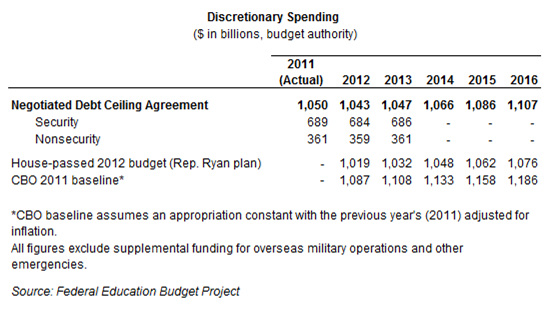
According to Roll Call, the House intends to stick with its $1.019 trillion spending limit, rather than the $1.043 trillion limit defined in the debt ceiling agreement, unless the House votes to override their original spending cap. Given the unpopularity of the debt ceiling agreement with House Republicans, it seems unlikely that the House will so easily accept the $1.043 trillion limit. But keeping the $1.019 trillion limit would mean even more drastic cuts to discretionary spending (though the House budget resolution does not specify the division between security and nonsecurity spending like the debt ceiling agreement does). This would put even more pressure on Pell Grant spending, making it more likely that Congress will have to decrease the maximum grant level (currently $5,550). Other U.S. Department of Education programs could be at risk as well – especially less popular programs like Race to the Top and School Improvement Grants.
This new development will further derail an already-complicated annual appropriations process. The Senate is unlikely to pass a budget resolution at this point, meaning they will not have an enforceable spending limit outside of the debt ceiling limit, either overall or at the agency level. Even if the House maintains the $1.019 trillion spending limit for 2012, it will eventually have to reconcile its appropriations bills with the Democratic-controlled Senate, which is more likely to stick with the $1.043 trillion limit set by the debt ceiling law. It looks like Congress is headed for another drawn out appropriations process, likely ending with a series of Continuing Resolutions, just like in 2011.
Check back with Ed Money Watch as this situation unfolds.
More About the Authors
Issues
Related

Funding the ADA’s Promise

English Learners Need More Federal Support to Succeed, Not Less