
House Appropriations Committee Releases Fiscal Year 2012 Appropriations Language

This week the House Appropriations Committee released its draft of the fiscal year 2012 Labor-Health and Human Services (HHS)-Education funding bill. The draft legislation comes about a week after the full Senate Appropriations Committee passed its version of 2012 appropriations.
To avert government shutdown, the House and Senate have passed a continuing resolution that will carry the government through the weekend, and that holds all education and health funding at fiscal year 2011 levels. But the simultaneous release of legislative language for 2012 Education and HHS appropriations nevertheless marks a critical step in the budget process.
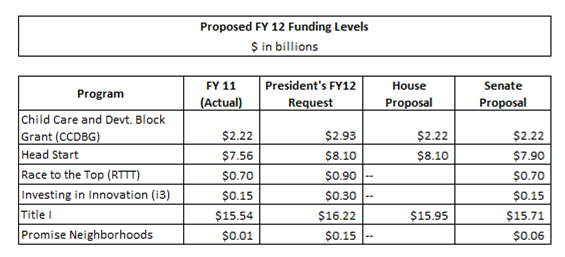
Few provisions in the bill are surprising; both the House and Senate, concerned with increasing levels of U.S. debt, made relatively conservative changes to fiscal year 2011 funding. Child Care and Development Block Grants, for example, are held at 2011 levels in both the House and Senate proposals, rejecting the president’s submitted request for increased funding for these programs.
The House appropriations bill zeros out funding for some of the President’s hallmark programs, including Race to the Top (RTTT) and Investing in Innovation (i3). The Senate proposal, however, holds both funding levels steady at fiscal year 2011 levels. The President had requested an increase in funding for each program. The House proposal also excludes funding for the Promise Neighborhoods program, ignoring the President’s request for a substantial increase.
Interestingly, the House proposal actually increases several programs over the Senate’s proposed levels and over last year’s funding levels, an unexpected boon for those programs. For Title I, the House proposes $24 million more than the Senate appropriates for the program. Additionally, the House met the president’s full request for Head Start at $8.1 billion, exceeding the Senate’s proposed increase over last year’s $7.56 billion funding level.
The Senate proposal would bring back Striving Readers, appropriating $183 million for the competitive literacy grant program that served children birth through 12th grade. It was eliminated as part of the fiscal year 2011 full-year continuing resolution.
Keep in mind that the appropriations process has a long way to go, and we may see a series of continuing resolutions rather than a complete budget process, as was the case in 2011. Neither the House nor the Senate numbers are likely to remain firm as negotiations proceed within and between the two chambers. Stay tuned for more on the fiscal year 2012 budget process.
More About the Authors
Issues
Programs/Projects/Initiatives
Related
Confronting Harmful Federal Disability Policy in Health and Human Services
Federal Early Education Update: March 2026
A Bureaucratic Shakeup Threatens Future Child Care Research