House Appropriations Committee Proposes New Continuing Resolution

This post and table have been updated.
Last Friday, the House Appropriations Committee (now under Republican control) proposed a Continuing Resolution bill that would provide funding for discretionary programs through the end of fiscal year 2011. This Continuing Resolution (CR) is the most recent in a host of bills that have been presented starting last summer in either the House or Senate to finalize appropriations for 2011, which began October 1 of 2010. Until now, a CR has been in place that provides 2010 levels of funding for the majority of education programs. That CR expires March 4th, 2011 and Congress must pass a new bill before then to prevent a government shut down.
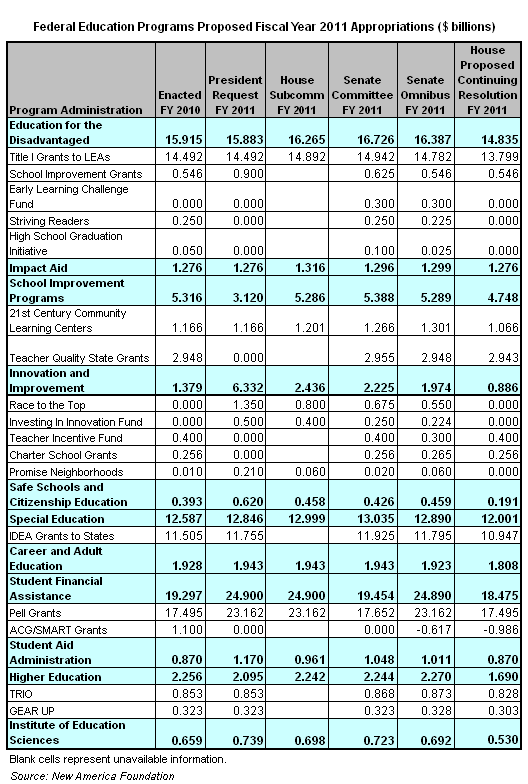
This new CR, which looks likely to pass the House by the end of this week, makes several changes to existing education funding. According to bill text and other supplemental documentation provided by the Appropriations Committee, it cuts $693 million from Title I, Part A grants to local education agencies from 2010 levels and $493 million from Innovation and Improvement programs. The original version of the bill also cut $557 million from Individuals with Disabilities Education Act grants to states but the House recently passed an amendment that would restore this funding and offset it with cuts from Title I School Improvement Grants and Improving Teacher Quality State Grants. Only a few programs are not slated for cuts from 2010 levels in the bill including Pell Grants, which would be funded at $17.5 billion (This is only enough to provide a maximum grant of $4,705, down from the current maximum grant level of $5,550.), and Impact Aid, which would be funded at $1.3 billion. The bill provides no funding for Race to the Top or Investing in Innovation, two of the Obama administration’s favored programs.
The House Continuing Resolution also cuts funding entirely for several education programs. These include Mathematics and Science partnerships (funded at $180 million in 2010), the Striving Readers program (funded at $250 million in 2010), Education Technology State Grants (funded at $100 million in 2010), and Teacher Quality Partnerships (funded at $43 million in 2010), just to name a few. Some favored earmarks would also lose funding including Teach For America, which received $18 million in 2010.
The table below provides details on the House proposed version of the CR and provides comparisons to 2010 funding levels and previously proposed versions of fiscal year 2011 appropriations.
Though many of these cuts are unlikely to pass in the Senate, and the president has threatened to veto the CR as it currently stands, this House version of the CR shows that House Republicans are serious about making some major cuts to education programs. Though some of these cuts echo the president’s desire to cut or consolidate some education programs, they go above and beyond those recommendations, cutting entirely some of the administrations favorite programs. Check back with Ed Money Watch as this process continues.
More About the Authors
Issues
Related
5 Takeaways from the Trump Plan Overhauling College Accreditation

Accreditation on the Ground: A Q&A with Heather Perfetti