Braden Goetz
Senior Policy Advisor, Center on Education and Labor
How states interpret a confusing phrase could drive funding for Workforce Pell

When Congress inserted a confusing phase in the Carl D. Perkins Career and Technical Education Act (Perkins) in 2018, the result was mostly inconsequential for the program, which distributes $1.4 billion in formula grants annually to states, school districts, and community colleges to support career and technical education (CTE) programs. Now, however, that phrase has become high-stakes in another federal program, Workforce Pell, because lawmakers cross-referenced it as the standard states can use to approve programs for the new funding. How states interpret the provision could affect how hundreds of millions of dollars in federal student aid are distributed to short-term workforce development programs when Workforce Pell launches later this year.
The phrase, “high-skill, high-wage, or in-demand industry sectors or occupations,” was scattered by Congress throughout Perkins. Those less familiar with Perkins often believe that only programs targeting these occupations can receive Perkins grant funds, but that’s not how the term is used in the law. Instead, Perkins directs states and local grantees to explain how they will increase student awareness of these programs and promote access to them.
It’s a different story under Workforce Pell: one of the criteria programs must meet to be eligible is preparing learners for jobs in the “high-skill, high-wage, or in-demand sectors or occupations” the state identified “pursuant to” the state plan it submitted to the Department of Education (ED) to receive Perkins funds. Lawmakers may have thought that “high-skill,” “high-wage,” and “in-demand” were clearly defined and well-understood concepts, and that, in administering Perkins, all states regularly compile lists of the occupations and sectors that they describe. They were mistaken.
Congress left few clues in the Perkins and Workforce Pell laws about the meaning of the phrase and how states should operationalize it. The only term Congress defined in Perkins is “in-demand industry sectors and occupations,” which was cross-referenced to the definition in the Workforce Innovation and Opportunity Act (WIOA). That is a sensible connection between the two programs, but the WIOA definition provides only vague guidance to help state and local decision-makers identify these sectors and occupations. Legislators did not provide definitions for either “high-skill” or “high-wage,” and ED chose not to issue regulations for Perkins. That left the states on their own.
Let’s pause for a moment, though, to consider what an unhelpful construct “high-skill, high-wage, or in-demand industry sectors or occupations” really is. By using the conjunction “or” not once, but twice, the phrase becomes a perplexing muddle. So, should states target all occupations in high-wage, in-demand sectors, even if some are low-wage occupations and not in demand? And they should focus on all in-demand occupations regardless of their wages? And all high-wage occupations, regardless of the demand? And what do you do with “high-skill?” What does that mean, and why is it as important as demand and earnings? That “or” duo creates a lot of uncertainty and invites incoherence.
State CTE leaders have done their best to make sense of what they were given and have taken a variety of approaches to defining and using the terms “high-skill,” “high-wage,” and “in-demand” in their administration of Perkins. We conducted a 50-state scan in February 2026 to capture where states stood pre-Workforce Pell. In our search for state definitions or criteria, we reviewed all publicly available information we could find on state CTE agency websites, including the most recent Perkins state plans approved by ED, local applications for Perkins funds, policy documents, and state templates for the comprehensive local needs assessment that local recipients must carry out every two years for Perkins. (“Pursuant to” the Perkins state plan does not necessarily mean it is in the state plan itself). When Perkins state plans cross-referenced the most recent WIOA state plan or were silent on the definition of “in-demand,” we reviewed WIOA state plans, too. When we still could not locate an “in-demand” definition in these documents, we went to the websites of state labor departments. The scan is likely incomplete because some states put documents behind firewalls accessible only to local grantees, and it may be out of date in some cases because states do not always have the resources to keep websites current. But our scan offers a good, comprehensive overview of where many states were as of February 2026 in trying to master the “high-skill,” “high-wage,” and “in-demand” challenge that Congress and ED handed them.
We found definitions or criteria for at least one of these terms for 44 states and the District of Columbia. In four states for which we found no definitions, we identified policy documents stating that the state chose not to define the terms and instead directed local grantees to identify these sectors and occupations using state-provided labor market information. Other states for which we found no definitions may also have pursued this strategy less explicitly or defined the terms in a document accessible only to local grantees. The absence of a definition, in other words, does not mean the state ignored the challenge of defining and using these terms, only that we were unable to locate it.
In our scan, we found that:
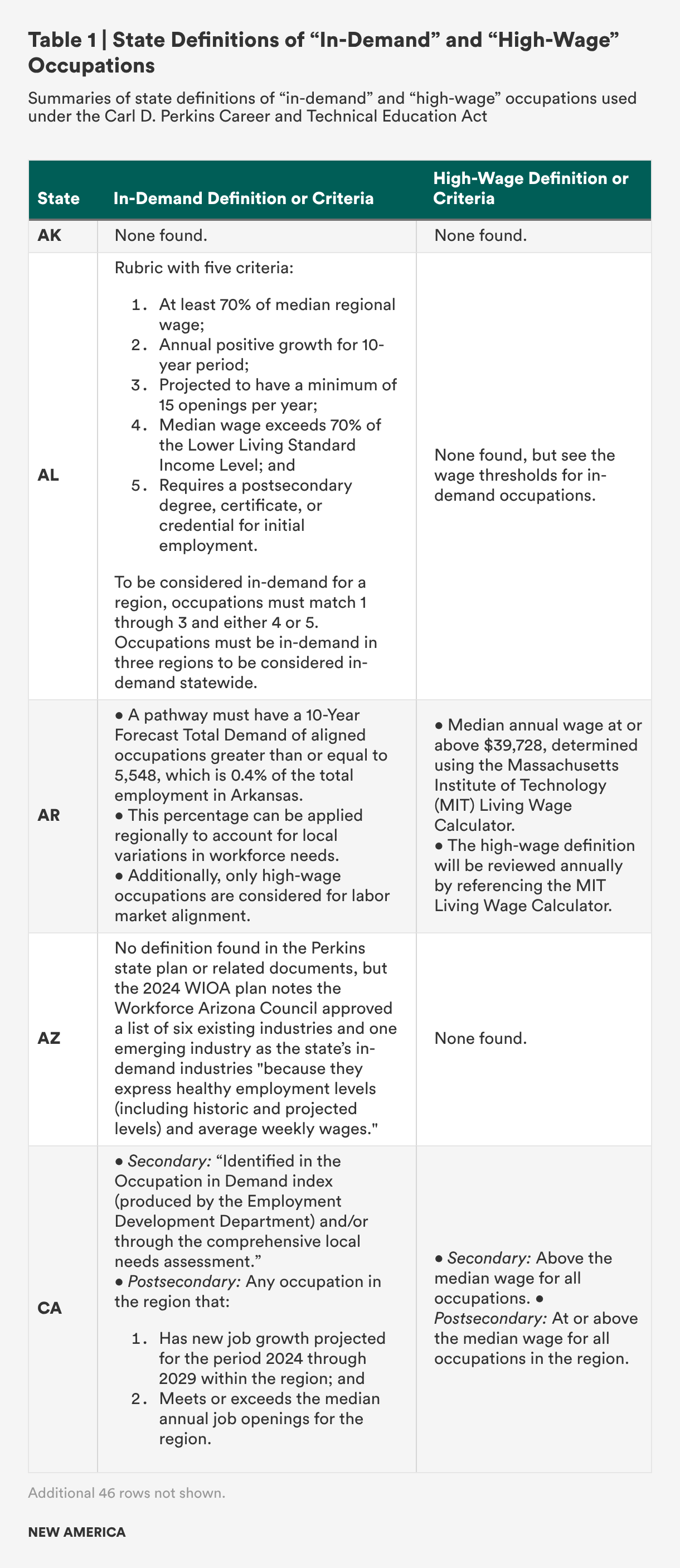
We provide summaries of the definitions or criteria we found for each state and the District of Columbia in Table 1 below. Because state definitions of “high-skill” are so similar, we do not provide state-by-state summaries of those definitions.
Many of these definitions may soon be out of date as states consider their implications for Workforce Pell. For example, earlier this year, bills were introduced in Missouri and West Virginia that would define “high-wage” as median earnings greater than 150 percent of the poverty level for an individual. Importantly, what works for the universe of Perkins programs may not work as well for a student aid program for a subset of very short-term workforce development programs. The Department of Labor requested state updates to their WIOA state plans by March 3, 2026, and ED asked for revisions to Perkins state plans (or an entirely new state plan if a state chooses to do one) by April 30, 2026. States that included definitions in their Perkins state plan may want to revise it to remove the definitions and establish them administratively elsewhere “pursuant to” the state plan. This way, a state can maximize its flexibility to fine-tune its definitions over time. Putting state implementation of Workforce Pell on a long-term runway, trying and testing different definitions and strategies over time, will help ensure states get the greatest value from the program for their learners and their economies.
When Congress next returns to the Perkins Act, it should revisit “high-skill, high-wage, or in-demand industry sectors and occupations” and devise a clearer and more coherent description of the priority jobs we want to target with limited federal funds, while still maintaining some flexibility for states. The difficult work that states have done to define and operationalize these terms since 2018 has given Congress interesting options with which to work.
Senior Policy Advisor, Center on Education and Labor