
Understanding “Educator Micro-credentials”
The Rise of Educator Micro-credentials
In 2014, a nonprofit dedicated to expanding access to high-quality virtual learning experiences named Digital Promise saw a burgeoning approach in the technology industry as a promising tool for helping address some of these issues with professional learning and advancement: micro-credentials.1 In 2015, Digital Promise collaborated with BloomBoard, a company that provides a digital platform for educator MCs, to introduce the first MC platform for educators.
Since then, these two entities have developed their own independent platforms, and the number of other entities offering MCs to engage teachers in professional learning and offer career growth has multiplied exponentially. Issuers include regional and local education agencies, as well as nonprofit and for-profit organizations that often focus on a specific content area or aspect of teaching. Even traditional institutions of higher education are developing MCs as a new way to reach the teacher market for development and advancement. Just among the three major MC platforms for educators, there are, at last count, well over 1,000 MCs currently active. BloomBoard and Digital Promise host over 500 active MCs each, and the National Education Association (NEA) offers nearly 200 as part of the labor union’s teacher development portfolio.
Just among the three major MC platforms for educators, there are, at last count, well over 1,000 MCs currently active.
Defining Micro-credentials
People often use the term “micro-credentials” definitively, as if everyone in the ecosystem agrees on what they are and are not. New America’s analysis finds this is far from the truth.2
For the purpose of consistency and clarity, we define educator MCs as follows: A verification of a discrete skill or competency that a teacher has demonstrated through the submission of evidence assessed via a validated rubric. Educator MCs are similar to other credentials, like degrees or diplomas, in that they provide public recognition and a way to signal knowledge and/or skills held, but they differ in their focus on demonstrated application of one specific “micro” competency in practice.
The MC offerings available from the entities interviewed for this project largely meet this definition of MC, and hereafter, all references to MCs assume this definition. However, the number of entities providing offerings labeled “micro-credentials” is growing rapidly, and many are not aligned with the definition of MC used here.
Several entities play complementary roles in the process of earning a high-quality educator MC. See The Micro-credential (MC) Ecosystem for terms and descriptions for each, and a visualization of how they interact in The Process to Earn a Micro-credential below.
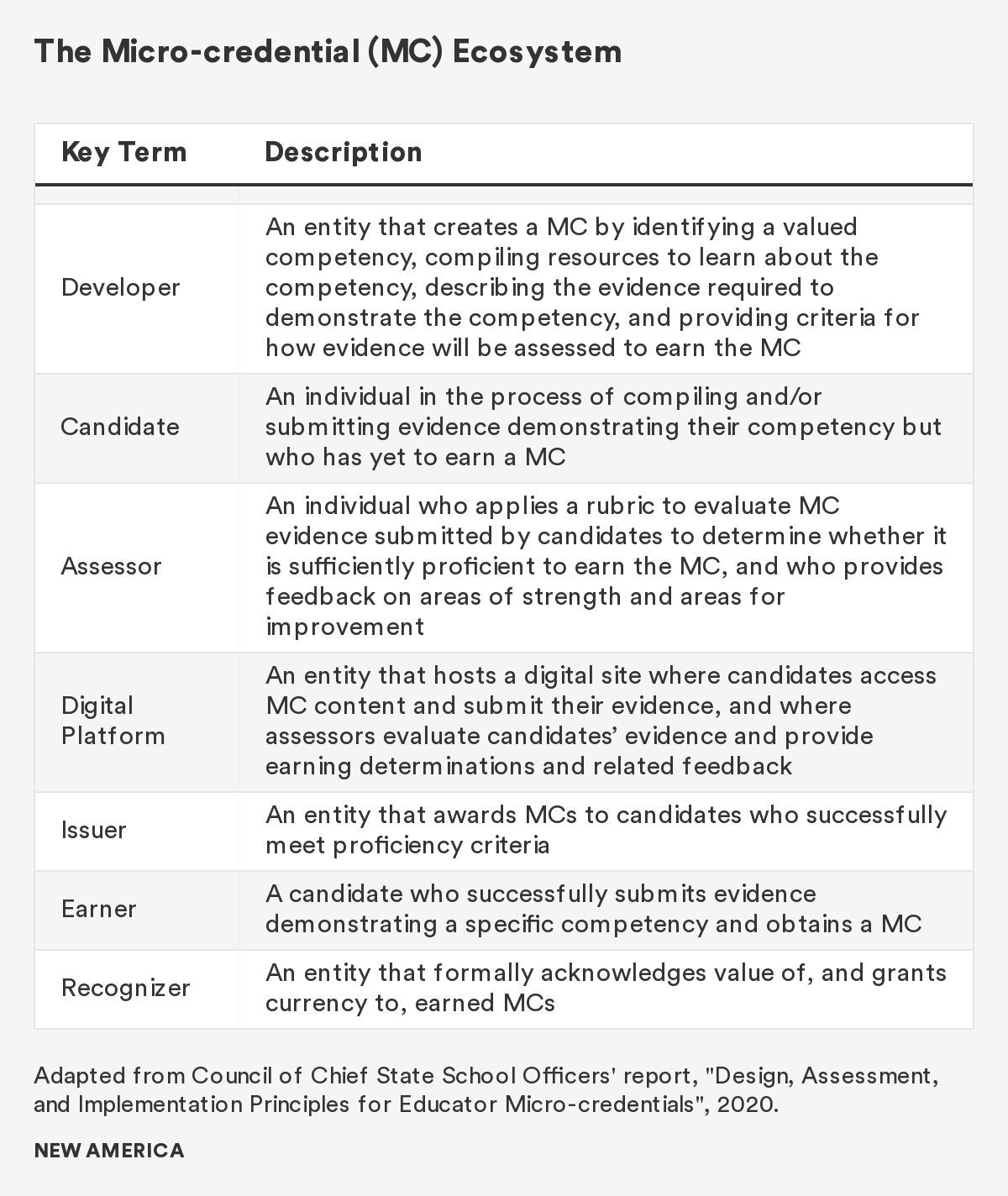

Note: In addition to being developers and issuers of their own MCs, the three most prominent organizations currently offering MCs (BloomBoard, Digital Promise, and NEA) also provide a digital platform for others to develop and issue MCs. For the purpose of this research, we will use the term “provider” to refer both to MC platforms and to individual MC issuers, although a few of the smaller platforms (e.g., Frontline Education) do not develop and issue their own MCs.
Citations
- Melissa Tooley and Joseph Hood, “Schools Take a Lesson from Tech Industry to Develop and Retain Strong Teachers,” EdCentral (blog), New America, September 14, 2020, source
- The notion that a MC provides public recognition of knowledge and skills held is similar in the higher education and the PreK–12 educator space. However, the process of attaining one is typically quite different. For example, in higher education—and massive open online course (MOOC) providers in particular—a MC may be earned when an individual completes some subset of coursework in a specific subject/skill area that is more than a single course but less than a full degree. In higher education spaces, the term “competency-based” denotes that a course or module is self-paced, and any demonstration of competency is often simplified to the idea of successfully completing an online assessment or assignment, without necessarily implementing any skills in practice. This approach may be appropriate for individuals who have yet to enter the workforce but is less relevant for individuals in the workforce who are engaging in MCs with the specific goal of influencing their practice.