Introduction
Across the nation, states and school districts are increasingly recognizing the need to diversify the teacher workforce and to provide students with access to teachers who share their race, ethnicity, and home languages. A racially and ethnically diverse teacher workforce has numerous benefits for students of color, including better test scores,1 higher rates of high school graduation, and more college aspiration.2 Racially diverse students with teachers who reflect student demographics experience lower rates of suspension and absenteeism,3 and they are more likely to be recommended for advanced courses.4
State and local education agencies (LEAs) have increasingly turned to Grow Your Own (GYO) teacher programs as one way to increase the racial and linguistic diversity of the teacher workforce. GYO programs are partnerships between educator preparation programs, school districts, and local organizations that recruit and prepare community members (e.g., parents, paraprofessionals, uncertified school staff, high school students) to teach where they live. At its best, GYO presents opportunities for schools to recruit teachers from their community for their community, letting them focus on who is recruited and how barriers are removed to promote success and persistence in teacher preparation programs.
This paper highlights GYO efforts across the state of Minnesota, examining GYO growth in the last decade, the role that the state and LEAs play in its development, and its impact on educators and students alike. A key takeaway is that while GYO is a catch-all phrase describing approaches to recruiting and developing educators locally, how that is done depends on the context of the community where the program is located. The steps that grassroots activists, state and local officials, and dedicated educators and professionals have taken to make GYO work in Minnesota can be instructive for other policymakers and school leaders looking to follow suit.
Background: Minnesota
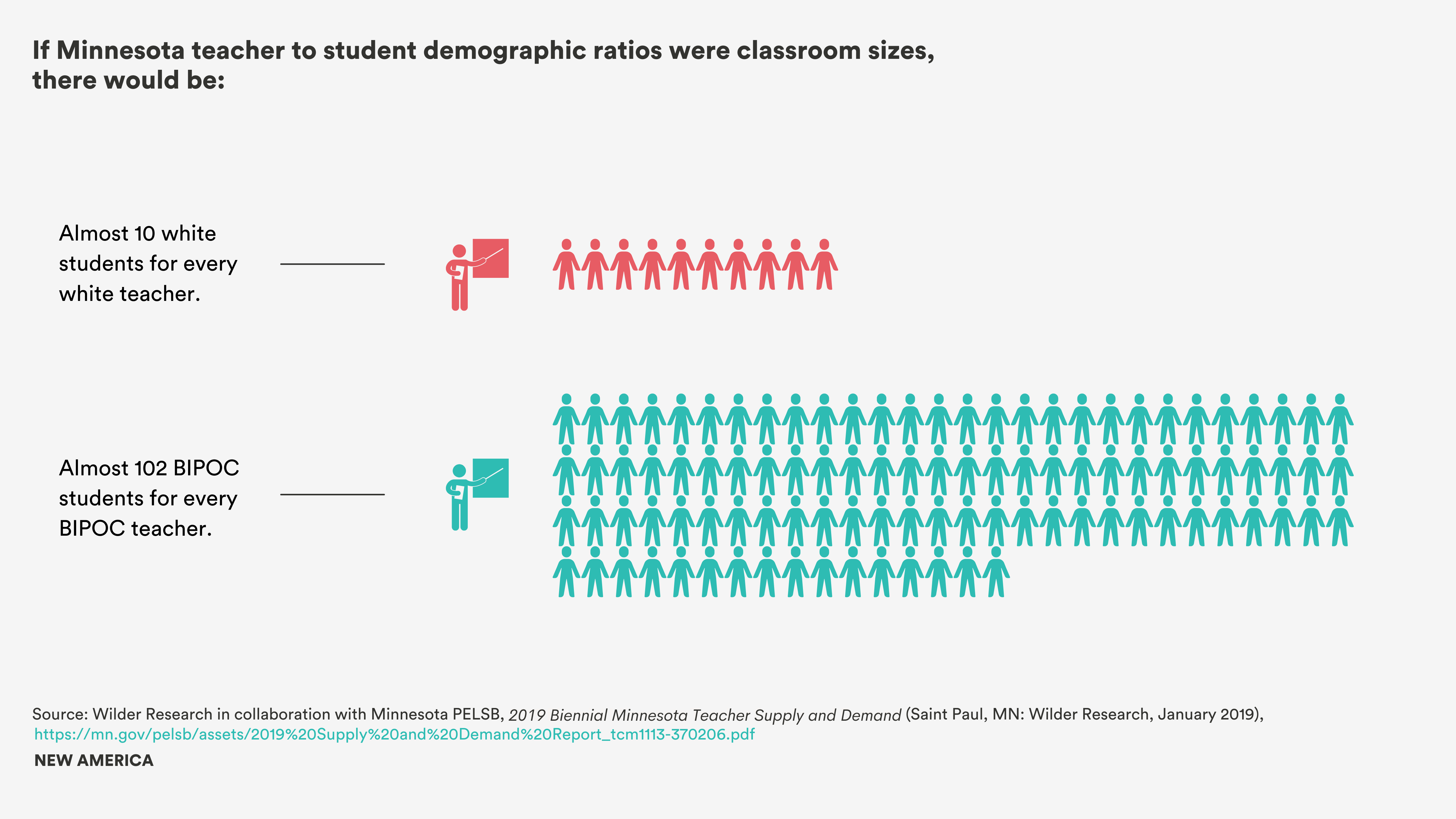
According to the 2019 Biennial Minnesota Teacher Supply and Demand report,5 only 4.3 percent of licensed teachers in the state are teachers of color.6 This is far lower than the share of students of color statewide, which is 32.4 percent.7 For every teacher of color in the state, there are nearly 102 students of color. For every white teacher, there are nearly 10 white students. Not one of the state’s 13 economic development regions has a teaching workforce that even approaches the diversity of its students.8 This is true not only in the areas traditionally viewed as more diverse, like the Twin Cities region (Minneapolis and Saint Paul), but also in the northern headwaters region and increasingly diverse rural schools and districts. As the state has diversified, its teaching population has not. Given the benefits of a diverse teacher workforce, it stands to reason that if Minnesota diversifies its teaching workforce, its BIPOC students will benefit in turn.
Citations
- Thomas S. Dee, “Teachers, Race, and Student Achievement in a Randomized Experiment,” The Review of Economics and Statistics 86 (2004): 195–210, source
- Seth Gershenson, Cassandra M. D. Hart, Constance A. Lindsay, and Nicholas W. Papageorge, “The Long-Run Impacts of Same-Race Teachers,” IZA Institute of Labor Economics 10630 (2017): 1–70, source
- Stephen B. Holt and Seth Gershenson, “The Impact of Demographic Representation on Absences and Suspensions,” Policy Studies Journal 47 (November 2019): 1069–1099, source
- Jason A. Grissom and Christopher Redding, “Discretion and Disproportionality: Explaining the Underrepresentation of High-Achieving Students of Color in Gifted Programs,” AERA Open 2 (January–March 2016): 1–25, source
- Wilder Research in collaboration with Minnesota PELSB, 2019 Biennial Minnesota Teacher Supply and Demand (Saint Paul, MN: Wilder Research, January 2019), source. The 2021 report contained numerous errors in the race and ethnicity data, making an accurate analysis of the numbers all but impossible. For more information, see 2021 Biennial Report: Supply and Demand of Teachers in Minnesota (Saint Paul: Minnesota PELSB, 2021), 18–19, source
- Wilder Research with PELSB, 2019 Biennial.
- Minnesota Department of Education (MDE), “Minnesota Education Statistics Summary,” September 5, 2019, source
- Wilder Research with PELSB, 2019 Biennial, 5.