Table of Contents
Amber Waves of Grain: Natural Security Index for the United States

Dan Thornberg / Shutterstock
The United States is largely self-sufficient in agriculture, well-endowed with mineral and metal resources, and increasingly self-sufficient in energy. For some resources, the United States is a major world exporter, including staple crops and proteins (e.g., corn and beef). Although a small part of this resource production is on public lands, it is all done by private businesses. Despite this inherent natural security, U.S. companies also import and invest in oil, natural gas, commodity metals, agricultural products, and, increasingly, critical minerals essential to the digital age and clean energy technologies.
According to New America’s Natural Security Index (Figure 1), Canada is by far the most important natural security partner for the United States. In particular, Canada is the top supplier for cadmium, aluminum, nickel, zinc, lead, and imported oil, and comes in second for a handful of other resources. The United States also has considerable defense, diplomacy, economic, and cultural investments in its neighbor to the north. The importance of Canada and Mexico to the United States highlights the power (and efficiency) of proximity and the North American regional resource trading bloc.
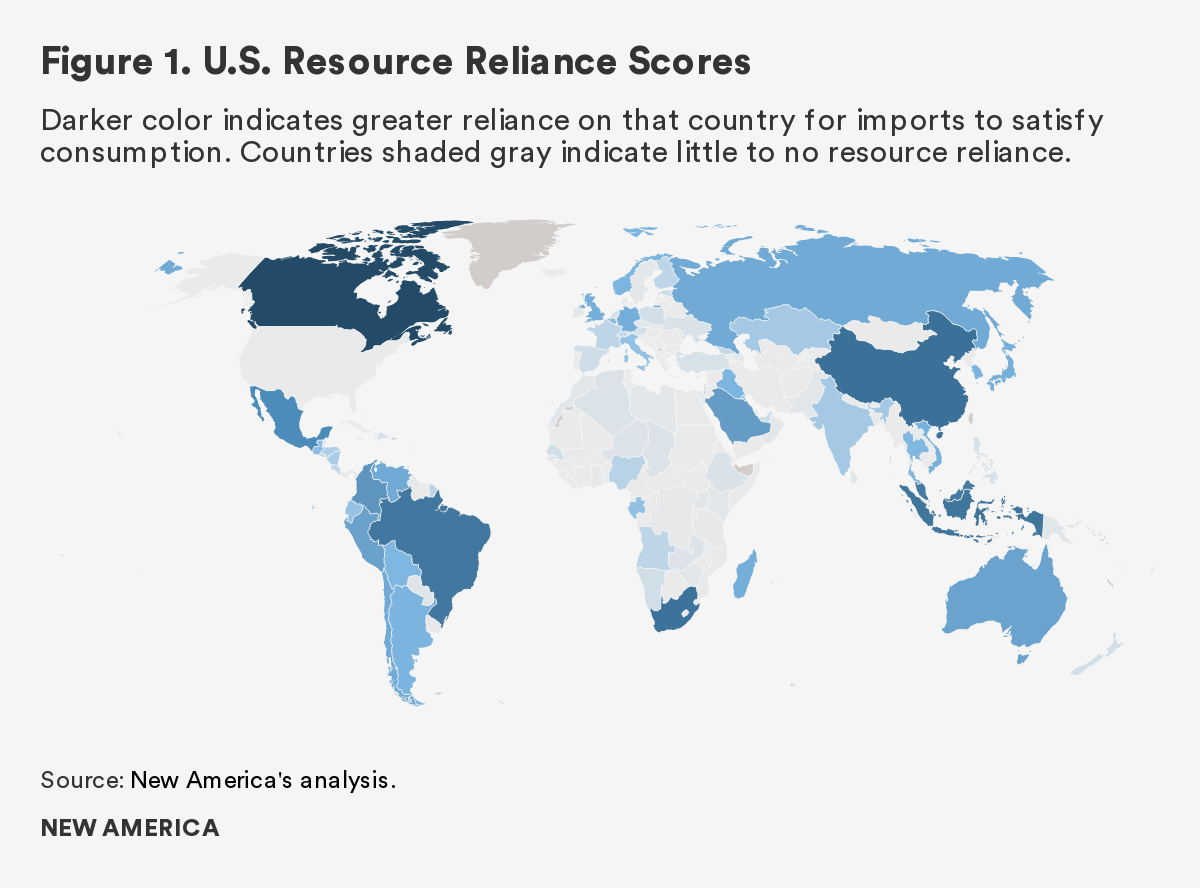
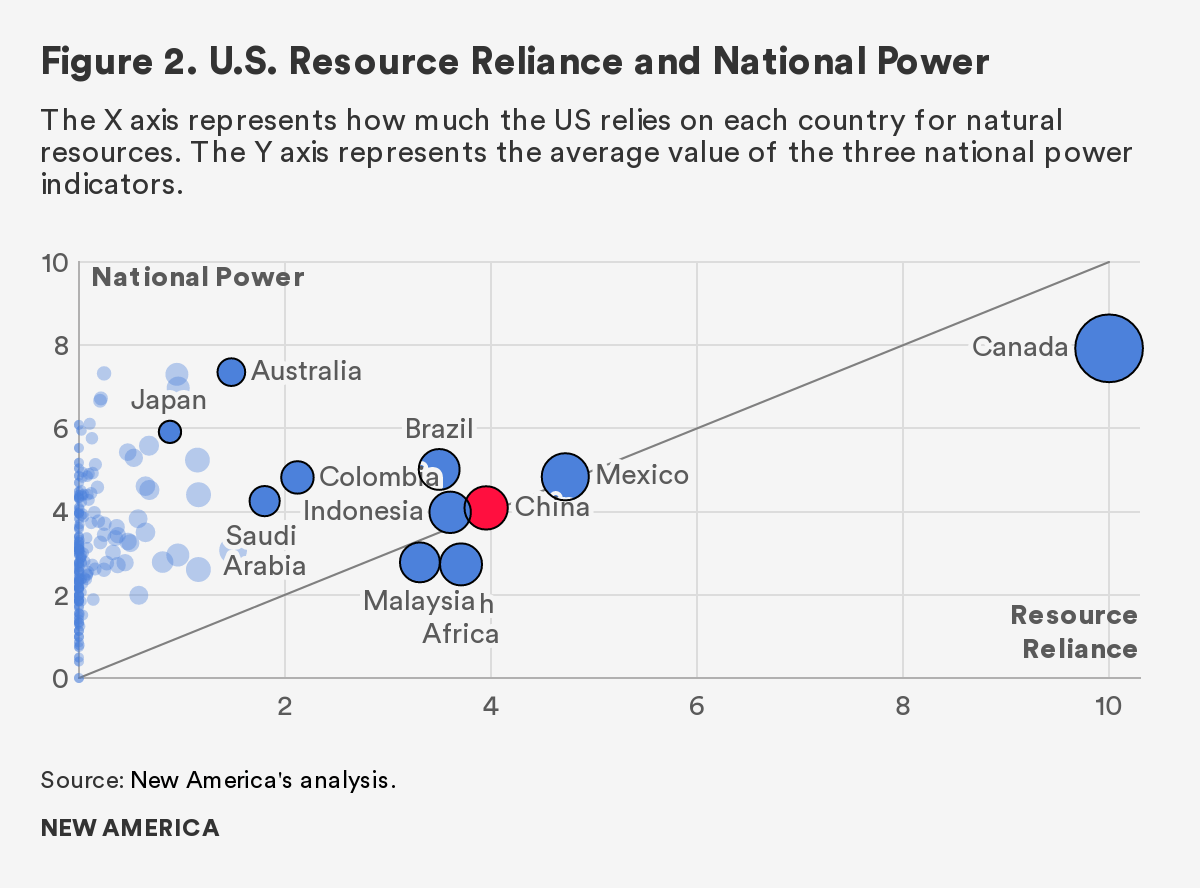
Mexico is the next most important natural security partner, largely for sugar, commodity metals, and oil. Diplomacy, military, and cultural and economic investments are likewise high, though there are new strains in the relationship over border security and trade, and it is difficult to say the long-term effects on the relationship.
After Canada and Mexico, the United States’ most critical resource partners are South Africa, Brazil, Indonesia, and, indeed, China.
China is third in line as a U.S. resource partner. Throughout the 1990s, as China opened its economy to the world, heightened economic interdependence was a major U.S. foreign policy goal. More recently, however, the United States has identified China’s economic policy in certain areas, including critical minerals, as a strategic vulnerability. Despite labeling Russia a “great power competitor,” along with China, the United States also relies on Russia for platinum group metals (PGMs).
These interdependencies are not necessarily a strategic weakness, however. Indeed, relying on each other may not only mean a mutual economic benefit, it may also deter conflict or build confidence. Right now, the United States, Russia, and China still have a stake in each other’s success. A disproportionate dependency can be used as a weapon, however, as the United States has shown recently with tariffs on a range of Chinese imports, to which the Chinese responded with tariffs on soy. In the past, China has restricted exports of rare earth elements as a means of applying political pressure.