
Table of Contents
Making Multipartyism Work
We cannot know the exact conditions under which multipartyism might arise or what the party system will look like. We do know, however, that the House’s centralized and rigid institutions are already ill-suited to handle factionalism in a two-party system and cannot imagine they will perform better in a multiparty system—or could even be sustained. In this spirit, we focus on decentralizing reforms that would, even in a two-party system, encourage policy majorities that can form outside the procedural majority. We also suggest reforms to guard against the chaos and ungovernability that unbounded pluralism can create.
Reform is necessary because, without it, there is no guarantee that we would avoid the same pathologies in a multiparty House that we see in a two-party House. One could imagine a multiparty Congress where centralized leadership takes hold or multiple parties struggle to forge coalitions that can organize the House. Indeed, we can easily find examples of both when looking across foreign countries, though they typically come from highly fragmented systems with extremely permissive versions of proportional representation, such as Brazil and Israel.1 We would not recommend, nor would we expect, the United States to adopt such highly permissive systems.
We expect politicians and lawmakers will account for the context of the moment, including factors we are not anticipating, when they are deciding how the system should work. As such, our suggestions should not be followed too rigidly or without caveat. Instead, we are arguing that based on what we are observing in our current politics, reforms that promote decentralization and protect against chaos are generally the direction in which a multiparty Congress, or even a more factionalized two-party Congress, should move to increase problem-solving capacity.
Decentralizing the House
Almost all successful policymaking in our current system is bipartisan due to the separation of powers system and heterogeneity within the two major parties. Many different stakeholders have to agree that a status quo needs to be changed for a policy to make it through the long and arduous process that the Framers of the Constitution designed. We do not expect this difficult coalition-building to change in a multiparty system where the country’s diverse and pluralist interests would be even better represented and the separation of powers remained in place. Just as the founders intended, our system is not designed for majority coalitions to take quick action. It is designed for deliberation among a wide variety of stakeholders and supermajoritarian, if not nearly consensus, outcomes.
But even if the metaphorical policymaking puzzle is just as difficult to assemble in a multiparty system as it is in a two-party system (if not more so), we think that certain changes could be made so that a more diverse array of actors can at least lay down the first piece. In our current system, the successful legislation that emerges from the universe of potential bipartisan collaborations is significantly constrained by leaders who are reluctant to allow forward any efforts that potentially undermine their party’s collective electoral goals. This prevents members from representing their constituents and hamstrings Congress from taking action on important issues, even when there is majority support.
A recent example of this was Donald Trump and Mike Johnson blowing up the border security compromise that Republican Senator James Lankford negotiated with moderate Democrats in early 2024. Like many immigration reform efforts before it, the compromise almost certainly would have passed both chambers with a bipartisan majority if it had come to a vote. However, Trump saw immigration as a winning electoral issue for Republicans and did not want to muddy the political waters by giving Democrats credit for solving the problem.2 Johnson made it clear that he would not put the compromise measure on the House floor and dissuaded Republicans from offering support. Although it would have technically been possible for Republican supporters to work with Democrats and go around Johnson, his vast authority as Speaker made it prohibitively costly for them to do so.
Our key recommendation for unlocking bipartisan collaboration is decentralizing the legislative process in ways that empower committees and latent policy majorities while preventing leaders from concentrating power. This should look similar to what scholars call “regular order,” which describes a process where committees and members develop legislation through deliberation and consultation without undue influence from legislative leaders.3 When bills pass out of committee with a majority vote, they then come up for a vote on the House floor. On the House floor, all members debate and deliberate, and ultimately cast an up or down vote on the bill. Many scholars have a preference for this process as superior to the top-down leadership-driven process, arguing that it fosters more serious policy engagement from a diversity of members, ultimately producing better policy.
“Our key recommendation for unlocking bipartisan collaboration is decentralizing the legislative process in ways that empower committees and latent policy majorities while preventing leaders from concentrating power.”
While there is certainly a need for leadership-driven processes from time to time, having committees and rank-and-file members take the lead as the general rule would allow the latent policy majorities stymied by the centralized, two-party system to form more easily. Members would also be more motivated to form these coalitions in a multiparty system as they would be actively trying to differentiate themselves from their coalition partners. Adopting procedures that facilitate committee consideration and empower floor majorities could lead to more free-flowing interactions between parties aligned with different blocs and allow them to take action.
This doesn’t work in the current system because leaders decide what legislation makes it onto the House floor. Leaders are particularly likely to block legislation that is opposed by a significant chunk of the majority party, even when it is supported by a majority of the entire House. This practice of blocking bills without the support of most majority party members is known as the Hastert Rule.4 Party leaders enforce the Hastert Rule (which is not actually a rule but rather a convention) because they want to avoid intraparty feuds and criticism, particularly if those feuds threaten their jobs. This is essentially why Johnson blocked immigration reform—allowing a vote would have angered many members of his caucus by undermining the party’s political messaging.
The Hastert Rule pushes policymaking inside the majority party. In the current system, this reinforces the reality that majority party members mostly want to work with each other due to their shared policy and electoral goals. However, we expect that the desire to work only within one’s procedural coalition will be lessened in a multiparty system due to the fracturing of the left-right blocs into a variety of partisan mini-brands. The two blocs will still largely oppose each other on many issues, but there would be more internal competition among their members, likely leading some to pursue collaborations with parties in the other bloc. The question is, thus, how do we open up the House agenda so that policy majorities that cut across the two procedural coalitions can take action?
Empowering Committees and Latent Majorities
Members should empower committees to take action even when party leaders and a majority of the procedural coalition do not agree. In the mid-twentieth century House, committee chairs played a more prominent role in setting the agenda and leaders served as intra-faction brokers. As a result, the conservative coalition was influential in policymaking despite only partially overlapping with the Democratic procedural majority.5 Similar policy coalitions might be viable in a multiparty House if committees have more positive agenda-setting power and coalition leaders have more limited negative agenda power.
We expect that committee chairs would be divided among the parties in the majority procedural coalition. Dividing the spoils is natural in a multiparty system, but the best way to do it is not obvious, and there is some danger that policy extremists will dominate the committee and advance policies that violate the coalitional bargain. Accordingly, we recommend that committee majorities should never be comprised of just a single party. Instead, the majority of each committee should depend on members from multiple coalition partners (preferably some that have ideological differences with the chair) to ensure the procedural coalition can monitor the party holding the chair.
This “bargain policing” occurs in parliamentary democracies like Germany and the Netherlands.6 It does not preclude the committee from pursuing actions that cross coalition lines, but it does build some checks into the system so that majority coalition members cannot easily renege on the promises they made to their partners. Having some kind of monitoring regime in place is especially critical given that our next suggested reform gives committees more independent power than they have under the rules of the current Congress.
Committees need some guaranteed access to the floor calendar to have real influence and be able to work outside the majority coalition when forging policy agreements. They should be able to put committee-passed bills on the floor regardless of their support among the other parties in the procedural coalition or majority coalition leaders. For example, the Republican supporters of the border security bill would be able to put it on the floor even though Johnson and more conservative Republicans disagreed. Committee agenda-setting exists to some degree in the current system, as committee chairs can call up legislation on Calendar Wednesday. However, the process is almost never used anymore as committee leaders are hesitant to cross their party leaders.7
Guaranteed floor access and the willingness to use it, which we expect to be greater in a multiparty system, is necessary if committee chairs are going to bypass coalition leaders on their party’s favored issues and build cross-bloc coalitions. Committee floor access should not be unlimited, and it should be subject to some review by the Rules Committee to allow opponents to offer amendments (more on this below). But without this ability, legislation that has majority support in the House but not within the procedural coalition would remain stuck in limbo, just as it is when leaders enforce the Hastert Rule.
Some state legislatures have already given committees guaranteed floor access. A 1988 Colorado ballot measure called GAVEL, or Give A Vote to Every Legislator, amended the state constitution to ensure that, among other things, every bill that passed out of committee would be placed on the floor calendar and then called up sequentially. Subsequent research showed that this reform altered coalition-building in the chamber. Binder, Kogan, and Kousser find that “Republican leaders and the party’s most conservative members lost on more of their bills after GAVEL, as the GOP’s moderate faction made temporary alliances with Democrats on some bills.”8
While regular order emphasizes the benefits of committee governance, chairs sometimes act as gatekeepers who prevent latent floor majorities from taking action on legislation with wide support among rank-and-file members. For example, in the mid-twentieth century Congress, conservative Democrat chairmen like Howard Smith and James Eastland frequently blocked civil rights measures that would have passed with majority support in the House if they had made it to the floor. Thus, the strong committee system created inefficiencies by disempowering latent majorities on the House floor.
One way to empower latent floor majorities would be to change the discharge petition process. Since 1910, discharge petitions have allowed members to bypass committees and directly put legislation on the House floor. Major laws have passed via the discharge process, including the 2002 McCain-Feingold campaign finance reform bill. However, leaders can take advantage of certain features of the process to undermine bipartisan efforts, and, as a result, very few are successful.9 For example, discharge petitions must have a simple majority of the entire House for legislation to go to the floor, the names of petition signatories are publicly released every day, and there remain opportunities for the committees of jurisdiction to alter legislation even after it has been successfully discharged.10
To make the discharge petition more efficacious, we recommend decreasing the threshold for legislation to come to the House floor to somewhere around 30–40 percent of the House. This would allow proponents to put forward proposals that a majority of members might vote for even if a majority will not sign on to a discharge petition. Prior to 1931, the discharge petition only required one-third of the House to sign on rather than one-half.11 Additional measures could be taken to ensure that the discharge process is not abused for obstruction or partisan messaging (e.g., limit the number of petitions that can be deployed each week; only consider bills with support from a party in the procedural majority, etc.).
The House should also continue to experiment with reforms that allow legislation with widespread bipartisan support to be automatically put on the floor. The House Problem Solvers Caucus has championed these types of reforms in recent House rules packages.12 One reform allows bills that maintain 290 cosponsors for 25 days to be placed on the Consensus Calendar. The House is required to consider at least one Consensus Calendar bill each week at the speaker’s discretion.13 Future reforms should consider decreasing both the number of cosponsors and the speaker’s discretion over which bills get called up.
Power-Sharing among Leaders
Guaranteeing committee chairs floor access and easing the barriers for latent majorities to bring bills directly to the floor begs the question: What role should the speaker and party leaders play in a more decentralized system? The speaker currently has several powers that give them influence over the committees, including the ability to refer bills to committee, outsized discretion in committee appointments, and significant power in the Rules Committee (which is sometimes called “the speaker’s committee”). A speaker who maintains all of these powers could ensure that committees and latent policy majorities are either unable or unwilling to go against the majority (or a supermajority) of the majority procedural coalition. To create more opportunities for cross-bloc coalitions to form, centralized power should be devolved in three ways.
First, multiparty bargaining almost necessarily means that committee positions and chairs would be allocated through negotiations among the parties rather than through a top-down process, like steering committee selection.14 If a party cannot get its preferred committee appointments through negotiation, it might not agree to cooperate with the procedural coalition on other matters (or may even join the opposition). Factions would have more leverage in a multiparty system than in our current system because withdrawal is a far more credible threat than in a two-party system.15 Bargaining over committees would essentially mirror what happens in other multiparty democracies when parties negotiate over cabinet ministries. For example, in Germany’s coalition cabinet led by Social Democratic Party Chancellor Olaf Scholz, the Free Democratic Party holds the finance ministry, the Green Party holds the foreign affairs ministry, and so on. Moreover, committee chairs would be even more important than in the current House as it would give the parties that lead them some direct access to the floor. While the bargaining over committee chairs might occasionally lead to chaos, it would be fairer than the seniority system, which allowed southerners to dominate the committees in the pre-1970s period, and the current system, where committee appointments are often driven by party loyalty and fundraising prowess.
Second, the Rules Committee should no longer solely be an instrument of top leaders.16 Instead, it should represent the diversity of the majority procedural coalition.17 One potential arrangement, inspired by the multiparty Argentine Chamber of Deputies, would be for all parties (regardless of bloc) to elect their own leaders who serve on the Rules Committee. From there, leaders would appoint additional members to the committee, roughly in proportion to the partisan composition of the House (or whatever arrangement is negotiated). The parties in the majority procedural coalition would control a majority of seats on the Rules Committee, and the head of the largest party (or, alternatively, the president’s party) would serve as chair.
The Rules Committee would still be in charge of structuring floor access, amendments, and debate. But, to prevent domination by party leaders, there should be more limits on its ability to shut down debate and amending. The current House offers one extreme version of the amending process: extremely closed.18 The primary reason the Rules Committee has limited amendment opportunities is that the majority party wants to avoid “poison pill” amendments that could split their coalition and undermine support for the final passage of the bill or embarrass them. But the logic flips when the individual parties now comprise the majority procedural coalition and want to offer amendments to differentiate themselves and show their supporters they are fighting for the reasons they were elected in the first place. The diversity of the majority coalition would make a more open (but not completely open) amendment process possible for most bills. In a multiparty coalition, coalition maintenance depends on demonstrating the diversity of perspectives, not suppressing them. Put another way, a multiparty procedural coalition does not depend on the illusion of a united front. Instead, it depends on the demonstration of a diverse front.
“In a multiparty coalition, coalition maintenance depends on demonstrating the diversity of perspectives, not suppressing them.”
On the bills where committees were guaranteed floor access (again, this could be negotiated, but probably no less than five bills per Congress), the Rules Committee could offer structured rules that provide some (but not limitless) opportunities for amendments. The possibility for floor amendments would help prevent outlier committees from taking advantage of their proposal rights to push extreme legislation.19 At the same time, Rules Committee oversight would help protect compromises that were carefully crafted from poison pills. On must-pass bills where deadlines loom large (i.e., raising the debt ceiling or funding the government), the Rules Committee should still have the option to use closed rules. But these would hopefully become the exception rather than the rule.
Third and finally, the speaker should no longer hold power as the presiding officer of the House or, more generally, serve as the de facto leader of the House. By weakening the speaker’s influence over the steering committee and the Rules Committee, much of their formal power would already be gone. Further specifying that the speaker should follow the non-partisan parliamentarian’s recommendations for procedural matters, like committee bill referral, points of order, and more, would make the speaker a largely symbolic leader, similar to the speaker of the U.K. Parliament or the president of the U.S. Senate.
The party leaders who make up a majority on the Rules Committee would fill the power vacuum left by the absence of a powerful speaker. Like the majority and minority leaders in the U.S. Senate, these leaders would be elected by a majority of their individual parties rather than the majority of the entire chamber. This would put them on a safer footing than the current speaker as they would only need to maintain the support of a majority of their members rather than nearly the entire procedural coalition. As representatives of the members who make up the majority coalition, the leaders would work out power arrangements among themselves, including the possibility that one leader would be the first among equals (likely the chair of the Rules Committee) and a source of decisiveness in the plural leadership structure.
The speaker will likely continue to play some role in House politics as the election of the speaker is the first order of business for any Congress—and that election will be the first opportunity for the incoming procedural coalition to demonstrate its multiparty bargain has majority support (the failure of which will indicate the absence of a stable bargain). However, after that vote, the speaker would not be able to centralize institutional power as in the current system and would largely defer to the leaders of the individual parties.
Regardless of whether it is implemented in a multiparty House or in a more factionalized two-party House, bringing back some regular order would give members of Congress the ability to act outside the constraints of their procedural coalitions. Leaders in the current Congress block bipartisan collaborations that do not further their partisan interests. Opening up the agenda to committees and floor majorities while weakening the speaker relative to individual party leaders would give more members more opportunities to influence policymaking. This is a more natural fit in a multiparty system where the diversity of interests in our country would be more clearly represented.
Preventing Chaos
Regular order is unlikely to work if multipartyism makes the House more unstable and unwieldy. The 118th House exemplifies some of the dangers of excessive factionalization. The House’s procedural coalition was decapitated by a coalition of Democrats and dissident Republicans who voted to oust Speaker McCarthy. The chamber established a new precedent where it would not operate and ceased operations for nearly a month, besides holding additional elections for speaker.20 Even though the rebels and Democrats together constituted a majority of the chamber, they did not constitute a majority procedural coalition ready to replace the previous governing arrangement. In essence, they replaced “something” with “nothing” and, seemingly, had no plan to resolve the impasse.
The potential for leadership decapitation would be even greater in a multiparty system as any party that is both large enough to break the procedural majority coalition could choose to throw the House into chaos. Unlike most democracies, the House has fixed-term elections and cannot hold new elections whenever a government falls. As such, conflict and stalemates that result from coalitional breakdowns could go on for long periods of time without an obvious way to reset bargaining.
To prevent this, the motion to vacate the speaker (who would still be a constitutional officer necessary for the House to operate, even if weakened) and, more broadly, any maneuver intended to undermine the procedural majority’s governing arrangement in the midst of a two-year session, including a resolution to remove members from the Rules Committee, should be changed.21 Specifically, the House should require a constructive vote of no confidence. This is a rule used in many countries, including Germany and Spain, requiring any majority that seeks to replace existing leadership to simultaneously install new leadership.22
Under this rule, opponents of the status quo would need a plan to replace the existing arrangement with a new arrangement. Otherwise, they would not be able to vacate the speaker or remove members from their committee assignments. We also recommend raising the threshold for these types of resolutions to a majority of the chamber. This would not prevent disgruntled parties in the majority coalition from helping to vote down rules or bills, as is their right. But it would prevent dissidents from throwing the House into disorder and chaos without a plan.23
A more basic issue would arise, of course, if the House could not elect leaders in the first place.24 This was how the 118th Congress started off, with Kevin McCarthy going through 15 rounds of voting before winning the speakership. We hope that pre-electoral coalitions and post-election bargaining will resolve most issues, as they did in McCarthy’s case when he conceded seats on key committees to the House rebels at the beginning of the 118th. However, there might be extreme cases when no candidate is close to winning a majority of the House, and there appears to be no end in sight. This is what happened in the speakership elections in 1849 and 1855–56, which went to 63 ballots and 133 ballots, respectively.25 In both of those cases, members were locked into supporting candidates based on their positions on slavery (a highly salient issue where supporters would not accept deviation), but they eventually agreed to use plurality rule to elect the speaker. This allowed members to vote as their supporters expected but still eventually choose a speaker and move on to other business.
While we do not recommend that speakers be as powerful as McCarthy or his predecessors, the stakes of the election would still be high as an opportunity to finalize the details of the majority coalition bargain and move on with the business of the House (including committee appointments). Allowing for a plurality rule ahead of time might not be wise, as the expectation of this threshold could encourage parties to adopt obstructionist tactics beforehand. But other arrangements might work, including a top-two runoff election, an election where the winning percent threshold drops in subsequent rounds, or other mechanisms that ensure speaker races do not go on indefinitely and governing arrangements with minority support can eventually form.
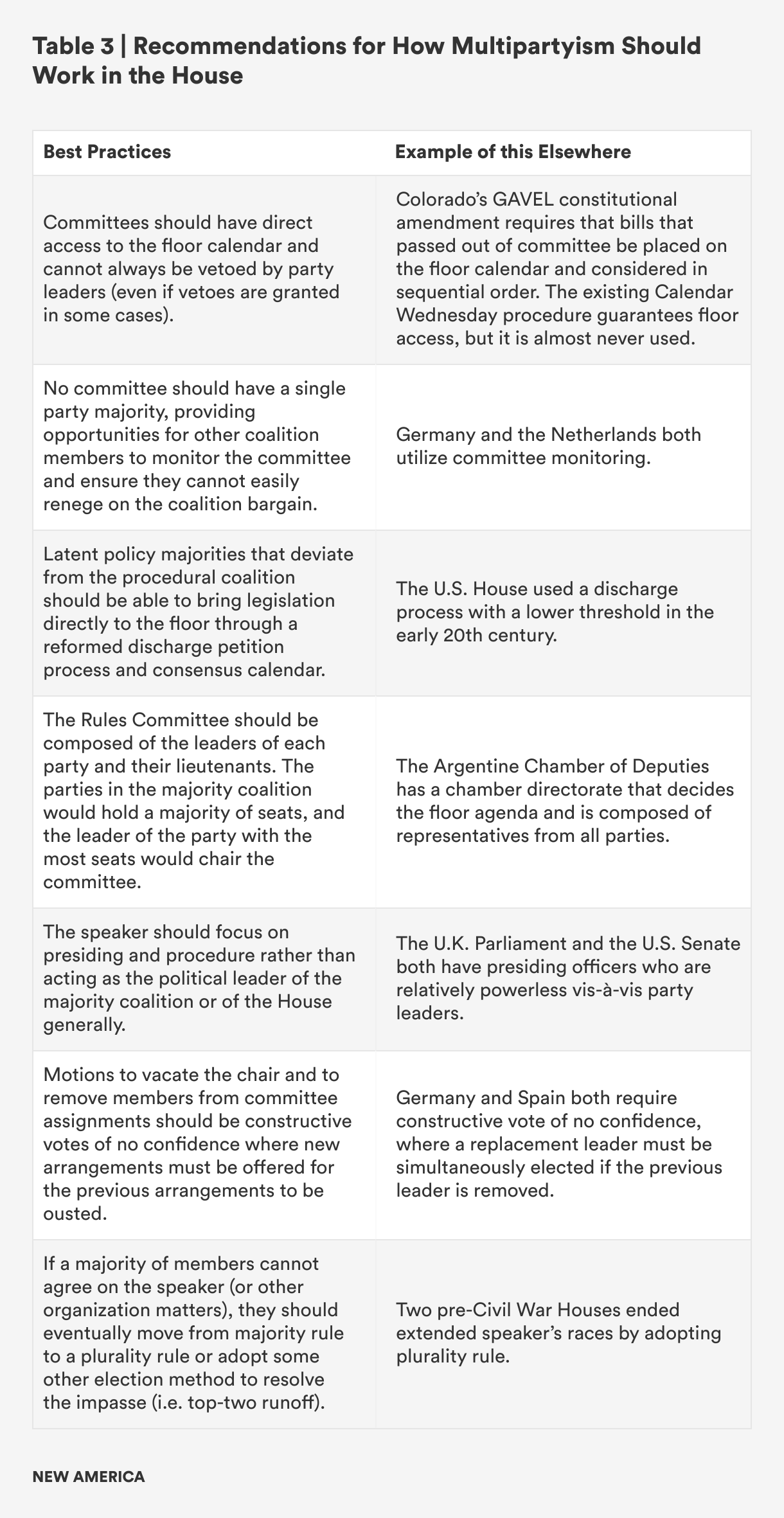
Overall, we are recommending that the House organize itself in ways that decentralize power but also install guardrails to ensure that greater pluralism does not regularly throw the body into chaos (or, at least, that there’s a clear way to move on from the chaos when it does). Our list of best practices is summarized in Table 3.
Citations
- In Brazil, for example, the president of the Chamber of Deputies, Arthur Lira, is generally seen as a powerful figure. Israel’s inability to forge a government in 2019 and 2020 is the most recent example of multiparty chaos in forming a procedural coalition. Beatriz Rey, “The Inevitability of Arthur Lira as Brazil’s House Speaker,” Brazilian Report, 2023, source; Mairav Zonszein, “Israel’s Winning Coalition: Culmination of a Long Rightward Shift,” International Crisis Group, November 8, 2022, source.
- Mary Clare Jalonick and Stephen Groves, “Abandoned by his colleagues after negotiating a border compromise, GOP senator faces backlash alone,” Associated Press, February 8, 2024, source.
- Sinclair, Unorthodox Lawmaking.
- In reality, party leaders are likely compelled to please either a supermajority of the majority party or the entire majority party given the ability of small factions to complicate their lives (e.g., the Republican rebels in the 118th Congress). Furthermore, the majority party usually only gets rolled when party leaders see the legislation as must-pass, leading them to override their members’ negative veto and go to the other party for support.
- Keith Poole and Howard Rosenthal, Congress: A Political-Economic History of Roll Call Voting (Oxford, United Kingdom: Oxford University Press, 1997).
- Keith Krehbiel, Information and Legislative Organization (Ann Arbor, MI: University of Michigan Press, 1991); Martin and Vanberg, “Parties and Policymaking in Multiparty Governments,” source.
- Kevin Kosar, “Testimony: The Excessive Complexity of House of Representatives Rules on Legislative Process,” American Enterprise Institute, July 28, 2022, source.
- Mike Binder, Vladimir Kogan, and Thad Kousser, “How GAVEL changed party politics in Colorado’s general assembly,” in State of Change: Colorado Politics in the Twenty-first Century (Denver, CO: University Press of Colorado, 2011), 153–173.
- Sarah Binder, “Don’t Count on the House Discharge Rule to Raise the Debt Limit, Brookings Institution, 2023, source.
- Philip Wallach and Priscilla Goh, “The Discharge Petition: Its History and Role in the 118th Congress,” (Washington, DC: American Enterprise Institute, 2024), source.
- Richard S. Beth, The Discharge Rule in the House: Recent Use in Historical Context (Washington, DC: Congressional Research Service, 2003), source.
- Sam Brasch, “Want A Congress That Gets It Done? Maybe They Should Be More Colorado,” Colorado Public Radio, February 4, 2019, source.
- Jane Hudiburg, The House Consensus Calendar: Establishment, Principal Features, and Practice in the 116th Congress (2019–2020) (Washington DC: Congressional Research Service, 2021), source.
- The composition of and decisions made by the current steering committee is also a result of negotiations, but it has a heavy leadership imprint as the speaker has extra votes.
- There is almost no credibility of threats to withdraw in our current system. The Republican rebels in the 118th Congress never considered joining with Democrats. There was always an understanding that, however chaotic, the process was going to result in a Republican speaker.
- Members truly do perceive the current Rules Committee to be an extension of top party leaders. When several Republican members refused to vote favored by party leaders in the 118th Congress, Rep. Anthony D’Esposito, a leadership ally, said, “It’s been made pretty crystal clear that those on the Rules Committee were supposed to carry out the will of the speaker. I would be in favor of his decision replacing those individuals.” See Jamie Dupree, “Israel, Ukraine Aid Stays on Track in the House,” Regular Order, April 19, 2024, source.
- Ironically, this recommendation is more consistent with how the Rules Committee works in the 118th Congress than how it did in previous Congresses. Due to negotiations at the beginning of the 118th, Chip Roy, Ralph Norman, and Thomas Massie (all conservatives with a rebellious bent) held three of the 10 Republican appointments. This is probably a slight overrepresentation of rebellious conservative strength within the Republican Conference, an indication of their strong bargaining position.
- Data on House rules show that the percentage of rules that are open to amendments fell from 56 percent in 1981–82 to zero in 2017–2018. Meanwhile, the percentage of rules that are closed to amendment rose from 18 percent to 41 percent, and the percentage of rules with structured amendment rose from 4 percent to 44 percent. See Michael Lynch and Anthony Madonna, “House Rules, 59th (1905-1907) – 115th (2017-2018) Congresses,” Congress Project, 2019, source.
- Michael Laver and Kenneth Shepsle, Making and Breaking Governments: Cabinets and Legislatures in Parliamentary Democracies (Cambridge, United Kingdom: Cambridge University Press, 1996); Lanny Martin and George Vanberg, “Coalition Governments, Legislative Institutions, and Public Policy in Parliamentary Democracies,” American Journal of Political Science 64, no. 2 (2020): 325–40, source.
- The House did not even consider a widely supported symbolic resolution in favor of Israel after the October 7 attacks because there was no speaker to preside over the body. Acting Speaker Patrick McHenry was opposed to reinterpreting the powers of his role. Kayla Guo, “What Can Patrick McHenry, The Interim Speaker, Do?” New York Times, October 4, 2023, source.
- Resolutions to remove House leadership or committee assignments are Questions of Privilege that can be offered by any member and are guaranteed a vote within a certain time span. However, as we’ve seen with the motion to vacate, the rules governing these questions can be altered in the House rules package. Meghan Lynch, Questions of the Privileges of the House: An Analysis (Washington, DC: Congressional Research Service, 2015), source; Jane Hudiburg, House Rules Changes Affecting Floor Proceedings in the 118th Congress (2023-2024) (Washington, DC: Congressional Research Service, 2023), source.
- The constructive vote of no confidence was adopted in the 1949 German Constitution due to the prewar Weimar Republic’s experience with Nazis and Communists. These groups collectively held a majority in the Reichstag after the June 1932 elections and proceeded to vote down government bills and support a no confidence motion, even though there was no possibility of these two extremist groups working together constructively. Reuven Hazan, Legislative Coalition Breaking: The Constructive Vote of No-Confidence (Jerusalem: Hebrew University of Jerusalem, 2015); Richard Evans, The Coming of the Third Reich (New York: Penguin Books, 2003).
- That being said, a determined majority can usually get its way. However, if a majority of the chamber was organized and angry enough to change the chamber’s rules to allow for ousting a coalition, they would hopefully also be organized and angry enough to replace the coalition with a new one.
- Although we recommend that the speaker be less powerful, it is still the case that a speaker must be elected at the beginning of the Congress. This vote would likely be an initial test for whether the leading coalition actually has enough support to control a majority of the chamber.
- Jenkins and Stewart III, Fighting for the Speakership.