Governing the House with Multiple Parties
Abstract
The two-party combat and leadership centralization in Congress are at odds with the considerable pluralism and diversity in American society. If we replaced our winner-take-all electoral system with a system of proportional representation in the U.S. House, more than two parties could hold a significant number of seats and better represent the nation’s diversity. But while proportional representation has long been heralded as an electoral reform, the reform community has had much less to say about how having multiple parties would affect governance.
We expect that proportional representation would create a multiparty presidential system where various parties would be organized under two broad pre-electoral coalitions and could engage in more fluid legislative dealmaking than in the current system. To facilitate more complex bargaining, we recommend reforms that empower committees and latent majorities relative to the speaker. We also recommend changes to ensure that inter-party disputes within the majority coalition cannot easily lead to breakdowns and chaos.
Our paper is an early step in imagining how multipartyism governance could work in the United States. We encourage future research into how multipartyism would interact with the President, the Senate, and other political institutions.
Acknowledgments
For helpful feedback on an earlier draft of this paper, we thank everyone who attended our March 2024 workshops at Princeton University and New America and commented on the paper, including Roel Bos, Danny Daneri, Soren Dayton, Alina Dunlap, Matt Glassman, Matthew Green, Will Horne, Frances Lee, Cerin Lindgrensavage, Nolan McCarty, Oscar Pocasangre, Connor Phillips, Mark Schmitt, Anthony Taboni, Michael Thorning, Philip Wallach, and Hye Young You. We also benefited from conversations at a May 2024 workshop on multiparty governance hosted by Protect Democracy and the American Enterprise Institute. Additionally, we thank New America’s Political Reform team, especially Sarah Jacob, Oscar Pocasangre, Mark Schmitt, and Maresa Strano, for their support and feedback throughout. Finally, we are grateful to Princeton University’s Graduate School and the GradFUTURES Social Impact Fellowship for funding the work on this project.
Editorial disclosure: The views expressed in this report are solely those of the authors and do not reflect the views of New America, its staff, fellows, funders, or board of directors.
Downloads
Executive Summary
Polarization and partisan combat in our two-party system have risen to historic levels in recent decades. Both sides tend to portray the next election in existential terms, with their opponent’s victory likely to lead the country into doom and destruction. Members of Congress have increasingly turned to centralized leadership to achieve their goals in this high-stakes, zero-sum environment. However, the centralization in our political institutions is at odds with the considerable pluralism and diversity in American society. We need to look no further than the chaotic 118th Congress for an example of pluralism bucking up against the constraints of a centralized, two-party system. Without reform, these contradictions will continue to heighten and threaten the integrity of our political institutions.
One solution would be to replace our antiquated and comparatively rare winner-take-all electoral system with a system of proportional representation, where more than two parties could hold a significant number of seats in the House and better represent the nation’s diversity. Proportional representation would likely end gerrymandering, improve the representation of historically marginalized groups, and help alleviate the toxic “us vs. them” political culture. But while proportional representation has long been heralded as an electoral reform, the reform community has had much less to say about how having multiple parties would affect governance. This includes concerns that multipartyism would make governing even more chaotic and difficult than it is under the current system, weakening Congress as an institution.
“Proportional representation would likely end gerrymandering, improve the representation of historically marginalized groups, and help alleviate the toxic ‘us vs. them’ political culture.”
Drawing from international comparisons and congressional history prior to the era of polarization, we expect that proportional representation would create a multiparty presidential system where various parties are organized under two broad pre-electoral coalitions. Affiliated with presidential candidates, or the government and the opposition, these broad coalitions would roughly align with the present-day Democratic and Republican parties, just with more clearly defined factions that voters could directly support during congressional elections. Inside the House, the coalitions would likely organize themselves as two legislative blocs and distribute “spoils,” like committee leadership positions, to the different parties within each coalition under a negotiated power-sharing arrangement.
We expect that the broad and looser coalitions would lead to more fluidity in legislative bargaining and complex dealmaking because members would not be as tied to the two broader coalitions as they are to the Democrat and Republican brands in the current system. To facilitate bargaining, we recommend reforms that would decentralize the House by empowering committees and latent majorities relative to the broader coalition leaders, most importantly the speaker. We also recommend reforms to rules like the motion to vacate to ensure that inter-party disputes within the majority coalition cannot easily lead to breakdown and chaos like we saw in the 118th Congress.
We encourage future research and critical thinking about how multipartyism would work if other basic institutional features of our constitutional system do not change. Specifically, we recommend further exploration of how introducing additional factionalism would affect Congress’s position within the separation-of-powers system, what role the Senate would play given that it cannot hold proportional elections, and how other details of the system—including district magnitude, ballot design, and the size of the House—might impact governing dynamics.
“Escaping bad equilibriums requires imagination, bold ideas, and deep thinking about systematic change.”
There are many possible paths that such a reform might take, and none of them would be guaranteed to improve our politics. Comprehensive institutional change is difficult. Uncertainty and unintended consequences lurk around every corner. However, not changing our institutions also entails risks. Escaping bad equilibriums requires imagination, bold ideas, and deep thinking about systematic change.
Introduction
Political polarization and hyper-partisanship are pushing America’s two-party system to its brink. The American people and our elected officials have largely separated into two evenly matched partisan camps. The most politically engaged citizens on each side are in an all-out war against each other on the airwaves, the internet, and in the halls of our governing institutions. This constant demonization and othering of the opposing party has created risks for democracy itself. The 2020 election results were rejected by many, and it is possible the same thing will happen in 2024.
Breaking out of the two-party system is possible, though. Across the United States, democracy reformers are exploring systemic electoral reforms like proportional representation that would allow multiple parties to win elections and be represented in Congress. The hope is that this would unlock fluidity and multidimensionality in our politics and allow members of different parties to see each other as more than just opponents or enemies. With multiple parties, we could celebrate our commonalities on some issues while recognizing our disagreements on others. The next election would not feel like the last stand against evil. Instead, it would present opportunities to build new coalitions.
While reform would have clear benefits on many fronts, particularly in overhauling our antiquated and comparatively rare winner-take-all electoral system, it is less clear how proportional representation and multipartyism would affect our governing institutions. Congress has long been organized to accommodate two-party politics. With rising polarization in recent decades, party leaders have increasingly dominated the institution and stifled its underlying pluralism in pursuit of electoral victory. A multiparty system could reverse this tendency and unlock new opportunities for factions to collaborate with one another. On the other hand, the two-party Congress still gets things done, particularly when there’s a crisis or a deadline in front of it. Introducing multiple parties could make coalition-building even more chaotic and difficult than it is under the current system.
The effect of multiple parties is unclear for two reasons. First, multiparty democracy would look different in the United States than it does in Europe (where countries mostly have parliamentary multiparty systems) and Latin America (where many countries have presidential multiparty systems with much stronger presidents). We are the oldest constitutional democracy in the world, and our institutions are distinct from democracies that formed afterward.1 There is not one obvious example for us to emulate. The unique political culture and history of the United States would likely lead to a distinctly American version of multipartyism that cannot be found elsewhere.
“The unique political culture and history of the United States would likely lead to a distinctly American version of multipartyism that cannot be found elsewhere.”
Second, and more directly relevant, the reform community has not paid nearly enough attention to the possible effects of multipartyism on our governing institutions. Rather, reform work usually focuses on how multipartyism would affect elections and mass politics. But governance cannot be ignored or made a secondary consideration. A multiparty Congress that is more chaotic and dysfunctional could counterbalance the benefits reaped elsewhere. Thus, we think it’s important to 1) think more concretely about what multipartyism would look like in our governing institutions, 2) be honest about the challenges it would face and acknowledge where there’s uncertainty, and 3) consider what complementary reforms might be necessary if multipartyism is going to improve problem-solving capacity.
This paper is an attempt to understand how multipartyism could work in American governing institutions. We focus primarily on the House of Representatives because it is the only institution where multipartyism could be introduced without changing the Constitution. Our exploration of House multipartyism proceeds in five parts.
- We discuss how polarized two-party politics have created significant difficulties in the House, particularly by centralizing power in the hands of party leaders. We argue that this centralization of power has undercut representation and, as seen in the 118th Congress, exposed contradictions and tensions between our institutions and the country’s underlying pluralism.
- We consider proportional representation as a reform that could resolve some of the problems our system faces. We first highlight and discuss various electoral benefits that would follow from adopting proportional representation. We then discuss the uncertainty in how proportional representation would affect our governing institutions.
- We draw from comparative examples and U.S. history to develop expectations for how multipartyism would work in the House. We identify the mid-twentieth century House as one model for more fluid, issue-centric factional bargaining that a multiparty legislature could strive for.
- We consider complementary institutional reforms that could help the House unlock the benefits of more factional representation while avoiding the chaos and instability it could potentially sow. Specifically, we recommend reforms that would decentralize the House agenda and ensure that majority coalition breakdowns would not render the chamber inoperable.
- Finally, we look beyond the House and outline a research agenda for assessing how multipartyism would interact with other aspects of the political system to affect governance. Areas for further research include the electoral and the separation-of-powers systems.
Citations
- Steven Taylor, Matthew Shugart, Arend Lijphart, and Bernard Grofman, A Different Democracy: American Government in a 31-Country Perspective (New Haven, CT: Yale University Press, 2014).
The Difficulties with Two-Party Politics
The United States is the world’s third-largest country. Sprawling across a landmass of nearly 4 million square miles, our nearly 350 million inhabitants represent dozens of distinct races, ethnicities, religions, languages, and national origins. Outside of the African continent, where countries typically rank highly across diversity indexes, the United States is one of the most culturally heterogeneous nations on Earth.1 Accordingly, our political system must accommodate a lot of diversity. Although the founders did not exactly foresee what the American republic would become, they did welcome a large and diverse country to diffuse power so that no single group would become too powerful and abuse the rights of others.
But despite our remarkable diversity and the founder’s intentions, just two parties capture the wide variety of ideologies, regional concerns, policy impulses, and other groupings in American politics. This two-party system has been, more or less, the norm throughout American history. Democrats and Republicans have been the two major parties since the Civil War, although exactly which groups fall into each party has changed a good bit since the nineteenth century.2 Democrats have gone from being the party of the agrarian, white supremacist South to an almost entirely urban party with strong support across racial groups. Similarly, Republicans have shifted from their roots in the abolition movement to become a largely white and Southern party that balances the interests of business and religious conservatives.
“Just two parties capture the wide variety of ideologies, regional concerns, policy impulses, and other groupings in American politics.”
The key to the stability of the two-party system prior to the 1990s was its fluidity and adaptability. Politics was rooted at the state and local level, so it was possible to have heterogeneous national parties that governed on a bipartisan basis. Conservative Democrats from the party’s southern wing regularly worked with conservative Republicans on certain issues at the expense of progressive Democrats and liberal Republicans.
However, since the mid-1990s, politics has become increasingly nationalized. The differences between Democrats and Republicans have widened, and the parties have become more internally homogenous. There are very few conservative Democrats or liberal Republicans remaining. Moreover, national politics have become oriented around identity, specifically the question of who we are as a country. In line with their respective political bases, Democrats see America as a fundamentally multicultural and cosmopolitan society, while Republicans see it as rooted in traditional values with a singular national character. Both of these views have truth in them, but complexity has been flattened into a more simplistic “us vs. them” identity politics among politically engaged citizens. Meanwhile, anti-system attitudes are rising among the politically disaffected and disengaged, who do not believe anyone represents them in the two-party system.3
“Anti-system attitudes are rising among the politically disaffected and disengaged, who do not believe anyone represents them in the two-party system.”
Plenty has been written about how the country has polarized in a two-party system.4 Our focus here is on how this polarization has affected Congress—the national political institution where the founders imagined various factions and groups would come together to decide important questions through compromise. We argue that polarization in the two-party system has led to increasing centralization in the U.S. House, imperiling representation without delivering the promised partisan victories. Moreover, the breakdowns seen in the 118th Congress are a consequence of the underlying pluralism in American politics bucking up against the rigidity of the two-party system.
Two-Party Politics, Polarization, and Centralization in the U.S. House
Alongside the politically engaged public, members of Congress have also become divided into two cohesive partisan teams.5 Polarization and partisan unity have risen to historic levels.6 There are few remaining moderate members who regularly reach across the aisle or vote with the other party. Instead, Capitol Hill is increasingly populated by partisan warriors for whom political combat is business as usual.7 Although there are myriad explanations for the now unprecedented levels of polarization and partisanship, electoral competition largely explains why the parties act as viciously as they do.8 Control of the government is on a knife’s edge, regularly alternating between Democrat and Republican leadership. This leads the parties to seek an electoral advantage over the other through high-stakes confrontation.9 Both sides tend to portray the next election in existential terms, with their opponent’s victory likely to lead the country into doom and destruction. This is not the stuff that healthy democracies are made from.
To coordinate their partisan teams and achieve their goals in this polarized environment, members of Congress have increasingly turned to centralized leadership. Political scientists argue that greater levels of unity within the parties and greater levels of disagreement between them, alongside stiffer electoral competition, make legislators more likely to utilize centralized leadership structures.10 When co-partisans are more aligned with each other and distinct from the other party, they are more likely to empower leaders to pursue the party’s collective goals—namely, more ideological policies and electoral victories. In turn, party leaders can use their institutional advantages to create even more unity and cohesion among their members than would have otherwise existed.11
Congress worked differently when there was less ideological overlap between the parties. Prior to the 1990s, there were conservative southerners in the Democratic Party and liberal northeasterners in the Republican Party. Moreover, there was very little electoral competition for control of Congress, as Democrats held the House for all but two years between 1933 and 1995. With Democrats a permanent majority, members saw little need to rally behind common partisan electoral goals.12 They usually just focused on winning their own seats, which, for conservative Democrats in particular, involved differentiating themselves from the national party rather than boosting it. Party leaders functioned more as “brokers” who facilitated bargaining between various intraparty factions but did not wield much power themselves.13
As the House became more polarized and partisan, members empowered party leaders to further their collective goals of securing more policy and electoral wins. With the blessing of their caucuses, leaders like Newt Gingrich and Nancy Pelosi stacked important committee posts with party loyalists, directed the legislative process to ensure their preferred legislation made it to the floor, dominated information flows through their larger and more experienced staffs, centralized messaging and electioneering efforts, and participated in summits with Senate leaders and the president to work out compromises on major bills.14
With leaders dominating everything from procedure to the information flows on Capitol Hill, rank-and-file members are often cut out of the legislative process.15 While leaders are often working in the interest of their caucuses, they do not often seek their input. In many ways, this undercuts the very idea of a Congress, where representatives of a diverse nation should come together to bring their unique perspectives to bear on the common problems the country faces. Instead, we have a Congress where members relinquish much of their authority to leaders who are more focused on party goals than the representation of diverse perspectives.
“We have a Congress where members relinquish much of their authority to leaders who are more focused on party goals than the representation of diverse perspectives.”
While centralized leadership promises more effective legislating, the results have been largely underwhelming. The parties are no more likely to implement their stated agendas than they were prior to the 1990s.16 Partisan lawmaking has barely budged over the last four decades, as most enactments involve widespread bipartisan support. Laws that pass without any minority party support (e.g., the Affordable Care Act, the Tax Cuts and Jobs Act, and the American Rescue Plan Act) are exceptions to the rule.17
In short, greater polarization and centralization have not brought us any closer to the idealized model of two-party politics that political scientists long pined for. In the responsible party government model of legislative politics, a cohesive majority makes law while an equally cohesive minority offers a contrast through opposition.18 The responsible party government model never clearly fit with American policymaking, though. Unlike the U.K. system on which it was modeled (essentially a unicameral parliament with two cohesive parties), the United States’ bicameral separation-of-powers system and supermajority veto points, alongside the intraparty disagreements and factions that are inevitable in a large and diverse nation, have largely prevented majority parties from implementing their policy agendas without significant compromise and accommodation.19
But despite it being patently unrealistic, leaders have still promised to lead their parties to glorious victories over the opposition. The results have been predictable. Bipartisanship is still, by far, the most common way to enact policy, even in an era of historic polarization, and leaders are most often using their advantages in the lawmaking process to secure bipartisan legislation. But the dissonance between the dream of partisan domination and the reality of bipartisan compromise has led to considerable disappointment among rank-and-file members. As a result, party leaders, particularly Republicans, must often drag their members to the finish line, kicking and screaming, to enact bipartisan bills.
“Despite it being patently unrealistic, leaders have still promised to lead their parties to glorious victories over the opposition.”
Rank-and-file members are particularly upset because so much of their party’s messaging is focused on demonizing the other party—their only enemy in a binary system. Collaborating with the people you claim are unfit to run the country is a surefire way to demobilize your base and undercut arguments for why voters should choose you in the next general election or primary.20 These contradictions create problems for leaders who win their positions promising to achieve partisan goals. When members are disappointed by the way party leaders use their power, the incentive to centralize and defer to those leaders is weakened, with sometimes explosive results. For an example of this explosiveness, we turn to the 118th Congress, where Republican disappointment with their leaders led to a breakdown in longstanding norms.
The Limits of Centralization
Traditionally, the party that wins the House majority has banded together as a cartel to control important aspects of the institution. Since the Civil War era, the majority party alone has elected the Speaker of the House and settled other organizational matters, such as committee leadership and the rules package. There was an expectation that all party members should vote for the speaker candidate on the House floor even if the leadership race was contentious within the caucus.21 The majority party also controlled the House agenda by voting for special rules that govern debate and amendment and by defeating the minority’s attempt to gain control of the floor via the motion to recommit and discharge petitions.22 The majority party typically hangs together on procedural matters even when it is internally divided on the underlying policy or substance.23
During the 118th Congress, a number of House Republican rebels rejected this norm by regularly revolting against their leaders on organizational and procedural votes, severely undercutting Republican control of the chamber. The rebels, who came from various corners of the caucus but mostly included members and close allies of the House Freedom Caucus, were furious at Republican leaders (current and past) for cutting bipartisan deals to enact budgetary, fiscal, and other must-pass policies. This history of disappointment seemed likely to repeat in the 118th Congress because Democrats held the presidency and the Senate while the House Republican majority was extremely narrow. However, this narrow control simultaneously gave the rebels enormous leverage over party leaders in terms of organizational and procedural votes. They resolved to vote against most Republicans and, thus, with Democrats on these typically party-line matters unless leaders gave the rebels disproportionate power in the conference and aggressively pushed for more conservative policies.
The rebellion began with an extended speakership battle at the beginning of the Congress. To secure 218 votes, Speaker-designee Kevin McCarthy made various concessions to the rebels, including representation on the Rules Committee (which has been stacked with leadership allies in recent decades) and increased sway in intraparty negotiations. After McCarthy cut bipartisan deals to raise the debt ceiling and to pass a continuing resolution funding the government, some of the rebels joined with Democrats—their sworn enemies on policy matters—to oust him through a motion to vacate. They also voted down several House rules and forced the speaker to rely on Democratic votes at other points. Democrats bailed Republican leaders out in some cases, but their own incentives to damage Republicans ahead of the 2024 elections led them to join with the rebels in others.
In short, intraparty factionalism effectively undermined House Republicans’ procedural and organizational majority.24 While intraparty bargaining and defections on leadership votes have become more common in recent decades, the House majority party has generally been willing to bury internal policy disagreements to wield power. The 118th Congress broke that trend. If open rebellion becomes more regularized, then the House is sure to become a more chaotic and ineffective legislative body.
The current system is particularly vulnerable to factionalism because party leaders usually do not have a credible outside option if members of their own party defect. The minority party rarely crosses over to help the majority party on organizational or procedural matters.25 Their electoral incentives to embarrass and undermine the majority are simply too strong. There was one example of a bipartisan bailout in the 118th Congress, when Democrats came to the rescue of McCarthy’s successor, Mike Johnson, when rebels also tried to oust him. However, they only helped out after Johnson advanced foreign aid legislation prioritized by President Biden.
“The 118th Congress demonstrates how the considerable diversity and heterogeneity in American politics are in tension with centralized leadership in a two-party system.”
Will the two-party system lead to regular institutional breakdowns like these? Maybe. The conditions were particularly ripe for rebellion in the 118th Congress. For a variety of reasons, Republicans are more likely to rebel against their leaders than Democrats, and, moreover, their majority in the House was historically narrow.26 Furthermore, divided government essentially requires bipartisan compromises that tend to disappoint rank-and-file members. Without these conditions, intraparty factions might not be able (or want) to put their leaders under extreme pressure in future Congresses.
But, in any case, the 118th Congress demonstrates how the considerable diversity and heterogeneity in American politics are in tension with centralized leadership in a two-party system. The two parties have always been “long coalitions” of diverse policy interests, congealed by a constructed ideology that binds a coalition around agreements and sublimates divisive disagreements.27 Moreover, there have always been elements of those coalitions that have been dissatisfied with their place in it. The changing variable here is the centralization of legislative leadership after decades of rising polarization, partisanship, and electoral competition. Empowered party leaders have sidestepped disagreement in pursuit of the one goal everyone agrees on—defeating the other party. However, if a highly centralized House cannot accommodate a resurgence in intraparty factionalism, this arrangement is in trouble.
“Our electoral system has pushed us into two camps, but American politics is much more complicated than this superficial binary.”
This problem is unlikely to be solved by reforms that further empower the two parties to discipline their members. The larger issue is that the centralization created by polarization and electoral competition does not fit with a broader governing system that requires power-sharing and compromise. Our electoral system has pushed us into two camps, but American politics is much more complicated than this superficial binary. If members decide that it no longer suits their interests to bury their disagreements in service of the two-party system and defer to strong leaders, they could alter institutions to achieve their goals through other means. In the next section, we explore one way to do this.
Citations
- We base this off measures of ethnic, linguistic, and religious fractionalization reported by the World Population Review, “Most Racially Diverse Countries,” 2024, source.
- John Gerring, Party Ideologies in America, 1828–1896 (Cambridge, United Kingdom: Cambridge University Press, 2001).
- Lee Drutman, “Why RFK Jr. Will Be a Chaos Factor This Election Year,” Undercurrent Events (blog), 2024, source.
- Lee Drutman, Breaking the Two Party Doom Loop: The Case for Multiparty Democracy in America (New York: Oxford University Press, 2020).
- The causal arrow here is somewhat ambiguous. Elected officials have both contributed to and responded to polarization in the electorate and elsewhere in the political system. See Nolan McCarty, Polarization: What Everyone Needs to Know (New York: Oxford University Press, 2019).
- Ideological polarization is typically measured as the distance between the DW-NOMINATE scores for the median Democratic and Republican legislators. Party unity is the percentage of votes where at least 50 percent of one party voted against 50 percent of the other party. McCarty, Polarization; David Rohde, Parties and Leaders in the Postreform House (Chicago, IL: University of Chicago Press, 1991).
- McCarty, Polarization.
- These actions include the realignment of the South during the Civil Rights era, the continued sorting of voters into conservative rural and liberal urban areas, the influence of money and ideological donors, and gerrymandering and primaries. See McCarty, Polarization.
- Frances E. Lee, Insecure Majorities: Congress and the Perpetual Campaign (Chicago, IL: The University of Chicago Press, 2016).
- John Aldrich and David Rohde, “The Consequences of Party Organization in the House: The Role of the Majority and Minority Parties in Conditional Party Government,” in Polarized Politics: Congress and the President in a Partisan Era, ed. Jon Bond and Richard Fleisher (Washington, DC: CQ Press, 2020).
- James Curry, Legislating in the Dark: Information and Power in the House of Representatives (Chicago, IL: University of Chicago Press, 2015).
- Frances E. Lee, Insecure Majorities: Congress and the Perpetual Campaign (Chicago, IL: The University of Chicago Press, 2016).
- Joseph Cooper and David Brady, “Institutional Context and Leadership Style: The House from Cannon to Rayburn,” American Political Science Review 75, no. 2 (1981): 411–25, source.
- Barbara Sinclair, Unorthodox Lawmaking: New Legislative Processes in the U.S. Congress (Washington, DC: CQ Press, 2017).
- Curry, Legislating in the Dark.
- Aside from partisan policymaking, Congress has addressed fewer items on its legislative agenda during the era of greater centralization. See Sarah Binder, “The Struggle to Legislate in Polarized Times,” in Congress Reconsidered (Washington, DC: CQ Press, 2021): 251–74.
- These disappointments are not necessarily the result of more centralized leadership. There are many reasons why Congress’s capacity to solve problems has declined. Moreover, leadership centralization has some silver linings. When Congress gets things done, it is often congressional leaders taking the charge as centralization has made it possible for them to navigate a difficult political environment. Critically though, party leaders are primarily using their powers to cut bipartisan deals, often deals on must-pass legislation that are major disappointments for many of their rank-and-file members. For example, Republicans have seen their leaders work with the opposition to fund the government, raise the debt ceiling, and disperse foreign aid. Democrats have watched as their leaders helped fund the wars in Iraq and Afghanistan and cut taxes for the wealthy. See James Curry and Frances E. Lee, The Limits of Party: Congress and Lawmaking in a Polarized Era (Chicago, IL: University of Chicago Press, 2020).
- See “Toward a More Responsible Party System: A Report of the Committee on Political Parties,” American Political Science Review 44, no. 3 (1950), Part 2, Supplement, source.
- Curry and Lee, The Limits of Party.
- Frances E. Lee, Insecure Majorities: Congress and the Perpetual Campaign (Chicago, IL: The University of Chicago Press, 2016).
- Jeffrey Jenkins and Charles Stewart III, Fighting for the Speakership: The House and the Rise of Party Government (Princeton, NJ: Princeton University Press, 2013).
- Gary Cox and Matthew McCubbins, Setting the Agenda: Responsible Party Government in the U.S. House of Representatives (Cambridge, United Kingdom: Cambridge University Press, 2005).
- For example, even though 10 House Republicans voted to impeach Donald Trump in January 2021, the special rule governing the impeachment proceedings passed on a straight party-line vote.
- A procedural majority, also known as a procedural cartel, is the group of legislators who comprise a majority of the House and use that majority to control the agenda. Closely related is an organizational majority, which is the group of members who band together to elect leaders and appoint committees. Both of these can be distinguished from a policy majority, which is the group of members that works together to enact some policy or substantive concern. Unlike procedural or organizational majorities, policy majorities tend to be bipartisan. Charles Jones, “Joseph G. Cannon and Howard W. Smith: An Essay on the Limits of Leadership in the House of Representatives,” Journal of Politics 30, no. 3 (1968): 617–46, source; Jenkins and Stewart III, Fighting for the Speakership; Curry and Lee, The Limits of Party.
- Perhaps some centrist factions would be willing to crossover, but these members tend to be less loud and more tied to party leaders than the ideological extremists who would never be able to align with the other coalition.
- Matthew Green, “We’re Ungovernable”: The Historical Origins of Republican Disunity in the U.S. House of Representatives (Washington, DC: The Catholic University of America, 2024), source.
- John Aldrich, Why Parties?: The Origin and Transformation of Political Parties in America (Chicago, IL: University of Chicago Press, 1995).
Proportional Representation and Multipartyism in the United States
If the two-party system is responsible for the rise of toxic identity politics among the politically engaged, fails to represent people who are heterodox or less politically engaged, and has contributed to the rise of polarized and leadership-driven politics in Congress, then why don’t we join most other advanced democracies and get rid of it?
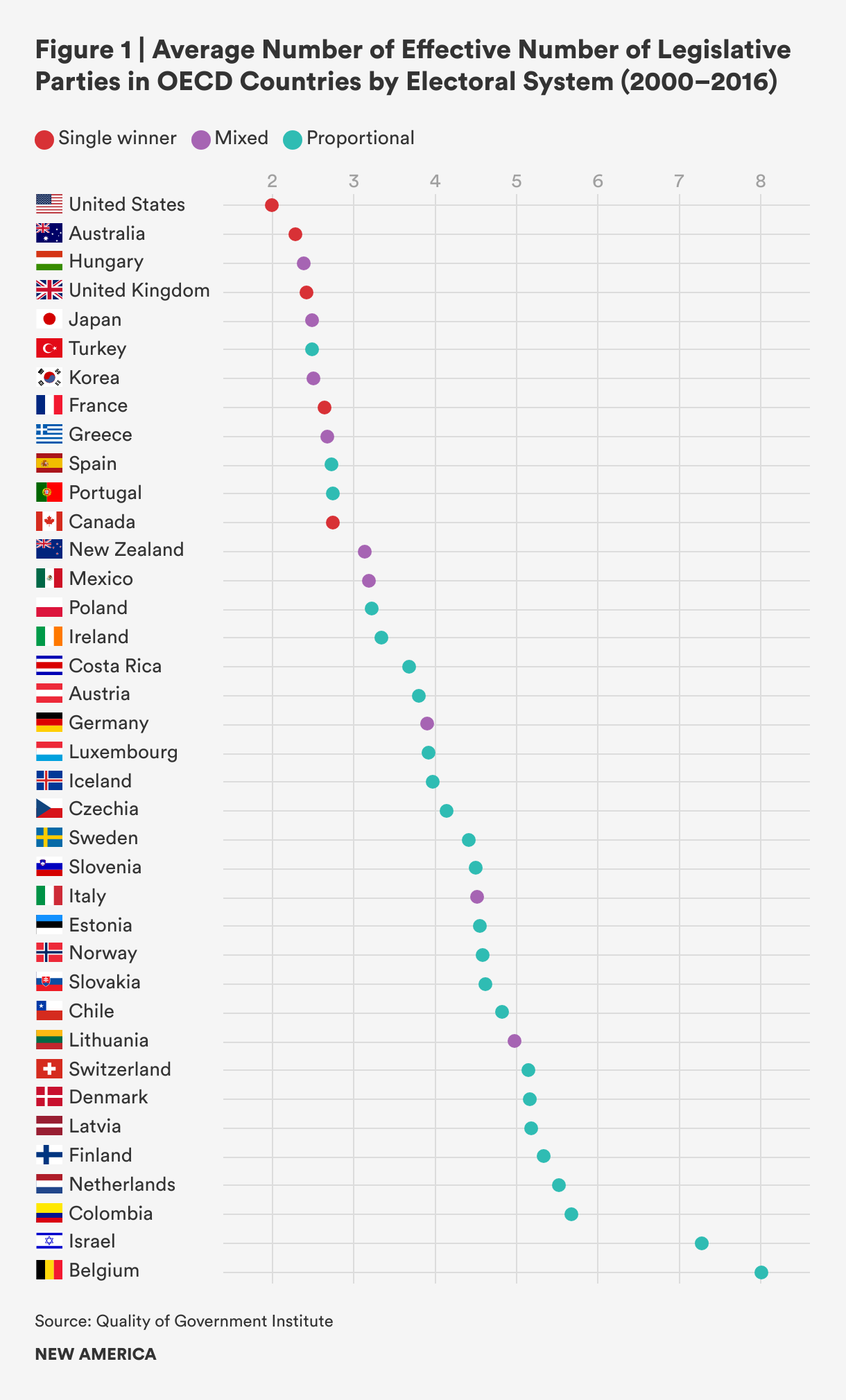
The United States is a global outlier when it comes to our party system. As Figure 1 shows, we have the lowest effective number of legislative parties of any OECD country.1 If there were more legislative parties, we would likely see a wider range of perspectives represented in Congress. For example, the rebels who toppled McCarthy might form their own party and officially disassociate themselves from the leaders they have long accused of being sellouts.
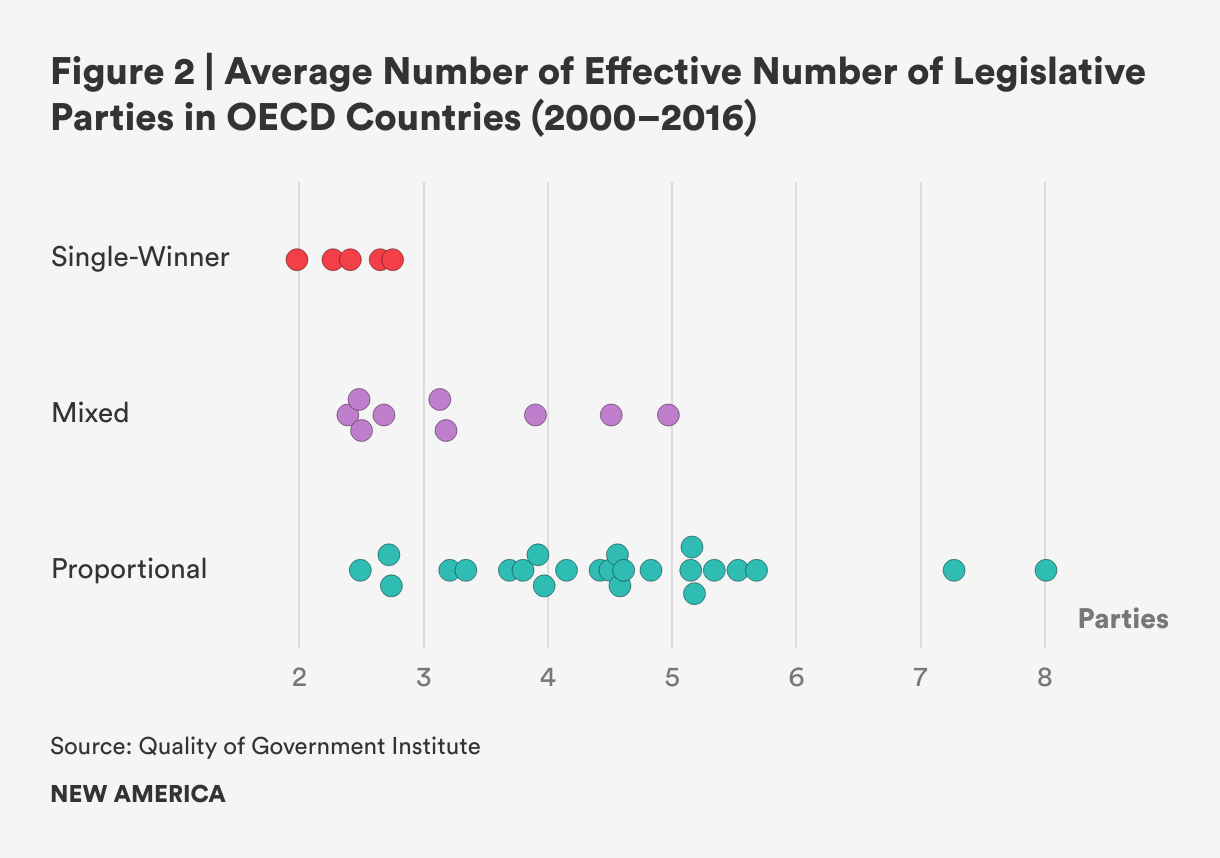
The most direct way out of the two-party binary is adopting a new electoral system that would make new parties viable.2 In most systems of proportional representation (the system used by most democracies), candidates run in multi-member districts and seats are allocated based on the relative number of votes received by the various parties. In our current system, legislative candidates run in single-member districts, and whoever gets the most votes wins the single seat, even if the margin is 51 percent to 49 percent. In a proportional system, a 51-49 percent margin in a district would split multiple seats evenly between the parties. Most democracies use proportional representation, and these countries almost always have more than two parties. Figure 2 shows a clear trend where countries that use proportional representation have a larger number of effective legislative parties.
Proportional representation is possible in the U.S. House because the Constitution does not say that House districts must be single-member. Debates about how to design electoral systems were in a nascent stage in 1787,3 and the founders were silent on how elections would be conducted. The design of the electoral system is critical, though, because it largely determines the number of competitive parties.4 Thus, the founding document’s silence about electoral design is a key part of our “unwritten Constitution”—the informal institutions and procedures that shape American governance.5
“Proportional representation is possible in the U.S. House because the Constitution does not say that House districts must be single-member.”
In the face of this silence, the states adopted a hybrid system with both single-winner majoritarianism and at-large bloc voting.6 Given concerns about malapportionment and racial disenfranchisement in the 1960s, Congress passed the Uniform Congressional District Act (UCDA), which required that all states use single-member districts for House elections.7 States use different methods to determine the winners of these elections (i.e., first-past-the-post, runoffs, and more recently, ranked choice), but the commonality across all districts is that only one winner will emerge from each contest, so there are strategic incentives to consolidate around the two most viable choices.8
While amending the UCDA would be a relatively simple technical change to electoral law, doing so would have significant effects on our elections and governing system. Reformers have, thus far, devoted significantly more attention to the former, even though governance is equally important in American politics. We first review proportional representation as an electoral reform and then consider it as a governance reform.
Proportional Representation as an Electoral Reform
If we amended the UCDA to mandate that states use multimember districts and proportionally allocate votes when electing representatives, then it is almost guaranteed that more than two parties would be viable in House elections. We, along with many other scholars, believe that if a modest number of members are elected in each district, a proportional system will make our politics more representative, our electorate more engaged, and soften the all-or-nothing binary.9 While the benefits of proportional representation for elections and voters are not the focus of this paper, it is worth highlighting a few of them.
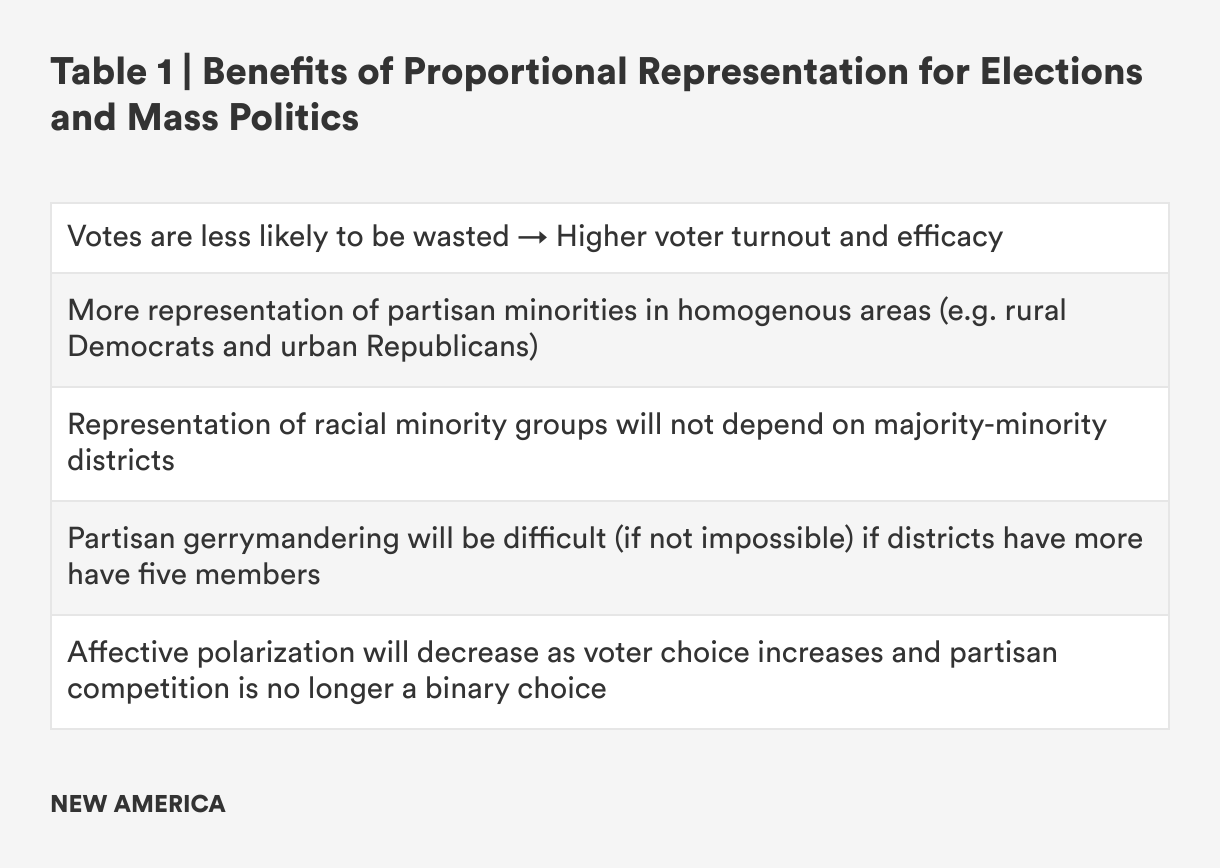
Proportional representation would make citizens’ votes count more equally. In multimember districts—which are a necessary feature of proportional representation— parties can win seats even if they are well short of a majority. Accordingly, fewer votes are wasted than in lopsided single-member districts, where voters can abstain without affecting the outcome. This would likely improve voter turnout and ease the urban-rural divide, as Democratic voters in conservative rural areas and Republican voters in liberal urban areas would be able to secure some representation even though they are vastly outnumbered. For example, Massachusetts Republicans would be able to elect some members of the state’s congressional delegation. Under the current system, Republican voters are about one-third of the electorate but are so thinly spread across the state that Democrats control all nine House seats. Similarly, Democrats do not hold any of Oklahoma’s five congressional districts despite winning a third of the vote in 2020.10
“A proportional system will make our politics more representative, our electorate more engaged, and soften the all-or-nothing binary.”
Racial and ethnic minorities would also receive fairer representation as long as most parties continue to support and value non-white candidates (given demographic trends, we have good reason to think that they will). In a proportional system, their representation would no longer depend on majority-minority districts mandated by the Voting Rights Act, which tend to “pack” minority groups in geographically concentrated areas and limit the possibilities for multiracial and multiethnic coalitions.
More generally, as long as districts elect at least five members, proportional representation would effectively end gerrymandering in American politics by making it very difficult (if not impossible) to draw lines that benefit one party or group over the others.11 Control of the House would no longer depend so much on lawyers and experts litigating the fairness of district lines and tit-for-tat gerrymanders in blue and red states.
Finally, proportional representation would move American politics away from zero-sum partisan competition. In a closely divided two-party system, each party only has one mortal enemy (the other), and a vote for one is effectively a vote against the other. As a result, the parties try to win votes through demonization. Proportional representation would give voters more options, and they would no longer feel that they must vote for a flawed candidate from one party because the other party is evil incarnate. Shifting coalitional alliances would soften the out-party hatred consuming U.S. politics.12 The binary rigidity in our current system would begin to be replaced by more nuance and complexity, lessening affective polarization and partisan identity politics.13
Proportional representation promotes a politics where different perspectives are represented, and Americans must learn to accept and live with each other. This is a more natural fit for a large and diverse nation like the United States than a single-winner system where two opponents focus on defeating each other for narrow majority control.14 It has worked well to build social cohesion in countries like the Netherlands and Switzerland, which have been able to overcome considerable religious and linguistic divisions over their histories.15 The salutary effects of this electoral system are summarized in Table 1.
Proportional Representation as a Governance Reform
While reformers have mostly focused on how proportional representation would affect elections, this is just one stage of the political process. Much less thought has gone into how a multiparty system would affect governance or the processes through which elected officials organize institutions and then create and implement public policy. Given that our basic governing institutions are enshrined in the Constitution (presidency, separation of powers, bicameralism, etc.) and cannot easily be changed, we must ask how multipartyism would work within what already exists.
Some of the benefits of proportional representation for governance follow naturally from the electoral changes. Most notably, proportional representation will change the composition of people who are elected to Congress. To the extent that gerrymandering and the rural-urban divide have prevented more moderate or cross-pressured representatives from entering Congress in the first place (e.g., conservatives from cities, liberals from the countryside, or anyone whose potential voting support coalition is currently too diluted to represent a majority in any single district), proportional representation would alleviate this problem.
“Given that our basic governing institutions are enshrined in the Constitution and cannot easily be changed, we must ask how multipartyism would work within what already exists.”
When Illinois used a form of proportional representation prior to the 1980s, lawmakers reported less rural-urban polarization, greater civility, and better representation of political minorities.16 If similar conditions were recreated in Congress, there could be downstream effects, as high-quality and more moderate candidates would no longer perceive Congress to be hopelessly polarized and be more attracted to run and serve.17
Changing the types of people who get elected opens up many possibilities, as Congress is, after all, made up of people who decide which issues are prioritized. Ultimately, all governing is coalition governing. In any legislature, multiple governing coalitions are possible across individuals, factions, and parties. But these coalitions can only be built by the representatives who get elected. The wide array of possibilities creates a significant challenge in taking the current dynamics of the two-party, single-member district House and projecting them forward into a multiparty, multi-member district House. Politics would simply look very different in ways we cannot anticipate.
But, as with all reforms, we must be careful about unintended consequences. Institutional reformers have been wrong before, and the consequences were not trivial.18 There are certainly reasonable concerns that more parties might make governing even more fractious and incoherent, worsen problems of gridlock and immobilism, and empower the president at Congress’s expense.19
We do not deny these are possible outcomes. But we also see ways in which more parties and a more proportional electoral system might improve governing and increase problem solving capacity. In other words, a range of outcomes is possible. Our goal here is not to proclaim a definitive analysis of what would happen but rather to anticipate how governing and institutional dynamics might change and consider how particular institutional design choices might foster compromise and collective problem-solving in a multiparty Congress.
“Many countries with multiple parties have better policy representation, legislative accountability, and government stability.”
Though we draw considerably on the history of Congress and the practices of state and international legislatures throughout, our judgments are necessarily speculative. Lawmakers are the ones who actually implement political reforms. The contingent choices they make and the norms they establish will be far more important than ideas and plans from outside advocates. And, while it is not guaranteed, we think there are pathways to success. Many countries with multiple parties have better policy representation, legislative accountability, and government stability.20 New Zealand transitioned to multipartyism while remaining one of the world’s most prosperous and politically stable countries. If other countries can make it work, it must also be possible in the United States.
Citations
- The effective number of legislative parties accounts for both the number of parties and their relative sizes. For more, see Taylor, Shugart, Lijphart, and Grofman, A Different Democracy, 174.
- Duverger’s Law states that single-member winner districts (district magnitude M = 1) will result in a two-party system; Gary Cox generalized this, claiming that the number of competitive parties in a district (P) is the sum of the district magnitude plus 1 (P = M+1). This is due to strategic considerations in electoral coordination. Duverger’s Law and its generalization does not hold in Canada and some federalist systems like India due to the presence of strong regional parties. Maurice Duverger, Political Parties: Their Organization and Activity in the Modern State (New York: Methuen & Co., 1954); Gary Cox, Making Votes Count: Strategic Coordination in the World’s Electoral Systems (Cambridge, United Kingdom: Cambridge University Press, 1997).
- Single-winner majoritarian was the only election being used at the time (and for decades afterwards), making it “the only game in town.” See Robert Dahl, How Democratic Is the American Constitution? (New Haven, CT: Yale University Press, 2003), 56.
- However, it is not the only factor and causation runs in both directions. See Josep Colomer, “It’s Parties That Choose Electoral Systems: (Or, Duverger’s Laws Upside Down),” Political Studies 53, no. 1-21 (2005), source.
- Dahl, How Democratic Is the American Constitution?.
- Multimember districts are used in a bloc voting system, but the individual contests are still decided by winner-take-all standards rather than proportional representation. This allows the party with more than 50 percent of the vote to potentially capture all of the seats in a district and disenfranchise the minority party. Grant Tudor and Beau Tremitiere, Towards Proportional Representation for the U.S. House: Amending the Uniform Congressional District Act (Washington, DC: Protect Democracy, 2023), source.
- The House had originally mandated single-member districts in the 1842 Apportionment Act, but several states using at-large bloc ignored this limitation as they believed it to be unconstitutional. See Tudor and Tremitiere, Towards Proportional Representation for the U.S. House, source.
- Cox, Making Votes Count.
- We caveat this because the particular details of the proportional system matter greatly. We would be most enthusiastic about an electoral system that encourages the formation of five to six legislative parties rather than one that encourages fragmentation. See John Carey and Oscar Pocasangre, Can Proportional Representation Lead to Better Governance? (Washington, DC: Protect Democracy, 2024), source.
- Peter Miller and Michael Li, “PR Can Reduce the Impact of Gerrymandering,” Democracy: A Journal of Ideas 70 (Fall 2023), source.
- Miller and Li, “PR Can Reduce the Impact of Gerrymandering,” source.
- Will Horne, James Adams, and Noam Gidron, “The Way we Were: How Histories of Co-Governance Alleviate Partisan Hostility,” Comparative Political Studies 56, no. 3 (2023): 299–325, source.
- Lilliana Mason, Uncivil Agreement: How Politics Became Our Identity (Chicago, IL: University of Chicago Press, 2018).
- Lee Drutman, Elections, Political Parties, and Multiracial, Multiethnic Democracy: How The United States Gets It Wrong (New York: NYU Law Review, 2021), source.
- Switzerland also solves its problem of different regional language and culture blocs through a heavy dose of localism. See Dahl, How Democratic Is the American Constitution?.
- Grant Tudor and Cerin Lindgrensavage, “The Lost Illinois Elections Experiment” (Protect Democracy unpublished brief), 2024.
- Danielle Thomsen, Opting Out of Congress: Partisan Polarization and the Decline of Moderate Candidates (Cambridge, United Kingdom: Cambridge University Press, 2017).
- Julian Zelizer, On Capitol Hill: The Struggle to Reform Congress and Its Consequences, 1948–2000 (Cambridge, United Kingdom: Cambridge University Press, 2006).
- Ruth Bloch Rubin and Gregory Elinson, “More Parties, More Problems? Why PR Might Not Work,” Democracy: A Journal of Ideas 70 (Fall 2023), source.
- Carey and Pocasangre, Can Proportional Representation Lead to Better Governance?, source.
Multipartyism in Action
Imagine we amend the Uniform Congressional District Act (UCDA) and require that all states draw proportional multimember House districts. These new districts make several viable parties other than Democrats and Republicans. If we can accept this premise, then how might the new multiparty House work?
This section gives a broad overview of what U.S. multipartyism might look like, including the electoral system, party coalitions, bargaining, and majority formation. These are not recommendations but instead observations about what multipartyism looks like in some countries and expectations about what it might look like in the U.S. House in particular. While lawmakers and politicians would ultimately decide how the system would work, we believe that their incentives would push them, more or less, in the directions we outline.
Multipartyism in the Comparative Perspective
The United States would be a multiparty presidential separation-of-powers system, a type of system typically found in Latin America. However, we can also learn important lessons from parliamentary systems, which most often come to mind when people think of multiparty democracy and have received the most scholarly attention. Though presidential and parliamentary systems are different, they have much in common. Fundamentally, they both involve building majority coalitions.1
In multiparty parliamentary systems, legislators are elected by voters and then bargain among themselves to select a government consisting of a cabinet and a head of state. Typically, the legislature has the option to bring down the government and call for snap elections that potentially upend the balance of power and allow a new government to form. In multiparty presidential systems, presidents and legislators are elected independently to fixed terms. The president serves as head of state and appoints the cabinet.2 Legislators can remove the president through impeachment, but otherwise, a government can only be replaced in the next scheduled election.
It is rare for a single party to win a majority of the seats in any multiparty legislature. Thus, the majorities that organize the legislature are usually coalitions of several parties that must reach an agreement on procedures and leadership. Going forward, we will call the constellation of parties that make up the majority of the House a procedural coalition or procedural majority.3
The agreements to form the procedural coalition involve compromise. Some of the compromises involve specific policies, while others involve cabinet appointments or legislative rules. The procedural coalition may establish a formal agreement, codifying the details of the negotiations so that they will remain binding for the term of the coalition.4 Generally, procedural coalitions reflect a broad agreement that compromises across the parties are based on their vote share.5
In many parliamentary systems, procedural coalitions form after the election. The party that won the most seats typically gets the first opportunity to build a majority coalition. The process of coalition formation involves much public and private back and forth, some of it performative, some of it genuine. On average, this post-election negotiation process takes a month, shorter than the two-month period between U.S. elections and the seating of a new Congress.6 However, the duration can vary. The Netherlands, which has the most proportional system in Europe and the most legislative parties, typically takes the longest to form a coalition—on average, about three months.7 Generally, high polarization and excessive legislative fragmentation contribute to longer negotiation periods.8
Though post-election coalitions are more common in parliamentary systems, about a quarter of all procedural coalitions emerge from pre-election coalitions. That is, multiple parties agree amongst themselves that if they win a majority of seats between them, they will govern as a coalition. It helps voters pick the government they want to support early on and improves the chances of a smooth coalition formation post-election.9
Obviously, tensions emerge as events challenge a coalition. Individual coalition partners still strive to differentiate themselves. Parties sometimes engage in public displays in the legislative process, including introducing amendments, to show their supporters they are fighting for core policies.10 Sometimes coalitions fall apart, and a successful no-confidence vote leads to a call for a new election.11 In the U.S. system, there is no option to call new elections if a procedural coalition breaks down. This means parties would need to work out their differences or face a continued impasse until the next election.
While some of the coalition formation dynamics seen in parliamentary democracies would probably occur in a multiparty House, the fact that the United States is a presidential system would also lead to some major differences. Most importantly, presidential systems tend to impose a binary structure on legislative politics, where some parties are aligned with the president and some parties are opposed to the president.12 This government vs. opposition dynamic tends to limit the possibilities for bargaining, as parties cannot credibly stray too far outside the boundaries set by presidential politics.13 It also creates pressure for parties to form pre-electoral coalitions around presidential candidates rather than post-electoral coalitions. Because presidential elections are inherently winner-take-all elections, leading presidential candidates from the larger parties have a clear interest in assembling the largest support coalition.
Smaller parties, which are unlikely to ever field a winning presidential candidate on their own, have good reasons to attach to a potential winner early. They can offer their support in exchange for promises of cabinet positions or policy enactments, particularly if they have particular priorities.14 Pre-electoral coalitions enable smaller parties to enhance election prospects, negotiate policy influence, gain government roles, and secure future electoral support. Joining a coalition may improve the ability of a smaller party to gain resources and visibility and help them win lower-level elections.15 As with any winner-take-all election, being on a winning team is better than being a spoiler or a wasted vote.
“As with any winner-take-all election, being on a winning team is better than being a spoiler or a wasted vote.”
Pre-electoral coalitions also help improve stability in presidential systems by negotiating policy and positions up front, sharing resources, and building trust: “By joining a pre-electoral coalition, parties surrender the possibility of controlling the presidency themselves but gain support and credibility through the coalition. This compensation provided by the formateur party strengthens the bond between coalition partners.”16 As with parliamentary systems, coalitions in presidential systems form more easily across fewer and better-connected parties.17
Because pre-electoral coalitions are common in presidential systems, voters are often voting for the coalition they would like to see in the majority. And because voters can choose both a president and a congressional representative separately, they can both support a broader coalition and the specific part of the coalition they feel represents them best. For example, a right-leaning voter who does not like Donald Trump but still supports him over the Democratic nominee could cast a vote for Trump as president but a center-right party that promises to serve as a check on Trump for Congress. By contrast, in a parliamentary system, where coalitions more commonly form after the election, voters have much less control. They might vote for a party that, post-election, ends up aligning with the left or right coalition they wanted to keep out of power.
Multipartyism in the United States
Based on the experiences of other countries, we expect that multiparty presidentialism in the United States would share some similarities with our current president-dominated electoral system. The presidency would remain a winner-take-all office, and there would be strong incentives for the parties on the left and the right to consolidate behind one candidate each in two pre-electoral coalitions. This would largely mirror the current party structure, just with better-defined and more publicly visible intra-coalition factions. For example, a voter on the right who would have formerly affiliated with Republicans could now choose among a few right-leaning parties. Those parties would likely emphasize (or at least acknowledge) their alignment with the right coalition and its presidential candidate and their opposition to the left coalition and its candidate.
The process through which the parties form pre-electoral coalitions would probably be somewhat different in the United States than in other countries. The Electoral College creates more than 50 winner-take-all contests across the country, so there are incentives for similar parties to line up behind the same candidate. If they do not, then they will probably split the vote and cause the opposition candidate to be elected.18 In Latin American countries, presidents are usually elected in two-round elections. In the first round, many parties put forward presidential candidates. The pre-electoral coalitions then form around the two candidates who advance to the second round (usually one left candidate and one right candidate). The United States does not have a two-round system, so the pre-electoral coalitions would have to be organized in some other way. One possibility is that the presidential primary system evolves so that all presidential candidates must run in either a right-bloc primary or left-bloc primary, as third-party bids would not be allowed in the general election. The primaries would effectively be the first round, and then the regular presidential election would be the second round. This would, of course, create complications, but it could work if reforms to presidential primaries and ballot access are adopted.19
After the election, the pre-electoral coalitions would operate in the House as two blocs, with the more numerous bloc constituting the majority procedural coalition that organizes the House. It is possible that neither pre-electoral coalition would win enough seats to form a procedural coalition.20 In this case, the larger coalition would need to adjust its priorities to bring in additional parties as coalition partners or at least neutralize enough opposition so that a plurality coalition could organize the House.
Coalition partners brought on after the election would most likely be those that did not affiliate with either major pre-electoral coalition—probably small, centrist parties that switch from one bloc to the other, depending on the election. Unlike in our current politics, these truly independent parties would almost certainly be viable in a proportional system if they could clear a minimum threshold for representation. These parties would inject some fluidity into the system as they could align with left parties on some issues and right parties on other issues. More so than the parties that are permanent members of the left and right blocs, we expect these parties to act as “free agents.”21 The number and nature of these parties would depend on the exact details of the party system, but given the success in the United States of politicians who don’t fit cleanly into the left-right political spectrum (e.g., Ross Perot and Donald Trump), it would be surprising if they didn’t win some seats.
The pre- and post-election negotiations would almost certainly involve bargaining over positions with agenda-setting powers, like committee chairs and cabinet seats, and the final negotiated agreement would likely match policy jurisdictions to party interests. For example, if the left bloc controls the House, a working-class labor party might control the committee with jurisdiction over labor, while a party supported by knowledge economy workers might control the committee with jurisdiction over tax policy. In addition to committee chairs, the coalition would have to decide on leaders who would manage their procedural majority more broadly, including the House Speaker. These coalition leaders would probably be drawn from the ranks of the individual party leaders. In the next section, we give more specific suggestions for how power could be balanced between committees and majority coalition leaders as well as among the leaders of the different parties within the majority coalition.
Once organized, we expect that the parties that make up the procedural majority would have some incentives to work outside their coalition on legislation, at least compared to factions in the current system. In addition to their distinct policy priorities, parties would want to differentiate themselves from their coalition partners on some issues to appeal to their base and woo more voters. This would be similar to how southern Democrats and northeastern Republicans distinguished themselves from the national party brands in the mid-twentieth century. For example, the moderate right-bloc parties might be able to grow their voter base by working with left-bloc parties on policies that expand high-skilled immigration, even if other right-bloc parties opposed them.
Parties would be less concerned with maintaining the coalition’s overall brand as it would be a less important public good than in the current system. However, like coalition politics in the mid-twentieth century, the parties would also face some constraints in their positioning given the centrality of presidents in American politics and their desire to maintain influence within the coalition. Presidential politics drive public opinion about legislative parties, and much congressional discourse and voting revolves around supporting or opposing the president.22 This would likely continue in some form as parties aligned with the president would not want to undercut him on a regular basis.
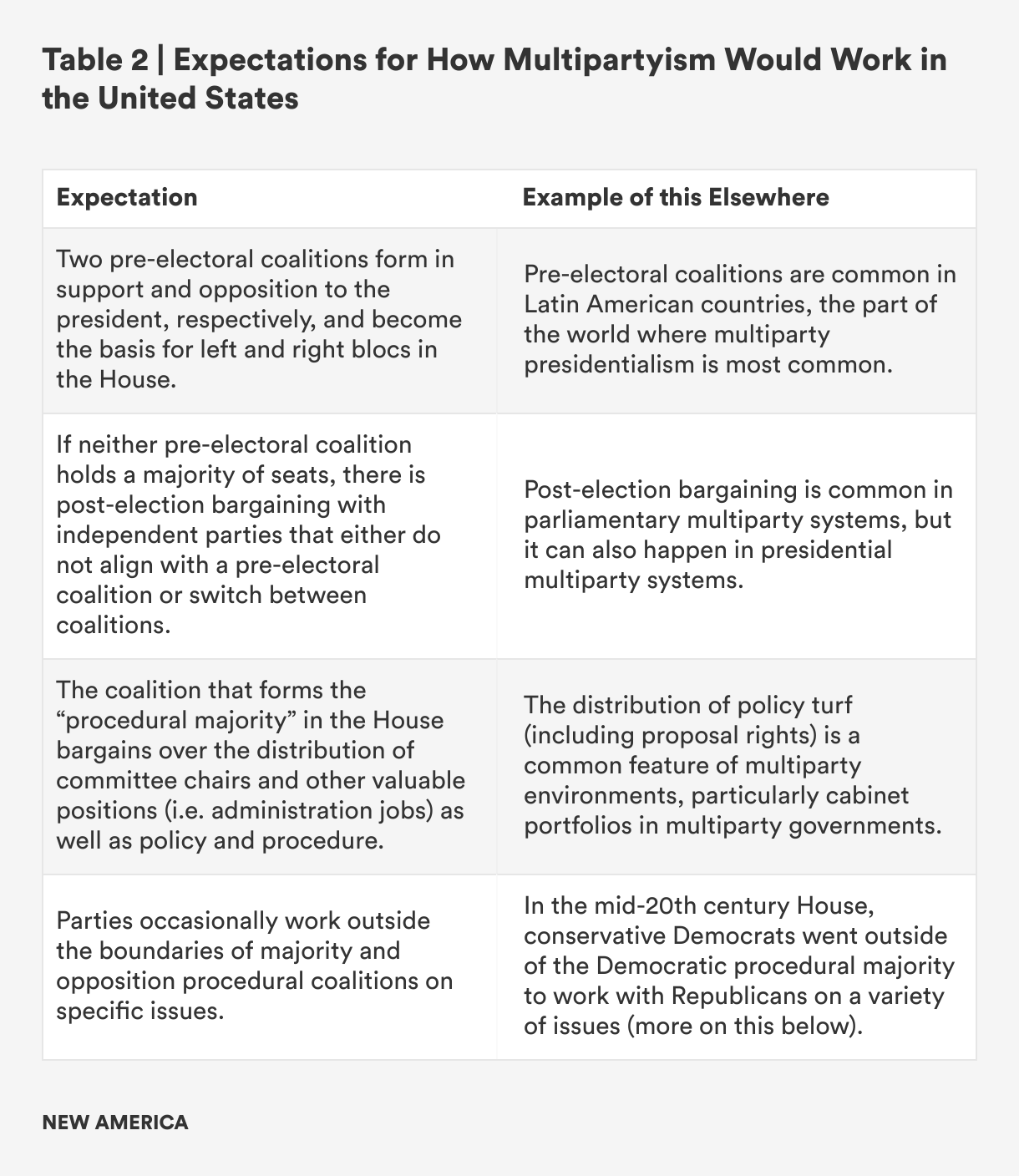
Overall, we expect House multipartyism to be somewhat constrained by the binary nature of presidential elections and left-right politics. This would prevent the House from becoming completely fluid and free-for-all, where factions regularly shift their allegiances. However, we also do not expect things to be exactly the same as in the current system. The incentives and ability to maintain a lock-step procedural majority—now a constellation of parties rather than a single majority party—would be quite different from those in the existing system. The various factions that currently exist in American politics would have more formal recognition as standalone parties but less reason to work exclusively with the factions with whom they share a party in the current system. So, there probably would be somewhat greater coalition shifting from issue to issue. We summarize our expectations for the multiparty House in Table 2.
An Example to Follow: The Mid-Twentieth Century House
For an example of how the multiparty House might operate, we turn to the Congress of the mid-twentieth century, where there was significant fragmentation in the Democratic majority that controlled the House. While Democrats held the procedural majority, a bipartisan conservative coalition of Republicans and southern Democrats aligned on many policy matters.23 As a result, the House had a fluid and decentralized governing arrangement where members of the procedural majority, namely liberal Democrats, were often (but not always) on the losing side of major policy decisions. Speakers like Sam Rayburn served as brokers who worked to bring various factions together rather than as iron-fisted leaders.24 The standing committees, assigned by seniority, largely controlled the chamber, and the Rules Committee, run by the conservative coalition, largely proscribed the limits of the possible.
This bipartisan governing arrangement was very different from the one we’ve seen in recent congresses, including the 118th. In the mid-twentieth century Congress, there was regular bipartisan policy action on matters beyond must-pass issues like government funding and raising the debt ceiling.25 In modern Congresses, majority party members do not go outside their procedural coalition to work with the minority unless they view it as absolutely essential. The same goes for the minority party in reverse. Why help members of the majority party win reelection unless they are offering significant concessions?
“In the mid-twentieth century Congress, there was regular bipartisan policy action on matters beyond must-pass issues like government funding and raising the debt ceiling.”
This logic did not hold in the mid-twentieth century Congress, though, because both parties, for a time, believed that moving away from bipartisan governance would involve unacceptable costs. Democrats decided they’d rather maintain the procedural majority than push conservatives out of the party. And Republicans decided they’d rather wield power by working with conservative Democrats than sharpen the contrasts between the parties and risk losing their influence. These incentives changed over time as politics nationalized and parties became more internally homogenous, with members sharing more common goals. In turn, the parties developed top-down leadership structures that worked to advance members’ common partisan interests and cautioned against bipartisanship.
As we’ve seen, rising polarization in the late-twentieth and twenty-first centuries did not lead to glorious partisan victories. While the “success” of government is both subjective and determined by many factors beyond its institutional structure, Congress passed more major laws and addressed a larger share of its agenda in the era with more bipartisan governance.26 In other words, Congress arguably worked better, or at least got more stuff done, when cross-party policy majorities formed on many different issues and members were not stuck in partisan procedural coalitions directed by powerful leaders.
The mid-twentieth century Congress provides an example of how the multiparty Congress could work. However, a stylized example of how something worked in the past is not a plan for making it reoccur in the future. The question is, how do we make a multiparty House look more like the mid-twentieth century version than the 118th Congress version? Both feature internally divided procedural majorities, but the results have been very different. In the next section, we discuss ways that the House could work differently to take advantage of the possibilities of a more pluralistic system while also hedging against the risks.
Citations
- Josep Colomer and Gabriel Negretto, “Can Presidentialism Work Like Parliamentarism?” Government and Opposition 40, no. 1 (2005): 60–89, source.
- The United States is one of the few countries where the president’s cabinet nominees must be confirmed by the legislature. See Carlos Galina, “The U.S. Process for Confirming a Cabinet Takes Longer Than Almost All Other Countries,” Center for the Presidential Transition, May 5, 2021, source.
- We are simplifying terms here as the procedural coalition and the organization coalition perform different tasks but usually consist of the same members. See Jenkins and Stewart III, Fighting for the Speakership.
- Kaare Strøm, Wolfgang Müller, and Daniel Markham Smith, “Parliamentary Control of Coalition Governments,” Annual Review of Political Science 13, no. 1 (2010): 517–35, source.
- Lanny Martin and George Vanberg, “Parties and Policymaking in Multiparty Governments: The Legislative Median, Ministerial Autonomy, and the Coalition Compromise,” American Journal of Political Science 58, no. 4 (2014): 979–96, source.
- Sona Golder, “Bargaining Delays in the Government Formation Process,” Comparative Political Studies 43, no. 1 (2010): 3–32, source.
- Alejandro Ecker and Thomas Meyer, “The Duration of Government Formation Processes in Europe,” Research and Politics 2, no. 4 (2015): 1–9, source.
- Golder, “Bargaining Delays in the Government Formation Process,” source.
- Sona Golder, “Pre-Electoral Coalition Formation in Parliamentary Democracies,” British Journal of Political Science 36, (Spring 2006): 193–212, source.
- David Fortunato, The Cycle of Coalition: How Parties and Voters Interact under Coalition Governance (Cambridge, United Kingdom: Cambridge University Press, 2021).
- Henning Bergmann, Hanna Bäck, and Thomas Saalfeld, “Party-System Polarisation, Legislative Institutions and Cabinet Survival in 28 Parliamentary Democracies, 1945–2019,” West European Politics 45, no. 3 (2022): 612–37, source.
- Cesar Zucco, “Ideology or What? Legislative Behavior in Multiparty Presidential Settings,” Journal of Politics 71, no. 3 (2009): 1076–92, source.
- An example of an extremely flexible system can be found in Denmark, where governments—which usually represent a minority of legislative parties—form issue-specific agreements with opposition parties not represented in the government. These agreements, called forlig, effectively create a majority governing coalition for specific issues. See Christoffer Green-Pedersen and Asbjørn Skjæveland, Governments in Action: Consensual Politics and Minority Governments, in Oxford Handbook of Danish Politics (Oxford, United Kingdom: Oxford University Press, 2020), 230–41.
- This process is similar to the ways in which the “invisible primary” works in the U.S. presidential nomination system. Candidates compete for endorsements, and important individuals and groups make demands in exchange for such endorsements. In a multiparty system, however, the key endorsements are both more visible and more concentrated. See Martin Cohen, David Karol, Hans Noel, and John Zaller, The Party Decides: Presidential Nominations Before and After Reform (Chicago, IL: Chicago University Press, 2008).
- Andre Borges, Mathieu Turgeon, and Adrian Albala, “Electoral Incentives to Coalition Formation in Multiparty Presidential Systems,” Party Politics 27, no. 6 (2020): 1279–89, source.
- Adrian Albala, Andre Borges, and Lucas Couto, “Pre-Electoral Coalitions and Cabinet Stability in Presidential Systems,” British Journal of Politics and International Relations 25, no. 1 (2021): 64–82, source.
- Gabriel Negretto, “Minority Presidents and Democratic Performance in Latin America,” Latin American Politics and Society 48, no. 3 (2006): 63–92, source.
- Even if this coalition splitting happened once or twice, we expect the parties would learn from this system and get better at coalition-building over time.
- Some of the reforms that might turn U.S. presidential elections into an effective two-round system could include establishing a single national primary date, establishing uniform standards for participating and running in primaries, or making it very difficult (or impossible) for anyone other than the right bloc and left bloc nominees to make the general election ballots.
- This has been a somewhat unlikely scenario in Latin America, where, from 1980 to 2008, president-aligned majority coalitions governed about 48 percent of the time and president-opposed majority coalitions governed about 20 percent of the time. This latter arrangement is called a divided government in our current system. It might be more common in the United States than Latin America given the tendency of voters to “balance” the president’s party in midterm elections. However, one major difference in proportional elections is that small swings in voter support are less likely to result in wild swings in seats than they do in majoritarian elections. Eduardo Alemán and George Tsebelis, “Legislative Institutions and Agenda Setting,” in Legislative Institutions and Lawmaking in Latin America, ed. Eduardo Alemán and George Tsebelis (Oxford, United Kingdom: Oxford University Press, 2016): 1–31; Robert Erikson, “The Puzzle of Midterm Loss,” Journal of Politics 50 (1988): 1011–29, source.
- They could also be influential in organizing the House. For example, they might decline to join a pre-electoral coalition but then participate in post-electoral coalition negotiations if neither side obtains a majority of seats.
- Benjamin Noble, “Presidential Cues and the Nationalization of Congressional Rhetoric, 1973–2016,” American Journal of Political Science (Fall 2023), source; Matthew Lebo and Andrew O’Geen, “The President’s Role in the Partisan Congressional Arena,” Journal of Politics 73, no. 3 (2011) 718–34, source; Frances E. Lee, Beyond Ideology: Politics, Principles, and Partisanship in the U.S. Senate (Chicago, IL: University of Chicago Press, 2009).
- These issues included blocking civil rights legislation, crushing communism, increasing defense spending, and much else.
- Cooper and Brady, “Institutional Context and Leadership Style,” source.
- This is not to say we should praise the anti-Civil Rights, anti-labor, and anti-Communism legislation that the conservative coalition pushed. The central point is not the content of the policies but rather that they were sometimes able to take action on bills that split the majority coalition.
- David R. Mayhew, Divided We Govern: Party Control, Lawmaking, and Investigations, 1946–1990 (New Haven, CT: Yale University Press, 1991).
Making Multipartyism Work
We cannot know the exact conditions under which multipartyism might arise or what the party system will look like. We do know, however, that the House’s centralized and rigid institutions are already ill-suited to handle factionalism in a two-party system and cannot imagine they will perform better in a multiparty system—or could even be sustained. In this spirit, we focus on decentralizing reforms that would, even in a two-party system, encourage policy majorities that can form outside the procedural majority. We also suggest reforms to guard against the chaos and ungovernability that unbounded pluralism can create.
Reform is necessary because, without it, there is no guarantee that we would avoid the same pathologies in a multiparty House that we see in a two-party House. One could imagine a multiparty Congress where centralized leadership takes hold or multiple parties struggle to forge coalitions that can organize the House. Indeed, we can easily find examples of both when looking across foreign countries, though they typically come from highly fragmented systems with extremely permissive versions of proportional representation, such as Brazil and Israel.1 We would not recommend, nor would we expect, the United States to adopt such highly permissive systems.
We expect politicians and lawmakers will account for the context of the moment, including factors we are not anticipating, when they are deciding how the system should work. As such, our suggestions should not be followed too rigidly or without caveat. Instead, we are arguing that based on what we are observing in our current politics, reforms that promote decentralization and protect against chaos are generally the direction in which a multiparty Congress, or even a more factionalized two-party Congress, should move to increase problem-solving capacity.
Decentralizing the House
Almost all successful policymaking in our current system is bipartisan due to the separation of powers system and heterogeneity within the two major parties. Many different stakeholders have to agree that a status quo needs to be changed for a policy to make it through the long and arduous process that the Framers of the Constitution designed. We do not expect this difficult coalition-building to change in a multiparty system where the country’s diverse and pluralist interests would be even better represented and the separation of powers remained in place. Just as the founders intended, our system is not designed for majority coalitions to take quick action. It is designed for deliberation among a wide variety of stakeholders and supermajoritarian, if not nearly consensus, outcomes.
But even if the metaphorical policymaking puzzle is just as difficult to assemble in a multiparty system as it is in a two-party system (if not more so), we think that certain changes could be made so that a more diverse array of actors can at least lay down the first piece. In our current system, the successful legislation that emerges from the universe of potential bipartisan collaborations is significantly constrained by leaders who are reluctant to allow forward any efforts that potentially undermine their party’s collective electoral goals. This prevents members from representing their constituents and hamstrings Congress from taking action on important issues, even when there is majority support.
A recent example of this was Donald Trump and Mike Johnson blowing up the border security compromise that Republican Senator James Lankford negotiated with moderate Democrats in early 2024. Like many immigration reform efforts before it, the compromise almost certainly would have passed both chambers with a bipartisan majority if it had come to a vote. However, Trump saw immigration as a winning electoral issue for Republicans and did not want to muddy the political waters by giving Democrats credit for solving the problem.2 Johnson made it clear that he would not put the compromise measure on the House floor and dissuaded Republicans from offering support. Although it would have technically been possible for Republican supporters to work with Democrats and go around Johnson, his vast authority as Speaker made it prohibitively costly for them to do so.
Our key recommendation for unlocking bipartisan collaboration is decentralizing the legislative process in ways that empower committees and latent policy majorities while preventing leaders from concentrating power. This should look similar to what scholars call “regular order,” which describes a process where committees and members develop legislation through deliberation and consultation without undue influence from legislative leaders.3 When bills pass out of committee with a majority vote, they then come up for a vote on the House floor. On the House floor, all members debate and deliberate, and ultimately cast an up or down vote on the bill. Many scholars have a preference for this process as superior to the top-down leadership-driven process, arguing that it fosters more serious policy engagement from a diversity of members, ultimately producing better policy.
“Our key recommendation for unlocking bipartisan collaboration is decentralizing the legislative process in ways that empower committees and latent policy majorities while preventing leaders from concentrating power.”
While there is certainly a need for leadership-driven processes from time to time, having committees and rank-and-file members take the lead as the general rule would allow the latent policy majorities stymied by the centralized, two-party system to form more easily. Members would also be more motivated to form these coalitions in a multiparty system as they would be actively trying to differentiate themselves from their coalition partners. Adopting procedures that facilitate committee consideration and empower floor majorities could lead to more free-flowing interactions between parties aligned with different blocs and allow them to take action.
This doesn’t work in the current system because leaders decide what legislation makes it onto the House floor. Leaders are particularly likely to block legislation that is opposed by a significant chunk of the majority party, even when it is supported by a majority of the entire House. This practice of blocking bills without the support of most majority party members is known as the Hastert Rule.4 Party leaders enforce the Hastert Rule (which is not actually a rule but rather a convention) because they want to avoid intraparty feuds and criticism, particularly if those feuds threaten their jobs. This is essentially why Johnson blocked immigration reform—allowing a vote would have angered many members of his caucus by undermining the party’s political messaging.
The Hastert Rule pushes policymaking inside the majority party. In the current system, this reinforces the reality that majority party members mostly want to work with each other due to their shared policy and electoral goals. However, we expect that the desire to work only within one’s procedural coalition will be lessened in a multiparty system due to the fracturing of the left-right blocs into a variety of partisan mini-brands. The two blocs will still largely oppose each other on many issues, but there would be more internal competition among their members, likely leading some to pursue collaborations with parties in the other bloc. The question is, thus, how do we open up the House agenda so that policy majorities that cut across the two procedural coalitions can take action?
Empowering Committees and Latent Majorities
Members should empower committees to take action even when party leaders and a majority of the procedural coalition do not agree. In the mid-twentieth century House, committee chairs played a more prominent role in setting the agenda and leaders served as intra-faction brokers. As a result, the conservative coalition was influential in policymaking despite only partially overlapping with the Democratic procedural majority.5 Similar policy coalitions might be viable in a multiparty House if committees have more positive agenda-setting power and coalition leaders have more limited negative agenda power.
We expect that committee chairs would be divided among the parties in the majority procedural coalition. Dividing the spoils is natural in a multiparty system, but the best way to do it is not obvious, and there is some danger that policy extremists will dominate the committee and advance policies that violate the coalitional bargain. Accordingly, we recommend that committee majorities should never be comprised of just a single party. Instead, the majority of each committee should depend on members from multiple coalition partners (preferably some that have ideological differences with the chair) to ensure the procedural coalition can monitor the party holding the chair.
This “bargain policing” occurs in parliamentary democracies like Germany and the Netherlands.6 It does not preclude the committee from pursuing actions that cross coalition lines, but it does build some checks into the system so that majority coalition members cannot easily renege on the promises they made to their partners. Having some kind of monitoring regime in place is especially critical given that our next suggested reform gives committees more independent power than they have under the rules of the current Congress.
Committees need some guaranteed access to the floor calendar to have real influence and be able to work outside the majority coalition when forging policy agreements. They should be able to put committee-passed bills on the floor regardless of their support among the other parties in the procedural coalition or majority coalition leaders. For example, the Republican supporters of the border security bill would be able to put it on the floor even though Johnson and more conservative Republicans disagreed. Committee agenda-setting exists to some degree in the current system, as committee chairs can call up legislation on Calendar Wednesday. However, the process is almost never used anymore as committee leaders are hesitant to cross their party leaders.7
Guaranteed floor access and the willingness to use it, which we expect to be greater in a multiparty system, is necessary if committee chairs are going to bypass coalition leaders on their party’s favored issues and build cross-bloc coalitions. Committee floor access should not be unlimited, and it should be subject to some review by the Rules Committee to allow opponents to offer amendments (more on this below). But without this ability, legislation that has majority support in the House but not within the procedural coalition would remain stuck in limbo, just as it is when leaders enforce the Hastert Rule.
Some state legislatures have already given committees guaranteed floor access. A 1988 Colorado ballot measure called GAVEL, or Give A Vote to Every Legislator, amended the state constitution to ensure that, among other things, every bill that passed out of committee would be placed on the floor calendar and then called up sequentially. Subsequent research showed that this reform altered coalition-building in the chamber. Binder, Kogan, and Kousser find that “Republican leaders and the party’s most conservative members lost on more of their bills after GAVEL, as the GOP’s moderate faction made temporary alliances with Democrats on some bills.”8
While regular order emphasizes the benefits of committee governance, chairs sometimes act as gatekeepers who prevent latent floor majorities from taking action on legislation with wide support among rank-and-file members. For example, in the mid-twentieth century Congress, conservative Democrat chairmen like Howard Smith and James Eastland frequently blocked civil rights measures that would have passed with majority support in the House if they had made it to the floor. Thus, the strong committee system created inefficiencies by disempowering latent majorities on the House floor.
One way to empower latent floor majorities would be to change the discharge petition process. Since 1910, discharge petitions have allowed members to bypass committees and directly put legislation on the House floor. Major laws have passed via the discharge process, including the 2002 McCain-Feingold campaign finance reform bill. However, leaders can take advantage of certain features of the process to undermine bipartisan efforts, and, as a result, very few are successful.9 For example, discharge petitions must have a simple majority of the entire House for legislation to go to the floor, the names of petition signatories are publicly released every day, and there remain opportunities for the committees of jurisdiction to alter legislation even after it has been successfully discharged.10
To make the discharge petition more efficacious, we recommend decreasing the threshold for legislation to come to the House floor to somewhere around 30–40 percent of the House. This would allow proponents to put forward proposals that a majority of members might vote for even if a majority will not sign on to a discharge petition. Prior to 1931, the discharge petition only required one-third of the House to sign on rather than one-half.11 Additional measures could be taken to ensure that the discharge process is not abused for obstruction or partisan messaging (e.g., limit the number of petitions that can be deployed each week; only consider bills with support from a party in the procedural majority, etc.).
The House should also continue to experiment with reforms that allow legislation with widespread bipartisan support to be automatically put on the floor. The House Problem Solvers Caucus has championed these types of reforms in recent House rules packages.12 One reform allows bills that maintain 290 cosponsors for 25 days to be placed on the Consensus Calendar. The House is required to consider at least one Consensus Calendar bill each week at the speaker’s discretion.13 Future reforms should consider decreasing both the number of cosponsors and the speaker’s discretion over which bills get called up.
Power-Sharing among Leaders
Guaranteeing committee chairs floor access and easing the barriers for latent majorities to bring bills directly to the floor begs the question: What role should the speaker and party leaders play in a more decentralized system? The speaker currently has several powers that give them influence over the committees, including the ability to refer bills to committee, outsized discretion in committee appointments, and significant power in the Rules Committee (which is sometimes called “the speaker’s committee”). A speaker who maintains all of these powers could ensure that committees and latent policy majorities are either unable or unwilling to go against the majority (or a supermajority) of the majority procedural coalition. To create more opportunities for cross-bloc coalitions to form, centralized power should be devolved in three ways.
First, multiparty bargaining almost necessarily means that committee positions and chairs would be allocated through negotiations among the parties rather than through a top-down process, like steering committee selection.14 If a party cannot get its preferred committee appointments through negotiation, it might not agree to cooperate with the procedural coalition on other matters (or may even join the opposition). Factions would have more leverage in a multiparty system than in our current system because withdrawal is a far more credible threat than in a two-party system.15 Bargaining over committees would essentially mirror what happens in other multiparty democracies when parties negotiate over cabinet ministries. For example, in Germany’s coalition cabinet led by Social Democratic Party Chancellor Olaf Scholz, the Free Democratic Party holds the finance ministry, the Green Party holds the foreign affairs ministry, and so on. Moreover, committee chairs would be even more important than in the current House as it would give the parties that lead them some direct access to the floor. While the bargaining over committee chairs might occasionally lead to chaos, it would be fairer than the seniority system, which allowed southerners to dominate the committees in the pre-1970s period, and the current system, where committee appointments are often driven by party loyalty and fundraising prowess.
Second, the Rules Committee should no longer solely be an instrument of top leaders.16 Instead, it should represent the diversity of the majority procedural coalition.17 One potential arrangement, inspired by the multiparty Argentine Chamber of Deputies, would be for all parties (regardless of bloc) to elect their own leaders who serve on the Rules Committee. From there, leaders would appoint additional members to the committee, roughly in proportion to the partisan composition of the House (or whatever arrangement is negotiated). The parties in the majority procedural coalition would control a majority of seats on the Rules Committee, and the head of the largest party (or, alternatively, the president’s party) would serve as chair.
The Rules Committee would still be in charge of structuring floor access, amendments, and debate. But, to prevent domination by party leaders, there should be more limits on its ability to shut down debate and amending. The current House offers one extreme version of the amending process: extremely closed.18 The primary reason the Rules Committee has limited amendment opportunities is that the majority party wants to avoid “poison pill” amendments that could split their coalition and undermine support for the final passage of the bill or embarrass them. But the logic flips when the individual parties now comprise the majority procedural coalition and want to offer amendments to differentiate themselves and show their supporters they are fighting for the reasons they were elected in the first place. The diversity of the majority coalition would make a more open (but not completely open) amendment process possible for most bills. In a multiparty coalition, coalition maintenance depends on demonstrating the diversity of perspectives, not suppressing them. Put another way, a multiparty procedural coalition does not depend on the illusion of a united front. Instead, it depends on the demonstration of a diverse front.
“In a multiparty coalition, coalition maintenance depends on demonstrating the diversity of perspectives, not suppressing them.”
On the bills where committees were guaranteed floor access (again, this could be negotiated, but probably no less than five bills per Congress), the Rules Committee could offer structured rules that provide some (but not limitless) opportunities for amendments. The possibility for floor amendments would help prevent outlier committees from taking advantage of their proposal rights to push extreme legislation.19 At the same time, Rules Committee oversight would help protect compromises that were carefully crafted from poison pills. On must-pass bills where deadlines loom large (i.e., raising the debt ceiling or funding the government), the Rules Committee should still have the option to use closed rules. But these would hopefully become the exception rather than the rule.
Third and finally, the speaker should no longer hold power as the presiding officer of the House or, more generally, serve as the de facto leader of the House. By weakening the speaker’s influence over the steering committee and the Rules Committee, much of their formal power would already be gone. Further specifying that the speaker should follow the non-partisan parliamentarian’s recommendations for procedural matters, like committee bill referral, points of order, and more, would make the speaker a largely symbolic leader, similar to the speaker of the U.K. Parliament or the president of the U.S. Senate.
The party leaders who make up a majority on the Rules Committee would fill the power vacuum left by the absence of a powerful speaker. Like the majority and minority leaders in the U.S. Senate, these leaders would be elected by a majority of their individual parties rather than the majority of the entire chamber. This would put them on a safer footing than the current speaker as they would only need to maintain the support of a majority of their members rather than nearly the entire procedural coalition. As representatives of the members who make up the majority coalition, the leaders would work out power arrangements among themselves, including the possibility that one leader would be the first among equals (likely the chair of the Rules Committee) and a source of decisiveness in the plural leadership structure.
The speaker will likely continue to play some role in House politics as the election of the speaker is the first order of business for any Congress—and that election will be the first opportunity for the incoming procedural coalition to demonstrate its multiparty bargain has majority support (the failure of which will indicate the absence of a stable bargain). However, after that vote, the speaker would not be able to centralize institutional power as in the current system and would largely defer to the leaders of the individual parties.
Regardless of whether it is implemented in a multiparty House or in a more factionalized two-party House, bringing back some regular order would give members of Congress the ability to act outside the constraints of their procedural coalitions. Leaders in the current Congress block bipartisan collaborations that do not further their partisan interests. Opening up the agenda to committees and floor majorities while weakening the speaker relative to individual party leaders would give more members more opportunities to influence policymaking. This is a more natural fit in a multiparty system where the diversity of interests in our country would be more clearly represented.
Preventing Chaos
Regular order is unlikely to work if multipartyism makes the House more unstable and unwieldy. The 118th House exemplifies some of the dangers of excessive factionalization. The House’s procedural coalition was decapitated by a coalition of Democrats and dissident Republicans who voted to oust Speaker McCarthy. The chamber established a new precedent where it would not operate and ceased operations for nearly a month, besides holding additional elections for speaker.20 Even though the rebels and Democrats together constituted a majority of the chamber, they did not constitute a majority procedural coalition ready to replace the previous governing arrangement. In essence, they replaced “something” with “nothing” and, seemingly, had no plan to resolve the impasse.
The potential for leadership decapitation would be even greater in a multiparty system as any party that is both large enough to break the procedural majority coalition could choose to throw the House into chaos. Unlike most democracies, the House has fixed-term elections and cannot hold new elections whenever a government falls. As such, conflict and stalemates that result from coalitional breakdowns could go on for long periods of time without an obvious way to reset bargaining.
To prevent this, the motion to vacate the speaker (who would still be a constitutional officer necessary for the House to operate, even if weakened) and, more broadly, any maneuver intended to undermine the procedural majority’s governing arrangement in the midst of a two-year session, including a resolution to remove members from the Rules Committee, should be changed.21 Specifically, the House should require a constructive vote of no confidence. This is a rule used in many countries, including Germany and Spain, requiring any majority that seeks to replace existing leadership to simultaneously install new leadership.22
Under this rule, opponents of the status quo would need a plan to replace the existing arrangement with a new arrangement. Otherwise, they would not be able to vacate the speaker or remove members from their committee assignments. We also recommend raising the threshold for these types of resolutions to a majority of the chamber. This would not prevent disgruntled parties in the majority coalition from helping to vote down rules or bills, as is their right. But it would prevent dissidents from throwing the House into disorder and chaos without a plan.23
A more basic issue would arise, of course, if the House could not elect leaders in the first place.24 This was how the 118th Congress started off, with Kevin McCarthy going through 15 rounds of voting before winning the speakership. We hope that pre-electoral coalitions and post-election bargaining will resolve most issues, as they did in McCarthy’s case when he conceded seats on key committees to the House rebels at the beginning of the 118th. However, there might be extreme cases when no candidate is close to winning a majority of the House, and there appears to be no end in sight. This is what happened in the speakership elections in 1849 and 1855–56, which went to 63 ballots and 133 ballots, respectively.25 In both of those cases, members were locked into supporting candidates based on their positions on slavery (a highly salient issue where supporters would not accept deviation), but they eventually agreed to use plurality rule to elect the speaker. This allowed members to vote as their supporters expected but still eventually choose a speaker and move on to other business.
While we do not recommend that speakers be as powerful as McCarthy or his predecessors, the stakes of the election would still be high as an opportunity to finalize the details of the majority coalition bargain and move on with the business of the House (including committee appointments). Allowing for a plurality rule ahead of time might not be wise, as the expectation of this threshold could encourage parties to adopt obstructionist tactics beforehand. But other arrangements might work, including a top-two runoff election, an election where the winning percent threshold drops in subsequent rounds, or other mechanisms that ensure speaker races do not go on indefinitely and governing arrangements with minority support can eventually form.
Overall, we are recommending that the House organize itself in ways that decentralize power but also install guardrails to ensure that greater pluralism does not regularly throw the body into chaos (or, at least, that there’s a clear way to move on from the chaos when it does). Our list of best practices is summarized in Table 3.
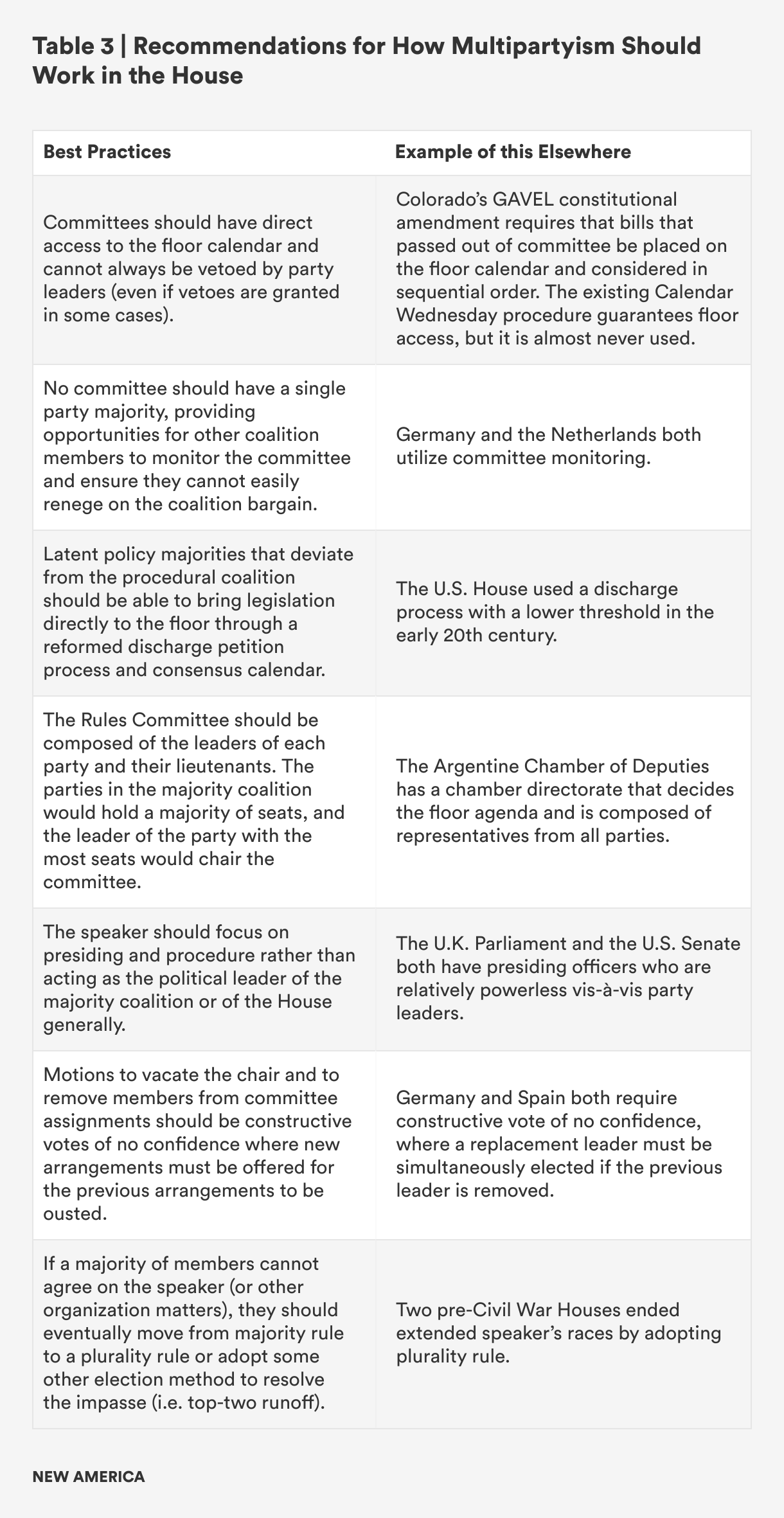
Citations
- In Brazil, for example, the president of the Chamber of Deputies, Arthur Lira, is generally seen as a powerful figure. Israel’s inability to forge a government in 2019 and 2020 is the most recent example of multiparty chaos in forming a procedural coalition. Beatriz Rey, “The Inevitability of Arthur Lira as Brazil’s House Speaker,” Brazilian Report, 2023, source; Mairav Zonszein, “Israel’s Winning Coalition: Culmination of a Long Rightward Shift,” International Crisis Group, November 8, 2022, source.
- Mary Clare Jalonick and Stephen Groves, “Abandoned by his colleagues after negotiating a border compromise, GOP senator faces backlash alone,” Associated Press, February 8, 2024, source.
- Sinclair, Unorthodox Lawmaking.
- In reality, party leaders are likely compelled to please either a supermajority of the majority party or the entire majority party given the ability of small factions to complicate their lives (e.g., the Republican rebels in the 118th Congress). Furthermore, the majority party usually only gets rolled when party leaders see the legislation as must-pass, leading them to override their members’ negative veto and go to the other party for support.
- Keith Poole and Howard Rosenthal, Congress: A Political-Economic History of Roll Call Voting (Oxford, United Kingdom: Oxford University Press, 1997).
- Keith Krehbiel, Information and Legislative Organization (Ann Arbor, MI: University of Michigan Press, 1991); Martin and Vanberg, “Parties and Policymaking in Multiparty Governments,” source.
- Kevin Kosar, “Testimony: The Excessive Complexity of House of Representatives Rules on Legislative Process,” American Enterprise Institute, July 28, 2022, source.
- Mike Binder, Vladimir Kogan, and Thad Kousser, “How GAVEL changed party politics in Colorado’s general assembly,” in State of Change: Colorado Politics in the Twenty-first Century (Denver, CO: University Press of Colorado, 2011), 153–173.
- Sarah Binder, “Don’t Count on the House Discharge Rule to Raise the Debt Limit, Brookings Institution, 2023, source.
- Philip Wallach and Priscilla Goh, “The Discharge Petition: Its History and Role in the 118th Congress,” (Washington, DC: American Enterprise Institute, 2024), source.
- Richard S. Beth, The Discharge Rule in the House: Recent Use in Historical Context (Washington, DC: Congressional Research Service, 2003), source.
- Sam Brasch, “Want A Congress That Gets It Done? Maybe They Should Be More Colorado,” Colorado Public Radio, February 4, 2019, source.
- Jane Hudiburg, The House Consensus Calendar: Establishment, Principal Features, and Practice in the 116th Congress (2019–2020) (Washington DC: Congressional Research Service, 2021), source.
- The composition of and decisions made by the current steering committee is also a result of negotiations, but it has a heavy leadership imprint as the speaker has extra votes.
- There is almost no credibility of threats to withdraw in our current system. The Republican rebels in the 118th Congress never considered joining with Democrats. There was always an understanding that, however chaotic, the process was going to result in a Republican speaker.
- Members truly do perceive the current Rules Committee to be an extension of top party leaders. When several Republican members refused to vote favored by party leaders in the 118th Congress, Rep. Anthony D’Esposito, a leadership ally, said, “It’s been made pretty crystal clear that those on the Rules Committee were supposed to carry out the will of the speaker. I would be in favor of his decision replacing those individuals.” See Jamie Dupree, “Israel, Ukraine Aid Stays on Track in the House,” Regular Order, April 19, 2024, source.
- Ironically, this recommendation is more consistent with how the Rules Committee works in the 118th Congress than how it did in previous Congresses. Due to negotiations at the beginning of the 118th, Chip Roy, Ralph Norman, and Thomas Massie (all conservatives with a rebellious bent) held three of the 10 Republican appointments. This is probably a slight overrepresentation of rebellious conservative strength within the Republican Conference, an indication of their strong bargaining position.
- Data on House rules show that the percentage of rules that are open to amendments fell from 56 percent in 1981–82 to zero in 2017–2018. Meanwhile, the percentage of rules that are closed to amendment rose from 18 percent to 41 percent, and the percentage of rules with structured amendment rose from 4 percent to 44 percent. See Michael Lynch and Anthony Madonna, “House Rules, 59th (1905-1907) – 115th (2017-2018) Congresses,” Congress Project, 2019, source.
- Michael Laver and Kenneth Shepsle, Making and Breaking Governments: Cabinets and Legislatures in Parliamentary Democracies (Cambridge, United Kingdom: Cambridge University Press, 1996); Lanny Martin and George Vanberg, “Coalition Governments, Legislative Institutions, and Public Policy in Parliamentary Democracies,” American Journal of Political Science 64, no. 2 (2020): 325–40, source.
- The House did not even consider a widely supported symbolic resolution in favor of Israel after the October 7 attacks because there was no speaker to preside over the body. Acting Speaker Patrick McHenry was opposed to reinterpreting the powers of his role. Kayla Guo, “What Can Patrick McHenry, The Interim Speaker, Do?” New York Times, October 4, 2023, source.
- Resolutions to remove House leadership or committee assignments are Questions of Privilege that can be offered by any member and are guaranteed a vote within a certain time span. However, as we’ve seen with the motion to vacate, the rules governing these questions can be altered in the House rules package. Meghan Lynch, Questions of the Privileges of the House: An Analysis (Washington, DC: Congressional Research Service, 2015), source; Jane Hudiburg, House Rules Changes Affecting Floor Proceedings in the 118th Congress (2023-2024) (Washington, DC: Congressional Research Service, 2023), source.
- The constructive vote of no confidence was adopted in the 1949 German Constitution due to the prewar Weimar Republic’s experience with Nazis and Communists. These groups collectively held a majority in the Reichstag after the June 1932 elections and proceeded to vote down government bills and support a no confidence motion, even though there was no possibility of these two extremist groups working together constructively. Reuven Hazan, Legislative Coalition Breaking: The Constructive Vote of No-Confidence (Jerusalem: Hebrew University of Jerusalem, 2015); Richard Evans, The Coming of the Third Reich (New York: Penguin Books, 2003).
- That being said, a determined majority can usually get its way. However, if a majority of the chamber was organized and angry enough to change the chamber’s rules to allow for ousting a coalition, they would hopefully also be organized and angry enough to replace the coalition with a new one.
- Although we recommend that the speaker be less powerful, it is still the case that a speaker must be elected at the beginning of the Congress. This vote would likely be an initial test for whether the leading coalition actually has enough support to control a majority of the chamber.
- Jenkins and Stewart III, Fighting for the Speakership.
Other Institutional Considerations
While we have focused on the House because it is the institution where multipartyism could be directly introduced by amending the Uniform Congressional District Act (UCDA), it would not be the only governing institution affected by multipartyism. Fully considering how multipartyism would impact elections and how institutions like the presidency and the Senate might operate in a multiparty system are beyond the scope of this paper. However, we want to acknowledge some of the most pressing concerns and suggest an agenda for scholars and reformers who are thinking about how proportional representation and multipartyism would work in the United States.
Electoral System
The details of the new electoral system are extremely important for a proportional system. Key questions include: How many members will be elected from the districts? Will there be a national vote threshold for a party to attain representation? Will states have discretion? Would the ballot be open list, closed list, or involve some sort of preference ranking?
The answers to these questions will ultimately determine important aspects of the party system and governing institutions, including how many parties are electorally viable, what kind of candidates have advantages, how much discipline party leaders will be able to impose on members, and more. To cite one example of why these details matter, a closed-list system, where parties decide which candidates appear on the general election ballot, would likely feature stronger party discipline in Congress compared to a system where candidates are more independent.1
Importantly, these details may be specified in a new version of the UCDA that applies to all House elections, or they could be specified in state-specific legislation. Either way, the reform coalition should think hard about how these decisions will impact elections, political parties, and governance and whether a one-size-fits-all or state-by-state approach would be better.
House Size
We believe five to six national parties would provide a reasonable balance between too much stability and too much flexibility.2 To do this, we would need a large proportion of districts to elect at least five or six members (M = 5 or 6 in the language of electoral system engineers). However, under the current apportionment of 435 House seats, there are 21 states with less than five seats. These 21 states collectively hold 50 of 435 seats, or 11.5 percent, and there are 37 states with less than 10 seats, the minimum number needed to draw two districts with M = 5. These 37 states collectively hold 168 of 435 seats, or 38.6 percent. In other words, a substantial portion of the population would have a limited ability to elect multiple parties. Proportional representation would mostly work in the large states where there could be multiple districts with five or more members. For the 10 largest states (which represent 57 percent of the country’s population), each would have at least two districts with at least five members. The largest state, California, would have 10 districts with five or more members.
To give voters in smaller states a better opportunity to participate in multiparty politics and to facilitate a transition to multimember districts that would not penalize incumbents, we could consider expanding the size of the House to 700 members—another change that is possible by amending statutory law rather than changing the Constitution.3 The United States House is an outlier in having an extremely high ratio of constituents to representatives.4 If we allocated 700 seats among the states, only 14 states representing 35 seats (5 percent of the 700) would have fewer than five seats, and just 24 states representing 104 seats (14.9 percent of the 700) would have fewer than 10 seats. Only Vermont and Wyoming would continue to have single-winner elections, while Alaska, Delaware, Montana, North Dakota, Rhode Island, and South Dakota would have two representatives each (and would almost surely give one seat to each party). While this reform could help accommodate multipartyism, it also could cause problems in the House if the increase is not rolled out gradually.
The Presidency
We would need to reconsider the role of the president in the new system. For better or worse, the U.S. presidency is here to stay. However, there is some basic tension and incompatibility between a unitary president and a multiparty legislature.5 Most obviously, the president is a more prominent figure than any legislative actor and is elected separately in a single-winner race. This imposes a binary pro-president vs. anti-president structure onto the system, as most parties will be primarily defined by whether they are for or against the president. Fears of presidential domination have long haunted multiparty presidential systems.6
Unlike a legislature, the presidency is vested in one person, and he is an agent of a singular national will (or at least presents himself as such). Thus, much of American politics revolves around what the president is doing, either their legislative agenda or unilateral actions. However, presidents will not have as many “built-in” allies (i.e., copartisans) as they would in a two-party system and might struggle to advance their initiatives. This is particularly true in the United States, where presidents are much institutionally weaker than they are in Latin America. Presidents facing multiparty legislatures are most successful when they have tools to build and manage coalitions around their priorities.7 As such, the president might need new institutional tools— such as increased power over cabinet appointments—to operate in a multiparty environment. Presidents who cannot get their programs through the legislature are more likely to try to bypass the legislature, sometimes in ways that strain the constitutional separation of powers.8
At the same time, though, giving the U.S. president more institutional tools would make them more like a Latin American president, which would also increase concerns about executive aggrandizement and accountability. The United States is already in the midst of a long-term shift in power from the legislative branch to the executive branch. Ditching a strong speaker for a more decentralized arrangement might further weaken Congress vis-a-vis the increasingly powerful president (and judiciary, for that matter).
On the other hand, Congress was a more effective counterweight against the president during the mid-twentieth century, when partisan ties between the legislative and executive branches were much weaker. Moderate and liberal Republicans joined with Democrats to provide effective oversight of the Nixon administration after Watergate. Similarly, some Democrats stood against President Lyndon Johnson on the Vietnam War.
Moreover, in recent decades, multiparty presidential democracies have proven more resilient than the conventional wisdom of earlier scholarship had expected. Indeed, the new conventional wisdom among comparative scholars is that multiparty presidentialism can work just fine and perhaps is even more resilient than two-party presidentialism with its risks of hyper-partisan polarization. Mainwaring and Drutman argue that multipartyism could lead to stronger checks on the president than occur in a unified government in a hyperpolarized two-party system.9
While our focus in this paper has been on coalition-building in the House, other reforms would be necessary for multipartyism to improve or maintain presidential-congressional relations. We also favor increasing Congress’s capacity to engage in independent policymaking and executive oversight through investments in human capital resources, like staff and nonpartisan research agencies based on Capitol Hill.10 We believe these capacity reforms are most likely to work if decentralization increases member efficacy and members begin to believe it is possible for them to enact policy that challenges the executive. A greater sense of efficacy would hopefully encourage members to use their new resources for more robust executive oversight rather than communications and partisan messaging.
The Senate
The U.S. Senate presents a unique issue for multipartyism. Since states receive equal representation in the Senate, the chamber is highly disproportionate by geography and population. Senate elections are also winner-take-all elections since only one senator is elected at a time. While altering the UCDA would likely lead to multiple parties winning seats in the House, it would not affect elections for the Senate, a body that is constitutionally designed to represent the nation’s 50 states as equal political units rather than give all voters equal weight.
The Constitution implies that the Senate must conduct winner-take-all elections, so there is no guarantee that multiparty coalitions would form in the Senate even if they emerge in the House. In a best-case scenario, senators might align themselves with a coalition of parties also present in the House.11 We might also see variations in regional strength, where certain parties run in Senate races in some parts of the country but do not field candidates in others, leading to multiple parties in the chamber.12
What happens in the Senate is particularly consequential for Congress because, unlike upper chambers in most other democratic legislatures, the Senate is uniquely powerful. Not only must it ratify any law passed by the House, but it also has special powers, like confirming the Cabinet and ratifying treaties, and has slid into an equilibrium where as few as 41 senators can block a majority from taking action through a threat to filibuster. This minoritarian impulse is exacerbated by the body’s malapportioned structure as smaller states that are more rural, white, and conservative have more representation relative to larger and more urbanized states where liberals and racial minorities are concentrated.13 As such, even if a multiparty coalition representing a majority of the country was able to take action in the House, senators representing a minority of the country could still block them.14
If the Senate frequently halts legislative action, it would blunt the potential for new alliances to unlock policy stalemates. In other words, party system reforms that ignore the Senate’s minoritarian tendencies may have limited impacts on the problems they aim to solve. An obvious reform here would be to abolish the filibuster. Beyond that, though, making the Senate work with multipartyism is tricky. One goal could be to make the Senate more similar to upper chambers in other democracies, where they rarely possess similar levels of veto power or empower political minorities to the same extent.15 Getting there is not simple, though, as any plausible institutional change (i.e., amending the Constitution) requires the consent of the Senate.
A more likely scenario for change is some long-term shift in norms where the Senate loses legitimacy and relevance, similar to the House of Lords in the United Kingdom. It is difficult to change norms through institutional reform, but in a world where proportional representation can happen, we would likely see partisan realignments and new coalitions that would be more receptive to dramatic change than they are in the current system. The United States has a long history of democratic institutional adjustments. Certainly, in a moment of zero-sum partisan warfare, in which even once bipartisan issues have become aspects of partisan hardball, it is difficult to imagine anything changing. But if we widen our aperture and expand our historical lens, many more possibilities come into focus.
Citations
- Gary Cox, “Comparing Responsible Party Government in the United States and the United Kingdom,” Journal of Politics 86, no. 1 (2024), source.
- John Carey and Oscar Pocasangre, Can Proportional Representation Lead to Better Governance? (Washington, DC: New America, 2024). In addition to the five to six national parties, we expect there would also be some regional parties, some of which would affiliate with national parties and some of which would not.
- The size of the House was set at 435 by the Permanent Apportionment Act of 1929. The U.S. population has grown considerably since then and, as a result, the House is a substantial outlier when it comes to its constituent-to-representative ratio of 762,000:1. The next highest ratio is Japan at 270,000:1. See Lee Drutman, Jonathan Cohen, Yuval Levin, and Norman Ornstein, The Case for Enlarging The House of Representatives (Cambridge, MA: American Academy of Arts & Sciences, 2021), source.
- Drutman, Cohen, Levin, and Ornstein, The Case for Enlarging The House of Representatives, source.
- Juan José Linz, “The Perils of Presidentialism,” Journal of Democracy 1, no. 1 (1990): 51–69, source.
- The old conventional wisdom was that presidential systems and multiparty legislatures created a “difficult combination” because presidents struggled to build majority coalitions. However, three decades of evidence have created a new consensus—that presidentialism and proportional representation can work just fine together. Still, the United States would be a new frontier for this type of system as Congress is one of the world’s most powerful legislatures while the U.S. president is far weaker than Latin American presidents when it comes to his formal agenda-setting and legislative powers. Linz, “The Perils of Presidentialism,” source; Lee Drutman and Scott Mainwaring, “PR and Presidentialism: Yes, We Can,” Democracy: A Journal of Ideas 70 (Fall 2023), source; Taylor, Shugart, Lijphart, and Grofman, A Different Democracy.
- Paul Chaistyl, Nic Cheeseman, and Timothy Power, Coalitional Presidentialism in Comparative Perspective: Minority Presidents in Multiparty Systems (Oxford, United Kingdom: Oxford University Press, 2018).
- William Howell, Power without Persuasion: The Politics of Direct Presidential Action (Princeton, NJ: Princeton University Press, 2003).
- Drutman and Mainwaring, “PR and Presidentialism,” source.
- Timothy LaPira, Lee Drutman, and Kevin Kossar, Congress Overwhelmed: The Decline in Congressional Capacity and Prospects for Reform (Chicago, IL: Chicago University Press, 2020).
- This could be encouraged if states adopt fusion voting and allow candidates to run on multiple party lines. For more see Lee Drutman, The Case for Fusion Voting and a Multiparty Democracy in America: How to Start Breaking the Two-Party Doom Loop (Washington, DC: New America, 2022), source.
- If this happened, the Senate would look like the Canadian or Indian systems—both vast federalist countries where Duverger’s Law does not apply at the national level due to regional variation.
- John Griffin, “Senate Apportionment as a Source of Political Inequality,” Legislative Studies Quarterly 31, no. 3 (2006): 405–32, source.
- Lee Drutman,“The Crisis of Senate Legitimacy,” in Disruption? The Senate during the Trump Era, ed. Sean Theriault (Oxford, United Kingdom: Oxford University Press, 2024); Lawrence Evans, “Senate Countermajoritarianism,” American Political Science Review (May 2024): 1–18, source.
- Taylor, Shugart, Lijphart, and Grofman, A Different Democracy.
Conclusion: The Possibilities and Limits of Reform
We have laid out reasons both for optimism and caution about how proportional representation and multipartyism would change our institutions. While we believe proportional representation would lessen partisan animosity in the mass public, largely end gerrymandering, and more fairly translate election results into legislative seats, the true effect of having multiple parties in our governing institutions is more difficult to predict.
Based on the experience of other countries, we think it would lead to two-bloc politics in Congress that would be somewhat similar to the dynamics of American congressional politics of the mid-twentieth century. While we are hopeful that some of the new parties would be more willing to break with the left and right blocs than intraparty factions are in the current system, free-roaming parties could also create instability like we saw in the 118th Congress.
If proportional representation is going to transform our governance in a way that improves the status quo, we need to implement changes in our institutions to accommodate it. In this paper, we focused on the House, where change is necessary both to incentivize more fluid coalition-building and to hedge against the chaos and instability that could accompany greater pluralism. Future research should focus on how multipartyism would work in other governing institutions.
This paper contributes to the broader conversation about multiparty democracy in the United States. We highlight several key points.
- Proportional representation and multipartyism might affect electoral outcomes and governance outcomes in different ways. Arguments that they will make our politics more representative, the electorate more engaged, and lessen the all-or-nothing binary do not necessarily imply that they will make governance any easier.
- The two-party system has never been able to deliver partisan governance due to the inherent pluralism in a large and diverse nation like the United States. This underlying pluralism is stifled by the binary nature of two-party politics, but it could be unleashed in a multiparty system.
- The United States would be a presidential multiparty system, which usually have pre-electoral coalitions of left parties and right parties. As such, the new system would have more similarities to the existing system than is commonly acknowledged. We expect a more factionalized two-bloc system centered around presidential politics.
- The history of the House and experiences in other countries provide some guidance for how a multiparty House could both take advantage of greater pluralism to unlock new policy coalitions and curb its tendency to cause chaos. Decentralization similar to what we had in the mid-twentieth century Congress would allow for more fluid coalition-building.
- The House is the most obvious fit for multipartyism, but other institutions also matter. The overall impact of multiparty politics on American politics also depends on what happens with the presidency, the Senate, and elsewhere.
Scholars and reformers should consider these points as we continue to debate the merits of transitioning our party system. There are many possible paths that such a reform might take, and none of them will necessarily improve our politics. Comprehensive institutional change is difficult. Uncertainty and unintended consequences lurk around every corner. However, not changing our institutions also entails risk. Escaping bad equilibriums requires imagination, bold ideas, and deep thinking about systematic change.
More About the Authors

Lee Drutman
Senior Fellow, Political Reform Program

Rob Oldham
Social Impact Fellow, Political Reform Program