
Getting to Know Guaranty Agencies: Options for Reform

[Higher Ed Watch concludes its guaranty agency series today by offering recommendations for reforming and fixing many of the most pressing problems we have identified with these agencies.]
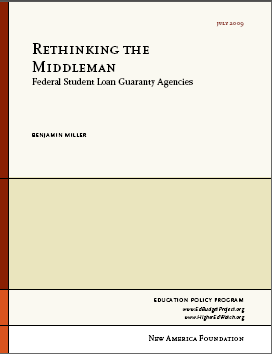 Guaranty agencies’ subsidies, responsibilities, and relationships are better suited for a different era of federal student aid policy. Their outdated roles and relationships with lenders not only undermine the underlying policy goals of the original student loan program, they lead to inefficient uses of taxpayer dollars and a variety of practices that harm rather than help student borrowers. Today, the New America Foundation is releasing “Rethinking the Middleman,” a report that explores the history and policy shortcomings of guaranty agencies and provides reform recommendations to Congress and the U.S. Department of Education.
The paper recommends that policymakers take the following steps to correct many of the problems with guaranty agencies we have previously identified:
Eliminate the Guaranty Agency Insurance Role
The initial purpose of guaranty agencies was to cover the costs incurred by student lenders when a borrower defaults on a loan, with some assistance from the federal government. Today, guaranty agencies perform that role by making payments to lenders entirely with federal funds held in trust. The vast majority of these funds are reimbursed by the U.S. Department of Education, making guaranty agencies a middleman with minimal stake in the FFEL Program.
Federal policymakers should remove guaranty agencies from this process altogether. Any claims lenders file for loan default reimbursement should go directly to the U.S. Department of Education, which can then make claim payments using the same process it employs now to provide quarterly interest rate subsidies to lenders. Under this arrangement, guaranty agencies should be required to return the $1.63 billion in federal assets they hold.
Prohibit Guaranty Agency and Lender Partnerships
The relationships between lenders and guaranty agencies are largely a product of incentives from the 1970s that today distort subsidies provided to both. Although not every relationship between a lender and guaranty agency leads to such outcomes, the opportunity for such activities is increased whenever these two types of agencies share common financial interests. To ensure that the missions of guaranty agencies and lenders are not compromised by their connections, the federal government should establish a strong firewall between the two. For existing lender-guaranty agencies, the secretary of education should exercise current regulatory authority to separate these entities from one another if doing so is in the federal fiscal interest, or to “ensure sufficient separation of responsibility and authority between its lender claims processing as a guaranty agency and its lending or loan servicing activities.” This authority should be used in cases where the guaranty agency and lender are part of the same organization or they have a contract in which one outsources some or all of its responsibilities to the other.
Eliminate Guaranty Agencies’ FFEL Program Oversight Role
Guaranty agencies are expected to serve as a neutral third party to monitor and audit participating lenders in the FFEL Program. Several lawsuits and reports by the U.S. Department of Education’s inspector general have demonstrated these agencies are not capable of playing this role in a way that protects student borrowers and taxpayers. The oversight role prescribed for guaranty agencies is also somewhat duplicative given that the U.S. Department of Education is expected to conduct its own program reviews and oversight of the FFEL Program as well.
Given these factors, guaranty agencies should no longer be expected to carry out any oversight functions. Any auditing responsibilities should be transferred to the U.S. Department of Education.
Balance Incentives for Borrower Assistance versus Loan Collection
The federal payments provided to guaranty agencies attempt to achieve competing policy outcomes: (1) preventing student loan default and (2) rehabilitating or collecting on a borrower’s loan that has not been successfully repaid. Because the compensation for the latter goal is greater than for the former, there is tension within agencies between pursuing activities that are better for their financial interests or for those of borrowers.
These competing policy goals should be resolved by assigning the duties currently performed by guaranty agencies to two separate groups of competitively determined federal contractors. One set of contractors would handle the collection of defaulted student loans, while a different group would provide default aversion assistance to borrowers. Guaranty agencies and other companies could bid on the default aversion contract, but no entity or related affiliate could perform both functions. Rehabilitating loans would be handled by the contractors that provide default aversion assistance.
Improve the Default Aversion Role
Assisting struggling student loan borrowers is a worthwhile policy goal that is currently executed poorly through the default aversion assistance fee. Rather than the current structure, in which the fee can be used to place borrowers in forbearance, default aversion should be handled by federal contractors whose compensation is based on successfully returning borrowers to repayment. Not only would this prevent excessive use of forbearances, but it would alleviate concerns about using this fee to gain greater federal subsidies. This change in the default aversion fee would also encourage more active interventions with struggling borrowers because greater work is required to return borrowers to repayment.
Alternatively, the default aversion fee could be turned into competitively bid block grants, in which any agency-including those not currently participating in the federal student loan program-would be eligible to submit a proposal for providing default aversion activities for all borrowers in a given state or region. This process would ensure that any agency performing default aversion activities would not have an incentive to manipulate a given borrower’s balance. A competitively bid contract would also create competition among agencies to prove their success at quality default aversion activities.
Make the U.S. Department of Education the Lender of Last Resort
The lender-of-last-resort loan program is a necessity because lenders are not required to make loans to all eligible borrowers. But the current construction of the lender-of-last-resort program creates opportunities for exploitation by guaranty agencies that have close relationships with federal student loan companies. Because of these concerns, the U.S. Department of Education should take over providing lender-of-last-resort loans in any situation where they may be needed. Loans could be provided through the same common origination and disbursement system that handles Pell Grant payments to schools. They could then be administered as part of the Direct Loan Program, a competing distribution system for federal student loans that involves the government issuing loans directly to students using Treasury funds.
Demand Accountability and Results for Other Activities
Guaranty agencies engage in a number of college planning and outreach activities in addition to the FFEL roles for which they receive explicit federal subsidies. This programming is often funded by excess federal revenue. Unlike the activities for which they are explicitly paid, this programming is not subject to any accountability measures designed to ensure that it is well executed and worthwhile.
To ensure that excess federal revenue is being used for quality purposes, guaranty agencies’ college planning and other similar programming should be subject to annual review by the U.S. Department of Education and the annual congressional discretionary appropriations process. Doing so would both ensure that these activities were well executed and provide an opportunity to share best practices research by carefully evaluating what works. Guaranty agencies that offer less successful programming would either return excess subsidies or alter their offerings to encompass more effective activities offered by other agencies.
Time for Reform
Guaranty agencies have played some role in federal student loan programs since their inception. But while these agencies have taken on new responsibilities during the ensuing decades, they have not abandoned roles that are now irrelevant. In addition, they have been forming relationships with lenders that create potential conflicts of interest. Enacting the changes described above would turn guaranty agencies into a useful part of a system for postsecondary education access, rather than unnecessary middlemen.
Issues
Programs/Projects/Initiatives
Related

State Legislatures Weighing in on Workforce Pell
A Trump Official’s Thin Legal Case Against Accreditors’ DEI Policies