Background
What Is SLCM-N?
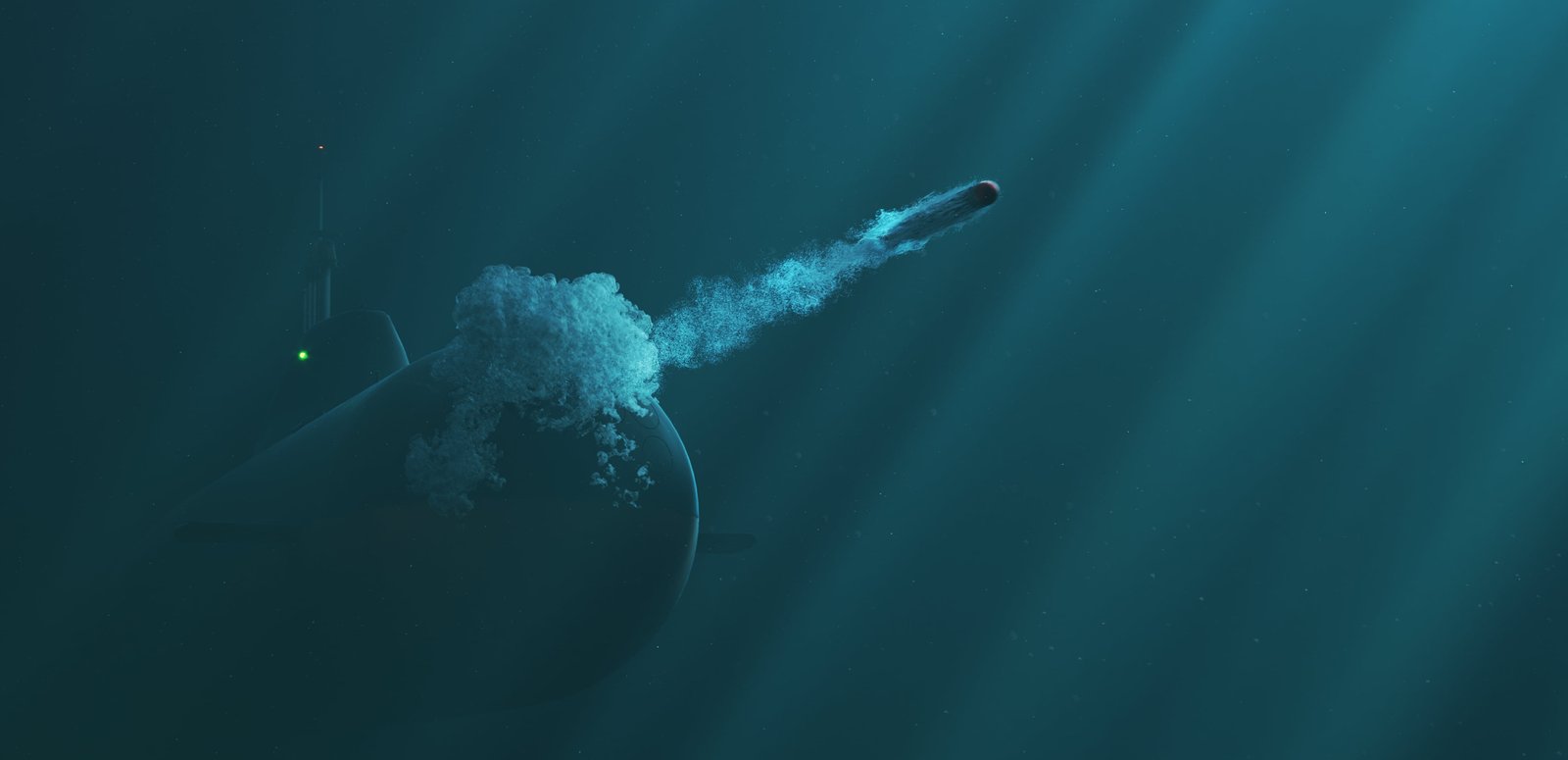
SLCM-N is a short-range, nuclear-armed sea-launched cruise missile designed for deployment on U.S. attack submarines (SSNs). It follows a low, maneuvering trajectory that enables it to better evade air defenses and deliver precise strikes at regional distances. Intended to operate in theater, SLCM-N is classified as a nonstrategic (or “tactical”) nuclear weapon—meaning it is designed for limited, battlefield or regional use rather than large-scale strikes—and is intended to strengthen U.S. extended deterrence in Europe and the Indo-Pacific.1
The system’s value derives from the survivability (that is, the ability to avoid detection and destruction), stealth, and mobility of its submarine launch platform. Submarines—the most survivable leg of the U.S. nuclear triad—can remain undetected, operate independently in open waters, and generate strikes without visible preparation. SLCM-N is also comparatively prompt: Once authorized, a forward-deployed missile could reach regional targets within hours. By contrast, air-launched cruise missiles delivered by strategic bombers must be generated from the U.S. homeland, may require refueling en route, and often take significantly longer to arrive in theater. As a sea-based capability, SLCM-N also sidesteps many of the political sensitivities associated with basing nuclear weapons on allied territory.
Operationally, a forward-deployed SLCM-N would provide the president with proportional response options in a crisis. If an adversary employs tactical nuclear weapons in a conflict, American use of higher-yield or longer-range strategic systems risks appearing escalatory or disproportionate—essentially skipping over several ladders in escalation management. SLCM-N is designed to offer a calibrated, low-yield, theater-level response option. It broadens the set of choices available to the president and thus gives more flexibility to decision makers.
The purpose of SLCM-N is threefold: (1) to reassure allies and strengthen U.S. extended deterrence, (2) to deter adversaries such as China and Russia from contemplating limited nuclear escalation, and (3) to give the American president a more flexible set of nuclear options. Its presence is intended to signal that no aggressor can expect to gain advantage from limited nuclear use without facing an assured and proportional U.S. response.
A Brief History of SLCM-N, from the Cold War to 2024
The United States first deployed a nuclear-armed sea-launched cruise missile in the mid-1980s, when the Navy fielded the Tomahawk land attack missile–nuclear (TLAM-N) on surface ships and attack submarines.2 With a range of roughly 2,500 kilometers (1,550 miles), TLAM-N was classified as a “tactical” nuclear weapon—referring to shorter-range, typically lower-yield nuclear systems intended for regional use rather than long-range strategic strikes. The Tomahawk was viewed as precise, stealthy, and therefore survivable—a tool bolstering U.S. presidents’ flexibility and countering the Soviet Union’s own deployment of sea-launched cruise missiles.
The United States withdrew TLAM-N from deployment in 1991 as part of President George H.W. Bush’s Presidential Nuclear Initiatives, which ordered the removal of all sea-based tactical nuclear weapons.3 Although the missiles were taken off operational platforms, they were kept in storage with the option to return them to submarines. The Obama administration ultimately determined that the system was no longer necessary and formally retired it in 2010.4
The debate over reviving a sea-launched nuclear cruise missile resurfaced under the first Trump administration’s 2018 Nuclear Posture Review (NPR), which proposed developing a new SLCM-N as a modern successor to the TLAM-N mission. The NPR criticized the Obama administration’s decision to retire TLAM-N, arguing that its withdrawal removed a key assurance tool for U.S. allies in Asia and left the United States relying almost exclusively on strategic nuclear forces for deterrence in the Indo-Pacific. In this context, the NPR argued that SLCM-N would “provide additional diversity in platforms, range, and survivability,” offering a politically uncontested means of reinforcing regional deterrence and strengthening allied confidence in U.S. defense commitments.5
The 2018 NPR reflected a reassessment of the threat environment, driven primarily by two trends:
- Russia’s significant, 10-to-1 advantage over the United States in nonstrategic nuclear weapons, combined with its increasingly assertive behavior, such as the deployment of ground-launched cruise missiles in violation of the Intermediate-Range Nuclear Forces (INF) Treaty.6 These developments informed the NPR’s judgment that Moscow sees limited nuclear first use with low-yield, short-range weapons as a means of coercion. This assessment reflects broader concerns about Russia’s so-called escalate-to-deescalate strategy.7
- China’s rapid expansion and modernization of its nuclear forces, including diversification of delivery systems to complete its nuclear triad and increase survivability as well as movement toward a larger and more sophisticated warhead stockpile. These trends informed the NPR’s assessment that Beijing is shifting away from a historically minimal deterrent toward a more flexible force posture, raising concerns about China’s future willingness to rely on nuclear signaling or limited use in crises, particularly in a Taiwan contingency.8
The 2018 NPR formally acknowledged the emergence of a second major nuclear competitor, China, alongside Russia; warned that both states could feel emboldened to test U.S. resolve through limited nuclear escalation; and expressed concern that a proportional, theater-range U.S. nuclear option was needed to quell adversaries’ doubts about U.S. willingness to escalate during a regional confrontation, thereby creating a perceived “deterrence gap.”9
To address this challenge, the 2018 NPR called for forward-deployed, flexible, tailored nuclear options, including developing a modern SLCM-N and modifying a small number of submarine-launched ballistic missiles (SLBMs) to carry low-yield warheads. These new capabilities would complement existing and forthcoming systems—such as the long-range standoff (LRSO) air-launched cruise missile carried by strategic bombers—by adding credible, theater-appropriate, and sea-based options to the U.S. deterrence posture.
Just a few years later, the Biden administration reached a different conclusion: Existing and planned U.S. capabilities—like low-yield SLBM, LRSO, and dual-capable F-35 fighters able to carry either conventional munitions or nuclear bombs—were sufficient to deter limited nuclear use without pursuing a new SLCM-N program. On this basis, the 2022 National Defense Strategy canceled SLCM-N.10
This decision, however, was met with congressional pushback. The 2023 bipartisan Strategic Posture Commission assessed that, faced with the so-called two-peer threat, the United States needed a larger and more diversified nuclear arsenal, with survivable, forward-deployed options that SLCM-N uniquely meets.11 Later that year, Congress reversed the administration’s cancellation, mandating that the Pentagon resume fielding the program under Section 1640 of the National Defense Authorization Act (NDAA) for fiscal 2024, with the goal of achieving initial operational capability (IOC) by 2034.12
2026 and Forward: Deployment Timeline and Operational Uncertainty
As of 2026, SLCM-N is moving forward, originally propelled by sustained congressional support and now aligned with executive policy. The U.S. Navy has selected five companies to advance early development work.13 Although the second Trump administration did not request additional discretionary funding for SLCM-N in the fiscal 2026 Navy budget, this reflects prior funding decisions rather than diminished momentum. The fiscal 2025 reconciliation legislation (also known as the One Big Beautiful Bill Act) provided $2 billion in mandatory funding to accelerate the development and procurement of SLCM-N, along with $400 million for its associated warhead.14 Congress is now shaping the program’s pace through the 2026 National Defense Authorization Act (NDAA), which authorized $210 million for the missile and $50 million for the warhead.15
However, even given optimistic assumptions, SLCM-N would not enter force until the early to mid-2030s. Several key parameters remain classified to the public, undetermined, or deliberately ambiguous, including:
- How many SLCM-Ns the United States would ultimately build and deploy—and how many each platform could carry (reportedly up to 12 per ship)16
- On December 22, 2025, President Donald Trump announced a new “Golden Fleet” initiative to build 20 to 25 battleships designated under a new “Trump class.” The president said the lead ship, the USS Defiant, would carry SLCM-N.17
- Platform choices change the signaling and deterrent value. A surface-combatant (or otherwise surface-based) deployment would involve more visible generation than SSN deployment, which, according to some of the experts we interviewed, could strengthen allied assurance and reduce ambiguity about whether a U.S. posture shift is underway. But greater visibility could mean lower survivability and increase incentives for adversary preemption.
- Whether the missiles would be kept at sea routinely or remain in U.S. central storage during peacetime
- Where the weapons would be stored, loaded onto submarines, and prepared for use (central storage versus forward loading sites)
- How many SLCM-Ns would be loaded onto the Virginia-class submarines (the Navy’s newest class of nuclear-powered attack submarines) or the new “Golden Fleet”
- How the Navy would balance the trade-off between nuclear and conventional capabilities, given that submarines have limited tube space and no at-sea reload capacity
- How often nuclear-certified vessels would deploy and how their movements might be interpreted by adversaries
- What targeting options SLCM-N would have, including whether it would be limited to military targets (counterforce posture) or extend to command-and-control and leadership targets (countervalue posture)
- What command-and-control procedures would govern a submarine carrying both nuclear and conventional weapons
- How SLCM-N deployment could place new burdens on the Navy’s infrastructure and industrial base—requiring expanded production capacity, a larger skilled workforce, crew retraining for nuclear missions, and platform modifications to support nuclear operations
Taken together, SLCM-N’s long development horizon and unresolved concept of operations (CONOPS) mean its strategic effects will be determined less by today’s debates than by the security environment into which it is eventually deployed. By the early to mid-2030s, the United States may confront two fully mature nuclear peers simultaneously, each fielding more integrated nuclear and non-nuclear capabilities as well as more sophisticated undersea sensing, with evolving doctrines shaped by rapid technological change. Decisions made now about SLCM-N’s scale, basing, employment, and signaling role will therefore interact with a future strategic balance that is likely to differ substantially from today’s. In this context, the uncertainty surrounding SLCM-N is not merely a programmatic challenge; it is a central determinant of whether the system ultimately functions as a stabilizing hedge, a marginal addition, or a source of new escalation risk.
Citations
- Anya L. Fink, Nuclear-Armed Sea-Launched Cruise Missile (SLCM-N) (Congressional Research Service, 2025), source.
- Fink, Nuclear-Armed Sea-Launched Cruise Missile (SLCM-N), source.
- Arms Control Association, The Presidential Nuclear Initiatives (PNIs) on Tactical Nuclear Weapons at a Glance (Arms Control Association, 2017), source.
- Fink, Nuclear-Armed Sea-Launched Cruise Missile (SLCM-N), source.
- Here, “politically uncontested” refers to the fact that SLCM-N would be deployed at sea on U.S. submarines and therefore would not require host-nation consent or the basing of nuclear weapons on allied territory, making it less politically sensitive than land-based nuclear deployments. Office of the Secretary of Defense, Nuclear Posture Review (U.S. Department of Defense, 2018), source.
- Matthew Kroenig, Mark J. Massa, and Christian Trotti, Russia’s Exotic Nuclear Weapons and Implications for the United States and NATO (Atlantic Council, 2020), source.
- Kroenig, Massa, and Trotti, Russia’s Exotic Nuclear Weapons, source.
- Hans M. Kristensen, Matt Korda, Eliana Johns, and Mackenzie Knight, “Chinese Nuclear Weapons, 2025,” Bulletin of the Atomic Scientists 81, no. 2 (2025): 135–160, source.
- John R. Harvey and Robert Soofer, Strengthening Deterrence with SLCM-N (Atlantic Council, 2022), source; Mariam Kvaratskhelia, “How a Second Trump Term Could Shape U.S. Nuclear Posture in Europe and the Indo-Pacific,” Center for Strategic & International Studies Nuclear Network, April 10, 2025, source.
- U.S. Department of Defense, 2022 National Defense Strategy of the United States of America, Including the 2022 Nuclear Posture Review and the 2022 Missile Defense Review (U.S. Department of Defense, 2022), source.
- Anya L. Fink, Congressional Commission on the U.S. Strategic Posture (Congressional Research Service, 2025), source.
- National Defense Authorization Act for Fiscal Year 2024, Pub. L. No. 118-31, § 1640 (2023), source.
- “U.S. Navy Advances Development of Sea-Launched Cruise Missile–Nuclear (SLCM-N) with Key Contractor Selections,” SSBCrack News, September 10, 2025, source.
- National Defense Authorization Act for Fiscal Year 2026, Pub. L. No. 119-21 (2025), source.
- Fink, Nuclear-Armed Sea-Launched Cruise Missile (SLCM-N), source.
- Peter Suciu, “Trump Announces New Class of Battleships—Named for Himself,” National Interest, December 23, 2025, source.
- Carter Johnston, “Trump Announces Nuclear-Armed Battleships for the U.S. Navy,” Naval News, December 23, 2025, source.