

With the passage of the Americans with Disabilities Act (ADA) more than 35 years ago, the United States recognized the rights of people with disabilities to participate in all aspects of public life. While there have been significant strides in creating more accessible infrastructure and public spaces, public systems are often fragmented and lack capacity to support full access and inclusion for the more than 70 million Americans with disabilities. Numerous federal programs support people with disabilities across multiple domains to help fulfill the promise of the ADA; however, they are often siloed, underfunded, and insufficient, thus preventing full participation in community life.
In fact, at a moment when the Trump Administration is broadly disrupting federal programs and agencies, threats to vital disability funding are not getting adequate attention. Yet periods of change provide the opportunity to rethink how our systems operate. We should not be limited by existing program structures, but instead consider how federal systems must evolve to meet the needs of the whole person. Even amid uncertainty, policymakers must continue to consider how today’s funding choices shape the accessibility and inclusion of public systems for people with disabilities. Maintaining the status quo is not sufficient; strengthening disability programs remains essential to fulfilling the ADA’s promise.
Federal Disability Spending: Mandatory vs. Discretionary
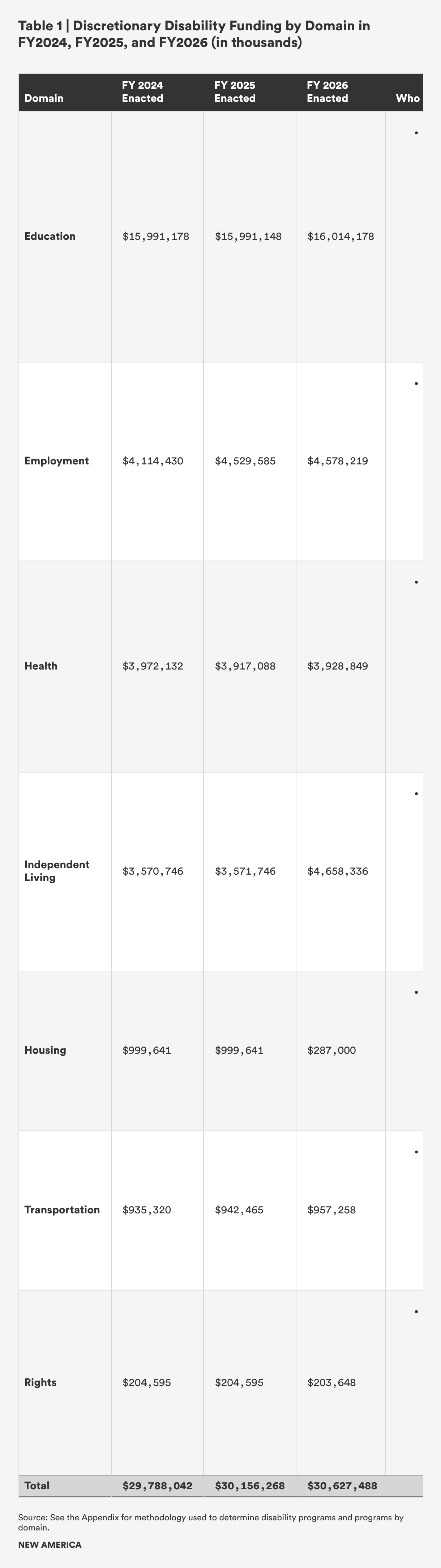
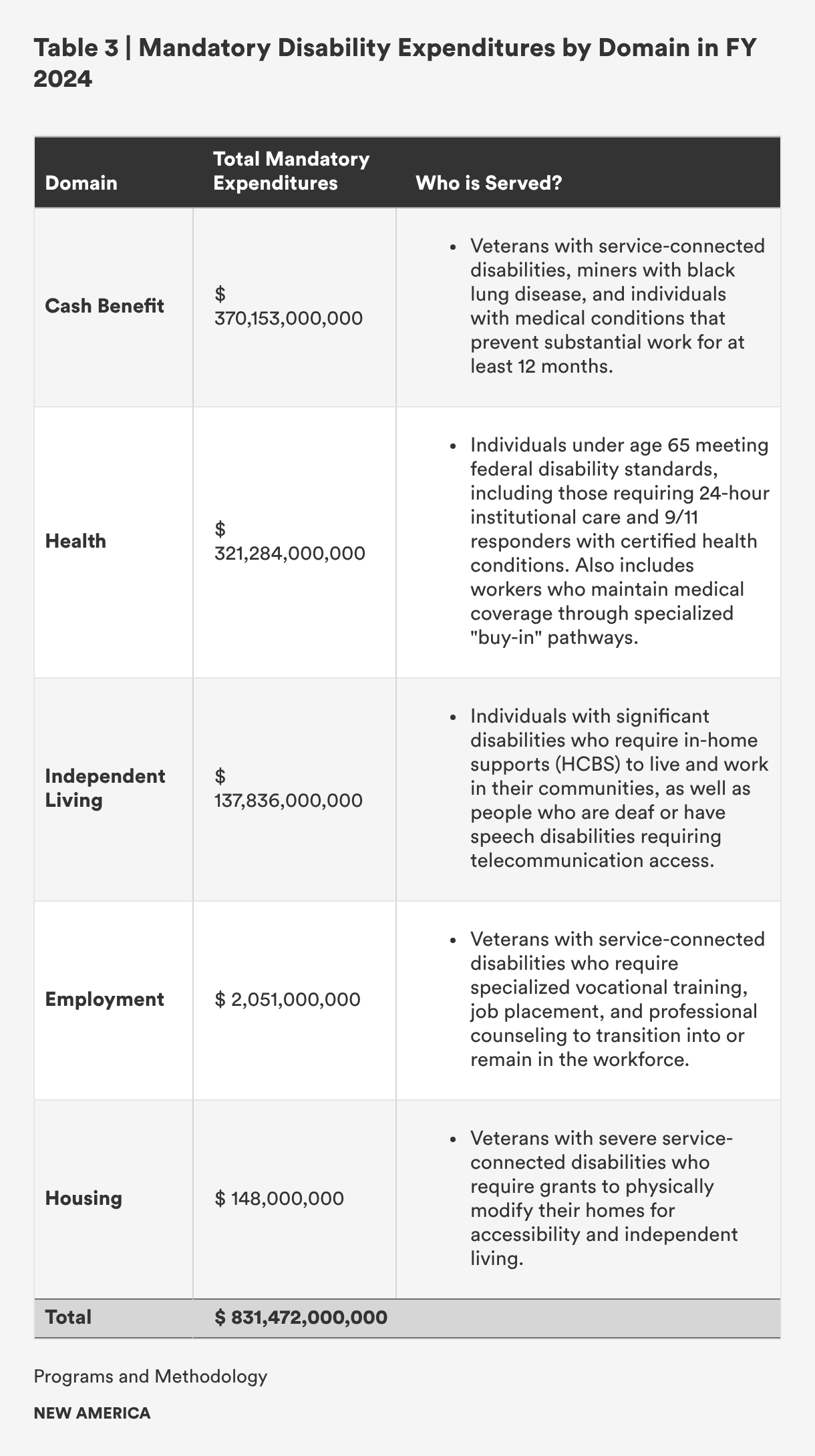
Federal disability programs are funded through a mix of mandatory and discretionary spending. In FY 2024, mandatory programs for people with disabilities accounted for roughly $831.5 billion, providing veterans’ benefits, health insurance, disability benefits, and Medicaid-covered independent living services (see Appendix). Discretionary federal programs, which provide critical access to broader public services like education, transportation, employment, and housing, received about $29.8 billion (see Table 1) or 1.6 percent of total discretionary spending. In comparison, Congress appropriated over $900 billion or about half of the total discretionary budget on defense programs in FY 2024. Together, these funding levels provide important context for understanding how Congress shapes which systems are equipped to support participation and those that remain under-resourced.
Policymakers must look beyond individual programs and consider how federal disability investments work together. This cross-systems perspective helps clarify how federal investments can better support access, participation, and inclusion. After all, every person needs a safe place to live, high-quality education and/or training, transportation, health care, employment, and supportive communities. Yet, we have neither designed nor funded our systems to make them easily accessible for everyone. For people with disabilities, participation often depends on targeted discretionary investments that remove barriers. For example, the Job Accommodation Network, which receives only about $3 million annually, promotes access to low-cost accommodations and provides individualized consultations to more than 40,000 people and employers a year. This initiative can allow a person with a disability to get or stay in a good job and secure independence while providing employers access to talent. Small investments in access can have an outsized impact.
“Discretionary” Does Not Mean Optional
Discretionary and mandatory programs provide critical access and support the foundational pillars of the ADA: full participation, independent living, equality of opportunity, and economic self-sufficiency; however, funding battles persist to maintain even existing programs. Americans with disabilities must navigate multiple systems with different rules that seemingly speak different languages, which inevitably leaves people behind. While numerous federal programs support people with disabilities with some overlap, these programs are generally not duplicative. They serve different populations, operate in different systems, and are designed to address distinct barriers to reaching the American Dream.
The presence of disability programs across different domains reflects the reality that people with disabilities interact with education, health care, housing, employment, and transportation systems that were not originally designed to serve them. These systems currently lack the capacity to fully meet their needs and consolidating or block granting disability-specific programs into broader funding streams risks reducing access in the name of improving efficiency. To create more effective systems that will fulfill the goals of the ADA, we need stronger investment in discretionary programs. Over time, these investments can expand meaningful choice and participation.
Disability Funding by Domain
Mandatory disability programs support five domains: cash benefits, health, independent living, employment, and housing, though the majority of funding flows to cash benefits, health, and independent living. These programs have broad approval and support a range of people with disabilities including veterans, children, first responders, miners, and those with terminal illnesses, significant impairments, or low income. For more detail, refer to the appendix.
Discretionary disability programs support seven domains: education, employment, health, housing, independent living, rights, and transportation. The author examined federal appropriations over the last three fiscal years to identify disability-specific programs. Table 1 shows funding for each domain for FY 2024, FY 2025, and FY 2026. Within each domain, minimal increases have occurred with primarily flat funding. In FY 2024 and FY 2025, the federal government provided roughly $29.8 billion and $30.15 billion for discretionary disability support programs, respectively. The FY 2026 appropriations bills provide about $30.6 billion, or a 1.6 percent increase for disability programs (See Appendix for methodology.)
This slight increase in FY 2026 was hard fought. The FY 2026 Presidential Budget Request would have decimated numerous long-standing disability programs by putting them in block grants rather than explicitly funding support for people with disabilities. In addition to the consolidation of disability housing programs which were partially enacted in the FY 2026 bill, the request proposed cuts to independent living, parent training and information centers, and mental health programs. Programs that help people understand their rights such as the Protection and Advocacy and Client Assistant programs were also zeroed out. Finally, the president’s request included a significant cut for programs that support employment. The suggested cuts were made at a time when at least half of states are limiting eligibility for vocational rehabilitation services for people with disabilities. Although Congress rejected most of the cuts, the request made clear that disability programs are not an administration priority.
The U.S. Needs A Holistic Approach to Disability Funding to Support Access and Participation
Discretionary programs fund critical access to systems that make community participation possible. They offer children access to trained special educators and free accessible textbooks. They provide job training and accessible housing. These programs create opportunities for those who otherwise would go without. As the late disability activist Alice Wong wrote, “The narrative trajectory of a disabled person’s life is necessarily webbed. We are often only as strong as our friends and family make us, only as strong as our community, only as strong as the resources and privileges we have.”
Mandatory programs will always be a pillar of federal support for people with disabilities, but discretionary programs that expand access to education, employment, housing, and independent living can be transformative. They can open the door to good jobs and self-determination. As Congress considers funding levels for the future, lawmakers must adequately support the full range of systems required to make the ADA’s promise of full participation and independent living a reality. These programs may be labeled “discretionary,” but they are not optional for people who rely on them to live and participate in society with independence and dignity.
Appendix
Methodology for Identifying Discretionary Disability Programs
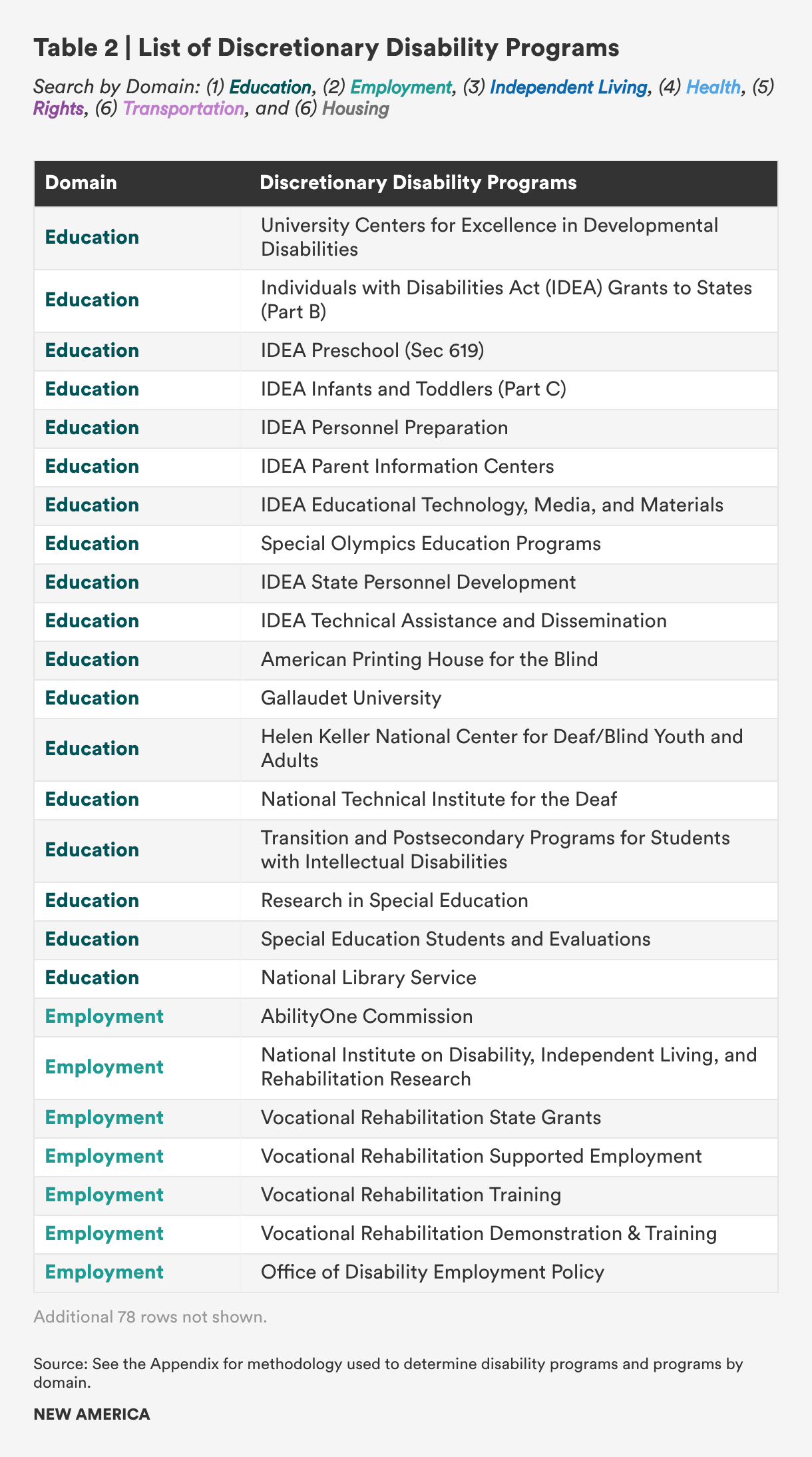
This analysis uses a framework to separate disability-specific spending from the broader social safety net while prioritizing the social model of disability. Programs are included only if they are solely for people with disabilities or their families. For example, IDEA funding is included, but Title I ESEA dollars are not. Even though those funds support students with disabilities, they do not do so exclusively.
The analysis excludes administrative overhead, cross-government civil rights offices, tax credits (e.g., ABLE), and earmarks. Each program has a distinct congressional appropriation. Finally, VR State Grants are included in discretionary programs.
Methodology for Identifying Mandatory Disability Programs
Mandatory estimates are based on statutory disability eligibility and reflect direct benefit spending in the form of cash payments and covered services. To estimate the disability-specific share of Medicaid, this analysis relies on eligibility-linked spending categories. This estimate includes the “Blind and Disabled” eligibility group for acute care spending, as well as the “Aged” population only for Long-Term Services and Supports (LTSS). Using estimates from the Library of Congress, this analysis estimates total LTSS spending accounts for 33 percent of spending, with the remaining spending attributable to other health care expenditures. To the extent that individuals with disabilities are enrolled outside these eligibility categories, their acute care spending is not reflected in this estimate. Finally, the Telecommunications Relay Service (TRS) program is included as mandatory spending due to its permanent statutory mandate and non-discretionary federal obligation.
Issues
Programs/Projects/Initiatives
Topics
Related

Congress Reintroduces Bill to Curb Restraint and Seclusion in Schools
Bridging the Gaps in Disability Policy: Reclaiming the Promise of the ADA
Closing Early Intervention Service Gaps to Infants is Both Policy and Practice
More About the Authors

Rob Trombley
President of Trombley Policy and Strategy LLC