
Funding Non-Degree Workforce Programs at Community Colleges
Abstract
High-quality non-degree workforce programs at community colleges, including both credit-bearing and non-credit programs, play a crucial role in equipping low-income and marginalized workers and learners with the skills and credentials they need to secure quality jobs and careers in a variety of occupations. Financing these programs can be a challenge for many colleges. As part of its New Models for Career Preparation project, The Center on Education and Labor at New America (CELNA), with support from Lumina Foundation, commissioned Non-Profit Finance Fund to undertake a study examining innovative financing approaches. This report presents the findings from the study.
Acknowledgments
The Center on Education and Labor at New America (CELNA) would like to thank Lumina Foundation and especially Chauncy Lennon, Kermit Kaleba, and Georgia Reagan for graciously supporting CELNA’s New Models for Career Preparation project under the hospices of which this brief was commissioned.
The views expressed in this report are those of its author and do not necessarily represent the views of Lumina Foundation, its officers, or its employees.
CELNA would also like to thank Nonprofit Finance Fund’s Ashley Gunn, LaShawn Taylor, and Tessa Borelli for their contributions to this publication.
CELNA thanks New America’s Iris Palmer and Shalin Jyotishi who lead the New Models for Career Preparation project as well as CELNA’s Mary Alice McCarthy for guidance and feedback on this brief. We also thank Riker Pasterkiewicz, Julie Brosnan, Sabrina Detlef, and Fabio Murgia for their support of the editing, design, and supporting communication around this publication.
CELNA also thanks the following individuals for their time and insights contributing to phone interviews, background research, and other guidance:
- Anne Bartlett, Brazosport College
- Brendan Beier, New Markets Tax Credit consultant
- Mildred Coyne, Broward College
- Antonio Delgado, Miami Dade College
- Rey Garcia, University of Maryland University College
- Isabel Gonzalez, Broward College
- Lori Keller, Bates Technical College
- Amy Kardel, CompTIA
- Marcia Lynch, Monroe Community College
- Leah Palmer, Mesa Community College
- Lenora Reece, Dallas College
- Beth Stall, Dallas College
- Millicent Vallek, Brazosport College
- Tracee Watts, Brazosport College
Downloads
Background and Introduction
Since their earliest days, community colleges have been asked to fulfill a “dual mission” that includes meeting the academic and workforce development needs of their communities. Community colleges are a critical piece of our higher education infrastructure, as open access institutions providing a range of credentials, enrolling close to 40 percent of all undergraduates. As providers of career-technical and workforce education, they are also critical to the success of local economies, meeting the needs of both job seekers and employers. Indeed, according to a recent survey by the Community College Research Center, 48 percent of working adults have used community colleges at some point in their lives to advance their job prospects.
While community colleges seek to carry out their dual mission, the policy environment in which they operate is heavily tilted toward their academic mission, with the lion’s share of state and federal funding going to support degree-seeking students. But many community college students are not interested in a degree. Rather, they are looking to obtain the skills and/or credentials necessary to get a job, keep a job, or move up in a job. In Illinois, for example, of the 600,000 plus students enrolled across the state’s 48 community colleges in 2020, nearly a quarter were enrolled in “noncredit” courses and 47 percent of students in credit-bearing courses indicated that they were not seeking an associate degree.
Meeting the needs of the large share of community college students seeking specific skills for local, in-demand jobs can be challenging for colleges. The funding colleges rely on for their academic offerings – Pell grants, federal student loans, state-based student aid programs – often cannot be used to pay for programs that are short-term, highly-specific, or need to be delivered on-the-job or be taught by experts other than faculty. Funding for job training through programs like the Workforce Innovation and Opportunity Act, Trade Assistance Act, or state workforce programs, is often insufficient to cover the costs of standing up and/or sustaining a new program.
To better understand the challenges and opportunities for community colleges face in developing financing strategies to support their workforce development mission, New America partnered with the Nonprofit Finance Fund (NFF), a community development financial institution (CDFI) with forty years of experience as a lender and advisory to the nonprofit sector. Using research from our New Models of Career Preparation project, which is identifying and elevating high-quality non-degree programs at community colleges across the country, NFF interviewed college leaders, as well as experts in the fields of workforce development and community college administration. The interviews took place over a five-month period spanning 2020 and 2021, and enabled NFF staff to analyze how non-degree programs are currently funded, to identify innovative approaches, and to explore how specific practices contribute to a program’s ability to achieve its mission. The research also surfaced a number of promising financing practices that college leaders can use to secure the resources they need to build high-quality non-degree programs.
Over the past two years, American workers and employers have been wracked by a set of unprecedented economic and social challenges. Many employers are struggling to find and retain workers, while many workers are looking to move into jobs that pay better and are safer. For both groups, access to high-quality non-degree workforce training programs can play a critical role in helping them reach their goals. This paper offers some concrete strategies that community colleges can use to stand up and sustain the non-degree programs that their communities need.
Applying the Full Cost Framework to Non-Degree Programs at Community Colleges
One of the fundamental building blocks of NFF’s work to improve the financial health and resiliency of the nonprofit sector is the concept of full cost.
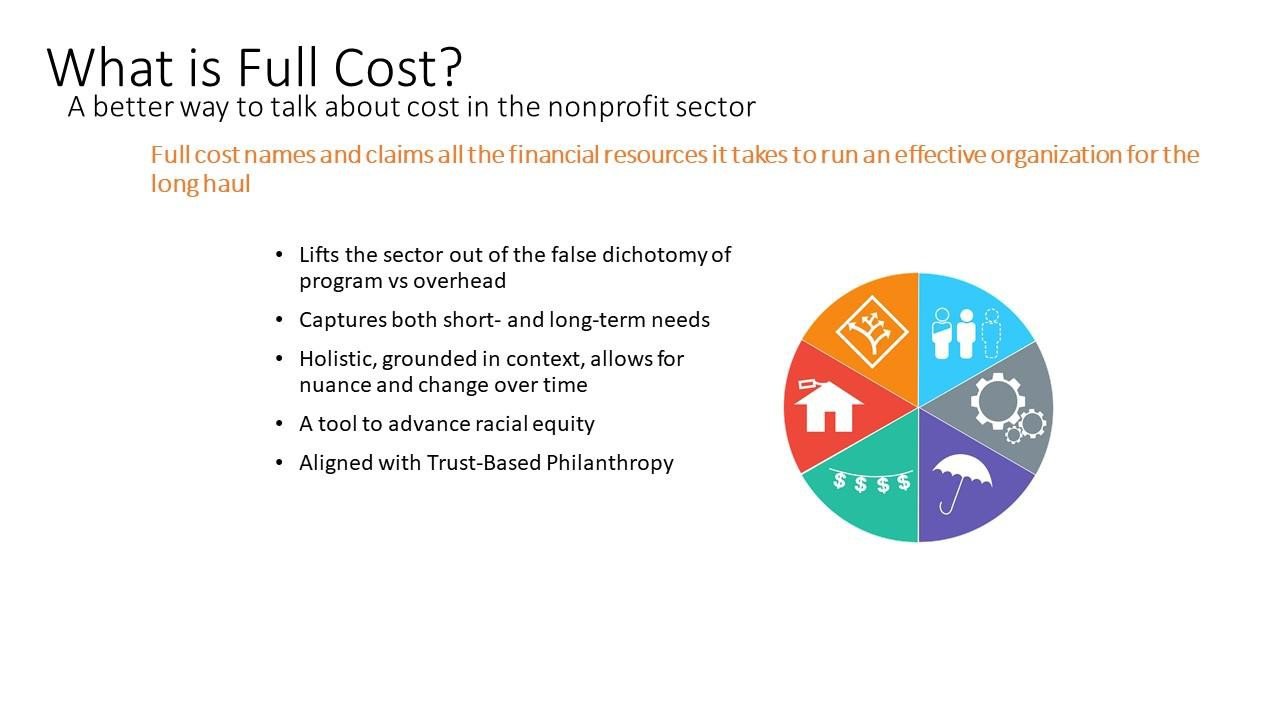
We define full cost as all the financial resources it takes to run an effective organization for the long haul. We believe that healthy organizations can respond and adapt to the changing needs of their communities.
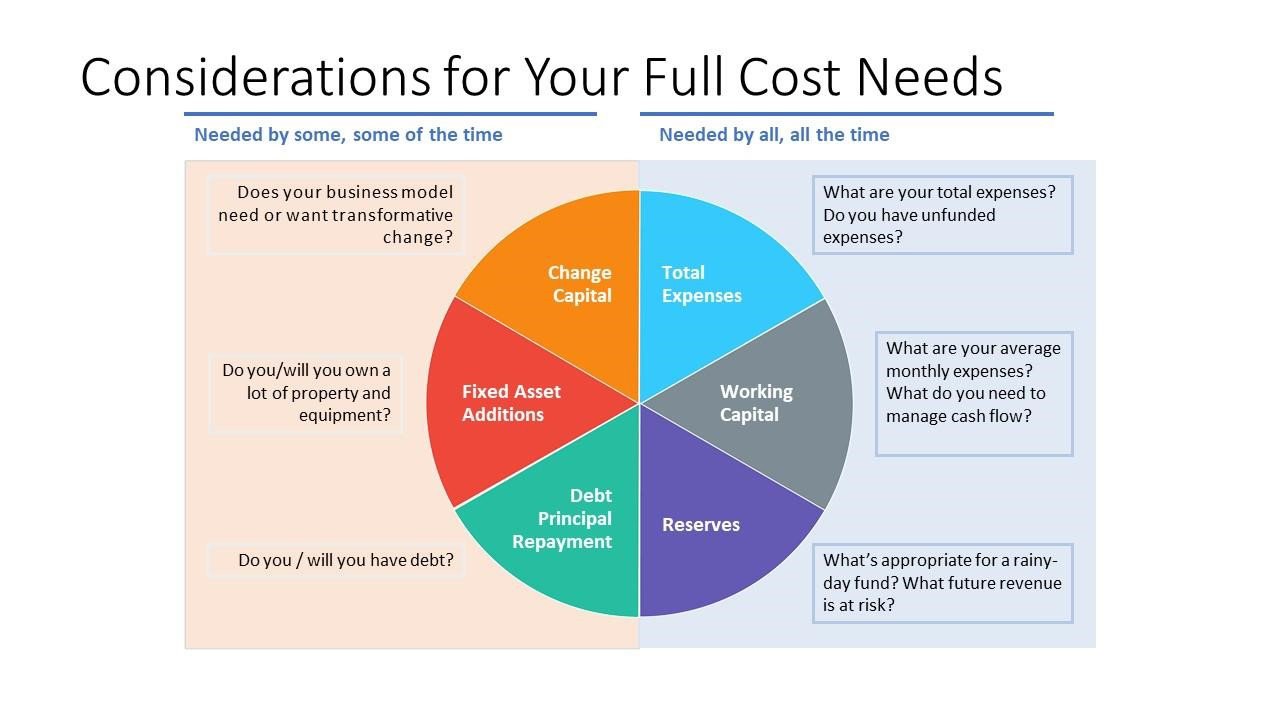
When calculating full cost, our definition incorporates an organization’s expenses and budgeting needs and is comprised of categories that are both needed by all organizations all of the time and needed by some organizations some of the time:
- Total expenses: Funds to cover day-to-day direct and indirect, program and overhead, and unfunded expenses
- Working capital: Funds to keep operations going
- Reserves: Funds to navigate the unexpected, survive a crisis, or act on a new opportunity
- Debt principal repayment: Funds to pay back what has been borrowed
- Fixed asset additions: Funds to pay for new equipment, buildings, and other fixed assets
- Change capital: Flexible funds to reposition an organization’s business model
NFF’s full cost exercise takes an organization-level view because an organization’s income and balance sheet are both part of the full financial picture. An organization’s ability to cover its full costs is tied to its ability to generate consistent surpluses. However, there are several key differences between how community colleges and other nonprofits operate financially. Nonprofits typically view full cost exercises at the organizational level, but, generally, taking an organizational-level view is not possible for non-degree programs at community colleges, as it is standard that any unspent funds at the program or department level are incorporated into the college’s general funds.
View our technical assistance webinar recording addressing How Community Colleges can Leverage Full Cost Budgeting to Finance Non-Degree Programs
Why Talk About Full Costs?
Full cost calculations can be a powerful advocacy tool that community college leaders can use to guide discussions around resource allocation for non-degree programs both internally–with faculty, leadership, boards, and staff, and externally with funders, employers, unions, alumni, economic and community development partners.
In many ways, NFF’s discussions with community college program and institutional leaders about how to effectively and sustainably finance non-degree workforce programs mirrored the conversations that we have with nonprofit leaders throughout the country and across sectors.
Most nonprofit enterprises and programs, including non-degree programs at community colleges, are not accustomed to naming the resources they need to do their work, because they have been conditioned not to do so.
This is because nonprofit organizations operate in a system where funders—including governments, philanthropists, corporations, and foundations—determine how much they will pay for services and set restrictions on how their money can be used. In addition, nonprofits must often rely on constrained public funding streams, which creates an environment of resource scarcity.
As a result, many organization and program leaders are accustomed to “taking what they can get” and “making it work,” and thus do not account for the range of financial resources that it takes to maintain a healthy program within a healthy organization.
Full Cost as a Tool for Internal Advocacy
Leadership can bring strong financial management to their organizations by understanding their organization’s current financial condition, recognizing short-and long-term full cost and needs, and striving to address these needs when planning and budgeting.
Consider the following hypothetical example:
Andréa is creating a new information technology boot camp program at her community college with her employer partners, a consortium of companies in the region’s highest-growth IT companies. Employers are providing financial and in-kind support for instructional design, instructional costs, space, and specialized equipment. Andréa has a grant to provide stipends to students for lost wages while they are in training. She needs to convince her leadership team to use general funds to cover wraparound services for transportation specifically for her boot camp program because she wants to recruit students from neighborhoods where rates of car ownership are low and public transportation is unreliable. Further, she does not know how many years the industry’s financial support will continue and needs to ensure that there are resources available in the future for equipment replacement.
Andréa’s ability to articulate the needs of her program and its students, as well as the different types of revenue associated with them, will help the college’s financial planning and budgeting staff understand the full scale and scope of the program’s budget, and contextualize the amount of funding she is requesting in light of that budget. These data can also help leaders plan for future sustainable investments in the program.
Full Cost as a Tool for External Advocacy
Understanding full cost is a way of naming and claiming the resources than an organization needs to meet its mission in the short and long term. The needs of an individual organization, and the community it serves. This pattern plays out in an organization’s ability to cover its full costs: our society remains segregated by race and class, and philanthropic giving tends to follow these same patterns and networks.
In higher education, governments and local businesses often underinvest in community colleges, and the students they serve are frequently those most excluded from higher education and the labor market on the basis of race, ethnicity, socioeconomic status, and gender. Community colleges and the individuals they serve have financial needs that are different from private and four-year public institutions and their students.
For community colleges, understanding and presenting the full program cost to funders, government, and employers can inform a more realistic conversation about the investment required to move people into better jobs while building the case for longer-term investments in community colleges. Consider the example below:
After several years of running the boot camp mentioned above, Andréa has the opportunity to present the program to state legislators as an example of why her college’s non-degree workforce programs should be included in the state budget. She has data to show strong labor market outcomes, including job retention, earnings, and estimated contributions to economic mobility for underrepresented communities in addition to local tax revenue.
State reimbursements for non-degree programs have typically only covered the instructional costs of programs, but Andréa wants to make a case for increasing the reimbursement rate and having more flexibility in what the state funds can cover, including wraparound supports to make participation in the program and subsequent employment opportunities more accessible to students. Articulating the full cost of the program in the context of the strong outcomes the program has produced lays the groundwork for a more realistic, data-driven conversation about what level of investment the state will need to make in order to meet its economic development goals, and it helps Andréa advocate for increased funding for her program and others like it.
What Are the Full Costs of Delivering High-Quality Non-Degree Programs?
The core business of community colleges is instruction, but the non-degree program leaders we consulted identified a range of non-instructional costs that are critical to their students’ success and their efforts to advance equity goals: serving students from communities that have historically been denied access to resources, ensuring and measuring strong labor market outcomes, and promoting occupational diversification.
In order to articulate their full costs, non-degree program leaders must account for total expenses—including direct, indirect, and unfunded costs—as well as fixed asset additions and change capital.
Here, and in Figure 1 (page 5), we give a representative, though not exhaustive, list of the types of costs that high-quality non-degree programs incur:
Direct costs, the costs associated with program delivery, would not exist if a program was not offered. They may fluctuate with levels of service. Based on our conversations, we identified the following types of direct costs in non-degree programs:
Indirect costs are made up of the overhead contributed by the institution itself, including administration, financial and grants management, and non-instructional space. These are costs that cannot be tied directly to program delivery but that are critical to providing the college’s infrastructure that supports program delivery.
Unfunded expenses are costs that are not currently part of the budget but that, if included, would allow an organization or program to work at its current level without putting unreasonable expectations or strains on the organization and its employees. Common examples in the nonprofit sector include paying staff low salaries, not increasing pay to reflect greater responsibilities or cost of living adjustments, and giving staff members tasks and responsibilities in excess of what can be achieved in a standard work week. Examples of potentially unfunded expenses for non-degree programs include tasks that are considered essential but are added onto into existing staff roles in the absence of adequate resources, including data collection around student outcomes or employer satisfaction; training and professional development of faculty to meet employer needs; instructional design; employer or job placement engagement; fundraising to support ongoing program delivery or wraparound services; and administration of wraparound support programs.
For programs that rely on community-based organizations or other external partners to provide wraparound services, the cost of the partner’s work may also be an unfunded expense in a program budget. If this support is critical to student success, program leaders should try to quantify it in order to capture the full scope of resources need to ensure student success.
Fixed asset additions are the dollars needed to purchase new equipment, buildings, furniture, and land and make leaseholder improvements, all of which depreciates over time. Fixed asset additions do not include small equipment purchases included in annual or program expense budgets or the simple maintenance of existing fixed assets. Examples of fixed assets for non-degree programs include dedicated instructional space, including labs, workshops, and other spaces for hands-on learning. These spaces may include specialized equipment that needs to be updated on a regular or periodic basis in order to keep the instruction relevant and in line with industry needs and employer expectations. For example, some colleges addressing diversity issues may make use of mobile labs, which allow the college to take a classroom experience into the community where underrepresented students reside.
Change capital is the term NFF uses to describe a large, periodic investment into an organization to change its business model, like the size or reach of its mission and/or how it makes and spends money. NFF’s full cost framework is an organization-level framework, but we did see some applications of and need for change capital at the program level for piloting, designing, and launching new programs. New programs, for example, can represent emerging areas of work for a community college, which may require different partnerships, more areas of expertise to be developed, and additional facilities. Or the up-front costs associated with pivoting to an online instructional model might require change capital.
Figure 1: What Are the Full Costs of Delivering High-Quality Non-Degree Programs?
| Full Cost Component | Definition | Examples from Non-Degree Programs |
|---|---|---|
| Direct Costs | Day-to-day expenses incurred during program and organizational operations | Instructional costs Wraparound supports for students Program planning and management costs Data collection Partnership development and management Communications and marketing |
| Indirect Costs | Overhead and administrative costs not directly tied to program delivery | Registrar and enrollment servicesAdministrative offices |
| Unfunded Expenses | Expenses not reflected in spending but that, if included in the budget, would allow staff to work in a reasonable and fair way | Fair-market salaries for staff including overtime compensation Wraparound services provided by the college or by partners |
| Working Capital | Financial resources to maintain operations and meet regular financial obligations | Not applicable at program level |
| Reserves | Financial resources to navigate unexpected events, survive a crisis, or act on a new opportunity | Not applicable at program level |
| Debt Principal Repayment | Financial resources to pay back loans | Not applicable at program level |
| Fixed Asset Additions | New equipment, buildings, furniture, and other larger one-time purchases | Instructional equipmentSpecialized facilities for instruction |
| Change Capital | Money with few or no restrictions that can be used to reposition how an organization earns and spends money in service of its mission | Launching new degree programs or revenue-generating lines of businessOnline instruction platform development and launch |
Revenue Dynamics of Non-Degree Programs
Our research showed that non-degree programs can sit within or outside the academic infrastructure of their institution. They typically, though not always, are placed in the non-credit suite of offerings. Where a non-degree program is placed within the academic infrastructure of its institution has implications for the types of funding a program relies on, as well as the reliability and autonomy of funding streams.
Revenue Mix, Reliability, and Flexibility
Often times non-profits and colleges seek to know what is the right mix of revenue sources for their organization, with the assumption that diversifying revenue streams will increase their financial sustainability. While there is no one-size-fits-all mix of revenues for nonprofits or colleges, we do hold to several guiding tenets.
First, colleges, like nonprofits, need regular, recurring revenues to fund ongoing operations, as well as periodic infusions to cover periodic or one-time needs, like capital expenses and change capital. They also need flexibility in their funding. For this reason, we focus on the reliability and autonomy of funding streams. Reliability refers to the stability or volatility of the funding source. For example, how accurately can funding streams be predicted in financial projections, and will they be renewed from year to year? Autonomy refers to restrictions tied to the funding source. For example, does the money need to be used for certain types of expenses, or are there certain compliance requirements tied to it? And, while there is no right mix of revenues, when an organization or program is reliant on one or two funders or funding streams, it does run the risk of instability and potential interruptions to service delivery if a funding source changes, is no longer available, or is delayed.
Programs Within the Academic Structure
Programs that fit within the academic infrastructure of their institution have a mix of revenue similar to that of the college, which typically includes local and/or state funding based on enrollment, and tuition and/or financial aid. In this context, there are always some factors contributing to funding uncertainty—for example, fluctuations in enrollment and constrained public budgets. But most programs leaders we talked to were able to project their funding from year to year with some degree of certainty.
- The ideal example of reliability comes from Bates Technical College in Washington State, which is a partner for machinist training for the state’s Aerospace Joint Apprenticeship Committee (AJAC). Bates receives a permanent tuition allocation for 20 full-time equivalent (FTE) students, which covers about half the cost of tuition, with the other half paid for by employers of apprentice machinists.
- A more typical example of revenue reliability is Dallas College, which is funded by a mix of state funding, a local funding source based on property taxes, and tuition and financial aid. While there is some fluctuation in state and local funding, together these sources provide a relatively stable revenue stream that covers instructional costs.
Programs Outside the Academic Structure
Programs that sit outside of the academic infrastructure—for example, in divisions of continuing education or workforce development—are typically under pressure to be financially self-sustaining and raise money to support their programs. Their mix of funding looks more like a typical nonprofit organization, which includes a mix of private or corporate philanthropic sources and public grants and contracts.
- Brazosport College’s Jumpstart program covers its tuition, fees, and student services with external funding sources, though the majority of the classes offered in the program are credit courses for which the college receives state funding. However, those funds are not redirected to cover costs for the Jumpstart program. Instead, the program for pipe fitters has relied on successive rounds of public funding over the course of its six years. The college piloted the program with a grant from the Texas Workforce Commission’s Self-Sufficiency Fund, which provided funding to train low-income Texans. But the fund had rigid eligibility requirements about who could be served and how the funds could be used. Follow-on state and federal funding—for example, a federal Department of Labor grant, and state grants for adult education and literacy—have provided multi-year support that covers instructional costs and wraparound services. Still, the program has relied on close partnership with the college’s foundation to secure donations from local philanthropists and philanthropic organizations to help meet students’ need for services like transportation, food, and other incidental costs that can become barriers to program participation if not met.
Sources and Uses of Non-Degree Program Funding
Regardless of where a program sits in a community college, program leaders are leveraging and blending resources from different sources and places in order to cover the full range of costs that are critical to student success. Resources come from the institution itself, as well as external sources, and different sources tend to cover different types of costs. We heard about the following types of support and practices for securing support for non-degree program from our interviews with college workforce leaders.
Leveraging Internal Resources
Most programs are relying on some resource contribution from the college itself. Space and equipment are probably the most common institutional resources that programs leverage. Most program leaders we interviewed said that students in non-degree programs are eligible for support from student services departments, which can provide some of the wraparound supports necessary.
Other types of institutional support include communications, marketing, and outreach for programs, as well as the institutional infrastructure that supports recruitment and enrollment and grants management. For programs that are required to be self-sufficient, these institutional contributions are paid for through indirect rates charged to grants and contracts.
Traditional Philanthropy
Program leaders cited a range of philanthropic sources, including individual, corporate, and private foundations, used to cover costs. Leaders also cited various ancillary costs that they need philanthropic support to cover. Sources tended to be local, rather than national.
- Monroe Community College is an example of a school where non-degree programs must be financially self-sufficient. The Certified Nursing Assistant (CNA) program, run by the Economic and Workforce Development Center, has received money for student scholarships from a range of local sources, including community foundations, the county, and support organizations.
- Dallas College believes that having coaches with the Cisco A+ networking certification offers an advantage to students enrolled in its Cisco Networking Academy training program. These coaches can help them with troubleshooting and problem-solving as they develop the critical thinking skills needed for success as an IT professional. The program leaders have seen positive results from having these certified coaches, but cited them as a challenging cost to meet with institutional funding streams, so they seek outside support to cover the cost. Similarly, if the program leaders want to include the cost of certification exams that students take but have a hard time finding the resources internally, they may seek philanthropic resources to cover the cost.
Government Grants and Contracts
Government is the largest funder of social and human services, including workforce development and job training.
We identified several examples of community college non-degree programs securing one or more grants or contracts for their non-degree programs from public funding streams falling including adult basic education, literacy, social welfare and public benefits. There were also sources outside the human services arena, including regional and state economic development agencies. Examples of government funding for non-degree programs include:
- Brazosport College has secured successive rounds of public funding for its Jumpstart program, including multiple streams of funding from the Texas Workforce Commission (e.g., the Texas Self-Sufficiency Fund and the office for adult education and literacy), as well as funding from the U.S Department of Labor. Current funding comes from the Texas Workforce Commission’s Accelerate Texas VI program, which does not cover the cost of wraparound services.
- Mesa Community College secured a multiyear grant from the Arizona Commerce Authority, a statewide economic development agency, for its Cable Harness Wiring Boot Camp training program. The grant allows the college to reimburse students who complete the program successfully for the full cost of their tuition. State funding covers the cost of instruction sources based on enrollment.
Industry and Employer Support
High-quality programs are responsive to labor market conditions and industry and employer needs in order to ensure good outcomes for program participants. Partnerships with employers can be another source of financial and non-financial support for non-degree programs. We found that the scale and scope of employer support exists on a spectrum, from sustained partnership with significant financial contributions to ongoing or episodic in-kind support.
- Miami Dade College is one of 10 colleges nationwide that has partnered with electrical vehicle manufacturer Tesla to offer the Tesla START program, a 16-week program that prepares students for jobs as service technicians with the company. Tesla makes a significant financial contribution to the program’s operations, providing the program curriculum, instructors, and equipment for use during training, as well as a stipend to students for the time spent in the program.
- Mesa Community College in developed its Cable Harness Wiring Boot Camp program in partnership with the Boeing Company, the aerospace giant that is one of Arizona’s 50 largest employers. Boeing identified a need for 450 wire harness assemblers in a two-and-a-half-year period and approached Mesa’s Arizona Advanced Manufacturing Institute for help. Together, the two entities designed an innovative program model—a nine-day boot camp with 36 hours of hands-on instruction. Since the program launched, Boeing has continued to partner with Mesa by participating in program recruitment, student hiring, program evaluation, and continuous improvement.
- Monroe Community College secured the commitment of local long-term care facilities to pay for 20 percent of the cost of training new certified nursing assistants as well as wages for CNAs in training to help address a labor shortage and persistent staff turnover. Employers can be reimbursed by Medicaid for most of this training expense. In return for Monroe securing 80 percent of tuition funds and training their students, employers committed to pay students at least minimum wage while in class and higher wages upon employment as a CNA, to create career pathways, and to provide more schedule flexibility to allow CNAs to take part in ongoing professional development.
Promising Practices in Funding for Non-Credit Programs
Maximizing and Diversifying Government Funding
Government funding has complexities and restrictions, which require close monitoring and diligence to ensure that all allowable costs are being allocated and reimbursed and that money is not left on the table. We found several promising examples of non-degree programs and community college leaders finding creative ways to maximize and diversify their government funding streams.
Maximizing Performance-Based Funding
In 2013, the Texas Legislature approved a “Success Point” model to measure community college performance in a way that incentivizes student achievement and determine what percentage of the state funding should be allocated to community colleges. The state awards points for following a proposed sequence of milestones, starting with college readiness and semester credit hour attainment, followed by degree and credential attainment near the end.
Dallas College takes a different approach to how milestones are sequenced in its program. It uses a certification-first program model, based on the philosophy of helping students achieve quick wins by earning industry-recognized credentials and securing well-paying jobs. These early successes can then encourage students to pursue additional education.
This certification-first model has the benefit of doubling the amount of success point payments that the college could collect. The state’s proposed model only allows funding for one award per student for each fiscal year, so in the case that a student received a certification at the same time as an associate degree, the college would only receive one success point award. By awarding the certification first, Dallas College is eligible for points for both milestones, since they would typically be achieved in different fiscal years. This different sequence of milestone payments did not need to be approved by the state because it is just a reflection of Dallas College’s program model.
This example highlights the importance of practitioners being the ones to define what success looks like and how to achieve it, especially as outcomes-based funding becomes more prevalent in government and other social sector funding streams.
Identifying Nontraditional Sources of Government Support
We identified several examples of community colleges tapping into government funding sources outside of the traditional federal, state, and local workforce and education departments, including economic development incentives to incentivize private sector growth.
- Monroe Community College in Rochester, New York received a $4 million grant for its health care and social and human services program from the Finger Lakes Provider Performance System (FLPPS), a regional health care entity with the mission to improve the design and delivery of care for Medicaid patients. FLPPS is designated as a Long-Term Care Workforce Investment Organization by the New York State Department of Health under New York State’s Medicaid redesign process. Associated funding is provided through Medicaid savings that the state was allowed to keep and reinvest in system redesign under a federal waiver, with the goal of improving Medicaid recipient health and reducing hospitalizations and costs. Having a stable, well-trained workforce is a key factor in improving patient outcomes, particularly in an occupation marked by turnover.
- The Michigan New Jobs Training Program creates a revenue stream for community colleges to offer customized trainings to new hires of employers that have created new jobs in the state. The program is designed as an economic development incentive, encouraging companies to relocate to, or grow in, the state and create good jobs. The new employees trained must earn at least 175 percent of the state’s minimum wage. Community colleges shoulder the up-front costs of the trainings and are repaid by the state through an allocation of income tax from the new employees’ wages.
- Brazosport College uses tax abatements, another established economic development incentive, as a tool for long-term financial planning. Tax abatements are a reduction or exemption in the tax liability of an individual or corporation, usually used to incentivize or encourage certain activities, like job creation or real estate investment. The college, which is a taxing jurisdiction within Brazoria County where it is located, considers and grants abatements to private employers who are planning expansions in the area. The value of the abatement is based on the number of new jobs the employer projects. The abatements essentially act as deferred revenue for the college, while also generating an annual fee during the abatement period (typically 7–10 years). The deferred revenue acts as a flexible source of funding that goes into the college’s general funds to support the operating budget. Being able to project future revenue allows the college to develop new programs, knowing that they will have flexible resources in the budget to support programs once they are operational. Granting abatements also generates goodwill with industry partners, who act as employers of graduates of both college degree and non-degree programs and as potential funders of other projects at the college.
Diversifying Institutional Revenue
The focus of our research was on program-level financial dynamics and programs cannot typically build up financial reserves, which is a key to financial health and adaptability at the institutional level. However, we did find several examples of programs that have benefitted from the strong financial positions of their host institutions.
Community colleges operate in the resource-constrained environment of public funding and state budget processes, so improving financial health requires creativity and entrepreneurialism. One promising strategy we heard about was asset monetization, such as selling or leasing some of the physical assets—land and buildings—of a college, in light of declining enrollments and a switch to more virtual or hybrid instruction environments. This strategy can result in episodic infusions (e.g., from the sale of a piece of land) or recurring sources of flexible revenue (e.g., from a long-term lease) that can then be used for internal needs, including building change capital.
- Broward College in Fort Lauderdale, Florida has taken advantage of its prime urban real estate to generate revenue through land sales and leases. Strategies like this have given it the flexibility to expand its reach, as in the example of Broward UP (Unlimited Potential), conceived as a way of extending the college’s reach into low-income communities with disproportionately high rates of unemployment and low rates of educational attainment and enrollment at the college. In 2018, Broward started expanding its existing partnerships with community-based organizations to use their space to offer free non-credit classes. The college invested $1 million of its own flexible resources in seeding this program over its first three years. From this investment, the college has leveraged an additional $47 million in grants and contributions specifically for this program, including CARES Act funding and philanthropic contributions from local and national donors. Now, just three years later, Broward UP has formal partnerships with more than 25 organizations, including affiliates of national organizations like the National Urban League, Boys & Girls Club of America, the YMCA, and local organizations providing services like child care, housing, adult basic education, and other social services. The college has invested resources in these organizations to embed case managers who can help students in Broward UP communities access the support they need to make the transition to college enrollment.
Exploring Other Funding and Financing Sources
Partnering with Organized Labor
We have noted various examples of industry partnership as a source of financial and non-financial resources for non-degree programs, but our research identified several other ways in which industry representatives can contribute.
In industries and regions that have high rates of unionization, like health care, manufacturing, and construction, employee benefit funds can be a source of funding for worker education and training. These funds are determined through the labor contract negotiation process, and typically are structured as a per worker, per hour contribution from the employer. Employee benefit funds could be a particularly good fit for upskilling programs to move entry-level workers into middle-skill and middle-wage jobs, since the funds are associated with incumbent workers.
Potential Sources and Uses of Debt
Debt can be used at the institutional level to benefit non-degree programs. The main source of debt that we heard about from community college leaders was bonds, which some community colleges have the power to issue. But there are other sources of debt that they may be able access, particularly for uses that have positive economic and community development outcomes.
Community Development Financial Institutions (CDFIs)
The field of community development financial institutions (CDFIs) includes loan funds, banks, credit unions, and venture capital funds that have a mission to create economic opportunity and access to affordable financial services and products in economically underserved communities. The CDFI designation comes from the U.S. Department of the Treasury, and CDFIs may receive capital from this department as well as from a range of private investors, including individual and institutional investors. One common source of CDFI capital are banks that are beholden to the Community Reinvestment Act of 1977 (CRA), which compels them to meet the credit needs of communities in which they do business, including low-income communities. Banks can meet their CRA obligations by providing loans, investments, and financial support for a range of activities that benefit low-income communities, including workforce development and job training. There are more than 1,000 CDFIs nationwide that operate locally or with a national footprint, and some have specific areas of focus—as with NFF, a CDFI focused on lending to the nonprofit sector. Tapping into this source of financing requires community colleges to get to know the local CDFI community or identify national entities whose area of focus aligns with the potential uses of financing, like small business development and job creation, affordable housing, commercial revitalization, and so on.
New Markets Tax Credits
The New Markets Tax Credit is a program of the U.S. Treasury Department’s CDFI Fund designed to attract private investment to projects located in or serving low-income and rural communities. Investors receive a credit against their federal income taxes equal to 39 percent of their investment, spread over a period of seven years. The investments, made through intermediaries known as Community Development Entities, are typically structured as debt to the beneficiary organizations, with the option that the debt will be forgiven at the end of the seven-year compliance period. New Markets Tax Credits are commonly used for real estate projects, including schools and training facilities; community facilities, including space for day cares and social service providers; mixed-use commercial spaces; and manufacturing facilities. In 2021, Ivy Tech Community College in Indianapolis opened its new $14 million, 59,000-square-foot Automotive Technology Center to house the college’s array of automotive technology programs, including non-degree certificates, an associate degree, and education opportunities with corporate partners General Motors and Toyota. The new building was financed in part by a New Markets Tax Credit deal involving Cinnaire, PNC Bank, and the City of Indianapolis. With the new building, the college hopes to double enrollment, currently at 300, in its automotive technology programs and serve more current Ivy Tech students who live in the community where the new facility is located.
Public Loan Funds Revolving loan funds are a potential source of flexible financing that community colleges could use to fund the development and/or expansion of new non-degree programs. Twenty years ago, Kentucky established a $1.5 million state-supported "venture capital fund” designed to help colleges jump-start online learning programs without having to go through sluggish budget procedures or apply for competitive, time-intensive federal grants. Under the model, colleges could apply for interest-free loans to finance such projects (already used “jumpstart online learning projects” above. The Kentucky Community and Technical College System sought a loan and secured funding in a fraction of the time a traditional budget proposal process would take, which allowed it to quickly capitalize on the booming online education market.
Community colleges could benefit from access to similar financing mechanisms to fund the start-up costs of new non-degree programs. Start-up costs typically include instructional design, faculty hiring and onboarding, accreditation, and outfitting instructional facilities and labs. Loan repayment can be funded by program revenues, including the mix of public funding, tuition, and other external support that programs secure.
Aligning Impact with Investment: Demonstrating Return on Investment
We live in a world that is increasingly focused on outcomes. In a resource-constrained environment with rising economic inequity and persistent socioeconomic challenges, legislators, funders, and the general public want to be sure that money spent is achieving results. Demonstrating the return on investment (ROI) that a program generates is a powerful way to make the case for continued funding.
- Monroe Community College’s CNA program was initially piloted at Finger Lakes Community College, in the same region. Program leaders worked with employers, who were paying for part of the training and had committed to improvements in job quality, to analyze trends in worker retention and turnover. In the first year, retention increased from 47 percent to 76 percent. In the second year, it increased to 83 percent, saving employers more than $30,000 on turnover and training annually. With these data from the pilot, the director moved to Monroe Community College with the goal of expanding across the region. Currently, there are 10 employers engaged in the CNA program. Employer partners have hired more than 550 program graduates to date, who are earning an average of $17 to $18 an hour.
- Broward College invested $1 million of its own general funds in seeding the Broward UP program, which has yielded nearly 50 times that amount in additional public and philanthropic funding. However, the college took its ROI analysis further and commissioned an independent study of the benefits generated to individual program participants and the general public. Florida TaxWatch’s analysis found a total benefit of roughly $13 to the state for every $1 invested in the program. And it found an impressive economic development and labor market impact at the individual and societal level, including: a $71 million boost in personal income in the six zip codes targeted by the program, an increase of more than $200,000 in lifetime earnings for individual participants, and more than $500,000 in added annual tax revenue as a result of increased spending on taxable goods and services by newly-employed program participants. Based on this analysis, Florida TaxWatch recommended that policymakers use the Broward UP framework as a model for the rest of the state by supporting partnerships between higher educational institutions and local organizations to offer comprehensive workforce development services.
Conclusion
There is no one-size-fits-all approach to funding and financing for non-degree programs at community colleges. Rather, the right model is one that takes into account the full range of needs of the target student population; leverages the best possible mix of funding to meet those needs; and has the financial and non-financial resources to remain responsive and adaptive to evolving labor market conditions and community member and employer needs. Our goal in this report has been to showcase the range of tools, resources, and approaches that we saw in practice—or with potential applications—in the non-degree space at community colleges. We hope this paper will spark more conversation, learning, and exchange about the value of full cost and other financial planning strategies among community college presidents, financial officers, and program leaders as well as the government, employers, and community partners that are stakeholders in their non-degree workforce development programs.
More About the Authors

Dana Archer-Rosenthal
Issues
Programs/Projects/Initiatives
Related