
Section 2. FEAT Input Data
There are two ways that users can access housing loss analysis through FEAT. Users can upload their own data, or users can use eviction filing data from Eviction Lab’s Eviction Tracking System (if available for their city or state). This section provides detailed information on the data requirements for data uploaded to FEAT.
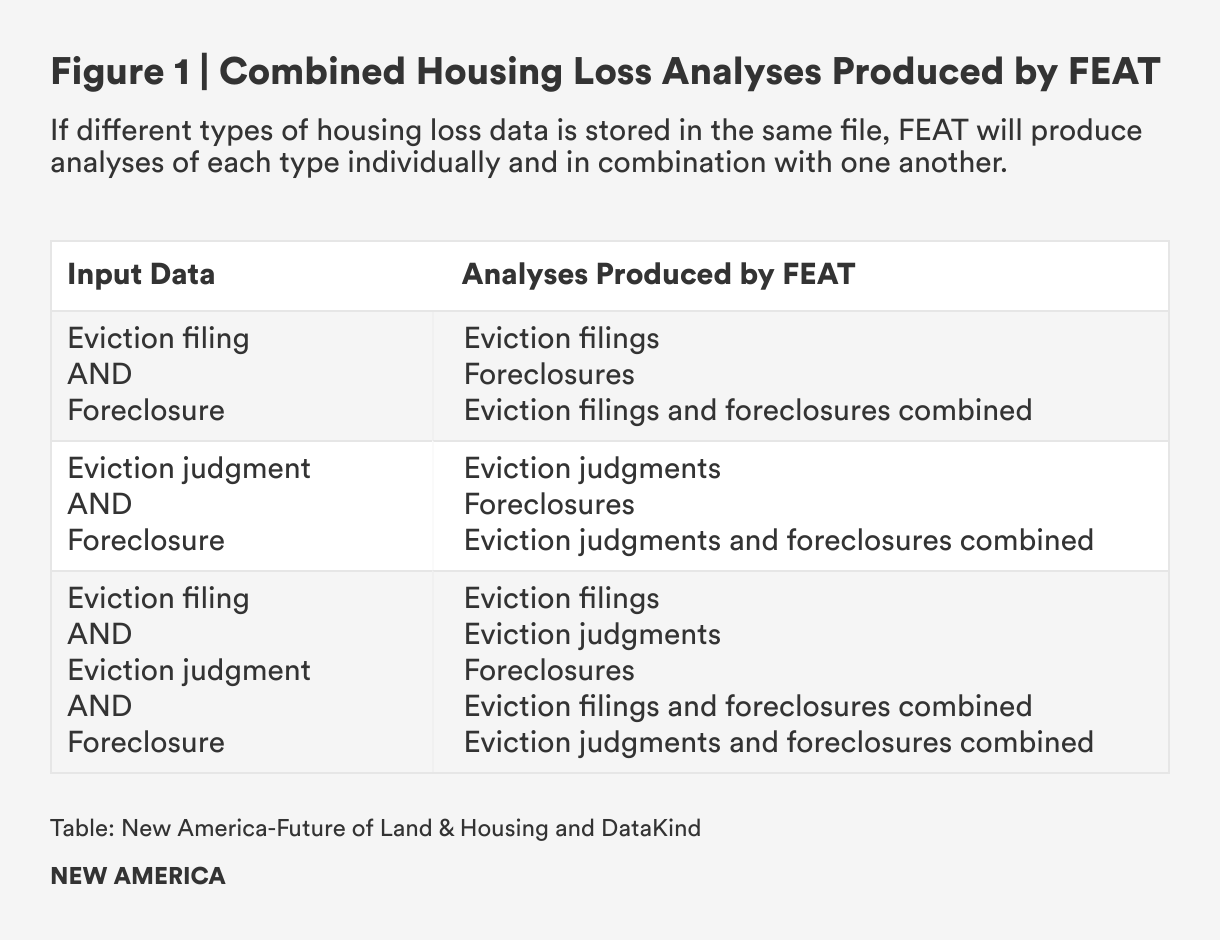
If only one form of housing loss data (eviction filings, eviction judgments, or mortgage foreclosures) is uploaded, FEAT will produce analysis on that form of housing loss. If a user uploads a combination of eviction and foreclosure data, however, FEAT will combine the two to calculate a combined housing loss metric. Figure 1 below depicts the analyses that FEAT will produce based on the type(s) of housing loss data that a user inputs.
Using Your Own Housing Loss Data in FEAT
Users uploading their own housing loss data must ensure that their input data meets the following criteria (a template for storing FEAT input data can be found here):
- Data must be stored in a .csv (comma-separated values) file no larger than 20 MB in size.
- Data must be recorded at the level of individual evictions or foreclosures (in other words, not aggregated).
- Data must contain the following columns:
- Street address (column label: street_address_1);
- City (column label: city);
- Zip code (column label: zip_code);
- State (column label: state);
- Date to indicate when the event happened (column label: date); and
- Type to indicate data type where options are eviction_filing, eviction_judgment, and foreclosure (column label: type).
- Data can cover any time period from 2016 to present day, and it will be analyzed by individual years and across all years included in the data. Please note that if you upload data that does not cover a full calendar year, FEAT will process and analyze the data as if it’s a full year of data. Users should use caution in uploading and interpreting FEAT results based on partial years of data.
Figure 2 specifies the data fields required for each type of housing loss, including any data formatting specifications.
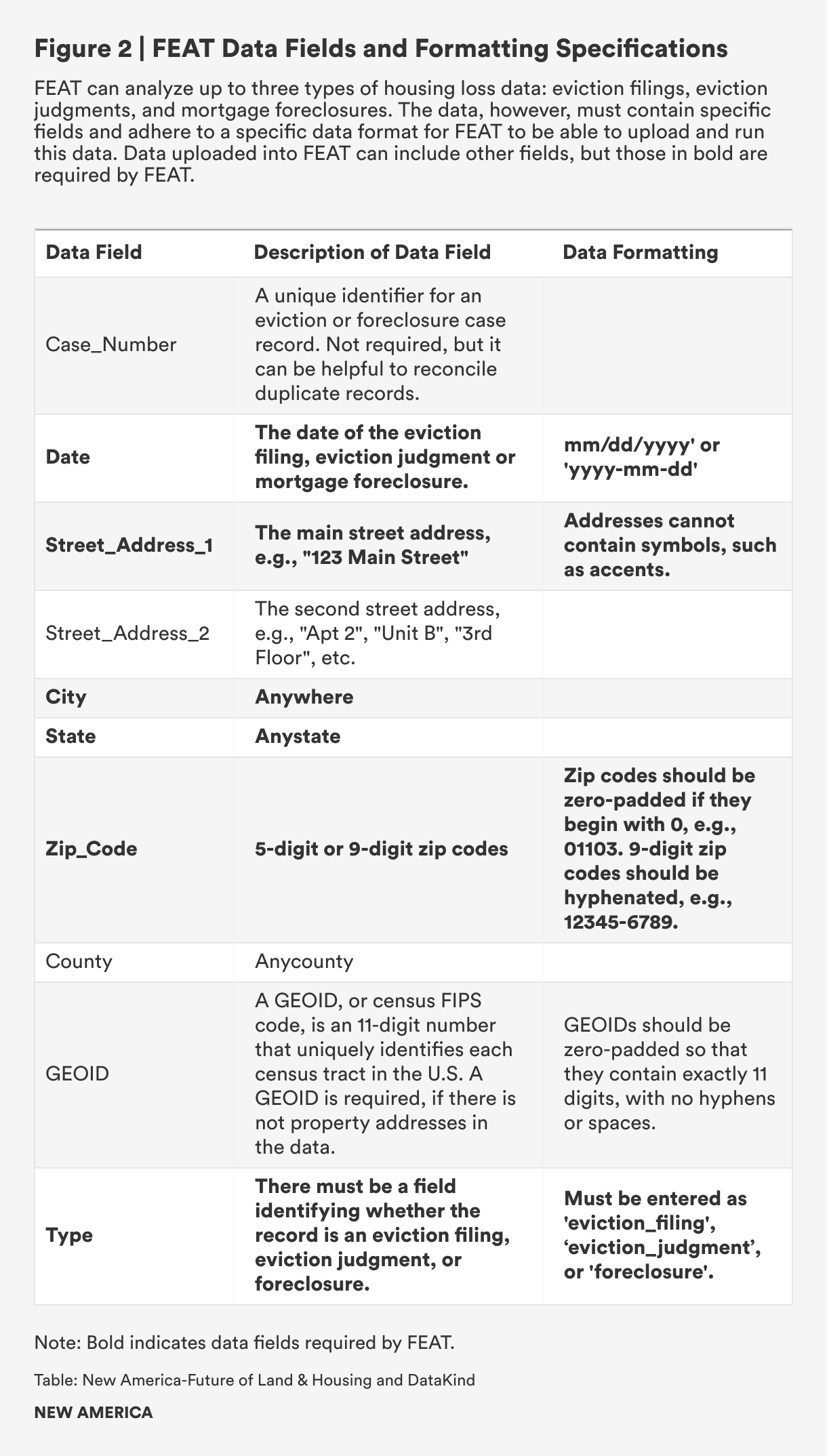
Note that other data fields can be present in your input file. In other words, users do not have to delete all other data beyond the required fields in their input data file for FEAT to run.
Using Eviction Lab’s Eviction Tracking System Data
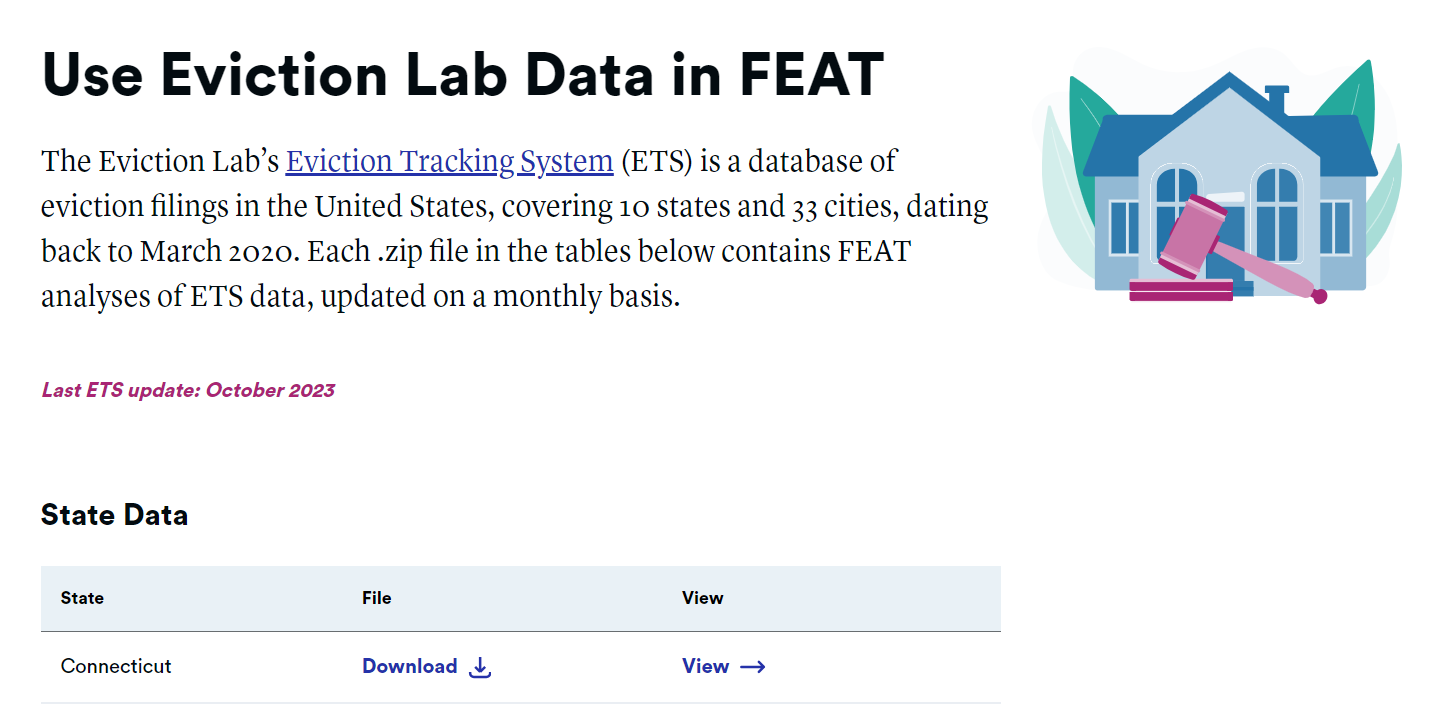
FEAT can also run eviction filing data from Eviction Lab’s Eviction Tracking System (ETS) and produce the same analysis as it would on housing loss data sourced by a user. The ETS is a database of eviction filings across approximately 10 states and 30 cities. The ETS tracks eviction filings from March 2020 until present day, and Eviction Lab updates this data on a monthly basis.
FEAT includes only the states and cities for which the ETS provides data at the census tract level, since FEAT analysis is at the census tract level. This means that the cities and states for which ETS data is provided at the zip code level are not included in FEAT. In Section 3, we discuss the methods used to process and produce analysis on ETS data in more detail.