A Focus on Teaching and Learning in Pre-K through 2nd Grade
Abstract
This report explains the work that has taken place over the last decade in Boston to not only improve pre-K, but to build on the successes of pre-K through reform of classroom environments, instructional practices, and curricula in pre-K, kindergarten, and, more recently, in first and second grade. It is a story of reforming from the bottom up, of realizing that the work of increasing student achievement is not confined to a single grade, but requires sustained efforts to improve the grades that follow, efforts that persist despite multiple changes in district leadership. It is a story of the importance of using research and data to drive continuous improvement. It is a story worthy of attention from all states and districts across the country working to build on the gains made as a result of high-quality pre-K programs.
Acknowledgments
Thank you to the multiple individuals in Boston Public Schools who made time to speak with us about their work, particularly Marie Enochty, Jason Sachs, Marina Boni, and Brian Gold. Thank you to Amy O’Leary, Titus DosRemedios, Carrie Gillispie, Chris Weiland, Meghan McCormick, and JoAnn Hsueh for their assistance and feedback. Thanks also to New America colleagues Lisa Guernsey, Melissa Tooley, Cara Sklar, Amaya Garcia, and Sabrina Detlef for their expertise and editorial insight; and Maria Elkin and Riker Pasterkiewicz for their help in the production of this project.
This report was funded by the Foundation for Child Development. New America thanks the Foundation for its support. The views expressed in this paper are those of the authors alone.
Downloads
Introduction
Definitions
- BPS: Boston Public Schools
- DEC: Boston Public Schools Department of Early Childhood
- Focus: grade-specific curriculum created by the BPS early childhood team
- PEG: preschool expansion grant; federal funds used to expand high-quality pre-K programs
- K1: serves four-year-olds, traditionally known as pre-K
- K2: traditionally known as kindergarten
On a warm Monday morning in late August, hundreds of educators walked into lecture halls on the campus of Boston University to attend the first day of the Teacher Summer Institute, a three-day training event co-sponsored by Boston Public Schools (BPS) and the Boston Teachers Union. The first and second grade teachers filling one lecture hall to capacity were there to learn about a curriculum created by the BPS Department of Early Childhood (DEC) that was new to many of them: Focus on First and Focus on Second.
The training began with a welcome from Melissa Tonachel, a program director with the BPS early childhood team. “Welcome to the early childhood department,” Tonachel told the audience. “First and second grade aren’t typically thought of as part of early childhood, but here at BPS they are.”
Tonachel’s message reflects a broader philosophical shift that has taken place in the district over the past decade. The district realized that a singular focus on expanding access to pre-K was not enough for ensuring long-term academic success. How the early childhood team became responsible for the education of not only pre-kindergarteners, but also kindergarteners and first and second graders is a story that begins in 2005 and continues today. What started as an attempt to improve quality and access to pre-K in Boston grew into a team of more than two dozen people charged with building on the successes of pre-K for four-year-olds (known as K1 in BPS) by transforming kindergarten and the early elementary grades. Now the early childhood team, with a focus on equity across schools, is working to ensure that the district’s young students experience aligned instructional practices, classroom environments, and curriculum in K1 through second grade. DEC sees this as key to deepening and building on children’s learning in K1.
Despite growing pre-K enrollment across the country, there is an emerging consensus that high-quality pre-K is not enough to give every child what he or she needs to succeed and thrive in school and life. Without reforms to the early elementary grades that follow pre-K, it is unrealistic to expect students to maintain the advantages they gained as a result of their pre-K experience.1 As a result, policymakers, district leaders, and school leaders are rethinking what and how children are learning in kindergarten, first, and second grade. Boston is at the forefront of this work.
Without reforms to the early elementary grades that follow pre-K, it is unrealistic to expect students to maintain the advantages they gained as a result of their pre-K experience.
In this report, we explain the work that has taken place over the last decade in Boston to not only improve K1, but to build on the successes of K1 through reform of classroom environments, instructional practices, and curricula in K1, kindergarten (known as K2 in BPS), and, more recently, in first and second grade. It is a story of reforming from the bottom up, of realizing that the work of increasing student achievement is not confined to a single grade, but requires sustained efforts to improve the grades that follow, efforts that persist despite multiple changes in district leadership. It is a story of the importance of using research and data to drive continuous improvement. It is a story worthy of attention from all states and districts across the country working to build on the gains made as a result of high-quality pre-K programs. It is a story that begins with the goal of universal pre-K.
Citations
- Christina Samuels, “Is Preschool ‘Fade Out’ Inevitable? Two Studies Zero In On The Issue, “ Education Week, April 25, 2018, source
History of Boston’s Department of Early Childhood
In his State of the City Address on January 11, 2005, Mayor Tom Menino declared that he would “direct the Boston Public Schools to provide all four-year-olds in the city with full-day school within five years. Boston will be the first city in the nation to achieve this.”1 Prior to Menino’s announcement, the city had already made some strides in offering early education to its four-year-old population. In 1998, Boston opened three public early education centers and eventually added three more, serving a total of about 350 three- to five-year-olds from low-income families. A handful of the city’s elementary schools offered half-day programs for four-year-olds, serving about 400 children in all.2 But Mayor Menino’s pledge to provide universal pre-K by dramatically expanding the number of pre-K classrooms across the city within five years was a bold call since Boston is home to approximately 6,000 four-year-olds.3
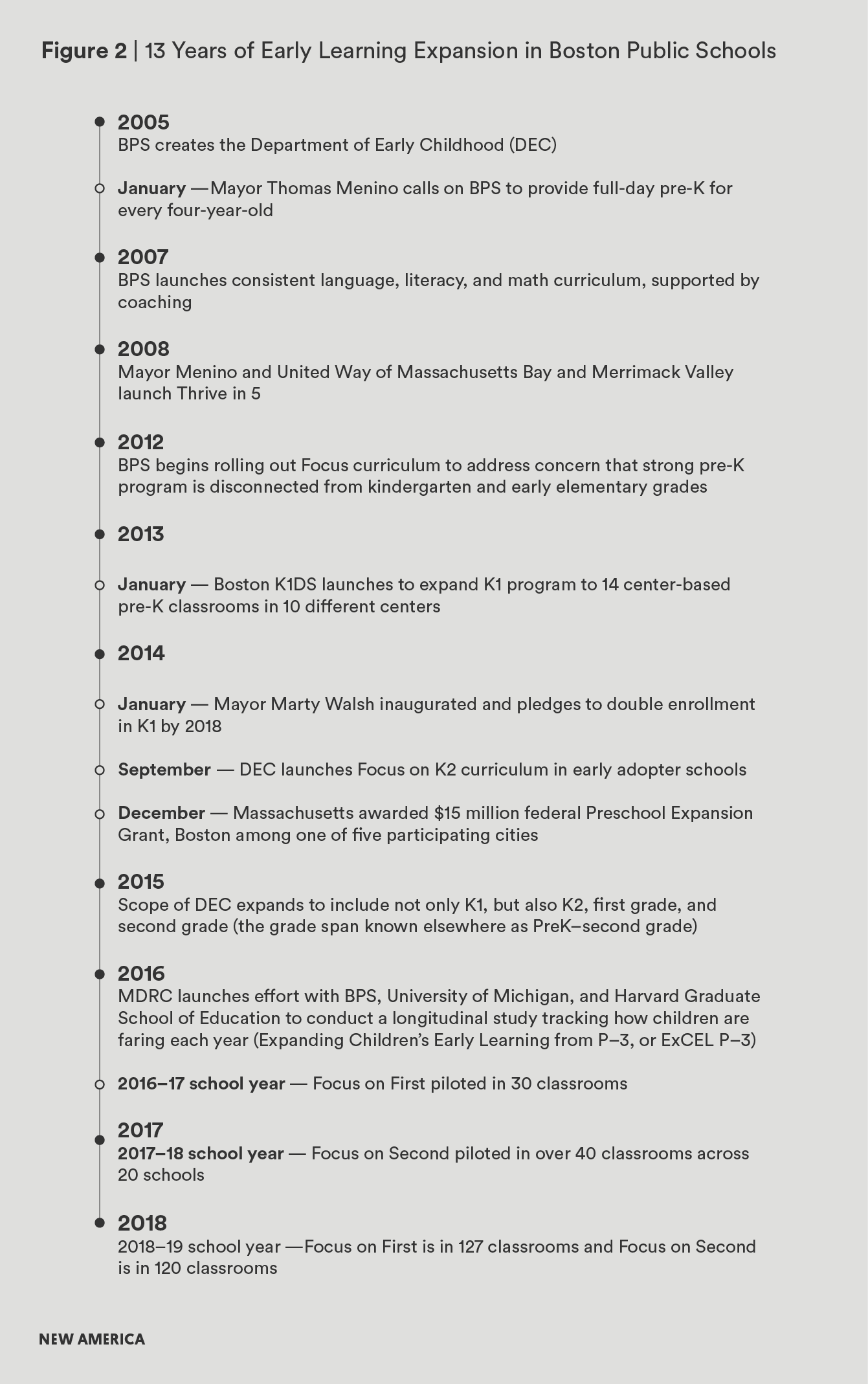
Later that same year, under the leadership of Superintendent Thomas Payzant, Boston Public Schools took an important step toward expanding K1 access by creating the Department of Early Childhood. The early childhood team started with a staff of only three people and jurisdiction over only K1 programs. Jason Sachs, the department’s executive director, was its first official hire.4
One of Sachs’s first tasks was acquiring funding to support the growth of K1 throughout the city. While Menino strongly supported the growth and improvement of K1, Sachs knew he would need outside money to supplement city funds to build up his staff and make the kind of wide-ranging reforms he envisioned. Sachs turned to the Barr Foundation, a private, Boston-based foundation for support. The Barr Foundation agreed to contribute $3 million over three years to allow the early childhood department to purchase research-backed, domain-specific curricula, pay for coaches to mentor teachers, and open more K1 classrooms as long as the district matched its investment.
The Barr investment was one of several that made it possible for K1 to expand rapidly across the city, going from serving 750 children in 38 classrooms in 2005 to more than 2,000 children across 110 classrooms in 2010.5 The city helped create Countdown to Kindergarten in 1999, an effort that includes 28 local organizations working together to support children’s transition to kindergarten. In 2008, Mayor Menino and the United Way of Massachusetts Bay and Merrimack Valley launched Thrive in 5, a sustained, citywide movement to ensure all children are ready for school success.6 Since its launch, Thrive in 5 has generated $23 million in new resources for Boston’s early childhood community, the vast majority of which has gone to local organizations working with families.7 Some of the money helped establish weekly play to learn groups in BPS schools to support children between the ages of birth to three.
Working with Center-based Pre-K Providers
In December 2014, Massachusetts was one of 18 states awarded a federal grant to build or expand high-quality pre-K programs. The state received the maximum award of $15 million in four grant cycles which it distributed to communities across Massachusetts.8 The Bay State was one of 13 states to receive a grant to expand high-quality pre-K programs in high-need communities (referred to as Preschool Expansion Grants, or PEG). Boston received just over $4 million of the grant money and used it to work with center-based pre-K programs — i.e., private programs that are not part of the school system, such as independent early learning centers and Head Start — to implement the Focus on K1 curriculum throughout the programs by providing curricular materials, professional development (PD), and coaching to PEG sites.9
The PEG work was a continuation of Boston K1 in Diverse Settings (K1DS), a 2013 pilot program that expanded the BPS K1 program to 14 center-based K1 classrooms, targeting neighborhoods with the highest concentrations of poverty.10 Evaluators found a correlation between classrooms that faithfully implemented the BPS curricula and higher overall classroom quality.11 “Through Boston K1DS we were able to give community programs our very same curriculum, coaching, and PD, believing we could get the same results, and we did,” said Abby Morales, a program director at the DEC.
An evaluation of the first year of PEG implementation in the summer of 2016 found that PEG students statewide demonstrated levels of early math skills, early literacy skills, and vocabulary comprehension that would be expected of them once they begin kindergarten.12
Implementing the BPS curricula and PD in center-based pre-K programs is not without its challenges. Currently, K1 students enrolled in public schools are guaranteed a spot in the same school for K2, and BPS is working to establish a connector system that guarantees admission into a specific elementary school for K2 following completion of K1 at a center-based pre-K provider. However, the current lack of a connector system is mediated, in part, by the work the district has been doing to align the K1-second grade curricula.
Morales explained that the DEC’s main challenge in working with these centers is the need to shift the way the programs see themselves: “You’re changing the way you speak to a three-year-old, assuming and believing they’re capable of discourse.” The organizations have to view their teachers as true educators and provide them with weekly time away from children to plan instruction and evaluate student data. These changes do not happen quickly, but DEC has worked with the programs in order to shift teaching practices through coaching and PD. Another challenge is that teachers in center-based pre-K programs will sometimes decide to leave for BPS after they have earned a degree and worked with the BPS early childhood team. Morales explained that, “you increase their salaries, you give them this PD, and unfortunately what ends up happening is they say, ‘Now that I have the training, capability, and knowledge, I’m going to go to BPS and be a teacher.’” This is a challenge for the early education community across the country since there is typically a lack of pay parity across the various settings in which children attend pre-K.
K1 continued to expand and improve in quality over the years. A 2013 Harvard study of the impacts of the K1 program found students made improvements in language, literacy, math, executive function, and emotional development skills. Some of the study’s impacts were the largest found to date in evaluations of large public pre-K programs.13 But the BPS early childhood team knew there was still work to be done to improve the quality of K2 and first and second grade. A 2006 evaluation that showed promising improvements in the K1 program found that the same positive results were not evident in K2 classrooms across the city.14 A 2012 needs assessment found that the quality of BPS first-, second-, and third-grade classrooms was much lower than that of K2.15
In order to sustain the gains students achieved as a result of a strong K1 program, real work had to be done to improve the quality of the grades following K1.
These findings convinced DEC that, in order to sustain the gains students achieved as a result of a strong K1 program, real work had to be done to improve the quality of the grades following K1. “There was a realization that doing universal pre-K meant you then needed to change kindergarten, then first grade, and so on to sustain those gains,” Morales said.16 K1 expansion had proceeded at an impressive pace, growing from 750 students in 2005 to more than 2,800 students in the 2017–18 school year17 with a waitlist of almost 1,000 children.18 And the BPS early childhood staff had grown rapidly as well, from a team of only three to a staff of 26, made up of curriculum writers, coaches, and project leaders.19
In 2015, DEC was given the opportunity to fulfill its vision of improving not only K1 and K2, but also the early elementary grades. This expansion would have important implications for sustaining the gains children were making in their earliest school years. The staff fought for reorganization that would allow for bottom-up alignment, spanning K1 to second grade, arguing that their success in K1 and K2 proved its methods worked and that DEC needed control of first and second grade to continue to build off that success. When Tommy Chang came on as the new superintendent in March 2015, he agreed to allow K1 through second grade curriculum decisions to be made by the early childhood team.20
Despite the fact that there have been two different mayors and six different BPS superintendents since the early childhood team was established in 2005, one constant has been Sachs as the Executive Director. His continuous, steady leadership over the past 13 years has a lot to do with DEC’s success in fulfilling the goals Sachs set out at the outset of his tenure. Since its inception, there has been a clear vision for BPS early childhood rather than a series of priorities that shift every few years based on changes in district leadership.
While passionate and focused leadership by Sachs and a committed DEC team have certainly been important to BPS’s progress so far, these are not the only important elements. Below we discuss how the BPS early childhood team has transformed what and how children learn, the classroom environments in which children spend their days, and how teachers interact with and engage children in rich learning opportunities.
Since its inception, there has been a clear vision for BPS early childhood rather than a series of priorities that shift every few years based on changes in district leadership.
Citations
- “2005 State of the City Address: Remarks of Mayor Thomas M. Menino,” Boston.com, January 11, 2005, source
- Betty Bardige, Megina Baker, and Ben Mardell, Children at the Center: Transforming Early Childhood Education in the Boston Public Schools (Cambridge: Harvard Education Press, 2018), 36.
- The Mayor’s Advisory Committee on Universal Pre-Kindergarten (UPK), “Investing in Our Future: Recommendations to Inform City Planning for High-Quality Universal Pre-Kindergarten in Boston,” April 2016, source
- Sachs came from the Massachusetts Department of Education where he worked in the Division of Early Learning Services helping communities gather and use data to improve the quality of early education programs.
- Bardige, Baker, and Mardell, Children at the Center, 41.
- Every Child Given Every Opportunity to Thrive: Advancing School Readiness in Boston (Boston: Thrive in 5, 2016), source
- Educational Alignment for Young Children: Profiles of Local Innovation (Washington, DC: National League of Cities: Institute for Youth, Education and Families, 2012), source
- U.S. Department of Education (website), “Preschool Development Grants: Awards,” last modified August 29, 2017, source
- Report on the Federal Preschool Expansion Grant–Year One (Boston: Massachusetts Department of Early Education and Care, January 2017), source
- Every Child Given Every Opportunity to Thrive: Advancing School Readiness in Boston (Boston: Thrive in 5, 2016), source
- BPS K1DS: Piloting the Boston Public Schools’ Prekindergarten Model in Community-Based Organizations (Boston: Boston Public Schools, February 2016), source
- Year 1 Massachusetts Preschool Expansion Grant (PEG) Evaluation Report (Cambridge: Abt Associates, December 5, 2016), source
- Christina Weiland and Hirokazu Yoshikawa, “Impacts of a Prekindergarten Program on Children's Mathematics, Language, Literacy, Executive Function, and Emotional Skills,” Child Development 84, no. 6 (November/December 2013): 2112–2130, source
- Educational Alignment for Young Children: Profiles of Local Innovation (Washington, DC: National League of Cities: Institute for Youth, Education and Families, 2012),12, source
- Jason Sachs, “New P-2 Early Childhood Strategic Plan & Update on Boston Universal Preschool,” (presentation to the BPS School Committee, April 26, 2017), source
- Abby Morales (program director, DEC), interview with authors, April 24, 2018.
- Jason Sachs, “New P-2 Early Childhood Strategic Plan & Update on Boston Universal Preschool,” (presentation to the BPS School Committee, April 26, 2017), source
- Carrie Jung, “Making Elementary School A Lot More Fun: Like Preschool!” NPR, March 6, 2018, source
- Bardige, Baker, and Mardell, Children at the Center, 34.
- Bardige, Baker, and Mardell, Children at the Center, 174.
A Focus on What Children Are Learning

Laura Bornfreund / New America
The early childhood team recognized the value in making sure all children learned via a singular, research-based curriculum that was supported by coaching and PD for teachers. This would help provide all children with high-quality experiences, ensuring that similar instructional practices were taking place across all elementary schools in BPS, regardless of the socioeconomic or racial makeup of the classrooms.1 Sachs made this a priority because he knew an effective, evidence-based curriculum could encourage warm and supportive interactions between students and teachers and help students build background knowledge and language skills better than a hodgepodge of different curricula that rely on rote memorization and do not expose children to rich content.2
Curriculum
After years of using the Opening the World of Learning (OWL) curriculum for literacy and Building Blocks for math in K1, BPS staff revised it and integrated Building Blocks to create the Focus on K1 curriculum. DEC next turned its attention beyond K1, towards K2, and eventually the early elementary grades. DEC knew it needed to address the fact that the district’s successful K1 program was largely disconnected from the instruction delivered in later grades. Aligned, evidence-based P–3 curricula did not currently exist, so rather than piecing together various curricula, the early childhood team began writing a new program designed to build on the gains students made in K1 and ensure instructional alignment as students entered K2. Focus on K2 was piloted in over half of the district’s 80 elementary schools in the 2014–2015 school year and is currently being used in 80 percent of the district’s elementary schools.3 Focus on First was piloted in 30 classrooms in the 2016–2017 school year, expanded to about 40 more classrooms the next school year, and will reach another 60 classrooms during the 2018–2019 school year. Focus on Second was piloted in the 2017–2018 school year and is now in 120 classrooms across the district.4
Focus on K2, Focus on First, and Focus on Second each intentionally mirror many of the practices found in a K1 classroom, such as the use of center time, where children play or work together on an activity; teacher-led small group instruction; read-aloud books; and independent literacy stations.5 Lessons are theme-based, allowing for deep content instruction, as well as project-based, encouraging collaboration with peers.6 Most importantly, the curriculum is aligned across K1 through second grade so that the skills taught at the beginning of each school year naturally build upon the skills learned by students at the end of the previous year.
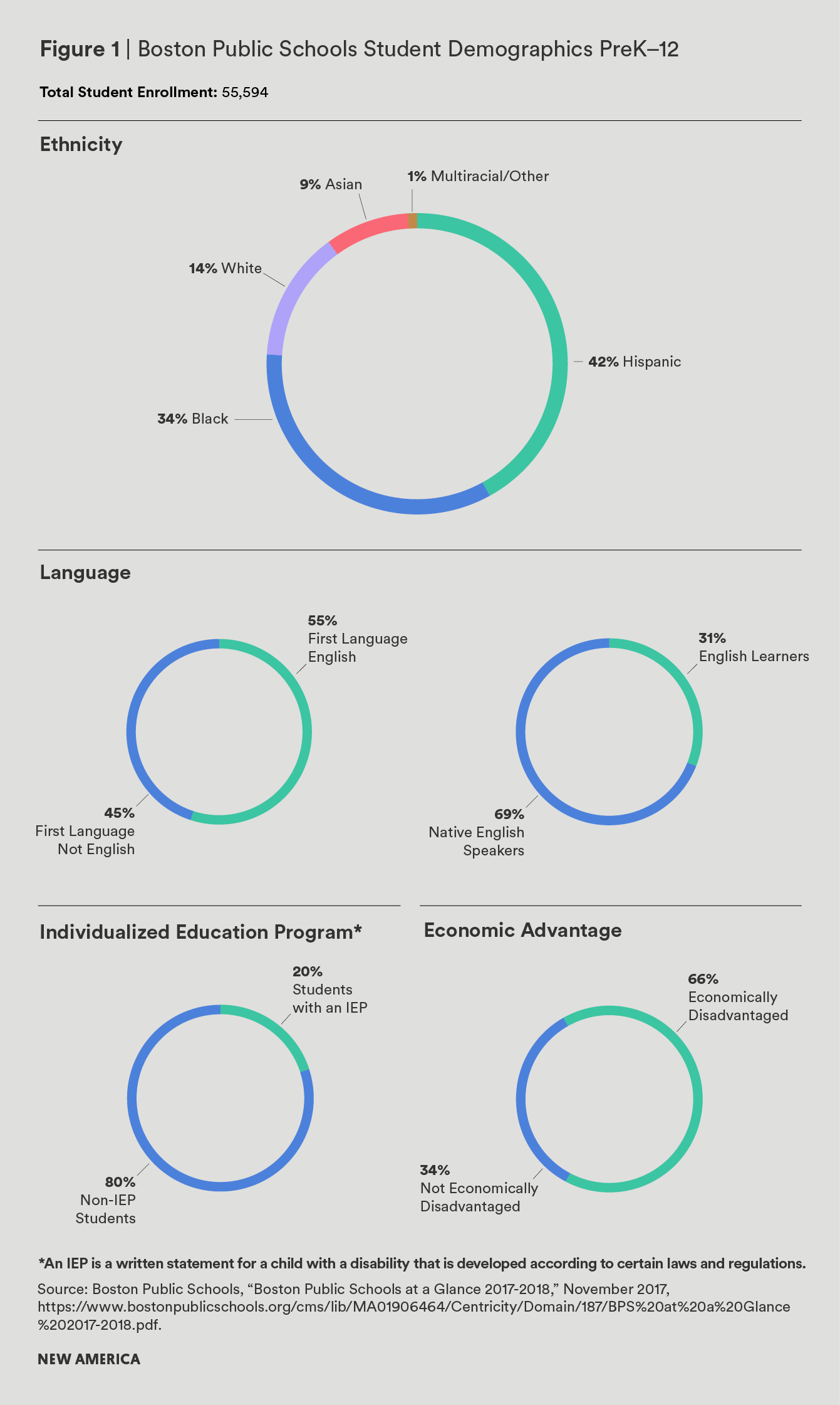
Since 31 percent of all BPS students are considered English learners (and an even higher percentage of young BPS students are English learners), it was important that the curriculum include strategies for supporting this growing population of students. For that reason, strategies such as including visual supports, using multicultural and multilingual read-aloud books, making explicit vocabulary instruction part of play, and using concrete materials to facilitate dialogue are all built into the Focus curriculum as well as the professional development teachers receive throughout the year. The commitment to serving English learners was illustrated in 2017 when the early childhood team collaborated with the BPS Office of English Learners to open a Haitian Creole-English dual immersion program with 25 K1 students.7
Since 31 percent of all BPS students are considered English learners, it was important that the curriculum include strategies for supporting this growing population of students.
One advantage of DEC staff writing the curriculum rather than purchasing curricula is that it can be revised as frequently as deemed necessary. “After a year or two of a curriculum, we go back and revise it based on teacher feedback and our coaches’ logs. We use the data to say, ‘How do we change PD and what revisions to curriculum need to happen?’” said Brian Gold, school readiness manager for the early childhood team. Writing the curriculum in-house also allows staff to make it specific to Boston, focusing on the particular cultures found throughout the city. As part of its commitment to data, DEC staff developed a curriculum fidelity tool with the help of outside researchers from MDRC, the University of Michigan, and the Harvard Graduate School of Education. This tool, used by instructional coaches, “looks at all the different components of the curriculum,” Gold said. The fidelity data offer a snapshot of how individual teachers and schools are doing when it comes to curriculum implementation and give the team a better idea of where more coaching and professional development might be needed.
An essential component of the Focus curriculum from K1 through second grade is storytelling and story acting. Based on the work of Vivian Gussin Paley, storytelling and story acting are focused on two connected activities: dictation and dramatization.8 Students are encouraged to dictate fiction or nonfiction stories as their teacher transcribes the words. After the story has been put down on paper, a small group of students, including the author, acts it out in front of the whole class as the teacher reads it aloud. Once it has been acted out, students can share what they liked about the story or give suggestions to the author about how it can be improved.9
“We use the data to say, ‘How do we change PD and what revisions to curriculum need to happen?’”
Another important element that runs through the Focus curriculum is the “Thinking and Feedback Protocol,” a routine that is practiced in a whole group format at the end of each center time block. One or two students present something they created during center time to the entire class and the class provides feedback and asks questions. The protocol includes four steps: 1) observing and sharing what you notice about the classmate’s creation, 2) listening to the classmate talk about his or her creation, 3) asking questions about the creation, and 4) providing suggestions about how the student can improve on his or her creation.10 The activity encourages active listening among students and sends a message that the play children are involved in is important and worthy of discussion.
The Focus curriculum is available to view and download on the BPS early childhood website for no charge. “We intentionally made all of our curriculum open and available on our website,” Gold said. According to Sachs, the decision to make the curriculum open source was to “help the field” so other urban districts wanting to use a similar curriculum would not have to start from scratch. Individual units can be downloaded and customized, along with weekly plans, pacing calendars, grading rubrics, family engagement activities, specific questions for read-alouds, and instructions for setting up STEM and literacy centers. DEC hopes to generate revenue by providing training for other districts that choose to use the Focus curriculum in their classrooms.11
Accreditation
The early childhood staff knew that ensuring equitable high-quality instruction for children in all BPS elementary schools would require more than just curricular changes. After a 2006 evaluation found that the positive results of K1 were not evident in K2 classrooms across the city, DEC decided to pursue accreditation from the National Association for the Education of Young Children (NAEYC) for its K1 and K2 classrooms.12 Staff saw this as a way to create a culture of early learning and build early childhood-friendly elementary schools. Currently, over 60 percent of BPS elementary schools have achieved accreditation or are in the process of working towards accreditation.13 BPS wants to obtain NAEYC accreditation for all K1 and K2 classrooms by 2020.14
Achieving NAEYC accreditation in BPS is a labor-intensive process overseen by Karen Silver, an experienced NAEYC accreditation specialist. There are 10 standards schools must meet to earn accreditation, focused on: relationships, curriculum, teaching, assessment of child progress, health, teachers, families, community relationships, physical environment, and leadership and management. In all, there are 41 criteria that schools must demonstrate they have met in order to become accredited. The BPS early childhood team has budgeted $75,000 per school undergoing the accreditation process, which amounts to about $6,000 per classroom per year. This cost includes a DEC coach to shepherd schools through the process. The Barr Foundation gave $2 million to help fund it.15
The BPS early childhood staff sees positive results as a result of the accreditation process. A 2010 needs assessment discovered a strong association between schools that had earned or were seeking accreditation and the quality of the schools’ early childhood classrooms.16 Then-Harvard researcher Christina Weiland (now at the University of Michigan) found that BPS K1 classrooms seeking accreditation scored higher on all subscales of an assessment known as the Early Childhood Environment Rating Scale (ECERS-R) compared to BPS classrooms not yet undergoing the accreditation process. Weiland also found that the process was associated with greater gains in children’s learning: the students in classrooms that were accredited or seeking accreditation made better gains in student vocabulary scores, even when controlling for a host of other factors. Sachs and Weiland speculated that the reason for these positive results was the professional development and coaching DEC provided to schools undergoing accreditation.17
Marie Enochty, program manager for BPS, said that without the NAEYC accreditation process it would be much more difficult to improve overall school quality. She said that teachers and principals were more willing to buy into the process because it is nationally recognized and grounded in research on what is required to improve the quality of early childhood programs. Another benefit of the accreditation process is that it opens a path for collaborating with principals, many of whom do not have an extensive background in early education. Early childhood coaches working with schools in the accreditation process have monthly meetings with principals to discuss progress teachers are making and offer guidance on how the principal can support developmentally appropriate practices in the K1 and K2 classes.18 Accreditation allowed DEC to work beyond just K1 and begin work on improving K2, an important step for laying the foundation for later expansion into first and second grades. The accreditation process has also been an important vehicle to get BPS staff into special education classrooms that often needed the most supports in terms of materials, coaching, and facility improvement.
Challenges
Teachers have multiple curricula and programs to implement at one time and not enough guidance on how to integrate them in their day; this is an issue that came up repeatedly in conversations with BPS educators. Schools that adopt the Focus curriculum may also have other programs in place, and rather than embrace Focus as a replacement, teachers were frustrated that it gets layered on top. One K2 teacher summed it up this way: “What’s tough is that it requires a lot of time. A lot of things are required that have nothing to do with Focus. We have Literacy Collaborative [a literacy program], and Second Step [a social-emotional curriculum], Fundations [a phonics program], all in addition to Focus.” DEC coaches are aware of this issue and work with principals to simplify and streamline what is required of classroom teachers, but curricula choices are ultimately a principal’s decision. When principals opt to keep other programs and curricula in place as well, coaches provide guidance to teachers on approaches to juggle all they are expected to implement.
Accreditation also presents challenges. According to the early childhood team, some of the accreditation process is focused on health and safety and educators say it can become more of a checklist than a reflective process. For example, how important a role has the accreditation process played in driving improvements in instructional practices versus making sure staff members are following the prescribed handwashing protocol? BPS, like many districts, is always working with limited funds. One staff member questioned whether it was wise to continue to direct funds towards accreditation rather than on improvements to curricula and instructional resources: “Should we buy new mats for the doors of classrooms because NAEYC says we need to or should we spend that money on new read-aloud books?” Members of the BPS early childhood team say they want to better understand how accreditation connects to child outcomes. Having this information would be helpful in making future investment decisions.
“The ultimate question… is whether the reforms that accreditation bring about truly last once the process has ended."
Another issue is that there is no accreditation process for first and second grade, so those grades are missing a key tool to improve quality. This concern could soon be addressed, however, since NAEYC is piloting an accreditation process for children ages eight and younger19 and other accreditation processes exist for elementary school-aged students that could be explored.
The initial accreditation may be most important for improving environments and instructional practice. With limited resources, some staff question whether maintaining accreditation makes sense. The ultimate question, according to one member of the BPS early childhood team, is whether the reforms that accreditation bring about truly last once the process has ended.
Citations
- Abby Morales (program director, DEC), interview with authors, April 24, 2018.
- Anne Katz, “Fostering Equity Through Educator and Family Empowerment,” EdCentral (blog), New America, July 18, 2018, source
- Bardige, Baker, and Mardell, Children at the Center, 108.
- Bardige, Baker, and Mardell, Children at the Center, 177.
- “FAQ Focus on First & Second 2017,” Google Docs, source
- Meghan McCormick, Joann Hsueh, Christina Weiland, and Michael Bangser, The Challenge of Sustaining Preschool Impacts: Introducing ExCEL P–3, a Study from the Expanding Children's Early Learning Network (Washington, DC: MDRC, July 2017), source
- Bardige, Baker, and Mardell, Children at the Center, 121, 168.
- For more on Vivian Gussin Paley’s work, see her The Boy Who Would Be A Helicopter: The Uses of Storytelling in the Classroom (Cambridge, MA: Harvard University Press, 1991).
- Bardige, Baker, and Mardell, Children at the Center, 106.
- The P–3 Learning Hub, (blog), “The Power of a Good Kindergarten Curriculum,’ October 14, 2016, source
- To learn more about the emerging importance of open educational resources (OER) in public schools, check out New America’s recent report, “Making Connections: PreK-12 OER in Practice,” source
- Educational Alignment for Young Children: Profiles of Local Innovation (Washington, DC: National League of Cities: Institute for Youth, Education and Families, 2012), source
- Boston Public Schools, Department of Early Childhood (website), “NAEYC Accreditation,”source
- Educational Alignment for Young Children: Profiles of Local Innovation (Washington, DC: National League of Cities: Institute for Youth, Education and Families, 2012),12, source
- Bardige, Baker, and Mardell, Children at the Center, 59, 127.
- Bardige, Baker, and Mardell, Children at the Center, 58.
- Jason Sachs and Christina Weiland “Boston's Rapid Expansion of Public School-Based Preschool: Promoting Quality, Lessons Learned,” Young Children 65, no. 5 (September 2010): 74–77, source
- Marie Enochty, interview with authors, July 19, 2018.
- National Association for the Education of Young Children, “School-Age Accreditation Option,” source
A Focus on Improving Teacher Instruction and Learning Environments
Laura Bornfreund / New America
In addition to the coaching that is tied to the accreditation process, there are a number of professional development opportunities focused on implementing the curriculum, observing children’s learning, and using instructional strategies to better support children’s learning.
Professional Development Before the School Year Begins
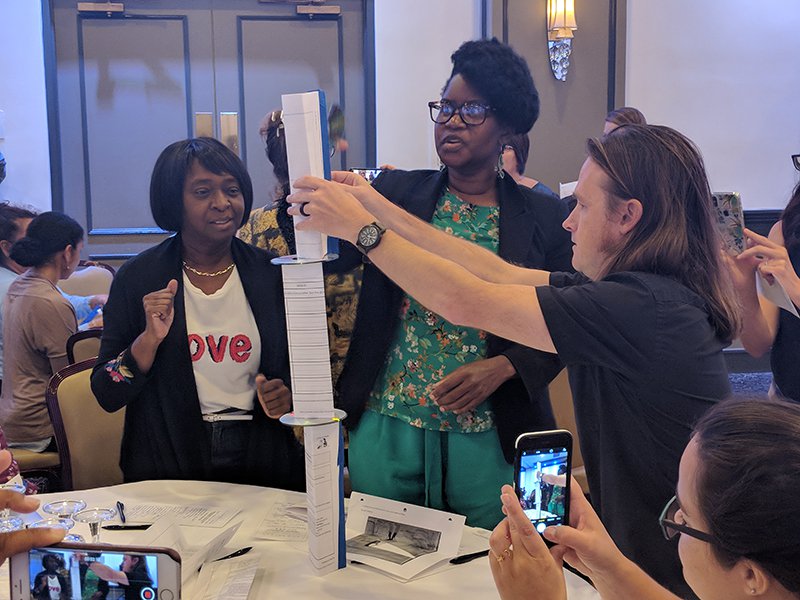
All teachers new to a grade level or teachers new to BPS attend the three-day Teacher Summer Institute in August where they learn about topics ranging from NAEYC accreditation to facilitating civic engagement to grade-specific curricula. During this summer’s institute, Tonachel described the essential elements of Focus on First and Focus on Second: standards-aligned, ample time to learn in centers, daily read-alouds, frequent opportunities for rich conversation among students, and, perhaps most importantly, an emphasis on learning as an active experience rather than a passive one. Later in the day, the first and second grade teachers separated to focus on their specific grade. Teachers in each grade received multiple large binders that contained all the information they needed to become better acquainted with the curriculum and get the school year off to a strong start.
According to first-year K2 teacher Kelly Garcelon, the training she received was time well spent. “I felt like I was really well-prepared by the district,” she said. “I spent three days doing the New Teacher Institute last summer. It was three full workdays of just Focus on K2…so I was lucky enough to start the school year knowing what the curriculum is, how to go about it, what our pacing plan was, and I had all the materials I needed.”
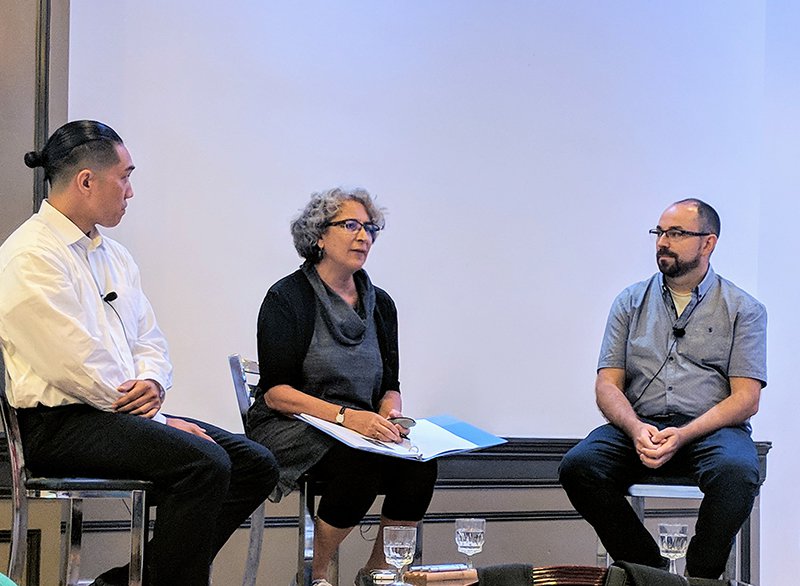
Each year, DEC also holds a kindergarten conference bringing K1 and K2 teachers and paraprofessionals together for joint learning. In the past, BPS has used the conference to emphasize the importance of opportunities for open-ended play, family engagement, and culturally sustaining teaching practices.1 This year built on the 2017 conference and focused on observation and documentation to inform instruction. Hundreds of teachers and paraprofessionals filled a conference room at Lombardo’s, south of Boston, to hear the plenary session which included Stephanie Cox Suarez, the founding director of the Documentation Studio at Boston University Wheelock College of Education & Human Development; Cliff Kwong, a K1 teacher at Nurtury Learning Lab (a BPS community partner); and Jerry Pisani, a K2 teacher— all speaking to the value of observation and documentation in guiding instruction.
Laura Bornfreund / New America
K1 teacher Kwong shared a powerful story about using observation to shift instruction and employ culturally sustaining practices. Mid-year, looking at student work, he noticed a child’s self-portrait was “off.” Kwong asked the little girl why she had drawn herself in such a sad way. She told him another student was making fun of how dark her skin was. Kwong made a change to his lesson: he read the book Color of Us to the class and engaged the children in a conversation about skin color. His goal was to provide an opportunity for the girl to feel positive about herself. Toward the end of the lesson, she said “this world needs my color.”
Suarez told a story and showed a video observation she did in a teacher’s classroom of a mostly non-verbal kindergartener named “James.” She watched James at a table working on his own with clay and heard him narrate what he was doing with single words. “Cut,” he said as he cut the line of clay into pieces. “Circle,” he said as he shaped the pieces. This went on for a period of time, and slowly, James began opening up to Suarez. She posted the photos with the words he used on the wall. James saw his photos and began sounding out the words that described what he was doing. His teacher reported that this was a turning point for James and later that year he became the first reader in the classroom. Sharing documentation with children can be a strong way of deepening their learning, Suarez said.
Some K1 and K2 teachers in BPS told us that there is a bit of hesitance about the time required for meaningful documentation. And this is a valid concern—watching children as they work and play, taking photos or video of them, and writing notes about that learning is time-consuming. But it is an important part of assessment, especially for young children in the early elementary grades who “don’t always show what they know when you want them to,” as Suarez noted during her talk. For the teachers in the room, listening to the story about James and other children spurred some “ah ha’s” about students they had in previous years. One shared reflections about a student similar to James and what she could have done differently to help him demonstrate his learning. “I could have acknowledged the value of non-verbal expression and recognized it as a place to start and build, giving him different materials to work with, providing opportunities to engage one-on-one, and being more attuned to and celebratory of small steps of progress,” she reflected.
At one of the breakout sessions following the plenary, teachers went around the room sharing what the day’s discussions had inspired them to do differently. Some offered thoughts such as, “I’m inspired to slow down my teaching and observe the process of learning;” “it’s up to us to figure out what children bring to the classroom and help them grow as learners;” and “to show documentation to my children so they have a role in their own learning.” One teacher said it would be valuable to have principals at the session.
Sharing documentation with children can be a strong way of deepening their learning
Because of a scheduling change this school year, the BPS early childhood team had the opportunity for a second day at the kindergarten conference. Boston is one of the Early Learning Network sites2 and the Boston research team is completing its third year of data collection. The Boston project includes multiple components, one of which is curriculum implementation. Sachs asked the researchers to look at the data they had collected and help him figure out the instructional practices within the Focus curriculum with which teachers struggled and the ones that correlated with gains in student outcomes. This exercise led the early childhood team to structure the second day of the conference around four instructional practices:
- extending and building children’s learning by posing questions that lead to critical thinking
- personalizing instruction so that every child is able to actively engage in learning
- making connections within and across learning domains (such as reading, math, science, social-emotional) to help deepen and broaden children’s understanding
- using vocabulary that is rich and complex3
A coach with the early childhood team mentioned at the conference that the focus on improving documentation will continue throughout the year with monthly PD opportunities by DEC coaches for all interested teachers from pre-K to second grade.
Professional Development Throughout the Year
New teachers also take part in one-on-one coaching sessions about twice a month during their first year in BPS. The instructional coaches work to build trusting relationships with teachers, so they are viewed as allies of the teacher and school rather than evaluators checking for compliance. A written contract agreed to by the coach, teacher, and school principal sets clear expectations and helps the collaboration stay strong over time.4 Kelly Garcelon described the relationship with her instructional coach this way: “I probably see her two hours a week and that’s been huge because I can only ask so many questions at common planning time.” She added, “the new teacher developer is something I’ll be saddest about not having next year… Can I have a coach every year, please?"
Once a strong relationship is established, coaches deliver feedback to teachers that is specific, actionable, and discussed during shared observations. Teachers then develop a specific implementation plan to guide them as they work on discrete skills over the next weeks or months of instruction.5 The exact coaching ratios have changed over time, with some schools with a ratio of as low as one coach per 10 classrooms.6 According to Morales, a lot of coaching is about helping teachers build good habits: “You may hate running, but if I make you go outside and run every day after six weeks you’re better,” Morales said. “Six weeks is what you need to build a habit. I usually figure if I can get you through Unit One reading out of the book then by Unit 2 you won’t even have to look at it.”
Once teachers are familiar with the curriculum, they attend targeted PD sessions on specific instructional practices, such as guided reading, the thinking and feedback protocol, and storytelling and story acting. For teachers located in schools going through the accreditation process, coaches observe and assist for an average of three years, helping the school successfully navigate the accreditation process. About 20 percent of teachers each year are new to BPS and those teachers take part in several days of curriculum training which helps to ensure schools stay faithful to the prescribed curriculum.7
Using Data to Drive Improvement
The BPS early childhood team takes pride in how much stock it puts in data collection and analysis. Data are collected for a variety of purposes, such as assessing teacher and parent satisfaction, informing decisions related to resource allocation, informing conversations about project change, planning professional development, and evaluating specific elements of the early childhood program. Evaluation, research, and regular data collection are all built into DEC’s five-year strategic plan. The BPS early childhood team views data as a tool to help build and change the program rather than simply for measuring it.8
Teacher feedback, observations from instructional coaches, and observations of curriculum fidelity are all used to inform and change the content and frequency of professional development. Since its inception 13 years ago, DEC has contracted with researchers from the Wellesley Centers for Women and Abt Associates to conduct periodic needs assessments of specific grade levels. Once completed, these needs assessments are reviewed, and next steps are identified by the early childhood staff.
The BPS early childhood team views data as a tool to help build and change the program rather than simply for measuring it.
This commitment to data is also exemplified by the early childhood team’s collaboration with a multi-year, longitudinal study being led by MDRC in partnership with the University of Michigan and the Harvard Graduate School of Education. The study, formally known as the Expanding Children’s Early Learning study (ExCEL P–3) will examine, among other things, whether gains in student skills by the end of K1 are sustained through the end of third grade and the factors that best support lasting impacts of K1. While final results will not be available for several years, BPS staff members are already using initial findings to inform professional development and help set priorities. At the Kindergarten Conference, for example, district staff provided teachers with their specific data resulting from the curriculum fidelity data analysis to help them improve.
Challenges
Since teachers new to the curriculum receive only one year of coaching, fidelity to the curriculum after coaching is completed can be an issue, but Sachs describes the accreditation process as “a built-in maintenance process” for encouraging curriculum fidelity. Not surprisingly, the early childhood team has found coaching to be most effective with those teachers who are willing participants, those who want to be coached. For teachers implementing Focus, coaching is voluntary unless they are in a school going through the NAEYC accreditation process.
While the early childhood team has made headway with some principals, Jason Sachs acknowledges there is much work to do. The team knows principals are essential for establishing the conditions that enable teachers to use the strategies and practices discussed above. Building greater principal understanding of early education will be a stronger priority for the team in the coming years. A tension exists between principal autonomy and the establishment of district-wide guidelines for curriculum and instruction. At times, the early childhood team has attempted to work around resistant principals and work directly with teachers instead. The hope is that the teachers will then act as ambassadors to their principals and help convince them of the importance of the work being done to improve the early elementary years.
Citations
- Culturally sustaining practice seeks to sustain linguistic, literate, and cultural pluralism as part of schooling for positive social transformation and revitalization. For more, see Django Paris and H. Samy Alim, Culturally Sustaining Pedagogies: Teaching and Learning for Justice in a Changing World. (New York: Teachers College Press, 2017).
- Funded by the Institute for Education Sciences, the Early Learning Network consists of five research teams conducting in-depth research in areas that provide pre-K access to children from disadvantaged backgrounds.
- Boston Public Schools, Department of Early Childhood (website), “Kindergarten Conference,” source
- Bardige, Baker, and Mardell, Children at the Center, 142.
- Bardige, Baker, and Mardell, Children at the Center, 144.
- Educational Alignment for Young Children: Profiles of Local Innovation (Washington, DC: National League of Cities: Institute for Youth, Education and Families, 2012), 13, source
- Jason Sach, interview with authors, July 19, 2018.
- Christina Weiland and Jason Sachs, “Appendix: The Role of Data, Research, and Evaluation in the Process of Change,” in Children at the Center: Transforming Early Childhood Education in the Boston Public Schools by Betty Bardige, Megina Baker, and Ben Mardell (Cambridge, MA: Harvard Education Press, 2018), 195–210.
Looking to the Future
BPS and the early childhood team say they have no plans to slow down in their efforts to transform the early elementary grades, and this is evidenced by their 2017–2022 strategic plan.
Depth and Spread
At his inauguration in 2014, Mayor Marty Walsh pledged to double the enrollment of four-year-olds in high-quality, full-day pre-K in the city by 2018 through the use of a mixed-delivery system that included BPS classrooms as well as center-based pre-K providers.1 Because BPS elementary schools are at capacity and have no room for additional K1 classrooms, further K1 expansion will need to take place in center-based pre-K programs. Therefore, a major goal of both BPS and the early childhood team over the next several years is to continue the work started by the Boston K1DS and Preschool Expansion Grant programs to expand access and provide high-quality K1 in center-based pre-K programs while creating formal pathways to elementary schools throughout the city. This will require continued investment in professional development and coaching for teachers at center-based pre-K programs.2
DEC also plans to continue expanding access to the Focus curriculum in first and second grade across the district, as well as continue to align and deepen instructional practices from K1 and K2 to first and second grade. There are also efforts underway to strengthen family engagement in the curriculum by expanding the use of family activities in K1 and K2.
The success of pre-K in Boston and the early childhood team’s work to transform the preK–second grade span has drawn national attention and interest from others in Massachusetts and beyond, including school districts in Rhode Island and Maine. So the team is now working to extend its reach beyond Boston. The team provides some training and coaching to other communities on implementing the curriculum, as well as assistance in strategic planning, coaching, and research and evaluation. The Focus curriculum is open source and DEC is currently working to add a Creative Commons license to their materials so other districts can share, use, and revise the curricula to best fit their particular needs. Supports to other states and districts range from one-time informational sessions to year-long training series tailored to fit the particular professional development needs of a community.3
Continuous Improvement
DEC hopes to find answers about the best way to improve its reform efforts through the results of various longitudinal studies led by MDRC in partnership with the University of Michigan and the Harvard Graduate School of Education. One of these studies, mentioned earlier, will leverage the district’s lottery-based school assignment process to compare outcomes for children assigned to K1 to those who were not assigned to K1. The researchers seek to answer two main questions: 1) What are the impacts of K1 on student skills at the beginning and end of K2 and third grade; and 2) What factors help explain whether gains in skills are sustained through the third grade. The outcomes will be examined for differences between key subgroups, including dual language learners, students from low-income families, and students from different racial and ethnic groups.4
Part of the study will include a survey about teachers’ use of the Focus curriculum in K1 and the early elementary grades, as well as an investigation of the sustainability of K1 impacts. The study could find that academic gains are sustained more in classrooms with larger numbers of students who had access to K1, providing yet another reason to provide more K1 throughout the city. Researchers might also find that students in elementary school classrooms with teachers who faithfully implemented the Focus curriculum made the largest gains, providing evidence for the importance of instructional alignment through K1 and the early elementary grades.5
One study will leverage the district’s lottery-based school assignment process to compare outcomes for children assigned to K1 to those who were not assigned to K1.
As the BPS early childhood team plans to use the results of this study to guide practice, it is also moving forward with efforts to improve the professional development and coaching process for teachers. For example, efforts are underway to provide principals with specific “look-fors” to use when evaluating K1–second grade teachers. The team is also working to develop teacher leaders to increase early education knowledge within each school; it is piloting an Early Childhood Leadership Team model in nine schools that have already earned NAEYC accreditation in order to help develop teacher leaders capable of offering school-based support for curriculum implementation, NAEYC accreditation maintenance, and other school and district priorities. The early childhood team is also working to synchronize professional development and coaching cycles to the district’s teacher evaluation cycle and continues to work on methods to measure and encourage fidelity when it comes to implementation of the Focus curriculum.
Pieces Left to Tackle
According to Sachs, a big goal for next year is better supporting special education students and English learners. The early childhood team is working with the Office of Special Education and Student Services to better support students with disabilities, both those learning in inclusion classrooms and those in substantially separate classrooms. DEC is also working with the Office of English Language Learners to modify Focus curriculum materials so they work more effectively in bilingual classrooms.
Another goal for DEC is implementing a new kindergarten assessment. In the 2017–18 school year, the team piloted a new kindergarten rubric to help teachers document children’s learning in key areas. DEC staff have held several feedback sessions and is working with teachers to develop a tool that is comprehensive, useful, and reasonably easy to complete.
And two additional goals include continuing the expansion of pre-K into center-based settings and refining the model for helping other districts who want to reform early and elementary education.
One important challenge left for DEC to address is how to expand all BPS elementary school principals' knowledge and understanding of strong learning environments and instructional practices in PreK–third grade. DEC staff work closely with principals at schools undergoing the accreditation process, but these principals have elected to go through the process. There are many more principals across the district left to reach.
Finally, BPS will have yet another School Superintendent. Tommy Chang departed in July, and Interim Superintendent Laura Perille took the helm. To continue the early grade transformation, it will be important for Sachs—as he has done several times in the past—to make the case for the current work underway and DEC’s ambitious strategic plan.
Citations
- City of Boston (website), “Mayor Walsh Announces Universal Pre-Kindergarten Advisory Committee,” May 6, 2015, source
- Jason Sachs, “New P-2 Early Childhood Strategic Plan & Update on Boston Universal Preschool,” (presentation to the BPS School Committee, April 26, 2017), source
- “How to Bring Focus on Early Learning to Your Community,” source
- Meghan McCormick, Joann Hsueh, Christina Weiland, and Michael Bangser, The Challenge of Sustaining Preschool Impacts: Introducing ExCEL P–3, a Study from the Expanding Children's Early Learning Network (Washington, DC: MDRC, July 2017), source
- Christina Weiland, (assistant professor, University of Michigan School of Education), interview with authors, July 19, 2018.
Key Takeaways
Laura Bornfreund / New America
When it comes to building a strong continuum of early learning, Boston is leading the way in Massachusetts. Five other communities (Boston, Holyoke, Springfield, Lawrence and Lowell) also received the federal Preschool Development Grant and have been able to expand the number of children in their communities enrolled in high-quality pre-K. Along with the federal funding, the state budget has included money to support local planning efforts to expand pre-K, and there are 18 communities, including Boston, with plans for pre-K expansion. Some of the key components of the local plans include birth–third grade alignment and public/private partnerships and workforce improvements, including increasing the numbers of degreed early educators, ensuring pay parity, recruiting and retaining early educators, and providing professional development for teachers who work with specific populations.1
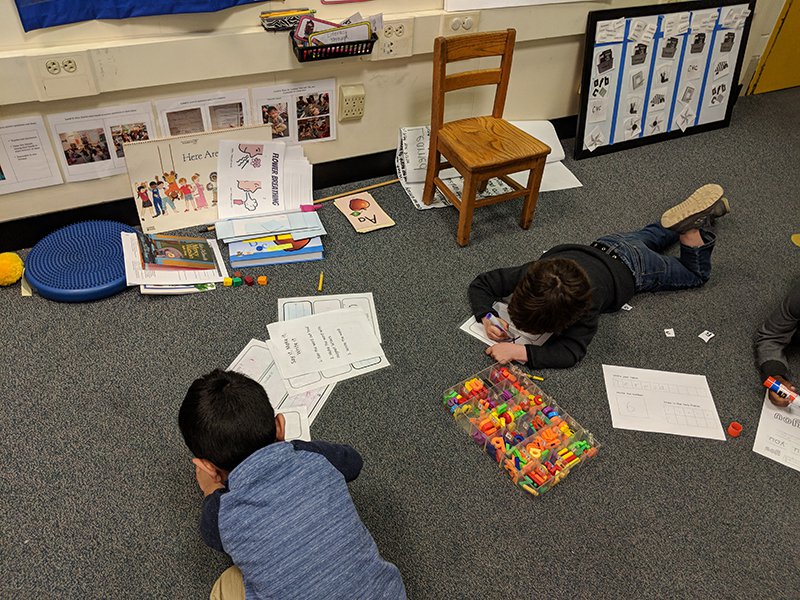
The BPS Department of Early Childhood has made slow, deliberate progress toward providing not just high-quality pre-K, but also following it up with kindergarten, first, and second grade. Recognizing that pre-K is no inoculation against future struggles and what follows pre-K matters, the department is pushing up early childhood education practices that are so needed — but not often seen — into kindergarten and the early elementary grades. Equipped with a promising approach and data to back it up, DEC is committed to staying the course and expecting better outcomes for the district’s most vulnerable children. The work, however, is not without challenges with which leadership must grapple.
According to Jason Sachs, about 40 percent of his 26-member staff is funded by private philanthropy.2 While the ability to raise money from outside groups has been key to the department’s success in expanding its size and scope, such a large dependence on private funding raises questions of program sustainability. It is unlikely that the philanthropic funds will continue in perpetuity. In fact, the Barr Foundation has already indicated it is shifting priorities and will end support at the end of 2019.
Jason Sachs has played a significant role in growing the department and driving the vision. Jeri Robinson, Vice President of Early Childhood Initiatives at Boston Children’s Museum and member of the BPS School Committee, says, "a lot has to be said for Jason's work and vision around really wanting to create clear and consistent programming for first K2, now K1, and now moving up to second grade… He’s built a phenomenal team of people who really know early childhood.”3 While Sachs has increased the stature and responsibility of DEC, his prominence raises the question of what would happen to all the work that has been accomplished if he were to leave the department. One question is how embedded the team’s work is in the culture of Boston Public Schools.
There is some evidence of culture change. For instance, early education is now recognized in Boston as spanning up through second grade and it is widely understood that curriculum and instruction look different in the early grades compared to the upper grades. Sachs’s smart use of data to show the progress made and make the case for the work left to do has bolstered this district shift.
As other public school district leaders and community leaders across the country consider how to sustain and build on children’s experiences in pre-K programs, Boston’s story offers several key takeaways:
- Begin with a vision and strategic plan for equitable learning opportunities, culturally sustaining practices, and high expectations for what young children can learn and are able to do.
- Use data from the start to develop a model and vision, as well as to make the case for a focus on improving teacher practice in kindergarten and the early grades and for guiding professional development and coaching.
- Adopt principles of continuous improvement by gathering stakeholder feedback, piloting changes, and revising as needed.
- Consider an external accountability metric—such as accreditation—aligned to the transformation needed, which can provide a picture of quality, establish clear standards or indicators to work toward, and guide the professional development needed.
- Select a research-based, robust curriculum (or curricula) that challenges children across multiple domains of learning, provides ample opportunities for conversation and critical thinking, and engages children in developmentally appropriate activities.
- Focus professional development on strong teacher-child interactions and the practices that support them; include all adults who work directly with children by bringing paraprofessionals and teachers together to learn.
- Align curricula, assessments, instructional strategies, and professional development across grade levels.
- Build relationships with elementary school principals because they establish conditions for classroom reforms to be successful.
- Partner with center-based pre-K providers because public schools alone are unlikely to have the capacity to serve all four-year-olds.
- Think about how to fund transformation: Local, state, and national foundations can help catalyze change, expand an initiative, and build a case for district or state funding that can sustain the work over time.
Citations
- Amy O’Leary (director, Early Education for All), email correspondence with authors.
- Jason Sachs, interview with authors, April 25, 2018.
- Interview with authors, April 25, 2018.
More About the Authors

Laura Bornfreund
Senior Fellow, Early & Elementary Education

Aaron Loewenberg
Senior Policy Analyst, Early & Elementary Education