
Five Things Policymakers Should Know About Short-Term Credentials
Table of Contents
- Introduction
- #1 Students Hold High Hopes That a Short-Term Credential Will Allow Them to Enter a New Field
- #2 Half of Working Adults with a Short-Term Certificate Earn Poverty-Level Wages
- #3 Most Adults Believe Their Short-Term Certificates Are Useful for Getting a Job—Even if the Job Is Unrelated to Their Credential
- #4 Many Adults with a Short-Term Certificate Are Not Employed
- #5 Students Think Hands-On Training is Useful, But Few Adults with Short-Term Certificates Receive This Training
- Discussion and Conclusion
Abstract
Policymakers are interested in extending federal higher education dollars to programs fewer than 15 weeks. This analysis shares key facts about the outcomes and equity implications of very-short-term (15 weeks or fewer) programs. This analysis of nationally representative survey data from the Adult Training and Education Survey, combined with insights from a series of focus groups conducted on behalf of New America, suggest that many short-term programs fall short of their promises, with many graduates left unemployed or facing very poor earnings. Post-completion earnings are especially low for people of color and women.
Acknowledgments
New America would like to thank Lumina Foundation and The Joyce Foundation for their support of this project, and the Bill & Melinda Gates Foundation and Arnold Ventures for their generous support of our work. The views expressed in this report are those of its author and do not necessarily represent the views of the foundations, their officers, or employees.
Downloads
Introduction
Within higher education, there are bleak differences in the return on investment for different types of credentials and degrees. Differences in the types of credentials students earn and where they get them have long-term implications on income, career satisfaction, and diversity within the U.S. workforce.1
Research shows that Black students, women, and older adults are more likely to enroll in sub-baccalaureate programs than any other subgroup of students.2 However, these credentials may have depreciating labor market value3 compared to bachelor’s degrees that are substantially more likely to lead to continuous increases in earnings.4
As a result, there is growing concern about the inevitable, continued stratification of higher education attainment, in which our most vulnerable students earn non-degree credentials that tend to be valueless towards social and economic mobility.5 Where research shows positive income gains for such non-degree credentials, studies find these gains are modestly concentrated in specific industries6 and tend to fade quickly.7 And for students who experience economic benefits from their non-degree credential, research shows it overwhelmingly favors men, while women with similar credentials do not experience such high economic returns.8 Other research studies on non-degree credentials find null or even negative returns on earnings, with short-term credentials9 showing the most dismal return.10
Despite the limited evidence showing significant value of sub-baccalaureate programs, they are the largest-growing credential within higher education.11 As of 2015, half (51 percent) of undergraduate credentials were at the sub-baccalaureate level.12 Survey research found that one in four in the current workforce have some form of a non-degree credential, such as a certificate or license.13 The largest growing subset of these credentials are from short-term programs (those that require less than a year of study to complete). From 2000 to 2010, colleges witnessed a 151 percent national spike in the number of short-term certificates awarded.14
The growth of short-term credentials, combined with relatively scant research on whether these programs pay off, raises reason for caution around them, especially for historically underserved students. This issue brief seeks to identify some of those key concerns for policymakers by evaluating nationally representative data on adults’ awarded short-term certificates and participation in work-experience programs. The data for this brief comes from the 2016 Adult Training and Education Survey (ATES), as well as regional focus groups we convened to better understand students’ perceptions, beliefs, and experiences. The focus groups included adults currently enrolled in, or who graduated from or previously attended, a very short-term program15 across various fields.
The primary goal of this brief is to evaluate the participation and labor market experiences of students with non-degree credentials, with a focus on short-term certificates (programs of approximately 15 weeks or fewer).16 A secondary goal is to learn more about students’ work-experience programs, including students’ access to them and their perceptions of their usefulness in the labor market. The analyses specifically evaluate across gender and race/ethnicity to identify if there are equity implications from the experiences and outcomes of short-term programs. This brief aims to build an evidence base around federal policymaking on this issue.
Box 1
Methodology
For this analysis, we are primarily interested in short-term, non-degree credentials. Using the Adult Training and Education Survey (ATES) data, we defined a short-term certificate as requiring 40 to 479 hours to complete as a proxy for programs fewer than 15 weeks long. We are interested in programs fewer than 15 weeks because they are currently ineligible to receive Pell Grant funding, but there are proposed bills to extend Pell grants to students enrolled in those programs.17 We used weighted estimates for all variables.
ATES gathered information from individuals ages 16 to 65 (N= 47,744) in 2016. The primary purpose of the survey is to capture the prevalence of non-degree credentials (licenses, certifications, and certificates). The survey’s secondary purpose is to learn more about work-experience programs. This survey is ideal for our analysis, as it provides estimates of adults who have a postsecondary certificate, including their fields of study (as defined by ATES) and perceptions of the usefulness of their credentials in the labor market. ATES also provides estimates on the characteristics of adults in work-experience programs and the perceived usefulness of such programs in the labor market.18
To supplement the ATES data, New America worked with Lake Research Partners to conduct focus groups of adults who enrolled in short-term programs and/or earned short-term credentials. Through the focus groups, we explored participants’ reasons for enrolling in these programs, perceptions of the quality and outcomes of their programs, and future educational and career goals and plans.
Sample
For the ATES analysis, our sample criteria included (N=1,393):
- adults (18+ years of age) and
- those with at least a high school equivalence but less than an associate degree (i.e., highest level of education is a short-term postsecondary certificate requiring 40–479 hours to complete).
Our focus groups included 48 adults from Atlanta, GA and Richmond, VA via in-person and telephone conversations. The participants represented short-term programs of fewer than 15 weeks, including certifications, certificates, and licenses, in a variety of fields. Several were conducted for specific occupations, including a Richmond group of current or recent attendees of a commercial driver’s license (CDL) program; a Richmond group of current or recent attendees of a child development associate (CDA) program; and a Richmond group of current or recent attendees of a certified nursing assistant (CNA) program. Graduates of programs were required to have completed the program within the last five years.
Limitations
For the ATES data, we are unable to account for students with multiple postsecondary certificates due to limitations of the survey questions.
For our earnings analysis of the ATES data, we are unable to separate the income from each job for individuals with multiple jobs due to limitations of the survey questions.
Limitations of survey data include, but are not limited to, the fact that respondents may not feel encouraged to provide accurate, honest answers or may not be fully aware of their reasons for any given answer.
The focus groups are not nationally representative, but shed light on the perceptions, beliefs, and experiences of adults with short-term credentials.
One more caveat: our initial, in-person focus groups (conducted in February and early March 2020) occurred prior to COVID-19 restrictions. In these conversations, students expressed excitement. In contrast, participants of the focus groups in April and May expressed heightened anxiety due to uncertainties stemming from the pandemic.
Citations
- CJ Libassi, The Neglected College Race Gap: Racial Disparities Among College Completers (Washington, DC: Center for American Progress, May 23, 2019), source
- Jizhi Zhang and Ceylan Oymak, Participants in Subbaccalaureate Occupational Education: 2012 (Washington, DC: U.S. Department of Education, June 2018), source
- Clive Belfield and Thomas Bailey, The Labor Market Returns to Sub-Baccalaureate College: A Review (New York: Center for Analysis of Postsecondary Education and Employment, March 2017), source
- Clive Belfield and Thomas Bailey, “Does it Pay to Complete Community College—And How Much?” Center for Analysis of Postsecondary Education and Employment, March 2017, source
- Belfield and Bailey, “Does it Pay?”
- Belfield and Bailey, “Does it Pay?” page 2.
- Belfield and Bailey, The Labor Market.
- Zhang and Oymak, Participants in Subbaccalaureate.
- Defined as requiring less than one year of full-time study (as defined by federal data systems).
- Di Xu and Madeline Trimble, “What About Certificates? Evidence on the Labor Market Returns to Non-Degree Community College Awards in Two States,” Educational Evaluation and Policy Analysis 38, no. 2 (June 2016): 272–292, source
- Zhang and Oymak, Participants in Subbaccalaureate.
- Zhang and Oymak, Participants in Subbaccalaureate.
- Clive Belfield and Thomas Bailey, Stackable Credentials: Do They Have Labor Market Value? (New York: Community College Research Center, November 2017), source
- Mina Dadgar and Madeline Joy Weis, Labor Market Returns to Sub-Baccalaureate Credentials: How Much Does a Community College Degree or Certificate Pay? (New York: Community College Research Center, June 2012), source
- For the focus groups, we defined short-term credential as a program of 15 weeks or fewer (including certifications, certificates, and licenses in a variety of fields)
- Defined as requiring 40–479 hours to complete. New America analysis of Adult Training and Education Survey (ATES), administered as part of the 2016 National Household Education Surveys Program (NHES: 2016; public use file).
- Pell Flexibility Act of 2019, H.R. 2161, 116th Cong. (2019), source
- Stephanie Cronen, Meghan McQuiggan, and Emily Isenberg, Adult Training and Education: Results from the National Household Education Surveys Program of 2016 (Washington, DC: U.S. Department of Education, February 2018), source
#1 Students Hold High Hopes That a Short-Term Credential Will Allow Them to Enter a New Field
Nearly every participant in our focus groups1 believes education and training are critical to their career and articulate four top reasons for enrolling in a short-term program:
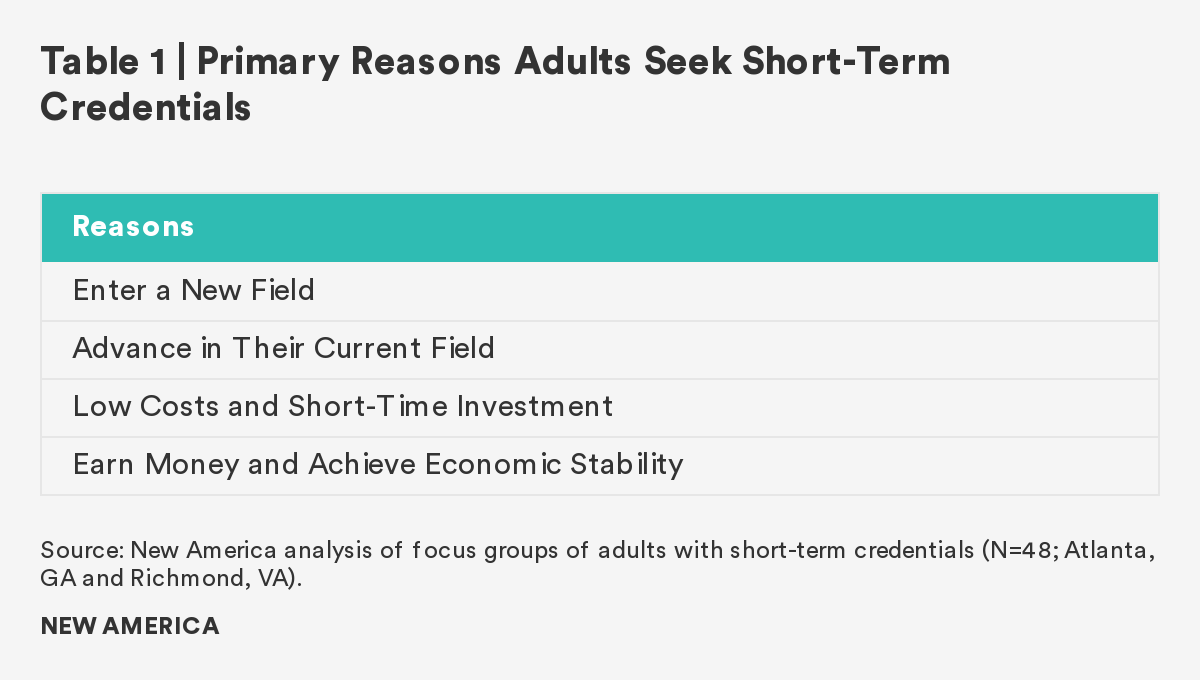
For the majority of adults in our focus groups, a short-term program is a way to change careers and enter into an entirely new field. This particularly applies to truck drivers, real estate agents, and others who need to earn a certification or pass a test to gain entry into their desired industry. Participants in the focus groups hope these short-term programs will help them overcome barriers to break into a new career path.
Others see short-term programs as one step on a longer career path, especially those working in the health care field or whose employers paid for the class as continuing education. For these students, enrolling in a short-term program is a means of advancement in their current field. For example, many certified nursing assistant (CNA) students or those working in health care facilities see their short-term credential as a step towards promotion to a management position. Some participants who take classes with their employer acquire the short-term credential to expand their knowledge in their current field. For example, some students with a child development associate (CDA) credential take classes as a required continuing education credit for their current job.
In both cases, students believe short-term programs are a way to enter into a new field or advance within their current field at a lower cost and with less time than a longer degree program. Students perceive short-term programs as a quick, cheap, and low-stakes option to earn a postsecondary credential with the hopes of immediately earning more money. Students enroll in these programs to ultimately help them achieve economic stability—a financial privilege they desire and believe they are unable to achieve without a short-term credential.
Earning a short-term credential “is my way to actually make some real good money… financial freedom.” – Truck Driver, Richmond, VA
Citations
- Lake Research Partners conducted focus groups of 48 adults with short-term credentials on behalf of New America, February–May 2020 (Atlanta, GA and Richmond, VA).
#2 Half of Working Adults with a Short-Term Certificate Earn Poverty-Level Wages
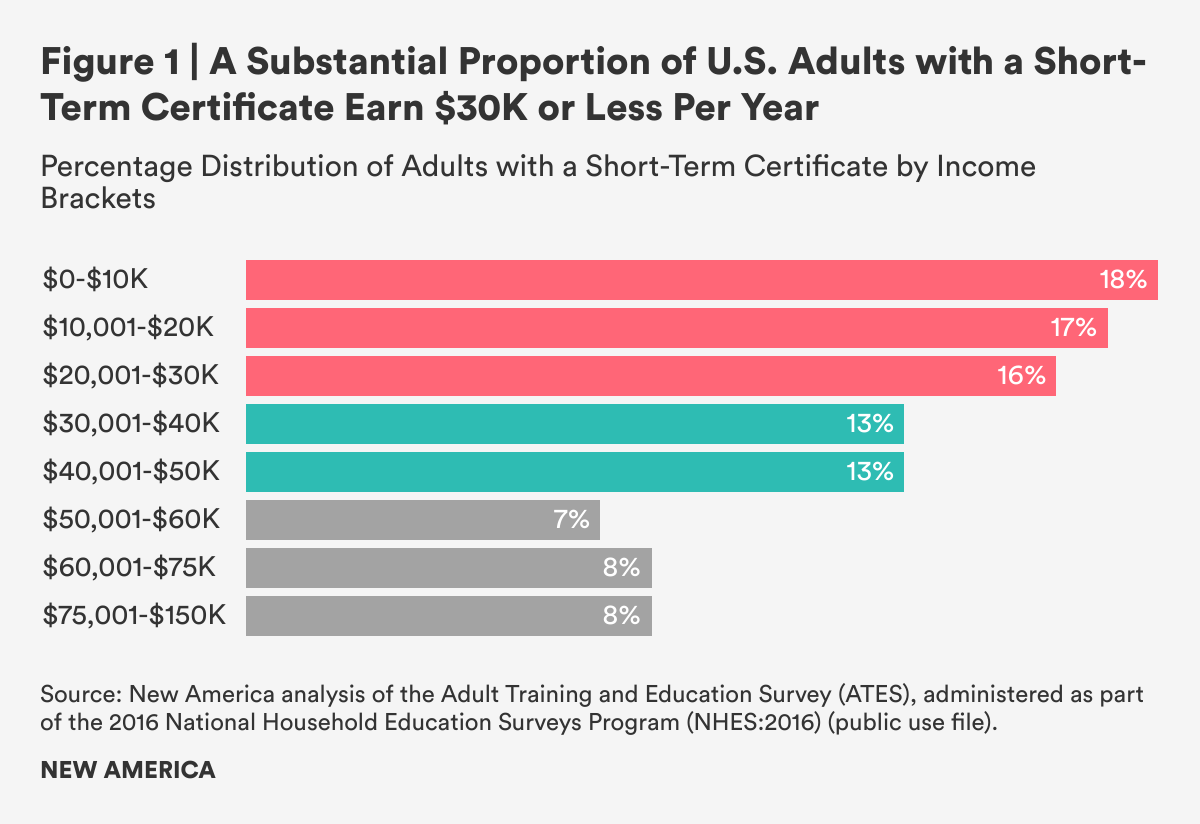
Although students pursue short-term credentials for economic stability, Figure 1 shows more than half of adults with a short-term certificate who are employed earn $30,000 or less per year,1 which is below the national poverty line for a household of four.2 The median yearly income for those with a short-term certificate ranges from $20,001 to $30,000 per year.3 With the highest concentration (18 percent) of short-term certificate-earners making $10,000 or less annually, obtaining only a short-term certificate is not a likely vehicle towards economic mobility for the average student.
People of Color and Women Earn Far Less Than White Graduates with Short-Term Certificates
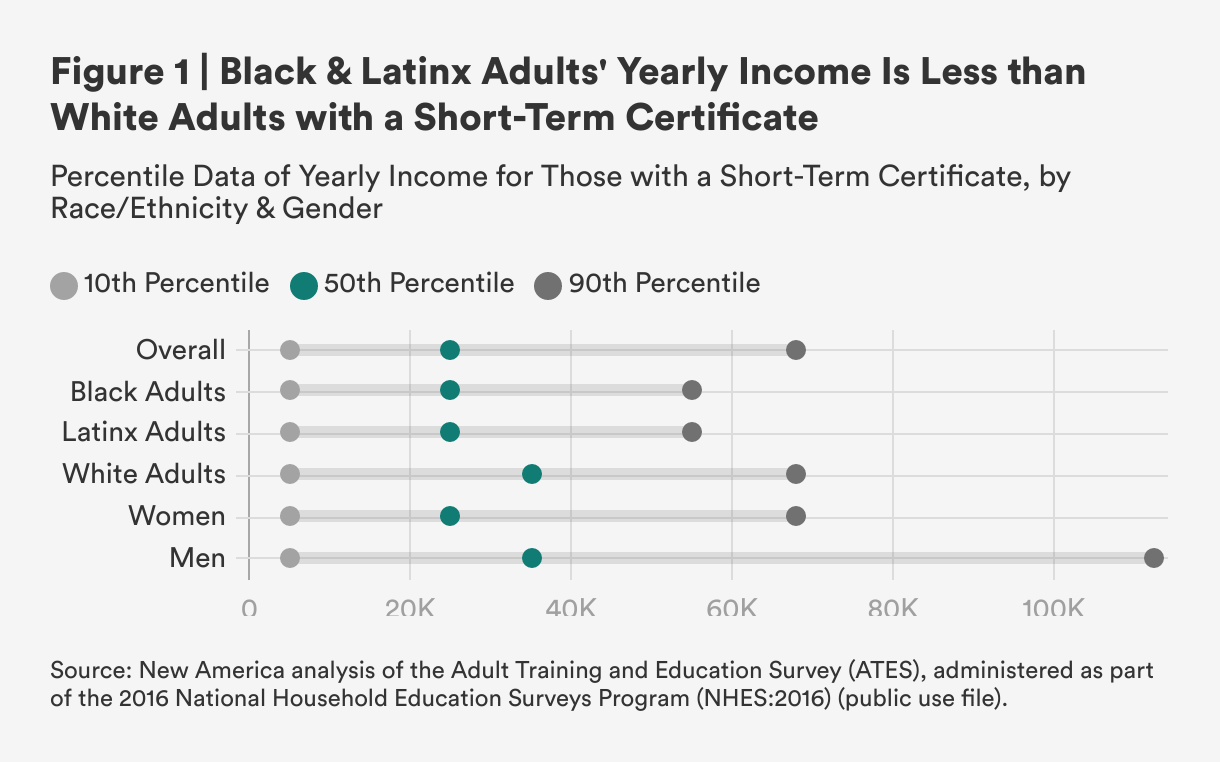
The earnings disparity for short-term certificates (15 weeks or fewer) is noticeably adverse for students of color and women. Figure 2 shows that, among those with a short-term certificate, the median yearly income is less for minority students than for white students. The median yearly income for Black and Latino/Latina adults with a short-term certificate is $10,000 to $20,000 less than the median yearly income of their white counterparts who hold a credential of similar length.
We find similar patterns across gender, where Figure 2 shows the median yearly income for women with a short-term certificate is less than that for men who also have a short-term certificate. These findings echo the current literature suggesting that men tend to experience economic benefits from non-degree credentials, while women with comparable credentials do not.4 Some of the disparity can be attributed to the fact that male-dominated industries yield higher wages compared to female-dominated fields.5 Yet even accounting for the disparity in earnings based on gender-dominated industries, there are longstanding systemic inequities within the U.S. labor market that are unfavorable to the pay of women.6
Certain Popular Fields Pay Far Less and Reify Inequities
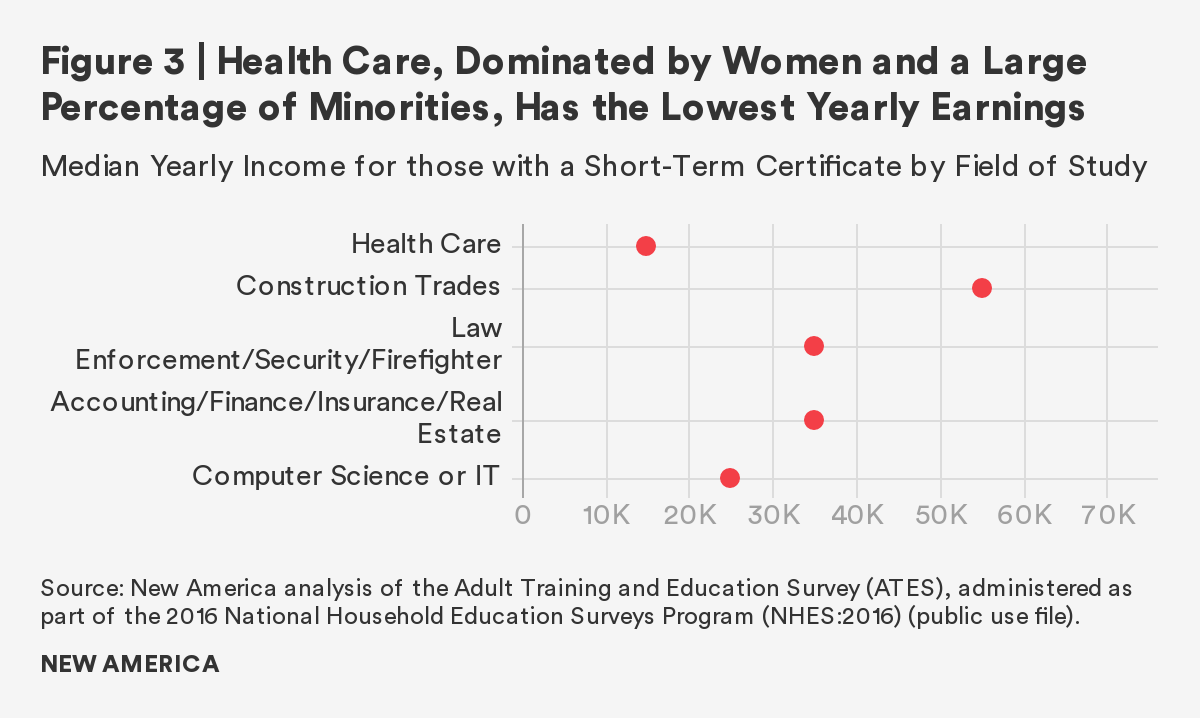
Figure 3 shows the median yearly earnings for the five most popular fields of study for short-term certificates. Health care and construction trades are the most popular fields of study for short-term certificates. Yet health care, a field of study dominated by women and a large percentage of people of color, has the lowest yearly earnings compared to the other four fields of study. The annual median income for adults with a short-term certificate in health care range between $10,001 and $20,000; those with a short-term certificate in construction trades (male-dominated) have median yearly earnings ranging from $50,001 to $60,000.
In addition, we found that adults with a short-term certificate in health care have the lowest rates of employment compared to the other four fields of study.7 Not only does a certificate of fewer than 15 weeks in health care yield very low pay, students are also at a higher risk for job instability. Stability is a benefit that many students who enroll in these programs are looking for.
“This is a downside to the job because there is so much work that we are required to do and the pay is dishearteningly low.” – Certified Nursing Assistant, Richmond, VA
Citations
- Includes earnings from wages, salary, commissions, bonuses, or tips from all jobs over the past 12 months. It is not assumed that these jobs are in the related industry of the earned certificate.
- U.S. Department of Health & Human Services, ASPE (website), Poverty Guidelines, “HHS Poverty Guidelines for 2021,” January 15, 2021, source
- New America analysis of ATES.
- Lul Tesfai, Kim Dancy, and Mary Alice McCarthy, Paying More and Getting Less (Washington, DC: New America, 2018), source
- Jizhi Zhang and Ceylan Oymak, Participants in Subbaccalaureate.
- Joan C. Williams, Reshaping the Work-Family Debate: Why Men and Class Matter (Cambridge, MA: Harvard University Press, 2010), chapter 3.
- New America analysis of ATES.
#3 Most Adults Believe Their Short-Term Certificates Are Useful for Getting a Job—Even if the Job Is Unrelated to Their Credential
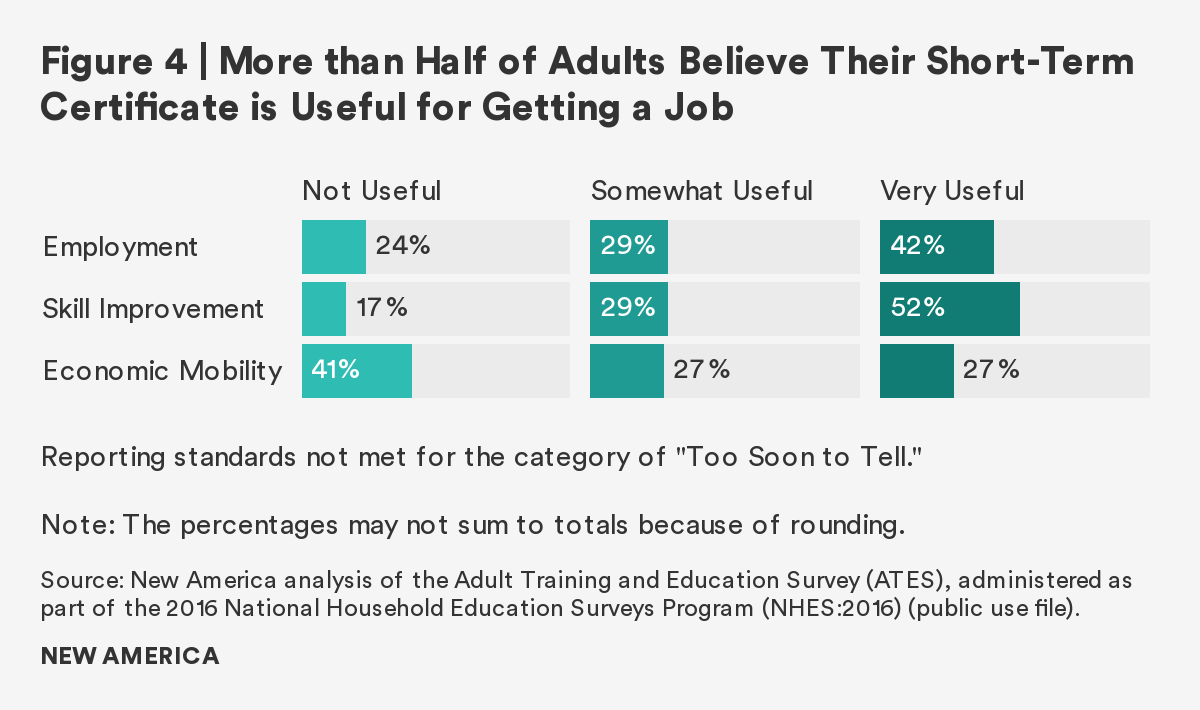
Although many students are dissatisfied with their wages,1 the majority of adults believe their short-term certificate is either somewhat or very useful for getting a job (Figure 4). Many participants in the focus groups believe that their program helped them to earn the certificate they needed to get a job and improve their skills,2 judging the quality of their short-term programs on their ability to readily obtain employment and develop their skills.3 However, almost half of adults with short-term certificates in the ATES survey believe their credential is not useful for increasing their pay, while the other half of adults believe it is either somewhat or very useful to help them earn more money.
Many Students Believe Their Current Job Is Not Related to Their Short-Term Certificate
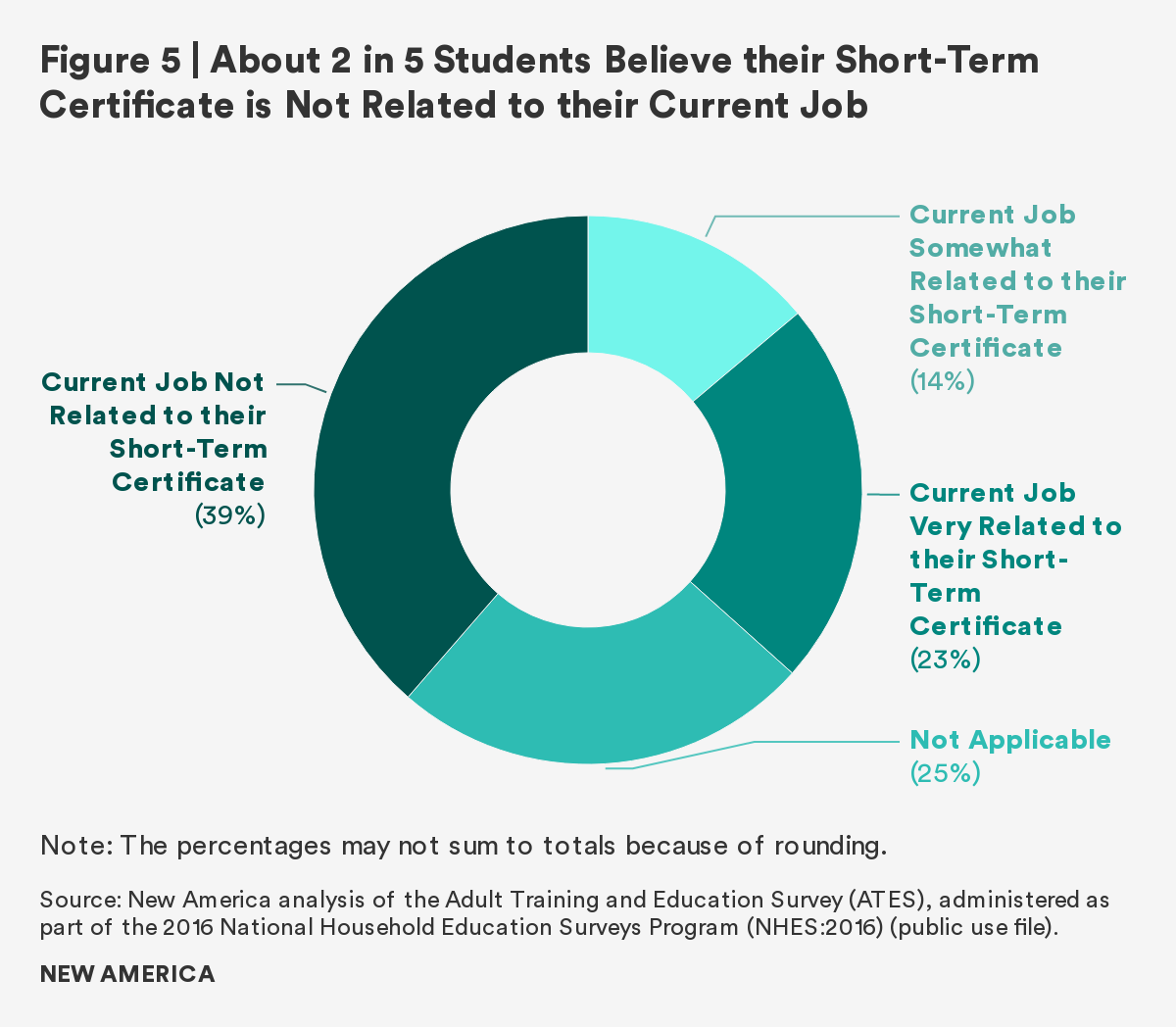
About two in five adults with a short-term certificate believe their current job is not related to their credential. Relatively split down the middle, a similar percentage (37 percent) of adults believe their short-term certificate is either somewhat or very related to their current job. Figure 5 shows that about one in four students get a job that is very related to their short-term certificate (15 weeks or fewer). These findings reveal that the odds are not in students’ favor for finding a job in an industry very related to their short-term certificate.
Citations
- Lake Research Partners.
- Lake Research Partners.
- Lake Research Partners.
#4 Many Adults with a Short-Term Certificate Are Not Employed
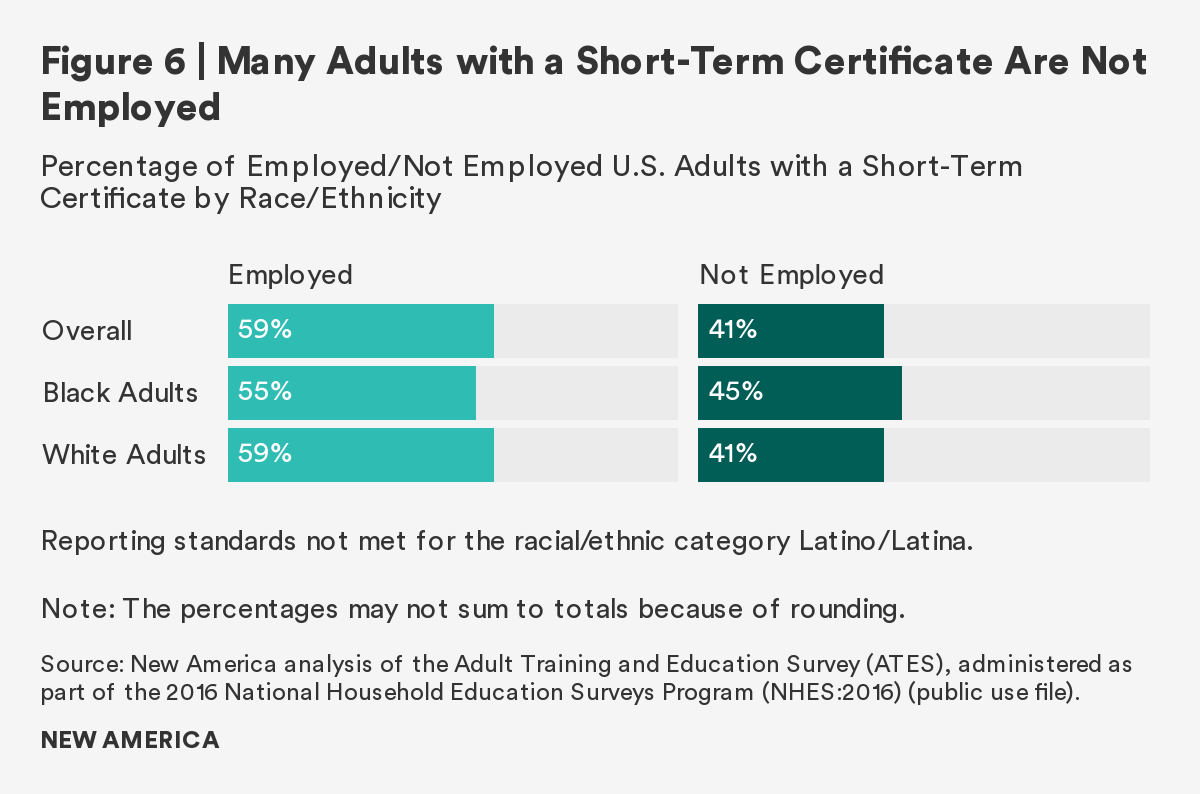
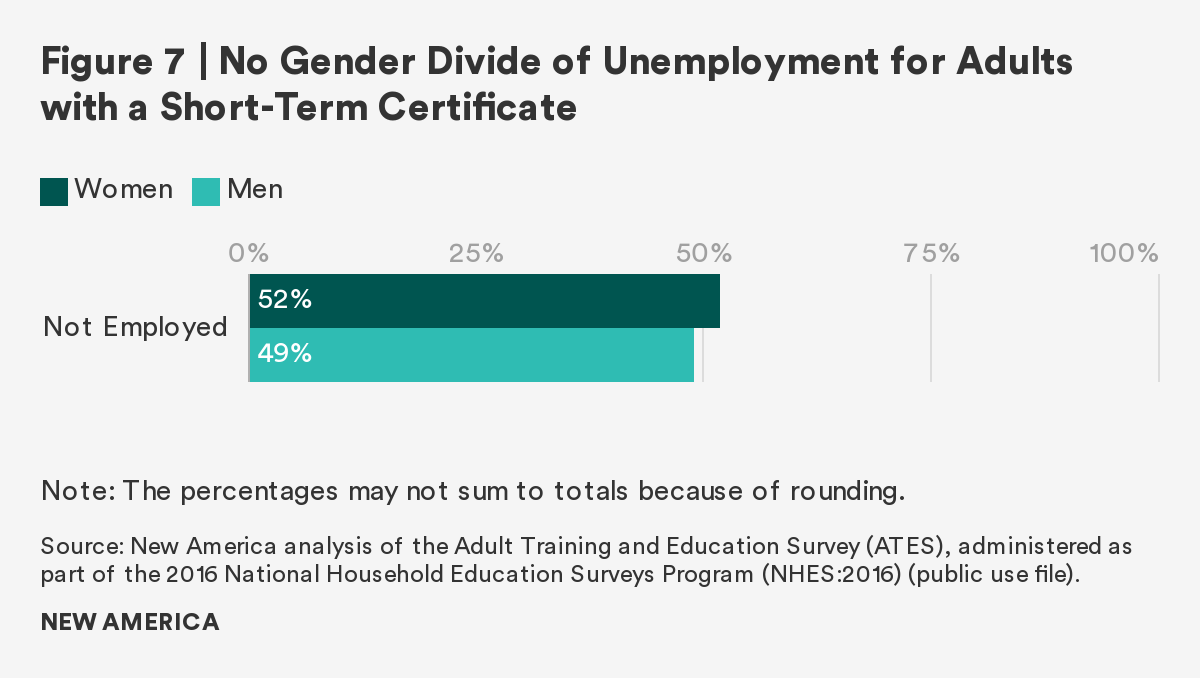
For adults with only a short-term certificate, as Figure 6 shows, roughly 40 percent say they are not employed. Of those who are not employed, there is neither a race/ethnicity nor a gender divide.1 The percentage of Black adults with a short-term certificate who are not employed is comparable to the percentage of unemployed white adults with a similar credential. Figure 7 shows that, similarly, the percentage of unemployed women and unemployed men is not significantly different. Regardless of race/ethnicity and gender, two in five adults with only a short-term certificate are not employed.
Citations
- New America analysis of ATES.
#5 Students Think Hands-On Training is Useful, But Few Adults with Short-Term Certificates Receive This Training
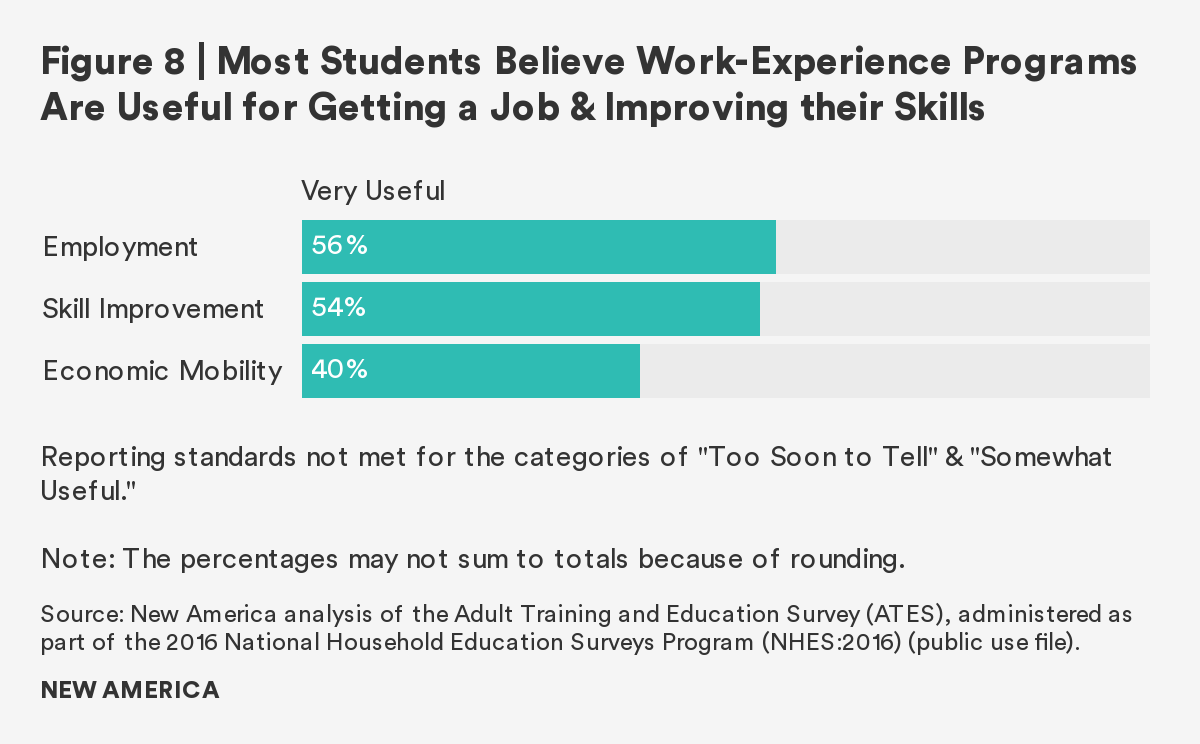
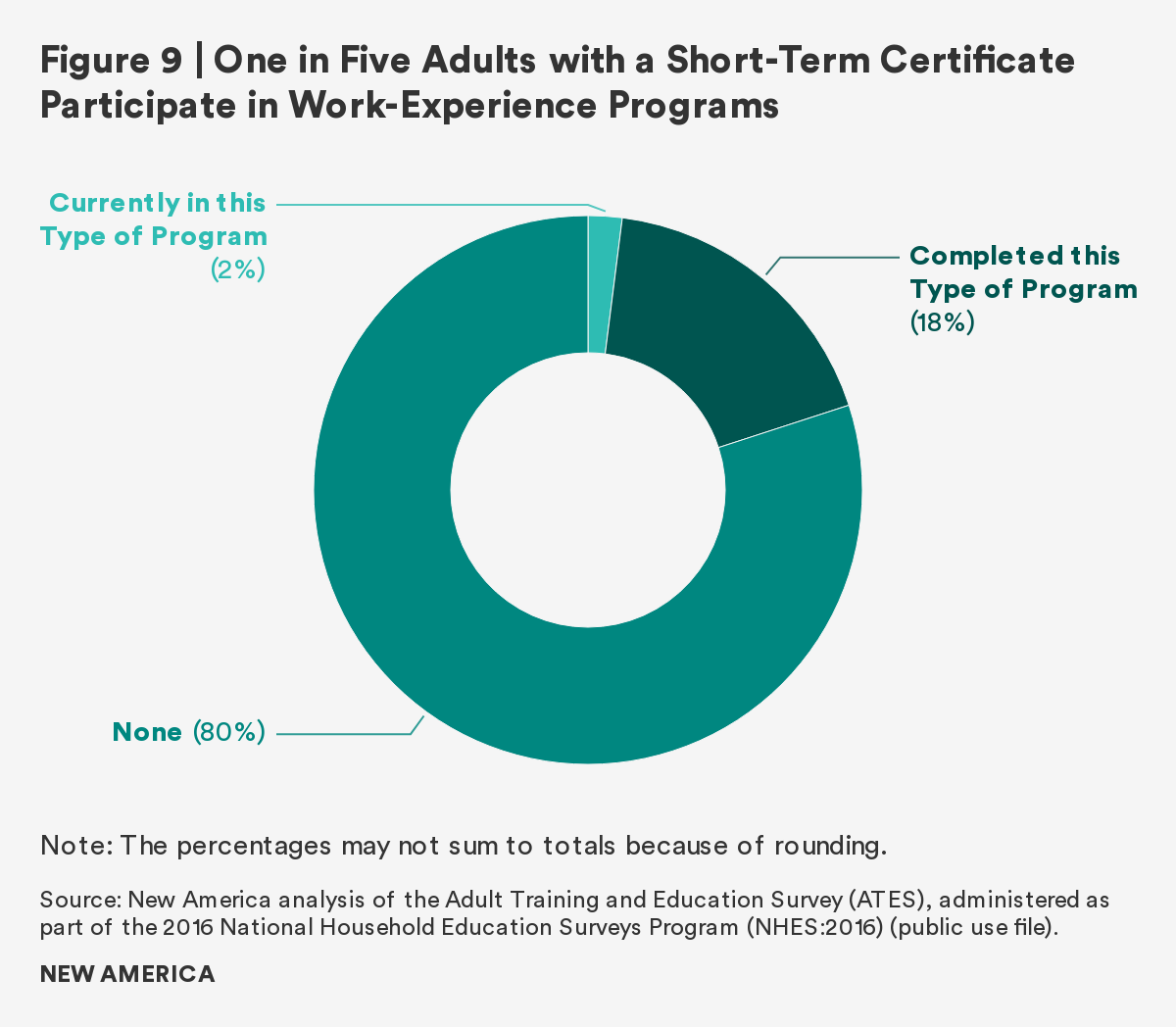
Although the majority of adult students who participate in work-experience programs1 (such as internships or apprenticeships) believe these hands-on experiences are very useful for getting a job and improving their skills, as shown in Figure 8, only one in five adults with a short-term certificate has the opportunity to participate in such experiences, as shown in Figure 9.
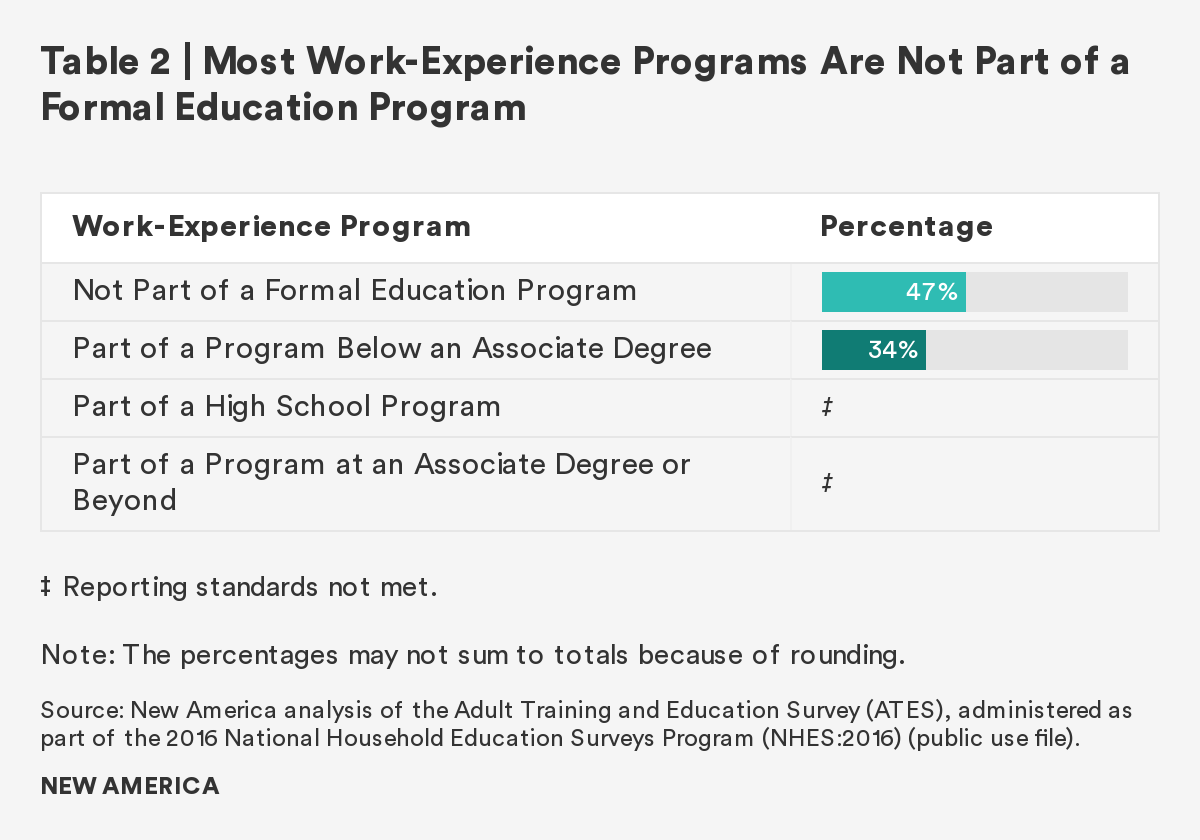
Contributing to the low participation rate in work-experience programs is the reality that most of these opportunities are not affiliated with an education program. Table 2 shows that about one-third of work-experience programs are associated with a sub-baccalaureate program, with most being separate from an educational course of study. That means students are responsible for identifying and pursuing their own opportunities to learn outside the classroom.
The field of study in which students pursue their short-term certificate may influence the extent to which they have access to on-the-job learning experiences. Our analysis found that the majority of students who do complete a work-experience program earn their short-term certificate in the field of health care.2
However, COVID-19 may further exacerbate the limited access to work-experience programs for students with short-term certificates. Most of the students in our focus groups felt that transitioning to online learning presented a challenge for curricula that requires hands-on work-experience, like clinicals for courses related to health care. One certified nursing assistant (CNA) student shared her frustration, saying “the majority [of students] said we were not getting what we want out of the class [primarily online modules due to the pandemic]. We need hands-on experience.”3
Many of the students in our focus groups agree that work-experience is essential, believing that the actual preparation and training happens once they enter the field. Students in the focus groups believe their short-term programs only help them get the certificate they need to get the job, rather than fully preparing them with the skill set they need to adequately perform day-to-day tasks. Many wish there had been an element of hands-on experience in conjunction with their course of study.4
Black and Brown Students with Short-Term Certificates Participate in Work-Experience Programs at Dismally Low Rates
When evaluating work-experience programs across race/ethnicity, we find the participation of Black and Latino/Latina students are so low that we are unable to report estimates of participation.5 These results emphasize the racial disparity in access to work-experience programs for Black and Brown students with a short-term certificate, as white adults disproportionately participate in and complete these opportunities.
Citations
- ATES counts work-experience as including internship, co-op, practicum, clerkship, externship, residency, clinical experience, apprenticeship, or similar programs.
- New America analysis of ATES.
- Lake Research Partners.
- Lake Research Partners.
- New America analysis of ATES.
Discussion and Conclusion
Ongoing questions around the value of very-short-term higher education programs are valid, especially when evaluating outcomes for marginalized students. Our analysis found that when Black and Latino/Latina students complete a short-term certificate, they make up to $20,000 less in median yearly earnings than white students with a similar credential. And we found that the typical annual earnings for over half of graduates who are working are less than $30,000. Additionally, as highlighted in our focus groups, many students believe work-experience programs are critical in labor market preparation; yet Black and Latino/Latina students participate in these programs at glaringly lower rates than white students. These disparities in outcomes warrant further research and new efforts to ensure that all students have equal access to the promise of higher education.
It is clear that educational providers offering short-term programs need to do much more to support their students’ goals of financial security and socioeconomic mobility. For instance, prioritizing real-world experience to supplement course work is critical. Students both benefit and tend to report higher levels of satisfaction from short-term programs when they participate in work-experience opportunities.1 It is essential that these hands-on experiences be accessible to all students through their programs to help buffer the racial and gender gaps in earnings for individuals with a short-term certificate.
The current research on very-short-term programs (15 weeks or fewer) is relatively scant and deserves more attention. But the fact that the economic returns of a postsecondary credential differ so substantially based on race/ethnicity and gender should give policymakers serious concern about the existing equity implications of these short-term programs, and especially about the unintended consequences of further subsidizing programs fewer than 15 weeks that do not lead to family-sustaining employment and wages. It is imperative for policymakers to consider these five critical findings to inform federal policymaking on this issue.
Citations
- Lake Research Partners.
More About the Authors

Monique O. Ositelu